
Paternity Actions in Richmond Texas: A Complete Guide for Fort Bend County Parents

Paternity Actions in Richmond Texas often begin at the same moment parents start noticing changes in their child’s life—missed homework, slipping grades, or a teacher quietly asking if everything is okay at home. Have you ever wondered why a child who was once thriving suddenly seems distracted or overwhelmed? The answer is often closer to home than we realize. When family dynamics shift, children feel it first—and school is usually where it shows up most clearly.
Under Texas Family Code §153.002, courts are required to act in the best interest of the child, and that includes protecting stability in a child’s daily life—especially their education. What many parents don’t initially realize is that legal decisions about parentage, custody, and support can directly shape whether a child feels secure enough to focus, learn, and succeed in school.
At The Law Office of Bryan Fagan, PLLC, we’ve guided families across Fort Bend County through these exact challenges. A father wanting to be present at parent-teacher conferences but lacking legal recognition. A mother working to maintain routines across two households. A child trying to process emotional change while still expected to perform academically. These are not just legal situations—they are real-life turning points.
Led by Bryan Joseph Fagan, a South Texas College of Law graduate and a trusted authority in Texas family law, our firm is built on a commitment to provide clarity, compassion, and practical solutions. We believe that when parents understand both the legal process and its real-world impact, they gain the power to create stability for their children.
In this article, you’ll learn how establishing paternity connects to your child’s academic performance, how Texas courts evaluate educational stability in custody decisions, and what steps you can take to support your child through these transitions. Because with the right guidance, even life’s hardest moments can become a path toward peace of mind and a stronger future.
Key Takeaways
- Paternity actions in Richmond Texas establish legal fatherhood and determine parental rights under Texas Family Code Chapter 160
- DNA testing provides 99.9% accuracy in determining biological parentage and is often court-ordered in disputed cases
- Establishing paternity affects custody, visitation, child support, and inheritance rights for both fathers and children
- Fort Bend County courts handle paternity proceedings with specific deadlines and procedural requirements

Your Family’s Future Starts Here
Don’t navigate your legal journey alone. Schedule a consultation now and get the clarity and support you deserve.
Listen to Our Texas Family Law Podcast
Prefer listening? In this episode, we discuss paternity in Richmond, Texas, including how to establish legal parentage, the rights and responsibilities of parents, and what you need to know to protect your role in your child’s life.
The Law Office of Bryan Fagan, PLLC can represent clients in a variety of family law matters, such as the following:
As a family law firm, we recognize that clients entrust us with a deeply personal aspect of their lives. Respecting this responsibility, our firm operates with professionalism, diligence, and efficiency, while maintaining open lines of communication with our clients. Not only do we provide access to their attorney, but also a dedicated client support team capable of addressing any inquiries regarding the case, status updates, billing concerns, or any other matters that arise throughout the process. Please don’t hesitate to discover how we can be of service to you.
Contact the Law Office of Bryan Fagan, PLLC at 281-245-1907 or online.
Paternity Actions in Richmond Texas: The Short Answer
Paternity Actions in Richmond Texas are legal proceedings designed to establish a child’s legal father under Texas Family Code Chapter 160. While the concept may seem straightforward, the impact is far-reaching. These cases determine not only biological parentage, but also the legal rights and responsibilities that shape a child’s future—everything from custody and visitation to financial support and long-term stability.
In a growing community like Richmond, these legal matters often arise during major life transitions. Whether you are already living in the area or planning a move, understanding the local environment can provide helpful context. If you’re getting familiar with the area, exploring what it’s like living in Richmond, Texas can offer valuable insight into the community where your case may be handled and where your child will grow and learn.
Once paternity is established, Texas law fully recognizes the parent-child relationship. This gives a father the legal standing to pursue custody and visitation under Texas Family Code §153.134, which governs conservatorship and parenting plans. At the same time, financial responsibilities such as child support are triggered, helping ensure the child’s needs are consistently met. Courts evaluate all of these decisions through the lens of the “best interest of the child” standard under §153.002, with a strong emphasis on stability—both at home and in school.
For mothers, establishing paternity creates the legal pathway to enforce child support and secure financial consistency. For fathers, it opens the door to meaningful involvement in a child’s life—participating in education, healthcare decisions, and daily development. Most importantly, for the child, it provides identity, access to benefits, and the emotional security that comes from having both parents legally recognized.
Of course, not every case is straightforward. Disputes over custody, support, or parental involvement can quickly become complex. In those situations, working with attorneys experienced in child custody matters in Texas can help you navigate the process with clarity while keeping your child’s well-being at the center of every decision. In more serious situations involving safety concerns, cases may intersect with Child Protective Services (CPS) matters, which are governed by additional protections under Texas Family Code Chapters 262 and 263.
At The Law Office of Bryan Fagan, PLLC, our team understands that these cases are about more than legal definitions—they are about helping families find stability during uncertain times. With the right guidance, you can move forward with confidence, knowing you are protecting your rights while creating a stronger, more secure future for your child.

What Is a Paternity Action?
A paternity action is a legal proceeding that establishes the identity of a child’s father under Texas law. The Texas Family Code Chapter 160, known as the Uniform Parentage Act, governs these proceedings and defines who may file, what procedures apply, and what outcomes result from establishing legal paternity.
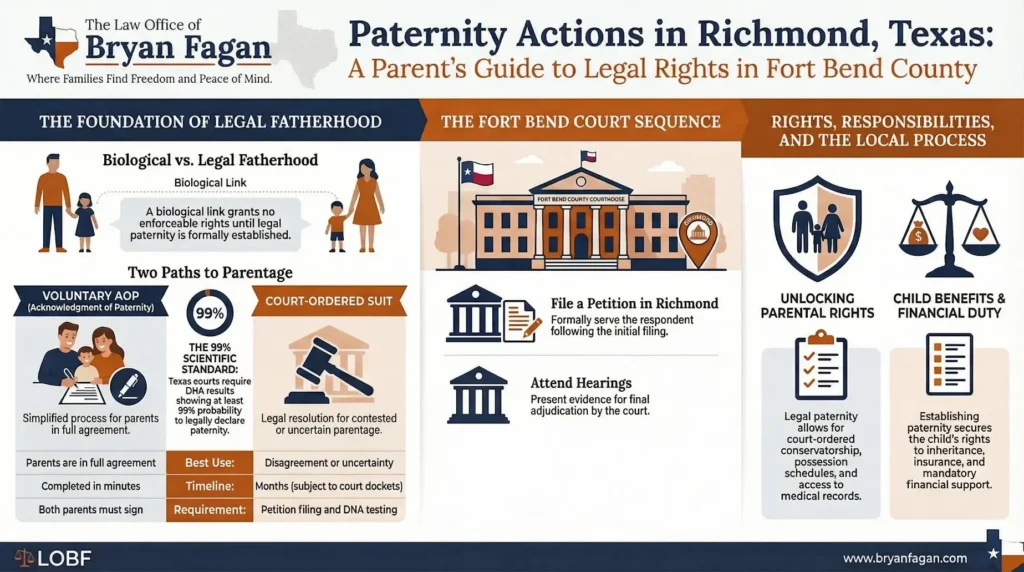
The distinction between biological father and legal father matters significantly. A man may be the biological father of a child, but without legal establishment of paternity, he has no parental rights. He cannot seek custody or visitation, make decisions about the child’s education or healthcare, or exercise any of the rights that come with legal fatherhood.
Paternity actions become necessary in Richmond when parents are unmarried, when the identity of the father is disputed, or when someone wants to challenge previously established paternity. The child, the mother, an alleged father, or the State of Texas in child welfare cases may file a paternity action in Fort Bend County courts.
Under Texas law, a presumed father exists when a man was married to the mother when the child was born, married within 300 days before birth, or continuously lived with the child while representing himself as the father. This presumption carries legal weight, but it can be challenged through proper legal proceedings when circumstances warrant.
Why Establishing Paternity Is Important
Paternity Actions in Richmond Texas do far more than determine legal parentage—they create the foundation for a child’s stability, support system, and long-term success. When paternity is not legally established, fathers are often left without the ability to participate in critical decisions, and children may miss out on both emotional and financial support. Texas law recognizes how important this relationship is, which is why courts prioritize clarity and structure when these cases are brought forward.
In a community like Richmond, where families balance work, school, and daily logistics, even practical considerations—like coordinating schedules and transportation—can impact a child’s well-being. Understanding how families move through daily life, including aspects like transportation in Richmond, Texas, can become relevant when courts evaluate parenting plans and routines that support consistency. Judges often look beyond legal rights and focus on how each parent contributes to a stable, functioning daily life for the child.
Once paternity is established, fathers gain the legal right to pursue conservatorship under Texas Family Code §153.134. This includes the ability to share in decision-making regarding education, healthcare, and overall development. Courts evaluate these requests through the “best interest of the child” standard under §153.002, with a strong emphasis on stability, consistency, and each parent’s ability to meet the child’s needs. For families navigating these issues, working with attorneys experienced in child custody in Texas can help ensure that parenting plans are thoughtfully structured and aligned with what courts expect.
At the same time, establishing paternity creates enforceable financial responsibilities. Under Texas Family Code Chapter 154, child support is calculated based on a percentage of the obligor’s net resources, ensuring that the child has access to housing, education, healthcare, and daily necessities. This financial structure is not just about obligation—it is about providing a consistent foundation that allows children to thrive regardless of their parents’ relationship status.
Beyond finances and custody, paternity also unlocks critical benefits for the child, including access to health insurance, Social Security benefits, and inheritance rights. It also allows fathers to contribute meaningful medical history, which can play an important role in long-term healthcare decisions. These are practical protections that many families don’t fully appreciate until they are needed.
Just as important are the emotional benefits. Children who have a clear understanding of their parentage often experience greater stability, identity, and confidence. They benefit from knowing both parents are legally recognized and involved in their lives. For fathers, this legal recognition provides the security of knowing their role is protected. For mothers, it creates a pathway to shared responsibility and support.
Of course, not every situation is straightforward. Disputes over custody, involvement, or support can add complexity, especially when parents are trying to balance competing priorities. In some cases, more strategic legal guidance may be necessary to protect parental rights while maintaining focus on the child’s best interests. The attorneys at The Law Office of Bryan Fagan, PLLC regularly work with families throughout Fort Bend County, helping them navigate these challenges with clarity and confidence.
At its core, establishing paternity is about more than legal status—it’s about creating a stable, supportive environment where a child can grow, learn, and succeed. When handled thoughtfully, it becomes a powerful step toward protecting your child’s future and giving your family the structure it needs to move forward.
Ways to Establish Paternity in Texas
Texas law provides multiple pathways to establish paternity, each suited to different circumstances and levels of agreement between the parties.
| Method | Description | When Used |
|---|---|---|
| Voluntary Acknowledgment of Paternity (AOP) | Mother and alleged father both sign an Acknowledgment of Paternity form through a certified entity; filed with Texas Vital Statistics Unit | When both parents agree on paternity and want to avoid court; typically completed at birth or shortly after |
| Court-Ordered Adjudication | Filing a suit under Chapter 160 asking a judge to determine parentage; often involves genetic testing | Disputed cases; when voluntary acknowledgment is not possible; when presumed father is contesting |
| Marriage Presumption | Texas law presumes a child born during marriage or within 300 days after dissolution is the husband’s child | When parents are married at child’s birth; simplifies establishment unless contested |
Voluntary Acknowledgment
The Acknowledgment of Paternity process offers the simplest path when both parents agree. Certified entities, often hospitals, present both parents with information about their rights and responsibilities. Both must sign the AOP form, and if a presumed father exists, he must sign a Denial of Paternity. Once filed with the Vital Statistics Unit, legal fatherhood is established without court involvement.
The Texas Attorney General’s updated AOP Manual requires that both parents watch or read information about their rights before signing. This ensures informed consent and reduces later disputes about misunderstanding.
Court Adjudication
When parents disagree about paternity or when voluntary acknowledgment isn’t possible, court adjudication provides the formal pathway. This process involves filing a petition in Fort Bend County courts, potentially undergoing DNA testing, and appearing before a judge who will issue a ruling establishing paternity.
DNA Testing in Paternity Cases
In Paternity Actions in Richmond Texas, DNA testing often becomes the most important step when questions about biological parentage arise. While emotions can run high in these situations, the legal system relies on clear, scientific evidence to bring certainty. Modern genetic testing is highly reliable—typically exceeding 99.9% accuracy—and plays a central role in helping courts make informed decisions that protect children and families.
The process itself is straightforward but carefully controlled. DNA samples are usually collected through simple cheek swabs from the mother, child, and alleged father. These samples are then analyzed by accredited laboratories, with strict chain-of-custody procedures in place to ensure the results are admissible in court. This level of oversight is critical, especially in cases where the outcome will affect custody, support, and a child’s long-term stability.
When parents cannot agree on paternity, Texas courts have the authority to step in. Under Texas Family Code §160.503, a judge may order genetic testing, and §160.506 addresses how the costs are handled. In many cases, the requesting party pays initially, though the court may later reassign those costs depending on the results. Once testing is ordered, families in Fort Bend County typically complete the process through approved facilities, with results returned within a few weeks.
These results often carry significant legal weight. Once paternity is confirmed, courts can move forward with decisions related to conservatorship and parenting plans under §153.134, always guided by the best interest of the child standard in §153.002. For parents, this means that a DNA test is not just about biology—it is about unlocking the legal framework that supports a child’s emotional and financial well-being.
There are situations, however, where complications arise. A party may attempt to challenge the results under Texas Family Code §160.505, citing issues such as lab error or chain-of-custody concerns. While these challenges are allowed, they are rarely successful due to the high accuracy and strict protocols involved in modern testing. More commonly, issues arise when an alleged father refuses to participate. In those cases, courts may proceed with adjudication based on available evidence or impose legal consequences for non-compliance.
In some cases, paternity disputes overlap with more serious concerns, including allegations of family violence or unsafe environments. When that happens, the legal landscape can shift quickly, and courts may consider additional protections under Texas Family Code Chapters 262 and 263. If your case involves sensitive circumstances like these, understanding how issues such as assault-related legal concerns in Richmond may intersect with family law can be important for protecting both your rights and your child’s safety.
Because DNA testing often serves as the foundation for everything that follows, it is important to approach this stage with clarity and preparation. Working with attorneys experienced in child custody in Texas can help ensure that testing is handled properly, results are used effectively, and your case moves forward in a way that supports your child’s best interests.
At The Law Office of Bryan Fagan, PLLC, our team understands that behind every test result is a family trying to find answers. Whether your situation is straightforward or more complex, having the right legal guidance can help you navigate this process with confidence—so you can focus on what matters most: creating a stable and secure future for your child.

How Paternity Affects Custody and Support
Establishing paternity triggers significant legal consequences for custody arrangements and support obligations under Texas law.
Conservatorship Rights
Texas Family Code Chapter 153 governs conservatorship, which is Texas’s term for custody. Section 153.131 creates a presumption that fit parents should be appointed as managing conservators. Once paternity is established, fathers may petition for joint managing conservatorship, giving them equal decision-making authority regarding their child’s education, healthcare, and general welfare.
Visitation and Possession
The parent who does not have primary residence typically receives possessory conservatorship with visitation rights. Texas standard possession orders under Section 153.251 establish schedules for weekends, holidays, and extended summer periods. These orders ensure fathers maintain meaningful involvement in their child’s life.
Child Support Calculations
Texas Family Code Chapter 154 establishes child support guidelines based on the obligor’s net resources. Net resources include all income minus deductions for taxes, Social Security contributions, health insurance for the child, and union dues. The current administrative cap considers approximately $11,700 in monthly net resources for guideline calculations.
Medical Support
Beyond basic child support, orders typically include medical support obligations. Fathers may be required to provide health insurance coverage or contribute to healthcare costs not covered by insurance under Sections 154.181-190.
Best Interest Standard
Texas Family Code Section 153.002 requires courts to consider the best interests of the child in all custody and visitation decisions. Courts examine factors including the child’s physical and emotional needs, each parent’s abilities, the stability of proposed living arrangements, and any history of family violence or neglect.
The Legal Process in Fort Bend County
Understanding the local court system helps parents navigate paternity proceedings efficiently in Richmond, Texas.
Filing Location
Paternity cases are filed at the Fort Bend County Justice Center located at 1422 Eugene Heimann Circle in Richmond. The District Clerk’s office handles filings for suits affecting the parent-child relationship. Both District Courts and County Courts at Law may have jurisdiction depending on case specifics.
Required Documentation
Filing a paternity action requires a petition to adjudicate parentage identifying all parties, including the mother, alleged father, and any presumed or acknowledged fathers. Supporting documents include identity verification, any existing acknowledgments or denials, and relevant records such as the child’s birth certificate.
Service and Response
After filing, the alleged father must receive formal service of citation. Texas rules typically allow 20 days to file a response. If no response is filed, the court may proceed with a default judgment establishing paternity.
Court Proceedings
Following initial filings and responses, the court sets hearings. Discovery may occur, allowing parties to gather evidence. Contested cases involve testimony, presentation of DNA evidence, and legal arguments before the judge issues a ruling.
Timeline Considerations
Texas law imposes important deadlines. When no presumed or acknowledged father exists, a paternity action may be filed any time before the child turns 18. However, when a presumed father exists, challenges must generally be filed before the child turns four, with limited exceptions for fraud or misrepresentation.
Costs and Fees
Filing fees in Fort Bend County follow the county fee schedule. Genetic testing costs are allocated by court order under Section 160.506. The Fort Bend County Clerk charges $1 per non-certified page for copies, with additional fees for certified documents.
What Happens After Paternity Is Established
Establishing paternity triggers multiple legal and practical changes affecting the father, mother, and child.
| Area | Impact |
|---|---|
| Conservatorship/Custody | Father may obtain joint or sole managing conservator status with decision-making authority |
| Visitation/Possession | Legally enforceable possession schedule established; father gains right to regular contact |
| Child Support | Obligor must pay support under Chapter 154 guidelines; may include retroactive support |
| Birth Certificate | Texas Vital Statistics Unit updates to list legal father; amended certificate available |
| Inheritance/Benefits | Child becomes legal heir; gains access to father’s insurance, Social Security, and other benefits |
| Legal Standing | Father may enforce orders, file for modifications, and exercise full parental rights |
Modifications
Once orders are in place, substantial changes in circumstances such as income changes, relocation, or evolving child needs may warrant modifications. Texas courts retain jurisdiction to modify support and custody orders when circumstances change significantly.
Common Issues in Paternity Cases
Paternity Actions in Richmond Texas can seem straightforward at first, but many families quickly discover that these cases involve complex legal and emotional challenges. Whether questions arise about biological parentage, prior acknowledgments, or competing claims, navigating these issues often requires careful attention to both the law and the unique circumstances of each family.
One of the most common challenges involves disputed biological fatherhood. When more than one man may be the father, Texas courts may order genetic testing for each alleged parent under Chapter 160 of the Texas Family Code. These situations can become even more complex when assisted reproduction or gestational agreements are involved, requiring courts to apply specialized provisions of the law while still focusing on the child’s best interests under §153.002.
Another area where complications arise is when someone seeks to challenge already established paternity. While Texas law allows for limited opportunities to rescind an Acknowledgment of Paternity under §160.307, the window to act is typically short—often just 60 days. After that, the legal standard becomes much higher, requiring proof of fraud, duress, or a material mistake of fact. In certain cases, §161.005 may allow for termination of the parent-child relationship based on mistaken paternity, but strict deadlines apply, and courts approach these claims with caution due to the potential impact on the child’s stability.
Timing is critical in these cases. Texas law generally imposes a four-year statute of limitations for challenging a presumed father, meaning that waiting too long can permanently limit your legal options. Courts place a high value on stability, particularly when a child has formed an established relationship with a parent. This reflects the broader principle found in §153.134, where courts aim to create consistent, reliable parenting arrangements that support a child’s emotional and developmental needs.
Interstate complications can also add another layer of difficulty. When one parent lives outside Texas, issues like service of process, jurisdiction, and enforcement of court orders must be addressed carefully. The Uniform Parentage Act includes provisions for choice of law and full faith and credit, but navigating these rules often requires a more strategic legal approach, especially when custody or support is contested.
Because these issues can quickly become overwhelming, many parents benefit from working with attorneys experienced in child custody and conservatorship matters who understand how to protect both parental rights and a child’s long-term stability. In more complex or high-conflict situations, particularly those involving safety concerns or overlapping legal issues, additional guidance—such as insight into CPS-related cases in Texas under Chapters 262 and 263—may also be necessary.
If you are facing one of these challenges, taking the next step toward clarity can make all the difference. Meeting with a legal team that understands Fort Bend County courts and local procedures can help you move forward with confidence. If you’re preparing to speak with an attorney, reviewing what to expect when planning your visit to our Richmond office can help you feel more prepared and at ease before your consultation.
At The Law Office of Bryan Fagan, PLLC, our team recognizes that behind every legal issue is a family trying to find answers. Whether your case is relatively straightforward or involves multiple layers of complexity, having the right guidance can help you protect your rights while creating a more stable path forward for your child.

How a Richmond Family Law Attorney Can Help
Navigating Paternity Actions in Richmond Texas involves more than filing paperwork—it requires understanding detailed legal procedures, meeting strict deadlines, and presenting your case in a way that aligns with what Texas courts expect. For many families, the process can feel overwhelming, especially when the outcome directly affects a child’s stability, education, and future. Having experienced legal guidance can make that process clearer, more manageable, and ultimately more effective.
An attorney plays a critical role from the very beginning. This includes preparing and filing petitions, ensuring proper service, and representing your interests throughout court proceedings in Fort Bend County. These steps must be handled correctly, as even small procedural mistakes can delay your case or impact the outcome. Courts evaluate paternity-related decisions through the “best interest of the child” standard under Texas Family Code §153.002, so every detail matters when presenting your position.
When DNA testing is necessary, legal counsel helps coordinate the process to ensure results are properly obtained and admissible in court. This includes working with accredited labs, maintaining chain-of-custody requirements, and ensuring compliance with Texas Family Code Chapter 160. Once paternity is established, attorneys also help guide next steps involving conservatorship and parenting plans under §153.134, ensuring that custody arrangements support both parental involvement and the child’s long-term stability.
Just as important is protecting your rights throughout the process. Whether you are a father seeking legal recognition and involvement, or a parent working to secure financial support and structure for your child, an attorney helps advocate for outcomes that balance legal obligations with real-life needs. In some situations—particularly those involving conflict, safety concerns, or overlapping issues—cases may require a more strategic approach, including familiarity with additional protections under Texas Family Code Chapters 262 and 263.
Local experience also matters. Attorneys who regularly handle cases in Fort Bend County understand court procedures, judicial expectations, and the practical realities that can influence how a case unfolds. This insight can help you avoid unnecessary setbacks and make more informed decisions at every stage of the process. If you are considering taking the next step, visiting a local office—such as the team available at the Richmond family law office—can provide an opportunity to discuss your situation and better understand your options.
For many families, paternity cases naturally lead into broader legal questions about custody, visitation, and parenting plans. Working with attorneys experienced in child custody in Texas can help ensure that those decisions are structured in a way that supports your child’s emotional and academic well-being.
At The Law Office of Bryan Fagan, PLLC, our team understands that these cases are about more than legal outcomes—they are about helping families create stability during uncertain times. With the right guidance, you can move forward with confidence, knowing that your rights are protected and your child’s future remains the priority.
Checklist: Paternity Actions in Richmond Texas
- [ ] Determine whether formal paternity establishment is necessary
- [ ] Gather documentation including birth certificate and identification
- [ ] Consider whether voluntary acknowledgment or court action is appropriate
- [ ] Understand your legal rights and potential responsibilities
- [ ] Prepare for DNA testing if biological parentage is disputed
- [ ] Track important deadlines, especially the four-year limit for challenging presumed fathers
- [ ] Consider consulting with an experienced family law attorney
- [ ] Stay organized throughout the legal process with copies of all documents
Conclusion
When your family is going through change, it’s easy to focus on the legal questions—who has rights, who pays support, what the court will decide. But underneath all of that is something far more important: your child’s sense of stability, confidence, and ability to thrive, especially in school. The choices you make now don’t just shape a case—they shape your child’s daily life, from the classroom to the kitchen table.
The good news is that you don’t have to figure this out on your own. With the right legal guidance and a thoughtful approach to parenting, it’s absolutely possible to create a structure that supports both your rights and your child’s success. Whether that means establishing paternity, building a parenting plan that protects academic routines, or making adjustments as your child grows, each step forward brings more clarity—and more peace of mind.
At The Law Office of Bryan Fagan, PLLC, we believe families deserve more than just answers—they deserve a path forward. If you’re facing questions about paternity, custody, or how to support your child during a transition, speaking with an experienced Texas family law attorney can help you understand your options and make confident, informed decisions.
And as you think about your next step, here’s something worth holding onto: your child doesn’t need perfection—they need consistency, support, and parents who are willing to show up and do the work. You’re already here, asking the right questions. That’s a powerful place to start.
Frequently Asked Questions
A paternity action is a legal proceeding under Texas Family Code Chapter 160 that establishes the legal father of a child. These actions determine parental rights and responsibilities, including custody, visitation, and child support obligations. Either parent, the child, or the State may file a paternity action.
Paternity in Richmond can be established through voluntary acknowledgment or court adjudication. Voluntary acknowledgment involves both parents signing an AOP form through a certified entity. Court adjudication involves filing a petition in Fort Bend County courts, potentially undergoing DNA testing, and receiving a judicial determination.
DNA testing is not always required. If both parents agree on paternity and sign a voluntary acknowledgment, no testing is necessary. However, when paternity is disputed, courts typically order genetic testing to determine biological parentage with accuracy exceeding 99.9%.
Once paternity is legally established, fathers may petition for conservatorship (custody), seek visitation rights, participate in major decisions about the child’s education and healthcare, and exercise all parental rights under Texas law. They also become obligated to provide child support.
Timeline varies based on whether parties agree or contest paternity. Agreed cases may resolve within a few months. Contested cases involving DNA testing, discovery, and hearings may take six months to a year or longer depending on court schedules and complexity.
Challenging established paternity is difficult but possible in limited circumstances. Voluntary acknowledgments may be rescinded within 60 days. After that period, challenges require proof of fraud, duress, or material mistake of fact. Time limits apply to all challenges.
Under Texas Family Code Section 160.503, courts may order genetic testing. If an alleged father refuses to comply, the court may draw negative inferences from the refusal, proceed with default adjudication, or impose sanctions including contempt findings.
Costs vary based on case complexity. Filing fees follow Fort Bend County’s fee schedule. DNA testing typically costs several hundred dollars. Attorney fees depend on whether the case is contested. Some parties may qualify for assistance through the Office of the Attorney General.