
Alimony and Spousal Support in Richmond, Texas: Your Complete Guide to Spousal Maintenance Laws

The house was quiet in a way it had never been before. Just weeks earlier, it had been filled with the normal noise of everyday life—morning coffee brewing, phones ringing, conversations overlapping. Now, sitting alone at the kitchen counter with a stack of unopened bills, the reality had finally set in: everything had changed. Alimony and Spousal Support in Richmond Texas suddenly wasn’t just a legal phrase—it was the difference between staying afloat and falling behind.
Divorce has a way of turning familiar ground into uncertainty almost overnight. Questions come quickly and don’t wait for easy answers. How will the bills get paid? Can one household now support what used to be two? What happens next? Texas law does provide a path forward, but it’s not automatic. Under Texas Family Code Chapter 8, spousal maintenance is only awarded when strict requirements are met, and understanding those rules early can make a significant difference in how your future unfolds.
At The Law Office of Bryan Fagan, PLLC, we’ve seen firsthand how overwhelming this moment can feel—and how powerful the right guidance can be. Bryan Joseph Fagan, a South Texas College of Law graduate and trusted Texas family law attorney, has built his practice around helping people move from confusion to clarity. That means breaking down complex legal issues into real, practical steps you can take to protect yourself, your finances, and your next chapter.
The truth is, this process isn’t just about legal outcomes—it’s about restoring stability and giving you the confidence to move forward. In the sections ahead, we’ll walk you through what spousal support really looks like in Texas, how courts make decisions, and what you can do right now to put yourself in the strongest possible position.
Key Takeaways
- Spousal maintenance in Texas is not automatic—you must meet strict eligibility requirements under Texas Family Code Chapter 8, including proving you lack sufficient property to meet minimum reasonable needs
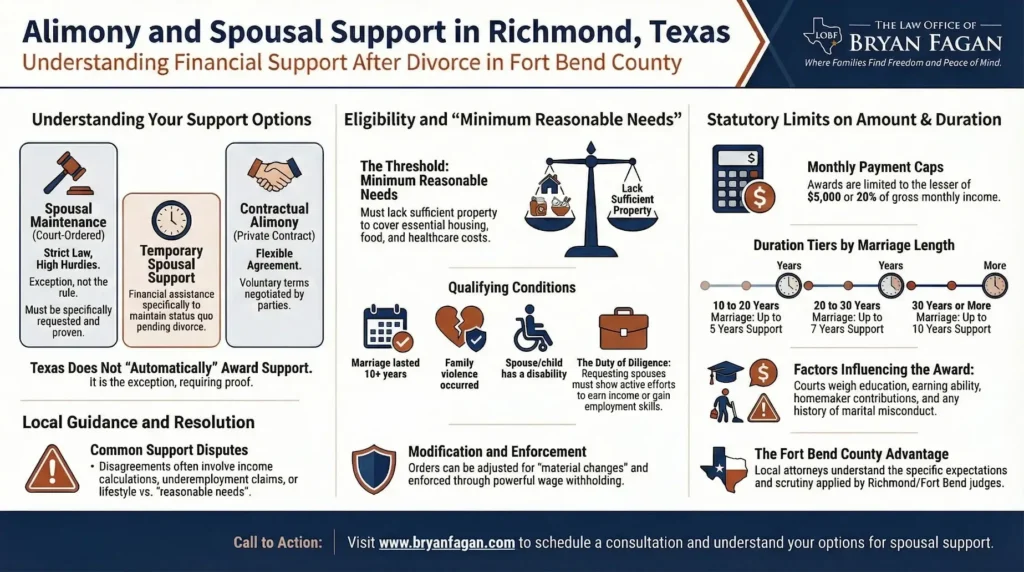
- Courts cap payments at $5,000 per month or 20% of the paying spouse’s gross monthly income, whichever amount is less
- Duration depends on marriage length: up to five years for marriages lasting 10-20 years, up to seven years for 20-30 year marriages, and up to 10 years for marriages exceeding 30 years
- Fort Bend County judges heavily scrutinize documentation, credibility, and whether the requesting party has made genuine efforts toward financial independence
- Temporary spousal support during divorce proceedings operates under different rules than post-divorce spousal maintenance and can provide essential financial assistance while your case is pending

Your Family’s Future Starts Here
Don’t navigate your legal journey alone. Schedule a consultation now and get the clarity and support you deserve.
Listen to Our Texas Family Law Podcast
Prefer listening? In this episode, we discuss alimony and spousal support in Richmond, Texas, including how it works, who may qualify, and what factors courts consider when determining support.
The Law Office of Bryan Fagan, PLLC can represent clients in a variety of family law matters, such as the following:
Understanding Spousal Maintenance Laws in Richmond, Texas
For many mothers navigating divorce, Alimony and Spousal Support in Richmond Texas is not just about financial assistance—it’s about maintaining stability, protecting your household, and creating a secure future for your children. Under Texas Family Code Chapter 8, spousal maintenance refers to court-ordered payments from one spouse to another after divorce, but Texas law sets a high bar for eligibility. Courts require clear proof that the requesting spouse lacks sufficient property to meet minimum reasonable needs and meets one of the statutory conditions outlined in §8.051, such as a marriage lasting at least ten years, family violence, disability, or the need to care for a child with special needs.
This strict framework reflects Texas courts’ focus on fairness and self-sufficiency. Unlike other states, support is never automatic. Judges carefully evaluate each case based on evidence, credibility, and financial realities. For mothers who may have stepped away from the workforce to raise children or support a spouse’s career, this often means demonstrating how that sacrifice impacted earning capacity. Under §8.052, courts also consider factors such as education, employment skills, and contributions as a homemaker—issues that frequently shape outcomes in cases involving mothers.
Planning for the future is just as important as understanding the law. Whether you intend to stay in Richmond or are considering a fresh start, learning more about the area can help you make informed decisions about housing, schools, and support systems. Resources like this helpful guide on moving to Richmond, Texas can provide valuable insight as you think about what comes next and how your financial strategy aligns with your long-term goals.
Preparation plays a critical role in securing spousal maintenance. Courts expect detailed documentation, including budgets, income records, and evidence of job search efforts or caregiving responsibilities. Simply earning less than your spouse is not enough—you must clearly connect your financial need to the legal standards set by the Texas Family Code. This is where working with an experienced Texas family law team can make a meaningful difference, helping you present a strong, well-supported case.
For additional guidance, you can explore practical insights and legal strategies through the firm’s Texas family law blog, which offers valuable information tailored to real-life situations. With the right knowledge and support, mothers in Richmond can move forward with clarity and confidence, knowing they are taking steps to protect both their financial future and their family’s well-being.

Alimony vs. Spousal Maintenance vs. Contractual Alimony in Texas
Understanding these three terms helps avoid costly confusion:
Court-Ordered Spousal Maintenance is what Texas Family Code Chapter 8 authorizes. It’s ordered by a judge, has strict eligibility requirements, and is subject to statutory caps on amounts and duration. Enforcement happens through contempt of court proceedings.
Contractual Alimony is an agreement between divorcing parties reached during settlement negotiations. Because it’s a contract, not a court order, it can exceed the statutory caps and last longer. However, enforcement relies on contract law rather than the more powerful contempt remedies available for court-ordered maintenance.
Temporary Spousal Support occurs during the divorce process itself—before the final decree. It provides temporary financial assistance while proceedings are pending and isn’t subject to the same restrictions as post-divorce maintenance.
In Richmond cases, many couples negotiate contractual alimony as part of their divorce settlement because it offers more flexibility. However, contractual agreements require careful drafting to ensure enforceability.
Eligibility Requirements for Spousal Support in Fort Bend County
To qualify for court-ordered spousal maintenance in Texas, you must prove two things:
First, you lack sufficient property—including your separate property and your share of community property from the property division—to meet your minimum reasonable needs.
Second, you must meet at least one of four qualifying conditions under Texas Family Code §8.051:
- The marriage lasted at least 10 years, AND you lack the ability to earn sufficient income to provide for your minimum reasonable needs
- Your spouse was convicted of or received deferred adjudication for family violence against you or your child within two years before filing or during the divorce proceedings
- You have a physical or mental disability that prevents you from earning sufficient income
- You are the custodian of a child with a physical or mental disability requiring substantial care that prevents you from earning enough to meet your basic needs
Meeting these requirements requires concrete evidence. Fort Bend County courts expect detailed documentation, not vague claims about financial hardship.
The Marriage Duration Factor
When families begin exploring Alimony and Spousal Support in Richmond Texas, one of the first questions that comes up is simple: “How long were we married—and how does that affect my case?” Under Texas Family Code §8.054, the length of your marriage plays a direct role in determining not only whether you may qualify for spousal maintenance, but also how long those payments may last. Texas law is structured to encourage financial independence while still recognizing that longer marriages often involve deeper financial interdependence and greater sacrifices by one spouse.
For marriages lasting between 10 and 20 years, courts may award maintenance for up to five years, provided the requesting spouse proves an inability to meet minimum reasonable needs under §8.051. When a marriage reaches 20 to 30 years, the maximum duration increases to seven years, and for marriages lasting 30 years or more, courts may extend support for up to 10 years. These timeframes are not guarantees—they are caps. Judges in Fort Bend County carefully evaluate each situation based on evidence, financial need, and the efforts made toward self-sufficiency.
There are important exceptions that can significantly change the outcome. Texas law recognizes that certain circumstances require additional protection. If family violence occurred and resulted in a conviction or deferred adjudication, the typical 10-year marriage requirement does not apply. In these cases, even a shorter marriage may qualify for spousal maintenance, though the duration will still depend on the facts and the court’s evaluation of the situation. This reflects the legislature’s intent to protect vulnerable spouses while maintaining fairness in the legal process.
Real-life situations often highlight how these rules work in practice. Imagine a Richmond couple married for eight years. Under normal circumstances, spousal maintenance would not be available based solely on duration. However, if one spouse can present credible evidence of family violence, the court may still award support despite the shorter marriage. These nuances make it critical to understand not just the law, but how it applies to your specific circumstances.
Planning for the future also means considering how your daily life will function after divorce. Factors like commuting, access to work, and proximity to essential services can influence financial independence and long-term stability. Resources like this guide on transportation in Richmond, Texas can help you think through those practical realities as you evaluate your options and build a sustainable plan.
Because every case is different, having reliable information is key. You can explore additional insights on how Texas courts approach support and related family law issues through the firm’s Texas family law blog. With the right legal strategy and a clear understanding of how marriage duration affects your case, you can move forward with greater confidence, knowing you are making informed decisions that protect your financial future and your peace of mind.

Financial Need and “Minimum Reasonable Needs”
Texas courts interpret “minimum reasonable needs” conservatively. This standard covers essential living expenses—not the lifestyle you enjoyed during marriage.
What courts typically include:
- Housing costs (rent or mortgage payments)
- Utilities and basic services
- Food and groceries
- Transportation (reasonable vehicle payment, insurance, gas)
- Health insurance and necessary medical care
- Childcare costs if applicable
- Basic clothing needs
What courts typically exclude:
- Luxury expenses
- Entertainment subscriptions
- Travel or vacations
- High-end vehicle payments
- Savings contributions beyond immediate needs
Self-Assessment Checklist: Do You Likely Qualify?
Ask yourself these questions:
- After property division, will I have enough assets or income to cover basic living expenses?
- Have I been out of the workforce long enough that my employment skills are outdated?
- Did I sacrifice career advancement to support my spouse or raise our children?
- Do I have a disability affecting my ability to work?
- Was there documented family violence in my marriage?
If you answered yes to multiple questions, you may have grounds to pursue spousal maintenance.
Required Documentation
Fort Bend County judges expect you to bring:
- Recent bank statements (3-6 months minimum)
- Detailed monthly budget showing actual expenses
- Pay stubs or income documentation
- Tax returns from recent years
- Medical records if disability is claimed
- Evidence of job searching efforts
What Fort Bend County Judges Really Look For
When it comes to Alimony and Spousal Support in Richmond Texas, understanding the law is only part of the equation. Fort Bend County judges go beyond the statutory requirements outlined in Texas Family Code §§8.051 and 8.052 and take a practical, real-world approach when evaluating each case. While eligibility and financial need must be proven, the way those facts are presented—and supported—can significantly influence the outcome.
Credibility is one of the most powerful factors in any courtroom. Judges carefully observe how each party presents their financial situation, including income, expenses, and efforts to become self-supporting. If a spouse exaggerates needs or downplays income, it can quickly damage their case. Courts expect honesty and consistency, and even small discrepancies can raise concerns about reliability. This is especially important in cases involving sensitive issues such as family violence, where documentation and credibility must align. For those navigating related legal concerns, resources like this guide on assault laws in Richmond, Texas can provide helpful context on how these issues intersect with family law matters.
Preparation is equally critical. Judges expect well-organized, detailed financial records, including bank statements, pay stubs, tax returns, and a clear monthly budget supported by documentation. Under Texas Family Code §8.051, proving a lack of sufficient property to meet minimum reasonable needs requires more than general statements—it requires evidence. A thoughtful, well-prepared presentation signals to the court that you are taking the process seriously and respecting the legal standards in place.
Effort toward employment also plays a key role in how courts evaluate requests for spousal maintenance. Texas law emphasizes a path toward financial independence, and judges want to see that a requesting spouse is making good-faith efforts to work, obtain training, or improve earning capacity. Even if full-time employment is not immediately possible, demonstrating initiative can strengthen your position significantly. Courts are less sympathetic when a party appears unwilling to take reasonable steps toward self-sufficiency.
Another important consideration is how your post-divorce financial needs compare to your lifestyle during the marriage. While Texas courts do not aim to maintain the same standard of living indefinitely, they do evaluate whether claimed expenses are realistic and consistent with past patterns. If a couple lived modestly, a sudden claim for significantly higher expenses may face scrutiny.
Ultimately, success in these cases comes down to preparation, transparency, and a clear understanding of how the law applies to your situation. For additional guidance on navigating these issues, you can explore the firm’s Texas family law blog, which offers practical insights designed to help families make informed decisions. With the right approach and support, you can present a strong case that reflects both your needs and your commitment to moving forward responsibly.

How Richmond Courts Determine Spousal Maintenance Awards
Once eligibility is established, Texas Family Code §8.052 directs courts to consider specific factors when determining amounts and duration:
- Financial resources of both spouses after community property division
- Education and employment skills of the requesting spouse, including time needed for training
- Duration of the marriage—longer marriages generally support longer maintenance periods
- Age, employment history, earning ability, and physical/emotional condition of the requesting spouse
- Ability of the paying spouse to meet their own needs while providing support
- Acts of marital misconduct, including adultery or cruel treatment, though Texas courts give this limited weight
- History of family violence and any convictions or deferred adjudication
- Contributions as homemaker and whether that role impaired earning capacity
- Property brought to the marriage by each spouse
- Education supported by one spouse for the other’s benefit
Courts balance these factors to reach an amount that helps the requesting spouse work toward financial independence without unfairly burdening the paying spouse.
Real Richmond Case Example: How Spousal Maintenance Is Decided
Consider this hypothetical based on common Fort Bend County situations:
The Facts: James and Sarah were married for 15 years. James earns $12,000 per month gross income as an engineer. Sarah worked part-time during their marriage while primarily caring for their two children, one of whom has mild autism requiring extra supervision. Sarah’s separate property is minimal, and her share of community property won’t generate sufficient income.
Eligibility Analysis: The marriage exceeded 10 years, meeting the duration threshold. Sarah must demonstrate she lacks sufficient property and cannot earn sufficient income to meet minimum reasonable needs.
Amount Calculation: The cap is the lesser of $5,000/month or 20% of James’s gross monthly income. Twenty percent of $12,000 equals $2,400—so the maximum Sarah could receive is $2,400/month.
Duration: For a 15-year marriage, maintenance can last up to five years.
Court Considerations: The judge examined Sarah’s employment history, the time she’d need for additional training, childcare responsibilities for their son with special needs, both parties’ health, and contributions each made during marriage.
Likely Outcome: Sarah received $2,400/month for four years, with the expectation that she pursue job training and eventually become self-supporting.
Duration and Amount of Spousal Support in Texas
Duration Limits
Texas Family Code §8.054 sets maximum durations based on marriage length:
| Marriage Length | Maximum Duration |
|---|---|
| 10-20 years | Up to 5 years |
| 20-30 years | Up to 7 years |
| 30+ years | Up to 10 years |
Exceptions allowing longer duration:
- Spouse or child has physical or mental disability preventing self-support
- Certain family violence circumstances
Amount Caps
Texas Family Code §8.055 limits payments to the lesser of:
- $5,000 per month, OR
- 20% of the paying spouse’s gross monthly income
This cap applies regardless of the paying spouse’s actual income or the recipient spouse’s needs.
Payment Calculation Methods
Understanding how maintenance amounts work helps set realistic expectations:
Step 1: Determine the paying spouse’s gross monthly income (before taxes, including bonuses, commissions, and retirement benefits)
Step 2: Calculate 20% of that figure
Step 3: Compare to the $5,000 cap—the lower number is the maximum
Quick Examples:
| Paying Spouse’s Gross Income | 20% Calculation | Maximum Possible Award |
|---|---|---|
| $6,000/month | $1,200 | $1,200 |
| $15,000/month | $3,000 | $3,000 |
| $30,000/month | $6,000 | $5,000 (cap applies) |
Remember: these are maximums. Courts often award less based on actual needs and circumstances.
Temporary Spousal Support During Richmond Divorce Proceedings
When families begin navigating Alimony and Spousal Support in Richmond Texas, one of the most immediate concerns is how to stay financially stable while the divorce is still pending. Temporary spousal support plays a critical role during this phase. Under Texas Family Code §6.502, courts have the authority to issue temporary orders that provide financial assistance before a final divorce decree is entered. These orders are designed to stabilize the situation, ensuring that basic living needs are met while the legal process moves forward.
Unlike post-divorce spousal maintenance governed by Chapter 8 of the Texas Family Code, temporary support does not require the same strict eligibility standards outlined in §8.051. It is also not limited by the statutory caps found in §8.055, which restrict long-term maintenance to the lesser of $5,000 per month or 20% of the paying spouse’s gross income. Instead, judges focus on maintaining the status quo, evaluating each party’s immediate financial needs, available resources, and overall circumstances at the time of the hearing.
In Fort Bend County, obtaining temporary spousal support typically involves filing a motion and attending a temporary orders hearing, often scheduled within a few weeks of filing for divorce. During this hearing, the court considers factors such as income, monthly expenses, custody arrangements, and each spouse’s ability to contribute financially. These early decisions can have a significant impact on the remainder of the case, especially when one spouse depends on that support to maintain housing, transportation, and day-to-day stability.
External factors can also influence how courts view financial responsibility during this stage. For example, issues such as substance-related offenses may affect a party’s credibility, financial standing, or ability to meet obligations. Understanding how these matters intersect with family law can be important, and resources like this guide on DWI and DUI laws in Richmond, Texas can provide additional context for families facing complex situations.
Temporary support is not intended to be permanent—it ends once the divorce is finalized—but it often serves as a lifeline during a challenging and uncertain time. Having a clear understanding of your rights and responsibilities during this phase can make a meaningful difference in your ability to move forward. For more insight into how Texas courts handle support and related issues, you can explore the firm’s Texas family law blog, which offers practical guidance tailored to real-life situations. With the right preparation and legal support, you can approach this stage with greater confidence and a clearer path toward long-term stability.

Timeline: From Divorce Filing to Spousal Maintenance Order
Understanding the process helps you prepare appropriately:
1. Filing for Divorce – One spouse files a petition in Fort Bend County District Court. If seeking spousal maintenance, request it in your pleadings from the start.
2. Temporary Orders Hearing – Usually occurs 2-4 weeks after filing. Temporary spousal support, child support, and child custody arrangements can be established.
3. Discovery Phase – Both sides exchange financial information including income records, tax returns, bank statements, and expense documentation. This phase typically lasts several months.
4. Negotiation or Mediation – Most divorce cases settle without trial. Spousal maintenance terms can be negotiated, potentially including contractual alimony exceeding statutory limits.
5. Final Trial or Settlement – If agreement isn’t reached, the court decides. Spousal maintenance determination happens at this stage.
6. Post-Decree Enforcement/Modification – After the divorce is final, maintenance orders can be enforced through wage withholding or modified if circumstances change substantially.
Modification and Enforcement of Spousal Maintenance Orders
When Modification Is Possible
Either party can seek modification of a spousal maintenance order upon showing a “material and substantial change in circumstances.” Under Texas Family Code §8.057, this might include:
- Significant income changes for either party
- Disability development or recovery
- Changes in the recipient’s financial situation
- Job loss or major employment changes
Courts won’t modify orders based on minor fluctuations—changes must be meaningful and ongoing.
Enforcement Tools
When a paying spouse fails to meet obligations, Texas provides enforcement mechanisms:
- Wage Withholding: The Fort Bend District Clerk maintains forms including “Request for Issuance of Employer’s Order to Withhold Spousal Maintenance,” allowing automatic deductions from wages
- Contempt of Court: Willful failure to pay can result in contempt proceedings with potential jail time
- Judgments: Unpaid amounts can be reduced to money judgments
When Spousal Maintenance Ends
Spousal maintenance automatically terminates under specific circumstances outlined in Texas Family Code §8.056:
- Death of either spouse
- Remarriage of the recipient spouse
- Cohabitation – when the recipient spouse lives with another person in a “continuing conjugal relationship”
The cohabitation provision has received recent attention. In 2025, Texas appellate courts clarified what constitutes “continuing conjugal relationship,” examining factors like shared finances, romantic involvement, and household sharing.
Termination also occurs when:
- The court-ordered duration expires
- A modification order ends payments
- The recipient becomes self-supporting
Tax Implications of Spousal Support in Richmond
Since the 2018 Tax Cuts and Jobs Act took effect, court-ordered spousal maintenance is:
- Not deductible for the paying spouse
- Not taxable income for the recipient spouse
This applies to all divorce decrees finalized after December 31, 2018. The change significantly impacts financial planning for both parties—the paying spouse no longer gets a tax benefit, while the recipient receives the full amount without federal tax liability.
Consulting with a tax professional remains essential, especially when negotiating contractual alimony or evaluating settlement offers.

Costly Mistakes to Avoid in Richmond Spousal Maintenance Cases
Waiting too long to request support. If you don’t include spousal maintenance in your initial pleadings, courts may decline to consider it. Timing matters.
Failing to document expenses properly. Generic budgets without receipts, bank statements, and verification undermine your credibility. Judges expect specificity.
Assuming support is automatic. Many spouses believe long marriages guarantee maintenance. Texas law requires proving eligibility—nothing is presumed.
Manipulating income or employment. Underreporting income or avoiding employment to appear needy can result in severe legal consequences and damage your case.
Representing yourself without understanding the law. Family law matters are complex. Self-representation often leads to worse outcomes than working with experienced attorneys familiar with Fort Bend County courts.
Overstating expenses or misrepresenting financial circumstances. Credibility is everything. Judges who catch exaggerations often penalize the offending party.
Common Challenges in Richmond Spousal Maintenance Cases
Disputes over eligibility arise frequently. The paying spouse may argue the requesting party has sufficient employment skills, property, or earning capacity to meet their needs independently.
Income disputes complicate calculations. When one spouse owns a business, receives irregular income, or has complex compensation structures, determining gross monthly income becomes contentious.
Proving minimum reasonable needs requires balancing documentation with realistic expectations. Claiming needs far above what you spent during marriage raises credibility issues.
Strategies for success:
- Begin documenting expenses months before filing
- Gather employment and education records showing your employment history
- Obtain evidence of any family violence or domestic violence
- Work with family lawyers who understand local judicial expectations
- Present honest, organized financial disclosures
Working with The Law Office of Bryan Fagan for Your Richmond Case
When you are dealing with Alimony and Spousal Support in Richmond Texas, your financial future and peace of mind are too important to leave to chance. Texas Family Code Chapter 8 sets strict requirements for spousal maintenance, including eligibility under §8.051 and the factors courts must evaluate under §8.052. Successfully navigating these laws requires more than a basic understanding—it requires a strategic approach tailored to how Fort Bend County courts actually evaluate evidence, credibility, and long-term financial planning.
The team at Bryan Fagan’s firm approaches every case with a clear purpose: to help families move from uncertainty to stability through education, preparation, and thoughtful legal strategy. No two divorces are the same, and that is why each case is handled with careful attention to your unique financial situation, your goals, and the practical realities you are facing. Whether you are seeking support or defending against a claim, having a legal team that understands both the law and the local court system can make a meaningful difference in your outcome.
Preparing for your consultation is one of the most important steps you can take. Bringing organized financial documents—such as recent pay stubs, bank statements, tax returns, and a detailed list of monthly expenses—helps your attorney evaluate your case under the standards outlined in the Texas Family Code. If family violence is a factor, documentation supporting those claims can also play a critical role in establishing eligibility for maintenance under §8.051. The more prepared you are, the more effectively your legal team can build a strategy that protects your interests.
If you are planning to meet with an attorney in person, this guide on planning your visit to the Richmond office can help you feel more confident and prepared before your consultation. Taking that first step often brings clarity to what can otherwise feel like an overwhelming situation.
For additional insight into how Texas courts handle divorce, support, and related family law matters, you can explore the firm’s Texas family law blog, which provides practical guidance designed to help you make informed decisions. With the right legal support and a clear plan in place, you can move forward knowing you are taking meaningful steps to protect your financial future and your family’s well-being.

Conclusion
Divorce may change the structure of your life, but it doesn’t have to define your future—or your family’s stability. The decisions you make now, especially around financial support and planning, can create a foundation that allows you and your children to move forward with confidence instead of uncertainty. Understanding how spousal support works in Texas isn’t just about knowing the law—it’s about using that knowledge to protect what matters most in your everyday life.
If you’re feeling unsure about your next step, that’s completely normal. Most people don’t walk into this process with all the answers. But you don’t have to figure it out alone. Taking the time to gather your financial documents, ask questions, and speak with someone who understands Texas family law can make a significant difference in both your outcome and your peace of mind. The right guidance helps you avoid costly mistakes and focus on solutions that actually work for your situation.
At The Law Office of Bryan Fagan, PLLC, the goal is simple: help you move from confusion to clarity with practical advice and compassionate support. Working with an experienced Texas family law attorney means having someone in your corner who understands not just the statutes, but how those laws play out in real courtrooms and real lives. Whether you’re just starting to explore your options or you’re already in the middle of a case, having the right strategy can change everything.
So here’s something worth thinking about—what would it feel like to have a clear plan instead of a list of worries? That shift is often closer than you think.
Frequently Asked Questions
Texas is one of the strictest states for awarding spousal maintenance. You must prove you lack sufficient property to meet minimum reasonable needs AND meet one of four qualifying conditions under Texas Family Code §8.051—typically a 10-year marriage, disability, family violence, or caring for a disabled child. Simply having lower income than your spouse isn’t enough.
Yes, but it’s challenging. Courts examine whether your current income meets your minimum reasonable needs. If you’re working but still can’t cover basic living expenses despite good-faith efforts, you may qualify. However, judges expect evidence showing the gap between your income and essential expenses.
Duration depends on marriage length: up to five years for marriages of 10-20 years, up to seven years for 20-30 year marriages, and up to 10 years for marriages exceeding 30 years. Exceptions exist for disability cases or when caring for a disabled child, potentially allowing longer or indefinite support.
Texas courts use the paying spouse’s gross monthly income—income before taxes and deductions. This includes salary, wages, bonuses, commissions, self-employment income, and even retirement benefits. Net income isn’t the determining factor; gross income is.
Fort Bend County judges follow Texas law strictly, meaning they don’t award maintenance unless statutory requirements are clearly met. Local judges particularly emphasize documentation quality, credibility, and whether the requesting party has made genuine efforts toward becoming self-supporting.
Yes. Under Texas Family Code §8.057, either party can seek modification by showing a “material and substantial change in circumstances”—such as significant income changes, disability, or major shifts in financial circumstances. Minor fluctuations don’t justify modification.
You may be disqualified if you have sufficient property to meet your needs, can earn sufficient income independently, were married less than 10 years without other qualifying factors, or engage in conduct undermining your credibility—such as hiding assets or refusing reasonable employment opportunities.
Temporary spousal support under Texas Family Code §6.502 provides financial assistance during pending divorce proceedings without the strict eligibility requirements or caps applying to post-divorce maintenance. It ends when the final decree is issued and serves to maintain stability during litigation.