
Child Support in Richmond Texas: Complete Guide for Fort Bend County Parents

Have you ever watched your child struggle to focus on homework and wondered if something deeper is going on? For many families, divorce brings more than legal questions—it brings emotional shifts that can show up in the classroom. Child Support in Richmond Texas is often seen as a financial issue, but in reality, it plays a critical role in providing the stability children need to stay grounded, focused, and successful in school.
When parents begin navigating Child Support in Richmond Texas, they’re also shaping the structure of their child’s daily life—where they live, how consistent their routines are, and whether their educational needs are fully supported. Texas courts, guided by Texas Family Code §153.002, focus on the best interest of the child, which includes maintaining academic continuity during periods of family transition.
At The Law Office of Bryan Fagan, PLLC, we’ve helped countless families across Fort Bend County find clarity during uncertain times. Led by Bryan Joseph Fagan, a South Texas College of Law graduate and a recognized authority in Texas divorce and custody law, our firm is committed to empowering parents with the knowledge and support they need to protect their children’s future.
In this guide, you’ll learn how child support, custody decisions, and parenting plans intersect with your child’s academic success—and how the right legal strategy can help restore stability, confidence, and peace of mind for your entire family.
Key Takeaways
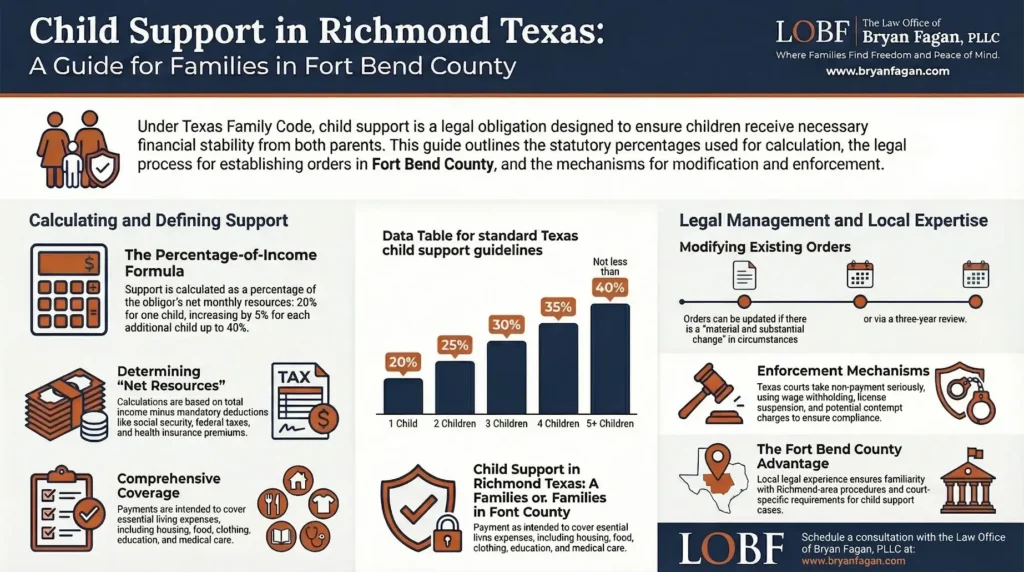
- Child support in Richmond Texas is typically calculated using statewide guidelines based on a parent’s net income, with percentages ranging from 20% for one child to 40% for five or more children under Texas Family Code §154.125.
- Texas courts focus on the child’s best interest when setting and enforcing child support, following the standard established in Texas Family Code §153.002.
- Net resources—your income after specific deductions like taxes, health insurance premiums, and union dues—determine your support obligation under Texas Family Code §154.062.
- Child support orders can be modified when there has been a significant change in circumstances, including job loss, income changes, or after three years if the current amount differs by 20% or $100 from guideline calculations.
- Fort Bend County parents can establish, modify, and enforce child support through the local district courts, with assistance available from the Fort Bend County Child Support Office and the Office of the Attorney General of Texas.

Your Family’s Future Starts Here
Don’t navigate your legal journey alone. Schedule a consultation now and get the clarity and support you deserve.
Listen to Our Texas Family Law Podcast
Prefer listening? In this episode, we discuss child support in Richmond, Texas, including how payments are calculated, how support is enforced, and what parents need to know about their rights and obligations.
The Law Office of Bryan Fagan, PLLC can represent clients in a variety of family law matters, such as the following:
Child Support in Richmond Texas: The Short Answer
Child Support in Richmond Texas is more than a monthly payment—it is a structured legal system designed to ensure children continue to receive consistent financial support for their daily needs, education, and healthcare after a separation or divorce. In Texas, child support is calculated based on the paying parent’s net resources, as defined under Texas Family Code §154.062, which outlines what income is included and what deductions apply. These calculations follow guideline percentages established in §154.125, creating a predictable framework while still allowing flexibility when needed.
When courts evaluate Child Support in Richmond Texas, their primary focus is always the child’s best interest, as required by Texas Family Code §153.002. Judges have the authority under §154.123 to deviate from standard guideline amounts when circumstances make the default calculation unjust or inappropriate. This often includes situations involving a child’s educational needs, healthcare expenses, or other factors that impact stability—especially during and after a family transition.
For families living in or relocating to the Richmond area, understanding the local community can play an important role in these decisions. Resources like the Richmond, Texas relocation guide provide helpful insight into schools, neighborhoods, and community support systems that may influence both custody and child support outcomes. You can also explore a deeper breakdown of how support is calculated in this Texas child support resource to better understand what to expect.
At its core, child support exists to protect children—not just financially, but by promoting consistency, security, and opportunity. Whether you are establishing support or adjusting an existing order, having clear guidance rooted in Texas law can help you make decisions that truly support your child’s future.

How Child Support Is Calculated in Texas
The calculation begins with determining the noncustodial parent’s net resources. Under Texas Family Code §154.062, net resources include all income sources—wages, salary, bonuses, commissions, self-employment earnings, rental income, and investment returns—minus specific deductions. Those deductions include Social Security taxes, federal income tax calculated at a single filer rate with standard deduction, union dues, and the cost of health insurance or dental insurance for the child.
Once net resources are determined, Texas Family Code §154.125 applies guideline percentages based on the number of children the parent supports. These percentages apply to monthly net resources up to $11,700 (as of September 1, 2025). Above that cap, additional support may be ordered only if the child has proven needs that justify it.
Table 1 – Child Support Guideline Overview
| Number of Children | Guideline Percentage | Maximum Monthly Support at $11,700 Cap |
|---|---|---|
| 1 child | 20% | $2,340 |
| 2 children | 25% | $2,925 |
| 3 children | 30% | $3,510 |
| 4 children | 35% | $4,095 |
| 5 or more children | 40% | $4,680 |
If a parent has other children from different relationships that they’re legally obligated to support, multiple family adjusted guidelines under Texas Family Code §154.129 reduce these percentages to ensure fair allocation across all the parent’s children.
What Counts as Income for Child Support
When it comes to Child Support in Richmond Texas, understanding what qualifies as income is one of the most important—and often misunderstood—parts of the process. Texas law takes a comprehensive approach under Texas Family Code §154.062, defining “net resources” as more than just a paycheck. Courts evaluate all sources of income to ensure that child support reflects a parent’s true financial ability to contribute to their child’s wellbeing.
This includes traditional earnings such as wages, salary, overtime, bonuses, commissions, and tips, as well as self-employment income after legitimate business expenses. Beyond that, courts may also consider rental income (after expenses), interest and dividends, retirement or pension benefits, trust distributions, and certain disability payments. Even unemployment and workers’ compensation benefits are included when calculating support obligations, ensuring that children receive consistent financial support regardless of how a parent earns income.
At the same time, Texas law provides clear limits on what is excluded. Means-tested public assistance programs such as SSI and TANF, foster care payments, and returns of capital are not counted toward net resources. These distinctions matter because they directly affect how child support is calculated under §154.125, which applies guideline percentages to a parent’s net monthly resources—currently capped at $11,700 as of the latest update to Texas law.
For families navigating life in Fort Bend County, practical considerations like commuting, access to employment, and daily routines can also influence income stability and support calculations. Resources such as the Transportation in Richmond, Texas guide can provide helpful context about how local infrastructure impacts work and income. You can also explore this detailed Texas child support calculation guide to better understand how courts apply these rules in real cases.
From a practical standpoint, courts expect full transparency. Accurate documentation—pay stubs, tax returns, business records, and proof of additional income—helps ensure a fair outcome and avoids unnecessary disputes. Families working through Child Support in Richmond Texas often find that clarity around income not only strengthens their legal position but also creates a more stable foundation for their child’s future.

When Courts Deviate from Child Support Guidelines
Texas Family Code §154.123 allows courts to deviate from guideline amounts when applying the standard percentages would be unjust or inappropriate. This flexibility recognizes that every family’s circumstances differ.
Common deviation factors include a child’s special medical needs or disabilities requiring additional expenses, extraordinary healthcare costs not covered by dental insurance or health insurance, and significant childcare expenses. The age of the child matters too—teenagers often have different financial needs than toddlers.
Travel costs for visitation can justify deviation, particularly when parents live far apart. A history of family violence may affect the court’s calculations. When one parent has significantly higher income than the cap but the child has demonstrable needs, courts may order support above guideline amounts.
Courts also consider whether the parent pays child support for other children from different relationships, educational expenses, and whether either parent provides primary care for other children living with them. The key is providing documented evidence supporting why deviation serves the child’s best interest.
How Custody Affects Child Support
Custody arrangements—called conservatorship in Texas—directly affect which parent pays child support and how much. Under Texas Family Code §153.002, all custody decisions prioritize the child’s best interest.
The parent designated as the primary residence parent (typically the managing conservator with primary custody) usually receives child support from the other parent. The noncustodial parent—often called the possessory conservator—generally pays support based on their income.
Many parents assume that having equal possession time automatically eliminates child support obligations. This isn’t accurate under Texas law. Possession schedules are one factor courts may consider when determining whether to deviate from guidelines, but equal time-sharing doesn’t automatically mean no support obligation. The law recognizes that even with shared time, children’s expenses don’t split perfectly in half, and income disparities between parents often justify continued support payments.
Joint managing conservatorship, where both parents share decision-making authority, doesn’t change the basic support calculation either. What matters is which parent’s home serves as the child’s primary residence and the income levels of both parents.
Establishing Child Support in Fort Bend County
When families begin the process of Child Support in Richmond Texas, the legal journey typically starts with filing a Suit Affecting the Parent-Child Relationship (SAPCR) in a Fort Bend County district court. This type of case addresses not only child support, but also conservatorship (custody) and possession schedules, ensuring that all aspects of the parent-child relationship are handled together under Texas Family Code §101.032 and §153.002. The law requires that every decision made in this process centers on the child’s best interest, including their financial stability and overall wellbeing.
The process begins by submitting the appropriate petition to the district clerk, along with the required filing fee. While many parents choose legal representation, those who proceed on their own may find guidance through local resources and community support systems. Helpful tools and services can often be found through government resources in Richmond, Texas, which provide direction for navigating paperwork, filing procedures, and available assistance programs. For additional legal insight, parents can also review this Texas child support overview to better understand how support is determined under Texas law.
After the case is filed, the other parent must be formally served with notice, ensuring due process is followed. Courts may then issue temporary orders under Texas Family Code §105.001, which can include temporary child support to provide immediate financial stability for the child while the case is pending. These temporary measures are critical in maintaining consistency in the child’s daily life, especially during periods of transition.
Final orders are entered either through agreement between the parents or after a contested hearing where the judge evaluates evidence and applies the Texas Family Code, including guideline support provisions under §154.125. The court will determine conservatorship arrangements, possession schedules, and the appropriate amount of child support based on each parent’s financial circumstances and the child’s needs. While uncontested cases may resolve more quickly, contested matters can take several months to complete.
Throughout this process, families navigating Child Support in Richmond Texas often find that having clear guidance and reliable information makes a significant difference. Establishing child support is not just about meeting legal requirements—it’s about creating a stable, supportive environment where children can continue to grow, learn, and thrive.

Child Support Process in Fort Bend County
Table 2 – Child Support Process
| Step | What Happens | What You Need |
|---|---|---|
| Filing the Case | Submit SAPCR petition to Fort Bend County district clerk | Filing fee, completed petition forms |
| Service of Process | Other parent receives formal notice | Address for other parent, service fee |
| Temporary Orders | Court establishes interim support | Income documentation, proposed support amount |
| Discovery | Exchange financial information | Pay stubs, tax returns, insurance costs |
| Mediation (if applicable) | Attempt settlement outside court | Willingness to negotiate, financial records |
| Final Hearing | Judge issues binding child support order | All documentation, witnesses if needed |
| Order Entry | Support obligation becomes enforceable | Compliance with payment terms |
The Fort Bend County Child Support Office assists with payment records, wage withholding setup, address changes, and direct deposit arrangements. Payments typically process through the Texas Child Support Disbursement Unit rather than directly between parents.
Modifying Child Support
Life rarely stays the same, and the law surrounding Child Support in Richmond Texas recognizes that reality. Under Texas Family Code §156.401, child support orders can be modified when there has been a material and substantial change in circumstances since the prior order. This legal flexibility is designed to ensure that support obligations remain fair and continue to reflect both the parent’s financial situation and the child’s evolving needs.
A material and substantial change can take many forms. Common examples include job loss, a significant increase or decrease in income, unexpected medical expenses, or a shift in custody arrangements that affects the child’s daily living situation. Even relocation or changes in visitation costs may qualify. In more serious situations, such as extended incarceration, courts may also find that circumstances justify a modification. For example, legal issues such as those discussed in the Richmond DWI/DUI legal resource can sometimes intersect with family law matters and impact a parent’s ability to meet financial obligations.
Texas law also provides a built-in review mechanism. If it has been three years since the last order or modification and the current support amount differs by at least 20% or $100 from what the guidelines under Texas Family Code §154.125 would now require, a parent may seek modification even without proving other changes. This ensures that child support remains aligned with current income levels and the updated statutory cap on net resources.
To request a modification, a parent must file a motion in the court that issued the original order, as that court retains continuing, exclusive jurisdiction under Texas Family Code §155.001. Supporting documentation—such as updated income records, medical bills, or proof of custody changes—is critical to building a strong case. Importantly, modifications typically apply only to future payments after the other parent has been properly served, meaning past-due support is generally not retroactively reduced.
Families navigating Child Support in Richmond Texas often find that timely action makes a significant difference. Addressing changes early can help avoid enforcement issues and maintain financial stability for your child. For additional guidance, this Texas child support modification overview provides a deeper look at the process and what to expect when seeking a modification through the courts.
Enforcing Child Support Orders
When a parent fails to pay child support, Texas Family Code Chapter 157 provides powerful enforcement tools. The custodial parent or the Office of the Attorney General of Texas can pursue enforcement action through the courts.
Available remedies include wage withholding, where support is automatically deducted from the obligor’s paycheck. Courts can hold non-paying parents in contempt, potentially imposing fines or even jail time for willful refusal to pay. Tax refund intercepts capture federal and state refunds to apply toward arrearages.
Liens on real estate and personal property protect the owed amounts, preventing the obligor from selling assets without satisfying child support debts. License suspensions—driver’s license, professional licenses, even hunting and fishing licenses—create additional pressure to comply.
Interest accrues on unpaid support, increasing the total debt over time. The court retains jurisdiction over child support cases until all current and past-due amounts, including medical and dental support obligations, are fully satisfied.
Common Child Support Issues in Richmond
Families navigating Child Support in Richmond Texas often encounter challenges that go beyond simple calculations, especially when financial situations are complex or communication between parents has broken down. One of the most common issues involves disputes over income. Under Texas Family Code §154.062, courts evaluate all sources of net resources—including bonuses, overtime, and self-employment income—but disagreements frequently arise over what should be included and how it should be documented. Providing complete and accurate records, such as pay stubs, tax returns, and business financials, is essential to reaching a fair outcome. For a more detailed breakdown, this Texas child support calculation guide offers helpful insight into how courts approach these issues.
Another significant problem comes from informal agreements between parents. While it may seem easier to adjust support amounts outside of court, these arrangements are not legally enforceable under Texas law. If one parent stops paying or disputes the agreement later, the other parent may have limited options to recover unpaid support. Texas Family Code §154.001 requires that child support obligations be established through a valid court order, making it critical to formalize any changes through proper legal channels.
Missed payments and ongoing arrears can quickly create financial and emotional strain for both the custodial parent and the child. Texas Family Code Chapter 157 provides enforcement tools such as wage withholding, property liens, and contempt actions to address nonpayment. However, preventing these issues is often more effective than resolving them after the fact. Consistent payment systems, such as income withholding orders, help maintain stability and reduce conflict between parents.
Changes in circumstances—such as job loss, health challenges, or relocation—are another common source of conflict. Texas Family Code §156.401 allows for modification of child support when there has been a material and substantial change, but parents must take proactive steps to request that modification. Simply stopping payments can lead to enforcement actions and increased financial liability. Courts tend to view parents more favorably when they act promptly and responsibly to address changing circumstances.
In some cases, broader legal issues can also impact child support and custody matters. Situations involving family violence or related concerns may influence how courts evaluate conservatorship and financial obligations, particularly under Texas Family Code §153.004. For those facing more serious legal challenges, resources like the Richmond assault legal information page can provide additional context on how these issues may intersect with family law proceedings.
Ultimately, addressing common challenges in Child Support in Richmond Texas requires a combination of accurate information, timely action, and a clear understanding of Texas law. By taking a proactive and informed approach, parents can reduce conflict, protect their financial interests, and most importantly, create a more stable environment for their children.

How a Richmond Child Support Attorney Can Help
Navigating Child Support in Richmond Texas can feel overwhelming, especially when you’re trying to balance legal requirements with your child’s needs and your own financial reality. Working with an experienced Texas family law attorney helps ensure that child support calculations are accurate and aligned with Texas Family Code §154.062 and §154.125, which govern how net resources are determined and applied. This guidance is essential in preventing unfair outcomes that may arise from incomplete or inaccurate financial disclosures.
As life changes, so do child support obligations. Whether you experience a shift in income, custody arrangements, or your child’s needs, Texas Family Code §156.401 allows for modification when there has been a material and substantial change in circumstances. A knowledgeable attorney can help you properly document those changes, present evidence effectively, and navigate the legal process with confidence. For a deeper understanding of how modifications work, you can explore this helpful Texas child support modification guide.
Enforcement is another critical area where legal support makes a meaningful difference. If child support is not being paid, Texas Family Code Chapter 157 provides enforcement tools such as wage withholding, liens, and contempt actions. Having an advocate who understands Fort Bend County court procedures ensures that these remedies are pursued efficiently and effectively, helping restore financial stability for your child.
Families throughout Fort Bend County turn to trusted legal teams for guidance through every stage of the process—from establishing support to modifying and enforcing existing orders. If you are considering your next steps, planning ahead can make the experience smoother and less stressful. Resources like the Richmond office visit guide can help you prepare for a consultation and understand what to expect when meeting with a legal professional.
At the end of the day, handling Child Support in Richmond Texas is about more than legal compliance—it’s about protecting your child’s future and creating stability during times of change. With the right support and clear guidance, you can move forward with confidence, knowing you’re making informed decisions for your family.
Checklist: Child Support in Richmond Texas
- Gather income documentation: Collect recent pay stubs, tax returns, and records of bonuses, commissions, or self-employment income
- Calculate estimated child support: Apply guideline percentages to your net resources for a preliminary estimate
- Review custody arrangements: Understand how conservatorship roles affect support obligations
- Document insurance costs: Gather health insurance and dental insurance premium information for children
- Track payments and records: Maintain detailed records of all support payments made or received
- Avoid informal agreements: Never change support amounts without court approval
- Document income changes promptly: Keep records of any significant changes to employment or earnings
- Stay compliant with court orders: Pay support as ordered, even while pursuing modification
- Prepare for modification if needed: Gather evidence of changed circumstances before filing
- Consult a family law attorney: Get professional guidance for complex situations or disputes
Conclusion
Divorce may change the structure of your family, but it doesn’t have to disrupt your child’s ability to learn, grow, and succeed. When child support and custody decisions are handled thoughtfully, they create something every child needs—consistency. And with that consistency comes confidence, stability, and the ability to focus on what really matters: being a kid.
The truth is, there’s no perfect roadmap for navigating these transitions. Every family is different, every child responds in their own way, and every decision you make carries weight. But you don’t have to figure it all out on your own. With the right guidance, you can make informed choices that protect your child’s academic future while also giving yourself clarity and peace of mind.
That’s where working with an experienced Texas family law attorney can make all the difference. At The Law Office of Bryan Fagan, PLLC, the goal isn’t just to resolve legal issues—it’s to help you build a stable foundation your child can rely on long after the case is over. Whether you’re just starting the process or dealing with a change in circumstances, having a trusted advocate by your side can turn uncertainty into a clear path forward.
If you’re facing questions about child support, custody, or how to best support your child during this transition, it may be time to take the next step. A conversation today could make tomorrow feel a lot more manageable—for you and for your child.
Frequently Asked Questions About Child Support in Texas
In Texas, parents can usually check the status of a child support case through the Texas Attorney General’s child support portal, where they may review payment history, account balances, and recent case activity. Depending on the situation, some information may also be available through court records or by contacting the local child support office. Keeping your case number, payment records, and court documents in one place can make the process much easier.
When child support arrears reach that level, the consequences can become very serious. Texas courts and enforcement agencies may use wage garnishment, tax refund interception, property liens, license suspension, and contempt proceedings to collect the unpaid support. A large unpaid balance can also make it harder for the parent owing support to negotiate manageable solutions later, especially once interest and enforcement costs begin to add up.
That depends on your net resources, not just your gross weekly income. In Texas, child support is generally calculated using a percentage of monthly net resources after certain deductions, such as taxes and the cost of a child’s health insurance. For one child, the guideline is often 20 percent of net resources, but the final amount can vary depending on other children, medical support, and the facts of the case.
There is no single average amount that applies to every family because child support in Texas is based on the paying parent’s income. For one child, the usual guideline amount is 20 percent of net monthly resources. That means the actual amount can vary widely from case to case depending on earnings, deductions, and whether the court finds a reason to depart from the guideline amount.
This question can be more complicated than it sounds. In Texas, child support enforcement is often handled through civil enforcement tools like contempt, but serious nonpayment can also create more severe legal consequences in some circumstances. It is not always tied to one simple dollar amount, so anyone facing major arrears or possible criminal exposure should get legal advice right away.
Some child support-related court filings and orders may appear in public court records, but that does not mean every detail of a case is fully open to the public. Sensitive financial information and certain family law records may be restricted or partially protected. If privacy is a concern, it is important to understand what may appear in the court file and what may remain confidential.
Courts tend to view certain behaviors very negatively, including hiding income, failing to provide accurate financial records, ignoring court orders, missing payments without taking action, or intentionally reducing income to avoid support. Informal payment arrangements can also create problems if they are not well documented. In most cases, honesty, consistency, and clear records help a parent far more than excuses after the fact.
Child support can remain unpaid for a long time, but the obligation does not simply go away. Unpaid support becomes arrears, interest may continue to accrue, and enforcement efforts can continue well beyond the original due dates. The longer the issue is left unaddressed, the harder it often becomes to resolve.
In most Texas child support cases, a new spouse’s income is not directly used to calculate your child support obligation. Child support is generally based on the parent’s own net resources. That said, a remarriage can affect the overall financial picture in some situations, which is one reason it is wise to have an experienced Texas family law attorney review the facts of your case.
