
Termination of Parental Rights in Richmond Texas: A Complete Legal Guide

It usually doesn’t start in a courtroom—it starts at a quiet kitchen table, late at night, when the house is finally still. A parent sits there staring at paperwork, replaying years of missed birthdays, broken promises, or moments that felt unsafe or uncertain. They’re not just asking a legal question—they’re asking a life-changing one: What is truly best for my child? Termination of Parental Rights in Richmond Texas is one of the most serious legal paths a parent can consider, and it often comes after months—or even years—of trying to hold things together.
In Texas, the law does not take this decision lightly. Under Texas Family Code §153.002, every court decision involving children must center on the child’s best interest, and termination requires clear and convincing evidence under Chapter 161 that ending the parent-child relationship is not only justified, but necessary. That high standard reflects something important: this isn’t about punishment—it’s about protection, stability, and the future of a child.
At The Law Office of Bryan Fagan, PLLC, we understand that families facing these decisions are not looking for abstract legal answers—they’re looking for clarity, guidance, and peace of mind. Led by Bryan Joseph Fagan, a South Texas College of Law graduate and a trusted authority in Texas family law, our firm has helped countless families navigate these deeply personal crossroads with compassion and precision.
If you’re here, you’re likely facing uncertainty about what comes next. This article will walk you through how termination of parental rights fits into the broader picture of custody, stability, and your child’s well-being—so you can move forward with confidence, knowing you’re making informed decisions about what matters most.
Key Takeaways
- Termination is permanent. Once a Texas court terminates parental rights, the legal parent-child relationship ends completely, including custody, visitation, decision-making authority, and inheritance rights.
- Texas courts require clear and convincing evidence. This is a higher standard than typical civil cases, requiring proof that makes the court firmly convinced that both a statutory ground exists and termination serves the child’s best interest.
- Both elements must be proven. Even if a parent abandoned a child or engaged in serious misconduct, the court must separately find that termination—not just removal or modification—is in the child’s best interest under Texas Family Code §153.002.
- Voluntary relinquishment has strict requirements. A parent voluntarily terminate parental rights only through formal procedures under Texas Family Code §161.103, requiring specific timing, witnesses, and court approval.
- Legal representation matters significantly. The termination process involves complex procedural requirements, evidence standards, and Fort Bend County court procedures that benefit from guidance from an experienced family law attorney.

Your Family’s Future Starts Here
Don’t navigate your legal journey alone. Schedule a consultation now and get the clarity and support you deserve.
Listen to Our Texas Family Law Podcast
Prefer listening? In this episode, we discuss Texas motions to retain, including how they work, when they are used, and how they can help prevent your case from being dismissed.
The Law Office of Bryan Fagan, PLLC can represent clients in a variety of family law matters, such as the following:
As a family law firm, we recognize that clients entrust us with a deeply personal aspect of their lives. Respecting this responsibility, our firm operates with professionalism, diligence, and efficiency, while maintaining open lines of communication with our clients. Not only do we provide access to their attorney, but also a dedicated client support team capable of addressing any inquiries regarding the case, status updates, billing concerns, or any other matters that arise throughout the process. Please don’t hesitate to discover how we can be of service to you.
Contact the Law Office of Bryan Fagan, PLLC at 281-245-1907 or online.
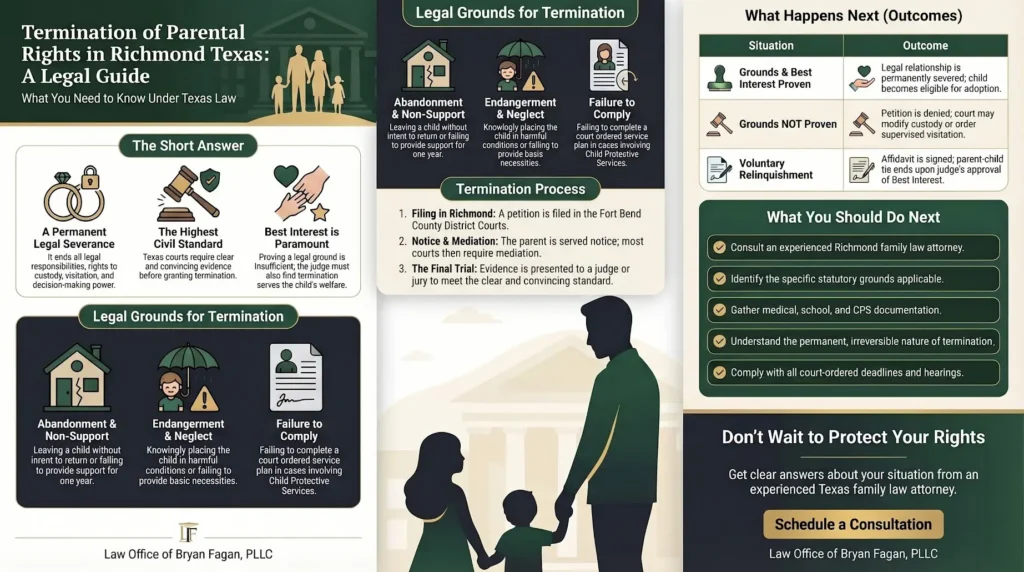
Termination of Parental Rights in Richmond Texas: The Short Answer
When a family law case is at risk of dismissal for inactivity, a Texas Motion to Retain becomes a critical tool to keep your case moving forward—especially in serious matters like Termination of Parental Rights in Richmond Texas. Termination is not just another filing; it is a permanent legal action that severs the parent-child relationship. Under Texas law, courts require clear and convincing evidence that termination is justified and that it serves the child’s best interest, as outlined in Texas Family Code §153.002 and Chapter 161.
In straightforward situations, such as uncontested cases or voluntary relinquishment under §161.103, the process may move efficiently once the petition is filed and proper documentation is submitted. However, even in these cases, failing to meet deadlines or allowing the case to sit inactive can lead to dismissal—making a Texas Motion to Retain essential to preserve your position and avoid starting over. In more complex cases—particularly those involving CPS under Chapter 262 or contested termination proceedings—courts closely evaluate diligence, case progression, and whether the parties are actively working toward resolution. Judges want to see consistent movement, credible evidence, and a clear plan that supports the child’s long-term stability.
Where disputes are contested or involve higher stakes—such as allegations of endangerment, noncompliance with service plans, or competing custody claims under §153.134—the legal strategy becomes significantly more important. Courts are not just reviewing paperwork; they are evaluating credibility, effort, and whether the case is being pursued with purpose. Delays, missed hearings, or incomplete filings can raise concerns about commitment and readiness, which may impact both the motion to retain and the underlying termination claim. For families navigating these challenges, understanding how procedural tools like a Texas Motion to Retain interact with substantive issues like Termination of Parental Rights in Richmond Texas is key to protecting both the case and the child’s future.
If your situation involves potential dismissal, contested litigation, or overlapping custody concerns, it may be time to take a more structured approach. You can learn more about how these issues connect to broader child custody in Texas and how courts prioritize stability and long-term outcomes. In cases where timing, evidence, and strategy all matter, having the right level of legal guidance can make the difference between moving forward with confidence—or losing valuable ground.

What Does Termination of Parental Rights Mean?
Termination of parental rights means the complete and permanent end of the legal relationship between a parent and child. This is not a temporary arrangement, a custody modification, or something that can be easily undone. When parental rights are terminated, the parent loses all legal rights, responsibilities, and privileges associated with being a parent toward the child.
Under the Texas Family Code, a parent whose rights have been terminated loses:
- Custody and possession of the child
- Visitation rights and access to the child
- Decision-making authority regarding education, healthcare, and religious upbringing
- Inheritance rights (unless the court orders otherwise). The child generally retains the right to inherit from the parent unless the court specifically orders otherwise.
- The legal right to be notified about the child’s welfare or whereabouts
The distinction between termination and custody modification is critical. When a court modifies conservatorship or possession, it changes who has authority over a child while preserving the parent-child relationship. Both parents remain legally connected to their child even if one has limited or supervised visitation. Termination, however, treats the legal bond as if it never existed.
For Richmond families, this permanence carries significant consequences. A father who has struggled with substance abuse but completed treatment cannot simply petition the court to restore his rights after termination. A mother who was incarcerated and lost her rights cannot automatically reconnect with her child upon release. The finality of termination is precisely why Texas law sets such high standards for when courts may order it.
Legal Grounds for Termination in Texas
In cases involving Termination of Parental Rights in Richmond Texas, understanding the legal grounds is only part of the equation—keeping your case active is just as critical. Under Texas Family Code §161.001, a court cannot terminate parental rights unless at least one statutory ground is proven by clear and convincing evidence, along with a separate finding that termination is in the child’s best interest under §153.002. These grounds include abandonment, endangerment, neglect, and failure to comply with court-ordered requirements, particularly in cases involving CPS under Chapters 262 and 263.
However, even when valid legal grounds exist, cases can stall or be dismissed if they are not actively pursued. This is where a Texas Motion to Retain becomes essential. Courts expect steady progress, timely filings, and clear effort from the parties involved. Judges are not just evaluating the legal merits—they are also assessing diligence, credibility, and whether the case is being handled with urgency. If a case sits inactive, the court may interpret that as a lack of commitment, which can create serious setbacks.
In straightforward situations, where termination is uncontested or tied to a stepparent adoption, meeting the evidentiary burden may be more predictable. But even then, missed deadlines or incomplete filings can put the case at risk. In more complex cases—especially those involving contested claims, CPS service plans, or disputes over child custody in Texas—the legal standard becomes harder to meet, and the need for a structured strategy increases. Courts will look closely at whether a parent has complied with required services, whether there is a pattern of instability, and whether termination truly supports long-term outcomes for the child.
Where disputes are contested or involve higher stakes, such as allegations of abuse or ongoing noncompliance, the margin for error narrows significantly. Evidence must be thorough, timelines must be respected, and the case must show consistent forward movement. You can explore how termination cases are handled in different regions by reviewing resources like San Antonio termination attorney services, which highlight how courts across Texas approach these serious matters. At this level, legal guidance is not just helpful—it often becomes critical to avoid dismissal, protect your position, and ensure the case is presented in a way that meets the court’s expectations.
Ultimately, whether your situation is procedural or deeply contested, the combination of strong legal grounds and consistent case progression is what moves a case forward. If delays are building or deadlines are approaching, taking action early can help protect both your case and your child’s future.
Table 1: Grounds for Termination of Parental Rights in Texas
| Ground | Description | Example |
|---|---|---|
| Abandonment | Parent voluntarily left child with another person without expressing intent to return, providing financial support, or maintaining contact for required statutory periods | A Richmond parent moves out of state, makes no child support payments, and has no contact with the child for over six months |
| Endangerment | Parent engaged in conduct or knowingly placed child in conditions endangering physical or emotional well-being | History of domestic violence in the home affecting the child’s safety; untreated substance abuse creating unsafe conditions |
| Neglect | Failure to provide necessary food, clothing, shelter, medical care, or supervision | Parent repeatedly fails to ensure child receives necessary medical treatment or adequate nutrition |
| Failure to Support | Parent failed to provide financial or emotional support for the child according to ability for one year | Non-custodial parent with steady employment makes no child support payments and provides no financial support for 12+ months |
| Criminal Conduct | Parent convicted of certain offenses or engaged in conduct resulting in criminal convictions affecting parenting | Parent convicted of offenses against children; incarceration for extended period preventing parenting |
| Failure to Complete Service Plan | Parent failed to comply with court-ordered service plan requirements in CPS cases | Parent in Richmond does not complete required parenting classes, drug rehabilitation, or counseling ordered by Fort Bend County court |
| Mental Illness | Parent has mental illness rendering them unable to meet child’s physical, emotional, and financial needs | Diagnosed mental health condition that remains untreated and significantly impairs parenting capacity through child’s minority |
Proving any single ground is not enough. The court must also find that termination—rather than a less drastic measure—serves the child’s best interest.

Voluntary vs Involuntary Termination
Understanding the difference between voluntary and involuntary termination is essential in cases involving Termination of Parental Rights in Richmond Texas, especially when case timing and progression directly impact whether your case stays active. Whether a case moves forward smoothly or risks dismissal often depends not just on the facts, but on consistent action. If progress slows or deadlines are missed, a Texas Motion to Retain may be necessary to demonstrate diligence and prevent the court from dismissing the case before it reaches resolution.
Voluntary Termination: Structured but Still Requires Precision
In straightforward situations, voluntary termination may appear more predictable. Texas Family Code §161.103 allows a parent to sign an affidavit of relinquishment, but the process is highly regulated. The affidavit must meet strict requirements, including proper timing, witnesses, and verification, and it must still be approved by the court based on the child’s best interest under §153.002. Courts are careful in these cases because termination permanently ends the legal relationship between parent and child.
Even when both parties agree, the case cannot simply sit idle. Courts expect documentation to be completed accurately and filed promptly. Delays in submitting affidavits or failing to move the case forward can create unnecessary risks, including placement on a dismissal docket. In these moments, a Texas Motion to Retain may be the key to keeping the case active and showing the court that the matter is still being pursued with purpose.
Involuntary Termination: Higher Stakes and Greater Scrutiny
In more complex cases, involuntary termination often involves contested facts, CPS involvement under Chapters 262 and 263, or allegations of endangerment, neglect, or noncompliance with court orders. Here, the court’s evaluation goes beyond legal grounds under §161.001—it also focuses on credibility, consistency, and whether each party is actively working toward resolution. Judges expect to see clear evidence, ongoing participation, and a pattern of conduct that supports the child’s long-term stability.
Where disputes are contested, the margin for error becomes much smaller. Missing hearings, failing to comply with service plans, or allowing the case to stall can significantly weaken your position. In these situations, filing a Texas Motion to Retain is not just procedural—it can be critical to demonstrate that your case is moving forward despite challenges. You can gain additional perspective on how these cases are handled across Texas by reviewing termination of parental rights guidance in Shenandoah.
Choosing the Right Approach for Your Situation
In straightforward situations, where termination is agreed upon and documentation is complete, basic legal guidance may be enough to keep the process on track. In more complex cases—especially those involving contested termination, custody disputes under §153.134, or CPS oversight—a more structured and strategic approach is often necessary. Where disputes are high-stakes, delays can quickly lead to dismissal risks, and recovering lost ground can be difficult.
Ultimately, whether voluntary or involuntary, cases involving Termination of Parental Rights in Richmond Texas require more than just understanding the law—they require consistent follow-through, careful preparation, and timely action. Recognizing when your case requires a higher level of strategy can help you protect both your position and your child’s future.
The “Best Interest of the Child” Standard
The child’s best interest is the most important factor in any termination of parental rights in Richmond, Texas. Under Texas Family Code §153.002, courts must prioritize what serves the child’s best interest and welfare above all other considerations. Even if a statutory ground for termination is clearly proven, the court cannot terminate parental rights unless it separately finds termination serves the child’s best interest.
Texas courts typically consider factors established in the landmark case Holley v. Adams, including:
- The child’s physical and emotional needs now and in the future
- The emotional and physical danger to the child
- The parenting abilities of the parties seeking custody
- Programs available to assist the parent
- Plans for the child by the individual seeking custody
- Stability of the home or proposed placement
- The parent’s ability to act in the child’s best interest
- Any history of child abuse or neglect
- The child’s own preferences (for older children capable of expressing them)
It is important to recognize that parents who voluntarily terminate their rights often experience significant guilt and grief, as they may feel they are abandoning their child, even if they believe it is in the child’s best interest. Additionally, children who experience the termination of parental rights may face long-term psychological effects, including feelings of abandonment, loss, and identity issues.
In Fort Bend County courts, judges carefully examine these factors through witness testimony, expert reports, and documentary evidence. A parent’s recent improvements may be considered, but courts focus on patterns of behavior and the likelihood of continued stability. The judge determines whether termination—rather than continued services, modified custody, or other arrangements—truly serves the child’s best interest and well-being.
The Legal Process in Fort Bend County
In cases involving Termination of Parental Rights in Richmond Texas, understanding the legal process is only part of what determines the outcome—maintaining steady case progression is just as critical. Courts in Fort Bend County follow structured procedures under Texas law, but they also expect consistent movement. When a case slows down or deadlines are missed, it can be placed on the dismissal docket. At that point, a Texas Motion to Retain may be necessary to show the court that your case is being actively pursued and should remain on track.
Filing the Petition and Avoiding Early Delays
The process begins with filing a petition in the appropriate district court, identifying statutory grounds under Texas Family Code §161.001 and requesting a best-interest finding under §153.002. In straightforward situations, such as uncontested filings, the case may move forward efficiently if documentation is complete and deadlines are met. However, even small delays at this stage—such as incomplete filings or missed service deadlines—can slow progress and increase the risk of dismissal. Courts expect early diligence, and a lack of movement may signal to the judge that the case is not being actively managed.
Notice, Service, and Credibility with the Court
Proper notice and service are essential in termination cases because constitutional rights are at stake. Courts require strict compliance with service rules, including addressing issues involving alleged or unknown fathers. Errors here can delay proceedings or weaken the credibility of the case. In more complex cases, especially those involving CPS under Chapters 262 and 263, judges also evaluate whether parents are engaging with service plans and making meaningful progress. This is not just a procedural step—it is a reflection of credibility, consistency, and commitment to the child’s well-being.
Hearings, Evidence, and Case Progression
As the case moves forward, the focus shifts to evidence and preparation. Texas law generally requires a waiting period before final hearings, allowing time for gathering documentation and completing required steps. During this time, courts expect continuous progress. Evidence may include CPS records, medical documentation, testimony from professionals, and proof of compliance with court orders. Where disputes are contested—such as disagreements over conservatorship under §153.134 or concerns about a child’s safety—the court will closely evaluate stability, patterns of behavior, and whether the case is being advanced with purpose. For additional context on how these issues connect to broader family law matters, you can explore child custody in Texas.
When a Texas Motion to Retain Becomes Critical
In more complex cases—particularly those involving contested termination, CPS oversight, or multiple hearings—timelines often extend. However, extended timelines do not excuse inactivity. Judges expect to see forward momentum at every stage. If the court perceives that a case has stalled, it may move toward dismissal. Filing a Texas Motion to Retain at the right time can demonstrate diligence, explain delays, and reinforce that the case is still being actively pursued. You can also gain insight into how termination cases are handled across Texas by reviewing termination of parental rights legal guidance in Austin, which highlights the importance of preparation and consistency.
Choosing the Right Level of Legal Strategy
In straightforward situations, where filings are uncontested and timelines are clear, basic legal guidance may be enough to keep the case moving. In more complex cases—especially those involving contested issues, CPS involvement, or long-term custody implications—a more structured and strategic approach becomes essential. Where disputes are high-stakes, delays can quickly become costly, and mistakes can be difficult to correct. Taking action early, maintaining consistent progress, and understanding when to elevate your legal approach can make the difference between keeping your case on track—or losing critical ground.

The Role of Child Protective Services
If you’re dealing with Child Protective Services in Texas, it’s important to understand their role when it comes to terminating parental rights. When CPS gets involved—whether it’s because of abuse allegations, neglect concerns, or abandonment issues—they’re there to investigate what’s really happening and figure out if your child needs protection. I know this can feel overwhelming and scary, but understanding the process can help you know what to expect. If CPS determines that a parent can’t provide safe, adequate care for their child, they may file a petition to terminate parental rights.
Here’s something that might give you some hope: CPS doesn’t jump straight to termination. In most cases, they’ll work with your family first, offering services and support to help address whatever brought them into your life in the first place. This could mean parenting classes, counseling sessions, or substance abuse treatment programs. They want to see families succeed and stay together when it’s safe for the child. However, if a parent doesn’t make meaningful progress or continues to put their child at risk, CPS may decide that the only way to protect that child is to seek termination of parental rights.
Throughout this entire process, there’s one principle that guides everything CPS does: your child’s best interest comes first, always. Their goal isn’t to tear families apart just because they can—it’s to make sure every child in Texas has a safe, stable, and loving home. When CPS decides to file for termination, they have to present solid evidence to the court showing why a parent is unfit and why termination is necessary to protect the child. The final decision rests with the judge, but CPS plays a central role in gathering the facts, advocating for your child’s safety, and recommending permanent solutions when they believe it’s necessary.
Child Support and Custody After Termination
I know this is an incredibly difficult situation you’re facing, and you probably have a lot of questions about what happens next. When a court decides to terminate parental rights, it’s essentially cutting all legal ties between a parent and their child permanently. Think of it like this – legally speaking, it’s as if that parent-child relationship never existed. This means all the legal obligations that come with being a parent – things like paying child support or having a say in custody – come to an end too. But there are some important details you need to understand about how this actually plays out in real life.
Let me explain what this means for child support, because I get this question a lot. Once parental rights are terminated, you’re no longer legally responsible for ongoing child support payments. However – and this is really important – any child support you owe from before the termination doesn’t just disappear. The state or the child’s guardian can still come after you for those past-due amounts, and they often will. It’s like having an old debt that doesn’t get erased just because your circumstances change. Now, if someone adopts your child after the termination, that new parent takes on all the financial responsibilities going forward. They become the one legally obligated to provide for the child’s needs.
As for custody and decision-making, this is where the permanence of termination really hits home. You lose all rights to make decisions about your child’s life – their medical care, education, where they live, how they’re raised. The court’s main concern becomes finding the most stable, loving environment for your child moving forward. That might mean custody goes to the other parent, a family member, or a prospective adoptive family – whoever the judge believes will best serve the child’s interests. I want you to understand that this decision is final and life-changing for both you and your child. It affects not just the immediate practical matters of support and care, but also your child’s sense of security and belonging as they grow up. That’s why it’s so crucial to fully grasp what you’re facing before any final decisions are made.
The Other Parent’s Rights and Responsibilities
If you’re dealing with one parent having their rights terminated, I know this feels overwhelming—but let me walk you through what this means for the other parent. Under Texas law, when one parent’s rights are terminated, the situation actually becomes clearer in many ways for the remaining parent. In most cases, you’ll be granted sole custody or conservatorship of your child. This means you become the person making all the important decisions about your child’s care, education, and well-being. It’s a big responsibility, but it also gives you the stability and control you may have been seeking.
Now, here’s something that worries a lot of parents going through this: what happens if the Texas court determines that the remaining parent—maybe you—also isn’t able to properly care for the child? I want you to understand that Texas courts don’t just give up on finding the right home for your child. The court will look beyond the biological parents to find who can truly provide a stable, loving environment. This might mean grandparents step in, other family members who have been involved in your child’s life, or even someone who isn’t related by blood but has built a meaningful relationship with your child over time.
Here’s what I want you to remember through all of this: Texas courts have one driving focus—what’s genuinely best for your child. The judge will carefully look at whether you or any other potential caregiver can meet your child’s needs, provide the stability they deserve, and keep them safe. If you do become the sole parent or guardian after the other parent’s rights are terminated, you’re taking on the full responsibility of raising your child. That’s significant, but it also means you get to be the person who guides their future without interference. The court wants to see your child thrive, and they’ll work to put them in the best possible situation to do exactly that.
Court Fees and Non-Custodial Parent Considerations
Facing a case involving Termination of Parental Rights in Richmond Texas can feel overwhelming—not just emotionally, but financially and procedurally as well. Court costs for filing, service, and hearings can add up quickly, especially if the case becomes contested or prolonged. While Texas courts may allow fee waivers in certain situations, those requests require proper documentation and timely action. Just as important, financial strain should never lead to inaction. When a case slows down or filings are delayed, it can increase the risk of dismissal—making a Texas Motion to Retain a critical step to keep your case active and moving forward.
Understanding Your Rights as a Non-Custodial Parent
If you are a non-custodial parent, your rights remain significant throughout the process. Texas law requires proper notice of all proceedings, and you have the right to present evidence, challenge claims, and participate fully in the case. Under Texas Family Code §153.002, the court’s focus remains on the child’s best interest, which includes evaluating your involvement, consistency, and ability to provide stability. In straightforward situations, where communication is clear and participation is consistent, protecting your rights may be more manageable. However, where disputes are contested—such as disagreements over conservatorship under §153.134 or concerns raised in CPS cases under Chapters 262 and 263—the court will look much more closely at credibility, effort, and follow-through.
Why Staying Proactive Matters in a Texas Motion to Retain
One of the most common mistakes in family law cases is waiting too long to act. Courts expect steady progress, and delays can raise concerns about whether the case is being taken seriously. If deadlines are missed or activity slows, the case may be placed on a dismissal docket. At that point, filing a Texas Motion to Retain becomes essential to demonstrate diligence and explain why the case should continue. Judges are not just reviewing legal arguments—they are evaluating whether each party is actively engaged and committed to resolving the matter in a way that supports long-term stability for the child.
Choosing the Right Level of Legal Support
In straightforward situations, such as uncontested matters or minor procedural issues, basic legal guidance may be enough to keep your case on track. In more complex cases—especially those involving contested termination, financial strain, or CPS involvement—a more structured and strategic approach is often necessary. Where disputes are high-stakes, even small mistakes can create setbacks that are difficult to correct. Taking early, informed action can help you avoid unnecessary delays and protect your position moving forward.
If you are navigating these challenges in the Richmond area, understanding the local landscape can also be helpful. You can explore what it means to live and resolve legal matters in this community by reviewing moving to Richmond, Texas. Whether your situation is procedural or deeply contested, the key is staying proactive, informed, and prepared—so you can protect both your case and your child’s future.

What Happens After Parental Rights Are Terminated
Once a Texas court enters a termination order, the consequences are immediate and comprehensive. The legal parent-child relationship is severed, and the parent loses all rights to make decisions for or contact the child. However, it is important to note that certain obligations, such as unpaid child support, may continue even after parental rights are terminated.
Additionally, reinstatement of parental rights is possible only under very limited and specific circumstances. This process is rare and complex, and courts will only consider reinstatement when it is clearly in the best interest of the child.
Table 2: What Happens After Parental Rights Are Terminated
| Area | Impact |
|---|---|
| Custody and Possession | Parent loses all legal custody and physical possession of the child |
| Visitation Rights | Parent has no legal right to visit or contact the child |
| Decision-Making | Parent cannot make decisions about child’s education, healthcare, or religious upbringing |
| Child Support Obligations | Generally end upon termination, though past-due amounts may still be owed |
| Inheritance | Child typically loses inheritance rights from terminated parent unless court orders otherwise |
| Adoption Eligibility | Child becomes eligible for adoption by another party |
| Legal Status | Parent is no longer legally recognized as the child’s parent for any purpose |
| Future Claims | Parent cannot later claim rights to custody, possession, or access |
The most common outcome following termination is adoption. When the court terminates parental rights, the child becomes legally available for adoption by a step parent, foster parent, relative, or other qualified individual. Many families pursue termination specifically to facilitate this process.
Child support obligations generally end because the parent’s rights terminated parent no longer has a legal relationship with the child. However, any unpaid child support that accrued before termination may still be collectible.
Common Challenges in Termination Cases
Termination cases in Fort Bend County present significant challenges for all parties involved. The process of termination of parental rights in Richmond, Texas is complicated and often requires experienced legal assistance to navigate the intricate legal procedures and potential risks.
In contested proceedings, the court closely examines the parent’s ability to care for and support the child. Factors such as unfitness, neglect, substance abuse, and overall parental competency are evaluated as part of the grounds for termination.
High Evidentiary Burden
The clear and convincing evidence standard creates a substantial burden for those seeking termination. Proving abandonment requires demonstrating specific statutory periods of no contact and no support. Proving endangerment requires showing ongoing patterns, not isolated incidents. Supporting evidence must be thorough and well-documented.
Contested Proceedings
When a parent contests termination, cases become more complex and prolonged. The parent has constitutional due process rights that must be respected. Courts must ensure reasonable efforts were made to reunify the family before terminating parental rights, particularly in CPS cases.
Emotional Consequences
The emotional well being of everyone involved—children, parents, and extended family—is profoundly affected. Children may experience trauma from separation regardless of the circumstances. Parents facing termination may struggle with grief, guilt, or anger. These emotional consequences extend well beyond the courtroom.
Appeals and Reversal
Once termination is ordered, reversals are exceptionally rare. A parent may appeal the decision, but appellate courts will only reverse if significant procedural errors occurred, the evidence was legally insufficient, or the best interest finding was clearly unsupported by the record. Successful appeals are uncommon.
Recent Texas appellate decisions have clarified certain procedural requirements. In February 2026, the Fourteenth Court of Appeals affirmed that a parent’s open-court judicial admission confirming understanding and voluntariness of a relinquishment affidavit can validate the document even when technical challenges arise regarding signatures or notarization.
How a Richmond Family Law Attorney Can Help
In cases involving Termination of Parental Rights in Richmond Texas, the legal process is not only complex—it is unforgiving when it comes to delays, missed steps, or lack of preparation. While understanding the law is important, knowing how to move a case forward strategically is just as critical, especially when facing potential dismissal and the need for a Texas Motion to Retain. Courts expect diligence, consistent progress, and a clear commitment to resolving the case in a way that protects the child’s best interest under Texas Family Code §153.002.
Evaluating Your Case and Avoiding Early Missteps
In straightforward situations, such as uncontested matters or voluntary relinquishments, identifying the correct legal grounds under Chapter 161 may be relatively clear. However, even in these cases, failing to act promptly or properly document your position can slow progress and increase dismissal risk. In more complex cases—particularly those involving CPS under Chapters 262 and 263 or disputes over conservatorship under §153.134—the court will closely evaluate credibility, patterns of behavior, and whether the case is being actively pursued. Judges are not just reviewing claims; they are assessing whether the evidence supports long-term stability for the child.
Building Evidence and Demonstrating Diligence
Strong cases are built on consistent, well-documented evidence. This may include medical records, professional evaluations, service plan compliance, and testimony showing a clear pattern over time. Where disputes are contested, the quality and organization of this evidence often determine how the court views the case. Just as importantly, the court expects to see ongoing effort. If a case stalls—whether due to incomplete documentation or lack of follow-through—it may be placed on a dismissal docket. At that point, filing a Texas Motion to Retain becomes essential to demonstrate diligence and keep the case alive.
Navigating Court Expectations and Local Procedures
Fort Bend County courts follow structured timelines, but they also expect flexibility when cases become more complex. In straightforward filings, meeting deadlines and submitting complete documentation may be enough to keep the process moving. In more involved cases—such as those with contested facts, multiple hearings, or CPS oversight—the need for a structured, litigation-aware approach increases. Courts will evaluate not only the legal arguments but also how the case is managed, including timeliness, preparation, and credibility. You can gain additional insight into how parental rights cases are approached across Texas by reviewing parental rights guidance in The Woodlands.
Choosing the Right Level of Legal Strategy
Not every case requires the same level of legal involvement. In straightforward situations, basic legal guidance may be enough to help you stay on track and avoid procedural mistakes. In more complex cases—especially those involving contested termination, custody disputes, or long-term implications for the child—a more strategic approach is often necessary. Where disputes are high-stakes, delays can quickly become costly, and missteps can be difficult to recover from. Understanding when your case requires more focused legal attention can help you protect both your position and your child’s future.
Ultimately, cases involving Termination of Parental Rights in Richmond Texas demand more than just legal knowledge—they require consistent action, careful preparation, and a clear strategy. Whether your situation is simple or complex, staying proactive and informed is the key to moving forward with confidence.

Checklist: Termination of Parental Rights in Richmond Texas
Use this checklist to organize your approach to a termination case:
- Evaluate legal grounds – Review Texas Family Code §161.001 to identify which statutory grounds may apply to your situation
- Gather documentation – Collect medical records, school records, CPS reports, and other evidence supporting your position
- Understand permanent consequences – Recognize that termination permanently ends the legal parent-child relationship
- Consider alternatives – Explore whether custody modification, supervised visitation, or other arrangements might address concerns without termination
- File in appropriate court – Ensure the petition is filed in the correct Fort Bend County district court with proper jurisdiction
- Check details – Double-check the spelling of URLs, court locations, and deadlines, or use search tools on court and legal websites to locate necessary resources
- Prepare for hearings – Organize evidence and identify witnesses who can testify about statutory grounds and best interest factors
- Follow all deadlines – Comply with court-ordered timelines for discovery, service plans, and hearing dates
- Seek legal guidance – Consult with a knowledgeable attorney to understand your rights and obligations
- Plan for outcomes – Consider what happens after termination, including adoption or alternative custody arrangements
- Document everything – Maintain records of all communications, service plan compliance, and relevant events
Conclusion
When you step back and look at the full picture, Termination of Parental Rights in Richmond Texas is not just a legal process—it’s a decision about stability, safety, and the kind of future you want your child to have. In straightforward situations, such as a stepparent adoption where everyone agrees, the path forward may feel clear and structured. In more complex cases—especially those involving CPS, allegations of endangerment, or contested rights—the legal and emotional stakes rise quickly, and the strategy behind your case becomes just as important as the facts themselves. If your case involves uncertainty, conflict, or long-term concerns about your child’s well-being, having the right level of legal guidance can make all the difference.
At The Law Office of Bryan Fagan, PLLC, our role is to help you make sense of those decisions with clarity and confidence. We don’t just handle cases—we help families understand their options, protect their children, and move forward with a plan that supports long-term stability. Whether you’re considering termination, defending against it, or exploring alternatives that better fit your situation, the next step is simply having the right conversation.
Frequently Asked Questions
Termination of parental rights is a legal process that permanently ends the legal relationship between a parent and child under the Texas Family Code. Once terminated, the parent loses all legal rights and responsibilities, including custody, visitation, and decision-making authority regarding the child’s welfare.
To terminate parental rights in Richmond, you must file a petition in Fort Bend County district court alleging specific statutory grounds under Texas Family Code §161.001. You must prove those grounds by clear and convincing evidence and demonstrate that termination serves the child’s best interest.
Yes, a parent may voluntarily terminate parental rights by signing a formal affidavit of relinquishment under Texas Family Code §161.103. However, this still requires court approval, must meet strict procedural requirements, and the court must find termination serves the child’s best interest.
Texas courts require clear and convincing evidence—a higher standard than typical civil cases—that produces a firm belief or conviction that at least one statutory ground exists and that termination serves the child’s best interest. Evidence may include medical records, witness testimony, CPS reports, and documentation of patterns of behavior.
Under Texas law, termination hearings cannot be held earlier than 180 days after the petition is filed. Contested cases often take longer due to evidence gathering and multiple hearings. Children exiting foster care via adoption in Texas spend a median of 25-26 months in the system before termination and adoption are completed.
Reversal of termination is exceptionally rare under Texas law. Appeals may succeed only if significant procedural errors occurred, evidence was legally insufficient, or the best interest finding was clearly unsupported by the record. Once a termination order is final, the legal parent-child relationship is permanently ended.
While not legally required in all cases, legal representation is strongly recommended given the complexity and permanence of termination proceedings. In cases brought by Child Protective Services, parents who cannot afford an attorney have the right to appointed counsel. An experienced family law attorney helps navigate Fort Bend County procedures and protects your rights.
Child support obligations generally end when parental rights are terminated because the legal parent-child relationship no longer exists. However, any unpaid child support that accrued before termination may still be owed and collectible through the Office of the Attorney General of Texas or court enforcement.