
Annulment in Richmond Texas: A Complete Legal Guide for Fort Bend County Residents

It started as something small—a quick courthouse wedding, a moment that felt right at the time. Maybe it was rushed, maybe there were things left unsaid, or maybe something didn’t come to light until after the vows were exchanged. Now, you’re sitting there wondering how everything unraveled so quickly and whether there’s a way to undo it. If you’re searching for answers about Annulment in Richmond Texas, you’re likely looking for clarity in a situation that feels confusing, emotional, and urgent.
Here’s the truth many people don’t realize right away: not every marriage can simply be erased, even if it was short-lived or built on shaky ground. Texas law is very specific about when a marriage can be declared invalid, and courts require clear proof under the standards outlined in Texas Family Code Chapter 6. That means understanding your rights—and your options—early on can make all the difference in how your case unfolds.
At the Law Office of Bryan Fagan, PLLC, we’ve guided families across Houston and Fort Bend County through moments just like this. Led by Bryan Joseph Fagan, a South Texas College of Law graduate and a recognized authority in Texas family law, our firm is grounded in one mission: helping people move forward with confidence, peace of mind, and a clear path ahead. We do that by combining practical legal knowledge with real-world understanding of what you’re going through—not just legally, but personally.
In the sections ahead, we’ll break down what qualifies for annulment, how the process works in Fort Bend County, and what you need to know before taking your next step. More importantly, you’ll gain the insight needed to make a decision that protects your future—because even when a chapter ends unexpectedly, the right guidance can help you start the next one with clarity and control.
Key Takeaways
Timing matters significantly—certain grounds have strict deadlines, and continuing to live with your spouse after discovering the issue may prevent annulment.
Annulment in Richmond Texas is a legal process that declares a marriage invalid, as if it never legally existed—unlike divorce, which ends a valid marriage.
Texas law requires specific legal grounds for annulment, such as fraud, underage marriage, mental incapacity, or intoxication at the time of the ceremony.
Not every marriage qualifies for annulment, even if it was short—the length of your marriage alone does not determine eligibility.
Children and property matters must still be resolved through the court, even when a marriage is annulled under Texas law.

Your Family’s Future Starts Here
Don’t navigate your legal journey alone. Schedule a consultation now and get the clarity and support you deserve.
Listen to Our Texas Family Law Podcast
Prefer listening? In this episode, we discuss annulment in Richmond, Texas, including when a marriage may be legally voided, the specific legal grounds required, and what individuals need to know before pursuing this option.
The Law Office of Bryan Fagan, PLLC can represent clients in a variety of family law matters, such as the following:
As a family law firm, we recognize that clients entrust us with a deeply personal aspect of their lives. Respecting this responsibility, our firm operates with professionalism, diligence, and efficiency, while maintaining open lines of communication with our clients. Not only do we provide access to their attorney, but also a dedicated client support team capable of addressing any inquiries regarding the case, status updates, billing concerns, or any other matters that arise throughout the process. Please don’t hesitate to discover how we can be of service to you.
Contact the Law Office of Bryan Fagan, PLLC at 281-245-1907 or online.
Annulment in Richmond Texas: The Short Answer
Annulment in Richmond Texas is a legal process that allows a court to declare a marriage invalid under Texas law, meaning it is treated as though it never legally existed. Unlike divorce—which ends a valid marriage—annulment focuses on whether the marriage should have been recognized in the first place. This distinction is grounded in Texas Family Code Chapter 6, Subchapter B (§6.101–§6.111), which outlines the specific circumstances under which a marriage may be annulled.
Texas law is very clear: not every difficult or short-lived marriage qualifies for annulment. Courts require proof that a legal defect existed at the time of the marriage—such as fraud, duress, mental incapacity, or another statutory ground—and that the person seeking annulment meets the legal requirements to pursue it. This means the burden of proof falls on the petitioner, and the standard is a preponderance of the evidence, making annulment more limited and often more complex than divorce.
For individuals and families considering their options in Fort Bend County, understanding whether annulment applies to your situation is a critical first step. Whether you are newly settled in the area or exploring helpful local insights through the Richmond, Texas community resource, having access to clear, reliable legal guidance can make all the difference. If you are unsure whether your circumstances meet the legal standard, reviewing practical insights from the firm’s Texas family law blog can provide additional clarity and direction as you evaluate your next steps.

What Is an Annulment Under Texas Law?
An annulment is a court order that declares a marriage legally invalid, as if it never occurred. Texas Family Code Chapter 6, Subchapter B defines the specific grounds under which a court may grant this remedy. When a judge grants an annulment, the legal effect is that both parties return to their unmarried status—not as divorced individuals, but as people who were never legally married.
This differs significantly from divorce in practical terms. Divorce ends a valid marriage and acknowledges that the marriage existed. Annulment legally nullifies the marriage, declaring it void or voidable from the start.
Annulments are far less common than divorces in Texas because the legal grounds are narrow and the burden of proof is substantial. You cannot obtain an annulment simply because you regret getting married, discovered you’re incompatible, or had a short marriage. The law requires evidence that something specific made the marriage invalid from the beginning.
Annulment vs Divorce: Understanding the Key Differences
Understanding whether annulment or divorce is appropriate for your situation requires knowing how these two legal proceedings differ fundamentally.
| Feature | Annulment | Divorce |
|---|---|---|
| Legal Effect | Declares marriage never existed | Ends a valid marriage |
| Grounds Required | Specific statutory grounds under Texas Family Code | No-fault or fault-based grounds |
| Marital Status After | Unmarried (never married) | Divorced |
| Property Division | May be handled differently; marriage treated as void | Community property divided under Texas law |
| Waiting Period | None required | 60-day waiting period |
| Availability | Only when specific grounds exist | Available to any married couple |
| Children | Custody and support still determined | Custody and support determined |
For Richmond residents considering their options, this distinction matters greatly. If you don’t have valid grounds for annulment, divorce may be your only path forward—and that’s not necessarily a negative outcome. Both processes can provide closure and resolution.
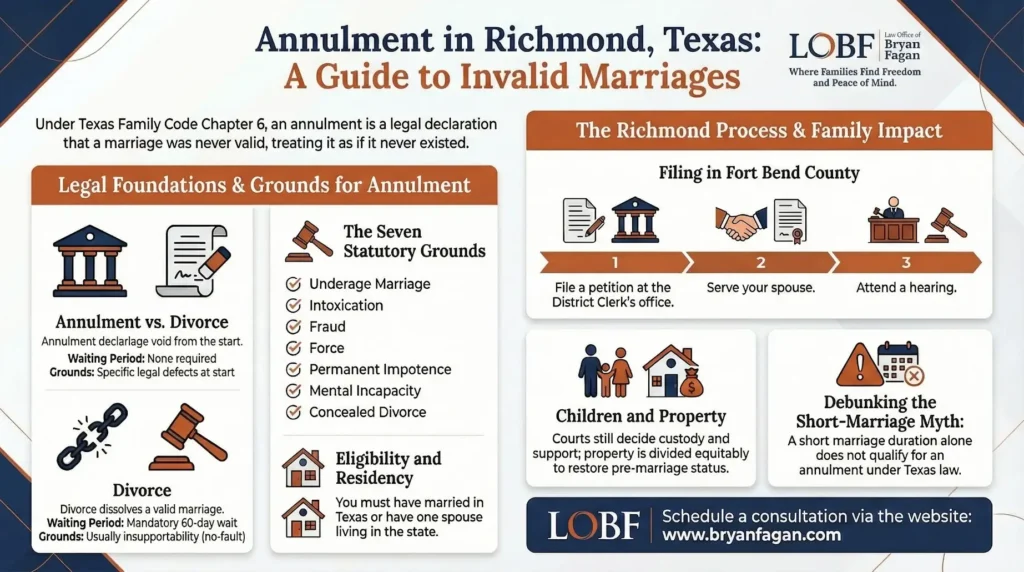
Legal Grounds for Annulment in Texas
Under Texas law, obtaining Annulment in Richmond Texas requires more than simply wanting to end a marriage—it requires proving that a specific legal ground existed at the time the marriage began. These grounds are outlined in Texas Family Code §§6.102–6.110, and each comes with its own legal standards, evidentiary requirements, and, in many cases, strict deadlines. Courts carefully evaluate these cases because annulment is not about ending a valid marriage, but determining whether the marriage should have been legally recognized in the first place.
One recognized ground is underage marriage under §6.102, which applies when a person between 16 and 17 years old marries without proper parental consent or a court order. In these cases, timing is critical—the petition must generally be filed within 90 days, and the right to seek annulment ends once the minor turns 18. Another ground, outlined in §6.105, involves intoxication due to alcohol or narcotics. If a person was impaired to the point of being unable to consent during the ceremony, annulment may be possible, but only if they did not continue living with their spouse after becoming sober.
Other grounds focus on conditions that affect the validity of consent. For example, impotence under §6.106 may justify annulment if one spouse was permanently unable to engage in sexual relations at the time of marriage and the other spouse was unaware. Similarly, fraud, duress, or force under §6.107 applies when one spouse was misled, pressured, or coerced into the marriage. This could involve significant misrepresentations about identity, finances, or life circumstances. However, if the affected spouse continues living with the other party after discovering the truth, the court may consider the marriage ratified and deny the annulment.
Mental incapacity, addressed in §6.108, applies when a person lacked the ability to understand the nature of the marriage ceremony due to a mental condition. To succeed on this ground, the petitioner must also show that they did not voluntarily cohabit with their spouse after regaining capacity. Another important provision is concealed divorce under §6.109, which allows annulment if one spouse’s prior divorce became final within 30 days before the marriage and the other spouse was unaware. This claim must typically be filed within one year.
Texas law also enforces procedural safeguards, such as the 72-hour waiting period between obtaining a marriage license and the ceremony under §2.204. If this requirement is violated without a valid exception, annulment may be available under §6.110, but only if the petition is filed within 30 days of the marriage. These deadlines are strictly applied, which is why early legal guidance is so important.
In situations involving coercion, threats, or physical harm, it’s also important to understand how family law intersects with broader legal protections. Individuals facing these challenges may find it helpful to review resources like the Richmond assault legal resource, which provides insight into related legal concerns that can impact family law cases.
For those navigating these complex issues, working with a knowledgeable legal team can provide clarity and direction. Additional guidance is available through trusted resources such as the firm’s Texas family law blog, where you can explore topics that help you better understand your rights and options. With the right information and support, you can take meaningful steps toward protecting your future and moving forward with confidence.
| Ground | Description | Example |
|---|---|---|
| Underage Marriage | Spouse was 16-17 without proper consent | 17-year-old marries without parental approval |
| Intoxication | Unable to consent due to alcohol or drugs | Heavily intoxicated during Las Vegas ceremony |
| Impotence | Permanent inability existing at marriage | Spouse concealed known medical condition |
| Fraud/Duress/Force | Deception or coercion to induce marriage | Lied about pregnancy to pressure marriage |
| Mental Incapacity | Couldn’t understand nature of marriage | Severe mental illness during ceremony |
| Concealed Divorce | Recent divorce hidden from spouse | Divorce finalized 20 days before wedding |
| 72-Hour Violation | Married too soon after license issued | Ceremony held day after obtaining license |
Who Qualifies for an Annulment in Richmond Texas?
To qualify for Annulment in Richmond Texas, you must meet specific legal requirements under Texas Family Code Chapter 6, Subchapter B (§6.101–§6.111) and present sufficient evidence to support your claim. Texas courts do not grant annulments simply because a marriage was short-lived or regretted. Instead, there must be a legally recognized issue—such as fraud, duress, mental incapacity, or another statutory ground—that existed at the time of the marriage. This is a key distinction that often surprises people, especially those navigating the legal system for the first time.
The type of evidence required will depend on the ground you are asserting. For example, medical records may be necessary to demonstrate mental incapacity under §6.108, while witness testimony can help establish intoxication or fraud under §6.105. Documents such as marriage licenses, prior divorce decrees, and communications between spouses can also play an important role in showing the timeline and circumstances surrounding the marriage. Working with an experienced Texas family law team ensures that your evidence is properly gathered, organized, and presented under the “preponderance of the evidence” standard required by the court.
Timing is equally critical. Certain grounds have strict statutory deadlines that cannot be extended. For instance, annulments based on a violation of the 72-hour waiting period under §6.109 must be filed within 30 days, while underage marriage claims under §6.102 are subject to a 90-day window. Claims involving a concealed divorce must typically be filed within one year. Missing these deadlines can permanently prevent you from seeking annulment, making early legal guidance especially important for families in Fort Bend County.
Another important factor—often overlooked—is how your actions after discovering the issue can affect your case. Texas courts may deny an annulment if you voluntarily continued to live with your spouse after learning of the problem, as this can be viewed as accepting or “ratifying” the marriage. This principle applies across multiple grounds and reflects the court’s focus on whether the marriage was truly invalid from the beginning. For individuals balancing legal decisions with everyday responsibilities, including commuting and logistics highlighted in the Richmond transportation guide, having a clear legal strategy can make the process far less overwhelming.
If you are unsure whether your situation qualifies, reviewing educational resources such as the firm’s Texas family law blog can provide helpful insight and direction. With the right information and guidance, you can move forward with clarity, confidence, and a plan that protects your future.

How the Annulment Process Works in Fort Bend County
The annulment process in Fort Bend County follows a structured legal path through the district court system. Understanding each step helps you prepare for what lies ahead.
Filing the Petition: The process begins when you file an annulment petition with the Fort Bend County District Clerk’s office. Your petition must state the legal grounds, relevant facts, and the relief you’re seeking. The filing fee is approximately $300-350, depending on whether children are involved.
Service of Process: After filing, your spouse must be officially served with the petition. In Fort Bend County, service by Sheriff or Constable costs approximately $80. This legal requirement ensures your spouse has proper notice of the legal proceedings.
Response Period: Your spouse has a specific timeframe to respond. If they contest the annulment, the case proceeds to contested hearings. If they don’t respond, you may be able to obtain a default annulment.
Court Hearing: You’ll need to present evidence supporting your grounds for annulment. This may include testimony from witnesses, medical records, documents proving fraud, or other specific evidence relevant to your claim. The judge evaluates whether you’ve proven your grounds and whether any conduct after discovery bars the annulment.
Judge’s Decision: The judge determines whether your marriage should be annulled. If children are involved, the court will also address custody, visitation, and child support at this stage, applying the best interest standard under Texas Family Code §153.002.
Residency requirements for annulment in Texas require that the parties married in Texas or that at least one spouse is domiciled in the state. For Richmond residents, Fort Bend County district courts have proper venue when you meet these requirements.
What Happens to Property and Children in an Annulment?
Even though annulment declares a marriage void, practical matters like property and children don’t simply disappear. The court must still address these issues.
Property Division: Unlike divorce, which divides community property under established Texas law, annulment treats the marriage as though it never existed. This can complicate property matters. Courts may still need to address property acquired during the time the parties lived together, though the legal framework differs from divorce proceedings.
Child Custody and Support: Children born during a marriage that’s later annulled still have two parents with legal obligations. The court determines custody (called conservatorship in Texas) using the best interest of the child standard under Texas Family Code §153.002. The parent child relationship survives the annulment.
Child Support: Parental rights and obligations continue regardless of whether the marriage is declared void. The noncustodial parent will typically be ordered to pay child support following Texas guidelines. Annulment does not eliminate these family law matters.
Spousal Support: Because annulment treats the marriage as never having existed, spousal maintenance may be handled differently than in divorce cases. This is one reason divorce may be the better option for some situations.
How Long Does an Annulment Take in Richmond Texas?
The timeline for annulment in Fort Bend County depends on several factors, but realistic expectations help you plan appropriately.
An uncontested annulment—where your spouse doesn’t fight the petition—can potentially be resolved within several weeks to a few months, depending on court scheduling. There’s no 60-day waiting period for annulment as there is for divorce in Texas.
However, contested annulments take longer. When your spouse disputes the grounds or other issues, the process includes hearings, evidence presentation, and potentially multiple court dates. Contested cases can take several months or longer.
Factors that affect timeline include:
- Whether children are involved (requiring custody and support determinations)
- Court backlog in Fort Bend County district courts
- Complexity of evidence needed to prove grounds
- Whether your spouse contests the annulment
- Completeness of your initial filings
Common Myths About Annulment in Texas
When it comes to Annulment in Richmond Texas, misunderstandings are incredibly common—and they can lead people down the wrong legal path. Texas law is very specific about when a marriage can be declared invalid, and relying on myths instead of accurate legal guidance can create unnecessary stress and delay. By looking closely at what the Texas Family Code actually says, families can make more informed decisions that protect their future.
One of the most persistent myths is that a short marriage automatically qualifies for annulment. In reality, the length of the marriage is irrelevant under Texas Family Code Chapter 6, Subchapter B (§6.101–§6.111). What matters is whether a valid legal ground existed at the time of the marriage, such as fraud, duress, mental incapacity, or another statutory basis. A marriage that lasted only a few days may not qualify, while a longer marriage could still meet the legal requirements if the proper grounds are present.
Another common misconception is that annulment is always faster than divorce. While it’s true that annulment does not require the 60-day waiting period found in divorce cases under §6.702, the reality is that annulments can become complex and time-consuming—especially when contested. Courts require proof under a preponderance of the evidence standard, and gathering that evidence can take time. In some cases, annulment proceedings may last just as long as, or even longer than, a traditional divorce.
It’s also important to understand that you cannot obtain an annulment simply because you regret getting married or feel incompatible with your spouse. Texas law does not recognize general dissatisfaction as a valid ground. The court must find that a specific legal defect existed when the marriage was entered into. For those seeking a deeper understanding of how annulment laws apply locally, resources like the Fort Bend County annulment guide can provide helpful, location-specific insight.
Finally, many people believe that annulment completely erases all aspects of the marriage. While it does void the legal status of the relationship, it does not eliminate real-world responsibilities. Courts still address issues involving children, including conservatorship and support under Texas Family Code §153.002, as well as certain property and financial matters. This is why having knowledgeable legal guidance is so important—because even when a marriage is declared invalid, your future still requires careful planning and protection.
If you’re trying to separate fact from fiction, exploring trusted educational resources like the firm’s Texas family law blog can help you move forward with clarity. With the right information and support, you can make confident decisions that align with your goals and provide stability for your family.

When Divorce May Be the Better Legal Option
Sometimes divorce is simply the more appropriate path forward. Understanding when this is true helps you make informed decisions.
When annulment grounds don’t exist: If nothing about your marriage meets the specific requirements under Texas Family Code Chapter 6, divorce is your only option. This isn’t a failure—it’s simply recognizing the legal reality.
When property division is complex: Divorce provides clearer frameworks for dividing community property and debts. For longer marriages with significant assets, divorce may offer more predictable outcomes.
When spousal maintenance is important: Annulment may limit access to spousal support that would otherwise be available in divorce. If you need ongoing financial support, divorce may better serve your interests.
When evidence for annulment is weak: If you can’t prove your grounds with sufficient evidence, pursuing annulment may waste time and resources. A family law attorney can help evaluate your evidence before deciding which path to pursue.
How a Richmond Family Law Attorney Can Help
Navigating Annulment in Richmond Texas requires more than just understanding the legal grounds—it involves managing detailed procedures, strict deadlines, and the realities of Fort Bend County courts. Texas Family Code §§6.101–6.111 set out the framework for annulments, but applying those laws to your unique situation takes careful legal analysis and strategic planning. Having experienced guidance can make the difference between moving forward with clarity or facing unnecessary delays and setbacks.
One of the first steps is determining whether your situation actually qualifies under Texas law. An experienced Texas family law attorney will evaluate your circumstances against the statutory grounds—such as fraud, duress, or mental incapacity—and help you understand whether annulment is truly available or if another legal path, like divorce, may be more appropriate. This kind of honest, informed assessment helps families avoid pursuing remedies that courts are unlikely to grant.
Equally important is gathering the right evidence. Annulment cases often hinge on documentation and testimony, whether that includes medical records under §6.108, proof of intoxication under §6.105, or communications that demonstrate fraud under §6.107. A knowledgeable legal team ensures that evidence is not only collected but presented in a way that meets the “preponderance of the evidence” standard required by Texas courts. For additional insight into how evidence and legal strategy come together in family law cases, resources like the firm’s Texas family law blog can provide helpful guidance.
Deadlines are another critical factor. Certain annulment grounds carry strict filing windows—such as the 30-day limit for violations of the marriage license waiting period under §6.110 or the 90-day timeframe for underage marriage claims under §6.102. Missing these deadlines can permanently prevent you from pursuing annulment, which is why timely legal advice is so important.
Local knowledge also plays a key role in navigating Fort Bend County courts. Understanding filing requirements, court procedures, and judicial expectations helps cases move more efficiently and reduces the risk of procedural errors. For those preparing to meet with an attorney or begin the process, reviewing practical details through the Richmond office visit guide can make the experience more comfortable and organized.
Finally, even though annulment treats a marriage as legally invalid, real-life issues like children and property still need to be addressed. Courts will apply the best interest of the child standard under Texas Family Code §153.002 when determining conservatorship and support, ensuring that children remain protected throughout the process. With the right legal support, families can navigate these complexities with confidence, knowing they are making informed decisions that protect both their rights and their future.
Checklist: Annulment in Richmond Texas
Use this actionable checklist to organize your approach:
- [ ] Determine if legal grounds apply to your specific circumstances under Texas Family Code Chapter 6
- [ ] Review your marriage timeline to identify any deadline issues for your particular grounds
- [ ] Assess whether you’ve continued cohabiting after discovering the issue—this matters greatly
- [ ] Gather supporting evidence including medical records, witness statements, or relevant documents
- [ ] Identify potential witnesses who can support your claims if needed
- [ ] Calculate approximate costs including filing fees ($300-350) and service fees ($80)
- [ ] Consider whether divorce is more appropriate based on your evidence and circumstances
- [ ] Consult with an experienced Richmond attorney before filing to evaluate your options
- [ ] File your petition correctly in Fort Bend County District Court with all required documents
- [ ] Prepare for your court hearing with organized evidence and clear presentation
Conclusion
Sometimes the hardest part isn’t understanding the law—it’s figuring out what to do next. Whether you’re considering annulment or facing the possibility of divorce, the decisions you make now have a real impact on your child’s sense of stability, confidence, and success—both at home and in the classroom. The good news is that with the right guidance and a thoughtful plan, it is absolutely possible to protect your child’s well-being while moving forward with your own life.
This is where having an experienced Texas family law attorney matters. At the Law Office of Bryan Fagan, PLLC, we don’t just look at your case on paper—we look at your family, your goals, and the future you’re trying to build. Our team works to create solutions that reduce disruption, support your child’s growth, and give you a clearer path ahead. Because when parents feel confident and supported, children tend to feel it too.
If you’re unsure whether annulment is the right option or how your situation could affect your child, it may be time to have a conversation. A simple consultation can bring clarity, answer your questions, and help you move forward with confidence instead of guesswork.
And if you’re feeling overwhelmed right now, that’s okay. Most parents do at this stage. Just remember—this moment doesn’t define your family’s future. The steps you take next do.
Frequently Asked Questions
To qualify for an annulment in Texas, you must have a legally recognized reason under the Texas Family Code. Common grounds include fraud, duress, force, intoxication at the time of the ceremony, mental incapacity, underage marriage without proper consent, impotence, a concealed recent divorce, or a marriage that took place too soon after the license was issued. A short marriage by itself does not qualify.
Two common grounds for annulment in Texas are fraud and intoxication. Fraud may apply when one spouse was misled into the marriage by a serious lie or concealment. Intoxication may apply when a person was so impaired by alcohol or drugs during the ceremony that they could not truly consent.
The timeline depends on whether the case is contested and how busy the court is. An uncontested annulment may take a few weeks to a few months. A contested annulment can take several months or longer. Unlike divorce, annulment does not have a mandatory 60-day waiting period, but the person asking for the annulment still has to prove valid legal grounds.
Usually not. In most cases, Texas law requires your spouse to be formally served with notice of the annulment case. They have a right to know about the proceeding and an opportunity to respond. Even if they never answer, the court still requires proof before granting the annulment.
The cost usually includes filing fees, service fees, and attorney’s fees if you hire legal counsel. Court costs are often a few hundred dollars, but the total can be higher if the case is contested or involves children, property, or multiple hearings. The exact amount depends on the complexity of the case.
Annulments are often denied because the person filing cannot prove one of the legal grounds required by Texas law. They may also be denied if the person continued living with the spouse after learning about the issue, missed a legal deadline, or simply does not have enough evidence. Annulment is more limited than divorce, which is why courts do not grant it automatically.
Some people want an annulment because it declares the marriage invalid from the beginning rather than ending a valid marriage. For some, that matters emotionally, legally, or religiously. Others pursue annulment because their situation involves fraud, incapacity, or another issue that makes annulment a better legal fit than divorce.
There is no simple statewide number that shows exactly how many annulments are denied in Texas. What is clear is that annulments are less common and generally harder to obtain than divorces because they require specific legal grounds and supporting proof. Many requests are denied because the facts do not meet the statute or the evidence is too weak.
Cheating alone is generally not a ground for annulment in Texas. Adultery may matter in a divorce case, but annulment requires one of the specific grounds listed in the law. In some situations, cheating may overlap with fraud if a spouse lied about something important before the marriage, but infidelity by itself usually does not qualify.