
Let Our Experienced Family Law Attorneys Help

Have you noticed your child struggling to focus in school lately—missing assignments, acting differently, or just not seeming like themselves? Common Law Divorce in Richmond Texas isn’t just about untangling legal rights between two adults—it can quietly reshape a child’s daily life, especially in the classroom where structure and stability matter most.
When a relationship ends, children often feel it first through changes in routine, emotional stress, and uncertainty about where they belong. Texas courts recognize this reality. Under Texas Family Code §153.002, the guiding principle in any custody case is the best interest of the child—and that includes their academic performance, consistency, and overall well-being. Judges aren’t just looking at who gets custody; they’re evaluating which parent can provide the most stable environment for a child to learn, grow, and succeed.
At The Law Office of Bryan Fagan, PLLC, we’ve guided countless families across Fort Bend County through situations where they didn’t even realize they were legally married under Texas law until everything began to unravel. What starts as confusion quickly becomes a series of critical decisions—about custody, school routines, and how to protect a child’s future during a time of change. That’s where experience and clarity make all the difference.
Led by Bryan Joseph Fagan, a South Texas College of Law graduate and a recognized authority in Texas divorce and custody law, our firm is built on a mission to empower families with knowledge and direction. We believe that when parents understand both the legal process and the real-life impact on their children, they can make better decisions—ones that restore stability instead of adding to the chaos.
In this article, you’ll learn how Texas courts evaluate educational stability, how common law divorce can complicate custody decisions, and what practical steps you can take to support your child academically and emotionally. Because when you have the right guidance, you’re not just navigating a legal process—you’re protecting what matters most.
Let’s walk through what this means for your family.
Key Takeaways
- Common law marriage is legally recognized in Texas, even without a wedding or marriage license
- You must get a formal divorce to end a common law marriage—simply separating is not enough
- Three elements define common law marriage: mutual agreement, cohabitation in Texas, and holding out as married
- Fort Bend County courts treat common law divorce the same as traditional divorce
- Property division, child custody, and child support laws apply fully under the Texas Family Code
- Failing to act within two years of separation can weaken your property rights and legal protections
- Proving (or disputing) the marriage is often the most critical part of the case

Your Family’s Future Starts Here
Don’t navigate your legal journey alone. Schedule a consultation now and get the clarity and support you deserve.
Listen to Our Texas Family Law Podcast
Prefer listening? In this episode, we discuss common law divorce in Richmond, Texas, including how informal marriage is recognized, what legal issues may arise, and what you need to know when ending the relationship.
As a family law firm, we recognize that clients entrust us with a deeply personal aspect of their lives. Respecting this responsibility, our firm operates with professionalism, diligence, and efficiency, while maintaining open lines of communication with our clients. Not only do we provide access to their attorney, but also a dedicated client support team capable of addressing any inquiries regarding the case, status updates, billing concerns, or any other matters that arise throughout the process. Please don’t hesitate to discover how we can be of service to you.
Contact the Law Office of Bryan Fagan, PLLC at 281-245-1907 or online.
Common Law Divorce in Richmond Texas: The Short Answer
Common Law Divorce in Richmond Texas is the legal process of ending a valid informal marriage recognized under Texas law. Even if you never had a wedding or obtained a marriage license, Texas courts—including those in Fort Bend County—treat informal marriages the same as traditional ones once the legal requirements are met.
That means you cannot simply separate and move on. If a common law marriage exists, you must file for divorce to divide community property, resolve financial obligations, and address issues involving your children. This includes establishing custody and support under the same legal framework applied to any married couple.
For families living in or transitioning to the Richmond area, understanding the local legal landscape is just as important as understanding the law itself. If you’re navigating a separation while settling into a new community, resources like this guide on moving to Richmond, Texas can help you better understand how your environment and local court system may influence your case.
When children are involved, Texas courts focus on one guiding principle: the best interest of the child under Texas Family Code §153.002. Judges look closely at stability—where the child lives, attends school, and receives emotional support. Custody arrangements, including joint managing conservatorship under §153.134, are structured to promote consistency and meaningful involvement from both parents whenever possible.
In reality, a Common Law Divorce in Richmond Texas follows the same path as any other divorce. Property must be identified and divided, parenting plans must be established, and financial responsibilities must be clearly defined. The only added layer is that one or both parties may need to prove the marriage existed, which can shape the entire direction of the case.
This is where experienced legal guidance becomes essential. Whether your situation involves agreement or conflict, working with attorneys who regularly handle divorce cases in Texas and child custody matters in Texas helps ensure your rights are protected and your child’s stability remains the priority.
If you’re unsure whether your relationship qualifies as a legal marriage—or what steps to take next—getting clear answers early can make a significant difference. With the right guidance, you can move forward with confidence, knowing you are making decisions that protect both your future and your family.

Quick Self-Check: Do You Have a Common Law Marriage?
Answer “yes” or “no”:
- Did you and your partner agree you were married?
- Did you live together in Texas as spouses?
- Did you introduce each other as husband or wife?
- Did you file tax returns together or share finances?
- Did others believe you were married?
👉 If you answered yes to at least two or three of these, you may already have a legally recognized marriage under Texas law.
What Is a Common Law Marriage in Texas?
Texas law allows couples to be considered married without a formal ceremony if certain legal requirements are met.
Under Texas Family Code §2.401, a common law (informal) marriage exists if:
- You agreed to be married — This means a present, mutual understanding that you are husband and wife, not just a plan to marry someday.
- You lived together as spouses in Texas — Cohabitation must occur within the state. There is no minimum time requirement.
- You represented to others that you were married — This is often called “holding out.” It includes introducing each other as spouses, filing joint documents, or presenting yourselves publicly as a married couple.
Plain English Example (Richmond Scenario)
- You move in together in Richmond
- You tell friends and family you’re married
- You share finances and act as a married couple
👉 You may have created a legal marriage without realizing it
Important Distinction
- Living together ≠ marriage
- Living together + holding out as married = potential legal marriage
Texas courts will look at the totality of the circumstances. A single piece of evidence rarely proves a common law marriage, but a consistent pattern of behavior—combined with documentation—often does.
Requirements for Common Law Marriage in Texas
| Requirement | What It Means | Example |
|---|---|---|
| Agreement to be married | Both parties intend to be married | Referring to each other as spouses in conversations |
| Living together | Cohabitation in Texas | Sharing a home in Richmond |
| Holding out | Public representation as married | Introducing partner as husband/wife, filing joint tax returns |
All three elements must be present simultaneously. If any element is missing, Texas courts may determine that no valid informal marriage existed.

How Do You Prove a Common Law Marriage Exists?
In a Common Law Divorce in Richmond Texas, one of the most important—and often most contested—issues is whether a valid marriage existed in the first place. Unlike traditional marriages, there is no certificate or ceremony to point to. Instead, Texas courts look at the full picture of your relationship, evaluating both your actions and your documentation to determine whether all legal elements were met.
Under Texas Family Code §2.401, you must show three things: an agreement to be married, cohabitation in Texas, and that you represented to others that you were married. This is not about a single piece of evidence—it’s about consistency. Courts want to see a pattern of behavior that reflects a genuine marital relationship.
Strong evidence often includes shared financial and legal responsibilities, such as joint bank accounts, leases or mortgages in both names, insurance policies listing a spouse as a beneficiary, and tax returns filed jointly. Communications can also matter more than people expect. Text messages, emails, or even cards referencing each other as husband or wife can help establish intent. Property records and loan documents signed as spouses further strengthen the case by showing how you presented your relationship in formal settings.
Equally important is witness testimony. Friends, family members, coworkers, and others who observed your relationship can provide valuable insight into how you held yourselves out publicly. Courts often consider whether people in your life believed you were married based on how you introduced each other and interacted as a couple.
For some couples, a formal step was taken through a Declaration of Informal Marriage under Texas Family Code §2.402. This document, filed with the county clerk, removes much of the uncertainty by creating an official record of the marriage. However, many couples never complete this step, which is why proving the marriage becomes a central issue in many cases involving Common Law Divorce in Richmond Texas.
What makes this even more complex is how real life intersects with legal standards. For example, where you lived, how you commuted, and how your household functioned day-to-day can all become part of the story presented to the court. Practical considerations—like those discussed in this guide on transportation in Richmond, Texas—can help illustrate how intertwined your lives were, especially when establishing cohabitation and shared routines.
When children are involved, proving the marriage can directly impact custody and support decisions. Texas courts will still apply the best interest standard under §153.002 and may structure conservatorship under §153.134, but the foundation of those decisions often depends on whether the relationship is legally recognized as a marriage.
This is where experienced legal guidance becomes critical. Some cases are straightforward, with clear documentation and agreement between both parties. Others involve disputes, conflicting evidence, or one party denying the marriage entirely. Our team regularly works with families facing both scenarios, helping gather evidence, organize timelines, and present a clear, compelling case to the court.
If you are unsure whether your relationship meets the legal standard—or if you anticipate a dispute—this is often the point where working with attorneys experienced in divorce law in Texas can make a meaningful difference. The way your case is built from the beginning can shape everything that follows, from property division to parenting arrangements.
Understanding what counts as proof is more than a legal exercise—it’s about protecting your rights, your children, and your future.

💡 Strategic Insight: Where Cases Are Won or Lost
This isn’t just about evidence—it’s about how the story is presented.
Strong cases feature:
- Consistent documentation over time
- Clear timeline of the relationship
- Multiple corroborating witnesses
- Unified narrative from both parties involved
Weak cases often have:
- Conflicting statements from one spouse
- Minimal documentation
- One-sided claims without corroboration
- Gaps in the timeline
If your spouse denies the common law marriage existed, you’ll need a skilled attorney to present compelling evidence to the court. This is where thoughtful legal guidance makes all the difference.
What Is a Common Law Divorce?
A formal divorce is required to end a common law marriage.
Even if you:
- Move out
- Stop speaking
- End the relationship
👉 You are still legally married until a court says otherwise.
Property and parental rights in a common law divorce are handled the same as in a traditional divorce. Texas courts apply the same legal standards, the same property division rules, and the same child custody considerations.
In Richmond / Fort Bend County:
- Divorce is filed in Fort Bend County District Courts
- The same residency requirements apply (six months in Texas, 90 days in the county)
- The 60-day waiting period applies before a final decree can be entered
What Happens If You Don’t File for Divorce?
In a Common Law Divorce in Richmond Texas, one of the most misunderstood—and potentially damaging—issues is timing. Many people assume that if they separate, the legal side of the relationship simply fades away. Unfortunately, Texas law does not work that way.
Under Texas Family Code §2.401(b), if you separate and do not take legal action within two years to establish that a common law marriage existed, the court may presume that no marriage ever existed at all. While this presumption can be challenged, it shifts the burden of proof significantly and can make your case much harder to win.
What does that mean in real life? It means waiting too long can affect far more than paperwork. It can impact your ability to claim community property, request spousal maintenance, and protect your financial future. In many cases, it also weakens your position when negotiating custody or parenting arrangements under Texas Family Code §153.002 and §153.134, where stability and credibility matter.
For families dealing with additional stress—such as high-conflict situations or allegations that may overlap with concerns like those discussed in Richmond assault cases and family-related disputes—acting quickly becomes even more important. These dynamics can influence how courts view safety, parenting ability, and the overall best interest of the child.
The reality is simple: the longer you wait, the more complicated your case can become. You may lose access to assets, face greater challenges proving your marriage, and find yourself reacting instead of planning.
Where Do You File for Divorce in Richmond, Texas?
If you are moving forward with a Common Law Divorce in Richmond Texas, your case will be filed in the Fort Bend County District Courts. The process begins with filing an Original Petition for Divorce through the District Clerk’s office, and all filings must be submitted electronically through the Texas eFile system.
While the filing process itself may seem straightforward, local court procedures and timelines can vary. Fort Bend County courts operate under updated scheduling rules, and while some cases move efficiently, others—especially those involving disputes over the existence of a marriage or contested custody—can take significantly longer.
This is where having the right legal strategy matters. Some cases require a more straightforward approach focused on documentation and agreement, while others demand a more proactive litigation strategy to protect your rights from the outset. Our team regularly works with families navigating both scenarios, helping them understand not just where to file, but how to position their case effectively from day one.
If you are unsure whether you are still within the two-year window or how to protect your rights moving forward, it may be time to speak with attorneys experienced in divorce proceedings in Texas and child custody matters in Texas. Early guidance can help you avoid costly mistakes and create a path that prioritizes both your financial stability and your child’s well-being.
Taking action now doesn’t just protect your case—it gives you the clarity and control needed to move forward with confidence.

Step-by-Step Common Law Divorce Process
- Initial consultation and case evaluation — Meet with an experienced lawyer to assess your situation and gather relevant documents.
- File Original Petition for Divorce — The party files the petition in Fort Bend County, initiating legal proceedings.
- Establish marriage (if disputed) — If one spouse denies the marriage existed, you’ll need to prove all three elements.
- Temporary orders — Courts may issue orders for child custody, child support, spousal maintenance, and property use during the divorce process.
- Discovery and financial disclosures — Both parties exchange financial information, including marital assets, debts acquired during the relationship, and business interests.
- Negotiation or mediation — Many cases settle through mutual agreement without trial. Mediation helps parties find common ground.
- Trial (if necessary) — If no agreement is reached, a judge decides contested issues.
- Final decree entered — The court issues a final divorce decree, officially ending the marriage.
Timeline: How Long Does It Take?
| Stage | What Happens | Typical Timeline |
|---|---|---|
| Filing | Petition submitted | Day 1 |
| Waiting period | Mandatory under Texas law | 60 days minimum |
| Discovery & negotiation | Exchange info, attempt resolution | 1–6 months |
| Trial (if needed) | Court decision | 6–12+ months |
Factors That Affect Timing:
- Whether the marriage itself is disputed
- Property complexity and business interests
- Presence of children requiring custody schedules
- Court availability in Fort Bend County
- Whether the case is contested or an agreed divorce
An uncontested divorce with clear documentation may conclude in 2–4 months. A contested divorce involving property disputes, child custody arrangements, or a disputed marriage can take 12 months or longer.
Property Division in a Common Law Divorce
The Short Answer:
Texas applies community property rules under Texas Family Code §7.001.
Key Principle:
Property is divided in a “just and right” manner—not always 50/50. Courts consider factors including:
- Each spouse’s earning capacity
- Financial circumstances of both you and your spouse
- Fault in the breakup (if applicable)
- The well being of any children
What Qualifies as Community Property?
- Assets acquired during the marriage (including informal marriage)
- Income earned during the relationship
- Debts acquired together
What Is Separate Property?
- Assets owned before the marriage began
- Gifts or inheritances received by one spouse
- Property clearly traceable to pre-marriage ownership
Common Disputes in Informal Marriages:
One of the biggest legal challenges in common law divorce is determining when the marriage began. Since there’s no marriage license or ceremony date, pinpointing when property became “marital” can be contested. This is where property records, financial documentation, and experienced attorneys become essential.
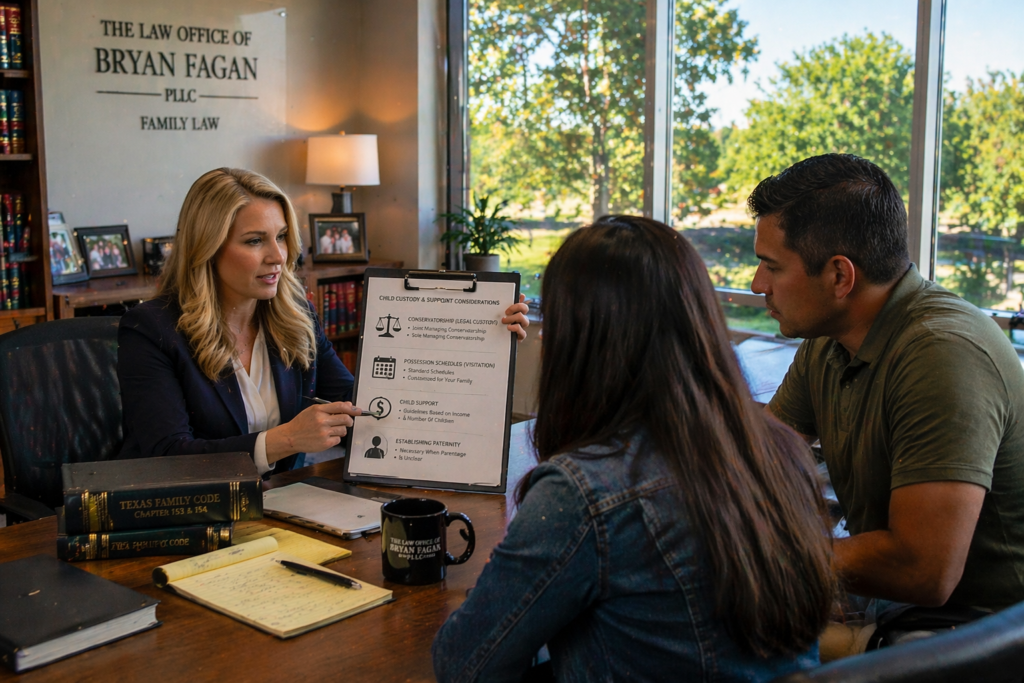
Child Custody and Support Considerations
In a Common Law Divorce in Richmond Texas, child-related issues are often the most important—and the most emotional—part of the case. While questions about property and finances matter, nothing carries more weight than ensuring your child is safe, supported, and positioned to thrive.
Texas law is clear on this point. Under Texas Family Code §153.002, the court’s primary focus is always the best interest of the child. This standard guides every decision, from where a child lives to how parents share responsibilities. Judges are not simply dividing time—they are evaluating which structure provides the most stability, consistency, and support for the child’s overall well-being, including their academic and emotional development.
When it comes to conservatorship, or legal custody, Texas courts often favor joint managing conservatorship under §153.134. This allows both parents to share in decision-making responsibilities, particularly in areas like education, healthcare, and extracurricular activities. However, this arrangement is only appropriate when both parents can effectively cooperate. In situations involving conflict, safety concerns, or instability, the court may award sole managing conservatorship to one parent to protect the child’s best interests.
Possession schedules—commonly referred to as visitation—are typically based on standard guidelines, but they are far from one-size-fits-all. Courts in Fort Bend County frequently tailor schedules to reflect the child’s school routine, extracurricular commitments, and the parents’ availability. The goal is to create a structure that minimizes disruption and supports consistency, especially during a time of transition.
Child support is another critical component. Under Texas Family Code Chapter 154, support is calculated based on the paying parent’s income and the number of children involved. Whether the marriage was formal or informal does not change these obligations. What matters is ensuring that the child’s needs—housing, education, healthcare, and daily living expenses—are consistently met.
In some Common Law Divorce in Richmond Texas cases, establishing paternity may also be necessary before custody and support orders can be finalized. Without legal parentage, a parent may face limitations in asserting rights or responsibilities. Addressing this early in the process helps avoid delays and ensures that decisions are made with clarity and legal authority.
Every family’s situation is different. Some parents are able to work together and create practical, child-focused solutions. Others may face disagreements that require a more structured legal approach. Our team regularly works with families across Fort Bend County to develop custody strategies that align with both the law and the realities of everyday life, whether that involves negotiation, mediation, or courtroom advocacy.
If you are trying to understand how custody will be determined in your case, exploring resources on child custody in Texas and divorce law in Texas can provide helpful context. For those who prefer to speak directly with someone familiar with local court practices, the attorneys at the firm are also available through the Richmond office of the Law Office of Bryan Fagan, PLLC.
Navigating custody and support decisions can feel overwhelming, but you don’t have to approach it alone. With the right guidance, you can create a plan that not only meets legal requirements but also supports your child’s long-term stability and success.
Common Challenges in Common Law Divorce Cases
- Proving the marriage existed — Without a marriage license, documentation becomes critical
- Property disputes — Unclear marriage start dates complicate asset division
- One spouse denying the marriage — Requires strong advocacy and evidence
- Emotional complexity — Unrecognized relationship status adds stress
- Financial issues — Hidden or commingled assets require thorough discovery
- Misunderstanding legal rights — Many people don’t realize they have the same rights as formally married spouses
Why Legal Guidance Matters in Common Law Divorce
A Common Law Divorce in Richmond Texas may follow the same legal framework as a traditional divorce, but it often begins with a critical question: was there a valid marriage at all? That added layer of complexity can shape everything that follows—from property division to child custody—and it’s where many cases become challenging without the right legal support.
Texas courts require clear evidence to establish an informal marriage, and once that threshold issue is addressed, the case moves into familiar territory involving community property, parenting plans, and financial obligations. When children are involved, the court applies the best interest standard under Texas Family Code §153.002 and may structure conservatorship under §153.134. These decisions are not just legal—they directly affect your child’s daily life, including their stability at home and success in school.
This is why experienced guidance matters. Some cases involve cooperation and clear documentation, making the process more straightforward. Others involve disputes over whether the marriage existed, disagreements about custody, or concerns about financial transparency. Each situation requires a different level of strategy, whether that means careful negotiation, detailed evidence gathering, or strong courtroom advocacy.
Working with attorneys who understand both Texas family law and Fort Bend County court practices can help you avoid common pitfalls. From organizing documentation and presenting your case effectively to developing parenting plans that prioritize your child’s well-being, the right approach can make a meaningful difference in both the outcome and your peace of mind.
If you’re beginning this process, reviewing resources on divorce law in Texas and child custody in Texas can provide helpful context. For those who prefer a more direct conversation about their situation, planning ahead using this guide to visiting the Richmond office can make the first step feel more manageable and less overwhelming.
The reality is that a Common Law Divorce in Richmond Texas is not just about resolving legal issues—it’s about protecting your future and creating stability for your family. With the right guidance, you can move forward with clarity, confidence, and a plan that supports both your rights and your child’s long-term well-being.
Checklist: Common Law Divorce in Richmond Texas
✅ Determine if a common law marriage exists under Texas law
✅ Gather proof of relationship (documents, witnesses, communications)
✅ Understand your legal rights under the Texas Family Code
✅ Identify all marital assets and debts acquired during the relationship
✅ Consider child custody arrangements and the child’s well being
✅ File for divorce in Fort Bend County District Court
✅ Prepare for court proceedings (discovery, temporary orders)
✅ Work with an experienced family law attorney
✅ Plan your timeline and set realistic expectations
✅ Stay organized throughout the legal process
Conclusion
Change at home doesn’t have to mean chaos at school. When you understand how Common Law Divorce in Richmond Texas affects your child—not just legally, but emotionally and academically—you’re in a much stronger position to protect their future. The goal isn’t just to get through a divorce. It’s to create a sense of stability that allows your child to keep learning, growing, and feeling secure, even when life feels uncertain.
If you’re starting to see changes in your child—whether it’s slipping grades, frustration with school, or emotional withdrawal—it’s worth taking a closer look at how your current situation may be impacting them. Small, intentional steps now can make a lasting difference. And when legal questions start to overlap with parenting decisions, having clear guidance matters more than ever.
That’s where working with an experienced Texas family law attorney can make all the difference. At The Law Office of Bryan Fagan, PLLC, the focus isn’t just on legal outcomes—it’s on helping families move forward with clarity, confidence, and a plan that actually works in real life. Whether you need help understanding your rights, building a parenting plan that supports your child’s education, or navigating the complexities of a common law divorce, you don’t have to figure it out alone.
If you’re ready for answers—or even just a better understanding of your options—consider scheduling a consultation. Sometimes the most important step isn’t having everything figured out. It’s simply deciding to move forward with the right support.
Because at the end of the day, your child isn’t just watching how this process unfolds—they’re learning from it.
Frequently Asked Questions
Under Texas Family Code §2.401, a common law marriage exists if both parties agreed to be married, lived together in Texas as spouses, and represented to others that they were married. All three elements must be present simultaneously for the marriage to be legally recognized.
Yes. If you meet the legal requirements for a common law marriage, you must obtain a formal divorce to end the relationship. Simply separating does not dissolve the marriage or protect your property rights.
Evidence can include joint financial accounts, shared property records, insurance policies, tax returns filed jointly, communications referencing the marriage, and testimony from witnesses who observed you holding yourselves out as married.
Texas courts apply community property rules under Texas Family Code §7.001. Property acquired during the marriage is divided in a manner the court deems “just and right,” considering factors like each spouse’s financial circumstances and contributions.
Absolutely. Child custody, visitation schedules, and child support are handled identically whether the parents were formally or informally married. Courts apply the best interest of the child standard under Texas Family Code §153.002.
Texas requires a minimum 60-day waiting period. An uncontested divorce may conclude in 2–4 months, while a contested divorce can take 6–12 months or longer depending on the complexity of major issues like property division and child custody arrangements.
You’ll need to present evidence establishing all three elements of common law marriage. This often requires documentation, witness testimony, and strong advocacy from a skilled attorney familiar with Texas courts.
While not legally required, an experienced family law attorney can help you prove the marriage existed, protect your property rights, establish fair custody arrangements, and navigate the legal process efficiently. Legal guidance is especially valuable when the marriage itself is disputed.