
Child Custody in Richmond Texas: A Complete Guide for Parents

What happens when your child’s grades start slipping at the same time your family is going through a divorce? For many parents, that moment—an unexpected email from a teacher, a missed assignment, or a sudden loss of focus—is when the reality truly sets in. Richmond Child Custody in Richmond Texas isn’t just about legal arrangements between parents; it’s about whether your child can stay grounded, supported, and successful in school while everything else around them is changing.
Under Texas Family Code §153.002, courts are required to make custody decisions based on the best interest of the child, and that includes emotional stability, consistency, and educational continuity. Judges are not only looking at where a child will live—they are looking at how that environment affects attendance, performance, and overall well-being. That means your child’s academic life can play a meaningful role in how custody decisions are shaped.
At The Law Office of Bryan Fagan, PLLC, we understand that families are not just navigating legal challenges—they are trying to protect their children’s future. Founded by Bryan Joseph Fagan, a South Texas College of Law graduate and a recognized authority in Texas family law, our firm is built on the belief that informed, compassionate guidance can help families move forward with confidence and peace of mind. We work with parents across Fort Bend County to create solutions that don’t just resolve legal issues—but support children where it matters most: at home, at school, and in their everyday lives.
In the sections ahead, you will learn how custody decisions in Texas can impact your child’s academic performance, what courts look for when evaluating stability, and what you can do right now to help your child succeed despite the challenges of divorce.
Key Takeaways
- Working with experienced child custody lawyers familiar with Fort Bend County courts can help you navigate the legal process more effectively and advocate for your children’s best interests.
- Child custody in Richmond Texas is determined based on the best interest of the child under Texas law, with courts examining factors like stability, safety, parental involvement, and each parent’s ability to meet the child’s needs.
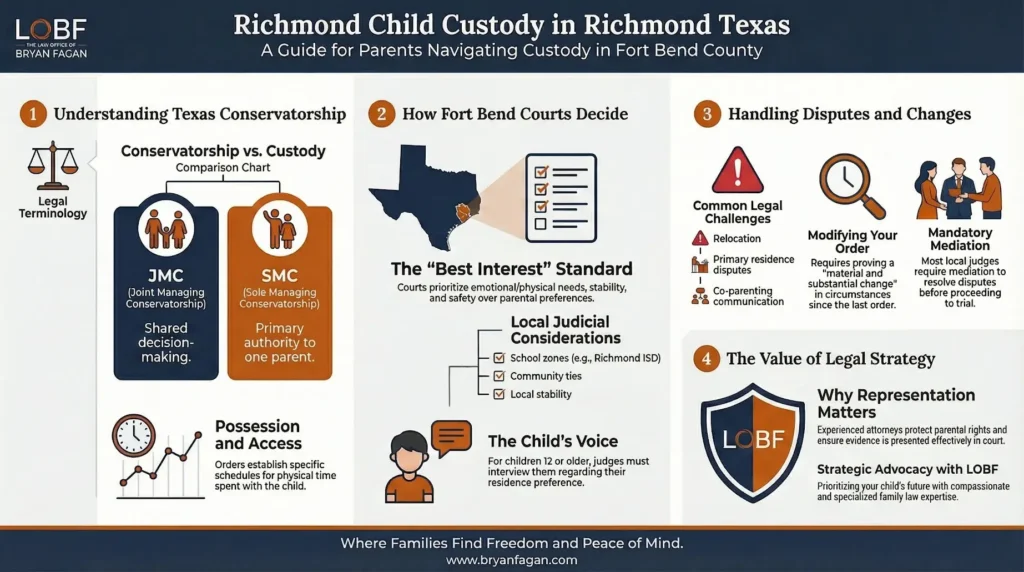
- Texas uses the term “conservatorship” instead of custody, which includes both decision-making rights and physical possession time with the child.
- Joint Managing Conservatorship is the most common arrangement in Fort Bend County, though it does not automatically mean equal time with both parents.
- Courts can modify custody orders when there has been a material and substantial change in circumstances, and orders can be enforced through contempt proceedings when violated.

Your Family’s Future Starts Here
Don’t navigate your legal journey alone. Schedule a consultation now and get the clarity and support you deserve.
Listen to Our Texas Family Law Podcast
Prefer listening? In this episode, we discuss child custody in Richmond, Texas, including how courts make custody decisions, key factors that affect parenting arrangements, and what parents need to know.
The Law Office of Bryan Fagan, PLLC can represent clients in a variety of family law matters, such as the following:
As a family law firm, we recognize that clients entrust us with a deeply personal aspect of their lives. Respecting this responsibility, our firm operates with professionalism, diligence, and efficiency, while maintaining open lines of communication with our clients. Not only do we provide access to their attorney, but also a dedicated client support team capable of addressing any inquiries regarding the case, status updates, billing concerns, or any other matters that arise throughout the process. Please don’t hesitate to discover how we can be of service to you.
Contact the Law Office of Bryan Fagan, PLLC at 281-245-1907 or online.
Child Custody in Richmond Texas: The Short Answer
When families begin navigating Richmond Child Custody in Richmond Texas, the most important principle to understand is that every decision made by a Fort Bend County court centers on the best interest of the child. This standard is codified in Texas Family Code §153.002, which requires judges to prioritize a child’s physical, emotional, and developmental well-being above all else. Whether you are new to the area or planning a transition, exploring this guide to moving to Richmond, Texas can provide helpful context about the community and factors that may influence custody considerations.
In practice, courts evaluate a wide range of factors to determine what arrangement best supports the child’s long-term stability. These include each parent’s involvement in daily caregiving, the child’s current living situation, educational continuity, and any concerns related to safety or welfare. Texas Family Code §153.134 further outlines considerations for appointing parents as joint managing conservators, emphasizing each parent’s ability to cooperate and make shared decisions in the child’s best interest. Judges also closely examine whether each parent supports the child’s relationship with the other parent—an issue that can significantly impact the outcome of a case.
It is also critical to understand that what many people refer to as “custody” is divided under Texas law into conservatorship and possession and access. Conservatorship governs decision-making authority regarding the child’s education, healthcare, and overall welfare, while possession and access determine when each parent spends time with the child under Texas Family Code Chapter 153, Subchapter F. For a deeper understanding of how these legal concepts affect your rights, review this Texas conservatorship overview, which breaks down the distinctions in a clear and practical way.
At the Law Office of Bryan Fagan, PLLC, the focus is not just on navigating statutes—it is on helping families move forward with confidence. By combining strategic legal insight with compassionate guidance, the firm works to protect your parental rights while ensuring your child’s future remains the top priority.

What Does “Child Custody” Mean in Texas?
In Texas, custody is referred to as conservatorship, which includes both rights and responsibilities. This distinction matters because Texas law separates decision-making authority from physical time with the child.
Conservatorship refers to the rights and duties each parent has regarding major decisions about the child’s life. These decisions include education choices, medical care, religious upbringing, and where the child primarily lives. Under Texas Family Code Chapter 153, conservatorship can be held jointly by both parents or solely by one parent.
Possession and access refers to the actual time each parent spends with the child. This is what most people think of as visitation or physical custody. A parent can have limited decision-making authority but still have significant possession time, or vice versa.
Understanding this distinction helps you focus on what matters most. When you discuss custody with your attorney or in court, you are really discussing two separate issues: who makes the big decisions, and when each parent has time with the child.
The rights and duties of parents under Texas law include:
- The right to receive information about the child’s health and education
- The duty to provide financial support for the child
- The right to consent to medical and dental care
- The right to make decisions about the child’s education
- The duty to protect the child’s welfare
Types of Custody Arrangements in Texas
Texas courts most commonly establish one of two conservatorship arrangements: Joint Managing Conservatorship or Sole Managing Conservatorship. The arrangement that works best depends entirely on the specific circumstances of each family.
Joint Managing Conservatorship (JMC) means both parents share rights and duties regarding the child. This is the presumed arrangement under Texas law when both parents are fit and capable. However, joint managing conservatorship does not automatically mean equal physical custody time. One parent is typically designated to determine the child’s primary residence, while both parents share decision-making on major issues.
Sole Managing Conservatorship (SMC) grants one parent exclusive decision-making authority and typically the exclusive right to determine the child’s residence. The other parent becomes a possessory conservator with visitation rights. Courts order sole managing conservatorship when joint conservatorship would not serve the child’s best interest, such as in cases involving family violence, abuse, neglect, or when one parent is unable to fulfill parenting responsibilities.
Table 1: Types of Conservatorship
| Type | What It Means | When It’s Used |
|---|---|---|
| Joint Managing Conservatorship | Both parents share rights and duties; one typically has primary residence designation | Most common arrangement; used when both parents are capable and can cooperate |
| Sole Managing Conservatorship | One parent has exclusive decision-making authority | Cases involving safety concerns, abuse, neglect, or when one parent cannot fulfill responsibilities |
| Possessory Conservator | Parent with visitation rights but limited decision-making authority | The non-primary parent in sole managing arrangements |
How Courts Decide Custody in Fort Bend County
When courts evaluate Richmond Child Custody in Richmond Texas, the guiding principle remains clear: the best interest of the child controls every outcome. Texas Family Code §153.002 codifies this standard, requiring judges to place a child’s physical safety, emotional well-being, and long-term development above all competing considerations. In Fort Bend County, courts often rely on a well-established framework of factors—commonly referred to as the Holley factors—to ensure a thorough and balanced evaluation of each family’s unique circumstances.
These factors include the child’s current and future emotional and physical needs, each parent’s ability to meet those needs, and the overall stability of each home environment. Judges also examine the child’s relationships with parents, siblings, and extended family, as well as each parent’s plans for the child’s growth and development. Under Texas Family Code §§153.131 and 153.134, courts frequently favor arrangements that allow both parents to remain actively involved—provided doing so serves the child’s best interest. Importantly, any history of domestic violence or abuse is given significant weight under §153.004, and a parent’s willingness to foster a positive relationship between the child and the other parent can heavily influence the court’s decision.
Evidence plays a critical role in these proceedings. Courts in Fort Bend County do not rely on allegations alone—they expect documentation. School records showing parental involvement, medical records identifying who attends appointments, and communication logs reflecting cooperation or conflict all provide tangible insight into each parent’s role. For parents preparing for custody proceedings, reviewing a guide to child custody evidence in Texas can help clarify what information may strengthen your case.
For families in Richmond, courts also consider practical, day-to-day realities that affect a child’s routine and stability. This includes school district boundaries such as Lamar Consolidated ISD, Fort Bend ISD, and surrounding districts, as well as commute times between households and access to extracurricular activities. Transportation logistics can become especially important when crafting possession schedules under Texas Family Code Chapter 153, Subchapter F, which governs standard and expanded possession orders. Understanding local travel patterns and infrastructure—such as those outlined in this Richmond transportation resource—can provide valuable context when evaluating what schedule truly serves the child’s best interest.
Families working with the Law Office of Bryan Fagan, PLLC receive more than just legal representation—they gain a team committed to helping them present a clear, evidence-based case while navigating an emotionally complex process. By combining deep knowledge of Texas law with a practical understanding of local courts, the firm helps parents protect their rights and build a stable future for their children.

Standard Possession Order (SPO) Overview
When parents cannot agree on a possession schedule, Texas courts typically apply the Standard Possession Order established in Texas Family Code §153.252. This order represents what the legislature has determined to be the minimum appropriate possession for a fit parent.
For parents living within 100 miles of each other, the standard possession order provides:
- First, third, and fifth weekends each month, from Friday evening to Sunday evening
- Thursday evenings during the school year
- Alternating holidays, including Thanksgiving, Christmas, and spring break
- Extended summer possession, typically 30 days
For parents living more than 100 miles apart, the schedule adjusts to accommodate travel, often with longer but less frequent visits.
The Standard Possession Order is a baseline, not a ceiling. Parents can agree to expanded possession schedules, and many Richmond families create custom arrangements that better fit their work schedules, the child’s activities, and the family’s specific needs. Courts generally approve parenting plans that both parents agree to, as long as they serve the child’s best interest.
Common Child Custody Disputes
Even after custody orders are established, disputes arise. Understanding the most common conflicts helps you prepare and potentially avoid escalation.
Relocation creates significant challenges. When one parent wants to move—whether across Fort Bend County or out of state—it can disrupt possession schedules, school stability, and the child’s relationship with the other parent. Texas courts require that moves serve the child’s best interest, not just the relocating parent’s convenience.
School choice disputes often arise when parents have joint managing conservatorship. Decisions about which school district, whether to pursue special education services, or participation in extracurricular activities can become battlegrounds if parents cannot communicate effectively.
Safety concerns including allegations of domestic violence, substance abuse, or neglect require immediate attention. Texas Family Code §153.004 allows courts to deny or limit possession when there is credible evidence of family violence or abuse.
Communication breakdowns between parents can make any custody arrangement difficult. When one parent refuses to share information about the child’s medical appointments, school events, or daily life, the other parent may need to seek court intervention.
Table 2: Common Custody Issues and Solutions
| Issue | Legal Approach | What Helps |
|---|---|---|
| Relocation | Modification request if it affects possession | Propose revised schedule that maintains relationship |
| School decisions | Court can allocate decision-making authority | Mediation to find common ground |
| Safety concerns | Protective orders; modification of possession | Thorough documentation; professional evaluations |
| Communication failures | Enforcement motion; parenting coordinator | Use communication apps; keep records |
| Missed visitation | Motion for enforcement; make-up possession | Document every incident; follow court orders precisely |
Child Support and Custody
When addressing Richmond Child Custody in Richmond Texas, it is essential to understand that child support and custody—while closely related—are treated as separate legal matters under Texas law. Texas Family Code Chapter 154 governs child support, establishing guidelines based primarily on the obligor’s net monthly resources and the number of children involved, with the most recent statutory updates continuing to reflect adjustments such as the increased cap on net resources under §154.125. These guidelines are designed to ensure that children receive consistent and adequate financial support from both parents, regardless of which parent has primary possession.
Child support is intended to cover a child’s basic needs, including housing, food, clothing, healthcare, and educational expenses. Typically, the parent with primary possession receives these payments to help maintain stability in the child’s daily life. Courts may also consider additional factors under Texas Family Code §154.123 when deviating from standard guidelines, including the child’s specific needs or extraordinary expenses. For parents seeking a clearer understanding of how these calculations work, this Texas child support guide offers practical, easy-to-follow insight.
Equally important, Texas law makes clear that possession and access rights are not dependent on child support compliance. Under Texas Family Code Chapter 153, a parent who falls behind on support does not automatically lose visitation rights, and a parent cannot lawfully deny court-ordered possession based on unpaid support. These obligations are enforced separately—child support through enforcement actions such as wage withholding under §158.001, and custody through possession orders enforceable by the court. This distinction protects the child’s right to maintain a meaningful relationship with both parents, regardless of financial disputes.
In situations involving allegations of family violence or assault, courts take an even more cautious approach. Texas Family Code §153.004 requires judges to carefully evaluate any history of abuse when determining conservatorship and possession, often limiting or supervising access when necessary to protect the child. For families navigating these sensitive issues, resources like understanding assault-related legal issues in Richmond can provide additional context on how such concerns may intersect with custody proceedings.
The team at the Law Office of Bryan Fagan, PLLC approaches these matters with both precision and compassion, helping families understand their rights while building strategies that prioritize their children’s well-being. By clearly separating financial obligations from parental rights, the firm empowers clients to move forward with confidence and clarity during challenging times.

Modifying a Custody Order
In cases involving Richmond Child Custody in Richmond Texas, it is important to recognize that custody orders are not necessarily permanent. Life circumstances evolve, and Texas law allows for modifications when those changes impact a child’s well-being. Under Texas Family Code Chapter 156, a court may modify conservatorship, possession, or access if there has been a material and substantial change in circumstances since the prior order and the requested modification is in the child’s best interest, consistent with §153.002.
Courts commonly grant modifications when a parent relocates in a way that disrupts the existing possession schedule, when a child’s medical, educational, or emotional needs significantly change, or when one parent has voluntarily relinquished primary care for at least six months under §156.101. Additionally, children age 12 or older may express a preference regarding their primary residence under §153.009, which the court will consider—though it is not solely determinative. Issues involving family violence, substance abuse, or criminal activity are taken especially seriously, as Texas Family Code §153.004 requires courts to prioritize the child’s safety and may restrict or supervise possession when necessary. For example, concerns involving impaired driving can directly impact custody decisions, and resources like understanding DWI and DUI issues in Richmond can help families better understand how these matters intersect with family law.
The modification process itself requires more than dissatisfaction with the current order. A parent must file a formal petition, provide proper legal notice to the other party, and present clear evidence demonstrating both the changed circumstances and why the proposed modification serves the child’s best interest. Courts expect documentation—such as school records, medical reports, or evidence of changes in living arrangements—to support these claims. If you are considering a modification, reviewing this guide to modifying child custody orders in Texas can provide helpful clarity on what to expect.
Working with the Law Office of Bryan Fagan, PLLC ensures that your case is approached with both legal precision and a deep understanding of the emotional stakes involved. By combining knowledge of Texas Family Code updates with practical courtroom experience, the firm helps parents navigate modifications effectively while keeping the focus where it belongs—on protecting their child’s future and stability.
Enforcing a Custody Order
When the other parent violates a custody order—by denying possession, failing to return the child on time, or ignoring provisions of the agreement—Texas law provides enforcement remedies under Chapter 157.
A motion for enforcement asks the court to find the other parent in contempt for violating the order. Remedies can include:
- Make-up possession time for visits that were wrongfully denied
- Attorney’s fees and court costs
- Fines and civil penalties
- Modification of the existing order to prevent future violations
Documentation is critical in enforcement actions. Keep detailed records of every violation: dates, times, communications, and witnesses. Text messages, emails, and calendar entries can serve as evidence that the other parent failed to comply with court orders.
What to Expect in Richmond Custody Cases
Understanding the Fort Bend County court process helps reduce anxiety and allows you to prepare effectively.
After a custody case is filed, the court typically schedules a temporary orders hearing within weeks. This hearing establishes interim arrangements for possession, support, and decision-making while the case is pending. Temporary orders can last several months given Fort Bend County’s busy family law docket.
Mediation is often required or strongly encouraged. Many Fort Bend County judges want to see that parents have attempted to resolve disputes through mediation before trial. Mediation can be surprisingly effective, and agreements reached through mediation often work better long-term because both parents participated in creating them.
If the case proceeds to a final hearing, both parents present evidence, call witnesses, and make arguments to the judge. The judge then issues final orders establishing conservatorship, possession schedules, child support, and other matters. From filing to final hearing, the process typically takes several months to a year depending on complexity and court scheduling.
How a Richmond Child Custody Attorney Can Help
An experienced child custody attorney provides strategic support at every stage of your case. This includes developing a tailored case strategy aligned with your goals and the statutory best interest standard under §153.002, preparing compelling evidence that demonstrates your involvement and ability to meet your child’s needs, and negotiating with the opposing party to resolve disputes efficiently when possible. If litigation becomes necessary, your attorney will advocate for you in hearings or trial, ensuring compliance with procedural rules and presenting your case clearly and persuasively. For parents looking to better understand how the process works, this overview of the child custody process in Texas offers helpful insight into what to expect.
Equally important, legal representation helps protect your rights while keeping the focus where it belongs—on your child’s well-being. Attorneys familiar with Fort Bend County courts understand local judicial expectations, common evidentiary requirements, and how factors such as school stability, parental cooperation, and daily caregiving responsibilities influence outcomes under Texas Family Code §§153.131 and 153.134. This level of insight can make a meaningful difference in both contested and uncontested cases.
Families working with the Law Office of Bryan Fagan, PLLC benefit from a team dedicated to education, preparation, and compassionate advocacy. Serving clients throughout Richmond, Sugar Land, and surrounding communities, the firm provides practical guidance tailored to your situation while helping you make informed decisions about your future. If you are ready to take the next step, you can review details about visiting the office through this plan your visit to the Richmond office resource and schedule a free initial consultation to discuss your options.

Checklist: Child Custody in Richmond Texas
- [ ] Understand your current court order completely
- [ ] Document your parenting involvement (school events, medical appointments, daily care)
- [ ] Keep communication with the other parent respectful and in writing
- [ ] Track visitation and any schedule issues
- [ ] Gather school and medical records
- [ ] Avoid social media conflict about your custody situation
- [ ] Follow court orders carefully, even when frustrated
- [ ] Prepare for mediation with clear goals
- [ ] Consult an attorney early in the process
- [ ] Focus on your child’s needs, not winning against the other parent
Conclusion
When everything around your child is changing, school is often the one place that should still feel steady. Custody decisions are not just legal outcomes—they shape daily routines, emotional security, and your child’s ability to focus, learn, and grow. The good news is that with the right approach, parents can create a structure that supports both stability and success, even during one of life’s most difficult transitions.
If you are facing a custody issue in Richmond or anywhere in Fort Bend County, you do not have to figure this out alone. Having a clear plan, the right information, and guidance from an experienced Texas family law attorney can make a meaningful difference—not just in your case, but in your child’s future. A thoughtful custody arrangement can reduce conflict, support academic consistency, and give your child the foundation they need to thrive.
At The Law Office of Bryan Fagan, PLLC, we are here to help you move forward with clarity and confidence. Whether you are just starting to ask questions or already in the middle of a case, a conversation with our team can help you understand your options and build a path that protects what matters most. Sometimes, the next right step is simply getting the right guidance—and that step can change everything for your family.
Frequently Asked Questions
The cost of a child custody case in Texas depends on whether the case is agreed or contested, how many hearings are needed, whether experts are involved, and how much evidence must be gathered. Filing fees are only one part of the expense. If the case becomes highly contested, attorney’s fees and related costs can increase. The best way to understand likely costs is to speak with an experienced Texas family law attorney about the facts of your situation.
If you are filing for divorce in Montgomery County, Texas, your case is generally filed with the district court through the Montgomery County District Clerk. Before filing, you should make sure you meet Texas residency requirements and any county-specific filing rules that may apply to your case.
Some of the biggest mistakes in a custody battle include speaking negatively about the other parent in front of the child, ignoring court orders, using the child as a messenger, posting harmful material on social media, and focusing more on fighting the other parent than protecting the child’s best interest. Courts usually respond better to parents who show stability, good judgment, and a willingness to support their child’s well-being.
Yes, it is possible to get divorced in Texas without a lawyer, especially in a simple uncontested case. However, divorce can quickly become more complicated when children, property, retirement accounts, support issues, or disagreements are involved. Even when a lawyer is not legally required, working with an experienced attorney can help you avoid mistakes that may affect you for years.
A child custody case in Texas can take anywhere from a few months to much longer depending on the level of conflict, the court’s schedule, whether temporary orders are needed, and whether the case settles or goes to trial. Agreed cases often move faster, while contested cases involving major disputes can take significantly more time.
In Texas divorce cases, the 6 month rule usually refers to the residency requirement. In general, at least one spouse must have lived in Texas for the previous six months before filing for divorce. There is also usually a county residency requirement, meaning one spouse must have lived in the county where the case is filed for at least 90 days.
Before a divorce, it is usually wise not to hide assets, drain accounts out of anger, destroy documents, violate court or standing orders, or post inflammatory comments on social media. If children are involved, do not pull them into adult conflict. Emotional decisions made early in a divorce often create bigger legal problems later.
Texas does not automatically offer a free divorce, but people with limited financial resources may ask the court to waive filing fees by submitting paperwork showing they cannot afford court costs. Some people may also qualify for legal aid or other low-cost legal assistance depending on their income and circumstances.
