
Uncontested Divorce in Richmond, Texas: A Complete Guide to Filing in Fort Bend County

Late one evening in Richmond, Texas, Michael and Laura sat across from each other at their kitchen table long after their two children had gone to bed. The house was quiet except for the hum of the refrigerator and the soft clink of coffee cups. After months of difficult conversations, they reached a shared realization: their marriage had reached its end. What surprised them most was that neither wanted a courtroom battle. They wanted a respectful way to move forward—for themselves and for their family. For couples in similar situations, Uncontested Divorce in Richmond Texas can offer a calmer path through a difficult life transition, allowing spouses to resolve legal matters cooperatively rather than through conflict.
Moments like these happen more often than people realize. Divorce is rarely the result of a single dramatic event; more often, it grows out of years of change, reflection, and the quiet recognition that two people need different futures. During these deeply personal moments, families often feel uncertain about what comes next—legally, emotionally, and financially.
At The Law Office of Bryan Fagan, PLLC, helping families navigate these crossroads is central to the firm’s mission. Bryan Joseph Fagan, a graduate of South Texas College of Law and a widely respected authority on Texas divorce and custody law, built the firm on a simple belief: families deserve both strong legal guidance and genuine compassion when facing life’s hardest transitions. Through education, thoughtful strategy, and innovative legal solutions, the firm works to simplify complex legal processes so clients can move forward with clarity and peace of mind.
Texas law recognizes that divorce is not only a legal process but also a turning point in a family’s life. Under the Texas Family Code, courts must ensure that the process is handled fairly while protecting the rights and responsibilities of each spouse. In many situations, couples who agree on the major issues—such as property division, parenting arrangements, and financial responsibilities—can resolve their divorce more efficiently through cooperative legal procedures.
For many families, this cooperative approach preserves dignity, reduces stress, and allows both spouses to maintain greater control over their future rather than leaving those decisions entirely in the hands of a judge.
In the sections ahead, you’ll learn how the process works in Fort Bend County, what legal requirements couples must meet, and how thoughtful planning can help families move through divorce with stability, respect, and confidence about the road ahead.
Key Takeaways
- Uncontested divorce requires complete agreement: Both you and your spouse must agree on all major issues—property division, child custody, child support, and spousal maintenance—before filing as uncontested in Fort Bend County.
- Texas law requires a 60-day waiting period: Under Texas Family Code § 6.702, no final decree of divorce can be granted until at least 60 days after filing, with few exceptions.
- Fort Bend County residency requirements are strict: At least one spouse must have lived in Texas for six months and in Fort Bend County for at least 90 days before filing.
- Uncontested divorce saves significant time and money: Compared to contested cases, an agreed divorce typically costs thousands less and resolves in weeks rather than months or years.
- Legal guidance protects your rights even in amicable divorces: Complex property division, retirement accounts, and child-related matters benefit from attorney review to prevent costly mistakes.

Your Family’s Future Starts Here
Don’t navigate your legal journey alone. Schedule a consultation now and get the clarity and support you deserve.
The advocacy and insight you need are just a phone call away. Contact us at 281-245-1907 today.
The Law Office of Bryan Fagan, PLLC can represent clients in a variety of family law matters, such as the following:
As a family law firm, we recognize that clients entrust us with a deeply personal aspect of their lives. Respecting this responsibility, our firm operates with professionalism, diligence, and efficiency, while maintaining open lines of communication with our clients. Not only do we provide access to their attorney, but also a dedicated client support team capable of addressing any inquiries regarding the case, status updates, billing concerns, or any other matters that arise throughout the process. Please don’t hesitate to discover how we can be of service to you.
Contact the Law Office of Bryan Fagan, PLLC at 281-245-1907 or online.
Texas law provides a clear legal foundation for this type of divorce. Under Texas Family Code §6.001, the most common ground for divorce is “insupportability,” which serves as Texas’s no-fault basis for dissolving a marriage. Insupportability means the relationship has become unworkable because of conflict or discord that destroys the legitimate purposes of the marriage, with no reasonable expectation that the couple will reconcile. Because Texas recognizes this no-fault ground, neither spouse must prove misconduct or assign blame in order to move forward with the divorce process.
The primary difference between an uncontested divorce and a contested one lies in whether spouses agree on the issues that must be resolved before the marriage can legally end. In a contested divorce, disagreements may arise over property division, conservatorship of children, child support obligations, or spousal maintenance. When that happens, the court must intervene to resolve the dispute through hearings, mediation, or even trial. Readers who want to understand how these conflicts can unfold can explore the firm’s overview of contested divorce in Richmond, which explains the legal process when spouses cannot reach agreement.
In contrast, couples pursuing an agreed divorce have already resolved the major legal and financial questions involved in ending their marriage. For Richmond families, that typically includes decisions about how community property and debts will be divided under Texas Family Code §3.002, how conservatorship and parenting time will be structured under Texas Family Code Chapter 153, and how child support will be calculated using the statutory guidelines outlined in Texas Family Code §154.125. These agreements must then be carefully documented in a Final Decree of Divorce that complies with Texas law and the expectations of local courts.
Even when spouses agree on the terms of their divorce, it is still important to ensure that those agreements are legally sound and clearly written. Issues involving retirement accounts, real estate, or parenting plans often require detailed legal language to prevent future disputes. Couples who want to better understand how Texas courts evaluate parenting arrangements may find it helpful to review the firm’s resource on child custody and conservatorship in Texas, which explains how courts apply the “best interest of the child” standard under Texas Family Code §153.002.
When couples are able to cooperate and reach agreement on these important issues, the divorce process often becomes faster, less expensive, and far less emotionally draining. Rather than spending months or years in litigation, families can move forward with greater stability and confidence, knowing that the decisions shaping their future were made thoughtfully and collaboratively.

Eligibility Requirements for Richmond Uncontested Divorce
To qualify for an uncontested divorce in Richmond, you must meet both Texas state requirements and demonstrate genuine mutual agreement on all divorce-related matters.
Texas law requires specific residency thresholds before any district court can grant your divorce. Under Texas Family Code § 6.301, at least one spouse must have been domiciled in Texas for the six months immediately preceding the filing of the petition. Additionally, that same spouse (or the other spouse) must have been a resident of Fort Bend County for at least 90 days before filing.
These residency requirements exist to establish proper jurisdiction. Texas courts have interpreted the county residency requirement to mean physical presence combined with a good-faith intent to make that county your home. If you’ve recently moved to Richmond from another county, you’ll need to wait until you’ve been here for 90 days before filing.
Beyond residency, both spouses must genuinely agree on every substantive issue. This isn’t simply a verbal understanding—it must be documented in your final decree and any supporting legal documents. If one spouse files for divorce expecting agreement but the other spouse chooses to contest any provision, the case immediately becomes contested, changing the timeline, cost, and complexity dramatically.
Common misconceptions about eligibility include believing that:
- You can file as uncontested and “work out details later” (you cannot)
- Only one spouse needs to want the divorce (both must agree to terms for uncontested status)
- Having children automatically makes divorce contested (it doesn’t, if you agree on custody and support)
Fort Bend County Specific Requirements
Families pursuing an Uncontested Divorce in Richmond Texas must follow both statewide rules under the Texas Family Code and the local procedures established by Fort Bend County courts. While Texas law sets the legal framework for divorce, each county applies its own administrative processes for filing documents, scheduling hearings, and finalizing divorce decrees. Understanding these local requirements early can help couples avoid unnecessary delays and move through the process with greater confidence.
Under Texas Family Code §6.301, at least one spouse must meet the residency requirements before filing for divorce in Fort Bend County. Specifically, the spouse must have lived in Texas for at least six months and in Fort Bend County for a minimum of ninety days prior to filing the Original Petition for Divorce. These residency rules ensure the court has proper jurisdiction to handle the case. Families who are new to the area sometimes have questions about residency requirements and life in the community, and those considering relocation can learn more about the area through moving to Richmond, Texas.
Divorce filings for Richmond residents are processed through the Fort Bend County District Clerk’s Office located at the Fort Bend County Justice Center at 301 Jackson Street in Richmond. The clerk’s office serves as the central location for filing the Original Petition for Divorce, submitting supporting documents, and obtaining certified copies of court orders. Filing fees for a divorce petition typically begin at approximately $131, with additional administrative costs for citation service and certified copies of documents. Because court fees may change over time, confirming the most current fee schedule with the clerk’s office is always recommended.
Fort Bend County also provides divorce form packets designed to assist couples pursuing uncontested cases. These packets typically contain the Original Petition for Divorce, a Waiver of Service, the Final Decree of Divorce, and worksheets for documenting property division and child support calculations. Any agreements involving children must comply with Texas Family Code Chapter 153, which governs conservatorship and possession schedules, as well as Texas Family Code §154.125, which outlines the statutory child support guidelines based on a parent’s net resources. These guidelines were recently updated to reflect a higher cap on net monthly resources used to calculate child support obligations. Parents seeking a deeper explanation of how these calculations work may find it helpful to review this resource on Texas child support guidelines.
Another factor couples should understand is that individual district courts within Fort Bend County sometimes follow different procedures for finalizing uncontested divorces. Some courts schedule brief prove-up hearings where one spouse appears before the judge to confirm the agreement, while others allow sworn affidavits or remote proceedings when the paperwork is complete and both parties have signed the final decree. Certain courts also require the submission of an uncontested matters checklist before a final hearing can be placed on the docket.
Because these procedures can vary depending on which court is assigned to the case, working with an attorney familiar with Fort Bend County’s filing practices can make the process significantly smoother. Careful preparation ensures that documents comply with the Texas Family Code, that agreements involving property and children are properly drafted, and that the final decree reflects the intentions of both spouses. When these steps are handled correctly, many couples are able to complete their divorce efficiently and begin the next chapter of their lives with clarity and stability.

Benefits of Choosing Uncontested Divorce in Richmond
Uncontested divorce offers Richmond families significant advantages over contested proceedings in nearly every measurable way—financially, temporally, emotionally, and practically.
When spouses agree to resolve their divorce cooperatively, they maintain greater control over outcomes, protect their privacy, reduce stress on their children, and preserve resources that would otherwise be consumed by litigation.
Cost Savings
The financial difference between contested and uncontested cases is substantial. While contested divorces in Texas can easily cost $15,000 to $50,000 or more in attorney fees alone—not counting expert witnesses, court costs, and lost work time—an uncontested divorce typically costs a fraction of that amount.
In Fort Bend County, your court costs for an uncontested filing include:
- Filing fee: approximately $131
- Citation/service fee: approximately $25 (or waived if spouse signs waiver)
- Form packets: $10-$12
- Certified copies: $10 each
Attorney fees for uncontested divorce are significantly lower because the legal process is streamlined. There’s no discovery, no depositions, no trial preparation, and no courtroom battles. Many Richmond families complete their uncontested divorce for under $2,000 total, including attorney fees—a cost effective approach that preserves family resources for life after divorce.
Faster Resolution and Greater Control for Richmond Families
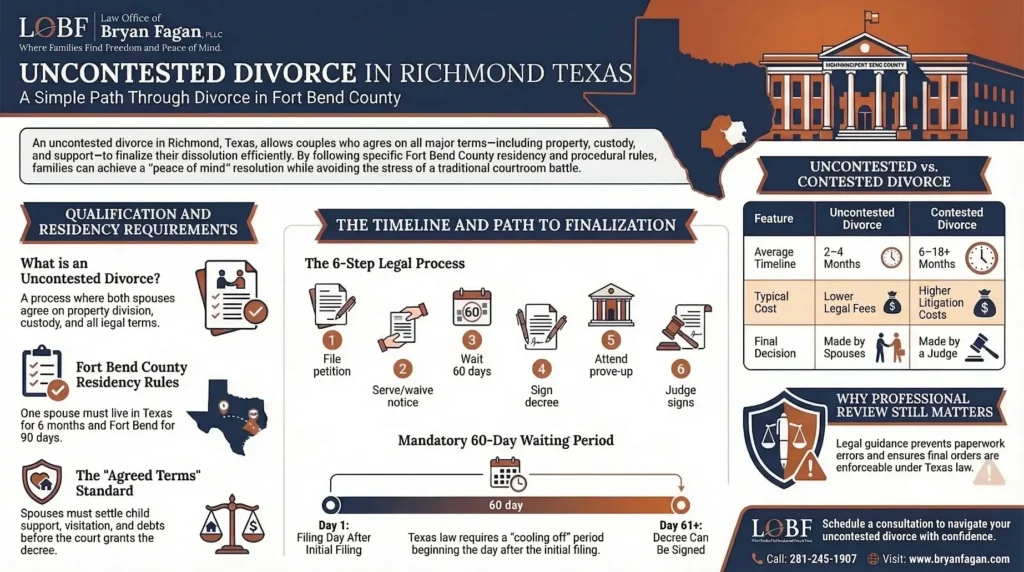
One of the most significant advantages of pursuing an Uncontested Divorce in Richmond Texas is the ability to resolve the legal process more efficiently than in contested cases. Texas law requires a mandatory waiting period before any divorce can be finalized. Under Texas Family Code §6.702, courts generally must wait at least sixty days from the date the Original Petition for Divorce is filed before signing a Final Decree of Divorce. This statutory cooling-off period applies to most divorce cases across the state, whether the spouses agree on the terms or not. Once that waiting period has passed and all paperwork is properly completed, however, an uncontested divorce may often be finalized shortly afterward.
In many Fort Bend County cases, cooperative divorces are completed within approximately sixty to ninety days from filing. By comparison, contested divorce cases—where spouses disagree on issues like property division, custody arrangements, or financial obligations—may take a year or longer to resolve. Litigation can involve extensive discovery, mediation sessions, hearings, and potentially trial. When couples reach agreement early in the process, they avoid many of these delays and are able to begin rebuilding their lives more quickly. For families balancing work schedules, parenting responsibilities, and daily life in Richmond, practical considerations such as commuting and daily routines often matter as much as the legal process itself. Those new to the area may find it helpful to learn more about local infrastructure through transportation options in Richmond, Texas.
Another key benefit of an agreed divorce is the level of control spouses maintain over the outcome. When couples work together to resolve their differences, they decide how their property will be divided and how parenting responsibilities will be structured. Texas courts must approve the final decree, but the terms are primarily determined by the spouses rather than imposed by a judge. In contested cases, however, a judge who may know very little about the family’s day-to-day life ultimately makes those decisions.
This control is particularly important in cases involving children. Texas Family Code §153.002 establishes that the “best interest of the child” is the primary consideration in determining conservatorship and possession orders. When parents cooperate and create a thoughtful parenting plan, they often design arrangements that better reflect their children’s routines, school schedules, and emotional needs. Parents who want to better understand how Texas courts evaluate custody arrangements may find helpful guidance in this resource on child custody and conservatorship in Texas.
Privacy is another important factor for many families choosing a cooperative divorce process. Contested cases frequently involve multiple hearings, extensive court filings, and testimony that becomes part of the public record. By contrast, an uncontested divorce minimizes courtroom appearances and reduces the amount of sensitive personal information discussed in open court. This discretion can be particularly valuable for parents who want to shield their children from unnecessary stress or public attention.
Perhaps the most meaningful benefit, however, is the emotional relief that comes from resolving a divorce without prolonged conflict. Divorce is never easy, but cooperative solutions can significantly reduce the tension that litigation often creates. When parents demonstrate respect and collaboration during the divorce process, they lay the groundwork for healthier co-parenting relationships in the years ahead. Children benefit greatly when they see their parents working together to manage difficult changes, reinforcing a sense of stability even as the family structure evolves.

Step-by-Step Process for Richmond Uncontested Divorce
The following five steps outline the complete legal process for obtaining an uncontested divorce in Fort Bend County. Following each step correctly ensures your divorce proceeds smoothly and efficiently.
Step 1: Verify Eligibility and Residency
Before anything else, confirm that you meet Texas and Fort Bend County residency requirements. At least one spouse must have lived in Texas for six months and in Fort Bend County for at least 90 days before filing.
Documentation that helps prove residency includes:
- Texas driver’s license or ID card
- Voter registration
- Utility bills in your name
- Lease or mortgage documents
- Employment records
Military families stationed in Texas face special considerations. Active duty service members may establish residency in Texas even if their permanent home of record is elsewhere, depending on circumstances. If either spouse is military, consulting with an attorney familiar with military divorce helps clarify jurisdictional issues.
Step 2: Filing the Original Petition for Divorce
For couples pursuing an Uncontested Divorce in Richmond Texas, the legal process begins when one spouse files an Original Petition for Divorce with the Fort Bend County District Clerk. This document formally asks the court to dissolve the marriage and outlines the relief requested, such as property division, child custody arrangements, and financial support. The petition serves as the foundation of the case and must contain specific information so the court can establish jurisdiction and ensure compliance with the Texas Family Code.
The petition typically includes the names and addresses of both spouses, the date and place of the marriage, and the legal grounds for divorce. In most uncontested cases, the grounds will be “insupportability,” which is the no-fault basis for divorce recognized under Texas Family Code §6.001. The petition must also disclose whether children were born or adopted during the marriage, since cases involving children must follow the requirements outlined in Texas Family Code Chapter 153 governing conservatorship and parenting time. Parents who want to better understand how courts evaluate custody decisions may find helpful information in this resource on child custody and conservatorship in Texas.
Residents of Richmond file their divorce petitions with the Fort Bend County District Clerk located at the Fort Bend County Justice Center at 301 Jackson Street in Richmond. Filing the petition generally requires a filing fee that is typically around $131, although court costs can change periodically. Once the petition is accepted by the clerk, the case is assigned a cause number and the divorce process officially begins. Individuals who prefer to discuss their situation in person can find directions and scheduling information for the firm’s local office through planning a visit to the Richmond office.
Step 3: Serve Your Spouse or Obtain Waiver
After the petition is filed, Texas law requires that the other spouse receive formal notice of the divorce case. This requirement protects both parties’ due process rights and ensures that each spouse has an opportunity to participate in the legal proceedings. The notice requirement is addressed through the Texas Rules of Civil Procedure and related provisions of the Texas Family Code.
In many uncontested divorce cases, the most efficient approach is for the responding spouse to sign a Waiver of Service. A Waiver of Service confirms that the spouse has received a copy of the divorce petition and voluntarily waives the need for formal service. This document must be signed after the petition has been filed and is typically notarized before being filed with the court. Because both spouses are cooperating in an uncontested case, using a waiver often allows the divorce process to move forward more quickly and with fewer expenses.
If a spouse does not sign a waiver, the law requires formal service of the divorce petition. This can be completed by a sheriff’s deputy, a licensed private process server, or certified mail with return receipt requested. While formal service ensures proper notice, it can increase both the time and cost of the process. For many couples pursuing an uncontested divorce, however, signing a Waiver of Service remains the most common and practical option for moving the case forward efficiently.

Step 4: Prepare Final Decree of Divorce
The Final Decree of Divorce is the most important document in your divorce case. This is the court order that actually ends your marriage and establishes the legally binding terms of your divorce.
Your final decree must address:
Property Division: Under Texas community property laws, property acquired during marriage is presumed to be community property, owned equally by both spouses. Your decree must specifically describe how this property—real estate, vehicles, bank accounts, retirement accounts, investments, and personal property—will be divided. Separate property (owned before marriage or acquired by gift/inheritance) should be confirmed to the appropriate spouse.
Debt Division: Just like assets, debts incurred during marriage are community debts. Your decree should specify who assumes responsibility for each debt.
Children: If you have children, your decree must include a detailed parenting plan addressing:
- Conservatorship (who makes decisions for the children)
- Possession and access schedules
- Child support amounts based on Texas guidelines
- Health insurance provisions
- Tax exemption allocation
Properly completed final decrees avoid delays and post-divorce disputes. Many uncontested divorces stall because decrees contain vague terms, missing property descriptions, or improperly calculated child support.
Step 5: Attend Prove-Up Hearing or Submit Affidavit
The prove-up hearing (also called final hearing) is a brief hearing where the petitioning spouse testifies under oath that everything in the divorce papers is true and the decree should be granted.
In Fort Bend County, different courts handle prove-ups differently:
387th Judicial District Court: No in-person uncontested dockets. Prove-ups must be submitted via sworn affidavit or video conference.
505th District Court: Requires completion of an Uncontested Matters Checklist before scheduling. All documents—Waiver of Service, Final Decree, child support worksheets—must be filed before the hearing.
The prove-up itself is typically a brief hearing lasting 5-15 minutes. The judge will ask basic questions confirming residency, grounds for divorce, and agreement on terms. Once satisfied, the judge signs your final decree of divorce, and your marriage is officially dissolved.
If both parties are pro se (without attorneys), most courts require an actual prove-up hearing. If at least one party has attorney representation, some Fort Bend County courts allow agreed orders to be signed without an in-person appearance.
Listen to Our Texas Family Law Podcast
Prefer listening? In this episode, we discuss uncontested divorce in Richmond, Texas, including how the process works, the benefits of a faster and simpler path forward, and what couples need to agree on.
Common Challenges and How to Avoid Them
Even when spouses pursue an Uncontested Divorce in Richmond Texas, certain procedural or legal challenges can arise during the process. While cooperative divorces are typically more efficient and less stressful than contested cases, misunderstandings about legal requirements or incomplete paperwork can still delay a final decree. Understanding these common obstacles ahead of time helps couples move through the process smoothly and with greater confidence.
One of the most frequent issues involves residency requirements. Texas law requires that at least one spouse must have lived in Texas for six months and in the county of filing for at least ninety days before submitting a divorce petition. These requirements are established under Texas Family Code §6.301 and determine whether the court has jurisdiction to hear the case. Filing too early—before meeting the required residency period—can result in dismissal of the case and require the process to begin again. Carefully confirming your residency timeline before filing can prevent unnecessary setbacks.
Another common challenge involves the Waiver of Service. In many uncontested divorces, the responding spouse signs a waiver acknowledging receipt of the petition and allowing the case to proceed without formal service by a process server. However, the waiver must be signed after the petition is filed and typically must be notarized before being submitted to the court. If the waiver is improperly completed or never filed with the clerk, the court may refuse to move forward with the case. Ensuring the waiver complies with Texas procedural rules can help prevent delays in scheduling the final hearing.
Drafting a legally sufficient Final Decree of Divorce is another area where mistakes sometimes occur. Even when spouses fully agree on the terms of their divorce, the court must review the decree to ensure it complies with Texas law. Property descriptions must be clear and complete, financial disclosures must accurately reflect the marital estate, and child support calculations must follow the guidelines outlined in Texas Family Code §154.125. Missing details or unclear provisions may cause a judge to reject the proposed decree and require revisions. Couples who want a clearer understanding of how Texas courts evaluate parenting and financial issues can review this helpful guide on child custody and conservatorship in Texas.
Local court procedures can also create confusion for families unfamiliar with the Fort Bend County court system. Each district court may have slightly different rules for handling uncontested matters. Some courts require a brief prove-up hearing where one spouse appears before the judge, while others allow sworn affidavits or remote submissions. Failing to follow the assigned court’s procedures may delay the case or require additional filings.
Finally, one of the most challenging situations arises when spouses believe they have reached agreement but later discover unresolved issues after reviewing the final paperwork. Disagreements about parenting time, financial obligations, or property division can quickly transform a cooperative case into a contested one. In some situations, conflict can escalate beyond family law issues, and individuals may need to understand related legal concerns within their community, such as those explained in this resource on Richmond assault laws and legal considerations.
Taking time to address potential concerns early, confirm residency requirements, and ensure all documents are prepared correctly can help couples avoid these complications. With thoughtful preparation and experienced legal guidance, many families are able to complete their divorce efficiently while preserving the cooperative spirit that makes an uncontested process possible.
When You Need an Attorney for Uncontested Divorce
While uncontested divorce is simpler than contested proceedings, legal guidance protects your interests and prevents costly mistakes—even when both spouses agree on everything.
An attorney ensures your rights are protected, your decree is properly drafted, and you don’t inadvertently waive important entitlements. The Law Office of Bryan Fagan, PLLC helps Richmond families navigate Fort Bend County procedures efficiently while safeguarding their futures.
Property and Asset Division in Texas Divorce
For couples pursuing an Uncontested Divorce in Richmond Texas, one of the most important steps in the process is carefully addressing how property and financial obligations will be divided. Texas follows a community property system, meaning that most property acquired during the marriage is presumed to belong to both spouses. This presumption is established under Texas Family Code §3.002, which defines community property as property other than separate property that is acquired by either spouse during the marriage.
While the concept may sound straightforward, determining whether property is truly community property or separate property often requires careful legal analysis. Separate property, defined under Texas Family Code §3.001, can include assets owned before marriage or property acquired through inheritance or gift. Properly identifying and documenting these distinctions is essential because the court has authority to divide community property in a “just and right” manner under Texas Family Code §7.001.
Certain financial situations can make property division more complicated and often benefit from experienced legal guidance. These situations may involve closely held businesses or professional practices, retirement accounts such as 401(k)s or pensions that require a Qualified Domestic Relations Order (QDRO), real estate with ongoing mortgage obligations, or compensation structures like stock options and deferred bonuses. Significant debt obligations or creditor claims can also complicate negotiations. Without careful planning, spouses may unintentionally waive valuable rights to retirement assets, accept an unfair allocation of debt, or overlook property that should be treated as separate.
Understanding the legal framework surrounding property division can help spouses make informed decisions before finalizing their divorce agreement. Individuals who want to explore how Texas courts divide marital assets can learn more by reviewing this helpful resource on property division in Texas divorce.
Child Custody and Support Considerations
When children are involved, Texas law places their wellbeing at the center of every decision made during a divorce. Courts evaluate custody arrangements using the “best interest of the child” standard established under Texas Family Code §153.002. Even when parents agree on custody terms, the court must still review the parenting plan to ensure that it protects the child’s physical, emotional, and developmental needs.
In many uncontested cases, parents agree to serve as joint managing conservators under Texas Family Code §153.131, allowing both parents to share important decision-making responsibilities for their children. Parenting plans must also address possession schedules, holiday arrangements, and communication between parents and children. These agreements must comply with Texas Family Code Chapter 153 to ensure they are enforceable and aligned with the court’s expectations.
Child support obligations are calculated using statutory guidelines found in Texas Family Code §154.125. These guidelines determine support based on a percentage of the paying parent’s net monthly resources. Texas recently updated the child support cap on net resources used for guideline calculations, reinforcing the importance of accurate financial documentation when determining support obligations. Parents must also address issues such as health insurance coverage, medical expenses, childcare costs, and any special needs a child may have.
For many families navigating divorce, understanding how local resources and community services support families can also be helpful. Individuals looking for information about public services in the Richmond area can explore government resources available in Richmond to better understand the support systems available to residents.
Because parenting arrangements and financial obligations can have long-term consequences, careful drafting of the final decree is essential. Attorneys experienced in Fort Bend County family courts help ensure that custody and support provisions comply with Texas law, accurately reflect the parents’ agreement, and protect the rights and responsibilities of both parents moving forward.

Timeline and Costs for Richmond Uncontested Divorce
The typical timeline for an uncontested divorce in Richmond runs 60-90 days from filing to final decree. The absolute minimum is 61 days due to Texas’s mandatory waiting period.
Cost Breakdown:
- Filing fee: ~$131
- Citation/service fee: ~$25 (waived if spouse signs waiver)
- Form packets: $10-$12
- Certified copies: ~$10 each
- Notarization: $5-$15
Attorney Fees: Vary based on complexity, but uncontested divorce representation typically ranges from $1,000-$3,500 for straightforward cases.
Total Typical Cost: $1,500-$4,000 for attorney-assisted uncontested divorce.
Compare this to contested divorce, which commonly costs $15,000-$50,000+ and takes 12-24 months. The cost effectiveness and speed of uncontested divorce make it the preferred option for couples who can reach agreement.
Factors that might extend your timeline include:
- Delays in obtaining spouse’s signature on waiver
- Errors in paperwork requiring correction
- Court scheduling backlogs
- Missing required documents
Conclusion
Divorce is rarely a chapter anyone plans to write, yet many families discover that how they move through it matters far more than the fact that it happens. When couples approach the process with cooperation, clarity, and a willingness to plan for the future, they often find that life on the other side of divorce can feel calmer and more stable than they expected.
For many families in Fort Bend County, choosing an uncontested approach allows both spouses to maintain dignity, reduce conflict, and focus on building a healthier next chapter for themselves and their children. Instead of spending months—or even years—in courtroom battles, parents can direct their time and energy toward creating routines, supporting their children, and rebuilding a sense of normalcy at home.
Still, even the most cooperative divorce involves important legal decisions that can shape your family’s future. Questions about parenting arrangements, financial responsibilities, and long-term stability deserve thoughtful attention. Working with an experienced Texas family law attorney can help ensure that the agreements you make today continue to protect your family tomorrow.
At The Law Office of Bryan Fagan, PLLC, the goal has always been simple: help families move through difficult moments with clarity, confidence, and compassion. Bryan Joseph Fagan and his team understand that behind every case is a real family trying to find a way forward. By providing guidance, education, and practical solutions, the firm helps Texans navigate divorce while protecting what matters most.
If you’re considering divorce or simply trying to understand your options, taking the first step toward reliable information can make all the difference. Sometimes peace of mind begins with a single conversation—and the right guidance can help you see that the future may be far brighter than it feels today.
Frequently Asked Questions
The cost of an uncontested divorce in Texas can vary depending on the county filing fees, whether children are involved, and whether either spouse hires an attorney to assist with paperwork. Because both spouses agree on the terms, uncontested divorces are typically far less expensive than contested cases that require hearings or trials. Even in cooperative situations, having an experienced Texas family law attorney review the final agreement can help prevent costly mistakes that may surface later.
Texas law requires a minimum 60-day waiting period after a divorce petition is filed before a court can finalize the divorce. This waiting period applies to almost all cases, including uncontested ones. If both spouses remain in agreement and all paperwork is properly completed, many uncontested divorces are finalized shortly after that waiting period ends.
To qualify for an uncontested divorce in Texas, both spouses must agree on every major issue related to the divorce. This typically includes property division, debt allocation, child custody arrangements, child support, and any spousal maintenance. Additionally, at least one spouse must meet the state residency requirements, meaning they have lived in Texas for at least six months and in the county where the case is filed for at least 90 days.
One of the most common mistakes during a divorce is allowing emotions to drive important financial or parenting decisions. Many people rush to settle quickly just to end the stress, but doing so without fully understanding the legal consequences can lead to long-term problems. Careful planning and informed decisions are often the key to protecting both your rights and your future stability.
In many cases, the least expensive path to divorce is an uncontested divorce where both spouses cooperate and agree on the terms before filing. When there is no dispute over property, custody, or finances, the legal process becomes simpler and requires less court involvement. However, even when trying to reduce costs, it is wise to ensure the final decree is legally sound and protects your long-term interests.
During a divorce, it is generally best to avoid major financial decisions without legal advice, negative communication with your spouse that could escalate conflict, and social media posts that might later be used in court. Parents should also avoid discussing legal disputes in front of their children. Staying calm, organized, and focused on long-term outcomes can make the process smoother for everyone involved.
Not necessarily. In many uncontested divorces, one spouse hires an attorney to prepare the documents while the other spouse chooses not to hire separate counsel. However, Texas ethics rules prevent a single attorney from representing both spouses in the same divorce. If both parties want independent legal advice, each spouse can hire their own attorney.
The phrase “three C’s of divorce” is often used to describe communication, cooperation, and compromise. These principles are especially important when children are involved. When spouses remain respectful and focused on practical solutions, it becomes much easier to reach agreements that benefit the entire family.
In Texas, most divorces cannot happen immediately because state law requires a waiting period after the case is filed. Even when both spouses agree on everything, the court typically must wait at least 60 days before finalizing the divorce. The fastest way to move through the process is to gather all necessary information early, reach agreement on the terms, and ensure that all paperwork is completed accurately so there are no delays.