
Child Support Attorneys in Houston Heights, Texas: What Parents Need to Know Before They File

Most parents searching for Child support Attorneys in Houston Heights Texas are not calling because they are confused about the law. They are calling because they are worried about their children. A father in Garden Oaks recently told me that the hardest part of his divorce was not moving out of the family home or negotiating child support. It was watching his young daughter ask every Friday night, “Which house am I sleeping at tomorrow?” A mother near Yale Street shared that her son started carrying the same backpack everywhere because he was afraid of leaving something important behind when moving between homes. These are the moments that stay with parents long after court hearings end. They are also reminders that divorce is not just a legal process—it is a life transition that affects children in very real ways.
The questions families ask are often practical. How will custody work? Who pays child support? Can an existing order be changed? What many parents do not realize is that these legal decisions often shape the stability children experience every day. Under Texas Family Code §153.002, courts are required to make decisions based on the best interest of the child. That standard reaches beyond possession schedules and financial obligations. It focuses on creating an environment where children can maintain consistency, security, and healthy relationships with both parents whenever possible.
Here is what this guide covers: how divorce affects children emotionally and developmentally, why stability matters during family transitions, how child support and parenting plans work together to support a child’s overall well-being, and the practical steps parents can take to reduce disruption during and after a divorce. You will also learn how Texas courts evaluate these issues when making custody decisions and how experienced family law attorneys help families build solutions designed around the needs of their children—not just the legal requirements of a court order.
One case I handled involved parents from the Heights who were locked in a dispute over custody and support. Both were focused on winning specific issues in court. During the process, it became clear that their child was struggling less with the divorce itself and more with the uncertainty surrounding it. The schedule kept changing, communication between the parents was inconsistent, and the child never knew what to expect from one week to the next. Once we helped create a clear parenting plan with predictable routines and realistic expectations, the tension in the household began to ease. The lesson was simple: children can adapt to change, but they need stability to do it successfully. That principle drives many of the decisions Texas courts make and explains why thoughtful child support and custody planning can have a lasting impact on a child’s future.
The Short Answer
In Texas, child support is set by a statutory formula: a percentage of the paying parent’s monthly net resources — 20% for one child, rising 5% per child to 40% for five. Under Texas Family Code §154.125 (2025), that percentage applies only to the first $11,700 of net resources, a cap raised from $9,200 effective September 1, 2025. Heights cases are heard in Harris County. An attorney’s job is to get the net-resources figure right, argue any deviation, and move fast on modification or enforcement.
Key Takeaways
- The formula is not negotiable, but the inputs are. Texas presumes the guideline percentage is correct. The fight is almost always over what counts as “net resources” — and that is where attorneys earn their fee.
- The 2025 cap increase matters most to higher earners. The ceiling moved from $9,200 to $11,700 in monthly net resources on September 1, 2025. If you earn above the old cap, your number can change — but only if an order is entered or modified after that date.
- Nothing changes automatically. A pay raise, a job loss, a child aging out — none of it adjusts your order on its own. You must file a modification under §156.401.
- Enforcement has teeth. Unpaid support can lead to wage withholding, license suspension, and contempt — including jail — under §157.001 and following.
- Every Heights case is a Harris County case. Your matter is filed and heard downtown. Local court practice and associate-judge dockets shape how fast you actually get relief.

Your Family’s Future Starts Here
Don’t navigate your legal journey alone. Schedule a consultation now and get the clarity and support you deserve.
Family lawyers and attorneys advise our clients of the immediate aftermath as well as the long-term effects of Family Law related issues, such as the following:
Trust us to help you with your Family Law Attorneys in the Houston Heights in Texas. Call (281) 245-1776 or contact us online today to schedule a free consultation with your Family Law Attorney in Humble, Texas.
How Texas Calculates Child Support
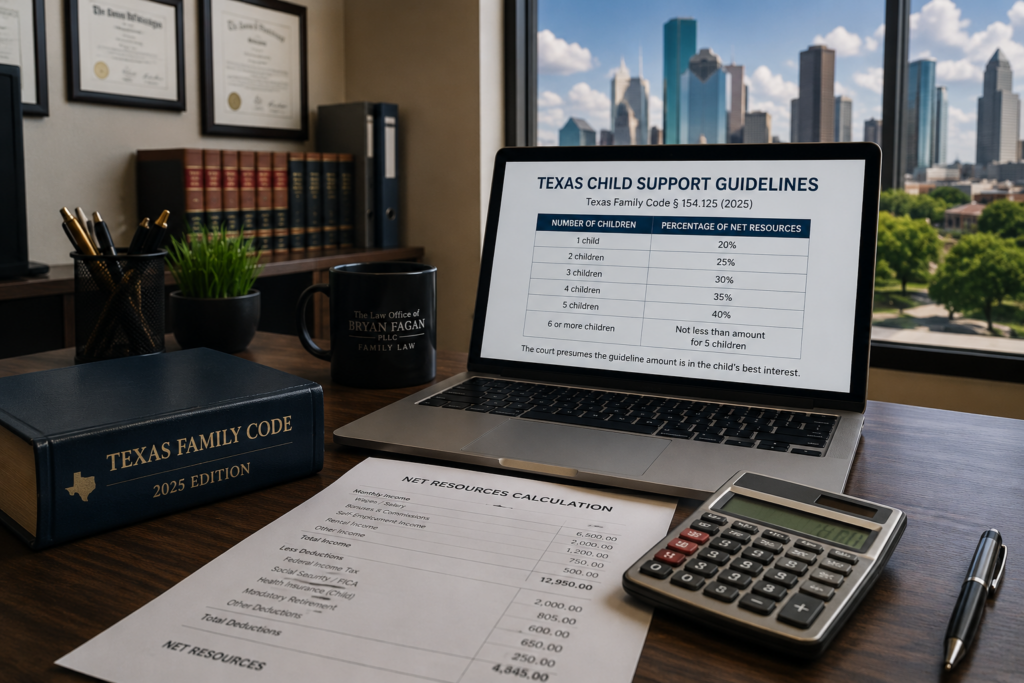
Parents looking for Child support Attorneys in Houston Heights Texas are often relieved to learn that Texas uses a structured formula to calculate child support rather than leaving the amount entirely to judicial discretion. Under Texas Family Code §§154.001 and 154.125, child support is generally calculated as a percentage of the paying parent’s monthly net resources. For many families in Houston Heights, Woodland Heights, Garden Oaks, Timbergrove, and Oak Forest, understanding that formula is the first step toward reducing uncertainty and making informed decisions about their future.
The percentage itself is usually not where disputes arise. The real issue is determining what counts as net resources under Texas Family Code §154.062. A parent with a traditional salary may have a relatively straightforward calculation, but situations involving self-employment income, commissions, bonuses, rental properties, or business ownership often require a much deeper financial analysis. Texas judges closely evaluate financial records, tax returns, credibility, and the consistency of the evidence presented when determining a parent’s actual income.
In straightforward situations, applying the guideline formula may be relatively simple. In more complex cases involving hidden income allegations, self-employment, child support modification, or enforcement proceedings, the calculation can become one of the most heavily contested issues in the case. Delaying action or relying on assumptions about the other parent’s finances can create costly mistakes that become harder to correct later.
Texas’s formula-driven approach creates more predictability than many other states, but successful outcomes still depend on accurate financial information and a clear understanding of the law. Parents navigating child support matters in Harris County can benefit from understanding both the statutory guidelines and the local court process. Additional information about local courts and resources can be found in our guide to Harris County governmental resources.
Why the inputs win cases: I have seen guideline support move by hundreds of dollars a month purely on whether overtime, a recurring bonus, or self-employment income was correctly characterized. The court will not do this work for you. Bringing organized proof of the other parent’s true net resources is the single highest-leverage thing you can do.
The Guideline Percentages at a Glance
| Category | What Texas Law Says | Practical Impact |
|---|---|---|
| One child | 20% of net resources (§154.125) | At the $11,700 cap, up to about $2,340/mo |
| Two children | 25% of net resources | Up to about $2,925/mo at the cap |
| Three children | 30% of net resources | Up to about $3,510/mo at the cap |
| Net resources cap | $11,700/mo as of 9/1/2025 (§154.125) | Percentages apply only to the first $11,700 |
| Above the cap | Court may order more (§154.126) | Requires proof of the child’s actual needs |
What Counts as Net Resources
In Texas, “net resources” means far more than your take-home pay. Under Texas Family Code §154.062 (2025), net resources include wages, salary, overtime, commissions, bonuses, self-employment income, rental income, dividends, interest, and most retirement income — minus a set of standardized deductions like federal income tax (figured as a single filer), Social Security or mandatory retirement, and union dues. Means-tested benefits such as TANF, SSI, and SNAP do not count.
This definition is where Heights cases are won and lost. A parent who runs a business can show low “income” on paper while living well; the court is entitled to look at actual resources, not just a tax return. A parent paid partly in cash, or one who suddenly reduces hours after a divorce filing, can be found to be intentionally underemployed — and the court can calculate support based on earning potential, not the reduced figure.
The takeaway: if the other parent’s real financial picture differs from what they report, that gap is your case. Bank records, business deposits, prior tax returns, and a clear timeline of when their income changed are the evidence that moves a judge.

The 2025 Cap Increase and Who It Affects
Parents searching for Child support Attorneys in Houston Heights Texas should be aware of one of the most significant recent changes to Texas child support law. Effective September 1, 2025, Texas Family Code §154.125 increased the cap on monthly net resources used to calculate guideline child support from $9,200 to $11,700. The guideline percentages themselves did not change. What changed is the amount of income subject to those percentages, which means higher-income parents may see substantially different support calculations under the new law.
The part many parents in Houston Heights, Woodland Heights, Garden Oaks, Timbergrove, and Oak Forest overlook is that the increase does not automatically change existing court orders. Child support orders entered before September 1, 2025 generally remain based on the prior cap unless a parent files a modification and the court approves the change under Texas Family Code §156.401. In straightforward situations, determining whether a modification makes financial sense may be relatively simple. In more complex cases involving significant income changes, bonuses, business ownership, self-employment income, or disputed financial records, a detailed analysis is often necessary before deciding how to proceed.
Texas courts do not modify child support simply because a parent requests it. Judges expect credible evidence, accurate financial documentation, and proof that the statutory requirements for modification have been met. Where disputes become contested, issues such as hidden income, fluctuating earnings, or disagreements about net resources can significantly affect the outcome. Delaying action can also be costly because support modifications generally do not apply retroactively to periods before a request is properly filed and served.
For many families, the cap increase creates new opportunities to review whether an existing order still reflects current circumstances. Understanding your rights early can help you avoid expensive mistakes and make informed decisions about your family’s future. Parents seeking additional local support resources may also find our guide to Harris County medical resources helpful when addressing the broader needs of children affected by family law matters.
Strategy point: If your net resources are above $9,200 and your order predates September 2025, the cap change alone may not be enough to justify reopening — you need a material and substantial change too. But paired with a real income shift or a child aging out, it can tip the math meaningfully. This is a calculation to run before you file, not after.
Common Misunderstandings About Child Support in Texas

Parents searching for Child support Attorneys in Houston Heights Texas often come into a consultation with assumptions that sound reasonable but can create serious legal problems if left uncorrected. One of the most common misconceptions is that child support and visitation are connected. They are not. Under Texas law, a parent cannot withhold possession of a child because support has not been paid, and a parent cannot stop paying support because visitation is being denied. Harris County family courts treat these as separate legal obligations, and violations of either can result in enforcement proceedings under Texas Family Code §157.001.
Another mistake parents in Houston Heights, Woodland Heights, Garden Oaks, and Timbergrove frequently make is relying on informal agreements. A handshake agreement, text message exchange, or verbal understanding between parents may feel practical, but it is generally not enforceable unless it is incorporated into a signed court order. In straightforward situations, updating an existing order may be relatively simple. Where disputes become contested, however, failing to properly document changes can create expensive complications and leave both parents without the legal protections they thought they had.
Many parents also assume that a 50/50 possession schedule automatically eliminates child support. In reality, Texas courts look at multiple factors, including each parent’s financial circumstances and the best interests of the child under Texas Family Code §153.002. A higher-earning parent may still be required to pay support even when parenting time is shared equally. If your case involves self-employment income, significant income disparities, child support modification, or contested custody issues under Texas Family Code §153.134, the analysis becomes much more complex than simply comparing parenting schedules.
The most effective decisions are usually made before misunderstandings turn into legal disputes. Taking the time to understand how Texas child support laws actually work can help parents avoid costly mistakes and make informed decisions for their families. Parents looking for local resources that affect day-to-day family life may also find our guide to transportation in Harris County helpful when planning custody exchanges, visitation schedules, and other family law obligations.
Listen to Our Texas Family Law Podcast
Prefer listening? In this episode, we discuss child support in Houston Heights, Texas, including how support is calculated, what rules parents should understand, and how enforcement may work when payments are missed.
What Matters Most in a Contested Child Support Case
Parents searching for Child support Attorneys in Houston Heights Texas are often surprised to learn that most contested child support cases do not revolve around the guideline percentages themselves. In Harris County family courts, the real disputes typically focus on three issues: the paying parent’s true net resources, whether a deviation from the guideline amount is justified, and whether a parent is intentionally earning less than they are capable of earning. These issues can significantly affect the outcome of a case, particularly when families in Houston Heights, Woodland Heights, Garden Oaks, Timbergrove, or Oak Forest are dealing with changing financial circumstances.
Texas law recognizes that every family is different. Under Texas Family Code §154.123, a judge may order child support above or below the guideline amount when the evidence shows that a child’s specific needs justify a different result. Factors such as significant medical expenses, educational needs, extraordinary travel costs for visitation, or a child’s disability may support a deviation. Under §154.126, support above the statutory cap requires evidence of the child’s actual needs, not simply proof that one parent earns a substantial income. In straightforward situations, guideline support may resolve the issue. In more complex cases, detailed documentation, financial records, receipts, evaluations, and credible testimony often become critical to proving what level of support is truly appropriate.
Another issue that frequently arises is underemployment. If a parent voluntarily leaves a higher-paying job, reduces work hours, or shifts income in a way that appears designed to lower child support, the court may consider earning capacity rather than current earnings. Where disputes become contested, judges evaluate work history, education, professional qualifications, employment opportunities, and the timing of any income changes. Credibility matters. Courts often look beyond what appears on paper to determine whether a parent’s financial picture accurately reflects reality.
Because contested child support cases frequently involve detailed financial evidence and child-focused considerations, obtaining accurate information early can make a significant difference. If your case involves self-employment income, hidden income allegations, child support modification, high-asset finances, or related custody disputes under Texas Family Code §153.002, a strategic approach may be necessary to protect your interests and your child’s future. Families looking for additional resources that support children’s long-term development may also find our guide to educational opportunities in Harris County helpful as they navigate life after a family law matter.
Is there already a child support order in place?
Yes, an order already exists No order yet ← Start overWhat’s driving you to look into this now?
The other parent stopped paying Income or circumstances have changed The order just seems out of date ← BackHas parentage been established or is it admitted?
Yes, parentage isn’t in dispute Not sure / it’s contested ← BackRoughly what are the paying parent’s monthly net resources?
Under $11,700/month Above $11,700/month Not sure — income is hard to pin down ← BackIs the paying parent self-employed or paid partly in cash?
Yes No, standard W-2 income Not sure ← BackWhere does the child primarily live?
Houston Heights or elsewhere in Harris County A nearby county (Fort Bend, Montgomery, Galveston, Brazoria) Out of state, or the order is from another state ← BackYou have a clear, well-positioned Harris County case.
Your matter is squarely in Harris County jurisdiction with a knowable path forward. The next step is an accurate net-resources calculation and a filing strategy — establishment, modification, or enforcement — built around the 2025 guidelines. This is exactly the kind of case we move quickly when the records are organized.
Start over
You have a real case — with a jurisdiction wrinkle to sort first.
Because the child or a prior order sits outside Harris County, venue and continuing jurisdiction need to be confirmed before filing. The Texas formula and the $11,700 cap apply the same way, but which courthouse hears your case affects timing. We handle cases across Harris, Fort Bend, Montgomery, Galveston, and Brazoria, plus out-of-state order issues.
Start over
Find out where your Houston Heights child support situation stands — in about 60 seconds.
Six quick questions. No contact info required. You’ll get a read on your situation and the right next step.
Start the check →“The guideline number is the starting line, not the finish. The case is built on what counts as income and what the child actually needs.”
Got your likely tier from the tool above? The next step is a real numbers review with an attorney who handles Harris County child support every week.
Schedule a Strategy SessionModifying an Existing Child Support Order
Parents searching for Child support Attorneys in Houston Heights Texas are often surprised to learn that child support orders do not automatically adjust when life changes. Under Texas Family Code §156.401, a child support order may be modified if there has been a material and substantial change in circumstances since the last order, or if at least three years have passed and the guideline amount would differ by either 20% or $100. These legal standards provide two separate paths for modification, and either one may be enough to justify asking the court for a new child support amount.
A material and substantial change can include many of the situations families in Houston Heights, Woodland Heights, Garden Oaks, Timbergrove, and Oak Forest commonly face. Examples include a significant increase or decrease in income, job loss, a change in custody arrangements, a child aging out of support, the birth of another child, or changes affecting a child’s needs. In straightforward situations, these changes may be well documented and relatively easy to present to the court. In more complex cases involving self-employment income, contested financial records, relocation issues, or ongoing custody disputes, the evidence required to support a modification request can become much more detailed.
One of the most important realities about child support modification is timing. Courts generally modify support prospectively, meaning the change often takes effect after the other parent is served—not when the underlying change occurred. A parent who waits months after losing a job or experiencing a major income reduction may still remain responsible for support at the previous amount during that delay. This is one of the most common and costly mistakes families make when they assume the court will automatically account for changed circumstances.
If your case involves child support modification, obtaining accurate information early can help you make informed decisions and avoid unnecessary financial exposure. Families who are new to the area or considering a move may also benefit from learning more about moving to the Houston Heights and the local community resources available to support their transition. Understanding your rights and obligations now can help create greater stability and peace of mind for your family moving forward.
Costly mistake: Do not stop paying or unilaterally reduce your payment while you “wait to file.” The order in place is the order you owe. Arrears accrue, interest attaches, and the court rarely forgives them. If your income dropped, the move is to file a modification immediately — not to self-adjust and hope a judge agrees later.
Enforcement When the Other Parent Stops Paying

When a parent stops paying court-ordered child support, Texas gives the receiving parent real enforcement tools under Texas Family Code §157.001 and following (2025). The court can order income withholding, suspend a driver’s or professional license, intercept tax refunds, place liens, and hold the non-paying parent in contempt — which can include jail time and a judgment for the full arrearage plus interest.
An enforcement action is technical. The motion has to plead each missed payment with specificity — date due, amount due, amount paid — and the proof has to match. Sloppy enforcement motions get dismissed and have to be refiled, which costs you months. This is not a do-it-yourself filing; the precision requirements are exactly why parents hire counsel for enforcement.
If you are the parent being pursued for arrears, you are not without options. Mistaken accounting, payments not credited, and periods where the order should have been modified are all defenses — but they have to be raised correctly and on time.
$11,700
2025 net-resources cap (§154.125)
20%
Guideline for one child
3 yrs
Modification track without a major change (§156.401)
Harris County Procedure for Houston Heights Cases
Every child support case arising in the Houston Heights is a Harris County case, filed and heard at the family courts downtown at 201 Caroline. The Heights, Garden Oaks, Woodland Heights, and the surrounding neighborhoods all fall within Harris County jurisdiction, which means your matter lands in one of the county’s family district courts and often in front of an associate judge for the support docket.
What that means practically: Harris County is a high-volume jurisdiction, and the difference between a quick resolution and a stalled one is often whether your paperwork is clean and your evidence is organized before the first setting. Associate judges hear a heavy support docket; a well-prepared case gets heard and decided, while an incomplete one gets reset.
The Office of the Attorney General Child Support Division also operates in Harris County and handles many establishment and enforcement cases. The OAG represents the State’s interest in support being paid — not your individual interest. If your case is in the OAG system and your situation is contested or financially complex, that is a reason to have your own attorney, not a reason to assume it is handled.
Which Situation Are You In?
| Your Status | Eligibility Test | What It Means |
|---|---|---|
| No order yet | Parentage established or admitted | Establishment case under Chapter 154 |
| Order exists, circumstances changed | Material & substantial change, OR 3 yrs + 20%/$100 | Modification under §156.401 |
| Order exists, other parent won’t pay | Missed payments documentable by date/amount | Enforcement under §157.001+ |
| High earner, pre-9/2025 order | Net resources above old $9,200 cap | Run the new-cap math before filing |
How Nearby Counties Differ
The Texas Family Code is statewide, so the formula and the cap are identical whether your case is in Harris, Fort Bend, Montgomery, Galveston, or Brazoria County. What differs is local court practice — docket speed, associate-judge assignments, standing orders, and how each county’s courts handle setting and resetting hearings.
If you live in the Heights but the other parent and child have moved to Montgomery County, or if a prior order was entered in Fort Bend, jurisdiction and venue questions come first. The court that entered the original order generally keeps continuing jurisdiction over modifications, which can mean your “Heights” case is actually litigated in a neighboring county’s courthouse.
This matters for one practical reason: an attorney who only knows the Harris County downtown courts may be slower in Conroe or Richmond. Our firm appears across Harris, Fort Bend, Montgomery, Galveston, and Brazoria, which is the realistic footprint of a Heights family’s life.
What to Do If You’re Dealing With Child Support in the Heights
Bring this checklist to a Legal Strategy Session and we’ll work through it line by line for your case.
Schedule a Strategy SessionWhat I Tell Every Client Who Calls About Child Support

The first thing I tell every Heights parent who calls is that the guideline number is knowable today. You do not have to live in uncertainty about what you will owe or receive — the formula is in the statute, the cap is set, and with an accurate net-resources figure we can give you a real range in one meeting. The uncertainty people feel is almost always about the other parent’s income or about a court process they have never been through, and both are things we handle constantly.
The second thing is that timing decides money. Whether you are modifying or enforcing, the date you file matters. Modifications run from the date of service, arrears accrue every month, and the parent who acts first is usually the parent in the stronger position. Waiting is the most expensive choice most people make in a child support case.
If you are dealing with child support in the Houston Heights — establishing it, changing it, or enforcing it — the threshold for getting help is low and the cost of waiting is high. Bring your order and your records to a Legal Strategy Session, and we will tell you exactly where you stand and what to do next.
Get a real answer on your child support number — this week.
Get a real answer on your child support number — this week.
Schedule a Strategy SessionConclusion:
Divorce and child support decisions are ultimately about more than court orders and financial calculations—they are about creating stability for children during a time of significant change. Whether you are establishing support, modifying an existing order, or working through custody concerns, the choices you make today can influence your child’s sense of security and well-being for years to come. Understanding how Texas courts approach these issues allows you to make decisions with greater clarity and confidence rather than reacting to uncertainty.
In straightforward situations, parents may simply need guidance on applying the Texas child support guidelines and documenting an agreement correctly. In more complex cases, the stakes are often higher. If your case involves disputed income, self-employment, modifications, enforcement actions, high-conflict custody issues, or concerns about how family transitions are affecting your child, having the right legal strategy becomes increasingly important. The goal is not just to resolve a legal issue—it is to create a framework that supports your family moving forward.
The team at The Law Office of Bryan Fagan, PLLC believes families deserve answers, not confusion. If you are searching for Child support Attorneys in Houston Heights Texas, our role is to help you understand your options, protect what matters most, and develop a path forward that fits your family’s unique circumstances. Through education, strategic guidance, and compassionate representation, we help Texas families move through difficult transitions with greater peace of mind and a clearer vision for the future.
Questions My Clients Ask About Child Support in Houston
It depends on what your case requires — an uncontested establishment costs far less than a contested modification with a self-employment income fight. Most family law attorneys in the Houston area work on a retainer against an hourly rate, with the retainer set by the complexity of your matter. In a Legal Strategy Session we give you a realistic range for your specific situation rather than a generic number, because the cost driver is whether the other side fights, not the label on the case.
A board-certified or experienced family law attorney who regularly handles support, modification, and enforcement in your county. Child support sits inside family law, and the cases that go sideways are the ones where the lawyer does not understand net-resources disputes or local court practice. For a Heights case, you want someone who appears in the Harris County family courts routinely and has handled the self-employment and underemployment arguments that decide close cases.
Roughly $2,000 a week is about $8,667 a month gross, which lands under the $11,700 net-resources cap after deductions for most people, so the guideline percentage applies to your full net figure. For one child at 20%, you would be looking at roughly $1,400–$1,600 a month depending on your exact deductions under §154.062. That is an estimate — the real number depends on your tax status, health-insurance costs for the child, and whether you support other children.
Yes for some situations. The Office of the Attorney General Child Support Division will help establish and enforce orders at no cost, and legal aid organizations serve qualifying low-income parents. The catch is that the OAG represents the State’s interest, not yours — it will not advocate for your particular position in a contested or financially complex case. If your matter involves disputed income, custody, or real money at the margin, your own attorney is the difference.
Yes. A significant increase in the paying parent’s income is a classic material and substantial change under §156.401, and it is one of the most common reasons Heights parents file a modification. You can also use the three-year/20% track if it has been at least three years since the last order and the guideline number would now differ by 20% or $100. Bring proof of the income change — the court will not investigate it for you.
Not automatically. Equal possession can reduce or eliminate support, but the income difference between the parents still drives the calculation. A parent who earns substantially more than the other can owe support even with a 50/50 schedule, because the guideline is built around net resources, not just time. The right approach is to run the actual numbers rather than assume equal time zeroes it out.
The other parent can file an enforcement action under §157.001, and the consequences are serious: wage withholding, suspension of your driver’s and professional licenses, tax-refund interception, liens, a judgment for the full arrearage plus interest, and contempt that can include jail. Arrears do not disappear and courts rarely forgive them. If you genuinely cannot pay, the answer is to file a modification immediately — not to stop paying and hope.
Generally until the child turns 18 or graduates from high school, whichever is later, under §154.001 and §154.002. Support can continue indefinitely for a child with a disability that requires ongoing care. When the youngest child covered by an order ages out, the order does not end on its own for multi-child orders — the amount may need to be recalculated, which is itself a modification.
Yes, and these are some of the most contested cases. Self-employment income counts as net resources under §154.062, and the court can look past a low reported income to actual business deposits and lifestyle. Proving a self-employed parent’s true net resources takes bank records, business records, and prior returns — it is exactly the kind of case where having an attorney who knows how to build the financial picture changes the outcome.
If your case is contested, very likely yes — the Harris County family courts downtown hear support matters for the Heights and surrounding neighborhoods. Many uncontested matters resolve on paper or in brief hearings, and some settings are handled by associate judges on the support docket. Whether you set foot in the courtroom depends on whether the other side agrees; either way, the case is filed in Harris County.
Still have a question that isn’t on this list? That’s exactly what a Strategy Session is for — bring it.
Schedule a Strategy Session