
Child Visitation Attorney in Texas: What a Parent Needs to Know About Possession and Access

Most parents do not start looking for Parental Visitation Attorneys in Houston Heights Texas because everything is going well. They call after something changed. A child who suddenly seems withdrawn. Grades that start slipping. A teacher asking whether something is happening at home. A parent who notices homework is no longer getting done, or that a once-confident child now dreads going to school. By the time a mother or father starts researching custody, visitation, and how divorce affects children, the concern is rarely theoretical. It is personal. It is happening in their home, right now.
Here is what I tell parents when they sit down in my office. Divorce does not just change where a child sleeps. It changes routines, expectations, relationships, and sometimes a child’s sense of stability. Texas courts understand that reality. That is one reason judges spend so much time evaluating what arrangement will serve a child’s best interest under Texas Family Code §153.002. The question is not simply where the child will live or how many weekends each parent receives. The question is whether the structure being created will help that child continue to grow, develop, and succeed despite the changes happening around them.
I remember speaking with a father who was frustrated because he believed his custody dispute was only about parenting time. As we dug deeper, we discovered his daughter had gone from being an honor-roll student to struggling in several classes during the divorce process. Neither parent had connected the dots. The frequent schedule changes, inconsistent routines between households, and ongoing conflict were affecting far more than visitation. Once the parents created a more predictable possession schedule and reduced conflict, her academic performance began improving almost immediately. Situations like that are more common than many people realize.
At The Law Office of Bryan Fagan, PLLC, we have spent years helping Texas families navigate these challenges with clarity and confidence. Founded by Bryan Joseph Fagan, a South Texas College of Law graduate and recognized authority on Texas divorce and custody law, our firm believes legal guidance should do more than help families resolve disputes. It should educate, empower, and provide practical solutions that protect what matters most. That commitment reflects our purpose: helping people reclaim freedom and peace of mind during life’s most difficult transitions.
This guide explains how divorce can affect a child’s academic performance, how Texas courts evaluate educational stability when making custody decisions, and what parents can do to support their children during this transition. More importantly, it will help you understand how thoughtful custody and visitation planning can create the consistency, structure, and security children need to thrive long after the divorce is finalized.
Key Takeaways
- Texas calls visitation “possession and access.” Your rights live in Chapter 153 of the Family Code, and the default is the Standard Possession Order under §153.252 (2025).
- The standard schedule is a presumption, not a ceiling. It is presumed in the child’s best interest at age three or older, but a court can order more or less time when the evidence supports it.
- Distance changes the schedule. Parents living within 100 miles get one version of the standard order; over 100 miles gets a different one with longer, less frequent blocks.
- Children under three are handled separately. Under §153.251(d) the standard presumption does not apply; the court builds a custom schedule from the §153.254 factors.
- Changing an order takes a real change. Modification under §156.101 (2025) requires a material and substantial change in circumstances plus best-interest proof.
- Deadlines are real and unforgiving. The summer-possession election deadline is April 1. Miss it and you take the default, not the schedule you wanted.
- Never self-help. Withholding the child or support to retaliate damages your own case. Enforce through the court instead.

Your Family’s Future Starts Here
Don’t navigate your legal journey alone. Schedule a consultation now and get the clarity and support you deserve.
Family lawyers and attorneys advise our clients of the immediate aftermath as well as the long-term effects of Family Law related issues, such as the following:
Trust us to help you with your Family Law Attorneys in the Houston Heights in Texas. Call (281) 245-1776 or contact us online today to schedule a free consultation with your Family Law Attorney in Humble, Texas.
What “child visitation” actually means in Texas

Many parents searching for Parental Visitation Attorneys in Houston Heights Texas assume that “visitation” is the legal term Texas courts use when determining a parent’s time with a child. It is not. Under Texas Family Code Chapter 153, the law refers to these rights as possession and access, and every schedule a judge signs must be guided by one overriding principle: the child’s best interest. Texas Family Code §153.002 requires courts to focus on what promotes stability, healthy parent-child relationships, and a child’s long-term emotional and developmental well-being—not what is most convenient for either parent.
One of the most common misunderstandings in family law is the difference between custody and visitation. In Texas, “custody” is generally referred to as conservatorship, which involves decision-making authority over important aspects of a child’s life, such as education and healthcare. Possession and access address something different: when each parent physically spends time with the child. A parent can share significant decision-making rights as a Joint Managing Conservator under Texas Family Code §153.134 while still following a structured possession schedule. Understanding that distinction often helps parents focus on the issues that actually matter in their case.
Texas provides more structure than many states through its Standard Possession Order, found in Texas Family Code §153.252. Rather than leaving every parenting schedule entirely to judicial discretion, the law establishes a default framework that courts presume is generally in a child’s best interest. Parents who want to better understand how these schedules work can review our guide to the Texas Standard Possession Order. In straightforward situations, these statutory schedules often provide a predictable roadmap for co-parenting. In more complex cases involving relocation, enforcement issues, special needs, or high-conflict parenting disputes, courts may need additional evidence to determine whether a different arrangement better serves the child.
The reality is that visitation cases are rarely just about calendar dates. Judges often evaluate a parent’s credibility, compliance with existing orders, willingness to support the child’s relationship with the other parent, and ability to provide consistency over time. When parents disagree about possession schedules, or when circumstances have changed significantly since an order was entered, waiting too long to address the issue can make resolution more difficult. Understanding your rights early and approaching the situation with a clear strategy can help preserve important parent-child relationships while creating the stability children need to thrive.
The Short Answer
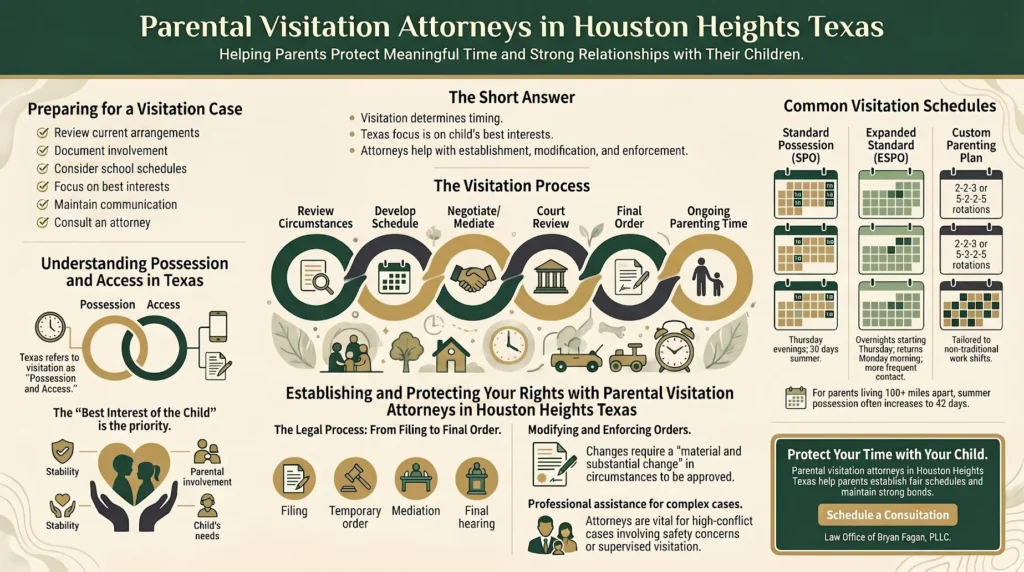
A child visitation attorney helps a parent obtain, enforce, or change court-ordered time with their child. In Texas, this is governed by Chapter 153 of the Family Code, and the default is the Standard Possession Order under §153.252 (2025), presumed to be in the best interest of any child age three or older. The schedule can be expanded, reduced, or customized when the facts justify it.
The Standard Possession Order, explained
Parents searching for Parental Visitation Attorneys in Houston Heights Texas often want to know one thing first: “What schedule am I likely to get?” In many Texas cases, the starting point is the Standard Possession Order, often called the SPO. Under Texas Family Code §153.252, the SPO is presumed to provide reasonable minimum possession for a parent named as a possessory conservator or joint managing conservator when the child is three years old or older. In plain English, that means Texas gives courts a default visitation framework—but the court still has to look at what serves the child’s best interest under Texas Family Code §153.002.
For parents who live within 100 miles of each other, the Standard Possession Order usually includes the first, third, and fifth weekends of each month, a Thursday evening during the school year, alternating holidays, and extended summer possession. When parents live more than 100 miles apart, the schedule often changes to fewer weekend visits but longer holiday and summer periods. Parents can learn more about how this works in our guide to the Texas Standard Possession Order. These details matter because a missed deadline, unclear exchange plan, or misunderstanding about school-year possession can quickly turn a workable order into a conflict.
In straightforward situations, the SPO may give both parents a clear, predictable rhythm that supports stability for the child. In more complex cases, however, the default schedule may not fit. If your case involves relocation, high-conflict co-parenting, unusual work schedules, special educational or medical needs, CPS concerns, or repeated violations of an existing order, the court may need stronger evidence before approving a different arrangement. Where visitation disputes become contested, judges often look closely at each parent’s credibility, history of involvement, compliance with prior orders, and willingness to support the child’s relationship with the other parent.
The SPO is a presumption, not a ceiling. A court can order an expanded or customized possession schedule when the facts support it, but parents should be prepared to explain why the change serves the child’s best interest. That is where early legal guidance can make a real difference. Waiting until exchanges are already breaking down, grades are slipping, or one parent is withholding time can make the case harder to fix. A thoughtful plan built around the actual facts of your family can help protect parent-child relationships, reduce conflict, and give children the consistency they need to move forward.
“The standard order is the floor the law gives you, not the ceiling of what you can ask for. Most parents leave time on the table because they treat the default as the only option.”
Strategy note: Children under three are treated differently. Under §153.251(d) the standard-schedule presumption does not apply to a child under three, and the court sets a schedule from the §153.254 factors — caregiving history, the child’s needs, the distance between homes. If you have an infant or toddler, your order should also spell out what changes when the child turns three, so you aren’t back in court.
100 miles
The distance that splits the SPO into two different schedules
Age 3
Where the standard-schedule best-interest presumption kicks in
April 1
The deadline to elect your preferred summer possession
Not sure whether the standard schedule fits your family — or how to argue for more? Let’s map it to your facts.
Schedule a Legal Strategy SessionCommon misunderstandings parents bring me
The single most common misunderstanding is that paying child support buys visitation, or that being denied visitation lets you stop support. Neither is true. Possession and support are separate obligations in Texas — a parent who withholds the child is violating the order, and a parent who stops paying support to retaliate is also violating the order. Both end up in front of the same judge, and the one who took matters into their own hands usually loses ground.
The second is the belief that mothers automatically get more time. Texas law is gender-neutral on its face; §153.002’s best-interest standard says nothing about which parent is which. Fathers in Texas are entitled to the same standard possession schedule, and “visitation rights for a father in Texas” is decided on the same statute and the same evidence as anyone else’s. The third myth is that a child of a certain age “gets to decide.” A child 12 or older can tell the judge their preference, but the judge is never bound by it — best interest still controls.
Warning: A verbal agreement to change the schedule is not enforceable. If you and the other parent informally swap weekends for two years and then the relationship sours, the written order is what the court enforces — not your handshake. Put every lasting change into a modified order.
What matters when visitation is contested
When visitation is contested, the case is won on evidence tied to the child’s best interest, not on which parent is angrier. Texas courts look at the caregiving history, the stability each home offers, the distance between residences, the child’s needs, and — critically — any history of family violence under §153.004 (2025), which a court must consider and which can justify supervised or restricted access.
The parent who documents wins. A calendar of actual exchanges, texts showing missed or denied visits, school and medical records showing involvement, and a clean record of following the existing order — these carry far more weight than testimony about what the other parent is “like.” Supervised visitation violations are a good example: if an order requires supervision and the other parent is violating it, contemporaneous documentation is what turns your complaint into an enforceable motion. The reverse is also true. If you are the parent under restrictions, the fastest route back to standard possession is a documented track record of compliance.
<div id="lobf-visitation-tool"> to its closing tag — is the paste-ready block for its own WordPress Custom HTML block. The outer page wrapper, fonts, and this note are preview-only. Test on the live/staging URL, not here: only Q1 should show, answers should advance, “Start over” should return to Q1, and a disqualifying answer should route straight to the gated screen.
Is there already a court order in place for possession and access?
Yes, we have a signed order No order yet — we’re starting fresh Not sure / it was never finalized ← Back to startAre you currently being denied the time the order gives you (or the time you’ve shared in practice)?
Yes, time is being denied right now Sometimes — it’s inconsistent No, but I want to change the schedule ← BackHave you been following the current order yourself — exchanges, support, everything?
Yes, I’ve followed it exactly Mostly, with a few gaps No / there have been real problems ← BackDo you have documentation — a log of exchanges, texts, or records showing what’s happening?
Yes, I’ve kept records Some, but not organized No documentation yet ← BackIs there an active CPS case, a protective order, or a family-violence finding involving you in this matter?
Yes — one of these applies No, none of these apply Not sure ← BackYou’re in a good position to act
An order in place, time being denied, your own clean record of compliance, and documentation to back it up — that’s the profile of an enforceable case. The next move is getting it in front of the right court before more time is lost.
The pieces are there — they need shoring up
There’s a real issue here, but some part of it — the order, your documentation, or the facts — needs to be tightened before you file. A short conversation can tell you exactly what to gather and how strong your position really is.
This needs a lawyer before you do anything
An active CPS case, protective order, or family-violence finding changes the entire strategy and the deadlines that come with it. Don’t file or respond on your own here — the first move matters too much. Let’s talk through it directly.
Find out where your visitation case stands — in about a minute.
Answer six quick questions about your situation. There are no forms and nothing to fill in — at the end you’ll see how strong your position looks and what to do next. Start here:
Step 1 of 6What are you trying to do right now?
Get a visitation schedule in place Enforce time I’m being denied Change an existing orderModifying and enforcing an order

Many parents who contact Parental Visitation Attorneys in Houston Heights Texas are not looking to create a visitation schedule—they already have one. The problem is that life has changed, or the other parent is no longer following the order. Texas law recognizes that families evolve over time. Under Texas Family Code §156.101, a court may modify a possession and access order when there has been a material and substantial change in circumstances and the requested change serves the child’s best interest. Common examples include a parent’s relocation, a significant job change, remarriage, a child’s changing educational or medical needs, or circumstances that affect the stability of the current arrangement. For parents who want a deeper understanding of visitation schedules and possession rights, our guide to Texas parental visitation and Standard Possession Orders provides additional insight.
In straightforward situations, modifying an order may involve updating a schedule that no longer fits the realities of a child’s life. In more complex cases, the court may need to evaluate extensive evidence regarding the child’s emotional needs, school performance, parent-child relationships, and each parent’s ability to provide consistency and stability. Texas judges do not modify orders simply because one parent prefers a different arrangement. They expect evidence showing that circumstances have genuinely changed and that the proposed modification will improve the child’s overall well-being. Waiting too long to address a problem can sometimes allow conflicts to grow and make resolution more difficult.
Enforcement is a different issue altogether. When parents disagree about visitation schedules or one parent repeatedly violates an order, Texas courts have tools available to enforce compliance. A court may award make-up visitation, order attorney’s fees, or, in some situations, hold a noncompliant parent in contempt. One of the most common mistakes parents make is attempting to solve the problem themselves by withholding visitation, refusing exchanges, or stopping child support payments. Those actions often create additional legal problems and can negatively affect how a judge views the case. Where visitation disputes become contested, courts frequently evaluate each parent’s credibility, willingness to follow court orders, and commitment to supporting the child’s relationship with the other parent.
If your case involves relocation, interstate custody issues, repeated visitation violations, high-conflict co-parenting, or concerns about a child’s safety and well-being, obtaining legal guidance early can be especially important. Jurisdiction questions, enforcement actions, and custody modifications often become more complicated when parents live in different cities or states. Taking proactive steps before problems escalate can help preserve parental rights, protect meaningful parent-child relationships, and create the long-term stability Texas courts seek when making decisions affecting children.
Is there already a court order in place for possession and access?
Yes, we have a signed order No order yet — we’re starting fresh Not sure / it was never finalized ← Back to startAre you currently being denied the time the order gives you (or the time you’ve shared in practice)?
Yes, time is being denied right now Sometimes — it’s inconsistent No, but I want to change the schedule ← BackHave you been following the current order yourself — exchanges, support, everything?
Yes, I’ve followed it exactly Mostly, with a few gaps No / there have been real problems ← BackDo you have documentation — a log of exchanges, texts, or records showing what’s happening?
Yes, I’ve kept records Some, but not organized No documentation yet ← BackIs there an active CPS case, a protective order, or a family-violence finding involving you in this matter?
Yes — one of these applies No, none of these apply Not sure ← BackYou’re in a good position to act
An order in place, time being denied, your own clean record of compliance, and documentation to back it up — that’s the profile of an enforceable case. The next move is getting it in front of the right court before more time is lost.
The pieces are there — they need shoring up
There’s a real issue here, but some part of it — the order, your documentation, or the facts — needs to be tightened before you file. A short conversation can tell you exactly what to gather and how strong your position really is.
This needs a lawyer before you do anything
An active CPS case, protective order, or family-violence finding changes the entire strategy and the deadlines that come with it. Don’t file or respond on your own here — the first move matters too much. Let’s talk through it directly.
Find out where your visitation case stands — in about a minute.
Answer six quick questions about your situation. There are no forms and nothing to fill in — at the end you’ll see how strong your position looks and what to do next. Start here:
Step 1 of 6What are you trying to do right now?
Get a visitation schedule in place Enforce time I’m being denied Change an existing orderOrder being ignored, or circumstances changed? The sooner you file, the more options you have.
Schedule a Legal Strategy SessionThe mistakes and deadlines that sink cases
Many parents who consult Parental Visitation Attorneys in Houston Heights Texas do not lose parenting time because they lack a strong case. They lose it because of small mistakes that seemed harmless at the time. In Texas visitation cases, missed deadlines, undocumented agreements, and attempts to handle disputes without court involvement can create problems that are difficult to fix later. One of the most common examples involves summer possession elections. Under the Standard Possession Order framework, parents who want specific summer dates often must provide written notice by a statutory deadline. Missing that deadline can mean losing preferred parenting time and being required to follow the default schedule instead. Parents can learn more about these rules by reviewing our guide to Texas Standard Possession Orders and visitation schedules.
Another common issue is what many family law attorneys call “informal drift.” Parents agree to change a visitation schedule verbally, follow the new arrangement for months or even years, and assume everything is fine. Then circumstances change, conflict arises, and one parent suddenly returns to the written court order. Because the agreement was never formalized through a court-approved modification under Texas Family Code §156, the parent relying on the informal arrangement may have little legal protection. In straightforward situations, parents can often avoid this problem by documenting changes properly and seeking court approval when a new schedule becomes permanent.
Where visitation disputes become contested, courts look closely at each parent’s conduct over time. Texas judges evaluate compliance with existing orders, credibility, co-parenting efforts, and whether each parent has acted in a way that supports the child’s best interest under Texas Family Code §153.002. If your case involves repeated missed exchanges, allegations of family violence, relocation issues, or ongoing violations of possession orders, the stakes become significantly higher. Evidence matters. Documentation matters. Waiting too long to address problems can allow harmful patterns to become more difficult to correct.
The best protection against these avoidable setbacks is consistency. Follow the court order, keep detailed records, communicate clearly, and address concerns before they escalate. When parents disagree about visitation schedules or circumstances have changed significantly since the order was entered, proactive legal guidance can often prevent small issues from becoming major litigation. Taking action early helps preserve parent-child relationships, protect parental rights, and create the long-term stability Texas courts strive to achieve for children and families.
Listen to Our Texas Family Law Podcast
Prefer listening? In this episode, we discuss parental visitation in Houston Heights, Texas, including how parenting time is arranged, what possession and access rights mean, and how to protect meaningful time with your child.
How the process runs in a Texas court
Parents searching for Parental Visitation Attorneys in Houston Heights Texas are often surprised to learn that the outcome of a visitation case depends on more than just the law itself. While Texas Family Code Chapter 153 establishes statewide rules regarding possession and access, every family court applies those rules within its own local procedures. Most visitation disputes begin in the county with continuing jurisdiction over the case, and many courts require mediation before a judge will hear a contested custody or visitation matter. Throughout the process, judges remain focused on the child’s best interest under Texas Family Code §153.002, evaluating factors such as stability, consistency, parent-child relationships, and each parent’s willingness to support healthy co-parenting.
In straightforward situations, parents may be able to resolve disagreements through negotiation or mediation without a lengthy court battle. When parents disagree about possession schedules, holiday visitation, exchanges, or parenting responsibilities, mediation often provides an opportunity to create practical solutions while maintaining greater control over the outcome. Parents seeking additional guidance on exchanges and transitions between households can review our article on helping children through visitation exchanges. Courts generally favor agreements that promote consistency and reduce conflict because children tend to benefit from predictable routines and stable relationships with both parents.
In more complex cases, the process can become significantly more involved. If your case involves relocation, repeated visitation violations, requests for custody modification under Texas Family Code §156, CPS concerns, or disputes over a child’s educational or emotional needs, judges often require substantial evidence before making decisions. Where visitation disputes become contested, courts frequently examine compliance with prior orders, communication between parents, witness credibility, documentation, and each parent’s ability to provide long-term stability. Small details that seem unimportant to a parent can become highly relevant when a judge is deciding what arrangement best serves a child’s future.
One of the biggest mistakes parents make is assuming that every court handles visitation issues the same way. Harris County courts, including those serving Houston Heights families, have their own procedures, scheduling practices, and expectations. A strategy that works in one county may require a different approach in another. Understanding both the statewide legal framework and the local court environment can help parents make informed decisions, avoid unnecessary delays, and protect meaningful parent-child relationships throughout the legal process.
What you can expect from us: a clear read on your visitation rights, a realistic schedule built from your child’s age and your circumstances, and a plan to obtain, enforce, or modify the order. Most clients hear back within 5 minutes during business hours (8 AM–10 PM CT, 7 days a week).
What to do if you’re dealing with this right now
1. Read your current order word for word. Know exactly what time you are entitled to before you argue about it.
2. Start a dated log of every exchange — completed, missed, or denied. This becomes your evidence.
3. Keep following the order exactly, even if the other parent isn’t. Your compliance is leverage.
4. Do not withhold the child or stop paying support to make a point. It will be used against you.
5. Save communications in writing. Move scheduling to text or a co-parenting app so there’s a record.
6. Mark your deadlines — especially the April 1 summer-possession election — on a calendar now.
7. If circumstances have changed, gather proof of the material and substantial change before you file.
8. Don’t sign a modified order you don’t fully understand. Once signed, it’s the new baseline.
9. Confirm which county and court your case belongs in — venue affects how it’s heard.
10. Talk to a visitation attorney before you file or respond. The first move often decides the case.
What I tell every client who calls about visitation

One of the first things I tell parents who contact Parental Visitation Attorneys in Houston Heights Texas is that visitation cases are rarely won by emotion alone. They are won by understanding the law, following the court order, and presenting credible evidence when problems arise. Texas Family Code Chapter 153 provides a detailed framework for possession and access, including the Standard Possession Order under §153.252. Whether you are trying to establish visitation, enforce an existing order, or seek a modification, the outcome often depends less on who feels wronged and more on whether the facts support the relief being requested. Parents who understand this early are usually in a much stronger position than those who rely on assumptions or verbal agreements.
In straightforward situations, resolving a visitation issue may be as simple as clarifying exchange logistics or ensuring both parents understand the schedule. When parents disagree about exchanges, transportation responsibilities, or missed visitation periods, reviewing practical guidance on child visitation exchanges in Texas can be a helpful starting point. In more complex cases involving repeated violations, relocation disputes, high-conflict co-parenting, or concerns about a child’s emotional well-being, courts often require detailed evidence demonstrating why intervention is necessary and how the requested outcome serves the child’s best interest under Texas Family Code §153.002.
One of the most common mistakes parents make is waiting too long to act. If you are consistently losing parenting time, if exchanges are repeatedly breaking down, or if the other parent is no longer following the order, hoping the problem resolves itself rarely improves the situation. Judges frequently evaluate each parent’s efforts to comply with court orders, maintain stability, and support the child’s relationship with the other parent. The longer a problem continues without documentation or action, the more difficult it can become to correct.
The goal is not simply to win an argument with the other parent. The goal is to protect your relationship with your child while creating the consistency and stability that courts want children to have. By understanding your rights, documenting concerns, and taking proactive steps when issues arise, you can make informed decisions that protect both your parental rights and your child’s future. In many cases, a well-informed strategy developed early can be the difference between reacting to a problem and effectively resolving it.
Protect your time with your child — starting today.
Sit down with a Texas child visitation attorney and leave with a plan to obtain, enforce, or modify your order.
Schedule a Legal Strategy SessionConclusion:
Divorce may change the structure of a family, but it does not have to define a child’s future. The decisions parents make about custody, visitation, communication, and consistency can have a lasting impact on a child’s emotional well-being and academic success. Understanding how Texas courts evaluate these issues gives parents the opportunity to make informed decisions that support stability when children need it most. That is why many families turn to Parental Visitation Attorneys in Houston Heights Texas for guidance—not simply to resolve a legal dispute, but to create a path forward that protects their children and their future.
In straightforward situations, parents may be able to work together to create a parenting plan that minimizes disruption and promotes consistency across both households. In more complex cases, additional legal strategy may be necessary. If your case involves significant academic concerns, relocation issues, high-conflict co-parenting, special educational needs, repeated visitation disputes, or requests to modify an existing order, having the right level of legal guidance can make a meaningful difference. At The Law Office of Bryan Fagan, PLLC, our goal is to provide the clarity, education, and strategic direction families need to move forward with confidence. By helping parents understand their options and make informed decisions, we remain committed to protecting what matters most while empowering families to regain peace of mind during life’s most challenging transitions.
Questions parents in the Heights ask us
Visitation rights are a parent’s legal right to spend court-ordered time with their child. In Texas the term is possession and access, governed by Chapter 153 of the Family Code. The default is the Standard Possession Order under §153.252 (2025), presumed in the best interest of a child age three or older, and it can be customized when the facts justify it.
Custody in Texas is called conservatorship and refers to decision-making rights over the child. Visitation — possession and access — is the separate question of physical time. You can be a joint managing conservator with shared decision-making and still have an every-other-weekend possession schedule. They are decided together but are not the same thing.
A father in Texas is entitled to the same standard possession schedule as any other parent. The §153.002 best-interest standard is gender-neutral, so a father’s rights are decided on the same statute and the same evidence. Establishing legal paternity first is the prerequisite if the parents were never married.
A parent can lose or have visitation restricted through documented family violence, neglect, or repeated failure to follow the order. Under §153.004 (2025) a court must weigh evidence of family violence, which can justify supervised or restricted access. The path back to standard possession is a documented record of compliance over time.
Sometimes, but the bar is high. Texas grandparents can request possession or access only in limited circumstances and must overcome the presumption that a fit parent acts in the child’s best interest. It is a narrower and harder claim than a parent’s, and it turns heavily on the specific family facts.
Yes. Under §156.101 (2025) a court can modify possession and access when there has been a material and substantial change in circumstances since the last order and the change serves the child’s best interest. Moves, job changes, school needs, and a child getting older are common grounds. Changing your mind is not.
You file a motion for enforcement in the court that issued the order. The court can order make-up time, hold the other parent in contempt, and award attorney’s fees. Do not retaliate by withholding the child or support — keep records of every denied exchange and let your attorney pursue enforcement.
When parents live in different states, interstate custody rules determine which state’s court has jurisdiction over the order — usually the child’s home state. Possession schedules across a distance often shift toward longer, less frequent blocks and extended summers. Confirm jurisdiction with a lawyer before filing anything.
A supervised visitation violation happens when a parent under a supervision requirement has unsupervised contact or breaches the order’s terms. These are enforced through a motion for enforcement, and contemporaneous documentation — dates, witnesses, communications — is what makes the violation provable in court.
A child 12 or older can tell the judge their preference, but the judge is never bound by it. Best interest under §153.002 still controls. A child’s stated wish is one factor among many, not a deciding vote.
Have a question that isn’t here? Bring it to a session — we’ll answer it against your actual facts.
Schedule a Legal Strategy Session