
Termination of Parental Rights in Houston Heights, Texas: The Three Paths and How Each One Works

When someone contacts my Heights office about Termination of Parental Rights in Houston Heights Texas, they’re almost never asking the same question. One parent wants to terminate an absent parent’s rights so a stepparent can adopt. Another has been asked to sign an affidavit relinquishing their own parental rights and wants to understand the consequences before making a permanent decision. Others are facing a CPS case where the State is asking the court to terminate their rights altogether. The legal phrase may be the same, but the facts, procedures, and potential outcomes are very different depending on how you arrive at that point.
Termination of parental rights is one of the most significant orders a Texas family court can issue. It permanently ends the legal relationship between a parent and child, including rights involving conservatorship, possession, decision-making, inheritance, and, in most situations, future child support obligations. Because these decisions have lifelong consequences for both parents and children, Texas courts require substantial proof before granting a termination. Under Texas Family Code Chapter 161, the legal standards are intentionally demanding to ensure that termination truly serves the child’s best interests.
I’m Bryan Fagan, founder of the Law Office of Bryan Fagan, PLLC. Since 2012, my team has represented families throughout Harris County and across Texas in complex family law matters involving divorce, child custody, CPS investigations, adoption, and termination of parental rights. We believe families make better decisions when they understand the law, which is why education is such an important part of how we serve our clients. Whether you’re trying to protect your child, preserve your parental rights, or understand your legal options, our goal is to provide clear answers and practical guidance during an incredibly difficult time.
In this guide, I’ll explain the different ways parental rights may be terminated in Texas, the legal requirements that apply to each path, and what you can expect if your case is filed in Harris County. We’ll also discuss how termination differs from custody modifications, why the “best interest of the child” standard drives every decision, and how these cases can affect a child’s long-term stability. By the end, you’ll have a clearer understanding of the law and be better prepared to decide what path is right for your family.
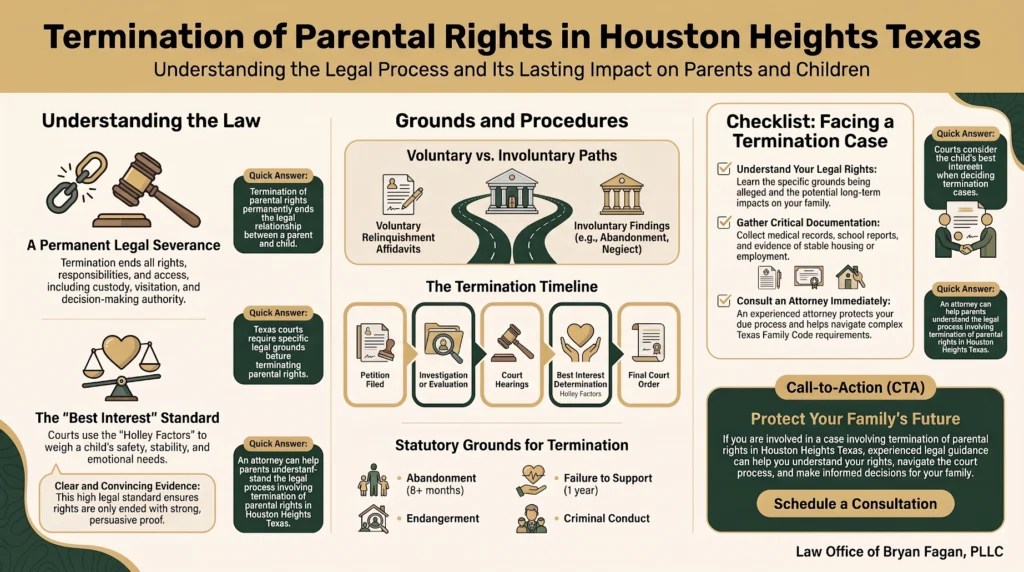
In Texas, termination of parental rights permanently ends the legal parent-child relationship, and it happens by one of three routes: voluntary relinquishment, an involuntary suit by one parent against the other, or a State-initiated CPS case. In every route, a judge must find that termination is in the child’s best interest — only a court order can end parental rights.
Key Takeaways
- There are three paths, not one. Voluntary relinquishment, involuntary termination between parents, and State-initiated CPS termination each have different filings, different proof, and different timelines.
- Only a court order ends parental rights. A signed affidavit or a parent’s absence is never enough on its own — a Harris County judge must sign a termination order for rights to end permanently.
- Best interest is nearly always required. Under Texas Family Code §161.001, involuntary termination requires a statutory ground and a best-interest finding, both by clear and convincing evidence.
- Voluntary relinquishment has strict rules. Under §161.103, an affidavit can’t be signed until at least 48 hours after birth, and whether it can be revoked depends on its exact terms.
- Termination usually ends child support — but not always. Ending rights typically ends the support duty going forward, though Texas keeps support in place in limited situations.
- Termination and adoption often travel together. Most private terminations in the Heights are filed alongside a stepparent adoption — the two are handled as one coordinated matter.

Your Family’s Future Starts Here
Don’t navigate your legal journey alone. Schedule a consultation now and get the clarity and support you deserve.
Family lawyers and attorneys advise our clients of the immediate aftermath as well as the long-term effects of Family Law related issues, such as the following:
Trust us to help you with your Family Law Attorneys in the Houston Heights in Texas. Call (281) 245-1776 or contact us online today to schedule a free consultation with your Family Law Attorney in Humble, Texas.
What Texas Law Says About Termination of Parental Rights

Termination of Parental Rights in Houston Heights Texas is governed by Texas Family Code Chapter 161, and only a judge can permanently end the legal relationship between a parent and child. For an involuntary termination under §161.001, the person requesting termination must prove two separate elements by clear and convincing evidence: that at least one statutory ground exists and that termination is in the child’s best interest. Both requirements must be satisfied. Even compelling evidence of abandonment, endangerment, or failure to support is not enough unless the court also finds that permanently ending the parent-child relationship benefits the child.
Texas law recognizes specific statutory grounds for termination, including abandonment, failure to support, endangerment, and voluntary relinquishment through an affidavit under §161.103. Judges do not terminate parental rights based on frustration, conflict between parents, or the belief that a parent has simply been uninvolved. Instead, they examine documented evidence, the child’s need for stability, and factors such as safety, permanency, and future opportunities. In straightforward cases involving a stepparent adoption, the evidence may be relatively clear. In contested termination proceedings or CPS cases, proving the legal requirements often requires substantially more evidence and careful preparation.
Another critical issue is standing—who has the legal authority to file the case. Under Texas Family Code §§102.003–102.006, only certain individuals or entities, such as a parent, the Texas Department of Family and Protective Services (DFPS), or someone who meets specific statutory requirements, may bring a termination suit. Before a Harris County court ever considers the facts, it must determine whether the person filing has the legal right to ask for termination in the first place.
Understanding these legal standards early helps families avoid costly mistakes and choose the right path for their circumstances. If your case involves CPS, an absent parent, or a planned stepparent adoption, learning how the law applies can make a significant difference in the outcome. For additional guidance, explore our Termination of Parental Rights in Dallas resource, or read our related guides on Stepparent Adoption in Texas and the Texas CPS Defense Guide for more detailed information.
No matter how absent the other parent is, and no matter what anyone has signed, parental rights in Texas end only when a judge signs a termination order. That protects everyone — and it means the paperwork has to be done right, or the termination doesn’t hold.
The Three Paths to Termination, Side by Side
Most termination questions in the Heights fall into one of three paths, and the first job in any Legal Strategy Session is figuring out which one you’re actually on. Each has a different filing, a different burden, and a very different feel in the courtroom.
| Situation | What Texas Law Says | Practical Impact |
|---|---|---|
| A parent agrees to give up rights | §161.103 — affidavit of voluntary relinquishment, signed no sooner than 48 hours after birth | Fast if uncontested, but revocability and adoption terms must be handled correctly |
| One parent seeks to end the other’s rights | §161.001 — a statutory ground plus best interest, clear and convincing evidence | Hardest to win alone; usually needs a real reason and often an adoption to back it |
| Who is allowed to file at all | §102.003–.006 — standing is limited to a defined list of people | Standing is often the first hurdle before the case can proceed |
| The State moves to terminate (CPS) | Chapter 262 removal process plus §161.001 grounds; §263.401 one-year deadline | Deadline-driven; see our dedicated CPS defense guide |
Voluntary Relinquishment: Signing Away Rights
Termination of Parental Rights in Houston Heights Texas may occur voluntarily when a parent signs an Affidavit of Voluntary Relinquishment under Texas Family Code §161.103, but signing the affidavit alone does not end parental rights. A Harris County judge must still determine that termination is legally appropriate and in the child’s best interests before issuing a final order. This process most often arises in uncontested stepparent adoptions, where one biological parent voluntarily relinquishes parental rights so another adult can assume the permanent legal role of parent through adoption.
Texas law places strict safeguards around voluntary relinquishment because the consequences are permanent. An affidavit generally cannot be signed until at least 48 hours after the child’s birth, and whether it can later be revoked depends on the specific language it contains. For example, an affidavit naming the Texas Department of Family and Protective Services (DFPS) or a licensed child-placing agency as managing conservator is generally irrevocable, while other affidavits may remain revocable unless they expressly provide otherwise. The statute also prohibits conditioning relinquishment on future visitation or continued contact, making it essential to understand exactly what rights are being surrendered before signing.
In straightforward termination cases connected to a stepparent adoption, voluntary relinquishment can provide a clear path toward creating legal permanence for a child. If questions arise about the validity of the affidavit, if another parent objects, or if CPS is involved, the legal analysis becomes significantly more complex. Courts carefully review the circumstances surrounding the affidavit, the child’s long-term stability, and whether termination truly serves the child’s best interests before approving the request.
Because even small drafting mistakes can affect whether a relinquishment is enforceable, families should understand the legal requirements before moving forward. If you’re interested in how these same Texas laws apply in another part of the state, our guide to Termination of Parental Rights in Austin provides additional insight. You may also find our Stepparent Adoption in Texas resource helpful if voluntary termination is part of an adoption plan.
An affidavit of relinquishment is often irrevocable or revocable only for a very short window. Parents sign them under pressure and later find they can’t undo it. Whichever side you’re on, have the document reviewed in a Legal Strategy Session before anyone signs.
Involuntary Termination Between Parents

Termination of Parental Rights in Houston Heights Texas may be involuntary when one parent asks the court to permanently end the other parent’s legal rights without that parent’s consent. Under Texas Family Code §161.001, the court cannot grant termination simply because a parent has been absent, difficult to co-parent with, or inconsistent. The person requesting termination must prove by clear and convincing evidence that at least one statutory ground—such as abandonment, endangerment, or failure to support—exists and that termination is in the child’s best interests. Texas judges carefully evaluate documented evidence, parental credibility, the child’s safety, and whether permanently ending the relationship creates greater stability for the child.
In straightforward cases, involuntary termination is often strongest when it is connected to a stepparent adoption. When another responsible adult is ready to assume the legal role of parent, courts are more likely to view termination as creating permanency rather than simply removing one parent from the child’s life. If the case is contested, involves disputed allegations, or arises alongside a CPS investigation or custody dispute, the legal and factual issues become considerably more complex, requiring substantial evidence and careful preparation before a Harris County court.
Timing also matters. Some statutory grounds carry filing deadlines that can affect whether a case may proceed. For example, certain claims based on a parent’s failure to support a child must be filed within the period established by Texas law after the required time of nonsupport has occurred. Understanding these deadlines, preserving evidence, and identifying the appropriate legal strategy early can significantly affect the outcome of a termination proceeding.
Because every involuntary termination case turns on its own facts, it is important to understand how the law applies to your specific circumstances before moving forward. If you’re interested in how these same legal standards apply elsewhere in Texas, read our guide on Termination of Parental Rights in San Antonio. You may also find our resources on Stepparent Adoption in Texas and Child Custody in Texas helpful when evaluating whether termination or another legal remedy is the best path for your family.
Common Misunderstandings That Cost Families
Termination of Parental Rights in Houston Heights Texas does not happen automatically simply because a parent has been absent or has stopped paying child support. One of the most common misconceptions is that parental rights expire with time. They do not. Until a Harris County court signs a termination order under Texas Family Code Chapter 161, the parent generally retains their legal rights and responsibilities, including the ability to participate in future legal proceedings involving the child. An absent parent may still have legal standing years later unless those rights have been formally terminated.
Another misunderstanding is that termination is an effective way to eliminate future child support or punish an uninvolved parent. Texas courts do not view termination as a penalty for poor parenting or unpaid support. Instead, judges focus on whether ending the legal parent-child relationship serves the best interest of the child under §161.001. Because termination often ends the obligation to pay future child support, parents seeking greater financial support may find that a child support enforcement action or a modification of conservatorship is a more appropriate legal solution.
In straightforward cases involving a planned stepparent adoption, termination may provide the child with greater permanency by allowing another adult to assume the legal responsibilities of parenthood. In more complex situations—such as contested termination proceedings, CPS litigation, or disputes involving abandonment, endangerment, or conservatorship—the court carefully weighs the evidence before deciding whether termination is appropriate. The right legal remedy depends on your goals, the available evidence, and what will best protect the child’s long-term stability.
Understanding the difference between termination, custody modification, and child support enforcement can prevent costly mistakes and help families make informed decisions. If you’d like to see how these same legal principles apply in another Texas community, visit our guide on Termination of Parental Rights in Shenandoah. You may also find our resources on Modification of Custody Orders and Stepparent Adoption in Texas helpful when evaluating the best path forward for your family.
A termination that gives the child a new legal parent is far easier to win than one that simply removes a parent. If a stepparent is ready to adopt, filing the two together is usually the strongest path through a Harris County court.
What Matters in a Contested Termination
Termination of Parental Rights in Houston Heights Texas becomes significantly more challenging when one parent contests the case. Under Texas Family Code §161.001, the court must find both a valid statutory ground for termination and that ending the parent-child relationship is in the child’s best interests. To make that determination, Texas courts commonly evaluate the Holley factors, including the child’s emotional and physical needs, the stability of each proposed home, each parent’s ability to care for the child, future plans for the child’s well-being, and any evidence of abuse, neglect, abandonment, or endangerment. The focus remains on the child’s future—not the conflict between the parents.
In contested proceedings, documentation often carries more weight than accusations. Harris County judges look closely at objective evidence such as visitation records, child support payment histories, school and medical records, photographs, text messages, emails, counseling reports, and testimony from teachers, counselors, or other credible witnesses. A parent seeking termination must present evidence supporting the statutory grounds, while the opposing parent typically offers proof of continued involvement, financial support, or efforts to maintain a meaningful relationship with the child.
In straightforward cases where the evidence is largely undisputed and a stepparent adoption is planned, the path may be more predictable. If allegations are disputed, CPS is involved, psychological evaluations become necessary, or expert testimony is required, the case becomes considerably more complex and demands a carefully developed legal strategy. The stronger the documented evidence connecting the facts to the legal requirements, the better positioned the court is to determine what outcome truly serves the child’s long-term stability and permanency.
Because every contested termination case is unique, understanding how Texas courts evaluate evidence can help families make informed decisions before stepping into the courtroom. For a broader explanation of the legal process, read our guide on Termination of Parental Rights in Texas Process. You may also find our Texas CPS Defense Guide and Stepparent Adoption in Texas resources helpful if your case involves child protective services or adoption alongside termination proceedings.
“Termination isn’t about punishing a parent — Texas courts ask one question: what does permanently ending this relationship do for the child?”
Termination, Adoption, and Child Support

Termination of Parental Rights in Houston Heights Texas affects more than just custody—it permanently changes the legal relationship between a parent and child. When a court grants a termination under Texas Family Code Chapter 161, the parent generally loses the right to make decisions for the child, inherit from the child, or seek future conservatorship or possession. In most cases, the obligation to pay future child support also ends, although any past-due child support remains enforceable. Texas law allows limited exceptions, such as certain cases involving children in the care of the Texas Department of Family and Protective Services (DFPS), where ongoing support may still be ordered.
In straightforward cases, termination is often part of a stepparent adoption under Texas Family Code Chapter 162. Rather than leaving a child with only one legal parent, the court considers whether another adult is prepared to assume the full legal rights and responsibilities of parenthood. This added permanency frequently strengthens the child’s long-term stability and is one reason stepparent adoption and termination commonly proceed together. If adoption is not part of the case, the court may examine more closely whether termination truly serves the child’s best interests.
A typical uncontested termination-and-adoption case in Harris County begins with confirming that the person filing has legal standing and identifying the appropriate statutory grounds for termination. The case then moves through filing, service on the other parent, any required home study or social study, and a final hearing where the judge determines whether both termination and adoption meet the legal requirements. If CPS is involved, a parent contests the case, or an absent parent cannot be located, additional procedures such as diligent search, substituted service, or appointment of a guardian ad litem may become necessary before the court can enter a final order.
Understanding how termination, adoption, and child support work together helps families choose the legal path that best protects their child’s future. For additional information about these issues in another Texas community, visit our guide on Parental Rights in The Woodlands. You may also find our Stepparent Adoption in Texas and Child Custody in Texas resources helpful when evaluating whether termination, adoption, or another family law solution is the right fit for your circumstances.
Listen to Our Texas Family Law Podcast
Prefer listening? In this episode, we discuss how Texas courts terminate parental rights in The Heights, including legal grounds, what parents should know, and how these cases may affect the parent-child relationship.
How a Private Termination Moves Through a Harris County Court
Tap any stage to see what happens, how long it usually takes, and what to do at that point.
1. Confirm Standing and the Right Path
Before anything is filed, the first question is whether you are even allowed to bring the case. Standing to file a termination suit is limited under Texas Family Code §102.003 through §102.006 — it isn’t open to any concerned relative. This is also where we decide which of the three paths applies and whether a stepparent adoption should be filed alongside the termination.
Typical timing: before filing — the planning stage.
What to do: confirm your standing and decide whether an adoption should be joined, so the case is built correctly from the start.
2. Relinquishment or Grounds Established
If the other parent agrees to give up rights, they sign an affidavit of voluntary relinquishment under §161.103 — which cannot be signed until at least 48 hours after the child’s birth, and whose revocability depends on its exact terms. If the termination is contested, this is instead where we build the evidence for a statutory ground under §161.001, such as abandonment or sustained nonsupport, plus the child’s best interest.
Typical timing: early in the case, once the path is set.
What to do: get the affidavit terms right before anyone signs, or start gathering documentation for the ground you’ll prove.
3. Petition Filed and the Other Parent Served
The termination petition is filed in the Harris County family courts and the other parent must be properly served. Service is where private terminations often stall — if the other parent is missing, Texas requires a documented diligent-search effort before the court will allow service by alternative means. Getting service right protects the final order from being challenged later.
Typical timing: the case opens; service can take days to weeks.
What to do: locate the other parent, or be ready to show a diligent search so service is valid and the order holds.
4. Home Study and Ad Litem (If an Adoption Is Joined)
When the termination is paired with a stepparent adoption, the court usually requires a social study of the home and may appoint an attorney or guardian ad litem to represent the child’s interests. This step is about showing the court the child is moving into a stable, permanent home — the heart of the best-interest question.
Typical timing: a few weeks to a few months.
What to do: complete the social study promptly and cooperate fully with any ad litem appointed for the child.
5. Final Hearing and Best-Interest Finding
At the final hearing, the court reviews the ground or relinquishment, weighs the child’s best interest using the Holley factors, and — if everything is in order — signs the termination order. When an adoption is joined, the judge can grant both in the same hearing, so the child leaves with a new legal parent in place.
Typical timing: when the court sets it on its docket.
What to do: present the best-interest case clearly; this is the hearing where the judge signs the termination and any adoption order.
| Step | Timeline | Action Item |
|---|---|---|
| Confirm standing and the right path | Before anything is filed | Verify who can file under §102.003–.006 and whether an adoption should be joined |
| Relinquishment or grounds established | §161.103 affidavit (48+ hrs after birth) or §161.001 grounds | Get the affidavit terms right, or build the evidence for the ground |
| Petition filed in Harris County | Case opens; other parent served | Ensure proper service — a missing parent needs a diligent-search effort |
| Home study / ad litem (if adoption joined) | Weeks to a few months | Complete the social study; cooperate with any appointed ad litem for the child |
| Final hearing / best-interest finding | When the court sets it | Present the best-interest case; the judge signs the termination (and adoption) order |
Harris County Procedure and the Heights
Termination cases from the Heights are filed and heard in the Harris County family district courts, and local rules, associate-judge assignments, and docket timing all shape how quickly your case moves. Private terminations paired with an adoption tend to run on the court’s civil-hearing schedule rather than the emergency timelines that govern CPS cases. Our Heights office at 848 Heights Boulevard is a short drive from the downtown courthouse complex.
The Law Office of Bryan Fagan, PLLC
848 Heights Blvd, Houston, TX 77007
Harris County family courts
Serving the Heights, the Greater Houston area, and clients statewide.
Call 281-810-9760How Nearby Counties Differ
Chapter 161 is statewide, but the county you file in shapes the experience. A Heights case sits in Harris County, while families we serve just outside it — in Fort Bend County to the southwest and Montgomery County to the north — face different courts, different associate judges, and different docket speeds. The legal standard for termination doesn’t change across a county line; the local process and timelines do.
Where you file usually follows the child’s home county, and if a prior custody order already exists, that court may keep continuing jurisdiction. We handle termination and adoption matters across Harris, Fort Bend, and Montgomery counties, and sorting out the right court early is exactly what a Legal Strategy Session is for.
When the State Is Involved (CPS Cases)

The third path is a State-initiated termination, where the Department of Family and Protective Services opens a CPS case and termination is on the table. This route runs on its own machinery — emergency removal standards, a full adversary hearing within 14 days, court-ordered service plans, and a one-year deadline to trial or dismissal under §263.401 — and it moves far faster than a private termination.
Because the CPS process has so many moving parts and hard deadlines, I’ve covered it in full on a separate page rather than compress it here. If the State is involved in your case, read our Texas CPS defense and removal guide for the step-by-step, then book a Legal Strategy Session so we can act inside those deadlines.
Want a clear read on which path fits your family and what it takes? Book a Legal Strategy Session.
Schedule a Legal Strategy SessionWhat to Do If You’re Considering Termination of Parental Rights
- Get clear on your real goal — adoption, ending contact, or ending support — because termination isn’t always the right tool for it.
- Identify which of the three paths you’re on: voluntary, involuntary between parents, or a State/CPS case.
- Confirm you have standing to file under §102.003–.006 before spending money on a case.
- If a stepparent wants to adopt, plan to file the termination and adoption together.
- Do not sign — or ask anyone to sign — a relinquishment affidavit until it’s reviewed.
- Gather documentation: records of contact or absence, support paid or missed, and the child’s current stability.
- Locate the other parent, or be ready to show a diligent search if they’re missing, so service is valid.
- Confirm the right county and court, especially if a prior custody order already exists.
- If the State is involved, read our CPS defense guide and move on its deadlines immediately.
- Book a Legal Strategy Session to map the specific path and paperwork for your case.
Ready to move forward? Book your Legal Strategy Session now.
Schedule OnlineWhat I Tell Every Family Who Calls About Termination of Parental Rights
Here is what I tell every family who calls from the Heights: start with the goal, not the word. “Termination” sounds like one thing, but it’s three different cases, and picking the wrong one wastes months. If a stepparent wants to adopt, the path is clear and often smooth. If you’re trying to cut off an absent parent, the bar is high and the case needs a real ground and, ideally, an adoption behind it. And if you just want more support or less conflict, termination is usually not the answer at all.
The families who do best are the ones who get the path right at the start, confirm standing, and handle the paperwork — especially any relinquishment affidavit — with care, because a termination that’s done wrong can come apart later. This is permanent; it deserves to be done once and done right.
If you’re weighing termination for your family, don’t guess your way through it. Call my office or book a Legal Strategy Session, and let’s figure out which path fits and build the case the right way.
Get the path right the first time.
Talk to my team today about termination of parental rights in the Heights.
Call 281-810-9760 Schedule OnlineConclusion:
Whether you’re exploring Termination of Parental Rights in Houston Heights Texas because of a stepparent adoption, an absent parent, or an active CPS case, the most important step is understanding which legal path fits your family’s circumstances. In straightforward situations, the process may involve clear statutory requirements and an agreed resolution between the parties. In more complex cases—such as contested termination proceedings, allegations of abuse or neglect, questions about standing, or cases involving CPS—it becomes even more important to develop a thoughtful legal strategy backed by experienced guidance. Every family is different, and the right approach begins with understanding both the law and your long-term goals for your child.
At the Law Office of Bryan Fagan, PLLC, we believe informed families make stronger decisions. Our mission is to empower parents with the knowledge, clarity, and strategic guidance they need to move forward with confidence while protecting what matters most. If your case involves questions about terminating parental rights, defending against a termination request, or exploring alternatives such as custody modification or adoption, we’re here to help you understand your options and determine the next step that best serves your family’s future. A well-planned legal strategy today can provide greater stability, peace of mind, and a stronger foundation for tomorrow.
Bryan Fagan
I’m the founder of The Law Office of Bryan Fagan, PLLC. My firm has represented Texas families in family law matters since 2012, with a Heights office serving Houston and clients across the state. I built this practice around one idea: families making permanent decisions deserve a real strategy, not a form letter.
Book a Legal Strategy SessionQuestions Families Ask About Termination of Parental Rights
The grounds for involuntary termination are listed in Texas Family Code §161.001 and include abandonment, failure to support the child for a defined period, endangering the child’s physical or emotional well-being, and signing an irrevocable affidavit of relinquishment, among others. The person seeking termination must prove at least one ground and that termination is in the child’s best interest, both by clear and convincing evidence.
You file a suit to terminate under Chapter 161, prove a statutory ground such as abandonment or sustained nonsupport, and show that termination serves the child’s best interest. These cases are strongest when paired with a stepparent adoption, because the child gains a new legal parent. An absent parent’s rights do not end on their own — a judge has to sign an order.
There is no automatic number of days. Texas looks at grounds like abandonment and failure to support, which turn on the facts — whether the parent left without support, without intent to return, and for a defined period. Absence combined with no support and no contact is what builds a ground; time alone does not end anyone’s rights.
Yes, by signing an affidavit of voluntary relinquishment under Texas Family Code §161.103, but only after a court also signs a termination order. The affidavit can’t be signed until at least 48 hours after the child is born, and whether it can be revoked depends on its exact terms. Voluntary relinquishment most often happens as part of a stepparent adoption.
Usually, ending parental rights ends the duty to pay future child support, though Texas keeps support in place in limited situations. Support already owed before termination does not simply disappear. Because ending rights often ends future support, terminating a parent’s rights is frequently the wrong tool if your real goal is to collect more support.
Once a court signs a termination order, reversing it is very difficult and available only in narrow circumstances. A revocable relinquishment affidavit can sometimes be withdrawn within a short statutory window, but after a final order the relationship is generally ended for good. That is why getting the decision and the paperwork right the first time matters so much.
No. If the other parent won’t agree, you can still pursue an involuntary termination under §161.001 — but you must prove a statutory ground and best interest by clear and convincing evidence. It is a higher bar than an agreed relinquishment, and it usually needs strong documentation and, ideally, a stepparent ready to adopt.
Standing is limited under Texas Family Code §102.003 through §102.006. It generally includes a parent, a person named as managing conservator in a relinquishment affidavit, and certain people who have had actual care of the child for a required period — not just any concerned relative. Confirming standing is often the first step before a termination case can move forward.
No. A CPS case is one route to termination, but many terminations are private matters between parents that never involve the State. If the Department of Family and Protective Services is involved in your case, that process has its own removal steps and deadlines — we cover it on our separate CPS defense guide. This page focuses on the private and voluntary paths.
An uncontested private termination paired with a stepparent adoption often resolves in a few months, depending on service, any required home study, and the court’s docket. A contested involuntary termination takes longer. State-initiated CPS cases run on a separate, faster track with a one-year deadline under §263.401. Your timeline depends entirely on which path you’re on.
Have a question specific to your family? That’s what the Legal Strategy Session is for.
Call 281-810-9760