
Adoption Attorneys in Houston Heights, Texas: What Families Need to Know Before Filing

Adoption Attorneys in Houston Heights Texas often hear the same story from families who call our office: someone is ready to make a child legally part of their family, but they also want to know how to protect that child’s future after years of uncertainty. Sometimes it is a stepparent who has been helping with homework, attending parent-teacher conferences, and cheering from the sidelines long before becoming a legal parent. Sometimes it is a grandparent or other relative who stepped in when life took an unexpected turn. Other times it is a foster family finally reaching the finish line after months—or even years—of waiting. No matter how the story begins, the question underneath is almost always the same: what does Texas require, how long will it take, and will this finally give our child the stability they deserve?
Working with adoption attorneys in Houston Heights, Texas means working within the Harris County court system and following the requirements of the Texas Family Code. Adoption is more than filing paperwork. Before a judge signs a final adoption order, families may need to address the termination or voluntary relinquishment of another parent’s rights, complete criminal background checks, participate in a home study, satisfy residency requirements, and attend a final hearing. Every requirement exists for a reason, and understanding the process before you file often makes the difference between a smooth adoption and months of avoidable delays.
One thing I have learned over the years is that adoption is rarely just about changing a birth certificate. It is about giving children consistency. After divorce or another major family transition, many children struggle with uncertainty that reaches into every part of their lives—including school. When they are unsure where they will live, who will make decisions for them, or whether the adults around them will remain constant, it often shows up in the classroom before it shows up anywhere else. That is one reason Texas courts place such a strong emphasis on a child’s best interests under Texas Family Code §153.002. While adoption cases are governed primarily by Chapter 162 of the Texas Family Code, many families arrive here after custody disputes where educational stability has already become an important concern.
In this guide, I’ll explain how adoption works in Texas, who can adopt, what courts require before granting an adoption, and the mistakes that most often slow families down. We’ll also explore how creating a permanent legal family can provide children with the structure, emotional security, and educational stability they need to thrive after divorce or other difficult life transitions. When families understand both the legal process and the purpose behind it, they are far better prepared to move forward with confidence and give their children the stable future they deserve.
The Short Answer
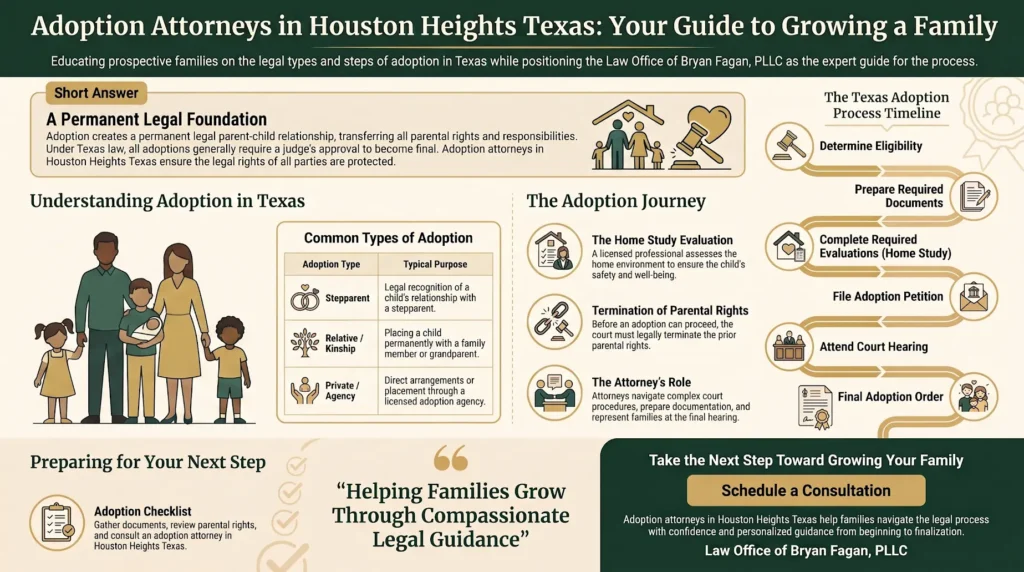
In Texas, adoption attorneys in Houston Heights help families complete a court process under Texas Family Code Chapter 162 (2025): the legal rights of any existing parent must end by consent or termination, the adopting adult must pass a criminal background check, a home study and post-placement evaluation are completed, and after a six-month residence period a Harris County judge enters a final adoption order.
Key Takeaways
- The other parent’s rights come first. No Texas adoption finalizes until any existing parent’s rights are ended by consent or court-ordered termination. This is the single biggest driver of your timeline.
- A home study is required, not optional. Texas requires a pre-adoptive home evaluation and a post-placement report before a judge will sign. Stepparent cases can sometimes shorten but not always skip this.
- Six months of residence is the baseline. Under Family Code §162.009, the child generally must live with the petitioner for six months before the adoption can be granted, though a judge may waive it in the child’s best interest.
- Married couples must petition together. Family Code §162.002 requires both spouses to join the petition. A divorce mid-case forces the court to abate unless one spouse amends to adopt alone.
- A new 2025 notice rule is in effect. The 89th Legislature added §162.0063, effective September 1, 2025, requiring prospective adoptive parents to receive a formal notice of their rights.
- Harris County procedure has its own rhythm. Court assignment, ad litem appointment, and final-hearing scheduling in Harris County differ from Montgomery, Fort Bend, and Galveston — where you file matters.

Your Family’s Future Starts Here
Don’t navigate your legal journey alone. Schedule a consultation now and get the clarity and support you deserve.
Family lawyers and attorneys advise our clients of the immediate aftermath as well as the long-term effects of Family Law related issues, such as the following:
Trust us to help you with your Family Law Attorneys in the Houston Heights in Texas. Call (281) 245-1776 or contact us online today to schedule a free consultation with your Family Law Attorney in Humble, Texas.
What Texas Law Requires for Adoption

Working with Adoption Attorneys in Houston Heights Texas begins with understanding that adoption is a legal process designed to create a permanent parent-child relationship while protecting the child’s best interests. Under Texas Family Code Chapter 162, a court cannot grant an adoption until all legal requirements have been satisfied, including resolving any existing parental rights. Whether you are pursuing a stepparent, relative, foster care, or private adoption, building a strong legal foundation before filing often determines how smoothly the case moves through the Harris County courts.
Texas law establishes specific requirements for every adoption. Under §162.001, the child must be legally eligible for adoption, while §162.002 generally requires married spouses to file a joint petition. Section §162.0085 requires criminal background checks, and §162.009 generally requires the child to live with the prospective adoptive parent for at least six months before the adoption may be finalized, unless the court determines a waiver is in the child’s best interests. Beginning September 1, 2025, §162.0063 also requires prospective adoptive parents to receive a formal notice explaining their legal rights before the adoption is completed.
Judges in Harris County do more than verify paperwork. They evaluate whether parental rights have been properly terminated or voluntarily relinquished, whether required consents are legally valid, whether home studies and background checks have been completed, and whether the adoption truly serves the child’s best interests. Even small procedural mistakes or unresolved questions about another parent’s legal status can delay an otherwise uncontested adoption.
In straightforward adoption cases, careful preparation and compliance with Chapter 162 often lead to a predictable process. In more complex adoption matters involving contested termination of parental rights, CPS history, absent parents, interstate placements, or jurisdictional disputes, developing a legal strategy before filing becomes even more important. Learning more about our Houston Heights adoption services or our guidance on termination of parental rights can help you better understand how these issues may affect your case.
Although every family’s circumstances are unique, one principle remains consistent: the strongest adoption cases are built long before the final hearing. Understanding the legal requirements early, gathering the necessary documentation, and resolving potential issues before filing can save months of delay while giving your family the best opportunity to move confidently toward a permanent, legally protected future.
Why this is good news: Texas adoption rules are strict, but they are knowable. When the other parent’s status is handled correctly from day one, these cases finalize on a predictable schedule — often within a few months of filing once the residence period is satisfied.
Types of Adoption We Handle in the Heights
In Texas, the type of adoption you are pursuing determines what the law requires of you. Most adoption attorney work in Houston comes down to a handful of case types, and each one changes the steps under Chapter 162. Here is the core breakdown.
| Category | What Texas Law Says | Practical Impact |
|---|---|---|
| Stepparent adoption | Other biological parent’s rights must end first (§162.001); residence often already satisfied | Fastest path when the other parent consents; contested if they do not |
| Relative / kinship adoption | Same termination requirement; home study may be modified | Common after a family disruption; standing rules in Chapter 102 matter |
| Private / agency placement | Relinquishment affidavits + full home study (§162.0085) | Most documentation; six-month residence applies |
| Adult adoption | No termination needed; adult consents | Simplest type; often inheritance or relationship driven |
Common Misunderstandings That Derail Cases
One of the most common misconceptions we encounter as Adoption Attorneys in Houston Heights Texas is that an absent parent automatically loses parental rights by disappearing or failing to support a child. Texas law does not work that way. Under Chapter 161 of the Texas Family Code, a biological parent’s rights remain intact until a court legally terminates them. Likewise, unpaid child support or limited contact does not automatically constitute consent to an adoption. Before a judge can finalize an adoption under Chapter 162, the court must determine that all statutory requirements have been met and that the adoption serves the child’s best interests under Texas Family Code § 153.002.
Another common misunderstanding is that every adoption follows the same path. In straightforward adoption cases, such as many uncontested or stepparent adoptions, the process may move efficiently when all legal requirements are satisfied. In more complex adoption matters—including contested adoptions, relative adoptions, foster care adoptions, interstate adoptions, military family cases, or situations involving CPS or disputed parental rights—the court closely evaluates consent requirements, home studies when applicable, criminal background checks, witness credibility, and procedural compliance before granting an adoption.
Families also create unnecessary obstacles by waiting too long to resolve parental rights or gather the evidence needed to support their case. Filing an adoption petition before addressing these issues can delay the process and increase costs. Careful planning before filing often allows families to resolve potential problems early, particularly in Harris County, where judges expect strict compliance with the Texas Family Code. Understanding related topics such as termination of parental rights can help families avoid common mistakes that slow adoption proceedings.
If your case involves an absent parent, contested parental rights, CPS involvement, interstate issues, or other high-conflict circumstances, developing a legal strategy before filing is especially important. These cases often require additional evidence, contested hearings, and careful adherence to Texas adoption procedures. Learning more about the Texas adoption process and reviewing resources for Adoption Attorneys in The Woodlands Texas can help you better understand how different adoption cases are evaluated across Texas.
Every adoption represents an opportunity to create a secure and permanent future for a child. Whether your adoption is relatively predictable or involves complex legal issues, obtaining experienced legal guidance early can reduce delays, avoid costly mistakes, and provide greater confidence throughout the process. At the Law Office of Bryan Fagan, PLLC, we are committed to educating families, simplifying complex legal issues, and helping parents protect their children’s futures through every stage of the Texas adoption process.
Warning: Do not file an adoption petition assuming the other parent will not show up. If their rights have not been properly terminated and they appear at the hearing, the case can collapse on the day you expected to finalize. Address their legal status before you file, not after.
What Matters When the Other Parent Objects

When another parent contests an adoption, the case becomes significantly more complex. As Adoption Attorneys in Houston Heights Texas, we often explain that an objection does not automatically prevent an adoption, but it does change the legal process. Under Chapter 161 of the Texas Family Code, the court must first determine whether statutory grounds exist for involuntary termination of parental rights. Even if one or more grounds are proven, the judge must separately decide whether terminating those rights and approving the adoption is in the child’s best interests under Texas Family Code § 153.002. In many Harris County adoption cases, the outcome depends less on how long a parent has been absent and more on the quality and credibility of the evidence presented.
In straightforward adoption cases, parental rights have often already been voluntarily relinquished or all parties agree to the adoption. In more complex adoption matters—particularly those involving disputed parental rights, stepparent adoption, CPS involvement, foster care, or interstate issues—the adoption process often shifts from paperwork to litigation. The court may appoint an attorney ad litem or amicus attorney to represent the child’s interests, carefully evaluate witness testimony, review documentary evidence, consider criminal background checks and home study requirements when applicable, and ensure every procedural requirement has been satisfied before entering a final adoption order.
One of the most common mistakes families make is filing an adoption petition before fully evaluating the legal status of the other parent. If your case involves an absent parent, contested consent, or uncertainty regarding the termination of parental rights, addressing those issues early often prevents costly delays and unexpected complications later in the case. Learning more about termination of parental rights and the overall Texas adoption process can help families understand what must be resolved before an adoption can move forward.
When another parent objects, strategic preparation becomes essential. Cases involving contested hearings, high-conflict parental rights litigation, military families, or CPS investigations require careful planning, thorough evidence, and strict compliance with the Texas Family Code. Families seeking additional guidance in other regions of the state may also find our resource on Adoption Attorneys in Austin helpful. Beginning the process with experienced legal guidance can often save significant time, reduce unnecessary expense, and help protect the permanent family relationship you are working to build.
Listen to Our Texas Family Law Podcast
Prefer listening? In this episode, we discuss adoption in Houston Heights, Texas, including how the legal process works, important requirements for adoptive families, and what to expect when building your family through adoption.
“The fastest adoptions are the ones where we settle the other parent’s rights before we ever walk into the courthouse.”
How We Build an Adoption Strategy
Every successful adoption begins with understanding the legal status of the other parent. As Adoption Attorneys in Houston Heights Texas, one of the first questions we answer is whether the other parent is willing to consent, whether there may be legal grounds for terminating parental rights under Chapter 161 of the Texas Family Code, or whether the adoption is likely to be contested. That single determination shapes nearly every step that follows, from filing timelines to evidence gathering and the requirements for a final hearing under Chapter 162. Taking the time to evaluate these issues early often prevents delays and costly surprises later in the process.
In straightforward adoption cases, such as many uncontested or stepparent adoption matters, careful planning allows several requirements to move forward at the same time. While one part of the case focuses on completing home study requirements when applicable, criminal background checks, residency requirements, and other procedural steps, another focuses on obtaining the necessary consents and preparing for the final adoption hearing. This coordinated approach helps families move efficiently while ensuring the court has the information needed to determine that the adoption serves the child’s best interests under Texas Family Code § 153.002.
In more complex adoption matters, strategy becomes even more important. When another parent contests the adoption, or if your case involves CPS, an absent parent, interstate adoption issues, military family considerations, or disputed parental rights, the adoption often becomes a two-stage legal process. Before the court can consider finalizing the adoption, it must first determine whether the legal requirements for terminating parental rights have been satisfied. Judges carefully evaluate witness credibility, documentary evidence, consent issues, procedural compliance, and the child’s long-term welfare before granting a final adoption order.
One of the most common mistakes families make is treating adoption as primarily a paperwork process instead of a legal proceeding that requires careful preparation. Filing before parental rights have been resolved or before the necessary evidence has been developed can create avoidable setbacks. Understanding the Texas adoption process and issues involving termination of parental rights before filing often helps families avoid delays and move through the Harris County adoption process more confidently. Families interested in adoption services elsewhere in Texas may also benefit from our guide to San Antonio Adoption Attorneys.
Whether your adoption is relatively predictable or involves contested litigation, the goal remains the same: arrive at the final hearing fully prepared. Early legal planning reduces uncertainty, strengthens the presentation of your case, and helps protect the permanent family relationship you are working so hard to create.
Strategy note: Run the home study and the six-month residence clock at the same time whenever the facts allow. Families who treat these as sequential add months to a case that could have closed sooner.
Risks, Mistakes, and Deadlines
The most expensive mistake in a Texas adoption is filing before the other parent’s rights are resolved. The second is missing the home study or background-check requirements and discovering it at the hearing. Here is how common situations tend to play out.
Has the child’s other legal parent’s rights already ended — by signed consent or a prior court order?
Yes, already ended No, still in place Not sure ← Back to startIf the other parent’s rights are still in place, will that parent voluntarily consent to the adoption?
Yes, they will consent No / they object There is no other legal parent ← BackHas the child lived in your home for at least six months?
Yes, six months or more Not yet ← BackAre you and (if married) your spouse both ready to be part of the petition?
Yes I am single / adopting alone Not sure ← BackWhere does the child currently live?
Harris County (Houston Heights area) A nearby Texas county We have an open CPS or other court case ← BackYour adoption looks like a clear, fileable case
Based on your answers, the pieces Texas requires appear to be in place. The next step is sequencing the petition, home study, and final hearing in Harris County — and confirming the other parent’s status is locked down in writing.
Your adoption is workable — a few details set the path
Your case can move forward, but the county of filing, the residence period, or the other parent’s consent still need to be nailed down. These are exactly the variables we sequence in a strategy session so nothing stalls at the final hearing.
Your situation needs a lawyer’s eyes before anything is filed
An open CPS or related court case changes how an adoption must be handled and who has to be involved. Do not file anything until we have reviewed it — the order of operations here is critical and timing-sensitive.
You’re early — let’s build the foundation first
Some of what Texas requires is not in place yet. That is normal at this stage. A short strategy session will tell you exactly what to put in motion now so the case is ready to file when the time comes.
Let’s see where your Texas adoption stands. What type of adoption is this?
Stepparent adoption Relative / kinship adoption Private or agency placement Adult adoption| Scenario | Likely Outcome | What to Do |
|---|---|---|
| Other parent consents in writing | Streamlined; finalizes after residence period | Secure a valid relinquishment, then file |
| Other parent is absent, never signed | Requires involuntary termination first | Build termination grounds before filing adoption |
| Other parent actively objects | Contested litigation; ad litem likely | Prepare evidence; expect a trial setting |
| Home study not started | Judge will not finalize | Order it at the start, in parallel |
Used the qualifier above and want a real read on your case? Bring your facts to a Legal Strategy Session and we will map your exact path.
Schedule a Strategy SessionHarris County Adoption Procedure

For many families seeking guidance from Adoption Attorneys in Houston Heights Texas, understanding the local court process is just as important as understanding Texas adoption law. Although Chapter 162 of the Texas Family Code establishes the legal requirements for adoption statewide, Harris County district courts manage their own dockets, scheduling, and case administration. Depending on the circumstances, the court may appoint an attorney ad litem or amicus attorney, review home study reports when required, confirm compliance with residency and consent requirements, and determine whether the proposed adoption serves the child’s best interests under Texas Family Code § 153.002.
In straightforward adoption cases, such as many uncontested or stepparent adoption matters, families can often move efficiently through the Harris County process once parental rights have been voluntarily relinquished or properly terminated and all required documentation has been completed. In more complex adoption matters—including contested adoptions, CPS cases, interstate adoptions, or disputes involving parental rights—additional hearings, evidence, and court review are often necessary. Planning ahead allows many procedural requirements to be completed before the final hearing, reducing unnecessary delays and helping families avoid common filing mistakes.
Families are often surprised to learn that while Texas adoption law remains consistent across the state, local court procedures can differ significantly. Counties such as Montgomery, Fort Bend, Galveston, and Brazoria each maintain their own scheduling practices and administrative procedures. A case that moves quickly in Harris County may follow a different timeline elsewhere, even though the legal standards governing parental rights, consent, and final adoption remain the same. Understanding these procedural differences can help families develop realistic expectations before filing.
Whether your case involves a relative adoption, foster care adoption, adult adoption, or contested termination of parental rights, early preparation is one of the best ways to protect your timeline. Learning more about the Texas adoption process and reviewing our comprehensive guide, Adoption in Texas: An A–Z Explanation for Parents, can help you better understand the legal requirements before your case reaches the courtroom.
Every adoption is ultimately about creating a permanent, secure future for a child. While some cases are relatively predictable with proper preparation, others require careful legal planning because of contested parental rights, CPS involvement, or other complex issues. By understanding both Texas law and the procedures followed by your local court, families can approach the adoption process with greater confidence and avoid many of the obstacles that commonly delay finalization.
What to Do If You’re Dealing With Adoption in Houston Heights
Print this checklist, then bring it in. We will turn it into a filing plan with a real timeline.
Schedule a Strategy SessionWhat I Tell Every Client Who Calls About Adoption

Adoption is one of the few areas of family law where the ending is almost always happy — but only if the legal foundation is built right. The families who struggle are the ones who filed on an assumption about the other parent and found out too late that an assumption is not a court order.
If you are anywhere in the process — from “we are thinking about it” to “we are ready to file” — the move is the same: pin down the other parent’s status, get the home study and residence clock running, and file in the right county with the right petition. Do those things in order and Texas adoption is predictable.
If the child has been in your home and you are ready to make it legal, do not wait for the calendar to drift. Bring your facts to our team and we will tell you exactly where you stand and what comes next.
Ready to make it official? Let’s map your adoption.
Schedule a Strategy SessionConclusion:
Every adoption represents more than a legal proceeding—it represents a child’s future. The right legal strategy can provide permanence, stability, and the confidence that comes from knowing your family is protected under Texas law. Whether you’re pursuing a stepparent adoption, adopting a grandchild, welcoming a foster child into your permanent family, or exploring another path, working with experienced Adoption Attorneys in Houston Heights Texas can help you understand the process, avoid unnecessary delays, and make informed decisions every step of the way. At The Law Office of Bryan Fagan, PLLC, our mission is to empower families through education, compassionate guidance, and practical legal solutions that protect what matters most.
In straightforward situations—such as an uncontested stepparent adoption with signed consents—the legal process may be relatively predictable with proper planning. In more complex cases involving contested termination of parental rights, absent parents, CPS history, interstate adoption issues, or questions about jurisdiction, a thoughtful legal strategy becomes even more important. If your case involves unique family dynamics or legal challenges, taking the time to understand your options now can help prevent setbacks later. Wherever you are in your adoption journey, our team is committed to helping you move forward with clarity, confidence, and a plan designed around your family’s needs.
Questions My Clients Ask About Adoption in Houston Heights
You file a petition for adoption under Family Code Chapter 162 (2025), ensure any existing parent’s rights are ended by consent or termination, complete a criminal background check and home study, satisfy the six-month residence period, and attend a final hearing where a judge signs the order. The exact sequence depends on your case type, which is why families start with a Legal Strategy Session to map it.
Cost depends on case type and whether it is contested. An uncontested stepparent adoption sits at the low end; a contested case requiring termination litigation, a home study, and an ad litem costs more because it takes more court work. In a strategy session we identify your specific cost drivers instead of quoting a number that does not fit your facts.
Texas does not set a fixed income threshold to adopt. What the court and home study look at is whether you can provide a stable, safe home for the child — financial stability is one factor among several, not a hard cutoff. Many adopting parents of ordinary means complete adoptions every year in Harris County.
A stepparent adoption in Texas requires that the other biological parent’s rights end first — by signed consent or court-ordered termination — after which the stepparent and their spouse jointly petition to adopt under §162.002. Because the child usually already lives in the home, the residence requirement is often satisfied, which is why these are frequently the fastest cases.
Under Chapter 162, an adult may petition to adopt an eligible child; if married, both spouses must join (§162.002); the petitioner must pass a criminal background check (§162.0085); a home study and post-placement report are completed; and the child must generally have lived with the petitioner for six months (§162.009). Any existing parent’s rights must be ended before finalization.
Adult adoption is the adoption of a person 18 or older, and it is the simplest type because no parental rights need to be terminated — the adult being adopted simply consents. Families use it for inheritance clarity, formalizing a long-standing parent-child relationship, or stepparent relationships that were never legally finalized in childhood.
Second parent adoption lets a parent’s partner or spouse adopt the child so both adults hold full legal parental rights. In Texas it runs through the same Chapter 162 process, including the requirement that any other existing parent’s rights be resolved first. We map standing and consent issues up front so the petition is clean.
The lowest-cost path is adopting a child from the Texas foster care system, where many fees are waived or subsidized and some adoptions qualify for assistance. Private and stepparent adoptions are not free, but the legal cost varies widely with whether the case is contested. We tell you which path realistically fits your situation.
Texas leans on a six-month residence period (§162.009) and a clean termination of the prior parent’s rights before finalizing. California allows a birth parent’s consent to become irrevocable relatively quickly and runs its own home-study system; New York separates surrender and adoption more formally and uses a supervisory placement period; Florida emphasizes a tightly structured consent-and-revocation window. The practical effect: Texas timelines hinge more on residence and termination than on a consent clock.
The 89th Legislature added Family Code §162.0063, effective September 1, 2025, requiring prospective adoptive parents to receive a formal notice of their rights, along with related changes to relinquishment and child-placing agency rules. We build current law into every case so your filing reflects the 2025 code.
Still have a question that is specific to your family? Those are exactly the ones we answer in a Legal Strategy Session.
Schedule a Strategy Session