
Retirement Planning Attorneys in Houston Heights, Texas: What They Actually Protect

A father in his late forties sat across my desk in Houston one afternoon with a divorce decree in one hand and a stack of retirement-account statements in the other. His question was not about investment returns. It was much more practical. “My daughter is twelve,” he said. “If something happens to me after this divorce is finalized, who controls this money, and does it actually go where I want it to go?” He had spent years saving responsibly. What he had not fully considered was how divorce changes beneficiary designations, retirement-account inheritance, estate planning, and the financial stability that children often depend on long after the divorce is over. That gap is exactly what many families discover when they begin working with Retirement planning Attorneys in Houston Heights Texas.
Most people who start researching retirement planning after a divorce are not looking for stock tips or investment advice. They want answers to questions that sit at the intersection of family law and estate planning. Does an ex-spouse still inherit my IRA? What happens if my child is a minor? Should I update my trust? Who manages retirement assets if I become incapacitated? Those questions become even more important when children are involved because financial uncertainty rarely stays confined to bank accounts. It affects family stability, household routines, and often the emotional well-being of the children caught in the middle.
Here is the part many parents do not immediately recognize. Divorce is not only a legal and financial event; it is also a life transition that can influence nearly every aspect of a child’s daily life. Texas courts understand this. Under Texas Family Code §153.002, the best interest of the child governs custody decisions, and judges routinely consider stability when evaluating parenting arrangements. When families are dealing with financial stress, uncertain living situations, or ongoing conflict, children often carry that burden into other parts of their lives, including their academic performance.
At The Law Office of Bryan Fagan, PLLC, we have seen how closely these issues are connected. Founded by Bryan Joseph Fagan, a graduate of South Texas College of Law and a recognized authority on Texas divorce and custody law, our firm helps families protect both their financial futures and the people they love most. The legal decisions made during a divorce can affect retirement assets, inheritance rights, custody arrangements, and a child’s long-term stability for years to come.
This guide explains how divorce can impact a child’s academic performance, how Texas courts evaluate educational stability in custody cases, why retirement and financial planning play a larger role than many parents realize, and what practical steps families can take to protect both their children and their future. By the end, you’ll have a clearer understanding of how thoughtful legal planning can create stability, reduce uncertainty, and help your family move forward with confidence.
A retirement-planning attorney in Houston Heights builds the legal documents that control your savings when you can’t: a will, a durable power of attorney under Texas Estates Code §752.051, a medical power of attorney, and often a living trust to avoid probate. The goal is simple — make sure your retirement assets pass to the people you choose, without delay, taxes you could have avoided, or court involvement.
Key Takeaways
- Beneficiary forms override your will. Your 401(k) and IRA pass by beneficiary designation, not by your will — a mismatch is the single most common, and most damaging, error.
- A durable power of attorney is non-negotiable. Under Texas Estates Code §752.051, the statutory durable POA lets someone manage your accounts if you’re incapacitated. Without it, your family goes to court for guardianship.
- Probate is avoidable, not inevitable. A properly funded revocable living trust keeps retirement-adjacent assets out of Texas probate entirely.
- Texas is community property. What your spouse owns, what’s separate, and what passes how is different here than in most states — and it changes the plan.
- The will deadline is real. A Texas will generally must be admitted to probate within four years of death under Estates Code §256.003, or heirs lose the easy path.
- County matters. Procedure, timelines, and local court practice differ across Harris, Fort Bend, Montgomery, Galveston, and Brazoria — and so does the plan if you own property in more than one.
- Doing it once, correctly, is cheaper than fixing it. A contested guardianship or a probate fight costs many times what the documents would have.

Your Family’s Future Starts Here
Don’t navigate your legal journey alone. Schedule a consultation now and get the clarity and support you deserve.
Family lawyers and attorneys advise our clients of the immediate aftermath as well as the long-term effects of Family Law related issues, such as the following:
Trust us to help you with your Family Law Attorneys in the Houston Heights in Texas. Call (281) 245-1776 or contact us online today to schedule a free consultation with your Family Law Attorney in Humble, Texas.
What a Retirement-Planning Attorney in Houston Heights Actually Handles

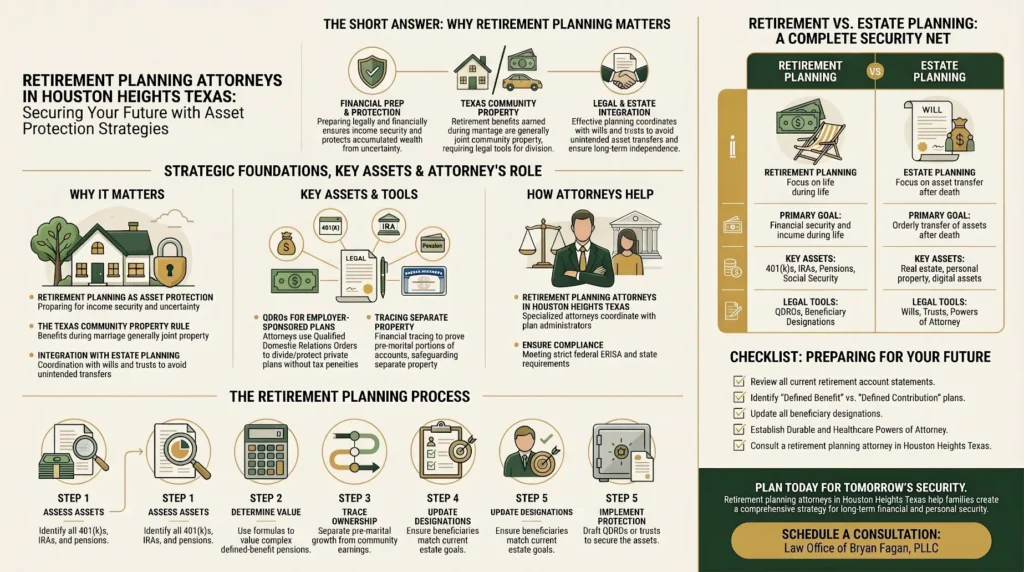
Retirement Planning Attorneys in Houston Heights Texas focus on the legal side of retirement—not the investments themselves. Their role is to create the legal framework that protects your savings through wills, trusts, beneficiary designations, powers of attorney, and other estate planning tools. The goal is simple: make sure your assets are managed according to your wishes if you become incapacitated and transferred efficiently to your loved ones when you pass away.
In Texas, retirement planning often comes down to three questions: Who manages your finances if you cannot? Who inherits your assets? And how can your family avoid unnecessary probate delays and expenses? In straightforward situations, a will, updated beneficiary designations, and a properly executed durable power of attorney may provide meaningful protection. In more complex estates, trusts, asset protection strategies, and comprehensive retirement planning may be appropriate.
Many families seek guidance because they want to protect a spouse, simplify inheritance for children, avoid probate administration, or prepare for long-term care concerns. If your retirement plan includes significant assets, blended-family considerations, business ownership, or retirement planning after divorce, additional legal planning may help prevent beneficiary conflicts, probate disputes, and unintended outcomes.
Texas community property laws also create planning opportunities and potential pitfalls that many out-of-state plans do not address. Whether you need a simple will-based plan or a more comprehensive estate strategy, the right legal guidance can help preserve family wealth, reduce future complications, and ensure your retirement savings ultimately benefit the people you intended to protect.
The most reliable retirement plans I see pair a funded revocable trust with matched beneficiary designations. When those two agree, your family skips probate and the accounts transfer in weeks, not months.
What Texas Law Says About Protecting Retirement Assets
The legal foundation behind retirement protection is often just as important as the retirement account itself. Retirement Planning Attorneys in Houston Heights Texas help families understand how Texas law governs wills, powers of attorney, trusts, beneficiary designations, and probate procedures that ultimately determine who controls assets during incapacity and who inherits them after death. A strong retirement plan is not simply about accumulating wealth—it is about ensuring that wealth is protected, accessible, and transferred according to your wishes.
Several provisions of the Texas Estates Code play a significant role in retirement planning. Under Texas Estates Code §251.051, a valid will must meet specific execution requirements to be enforceable. Texas Estates Code §752.051 authorizes a statutory durable power of attorney, allowing a trusted individual to manage financial affairs if incapacity occurs. Without this document, families may face guardianship proceedings that are often more costly, time-consuming, and stressful than proactive planning. If incapacity planning is a concern, combining financial powers of attorney with medical directives and other estate planning tools can help preserve family stability during difficult circumstances.
Texas law also imposes important probate deadlines. Under Texas Estates Code §256.003, a will generally must be admitted to probate within four years of death. Missing that deadline can create unnecessary complications and expenses for heirs. In straightforward situations, a properly drafted will and updated beneficiary designations may be sufficient. In more complex estates, revocable living trusts, coordinated beneficiary planning, and comprehensive estate planning in Texas can help families avoid probate risks, preserve privacy, and streamline asset transfers. Common mistakes such as outdated beneficiary forms, unfunded trusts, or conflicting documents often create problems that could have been prevented through periodic reviews.
For blended families, business owners, retirees who recently moved to Texas, or individuals with substantial retirement assets, the stakes can be even higher. Texas community property laws, retirement account inheritance rules, and intestate succession statutes may produce outcomes very different from what a family intended. Where multiple beneficiaries are involved, or where retirement planning after divorce is a factor, a comprehensive review can help identify potential risks before they become expensive disputes. Because Texas estate and probate procedures continue to evolve through legislative updates, reviewing older plans periodically helps ensure that your documents remain aligned with current law, your family’s goals, and the future you want to protect.
| Document | What Texas Law Says | Practical Impact |
|---|---|---|
| Will | §251.051 — written, signed, two witnesses or self-proved | Directs will-controlled property; self-proving speeds probate |
| Durable POA | §752.051 — statutory financial power of attorney | Agent manages accounts if you’re incapacitated; avoids guardianship |
| Medical POA | Health & Safety Code §166.151+ | Names who makes medical decisions; pairs with directive to physicians |
| Intestacy default | §201.001+ — state decides if no will | Distribution often wrong for blended families |
| Probate deadline | §256.003 — generally 4 years from death | Miss it and heirs face a harder, costlier path |
The Misunderstandings That Cost Heights Families the Most
One of the most common misconceptions we see is the belief that a will controls everything. It does not. Retirement Planning Attorneys in Houston Heights Texas regularly help families discover that retirement accounts, including 401(k)s and IRAs, typically pass according to beneficiary designations—not according to the instructions in a will. That means an outdated beneficiary form can override an estate plan, sometimes sending assets to an ex-spouse or unintended recipient. For blended families, retirement planning after divorce, or situations where multiple beneficiaries are involved, reviewing beneficiary designations is often just as important as updating wills and trusts.
A second costly mistake involves incapacity planning. Many people assume a spouse or adult child can automatically manage finances if a medical emergency occurs. In Texas, that is often not the case. Without the proper legal documents, families may be forced into guardianship proceedings simply to access accounts or make financial decisions. If incapacity planning is a concern, reviewing the differences between a durable power of attorney and living will is an important step toward protecting both your assets and your family’s peace of mind. In straightforward situations, a properly executed power of attorney may provide sufficient protection. In more complex estates, additional planning tools may be needed to address long-term care concerns, asset protection goals, and family wealth preservation.
The third mistake is treating estate planning as a one-time project rather than an ongoing process. Life changes. Marriages, divorces, births, deaths, retirement, business sales, and new property acquisitions can all affect how an estate plan functions. Most outdated plans were not created incorrectly—they simply were never updated. If your retirement plan includes significant assets, trusts, business interests, or retirement account inheritance concerns, periodic reviews can help identify problems before they become probate complications. Families who revisit their plans regularly are often better positioned to avoid beneficiary conflicts, preserve wealth, and ensure their wishes remain aligned with current Texas law.
Whether your situation calls for a simple will-based update or a comprehensive estate review, understanding these common mistakes can help you avoid costly surprises. The earlier potential issues are identified, the more options families typically have to protect retirement assets, minimize court involvement, and create a plan that supports the people and goals that matter most.
An outdated beneficiary form beats a perfect will every time. If your IRA still names an ex-spouse, that’s who inherits — no matter what your will says. Review every beneficiary designation when anything in your life changes.
What Actually Goes Wrong — and the Deadlines That Make It Worse
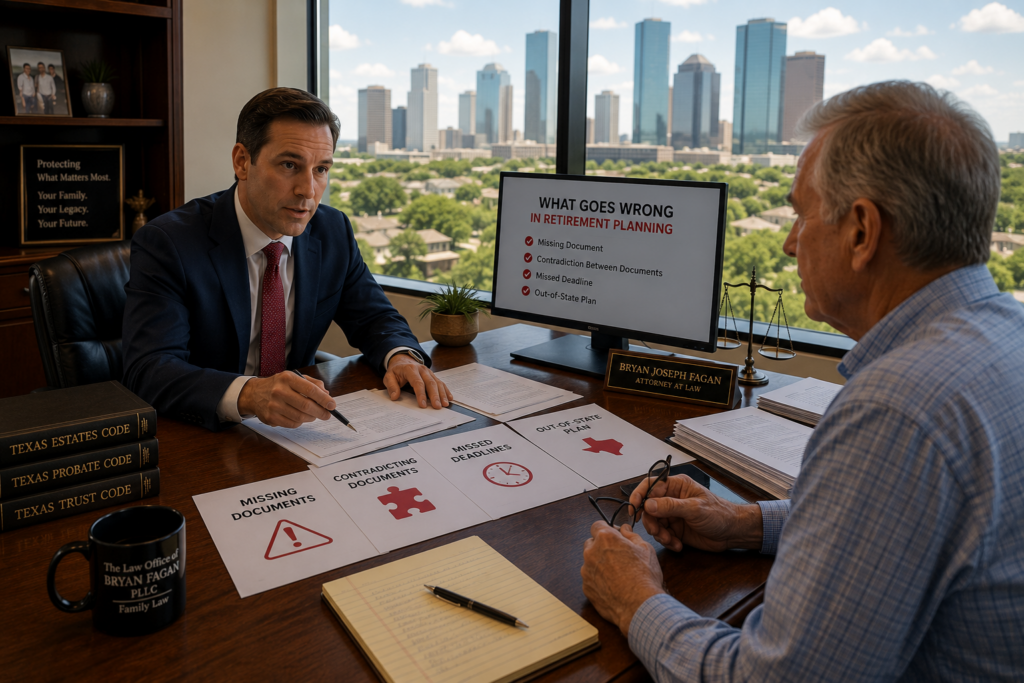
Many of the retirement-planning problems that create the most stress for Texas families are surprisingly predictable. Retirement Planning Attorneys in Houston Heights Texas frequently see the same issues repeated: missing documents, outdated beneficiary designations, conflicting estate-planning instructions, missed probate deadlines, and retirement plans that were created in another state but never updated to comply with Texas law. The good news is that most of these problems can be identified and corrected before they become expensive legal disputes.
One of the most important deadlines involves probate. Under Texas Estates Code §256.003, a will generally must be admitted to probate within four years of death. In straightforward situations, meeting that deadline may be relatively simple. However, when families wait too long, probate administration can become significantly more complicated and costly. Keeping original estate-planning documents organized and reviewing them periodically can help prevent avoidable delays. This is particularly important for families focused on probate avoidance, retirement asset inheritance, and long-term family wealth preservation.
Another common problem occurs when estate-planning documents do not work together. A will may divide assets equally among children, while a retirement account beneficiary designation names only one child. A trust may say one thing, while a deed or account registration says something else. Where multiple beneficiaries are involved, especially in blended families or retirement planning after divorce, these conflicts can lead to confusion and unintended outcomes. In more complex estates, coordinating beneficiary designations, trusts, and other planning documents is often just as important as drafting the documents themselves.
If incapacity planning is a concern, the risks can be even greater. A sudden illness, dementia diagnosis, or serious injury can leave loved ones unable to manage finances without legal authority. Without the proper documents, families may face guardianship proceedings simply to access accounts or make necessary financial decisions. A properly executed durable power of attorney can often prevent those situations by granting authority before a crisis occurs. Whether your needs involve a simple will-based plan or a comprehensive review of trusts, retirement accounts, and asset protection strategies, proactive planning can help reduce uncertainty, avoid costly mistakes, and protect the people who matter most.
Listen to Our Texas Family Law Podcast
Prefer listening? In this episode, we discuss retirement planning in Houston Heights, Texas, including how family law issues can affect retirement assets, long-term financial security, and the future you’ve worked for.
“The account balance is the easy part. Who controls it, and how it transfers, is the part that needs a lawyer.”
The Core Documents Every Retirement Plan in Texas Needs
A strong retirement plan is about more than growing your savings—it is about protecting those savings when life takes an unexpected turn. Retirement Planning Attorneys in Houston Heights Texas often begin with five foundational documents: a will, a durable power of attorney, a medical power of attorney, a directive to physicians, and, for many families, a revocable living trust. Together, these documents address two critical questions: who makes decisions if you cannot, and what happens to your assets when you pass away.
In straightforward situations, a will, updated beneficiary designations, and properly executed powers of attorney may provide meaningful protection. A will directs the distribution of probate assets, while a financial power of attorney authorized under Texas Estates Code §752.051 allows a trusted person to manage financial affairs during incapacity. A medical power of attorney and directive to physicians help ensure healthcare decisions reflect your wishes if you are unable to communicate them yourself. If incapacity planning is a concern, understanding the differences between a durable power of attorney and a general power of attorney can help families avoid confusion during a medical emergency.
In more complex estates, revocable living trusts often become an important part of the plan. If your retirement plan includes significant retirement assets, multiple properties, business interests, blended-family considerations, or long-term family wealth preservation goals, a trust can help streamline asset transfers and reduce probate exposure. When combined with coordinated beneficiary designations and comprehensive estate planning, trusts can provide additional privacy, efficiency, and asset protection. However, one of the most common retirement-planning mistakes is creating a trust and never funding it. A trust only controls assets that are properly transferred into it, making implementation just as important as the document itself.
For blended families, retirees who have recently moved to Texas, or families concerned about retirement account inheritance and probate avoidance, periodic reviews are essential. Life changes, laws evolve, and beneficiary designations can become outdated over time. Whether your needs involve a simple will-based plan or a more comprehensive trust-centered strategy, keeping these core documents current can help reduce future complications, protect loved ones, and preserve the financial legacy you worked hard to build.
How I Sequence a Retirement Plan So Nothing Slips
The order in which you create your estate-planning documents matters more than many people realize. Retirement Planning Attorneys in Houston Heights Texas often focus first on protecting clients during their lifetime before addressing what happens after death. The reason is simple: the consequences of being unprepared for incapacity can be immediate and expensive. A retirement plan should not only protect your assets but also ensure that trusted individuals can step in when needed and that your family can avoid unnecessary court involvement.
In straightforward situations, the foundation often begins with a durable power of attorney, a medical power of attorney, and basic estate-planning documents. These tools can help families avoid guardianship proceedings if a medical emergency, cognitive decline, or long-term care event occurs. Understanding which assets pass outside probate is also an important part of the process, especially when coordinating retirement accounts and beneficiary designations. Families can learn more about what assets do not go through probate as part of building a comprehensive plan. Once incapacity planning is in place, attention can shift to wills, beneficiary reviews, and strategies designed to preserve family wealth.
In more complex estates, additional planning layers may be necessary. If your retirement plan includes significant retirement accounts, multiple properties, business interests, blended-family considerations, or substantial assets accumulated over time, a revocable living trust may become an important probate-avoidance tool. Where multiple beneficiaries are involved, coordinating trusts, beneficiary designations, and other estate-planning documents helps reduce the risk of conflicts and unintended distributions. One of the most common mistakes is assuming documents created years ago still reflect current wishes when marriages, divorces, births, deaths, and financial changes may have altered the family’s needs.
A retirement plan should never be viewed as a one-time project. The most effective plans are reviewed periodically and updated after major life events or significant legal changes. Whether your needs involve a simple will-based strategy or a comprehensive trust-centered plan, regular reviews help identify outdated documents, missed beneficiary updates, and potential probate complications before they create problems for loved ones. Taking a proactive approach today can help preserve family stability, protect retirement assets, and ensure your plan continues to reflect your goals for the future.
Do you currently have a will?
Yes, I have a will No, or it’s outdated Not sure what counts ← Back to startHave you reviewed your 401(k) / IRA beneficiary forms in the last 3 years?
Yes, they’re current No, or not recently I don’t know where they are ← BackDo you want to keep your assets out of probate for your heirs?
Yes, that’s a priority Maybe, want to understand it Probate is fine with me ← BackWhere do your assets and home sit?
Houston / Harris County — Texas documents Multiple Texas counties I moved here — my documents are from another state ← BackYou’re in strong shape — let’s confirm the details
Your assets are Texas-based and you’ve started the right documents. A short Legal Strategy Session can verify your will is self-proving, your durable POA is current under Estates Code §752.051, and your beneficiary forms match your will. That’s the difference between “mostly covered” and “fully protected.”
You likely have a multi-county gap worth closing
Assets across more than one Texas county change how your estate is filed and administered. A plan that accounts for where each asset sits — and a funded trust to avoid probate in multiple counties — is usually the right move. Let’s map it in a Legal Strategy Session.
Your out-of-state documents need a Texas review first
Texas is a community-property state, so a plan drafted in California, New York, or Florida often doesn’t transfer cleanly. Before anything else, your documents should be reviewed and likely re-executed under Texas law. This is the most common gap I see in retirees who relocated to Houston.
You’re starting from scratch — that’s fixable fast
You don’t have the core documents yet, which means right now your retirement savings aren’t legally protected the way you’d want. The good news: a complete plan is usually four or five documents and a single focused session. Let’s build the foundation.
Is your retirement savings legally protected in Texas?
Answer six quick questions and see where your plan stands — and exactly which documents, if any, you’re missing.
Step 1 of 6What best describes you right now?
I have some documents and want them checked I’m starting from scratch — no plan yet I moved to Texas and need a reviewBuild the will and both powers of attorney first — they protect you while you’re alive. Add the trust second, and fund it the same quarter. An unfunded trust is just paper; funding is the step people skip and regret.
Used the checker above and found a gap? Let’s close it.
Schedule a Legal Strategy SessionWhat Retirement-Planning Legal Work Costs in Houston
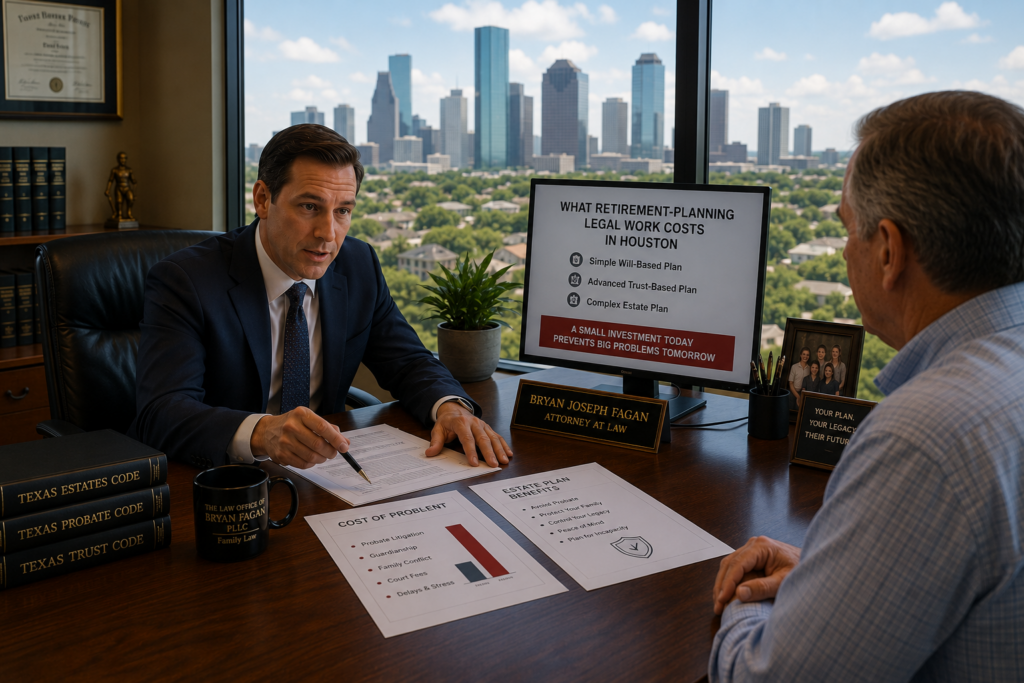
One of the most common questions families ask is what it costs to create a comprehensive retirement plan. The answer depends less on the documents themselves and more on the complexity of your goals, assets, and family situation. Retirement Planning Attorneys in Houston Heights Texas typically evaluate factors such as retirement account balances, real estate holdings, business interests, beneficiary planning needs, probate-avoidance goals, and whether trust-based planning is appropriate. In many cases, the cost of a well-structured plan is significantly less than the financial and emotional expense of a probate dispute, guardianship proceeding, or family conflict that could have been prevented.
In straightforward situations, a retirement plan may involve a will, updated beneficiary designations, powers of attorney, and basic estate-planning documents. In more complex estates, additional planning may be necessary to address blended-family concerns, retirement planning after divorce, long-term care considerations, family businesses, or substantial assets intended for future generations. If your retirement plan includes multiple properties, significant retirement accounts, or sophisticated wealth-preservation goals, trust-based planning may offer additional benefits beyond a traditional will-centered approach.
Many families are surprised to learn that retirement planning is often about preventing future costs rather than creating new ones. Common mistakes such as outdated beneficiary forms, unfunded trusts, missing incapacity documents, or misunderstandings about whether retirement accounts pass through probate can create expensive complications later. Understanding whether a 401(k) is considered a probate asset in Texas is just one example of how seemingly small details can have a significant impact on how assets transfer to loved ones.
The most effective way to evaluate the cost of retirement planning is to first understand your specific circumstances. Every family has different priorities, risks, and goals. Whether you need a basic estate review or a comprehensive strategy focused on asset protection, probate avoidance, and family wealth preservation, the right plan should be tailored to your situation—not based on assumptions. Taking the time to review your assets, beneficiary designations, and long-term objectives today can help reduce uncertainty, avoid future legal complications, and protect the legacy you have worked hard to build.
| Cost Driver | What It Covers | What Affects the Range |
|---|---|---|
| Will-based plan | Will, durable POA, medical POA, directive | Number of beneficiaries; blended family |
| Trust-based plan | Everything above plus a funded revocable trust | Asset count; real estate; business interests |
| The alternative | Guardianship or contested probate later | Costs many times the plan; public and slow |
Get a real number for your situation — bring your assets, leave with a plan.
Schedule a Legal Strategy SessionHarris County Procedure and Where Nearby Counties Differ
For many Houston Heights families, retirement planning does not stop at creating a will or trust—it also involves understanding where and how an estate may be administered. Retirement Planning Attorneys in Houston Heights Texas often help clients plan around probate procedures that can vary depending on where assets are located. In Harris County, probate matters are generally handled by dedicated statutory probate courts, which focus specifically on estate and guardianship cases. When a will is properly drafted, self-proved, and supported by a comprehensive estate plan, the probate process is often more predictable and efficient.
The picture can become more complicated when assets are spread across multiple counties. Many retirees own rental properties, vacation homes, family land, or investment real estate outside Houston. If your retirement plan includes property in Fort Bend County, Montgomery County, Galveston County, Brazoria County, or elsewhere in Texas, probate administration may involve different local procedures, filing requirements, and court practices. In straightforward situations, a properly structured estate plan may simplify administration. In more complex estates, multi-county property ownership can increase costs, delays, and administrative burdens if planning is not addressed in advance.
One of the most effective ways to reduce those complications is through proactive probate-avoidance planning. Assets that transfer outside probate through beneficiary designations, properly funded revocable living trusts, or other estate-planning tools often create a smoother transition for surviving family members. Families concerned about retirement account inheritance, blended-family planning, or preserving wealth across generations frequently explore strategies designed to minimize court involvement. Understanding how to avoid probate in Texas can help families identify opportunities to simplify future administration and protect loved ones from unnecessary legal hurdles.
If your retirement plan includes multiple properties, substantial assets, business interests, or family members living in different locations, it may be worth reviewing whether your current plan adequately addresses those realities. What works well for a single home in Harris County may not provide the same protection for a family with assets spread throughout Southeast Texas. By coordinating wills, trusts, beneficiary designations, and asset-titling strategies, families can often reduce probate risks, preserve family wealth, and create a plan that reflects both their goals and the practical realities of where their assets are located.
Own property in more than one Texas county? Your plan needs to account for that.
Schedule a Legal Strategy SessionWhat to Do If You’re Protecting Retirement Savings in Texas
What I Tell Every Client Who Calls About Retirement Planning
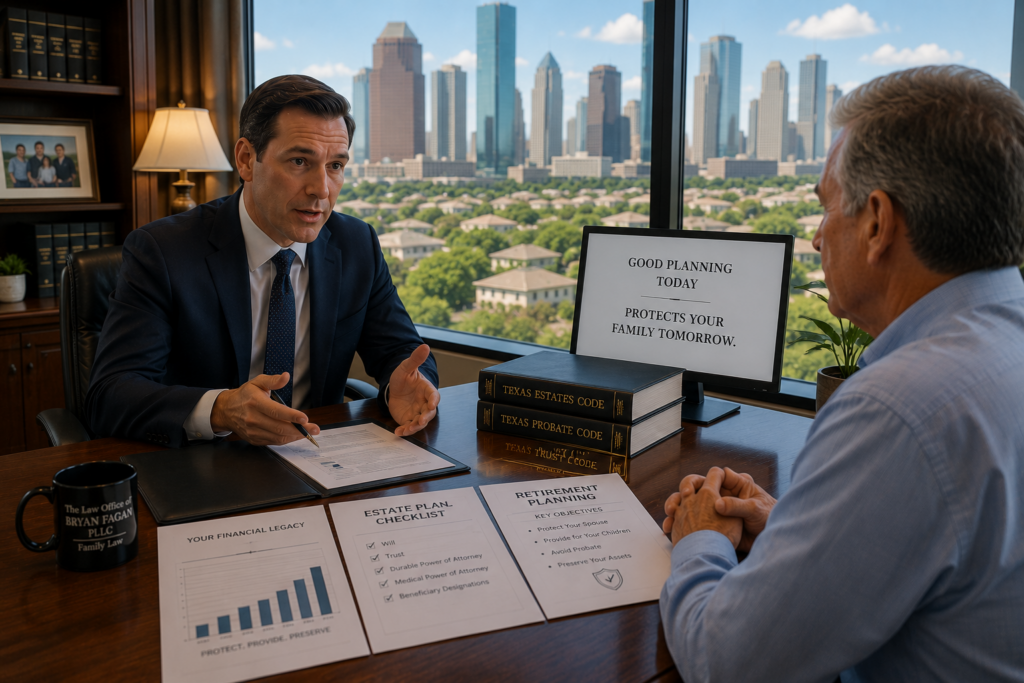
You did the hard part. You saved. The legal documents are what make sure that savings does what you intend — protects your spouse, reaches your children, and stays out of court. The gap between a good financial picture and a protected one is usually four or five documents and an afternoon.
The cost of waiting isn’t theoretical. It’s a guardianship hearing your family didn’t need, an IRA that went to the wrong person, or a probate fight that a self-proving will would have prevented. Every one of those is avoidable with documents that take far less time and money than the problems they head off.
If you’re in the Heights and you’ve been meaning to handle this, handle it now. Bring your statements and your forms, and I’ll show you precisely where you stand and what to do next.
Protect what you spent a career building. Let’s get your documents right.
Schedule a Legal Strategy SessionConclusion:
The decisions you make during a divorce rarely affect just one part of your life. Retirement accounts, beneficiary designations, parenting plans, custody arrangements, and your child’s long-term stability are often more connected than families realize. Working with experienced Retirement planning Attorneys in Houston Heights Texas can help you understand those connections and create a plan that protects both your financial future and the people who depend on you. When families have clarity about where they are going, they are better positioned to provide the consistency, security, and peace of mind children need to thrive.
In straightforward situations, a review of retirement assets, beneficiary designations, and estate planning documents may be enough to keep your plans aligned with your goals. In more complex cases, the stakes are often much higher. If your case involves significant retirement accounts, business ownership, blended families, special needs planning, high-conflict custody issues, or concerns about your child’s academic and emotional well-being, strategic legal guidance can make a meaningful difference. At The Law Office of Bryan Fagan, PLLC, our goal is not simply to help you navigate legal challenges—it is to help you make informed decisions that protect what matters most and position your family for a stronger future. The right next step is understanding your situation clearly, identifying the opportunities and risks unique to your family, and developing a plan that gives you confidence moving forward.
Questions My Clients Ask About Retirement Planning Attorneys
You need both, for different jobs. A financial advisor grows and allocates your savings. An attorney builds the legal documents that decide who controls those assets if you’re incapacitated and who inherits when you die. The advisor handles the balance; the attorney handles the transfer. Most problems I fix come from people who had one but not the other.
No. Retirement accounts pass by beneficiary designation, which overrides your will. Whoever is named on the account form inherits it directly. This is why I review every beneficiary designation as part of a plan — a stale form is the most common way a careful will gets quietly undone.
Your family has to petition a Texas court for guardianship to manage your finances and care. It’s public, slow, and costs far more than the durable power of attorney under Estates Code §752.051 that would have prevented it. This is the single document I most often wish a new client had signed years earlier.
Generally four years from the date of death, under Texas Estates Code §256.003. Miss that window and your heirs lose the straightforward probate route and face a harder, more expensive process to establish who inherits. Don’t wait — start probate promptly.
Yes, when it’s funded. A revocable living trust holds your assets so they transfer to your beneficiaries without going through probate. The catch is funding — the trust only avoids probate for assets actually titled in its name. An unfunded trust does nothing, which is why funding is part of the work, not an afterthought.
Significantly. Texas is a community-property state, so what a married couple owns — and how it passes — differs from California, New York, or Florida. A plan drafted in another state often doesn’t transfer cleanly. If you moved to Houston for retirement, your out-of-state documents need a Texas review.
Any time your life changes — marriage, divorce, a death, a new grandchild, a major asset, or a move to Texas — and after major legislative sessions. The 89th Texas Legislature amended several estate provisions effective September 1, 2025, so a plan that’s a few years old is worth a fresh look.
A will directs your property after death and goes through probate. A funded living trust transfers assets to your beneficiaries without probate and also manages them if you’re incapacitated. Most complete plans use both — the will as a backstop, the trust as the main vehicle.
Yes. A financial durable POA can’t make medical decisions. A medical power of attorney under Texas Health & Safety Code §166.151 names who decides your care if you can’t, and pairs with a directive to physicians. Both belong in a complete retirement pla
Book a Legal Strategy Session. Bring your account statements, any existing documents, and your beneficiary forms. I’ll show you exactly where the gaps are and what closing them takes. That first session turns a vague worry into a clear, prioritized plan.
Will-controlled assets pass under the Texas intestacy rules in Estates Code §201.001 and following, where the state decides who inherits. In a blended family that result is frequently not what you’d have chosen. Accounts with beneficiary designations still pass by those forms — another reason to reconcile everything while you can.
