
Contested Divorce Attorney in Houston Heights, Texas: What You Actually Face and How to Win It

A man called my office from his truck outside a gas station in Houston Heights. His wife had filed for divorce two weeks earlier. Since then, the joint account had been emptied, the conversation about who would stay in the house had turned into an argument, and every text message seemed to create a new dispute. His first question was not about property division or court dates. It was, “How do I keep this from hurting my kids?” Like many people searching for Contested Divorce Divorce Attorneys in Houston Heights Texas, he had reached the point where the divorce was no longer just about two adults ending a marriage. It had become about protecting his family’s future while navigating one of the most difficult transitions of his life.
The legal issues in a contested divorce are significant. Parents may disagree about conservatorship, possession schedules, child support, decision-making authority, or how assets should be divided. As conflict increases, uncertainty often increases with it. What many parents quickly discover is that the effects of divorce rarely stay confined to the courthouse. Family stress can spill into daily routines, emotional well-being, relationships, and the overall stability children depend on to thrive.
I have worked with families throughout Houston and Harris County facing high-conflict divorces, custody disputes, and complex family law challenges. One lesson emerges again and again: children tend to do best when parents create consistency, structure, and predictability, even when they can no longer live under the same roof. Texas courts recognize this reality. Under Texas Family Code §153.002, every custody decision must be guided by the best interest of the child. Judges are not simply deciding where a child sleeps. They are evaluating which arrangements are most likely to support that child’s long-term well-being and success.
At The Law Office of Bryan Fagan, PLLC, we believe family law is about more than legal outcomes. Our mission is to empower people to reclaim freedom and peace of mind during life’s hardest transitions. Through compassionate counsel, practical education, and innovative legal solutions, we help families make informed decisions when the future feels uncertain. Founded by Bryan Joseph Fagan, a South Texas College of Law graduate and recognized authority on Texas divorce and custody law, our firm has guided thousands of Texas families through difficult transitions while keeping their focus where it belongs: protecting what matters most.
The father who called from that gas station could not stop his divorce from happening. What he could do was take control of how he responded to it. By understanding the legal process early, documenting what mattered, and building a strategy focused on his children’s stability, he positioned himself to move forward with confidence. That is often the difference between parents who spend months reacting to a divorce and those who successfully navigate it. In this article, we will examine how contested divorces affect children, how Texas courts evaluate stability and parenting arrangements, and what parents can do right now to help their children succeed during a period of significant change.
The Bottom Line
A contested divorce in Texas is any divorce where the spouses disagree on property, children, support, or grounds, forcing a judge in your county, Harris County for Houston Heights, to decide the unresolved issues. It takes longer and costs more than an agreed divorce, but the outcome is shaped far less by the facts alone than by which spouse prepares, documents, and litigates strategically from the start.
Key Takeaways
- A case is “contested” the moment one real issue is in dispute. You do not need a courtroom brawl over everything. One genuinely contested item, custody, the house, a business, makes the whole case contested and changes how it is managed.
- Texas is a no-fault state, but fault still matters. Under Texas Family Code §6.001 (2025) you can divorce on insupportability alone, yet proving fault like adultery (§6.003) or cruelty (§6.002) can shift the property division your way.
- Texas property division is “just and right,” not automatic 50/50. Under §7.001, a Harris County judge can divide the community estate unequally based on fault, earning capacity, and who has the children.
- The 60-day waiting period is a floor, not a finish line. Section 6.702 bars any divorce in under 60 days; a genuinely contested case in Harris County usually runs 8 to 18 months or longer.
- The spouse who moves first usually controls the case. Temporary orders set in the first weeks, who stays in the house, who has the kids, who pays what, frequently become the template for the final decree.

Your Family’s Future Starts Here
Don’t navigate your legal journey alone. Schedule a consultation now and get the clarity and support you deserve.
Family lawyers and attorneys advise our clients of the immediate aftermath as well as the long-term effects of Family Law related issues, such as the following:
Trust us to help you with your Family Law Attorneys in the Houston Heights in Texas. Call (281) 245-1776 or contact us online today to schedule a free consultation with your Family Law Attorney in Humble, Texas.
What a Contested Divorce Means in Texas

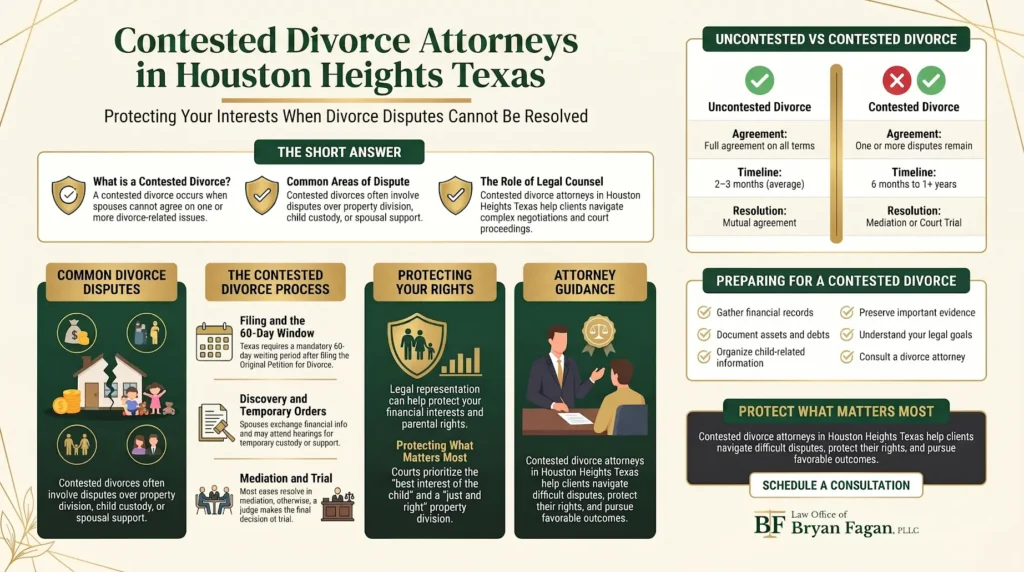
For families searching for Contested Divorce Divorce Attorneys in Houston Heights Texas, a contested divorce begins when spouses cannot agree on one or more issues the court must decide. That disagreement may involve child custody, visitation, child support, property division, or spousal maintenance. Instead of presenting a completed agreement for approval, the parties ask the court to resolve the dispute. Even a single unresolved issue can turn an otherwise straightforward divorce into active litigation, changing the timeline, cost, and strategy of the case. Families facing these challenges can learn more about the process through our guide to contested divorce in Houston Heights.
The disputes that most commonly create contested divorces are predictable. Parents may disagree about conservatorship, possession schedules, educational decisions, or child support obligations. Other cases center on community property division, retirement accounts, business interests, or whether certain assets should be classified as separate property. In custody matters, Texas courts are guided by the best-interest standard found in Texas Family Code §153.002 and frequently evaluate parental involvement, stability, cooperation, credibility, and each parent’s ability to provide a consistent environment for their children.
In straightforward situations, a contested issue may be resolved through negotiation or divorce mediation in Texas before extensive litigation becomes necessary. In more complex cases, disputes may involve significant assets, contested custody issues, hidden income, business ownership, or concerns affecting a child’s well-being. As the complexity increases, preparation becomes increasingly important. Harris County family courts rely on evidence, documentation, financial transparency, and credibility when making decisions. The spouse who is organized and proactive often places themselves in a stronger position than someone who waits until problems have escalated.
One of the most common mistakes people make is assuming the facts alone will determine the outcome. Courts can only evaluate the evidence presented to them. Temporary orders, financial disclosures, and early strategic decisions frequently shape the direction of a case long before a final trial occurs. Whether your situation involves a relatively simple disagreement or high-conflict litigation, understanding your rights and acting early can help protect your children, finances, and future.
What this means for you: You do not control whether your case is contested, your spouse’s refusal to agree can do that alone. But you fully control how prepared you are when it is. That preparation is where cases are won.
Contested vs. Uncontested Divorce in Texas
The difference between contested and uncontested divorce in Texas is agreement. An uncontested divorce means both spouses agree on every issue and sign off; a contested divorce means at least one issue goes to the judge. The contested vs uncontested divorce Texas distinction drives everything downstream: cost, timeline, discovery, hearings, and stress.
People often assume their case is uncontested because they “mostly agree.” Mostly is not all. If you agree on the children but not on whether the house is sold or refinanced, you have a contested divorce. If you agree on the money but one spouse wants primary custody the other will not concede, you have a contested divorce. The single open issue controls the label.
| Category | What Texas Law Says | Practical Impact |
|---|---|---|
| Grounds | No-fault available under §6.001 (insupportability); fault grounds under §§6.002–6.005 | You can divorce without proving fault, but pleading fault can change the property split |
| Property | “Just and right” division of community property under §7.001 | Not guaranteed 50/50; a judge can award you more or less based on the record |
| Residency | 6 months in Texas and 90 days in the county under §§6.301–6.302 | For the Heights, your case is filed in Harris County district court |
| Timing | 60-day minimum waiting period under §6.702 | No contested case finishes in 60 days; plan for many months |
Listen to Our Texas Family Law Podcast
Prefer listening? In this episode, we discuss contested divorce in Houston Heights, Texas, including what to expect when spouses cannot agree, key issues that may arise, and how to prepare for the legal process.
Grounds, Fault, and Why They Still Matter
Many people are surprised to learn that Texas allows both no-fault and fault-based divorces. For families researching Contested Divorce Divorce Attorneys in Houston Heights Texas, understanding the difference can have a meaningful impact on strategy, especially when disputes involve significant assets, child-related issues, or allegations of marital misconduct. Under Texas Family Code §6.001, a spouse may obtain a divorce based on insupportability, meaning the marriage has become insupportable due to conflict or discord with no reasonable expectation of reconciliation. In many straightforward situations, this no-fault approach allows the parties to focus on resolving issues rather than proving blame.
However, fault can still play an important role in contested divorce litigation. Texas Family Code §6.002 recognizes cruelty as a fault ground, while §6.003 addresses adultery. When significant assets are involved, fault allegations may affect how a court approaches community property division under Texas Family Code §7.001. For example, if one spouse spent substantial community funds on an extramarital relationship or engaged in conduct that harmed the marital estate, a judge may consider those facts when determining what constitutes a “just and right” division of property. In more complex cases involving business ownership, retirement accounts, hidden assets, or financial misconduct, strategic evaluation of fault claims becomes increasingly important.
The decision to pursue fault grounds should never be driven solely by emotion. Harris County family courts evaluate evidence, credibility, financial records, and documentation—not accusations alone. A common mistake is assuming that fault automatically guarantees a favorable outcome. In reality, proving fault requires evidence, preparation, and a clear understanding of how those allegations connect to the legal issues before the court. Where disputes are heavily contested, especially when temporary orders, property division, or a contested custody case are involved, early documentation and thoughtful planning often matter more than anger or frustration.
In some divorces, proceeding on no-fault grounds may be the most efficient path forward. In others, allegations of adultery, cruelty, or financial misconduct may become a meaningful part of the overall strategy. The key is understanding which approach aligns with your circumstances rather than assuming every case should be handled the same way. Families seeking guidance on contested divorce issues can learn more about working with a contested divorce lawyer in Texas and how Texas courts evaluate the facts that can influence both property division and the outcome of a contested case.
Strategy note: Decide the fault question early, with counsel, before you file. Pleading fault you cannot prove wastes money and credibility. Proving fault you can establish can move tens of thousands of dollars in a contested estate. This is a decision, not a coin flip.
How a Texas Court Divides Property in a Fight

In a contested Texas divorce, the court divides the community estate in a manner it considers “just and right” under Texas Family Code §7.001 (2025). Just and right does not mean equal. A Harris County judge can award one spouse 55, 60, or 65 percent of the community estate based on fault, disparity in earning power, health, custody of the children, and waste of marital assets.
The first battle is characterization: what is community property (acquired during marriage, presumed divisible) versus separate property (owned before marriage, inherited, or gifted, and not divisible). Money commingled in a single account, a house bought before marriage but paid down with marital income, a business that grew during the marriage, these are where contested cases are actually won and lost.
“The spouse who can document the estate controls the conversation about how it gets divided. Memory loses to records every time.”
How Long a Contested Divorce Takes
One of the most common questions people ask Contested Divorce Divorce Attorneys in Houston Heights Texas is how long a contested divorce will take. While Texas Family Code §6.702 imposes a minimum 60-day waiting period, most contested divorces in Harris County take considerably longer. A typical contested case often lasts eight to eighteen months, while high-conflict litigation involving business interests, substantial assets, or a contested custody case can extend beyond two years. The biggest factor is usually not the law itself, but the level of disagreement between the parties.
Most contested divorces move through several stages, including filing, temporary orders, discovery, mediation, and, if necessary, trial. In straightforward situations, disputes may be resolved during negotiation or divorce mediation in Texas. In more complex cases involving community property division, hidden assets, retirement accounts, or significant custody disputes, additional investigation and court involvement may be required. Temporary orders entered early in the case often shape parenting schedules and financial obligations long before a final decree is signed.
The good news is that most contested divorces settle before trial. Preparation, documentation, and a clear strategy frequently have a greater impact on the outcome than many people realize. Families who understand the process early and avoid reacting emotionally often place themselves in a stronger position as the case moves forward. To learn more about the process, visit our guide to contested divorce in Texas.
Do you and your spouse disagree on custody of the children?
Yes, custody is disputed No children involved We agree on the children ← Start overIs there significant property to divide, a house, retirement, or a business?
Yes, substantial assets Some, but modest Not really ← BackHave you been able to document the marital finances, accounts, deeds, and retirement?
Yes, I have records Partially No, my spouse controls the finances ← BackHas your spouse already hired an attorney or filed?
Yes Not yet I’m not sure ← BackDo you or your spouse meet Texas residency, 6 months in Texas and 90 days in the county?
Yes, residency is clearly met I think so, but I’m not certain No, or we just moved to Texas ← BackYou are positioned to fight from strength.
Texas jurisdiction is clear and you have documentation in hand, which are two of the biggest advantages in a contested divorce. The next move is converting that position into temporary orders and a mediation strategy before your spouse’s side hardens theirs. This is the moment to act, not wait.
You have a real case, with gaps to close fast.
You likely have Texas jurisdiction and a genuine contested matter, but uncertainty about residency or incomplete documentation are exactly the gaps the other side exploits. These are fixable, and fixing them early changes your leverage at mediation. A strategy session will tell you precisely what to lock down first.
Texas residency has to be confirmed before anything else.
Under Texas Family Code §§6.301–6.302, a court needs 6 months of Texas residency and 90 days in the county before it can hear your divorce. If that is not yet met, the timing and even the venue of your case may change. This is solvable, but it has to be sorted out first, and that is a conversation worth having now.
How strong is your contested divorce position? Answer 6 quick questions.
No contact information required to see your result. Let’s start with the core issue.
What is the main thing you and your spouse disagree about?
The children / custody Money, property, or the house Both, and it’s escalating We’re early, but it’s heading there| Phase | Typical Timeline | Your Action Item |
|---|---|---|
| File & serve | Weeks 1–3 | Secure records, separate finances, do not move out without advice |
| Temporary orders | Weeks 2–8 | Push for the arrangement you want to be permanent |
| Discovery | Months 2–9 | Produce honestly, demand fully, expose hidden assets |
| Mediation | Months 6–14 | Arrive with a documented, defensible number |
| Trial (if needed) | Months 12–24+ | Only the unresolved issues are tried to the judge |
Want a read on how strong your contested case actually is? We will give you a straight answer.
Schedule a Legal Strategy SessionThe Mistakes That Cost People Their Cases
Many people searching for Contested Divorce Divorce Attorneys in Houston Heights Texas assume their case will be decided by what happens at trial. In reality, some of the most damaging mistakes occur long before a court date arrives. Moving out of the marital home without understanding the consequences, agreeing to informal parenting arrangements, posting about the divorce on social media, or failing to preserve financial records can all weaken a case. What feels like a small decision today can become important evidence later.
In straightforward situations, these mistakes may create unnecessary delays or expense. In more complex cases involving a Texas child custody dispute, significant assets, business ownership, retirement accounts, or allegations of hidden property, the impact can be much greater. Harris County family courts evaluate credibility, documentation, financial transparency, and parental involvement when making decisions. Under Texas Family Code §153.002, judges focus on the child’s best interests, while property disputes often depend on proving whether assets are separate or community property.
Contested divorce litigation rewards preparation and punishes reaction. Temporary orders, financial disclosures, and early strategic decisions often influence the outcome long before mediation or trial occurs. Families who document important facts, stay focused on long-term goals, and avoid emotional decision-making frequently place themselves in a stronger position as the case progresses. For additional insight into how contested legal disputes develop, see our discussion of contesting information filed in a Texas proceeding.
Warning: Do not move out of the house, change the kids’ routine, or touch joint accounts before you have spoken to a lawyer. These feel like relief in the moment. In a contested case they become the facts the other side uses against you.
How It Works in Harris County and the Heights

If you live in Houston Heights, your contested divorce is filed in the Harris County district courts downtown, which operate a set of dedicated family law courts with their own local rules, standing orders, and associate judges who hear temporary matters. Harris County issues a standing order at filing that automatically restrains both spouses from hiding assets, harassing each other, or disrupting the children, and it takes effect immediately.
The Harris County family courts lean heavily on mediation before they will give you a contested trial setting. That is not a delay tactic, it is how the county manages a very large docket, and it means your leverage at mediation effectively decides most cases. Knowing which court you are likely to draw, and how that judge tends to rule, is part of building strategy.
Where Nearby Counties Differ
Many people assume that every Texas divorce follows the same process, but families working with Contested Divorce Divorce Attorneys in Houston Heights Texas often discover that local court practices can significantly affect how a case moves forward. While the Texas Family Code applies statewide, each county has its own court procedures, standing orders, scheduling practices, and expectations regarding mediation. As a result, a contested divorce filed in Harris County may proceed differently than a similar case filed in Montgomery, Fort Bend, Galveston, or Brazoria County.
For example, Harris County family courts often place a strong emphasis on mediation before setting a case for trial, while other counties may have different timelines or docket speeds. In straightforward situations, these differences may have little impact beyond scheduling. In more complex cases involving a Texas child custody dispute, significant assets, business ownership, or high-conflict litigation, local court procedures can influence strategy, preparation, and timing. Judges across Texas evaluate many of the same factors—including credibility, parental involvement, financial transparency, and the child’s best interests under Texas Family Code §153.002—but how cases move through the system can vary considerably.
The county where a divorce is filed is generally determined by the residency requirements found in Texas Family Code §§6.301–6.302. Confirming the proper venue early is important because filing in the wrong county can create delays and unnecessary expense. Whether your case remains in Harris County or proceeds elsewhere, understanding the local court process and preparing accordingly can help protect your position as the case moves forward. For additional perspective on how contested divorces are handled in neighboring communities, visit our guide to contested divorce in Texas.
What to Do If You’re Facing a Contested Divorce
Bring this checklist to a strategy session and we will turn it into your actual plan.
Schedule a Legal Strategy SessionWhat I Tell Every Client Who Calls About a Contested Divorce
A contested divorce is not a verdict on you. It is a process, and processes reward preparation. The spouse who understands the law, documents the estate, treats temporary orders seriously, and walks into mediation with a defensible position almost always does better than the spouse who is simply reacting to whatever the other side does next.
The window that matters most is the one you are in right now, before temporary orders are set and before positions harden. What you do this week, where you sleep, what you sign, what you post, what you preserve, shapes the decree you live with for years. That is not pressure for its own sake. It is the honest threshold: early moves carry disproportionate weight in a contested case.
If you are in the Heights or anywhere in the Houston area and your divorce has turned contested, sit down with us. We will tell you where you actually stand and what to do about it, this week, not someday. Schedule a Legal Strategy Session and let’s build your plan.
Your contested divorce will be decided by preparation. Start preparing now.
Schedule a Legal Strategy SessionConclusion:
A contested divorce is rarely just about ending a marriage. It is about protecting your relationship with your children, preserving financial stability, and creating a foundation for the next chapter of your life. The choices you make early in the process can have lasting effects on your family, which is why understanding your rights, your options, and the realities of Texas family law is so important. Whether you are researching your options or actively searching for Contested Divorce Divorce Attorneys in Houston Heights Texas, the goal is not simply to get through the divorce—it is to emerge from it with a clear path forward.
In straightforward situations, resolving disagreements through negotiation or mediation may be enough to achieve a fair outcome. In more complex cases, strategic litigation may be necessary to protect your parenting rights, financial interests, or long-term goals. If your case involves custody disputes, significant assets, business ownership, high-conflict co-parenting issues, or concerns about your child’s stability and well-being, having the right legal strategy—and the right attorney for your situation—can make a meaningful difference.
At The Law Office of Bryan Fagan, PLLC, we believe families deserve more than legal answers. They deserve clarity, guidance, and a trusted advocate who understands both the law and the challenges real families face. Our mission is to help you make informed decisions, regain a sense of control, and move forward with confidence while protecting what matters most. When you are ready to discuss your circumstances, our team is here to help you understand your options and build a strategy tailored to your family’s future.
Questions My Clients Ask About Contested Divorce
A contested divorce is a divorce in which the spouses cannot agree on at least one issue, such as property division, custody, or support, so a judge decides it for them. In Texas, even one genuinely disputed issue makes the entire case contested. It is the opposite of an uncontested or agreed divorce, where both spouses sign off on every term and the court simply approves the agreement.
In Texas, a contested divorce means the case stays active in your county district court, Harris County for the Heights, until every disputed issue is settled or tried. Texas requires a minimum 60-day waiting period under §6.702 and divides community property in a “just and right” manner under §7.001. Because Texas is a no-fault state under §6.001, you can be in a contested divorce even when neither spouse alleges any wrongdoing, the dispute is simply over terms.
The difference is agreement. In an uncontested divorce, both spouses agree on every issue and the court approves their signed terms, usually quickly and cheaply. In a contested divorce, at least one issue is disputed and a judge resolves it, which adds discovery, hearings, mediation, and possibly trial. A case can start uncontested and become contested, or settle partway through and convert to an agreed divorce before the final decree.
The minimum is 60 days from filing under Texas Family Code §6.702, but no genuinely contested case finishes that fast. In Harris County, a contested divorce typically takes 8 to 18 months, and cases involving a business, a custody evaluation, or high conflict can exceed two years. The timeline is driven by the degree of disagreement and the court’s docket, not by the law itself.
Cost depends almost entirely on how much is actually fought over. A contested divorce that settles at mediation costs far less than one that goes to trial over custody and a business valuation. The biggest cost drivers are custody disputes, asset complexity, expert witnesses, and the other side’s willingness to litigate. The most reliable way to control cost is to resolve what you can and litigate only what truly matters, which is something we map out with you at the strategy session.
After filing and service, the court usually sets temporary orders covering who lives where, who has the children, and who pays what during the case. Then both sides exchange financial and other information in discovery, attend mediation to try to settle, and if mediation fails, present the unresolved issues to the judge at trial. Most contested cases settle before trial, but the threat of trial shapes every negotiation.
No. Texas is a community property state, but under §7.001 the court divides the community estate in a “just and right” manner, which is not the same as equal. A judge can award one spouse more than half based on fault, earning capacity, health, who has primary care of the children, and waste of marital assets. Walking in expecting an automatic 50/50 split is a common and costly misunderstanding.
Yes, and it often does. Many cases begin contested and settle at or after mediation, converting into an agreed divorce that the court finalizes without a trial. Once the spouses reach agreement on every open issue, the disputed posture ends and the case proceeds like an uncontested one. A large part of strategy is resolving issues one by one to shrink what actually has to be litigated.
No. Texas grants no-fault divorce on insupportability under §6.001, so you never have to prove wrongdoing to end the marriage. However, proving fault like adultery (§6.003) or cruelty (§6.002) can influence a “just and right” property division in your favor. Whether to plead fault is a strategic decision that depends on the evidence you actually have, not on how angry you are.
If you live in Houston Heights and meet the residency rules in §§6.301–6.302, six months in Texas and 90 days in the county, your divorce is filed in the Harris County district courts downtown, which run dedicated family law courts. Those courts issue a standing order at filing and rely heavily on mediation before granting a contested trial setting. Confirming residency and the correct county early prevents costly procedural missteps.
Still have questions specific to your situation? That is exactly what a strategy session is for.
Schedule a Legal Strategy Session