
Annulment Attorneys in Houston Heights, Texas: Do You Actually Qualify?

Most people who call my office looking for Annulment Attorneys in Houston Heights Texas have already made up their minds about one thing: they wish the marriage had never happened. The harder question is the one I usually ask within the first few minutes of the conversation: does Texas law actually allow you to erase the marriage, or are you really looking at a divorce? That distinction matters more than most people realize because Texas grants annulments only in specific situations defined by statute. A marriage that was short, disappointing, or emotionally painful does not automatically qualify.
In Texas, an annulment is not simply a faster version of divorce. It is a legal claim that the marriage was defective from the beginning. Divorce ends a marriage that everyone agrees was valid. Annulment asks a court to determine that something existed at the time of the wedding that prevented a valid marriage from being formed in the first place. The recognized grounds are found in Chapter 6 of the Texas Family Code, and each carries its own requirements, deadlines, and evidentiary burdens. Miss the deadline or fail to prove the ground, and the opportunity may be lost entirely.
What surprises many parents is how quickly an annulment question can become a custody question. I recently spoke with a parent who initially wanted to know whether her marriage qualified for an annulment. By the end of the consultation, her greatest concern was not the marriage itself—it was her child. The uncertainty surrounding the relationship had already begun affecting family routines, emotional stability, and school performance. That conversation reflects something we see regularly in family law cases: legal decisions rarely affect only the adults involved.
At The Law Office of Bryan Fagan, PLLC, we believe family law should do more than resolve legal disputes. Our mission is to help families reclaim freedom and peace of mind during some of life’s most difficult transitions through education, compassionate guidance, and practical legal solutions. Founded by Bryan Joseph Fagan, a graduate of South Texas College of Law and a recognized authority on Texas family law, our firm has helped thousands of families navigate annulments, divorces, child custody disputes, and other complex legal matters throughout the Houston area.
This article will help you understand how annulments work under Texas law, the grounds courts recognize, the mistakes that commonly derail otherwise valid claims, and how family law decisions can affect children long after the legal case ends. You will also learn why Texas courts place such significant emphasis on stability, consistency, and a child’s overall well-being when making custody decisions, and what parents can do to protect both their legal interests and their children’s future during times of uncertainty.
The Short Answer
In Texas, you qualify for an annulment only if your marriage meets a specific statutory ground — fraud, force, duress, impotency, mental incapacity, intoxication at the ceremony, being underage, or marrying within 72 hours of getting the license — and you file within that ground’s deadline. A short or unhappy marriage is not a ground; those end in divorce.
Key Takeaways
- Annulment requires a legal defect, not regret. Texas grants annulments only on the grounds listed in Family Code §§6.102–6.110 (2025). No ground, no annulment.
- Deadlines are short and ground-specific. A 72-hour-rule annulment must be filed within 30 days of the marriage; an underage next-friend suit within 90 days. Wait too long and the claim is barred.
- Annulment is not always faster or cheaper than divorce. If the ground is contested, you must prove it — which can cost more than an uncontested divorce.
- Void marriages are a separate track. Bigamy or close blood relation makes a marriage void from the start (§§6.201–6.205), challengeable at any time — different from a voidable marriage you annul.
- Continuing to live together can kill your case. For several grounds, cohabiting after you learned the truth (or turned 18) ratifies the marriage and bars the annulment.
- Harris County handles annulments through its district family courts. Heights residents file in Harris County; nearby Montgomery, Fort Bend, and Galveston counties run their own dockets and local rules.

Your Family’s Future Starts Here
Don’t navigate your legal journey alone. Schedule a consultation now and get the clarity and support you deserve.
Family lawyers and attorneys advise our clients of the immediate aftermath as well as the long-term effects of Family Law related issues, such as the following:
Trust us to help you with your Family Law Attorneys in the Houston Heights in Texas. Call (281) 245-1776 or contact us online today to schedule a free consultation with your Family Law Attorney in Humble, Texas.
What Annulment Means in Texas

Many people searching for Annulment Attorneys in Houston Heights Texas assume an annulment is simply another way to end a marriage. In reality, Texas law treats annulment very differently from divorce. A divorce ends a legally valid marriage, while an annulment asks the court to determine that a valid marriage never legally existed because of a defect present when the marriage began. Under Texas Family Code Chapter 6, a court can grant an annulment only when specific statutory grounds exist, making the outcome dependent on the facts, evidence, and timing of your case rather than the emotions surrounding the relationship.
Most annulment cases involve what Texas law refers to as a voidable marriage. These marriages remain legally valid unless a judge grants an annulment based on grounds such as fraud, duress, force, intoxication, mental incapacity, or certain underage marriages under §§6.102–6.110. In straightforward situations where the facts clearly fit a statutory ground, the process may be relatively direct. In more complex cases involving fraud allegations, immigration-related concerns, disputed facts, or credibility issues, proving eligibility often requires substantial evidence and a strategic approach. Because some grounds carry strict filing deadlines, waiting too long can eliminate options that may otherwise have been available.
Texas also recognizes void marriages under §§6.201–6.205. These include circumstances such as bigamy or marriages between close relatives prohibited by law. Unlike a voidable marriage, a void marriage is considered invalid from the beginning. Determining whether your situation involves a void marriage, a voidable marriage, or a traditional divorce can affect everything from filing requirements and evidentiary burdens to the remedies available through the court system. If you would like a deeper explanation of the legal grounds and procedures, our guide to Houston annulment attorneys provides additional insight into how Texas courts analyze these cases.
When children are involved, the legal analysis often extends well beyond the validity of the marriage itself. Even if an annulment is granted, Texas courts remain focused on the best interests of the child under §153.002 and may still issue orders involving conservatorship, possession schedules, and child support. If your case involves custody concerns, high-conflict disputes, significant financial issues, CPS involvement, or questions about long-term family stability, obtaining guidance early can help protect your rights and avoid mistakes that become far more difficult—and expensive—to correct later. Understanding the distinction between a straightforward annulment and a more complex family law matter is often the first step toward making informed decisions that protect both your future and your family.
Why this distinction matters to you
If your marriage is actually void (e.g., your spouse was still married to someone else), you may not need a contested annulment fight at all — a declaration of voidness can be cleaner. Getting this classification right at the first session can save months.
The Legal Grounds for Annulment in Texas
The grounds for annulment in Texas are fixed by statute, and your facts must match one of them. Under Texas Family Code Subchapter B (2025), the recognized grounds include being underage (§6.102), intoxication at the ceremony (§6.105), impotency (§6.106), fraud, duress, or force (§6.107), mental incapacity (§6.108), concealed divorce (§6.109), and marrying within 72 hours of the license being issued (§6.110).
Fraud, duress, or force under §6.107 is the ground I see most often in the Heights. The fraud has to go to the essence of the marriage — a hidden inability or refusal to have children, concealed immigration motive, or a lie about a fundamental fact, not a disappointment that surfaced later. Critically, the statute bars the annulment if you voluntarily kept living together as spouses after you learned the truth.
Texas annulment requirements also reward speed. The 72-hour ground (§6.110) exists to protect against rushed ceremonies, but it must be filed within 30 days of the marriage. Concealed divorce (§6.109) applies when your spouse was divorced from a third person within the 30 days before your marriage and you did not know. Each ground is a separate key — and most fit only one lock.
| Category | What Texas Law Says | Practical Impact |
|---|---|---|
| Fraud / duress / force | §6.107 — deception or coercion going to the essence of the marriage. | Barred if you keep living together after learning the truth. |
| Under 18 | §6.102 — marriage of a 16–17-year-old without consent/order. | Next-friend suit barred after 90 days from the marriage. |
| 72-hour rule | §6.110 — ceremony within 72 hours of license issuance. | Must file within 30 days of the marriage — hard stop. |
| Intoxication | §6.105 — under the influence of alcohol or narcotics at the ceremony. | Barred if you cohabited voluntarily after sobering up. |
| Void (not annulment) | §§6.201–6.205 — bigamy, consanguinity, etc. | Never valid; can be declared void at any time. |
Annulment vs. Divorce in Texas: Which One Is Your Case?
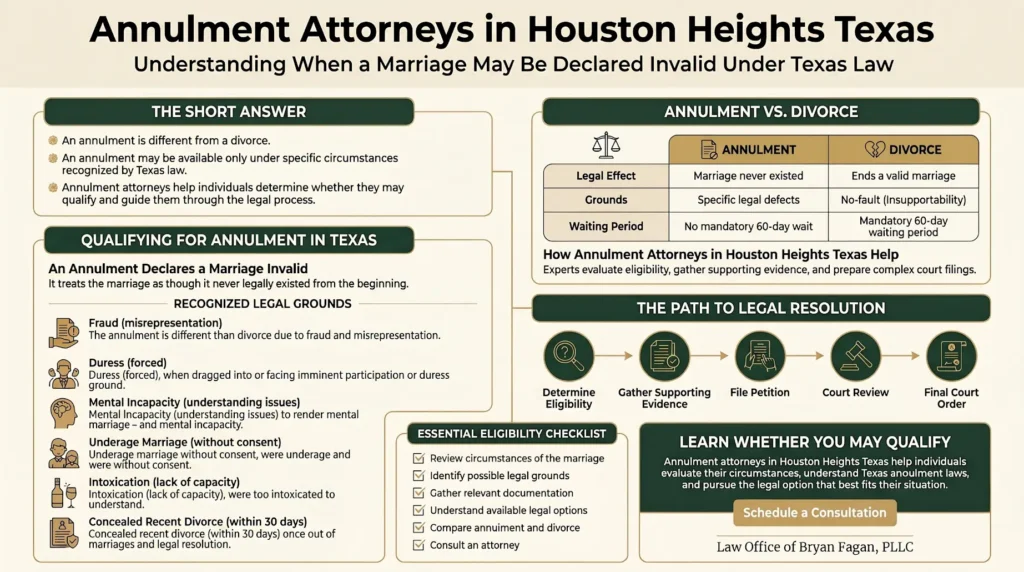
One of the most common questions we hear from people searching for Annulment Attorneys in Houston Heights Texas is whether they should pursue an annulment or a divorce. The answer depends on the facts of your case, not the outcome you prefer. Under Texas Family Code Chapter 6, an annulment is available only when a specific statutory ground exists and all applicable requirements are met. If no qualifying ground applies, a divorce may be the appropriate path forward. Texas also allows no-fault divorce under §6.001, meaning a spouse does not need to prove wrongdoing to end a legally valid marriage.
Many people assume an annulment is automatically faster, easier, or less expensive than a divorce. In practice, that is not always true. In straightforward situations where the legal ground is clear and the evidence is uncontested, an annulment may proceed efficiently. In more complex cases involving fraud allegations, mental incapacity, immigration-related concerns, or disputes about what occurred before the marriage, an annulment can become heavily evidence-driven litigation. Courts expect credible testimony, supporting documentation, and proof that the statutory requirements have been satisfied. Missing a deadline or failing to preserve key evidence can jeopardize an otherwise viable claim.
The distinction between annulment and divorce can become even more significant when children, property, or financial obligations are involved. While an annulment addresses whether a valid marriage existed, Texas courts may still issue orders regarding conservatorship, possession schedules, and child support in Texas when children are involved. Under §§153.002 and 153.134, judges remain focused on the best interests of the child regardless of how the marriage itself is classified. If your case involves custody concerns, significant assets, high-conflict disputes, or competing versions of events, strategic planning early in the process can help protect long-term outcomes and avoid costly mistakes.
Ultimately, annulment is not a shortcut around divorce—it is a specific legal remedy designed for specific circumstances. Determining whether your situation involves a qualifying annulment ground, a void marriage under §§6.201–6.205, or a traditional divorce requires a careful review of the facts, evidence, and applicable deadlines. For a deeper understanding of Texas annulment requirements, visit our guide to annulment requirements in Texas. You may also find it helpful to explore our resources on Texas child custody and other family law matters that can arise alongside an annulment or divorce proceeding.
Strategy note
When a client has a borderline fraud claim, I evaluate whether to plead annulment and divorce in the alternative. That keeps your options open if the court is not convinced on the annulment ground — a decision best made before you file, not after.
| Your Situation | Eligibility Test | What It Means |
|---|---|---|
| Spouse lied about something fundamental | Does the lie go to the essence of marriage? Did you stop cohabiting on discovery? | Possible §6.107 fraud annulment. |
| Married days ago, regret it | Was it within 72 hours of the license? Within 30 days now? | Possible §6.110 — act fast. |
| Short, unhappy marriage, no defect | No statutory ground applies. | Divorce, not annulment. |
| Spouse already married to someone else | Bigamy under §6.202. | Void marriage — separate, often cleaner path. |
The tool gives you a read. A Legal Strategy Session gives you a plan built on your actual facts and deadlines.
Schedule a Strategy SessionTime Limits and Deadlines You Cannot Miss

One of the most important realities about Texas annulment law is that timing matters just as much as the legal ground itself. Many people contact Annulment Attorneys in Houston Heights Texas believing they have a valid annulment claim, only to discover that a missed deadline has already closed the door. Under Texas Family Code Chapter 6, certain annulment grounds carry strict filing requirements. For example, the 72-hour marriage-license ground under §6.110 generally requires filing within 30 days of the marriage, while certain underage marriage claims under §6.102 may be subject to a 90-day deadline. In straightforward situations, acting quickly can preserve valuable legal options. When delays occur, even a potentially valid claim can become significantly more difficult to pursue.
Some deadlines are not measured by a specific number of days but by what happens after you discover the problem. In cases involving fraud, duress, force, or other voidable marriage grounds under §§6.102–6.110, continuing to voluntarily live together after learning the truth may be viewed as ratifying the marriage. Where disputes are contested, judges often look closely at timelines, credibility, living arrangements, communications between the parties, and other evidence to determine whether the right to seek an annulment has been preserved. This is one reason documentation and early legal analysis frequently become critical.
Texas law also places limits on when certain annulment actions can be brought. Under §6.111, a voidable marriage generally cannot be challenged through an annulment proceeding after the death of either spouse. In more complex cases involving disputed facts, immigration-related concerns, interstate jurisdictional issues, or significant financial consequences, waiting too long can create evidentiary problems that are expensive—or sometimes impossible—to overcome. For additional insight into how Texas courts evaluate these cases, review our guide on how difficult it is to get an annulment in Texas.
For families with children, timing can have consequences beyond the annulment itself. While courts may still address conservatorship, possession schedules, and child support in Texas, delays can complicate custody planning and long-term family stability. If your case involves parenting concerns, high-conflict disputes, CPS involvement, or significant disagreements about the facts, obtaining guidance early can help protect your options and avoid mistakes that become harder to correct later. In many annulment cases, the strongest claims are not necessarily the ones with the best facts—they are the ones where action was taken before time ran out.
Did you continue living together as spouses after you learned the key fact (or after turning 18)?
No — we stopped / never lived together after Yes — we kept living together Start overWhich best describes what happened?
Fraud, force, or duress led to the marriage Married within 72 hours of getting the license One spouse was underage, intoxicated, or incapacitated My spouse was already married to someone else / close blood relative BackHow long ago did the marriage take place?
Within the last 30 days More than 30 days ago BackDo you have any evidence of the ground — messages, documents, or witnesses?
Yes, or I’m not sure yet No evidence at all BackDo you or your spouse live in Texas (Harris or a nearby county)?
Yes — we’re in Texas Not sure / we recently moved BackYou likely have a real annulment ground worth filing
Your answers line up with a recognized Texas statutory ground, you acted inside the window, and venue is in reach. The next step is confirming the exact ground and pleading it correctly before any deadline runs.
You may qualify — but jurisdiction and timing need a closer look
You appear to have a ground, but residency, venue, or the deadline window needs to be pinned down before filing. A short strategy session can confirm whether Texas is the right place to file and which ground fits.
Your marriage may be void — a separate, often cleaner path
Bigamy or a close-blood-relation marriage is void from the start, not merely voidable. That is handled differently than annulment and can sometimes be resolved more directly. This is worth a direct conversation rather than a self-filed petition.
An annulment is unlikely — but a divorce probably fits
Continuing to live together after discovering the ground usually ratifies the marriage and bars an annulment. That does not leave you stuck — a no-fault divorce is straightforward in Texas, and a strategy session can map the fastest clean exit.
Do you believe your marriage had a legal defect at the start — not just that it isn’t working?
Yes — something was wrong from the beginning No — the marriage is just unhappy or shortDeadline warning
If your only ground is the 72-hour rule and you are past day 30, that door is closed — no extension, no exception. If you are inside it, every day you wait shrinks your window. Call before the calendar decides for you.
Mistakes That Sink an Otherwise-Valid Annulment
The most common mistake is continuing to live together after you learned the fact that gives you a ground. For fraud, intoxication, and several other grounds, voluntary cohabitation after discovery ratifies the marriage and bars the annulment. The second mistake is waiting — treating annulment as something you can get to “once things calm down,” when the deadline has already run.
The third is trying to force a divorce situation into an annulment frame because annulment feels less final. Courts do not grant annulments for emotional reasons, and a petition without a real statutory ground gets dismissed — costing you the filing fee and the time you could have spent on a clean divorce. Match the facts to the statute first, then file.
“Almost every annulment I turn away fails on timing or on cohabitation after discovery — not on whether the ground was real.”
The Annulment Process in Harris County
If you live in the Houston Heights, your annulment is filed in Harris County, where suits for dissolution and annulment go to the district family courts. The process tracks the Family Code: you file a petition stating the specific ground, serve your spouse, and — because annulment grounds must be proven — you typically appear before a judge even when the other side does not fight it.
Harris County’s family courts handle a high volume, so realistic scheduling and clean pleadings matter. An annulment petition that names the wrong ground, or omits the facts proving it, invites delay. Most uncontested annulments with a solid ground resolve in a matter of weeks to a few months; a contested one takes longer because you are litigating whether the ground exists.
How Nearby Counties Handle Annulment Differently

Although Texas annulment law is governed by the same statewide statutes found in Chapter 6 of the Texas Family Code, the practical experience of pursuing an annulment can vary from county to county. Whether a case is filed in Harris, Montgomery, Fort Bend, Galveston, or Brazoria County, the legal grounds for annulment under §§6.102–6.110 and the rules governing void marriages under §§6.201–6.205 remain the same. A court in Conroe applies the same legal standards to a fraud-based annulment as a court in Houston. What often differs is the local procedure, including court scheduling, standing orders, hearing availability, and how quickly a case moves through the system.
For many people searching for Annulment Attorneys in Houston Heights Texas, questions about venue and jurisdiction arise almost immediately. It is common for spouses to live in different counties, marry in another part of Texas, or relocate after the marriage. In straightforward situations, determining where to file may be relatively simple. In more complex cases involving interstate residency issues, military families, disputed jurisdiction, or related custody concerns, venue can become an important strategic consideration that affects timing, costs, and overall case management.
When children are involved, local procedural differences can have a meaningful impact on the pace of custody-related decisions. While the legal standard remains the best interests of the child under §§153.002 and 153.134, different courts may have varying scheduling practices for temporary hearings involving conservatorship, possession, or child support in Texas. If your case involves parenting disputes, CPS concerns, high-conflict litigation, or significant disagreements regarding the facts supporting an annulment, understanding the local court process can be just as important as understanding the law itself.
The key takeaway is that while the legal requirements for annulment do not change when you cross a county line, the path your case takes often does. Delays, filing mistakes, or choosing the wrong venue can create unnecessary complications and expenses. If you are unsure how county-specific procedures may affect your case, our guide to Texas annulment requirements provides additional information about the legal standards courts apply. You may also find our resources on Texas child custody helpful if your annulment case involves children and long-term family planning considerations.
Listen to Our Texas Family Law Podcast
Prefer listening? In this episode, we discuss annulment in Houston Heights, Texas, including when a marriage may be legally voided, the legal grounds required, and what to know before pursuing this option.
What an Annulment Costs in Texas
How much an annulment costs in Texas depends almost entirely on whether the ground is contested. An uncontested annulment with a clear ground — say a clean 72-hour-rule filing — is among the more affordable family law matters. A contested fraud or incapacity annulment, where you must prove the ground with evidence and possibly testimony, costs more because it is litigation.
On top of attorney fees, you have the Harris County filing fee and service costs. The honest number depends on your facts, which is exactly what the first session is for — I would rather give you a real range tied to your situation than a misleading “starts at” figure that ignores whether your spouse will fight it.
Get a real cost range tied to your facts — not a generic “starting at” number.
Schedule a Strategy SessionWhat to Do If You’re Considering an Annulment
- 1Write down the date of your marriage and the date you learned the key fact. Deadlines run from these dates.
- 2Identify which statutory ground might fit — fraud, force, 72-hour rule, underage, intoxication, incapacity, concealed divorce.
- 3Stop voluntarily cohabiting if you have discovered a ground. Continuing can ratify the marriage and bar the annulment.
- 4Gather evidence of the ground — messages, documents, witnesses — while it is fresh.
- 5Confirm whether your marriage is voidable or void. Bigamy and close relation are void — a different, often cleaner path.
- 6Determine your county and venue. Heights residents file in Harris County; a spouse elsewhere can change venue.
- 7Decide whether to plead annulment and divorce in the alternative. This protects you if the court is unconvinced on the ground.
- 8Book a Legal Strategy Session before you file. The cheapest annulment is the one pleaded correctly the first time.
Find out in one session whether you have an annulment — or a divorce.
Schedule a Strategy SessionWhat I Tell Every Client Who Calls About Annulment
When someone contacts our office looking for Annulment Attorneys in Houston Heights Texas, the first conversation is rarely about paperwork—it is about expectations. Many people have already decided they want an annulment because the marriage was brief, painful, or something they wish had never happened. The first question, however, is not what outcome you want. It is whether your circumstances actually fit one of the annulment grounds recognized under Texas Family Code Chapter 6. In my experience, most consultations quickly narrow into one of three paths: a valid annulment claim, a void marriage under §§6.201–6.205, or a divorce that more accurately reflects the facts and offers a clearer legal solution.
The second thing I explain is that timing often matters as much as the legal ground itself. In straightforward situations involving the 72-hour rule, underage marriage claims, or other statutory deadlines under §§6.102–6.110, waiting too long can permanently eliminate an otherwise valid claim. In more complex cases involving fraud allegations, mental incapacity, immigration-related issues, or disputed facts, evidence becomes increasingly important with each passing day. Courts often examine credibility, timelines, communications between the parties, and whether actions taken after the marriage affected eligibility for annulment. Many of the strongest cases become difficult not because the facts were weak, but because critical evidence was lost or deadlines were missed.
If your case involves children, additional considerations often come into play. Even when an annulment is granted, Texas courts remain focused on the best interests of the child under §§153.002 and 153.134. Issues involving conservatorship, possession schedules, and child support in Texas may still require careful planning and court involvement. Where disputes are contested, or when significant disagreements exist regarding parenting, finances, or the facts supporting the annulment, a strategic approach can help protect long-term outcomes and family stability.
The most valuable thing you can do is seek clarity before making assumptions about your legal options. If you believe your marriage may qualify for an annulment, take the time to understand how Texas courts evaluate these claims and what evidence may be required. Our guide on how to file for annulment in Texas provides a helpful overview of the process. Whether your situation involves a straightforward annulment, a void marriage, or a more complex family law matter involving custody and financial concerns, understanding your options early can help you make informed decisions that protect both your future and your family’s well-being.
Conclusion:
The right legal path starts with understanding your facts, not simply choosing the outcome you hope for. For some people, an annulment may be available because a specific legal ground exists under Texas law. For others, divorce may be the more appropriate and effective solution. In straightforward situations, identifying the correct path can happen quickly. In more complex cases, particularly those involving children, contested facts, property issues, fraud allegations, or questions about custody and support, a deeper legal analysis is often necessary. That is why experienced Annulment Attorneys in Houston Heights Texas spend so much time evaluating the details that can ultimately determine whether a case succeeds or fails.
At The Law Office of Bryan Fagan, PLLC, we believe families make better decisions when they have clear information, practical guidance, and a strategy tailored to their unique circumstances. If your case involves children, educational concerns, high-conflict parenting issues, disputed annulment grounds, or significant financial questions, obtaining the right guidance early can help protect both your legal interests and your family’s future. Our goal is not simply to help you navigate a legal process, but to provide the clarity and confidence needed to move forward with greater peace of mind and a plan designed around what matters most.
Questions My Clients Ask About Annulment in Texas
You file a petition in the district family court for your county stating a specific statutory ground from Family Code Subchapter B, serve your spouse, and prove the ground to the judge. Because annulment requires proof a defect existed at the marriage, you generally must appear in court even when the case is uncontested. The starting point is matching your facts to a ground and confirming you are inside its deadline.
It is harder than many people expect, because Texas grants annulments only on narrow statutory grounds and you must prove the ground. If your facts clearly fit a ground and you act inside the deadline, it can be straightforward. If you are trying to annul simply because the marriage was short or unhappy, it will not work — that is a divorce.
The main grounds in Family Code Subchapter B (2025) are being under 18, intoxication at the ceremony, impotency, fraud/duress/force, mental incapacity, a concealed recent divorce, and marrying within 72 hours of the license. Bigamy and close blood relation make a marriage void rather than voidable, which is a separate track under Subchapter C.
It depends on the ground. The 72-hour-rule annulment must be filed within 30 days of the marriage, and a next-friend underage suit within 90 days. For grounds like fraud, there is no fixed day count, but continuing to live together after you learn the truth can bar the claim by ratifying the marriage
Divorce ends a valid marriage; annulment declares the marriage was never legally valid because of a defect at the start. Divorce is available to anyone on no-fault grounds, while annulment requires a specific statutory ground. Annulment is not automatically faster or cheaper — a contested annulment can cost more than an uncontested divorce.
An uncontested annulment with a clear ground is one of the more affordable family law matters, while a contested annulment is full litigation and costs more. Beyond attorney fees, expect the county filing fee and service costs. The reliable way to get a real number is a strategy session where we look at whether your spouse will contest the ground.
Often not. For several grounds — including fraud and intoxication — voluntarily continuing to live together as spouses after you discover the ground ratifies the marriage and bars the annulment. If you have a ground and want an annulment, separating promptly after discovery protects the claim.
Possibly, under the fraud ground in §6.107, but the lie must go to the essence of the marriage — not every deception qualifies. Concealing a fundamental inability or refusal to have children, or marrying solely to obtain an immigration benefit, are the kinds of facts courts have treated as essential. A disappointment that emerged later usually is not enough.
You are not required to have one, but because annulment requires proving a statutory ground and beating tight deadlines, mistakes are costly and often unfixable. A wrongly pleaded ground gets dismissed; a missed deadline ends the claim. Most people get more value from one strategy session that confirms the right ground than from filing blind.
Even though an annulled marriage is treated as never valid, Texas courts can still divide property acquired during the relationship and address related claims in the annulment suit. The specifics depend on your facts. This is one reason getting the classification and pleadings right at the outset matters for your financial outcome.
Bring your questions to someone who answers them for a living. One session, real answers.
Schedule a Strategy Session