
Grandparents Rights Attorney in Houston Heights, Texas

A grandfather walked into my Heights office last fall carrying a worn photo album that had traveled to every birthday party, fishing trip, and family barbecue for nearly a decade. After his son’s divorce, the phone stopped ringing. Invitations disappeared. Twelve months had passed since he had hugged his granddaughter, and he asked me the question I hear more often than almost any other: “Do I have any legal right to see her again?” If you are looking for a Grandparents Rights Attorney in Houston Heights Texas, you may be asking that same question today. Texas law does provide answers, but they are far more limited—and far more complicated—than most families expect. My job is to help you understand where you stand before you invest your time, money, and emotions in a legal fight.
Texas does not automatically give grandparents the right to visitation simply because they love their grandchildren or played an important role in their lives. The law begins with the presumption that a fit parent has the constitutional right to decide who spends time with their child. Overcoming that presumption requires satisfying specific legal standards found in the Texas Family Code, and every successful case begins with determining whether those standards apply to your family’s circumstances. Understanding those requirements can mean the difference between pursuing a case with a legitimate legal foundation and filing one that a court must dismiss.
Over the years, I have also seen another painful reality emerge after family relationships break down. When children suddenly lose meaningful connections with grandparents and other trusted relatives during or after a divorce, the effects often reach beyond family gatherings. Many children experience emotional stress that can affect their confidence, routines, and even their performance at school. Throughout this guide, I’ll explain how Texas courts evaluate grandparents’ rights, how parental rights and a child’s best interests intersect under Texas law, and why maintaining stability in a child’s life—including the support of trusted family members—can matter when families are navigating difficult transitions.
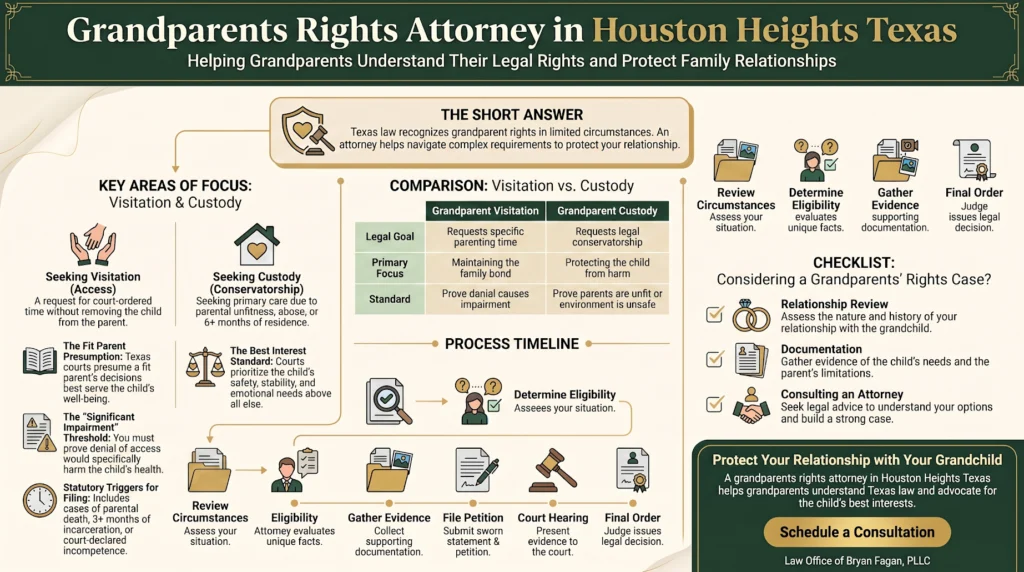
In Texas, a grandparent can ask a court for visitation only by overcoming the presumption that a fit parent acts in the child’s best interest. Under Texas Family Code §153.433, you must prove that denying access would significantly harm the child’s physical health or emotional well-being — and that at least one parent still has parental rights. Standing is the first gate, not a formality.
Key Takeaways
- Texas presumes the parent is right. A fit parent’s decision to limit contact is legally protected. You are asking the court to override a constitutional presumption, not to referee a family disagreement.
- Standing comes before merits. Under §153.432, only a biological or adoptive grandparent can file, and only when specific conditions are met. If you lack standing, the case ends before the facts matter.
- “Significant impairment” is the real test. Missing your grandchild is not enough. §153.433 requires proof that no access would significantly harm the child.
- An intact, two-parent home usually blocks the claim. If both fit parents are together and say no, Texas courts rarely allow a grandparent visitation suit to proceed.
- Adoption by a non-relative ends your rights. Under §153.434, once a child is adopted by someone other than a stepparent or relative, grandparent access claims are barred.
- Custody is a different, harder fight than visitation. Seeking to raise the child (conservatorship) requires separate standing under Chapter 102 and a much higher showing.
- Harris County procedure has its own rhythm. These cases run through the Harris County family courts in the Heights’ home county, and local practice shapes timing and strategy.

Your Family’s Future Starts Here
Don’t navigate your legal journey alone. Schedule a consultation now and get the clarity and support you deserve.
Family lawyers and attorneys advise our clients of the immediate aftermath as well as the long-term effects of Family Law related issues, such as the following:
Trust us to help you with your Family Law Attorneys in the Houston Heights in Texas. Call (281) 245-1776 or contact us online today to schedule a free consultation with your Family Law Attorney in Humble, Texas.
What Texas Law Actually Says About Grandparents’ Rights

Grandparents Rights Attorney in Houston Heights Texas is a phrase many families search when they suddenly lose contact with a grandchild, but Texas law gives grandparents only limited opportunities to ask a court for visitation or custody. Under Texas Family Code §§ 153.432–153.434, a biological or adoptive grandparent may have standing to file in specific circumstances, but filing a lawsuit is only the first step. Texas courts begin with the presumption that a fit parent has the constitutional right to decide who spends time with their child—a principle recognized by the U.S. Supreme Court in Troxel v. Granville and consistently applied by Texas courts.
To overcome that parental presumption, Texas Family Code § 153.433 requires more than proof of a close relationship. A grandparent must show, by a preponderance of the evidence, that denying access would significantly impair the child’s physical health or emotional well-being. In most cases, the grandparent must also be the parent of someone who is deceased, incarcerated, declared incompetent, or who no longer has court-ordered possession of the child. This is why judges in the Harris County Family Courts focus on documented caregiving, the child’s reliance on the grandparent, and credible evidence rather than emotion alone.
Strong cases are built with facts, not assumptions. Medical records, calendars, photographs, text messages, emails, therapist observations, and testimony from people familiar with the child’s daily life can all help demonstrate that a grandparent played a meaningful role in providing stability and support. In straightforward visitation cases, that evidence may help establish the statutory requirements. In more complex conservatorship, CPS, or contested custody matters, additional legal issues—such as standing under Chapter 102 or emergency relief—may also need to be addressed before a court considers the child’s best interests.
Texas Family Code § 153.434 creates additional limits. A grandparent generally cannot seek court-ordered access if both parents’ rights have been terminated or if the child has been adopted by someone other than a stepparent or another qualifying relative. If your family’s situation also involves preserving a closely held company, ranch, or agricultural property for future generations, you may find our guide to Family-Owned Businesses and Farms in Humble, Texas helpful for understanding how succession planning and family law issues can intersect. Family-Owned Businesses and Farms in Humble, Texas
Every grandparents’ rights case starts with the same question: Does Texas law allow you to ask the court for relief? Once standing is established, the outcome often depends on the quality of the evidence and how well it demonstrates that continued involvement serves the child’s well-being while respecting the constitutional rights of parents. Before filing a case, taking the time to understand the law can help you make informed decisions and pursue the legal path that best fits your family’s circumstances.
What this means for you: If a parent of your grandchild has died, is incarcerated, has been declared incompetent, or has lost court-ordered possession, you are far more likely to clear the standing gate. I look for that fact first — it often decides whether we file.
The core rules at a glance
| Situation | What Texas Law Says | Practical Impact |
|---|---|---|
| One parent is deceased, jailed, or incompetent | §153.433 condition is met; standing is reachable | Strongest position to file — the gate is open |
| Both fit parents, married, both say no | Parental presumption controls (§153.433) | Very difficult; courts rarely override |
| Child adopted by a non-relative | Access barred under §153.434 | Closed door — no suit available |
| Grandparent raised the child for years | May support Chapter 102 conservatorship standing | Opens a custody path, not just visitation |
Who Has Standing to File — and Who Doesn’t
Grandparents Rights Attorney in Houston Heights Texas is a phrase many families search after losing contact with a grandchild, but the first question under Texas law is not whether seeing the grandchild would be beneficial—it’s whether you have standing to ask the court for relief. Texas Family Code §153.432 generally limits grandparent visitation claims to biological or adoptive grandparents, meaning step-grandparents and most other relatives cannot use this statute. Before a Harris County judge considers the child’s best interests, the court must first decide whether you have the legal right to bring the case.
In straightforward visitation cases, standing often depends on the status of the child’s parent. Texas law typically requires that the grandparent’s son or daughter be deceased, incarcerated, declared legally incompetent, or no longer have court-ordered possession of the child. These requirements reflect the constitutional protections recognized in Troxel v. Granville, which presume that a fit parent acts in the child’s best interests. When both fit parents oppose visitation, Texas courts rarely override that decision unless the statutory requirements have been satisfied.
In more complex conservatorship matters, the analysis may shift to Texas Family Code §§102.003 or 102.004. A grandparent who has provided actual care, control, and possession of a child for the required period—or who can demonstrate substantial involvement together with evidence of significant impairment—may have a different legal avenue. These cases frequently overlap with CPS investigations, emergency custody disputes, or situations involving addiction, domestic violence, or the death of a parent, making it essential to determine which chapter of the Texas Family Code applies before filing suit.
Standing is often the deciding factor in grandparents’ rights litigation. Filing under the wrong statute or misunderstanding the legal requirements can end a case before the court ever considers your evidence. Families whose legal issues also involve preserving a closely held ranch, farm, or family-owned business should understand how those interests may intersect with broader family law matters. Our guide to Family Business and Farm Law in Humble explains how thoughtful legal planning can help protect both family relationships and multi-generational assets.
Every family’s circumstances are unique, which is why determining standing should always come before deciding whether to pursue visitation or conservatorship. A careful review of your relationship with the child, the parents’ legal status, and the available evidence will help identify the legal path that best fits your situation under Texas law.
Strategy note: If you have had the child living with you for six months or more, we may have a far stronger Chapter 102 conservatorship path than a Chapter 153 visitation claim. Bring me dates, school records, and medical records from that period — they build standing.
What Grandparents Get Wrong About These Cases
Grandparents Rights Attorney in Houston Heights Texas is a search many people make because they believe a close relationship with a grandchild automatically creates legal rights. It doesn’t. Texas law does not ask whether you are a loving grandparent or whether your grandchild enjoys spending time with you. Instead, under Texas Family Code §153.433, the court focuses on whether denying visitation would significantly impair the child’s physical health or emotional well-being while respecting the constitutional rights of parents recognized in Troxel v. Granville. Understanding that distinction is one of the most important steps before filing a case.
Another common mistake is waiting too long. Many grandparents hope family relationships will heal on their own, but months—or even years—can pass while important evidence becomes harder to prove. During that time, circumstances may change dramatically. A parent may regain possession of the child, an adoption may become final, or the documented caregiving history that once supported your case may no longer reflect the child’s current circumstances. Acting promptly allows you to preserve evidence such as photographs, calendars, medical records, text messages, and witness testimony that may become important later.
Grandparents also frequently confuse visitation with conservatorship. In straightforward visitation cases, the goal is to obtain court-ordered possession of or access to a grandchild under Texas Family Code Chapter 153. In more complex conservatorship matters, Chapter 102 governs who has standing to seek custody, and the legal burden is substantially higher. If CPS is involved, a parent has died, or issues such as addiction, domestic violence, or mental illness are affecting the child’s safety, the legal strategy may look very different from a traditional visitation case.
Perhaps the biggest misconception is believing that every grandparents’ rights case follows the same path. Texas judges evaluate each family’s circumstances individually, considering standing, credibility, documented caregiving, and the child’s long-term stability before making a decision. If you would like a broader explanation of how these laws work throughout the area, our guide to Grandparents’ Rights in Houston Heights provides additional information about visitation, conservatorship, and the legal standards Texas courts apply. Understanding the law before taking action helps families make informed decisions and pursue the legal remedy that best fits their unique situation.
“The court is not asking whether you are a good grandparent. It is asking whether the child will be significantly harmed without you. Those are not the same question — and winning means proving the second one.”
What Decides a Contested Grandparent Case
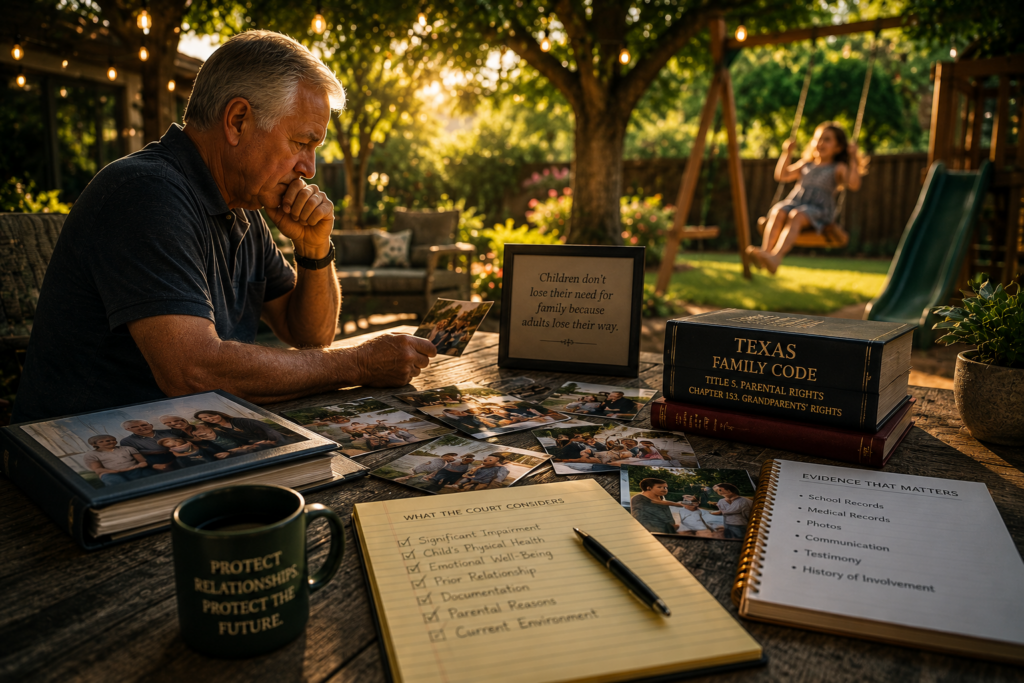
Grandparents Rights Attorney in Houston Heights Texas is often searched by grandparents whose cases have become contested, meaning a parent objects to visitation or conservatorship. In these cases, Texas courts do not decide the outcome based on who loves the child more or who has the strongest emotional bond. Instead, under Texas Family Code §153.433, the court examines whether denying the grandparent access would significantly impair the child’s physical health or emotional well-being. That legal standard is far more demanding than simply proving a close relationship.
In straightforward visitation cases, judges look for credible evidence showing that the grandparent played an important role in the child’s daily life. Documentation often carries far more weight than personal opinions. Medical records, photographs, calendars, text messages, emails, therapist observations, and testimony from teachers, neighbors, or other witnesses can help demonstrate that the child relied on the grandparent for stability, care, or emotional support. Courts also evaluate why contact ended, whether the grandparent consistently participated in the child’s upbringing, and whether maintaining the relationship would genuinely protect the child’s well-being.
In more complex conservatorship or custody disputes, additional issues may influence the court’s decision. If CPS is involved, a parent has died, or concerns such as addiction, domestic violence, incarceration, or mental illness are affecting the child’s safety, the court will examine the broader family circumstances alongside the legal requirements for standing. Texas judges carefully evaluate credibility, documented caregiving, and the child’s long-term stability rather than relying on emotional testimony alone. Strong cases are built on objective evidence that clearly demonstrates the child’s dependence on the grandparent—not assumptions or good intentions.
Preparation often determines the strength of a contested case. Gathering records early helps preserve evidence before memories fade or circumstances change, allowing the court to see the full picture of the relationship. If you would like to learn more about how Texas courts evaluate visitation, conservatorship, and grandparents’ legal rights, our guide to What Rights Do Grandparents Have in Texas Family Law? provides additional insight into the legal standards that apply. Understanding what judges actually consider before filing a lawsuit can help families pursue the legal strategy that best protects both the child and the important relationships that support their future.
Where do you stand?
| Your Status | Eligibility Test | What It Means |
|---|---|---|
| Parent of a deceased/jailed/incompetent parent | Meets a §153.433 condition | File for visitation — you can reach the merits |
| Cared for the child 6+ months in your home | §102.003 conservatorship standing | Consider a custody suit, not just access |
| Both fit parents object, family intact | Presumption stands; no qualifying condition | Weak case — rethink before filing |
| Grandchild adopted by non-relative | Barred by §153.434 | No suit available under this statute |
Listen to Our Texas Family Law Podcast
Prefer listening? In this episode, we discuss grandparents’ rights in Houston Heights, Texas, including when grandparents may seek visitation or custody, what the law allows, and how these cases are handled under Texas law.
How I Build a Grandparent Visitation Case
Grandparents Rights Attorney in Houston Heights Texas cases are built by matching the facts to the law before anything is filed. The first step is determining whether you have standing under the correct section of the Texas Family Code. Once standing is established, the focus shifts to gathering evidence that shows the child’s reliance on you and demonstrates why denying visitation would significantly impair the child’s physical health or emotional well-being under Texas Family Code §153.433. Every successful strategy begins with understanding what a Harris County judge must see to grant relief.
In straightforward visitation cases, strong evidence often tells the story better than testimony alone. Medical records, photographs, calendars, text messages, emails, therapist observations, and witness statements can help establish that you provided consistent care, emotional support, or stability in your grandchild’s life. Many of these disputes also resolve through mediation, allowing families to reach a parenting agreement without the uncertainty and stress of a contested trial while keeping the child’s best interests at the center of the discussion.
In more complex cases involving conservatorship, CPS investigations, adoption, or concerns such as addiction, domestic violence, or the death of a parent, the legal strategy becomes more detailed. These matters may require analyzing Chapter 102 standing in addition to Chapter 153 visitation rights and preparing for a court to closely evaluate credibility, documented caregiving, and the child’s long-term stability. Families interested in how these legal principles apply in other Texas communities can also explore our guide to Grandparents’ Rights in The Woodlands for additional insight.
Whether a case is resolved through negotiation or presented before the Harris County Family Courts, preparation makes the difference. Building a clear timeline, preserving important evidence, and applying the correct legal standard from the beginning gives families the strongest opportunity to protect meaningful relationships while respecting the constitutional rights of parents under Texas law.
Ready to map your facts onto the statute and get a real plan? Book a Legal Strategy Session with my office.
Schedule My Strategy SessionMistakes and Deadlines That Sink Cases
Grandparents Rights Attorney in Houston Heights Texas cases often succeed or fail because of timing, not just the facts. One of the most significant deadlines involves adoption. Under Texas Family Code §153.434, a grandparent’s right to seek visitation generally ends if a child is adopted by someone other than a stepparent or another qualifying relative. Once that adoption becomes final, the opportunity to pursue court-ordered access is typically lost. If adoption is being discussed or legal proceedings have already begun, it is important to understand how that timeline may affect your rights before circumstances change.
Another common mistake is pursuing the wrong legal remedy. In straightforward cases, grandparents sometimes ask for conservatorship when the facts support only visitation, while others wait so long that valuable evidence becomes outdated. Courts place significant weight on recent, documented caregiving and the child’s current circumstances. Medical records, calendars, photographs, text messages, and witness testimony often become less persuasive when they no longer reflect the child’s present life or relationship with the grandparent.
In more complex cases involving CPS investigations, pending custody modifications, the death of a parent, or concerns such as addiction or domestic violence, timing becomes even more important. Violating an existing court order by contacting the child or the other parent can also damage your credibility before the Harris County Family Courts. Taking the time to understand which legal path applies to your situation helps avoid costly mistakes and positions your case on a stronger foundation. To learn more about how grandparents’ rights intersect with child custody disputes, visit our guide on Grandparents’ Rights in Texas Child Custody Cases.
Every grandparents’ rights case has its own facts, deadlines, and legal challenges. Acting promptly, preserving important evidence, and understanding the difference between visitation and conservatorship can make a meaningful difference in the outcome. By making informed decisions early, families are better positioned to protect important relationships while working within the framework of Texas law.
Time-sensitive: If you have heard that the other parent or a new spouse intends to adopt your grandchild, your window may close for good once that adoption is final under §153.434. Do not wait to “see how it goes.” Call 281-810-9760 the day you hear about it.
How These Cases Run in Harris County

In Harris County — the county that includes the Heights — grandparent suits are heard in the family district courts, and local practice shapes both timing and approach. These courts handle a heavy family-law docket, so judges expect cases to be focused and well-documented from the first filing, and they lean hard on mediation before setting a contested final hearing. A grandparent case that arrives organized, with standing clearly pleaded and evidence of the child’s reliance attached, moves faster and lands better here.
Because my Heights office sits inside Harris County family-court territory, I prepare these cases for how the local courts actually run them: early mediation readiness, clean standing pleadings, and a documented impairment record before the first hearing. For the broader framework that applies across the state, see my Texas family law pillar guide; for how grandparent law works statewide, see grandparents rights in Texas.
Where Procedure Differs in Nearby Counties
The Texas Family Code is statewide, but how cases are scheduled, mediated, and tried varies court to court. If your grandchild lives in Fort Bend County (Richmond), Montgomery County (The Woodlands and Conroe), or Galveston County, venue under §102.003 generally follows where the child resides — which can put your case outside Harris County even though you live in the Heights. Each of those courts has its own mediation expectations and docket pace.
This matters because filing in the wrong county wastes time you may not have. I confirm proper venue at the outset based on where the child has lived, then prepare the case for that specific court’s practice. My firm serves families across Harris, Fort Bend, and Montgomery counties, so a case that crosses county lines does not have to mean starting over with new counsel.
When Grandparents Seek Custody, Not Just Visitation
Seeking custody — legally, conservatorship — is a separate and harder case than asking for visitation. It runs through Chapter 102, and the most common path is §102.003(a)(9): a grandparent who has had actual care, control, and possession of the child for at least six months ending not more than 90 days before filing. The other route, §102.004, requires substantial past contact with the child plus evidence that the child’s present circumstances would significantly impair their physical health or emotional development.
These cases arise most often when a grandparent has effectively been raising the grandchild during a parent’s addiction, incarceration, or absence. If that describes your situation, you may have a stronger custody claim than a visitation claim — and the evidence you need (proof of where the child lived and who cared for them) is different. I sort visitation from custody before we file, because choosing the right suit is half the case.
How a Grandparent Visitation or Custody Case Moves in Texas
Tap any stage to see what happens, how long it usually takes, and what to do.
Stage 1 — Establishing Standing
Before anything else, we confirm you have the legal right to file. Under Texas Family Code §153.432, only a biological or adoptive grandparent may seek access, and §153.433 requires a qualifying condition — a parent who is deceased, incarcerated, incompetent, or without court-ordered possession. If you are seeking custody, standing instead runs through Chapter 102.
Typical timing: Resolved in the first one to two meetings.
What to do: Bring proof of the parent’s status and any record of the child living with you.
Stage 2 — Filing the Suit (SAPCR)
We file a Suit Affecting the Parent-Child Relationship in the correct county — usually where the child lives. The petition must plead standing clearly and state the relief you want: a possession schedule (visitation) or conservatorship (custody). Filing in the wrong county or under the wrong statute invites dismissal.
Typical timing: Filed within days once standing is confirmed.
What to do: Confirm the child’s current county of residence so we file in the right court.
Stage 3 — Overcoming the Fit-Parent Presumption
This is the heart of the case. Under §153.433, you must prove that denying access would significantly impair the child’s physical health or emotional well-being. We assemble the evidence — caregiving records, the child’s reliance on you, proof of harm without the relationship — because the court starts by deferring to the parent.
Typical timing: Evidence-building runs alongside the early weeks of the case.
What to do: Pull school, medical, and household records that show your role in the child’s life.
Stage 4 — Temporary Orders and Mediation
Harris County courts lean hard on mediation before a contested hearing. Many grandparent cases resolve here with a negotiated possession schedule, which spares the child a trial. If temporary orders are needed to restore contact while the case proceeds, we request them at this stage.
Typical timing: A few weeks to a few months, depending on the docket.
What to do: Come to mediation ready with a realistic schedule you can sustain.
Stage 5 — Final Hearing and Resolution
If the case does not settle, it goes to a final hearing where the judge decides whether you have met the significant-impairment standard and what access serves the child’s best interest. A favorable order sets your possession schedule or conservatorship rights going forward. Cases that arrive documented and focused fare best here.
Typical timing: A contested case can run a year or more given the Harris County docket.
What to do: Stay consistent and follow every interim order — credibility decides close cases.
Wherever you are in this process, the first move is confirming standing. Let’s do that today.
Call 281-810-9760The Law Office of Bryan Fagan, PLLC — The Heights
848 Heights Blvd, Houston, TX 77007
Harris County
Phone: 281-810-9760
Book at the Heights OfficeEvery grandparent case starts with one question: do you have standing? Get that answered today.
Call 281-810-9760What to Do If You’re Fighting to See Your Grandchild
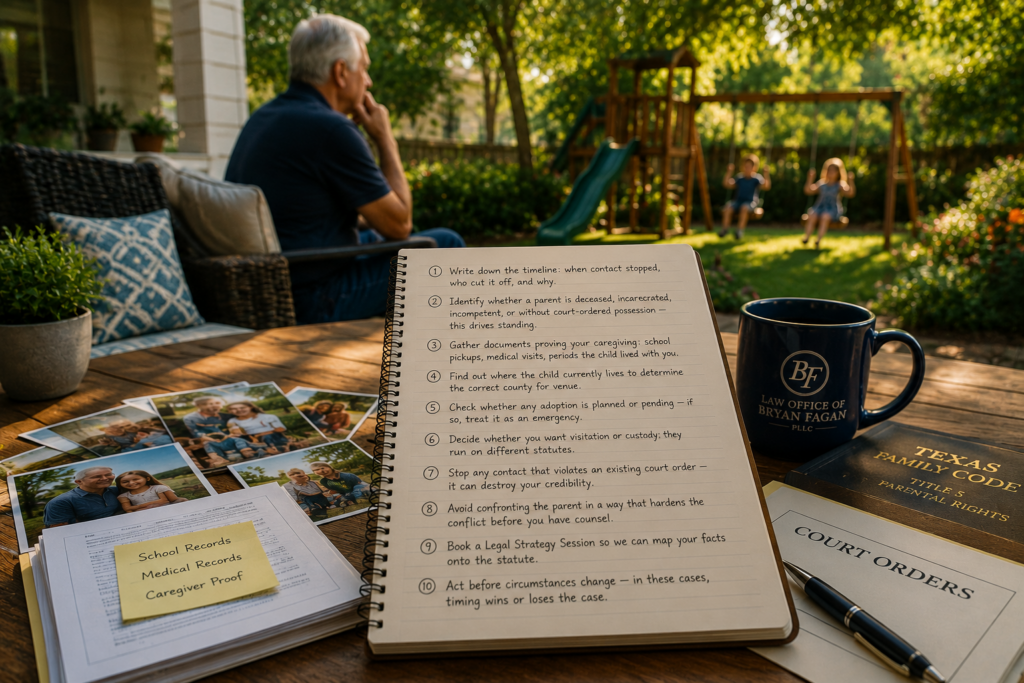
- Write down the timeline: when contact stopped, who cut it off, and why.
- Identify whether a parent is deceased, incarcerated, incompetent, or without court-ordered possession — this drives standing.
- Gather documents proving your caregiving: school pickups, medical visits, periods the child lived with you.
- Find out where the child currently lives to determine the correct county for venue.
- Check whether any adoption is planned or pending — if so, treat it as an emergency.
- Decide whether you want visitation or custody; they run on different statutes.
- Stop any contact that violates an existing court order — it can destroy your credibility.
- Avoid confronting the parent in a way that hardens the conflict before you have counsel.
- Book a Legal Strategy Session so we can map your facts onto the statute.
- Act before circumstances change — in these cases, timing wins or loses the case.
If you have been shut out of your grandchild’s life, the clock matters more than you think. Let’s find out today whether you have a case.
Call 281-810-9760What I Tell Every Family Who Calls About Grandparents’ Rights
Grandparents Rights Attorney in Houston Heights Texas is a search many people make after months of hoping family relationships will improve on their own. The first thing I explain is that Texas law is more restrictive than most grandparents expect. The court does not decide whether you are a loving grandparent or whether your grandchild misses you. Instead, it looks at whether you have legal standing under the Texas Family Code and whether denying contact would significantly impair the child’s physical health or emotional well-being. Understanding those requirements early can save families from pursuing a case that the law simply does not support.
I also explain that many grandparents do have a viable legal path when the facts fit the statute. In straightforward visitation cases, that may mean showing that a parent is deceased, incarcerated, declared incompetent, or no longer has court-ordered possession of the child. In more complex conservatorship matters involving CPS investigations, adoption, or concerns such as addiction or domestic violence, additional legal issues may need to be addressed before a court reaches the child’s best interests. The strongest cases are built on documented caregiving, credible evidence, and a clear understanding of which section of the Texas Family Code applies.
Another important conversation involves timing. Waiting too long can make a strong case more difficult to prove as evidence becomes outdated or family circumstances change. If adoption is pending, custody has recently changed, or a child’s living arrangements are in transition, acting promptly can make a meaningful difference. Families who want a broader understanding of how grandparents’ rights intersect with custody disputes can also explore our guide to Grandparents’ Rights and Child Custody Issues in Texas for additional insight into these legal issues.
Every family’s story is different, and every case deserves an honest evaluation based on the facts—not assumptions. My goal is to help you understand where you stand under Texas law, explain the options available, and develop a strategy that protects your grandchild’s well-being while respecting the legal rights of everyone involved. When families have clear information and thoughtful guidance, they are better equipped to make confident decisions during one of life’s most difficult transitions.
Conclusion:
No two families arrive at the same place, and no two grandparents’ rights cases follow the same path. If you are searching for a Grandparents Rights Attorney in Houston Heights Texas, the most important step is understanding where your situation fits under Texas law before taking action. In straightforward situations, a clear explanation of your legal options may be all you need to move forward with confidence. In more complex cases—such as those involving CPS investigations, domestic violence, addiction, mental health concerns, emergency custody, or contested conservatorship—the right legal strategy from the beginning can make a meaningful difference for both you and your grandchild.
At the Law Office of Bryan Fagan, PLLC, we believe families deserve more than legal answers—they deserve clarity, compassion, and a plan that protects what matters most. Whether your goal is preserving an important relationship, seeking visitation, or exploring conservatorship, our team is committed to helping you understand your rights and your options under Texas law. By combining practical guidance with experienced legal representation, we help families move forward with greater peace of mind and a strategy designed for their unique circumstances.
Questions Families Ask About Grandparents’ Rights in Texas
Not automatically. Texas presumes a fit parent decides who sees the child. A grandparent can ask a court for access only by meeting Texas Family Code §153.433 — proving that denying access would significantly harm the child and that a qualifying condition applies, such as a parent who is deceased, incarcerated, incompetent, or without court-ordered possession. I evaluate whether your facts meet that test before we file.
It is very difficult. When two fit parents in an intact home both refuse, Texas courts give that decision strong constitutional deference, and most grandparent suits in that situation do not survive. Your odds improve substantially if one parent is deceased, jailed, declared incompetent, or lacks court-ordered possession. I tell grandparents the truth about this up front rather than after they have spent money filing.
It means real harm to the child’s physical health or emotional well-being if access is denied — not simply that the child would benefit from seeing you. Courts look for evidence: prior caregiving, the child’s reliance on you, and proof of harm without the relationship. Generalized love and missing your grandchild, while real, do not meet the legal standard on their own.
Yes, but it is a separate and harder case than visitation. Custody (conservatorship) runs through Chapter 102. The most common path is §102.003, which requires having had actual care, control, and possession of the child for at least six months. If you have effectively been raising your grandchild, you may have a stronger custody claim than a visitation claim.
Usually, yes. Under §153.434, if the grandchild is adopted by anyone other than a stepparent, a grandparent loses the ability to request access. This is why timing matters so much — once a non-relative adoption is final, the door closes permanently. If you have heard an adoption is planned, treat it as urgent.
Texas is stricter than many states. California and New York apply broader best-interest balancing tests that make grandparent visitation easier to obtain. Texas instead requires proof of significant impairment and a qualifying condition, deliberately favoring parental autonomy. If you moved here from a state with looser rules, do not assume the same case would succeed in Texas.
For families in the Heights and greater Houston, grandparent suits are heard in the Harris County family district courts. Venue generally follows where the child lives, so if your grandchild resides in Fort Bend or Montgomery County, the case may be filed there instead. I confirm proper venue before filing so the case is not dismissed on a technicality.
Generally no under the grandparent access statute. Texas Family Code §153.432 limits these suits to biological or adoptive grandparents. Step-grandparents and great-grandparents usually cannot use this route, though in limited situations a different standing theory under Chapter 102 may apply. I assess which statute, if any, fits your relationship to the child.
It depends on whether the case settles or is tried, so here is what that depends on: a mediated possession schedule can resolve in a few months, while a fully contested case that goes to a final hearing can run a year or more given the Harris County family docket. Cases that arrive organized, with standing clearly pleaded, move faster. I set realistic timing expectations in your Legal Strategy Session.
Bring anything that documents your relationship and the child’s living situation: dates the child lived with you, school and medical records showing your involvement, the parents’ current circumstances, and any existing court orders. The stronger your documentation of caregiving and the child’s reliance on you, the faster I can tell you whether you have standing and a viable case.
Bring your timeline and your records. I will tell you where you stand.
Schedule My Strategy Session