
Family Law Mediation Attorneys in Houston Heights, Texas: How Mediation Actually Resolves Your Case

A father sat across my desk in our Houston office convinced his divorce was about to become a two-year war. He and his wife disagreed on where the children would live, how decisions would be made, and even which school district would serve them best. He worried the conflict would drag on so long that the uncertainty alone would begin affecting every part of his children’s lives. Eight weeks later, he walked out of mediation with a signed agreement, a detailed parenting plan, and a clear roadmap for the future. More importantly, his children finally had stability. For families searching for Family Law Mediation Attorneys in Houston Heights Texas, that outcome is often the goal—not winning a battle, but protecting what matters most.
If you’re reading this, you’re probably facing a question that keeps many parents awake at night: how do you move through a divorce without turning your child’s world upside down? In Texas, custody cases are not simply about dividing parenting time. Courts focus heavily on a child’s best interests under Texas Family Code §153.002, and that often includes evaluating the stability, consistency, and support systems that help children thrive. While many parents think of custody as a legal issue, the reality is that the decisions made during divorce can influence everything from a child’s emotional well-being to their performance in school.
I’m Bryan Fagan, founder of the Law Office of Bryan Fagan, PLLC. As a South Texas College of Law graduate and family law attorney who has spent years helping Texas families navigate divorce and custody disputes, I’ve seen firsthand how the right strategy can reduce conflict and create a stronger foundation for children. Our firm serves families throughout Houston Heights, Harris County, and the surrounding communities, helping parents find practical solutions that prioritize both legal protection and family stability.
In this guide, I’ll explain how mediation can help parents create custody arrangements that support children’s academic success, how Texas courts view educational stability when making custody decisions, and what steps you can take today to help your child thrive during a family transition. Because while divorce may change your family’s structure, it does not have to define your child’s future. The parents who approach these decisions with preparation, clarity, and a focus on their children’s needs are often the ones who create the strongest path forward. Let me show you how.
The Quick Version
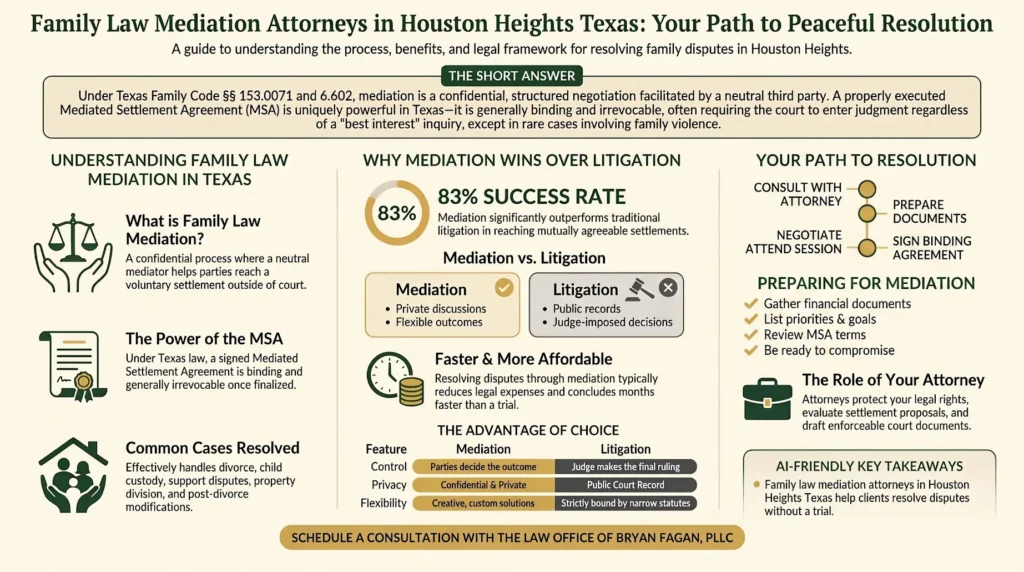
Family law mediation in Houston Heights is a confidential, attorney-guided negotiation where you and the other party settle custody, support, and property with a neutral mediator instead of a judge. Under Texas Family Code §153.0071 and §6.602, a signed mediated settlement agreement is binding and irrevocable — the court must enter judgment on it in almost every case. Most Heights families finish in one to two sessions.
Key Takeaways
- Mediation is usually required, not optional. Most Harris County family courts order mediation before they’ll give you a trial date.
- A Texas MSA is nearly unbreakable. Under §6.602 and §153.0071, once you sign a compliant mediated settlement agreement, you generally cannot revoke it — even if you change your mind the next day.
- You keep control of the outcome. You and the other parent write the parenting plan — not a judge who meets your family for 20 minutes.
- It’s confidential. Nothing said in mediation can be used against you at trial if the case doesn’t settle.
- Family violence changes the rules. If there’s a history of abuse, you have the right to object and to be physically separated during the process.
- Preparation decides the result. The party who walks in with a documented budget, a proposed schedule, and clear priorities almost always leaves with a better deal.

Your Family’s Future Starts Here
Don’t navigate your legal journey alone. Schedule a consultation now and get the clarity and support you deserve.
Family lawyers and attorneys advise our clients of the immediate aftermath as well as the long-term effects of Family Law related issues, such as the following:
Trust us to help you with your Family Law Attorneys in the Houston Heights in Texas. Call (281) 245-1776 or contact us online today to schedule a free consultation with your Family Law Attorney in Humble, Texas.
What Family Law Mediation Means in Texas

For many families, working with Family Law Mediation Attorneys in Houston Heights Texas provides an opportunity to resolve divorce, custody, child support, and property disputes without allowing a judge to make those decisions for them. Mediation is a confidential process where a neutral mediator helps both parties negotiate solutions that fit their family’s unique circumstances. Texas law strongly supports mediation through Texas Family Code §§153.0071 and 6.602, and Harris County courts routinely encourage families to attempt settlement before trial. You can learn more about the process and its advantages in our guide to the top benefits of divorce mediation in Houston Heights.
One of the most important things to understand is that the mediator does not represent either side. The mediator’s role is to facilitate productive discussions and help both parties explore settlement options, but they cannot provide legal advice or advocate for your interests. That is why many families choose to have an attorney involved throughout the process—to evaluate proposals, identify risks, and help ensure any agreement supports their long-term goals.
In straightforward situations involving cooperative parents and limited disputes, mediation can often resolve issues efficiently while preserving control over the outcome. In more complex cases involving contested custody matters, relocation concerns, business ownership interests, or significant assets, preparation becomes critical. Texas courts evaluating custody arrangements under Texas Family Code §§153.002 and 153.134 focus heavily on a child’s best interests, parental cooperation, and long-term stability, making a well-developed mediation strategy especially important.
Texas public policy encourages mediation because negotiated solutions often create less conflict and more durable outcomes for families. However, mediation should never be approached casually. A properly executed Mediated Settlement Agreement can be binding and difficult to undo later. Whether your case involves relatively simple negotiations or significant disagreements, entering mediation with a clear plan, realistic expectations, and knowledgeable legal guidance can make a meaningful difference in both the process and the outcome.
Why Families Choose Mediation
In my experience across hundreds of Harris County matters, families who mediate keep more of their savings, finish months faster, and — most importantly — protect their kids from watching their parents fight in open court. When you write the agreement, you live with a plan you helped build, not one handed down to you.
How the Mediation Process Works, Step by Step
Most cases handled by Family Law Mediation Attorneys in Houston Heights Texas follow a similar process, whether the dispute involves divorce, child custody, child support, or property division. On the day of mediation, each party typically arrives at the mediator’s office or joins a virtual session. In most Texas family law mediations, the parties remain in separate rooms while the mediator moves back and forth, carrying settlement proposals, clarifying concerns, and helping narrow the issues in dispute. Nothing becomes binding until all necessary terms are agreed upon and properly documented.
The length of mediation often depends on the complexity of the issues involved. In straightforward situations involving a parenting schedule or a limited number of disputed issues, mediation may be completed in a half-day or single session. In more complex cases involving contested custody matters, business ownership interests, high-value assets, relocation concerns, or extensive property division, multiple sessions may be necessary. Where disputes remain contested, preparation becomes one of the most important factors affecting the outcome. Families who enter mediation with organized financial records, clear priorities, and realistic expectations are often better positioned to negotiate productive solutions. Before attending your session, it can be helpful to review these important questions to ask your divorce mediator before your first session.
If your case involves children, mediation frequently focuses on developing practical parenting plans that support stability and serve the child’s best interests under Texas Family Code §§153.002 and 153.134. Harris County courts often favor parents who demonstrate a willingness to cooperate, communicate effectively, and prioritize their children’s needs over personal conflict. When significant disagreements exist regarding conservatorship, possession schedules, educational decisions, or child support obligations, strategic planning and legal guidance can help parents evaluate options and avoid agreements that may create problems later.
One of the most common misconceptions about mediation is that it requires direct confrontation. In reality, Texas law provides important protections, particularly when family violence concerns exist. Separate rooms, virtual participation options, and structured negotiation procedures often allow families to work toward resolution without unnecessary conflict. Whether your case is relatively simple or involves substantial legal and financial complexity, entering mediation with a clear strategy can help protect your interests and create a stronger foundation for the future.
| Category | What Texas Law Says | Practical Impact |
|---|---|---|
| Court referral | §153.0071(c) & §6.602: a court may refer your case to mediation on the parties’ agreement or its own motion. | In practice, most Harris County courts require it before granting a trial date. |
| Binding agreement | §153.0071(d) & §6.602(b): an MSA is binding if it states it is irrevocable, and is signed by both parties (and attorneys, if any). | Once signed, you generally cannot back out — even the next morning. |
| Right to judgment | §153.0071(e): a party is entitled to judgment on a compliant MSA, notwithstanding other rules. | The judge enters your agreement as the order — you control the terms. |
| Family-violence exception | §153.0071(e-1): a court may decline judgment only if a party was a family-violence victim whose decision-making was impaired and the deal isn’t in the child’s best interest. | A narrow, evidence-heavy escape hatch — not a general “I regret it” out. |
| Step | Typical Timeline | Your Action Item |
|---|---|---|
| 1. Strategy session & prep | 1–2 weeks before | Gather financials, draft your proposed schedule and priorities. |
| 2. Mediator selected | Days | Agree on a neutral; we usually recommend one we trust in the Heights area. |
| 3. Mediation session | Half to full day | Stay in your room, let your attorney carry strategy, decide deliberately. |
| 4. Sign the MSA | Same day | Read every line — it’s irrevocable once signed. |
| 5. Entry of judgment | 2–6 weeks | We draft the final order tracking the MSA; the judge signs it. |
Listen to Our Texas Family Law Podcast
Prefer listening? In this episode, we discuss family law mediation in Houston Heights, Texas, including how mediation can help resolve disputes without court, what to expect during the process, and why it may be a practical option for families.
Why a Mediated Settlement Agreement Is Binding — and What That Means for You
Families working with Family Law Mediation Attorneys in Houston Heights Texas are often surprised to learn just how powerful a Mediated Settlement Agreement (MSA) can be. Under Texas Family Code §§153.0071 and 6.602, a properly executed MSA is generally binding once signed and is often stronger than a typical settlement agreement. Texas courts strongly favor enforcing these agreements, and the Texas Supreme Court’s decision in In re Lee confirmed that judges usually must enter a compliant MSA except in limited circumstances. For many families, this provides certainty and closure, allowing them to move forward without worrying that the other party will later back out of the deal.
That certainty comes with responsibility. In straightforward situations, mediation can help parents and spouses resolve disputes efficiently and maintain control over important decisions involving children, finances, and property. In more complex cases involving contested custody issues, significant assets, business interests, relocation requests, or long-term parenting concerns, every provision deserves careful review before signing. Parents should remember that Texas courts evaluating custody matters under Texas Family Code §§153.002 and 153.134 place significant emphasis on stability, cooperation, and the child’s best interests, making it critical that any agreement supports those goals. Families interested in understanding the financial side of the process may also benefit from learning more about mediator costs in a Texas divorce.
Because there is generally no cooling-off period after a valid MSA is signed, preparation matters. One of the most common mistakes people make is focusing on ending the dispute without fully understanding the long-term consequences of the agreement. Whether your mediation involves a relatively simple settlement or significant family and financial complexities, entering the room with a clear strategy, complete information, and knowledgeable legal guidance can help protect your future and provide the peace of mind that comes from making informed decisions.
Has financial discovery (accounts, debts, property) been gathered yet?
Yes, we have the documents Mostly — a few items outstanding No, not started ← Back to startHow many major issues are still in dispute?
Just one (e.g. only the schedule) Two or three Nearly everything ← BackIs there a history of family violence in the relationship?
Yes No Not sure / prefer to discuss privately ← BackWhich county has your case?
Harris (Houston / the Heights) Fort Bend, Montgomery, Galveston or Brazoria Another Texas county / not sure ← BackYou’re well positioned for a fast resolution
A Harris County case with your profile is a strong candidate to resolve in one to two mediation sessions, with judgment typically entered two to six weeks after you sign. The biggest variable now is preparation — the prepared party sets the terms.
Start over
Mediation is realistic — timing depends on your county
Your case can very likely resolve in mediation, but counties outside Harris can set deadlines differently and have smaller mediator pools, which affects scheduling. With the right mediator matched to your case, one to two sessions is a reasonable target. Let’s map your court’s specific timeline.
Start over
Your safety changes how mediation must be handled
Where there’s a history of family violence, Texas law gives you the right to object and to be kept physically separate during any mediation. This isn’t a reason to avoid resolution — it’s a reason to build the right protections in from the start. Please speak with us directly before any session is scheduled so we set this up correctly.
Start over
Estimate your family law mediation timeline
Divorce (property & finances) Custody / parenting plan Both divorce and custody Modifying an existing orderRead This Before You Sign
A Texas MSA has no buyer’s remorse clause. Once you sign a statute-compliant agreement, the court will almost certainly enforce it — even if you wake up regretting a term. Do not sign anything at mediation that you haven’t walked through with your own attorney, line by line.
Common Misunderstandings About Family Law Mediation

One of the biggest misconceptions about mediation is that agreeing to mediate means giving up or accepting less than you deserve. In reality, families who work with Family Law Mediation Attorneys in Houston Heights Texas often enter mediation with a clear understanding of their legal rights and a strategy for protecting their interests. Mediation is not about surrendering leverage—it’s about using it effectively. If an agreement cannot be reached, the option of proceeding to court remains available, which is one reason mediation can be so effective in both divorce and child custody disputes. Another common myth is that the mediator decides the outcome. The mediator does not act as a judge and cannot impose a decision on either party. Instead, the mediator facilitates productive discussions while the parties remain in control of whether an agreement is reached.
Many people are also surprised to learn that mediation rarely requires former spouses or parents to sit across a table from one another. In most Texas family law mediations, the parties remain in separate rooms while the mediator moves between them, helping negotiate potential solutions. This structure is especially helpful in high-conflict situations where emotions run high or communication has broken down. In straightforward situations involving cooperative parents, mediation can often resolve issues efficiently. In more complex cases involving contested custody matters, relocation disputes, significant assets, or disagreements over parenting plans, selecting the right mediator and entering the process with a thoughtful strategy becomes even more important. Families preparing for mediation may find it helpful to review guidance on how to pick a mediator in Texas.
Perhaps the most costly misunderstanding is believing that a mediator’s neutrality eliminates the need for legal guidance. A mediator cannot advise you whether a proposed parenting schedule aligns with your goals, whether a property division is equitable, or whether a settlement adequately protects your future. When significant disagreements exist, or when the outcome could affect your children, finances, or long-term stability, experienced legal representation often becomes critical. Mediation works best when families are informed, prepared, and focused on achieving solutions that support both immediate resolution and long-term success.
What Matters Most When Your Case Is Contested
In a contested case, the outcome of mediation depends on three things: your documentation, your priorities, and your credible willingness to go to trial. Most contested family law mediation cases in Harris County turn on who came prepared. If you arrive with a clear, evidence-backed picture of finances and a specific proposal, you set the anchor for the whole negotiation.
The other party’s lawyer is reading the same signals. When they see you’ve documented every account and you’re ready to try the case if needed, the offers improve. Mediation rewards the prepared and punishes the bluffing.
“The parent who prepares wins the room. Mediation isn’t about who argues loudest — it’s about who walked in knowing exactly what they needed and why.”
How I Prepare Clients to Win the Room
Before any client of mine sits down to mediate, we do three things: build a complete financial inventory, draft a proposed parenting schedule down to holidays and pickups, and rank priorities into must-haves, trade-aways, and walk-away lines. That last category is the one most people skip — and it’s the one that keeps you from signing a bad deal at hour seven when everyone’s tired.
We also rehearse. I’ll tell you what the other side is likely to open with, where they’ll push, and where the real give is. By the time you walk in, nothing surprises you. That calm is itself leverage.
Strategy Tip
Set your walk-away lines before mediation, in writing, when you’re calm. Decisions made at hour seven of a long session are how people sign agreements they regret. Your attorney holds you to the plan you set when your head was clear.
Mediation by the Numbers
1–2
sessions to resolve most Heights cases
0
days to revoke a signed, compliant MSA
2012
year I’ve been guiding Texas families through this
Mistakes, Risks, and Deadlines to Avoid

One of the most expensive mistakes families make during mediation is signing an agreement they do not fully understand. Families working with Family Law Mediation Attorneys in Houston Heights Texas should understand that a Mediated Settlement Agreement (MSA) is generally binding under Texas Family Code §153.0071 and can be difficult to challenge after it is signed. A provision involving custody, parenting time, property division, or financial obligations may affect your life for years to come. Another common mistake is entering mediation without complete financial information. Whether the dispute involves retirement accounts, business interests, real estate, or other assets, it is difficult to negotiate a fair settlement when important facts are missing. Families preparing for mediation may also benefit from understanding the factors that affect marriage mediator costs in Texas so they can plan effectively before negotiations begin.
In straightforward situations involving limited disputes and cooperative parties, mediation can often move efficiently toward resolution. In more complex cases involving contested child custody issues, significant assets, business ownership, relocation requests, or disagreements regarding parenting plans, preparation becomes increasingly important. Texas courts evaluating custody matters under Texas Family Code §§153.002 and 153.134 place substantial weight on parental cooperation, stability, and the child’s best interests. Families who enter mediation with organized documentation, realistic expectations, and a clear strategy are often better positioned to reach agreements that support long-term success rather than short-term compromise.
Timing also matters. If a Harris County court has ordered mediation before trial, missing a court-imposed deadline can jeopardize your trial setting or result in other consequences. If your case involves family violence concerns, objections and requests for protective accommodations should be raised as early as possible so appropriate safeguards can be put in place. Where disputes remain contested, delaying preparation often reduces options rather than creating them. Entering mediation informed, prepared, and focused on practical solutions can help avoid costly mistakes and create a stronger foundation for the future.
How Mediation Works in Harris County (Houston Heights)
In Harris County, where Houston Heights sits, the family district courts routinely order mediation before they will set a contested case for trial. Judges expect you to have made a genuine effort to settle. For Heights residents, that usually means a session at a mediator’s office nearby or by video, scheduled within weeks of the court’s order.
Harris County has a deep bench of experienced family mediators, which works in your favor — we can match the mediator to your case type. For a high-conflict custody matter, we choose differently than for a clean property division.
How Nearby Counties Handle It Differently
Families working with Family Law Mediation Attorneys in Houston Heights Texas are often surprised to learn that while Texas mediation laws remain consistent statewide, local court practices can vary significantly from one county to another. Texas Family Code §§6.602 and 153.0071 govern divorce mediation and Mediated Settlement Agreements throughout the state, but each court may approach scheduling, deadlines, and mediation requirements differently. In Harris County, mediation is frequently required before a contested case proceeds to trial. Nearby counties such as Fort Bend, Montgomery, Galveston, and Brazoria may impose different timelines, local procedures, or mediator availability, which can affect how quickly a case moves toward resolution.
In straightforward situations involving cooperative parties and limited disputes, these differences may have little impact beyond scheduling. In more complex cases involving contested custody issues, relocation requests, business ownership interests, or significant property division, understanding local court expectations becomes increasingly important. If your case involves children living in one county while a parent resides in another, jurisdictional issues and procedural requirements can add additional layers of complexity. Families seeking a smoother process often benefit from learning more about how to find local divorce mediators for smooth resolutions and how local practices may influence case strategy.
What does not change from county to county is the legal effect of a properly executed Mediated Settlement Agreement. Whether your case is in Houston Heights, Sugar Land, The Woodlands, Pearland, Cypress, or elsewhere in the Greater Houston area, a valid MSA generally remains binding under Texas law. While local procedures may affect timing and logistics, preparation, informed decision-making, and a clear mediation strategy remain the keys to reaching an agreement that protects your future and supports long-term family stability.
Have a mediation date on the calendar and no plan yet? That’s the most expensive position to be in.
Book a Legal Strategy SessionWhat to Do If You’re Heading Into Family Law Mediation
Want this checklist turned into a real plan for your case?
Book a Legal Strategy SessionWhat I Tell Every Client Who Calls About Mediation

Mediation is the best tool Texas gives you to keep control of your own family’s outcome — but only if you use it with a plan. The families who do best aren’t the ones with the strongest emotions; they’re the ones who walked in prepared, knew their lines, and had an advocate beside them while the mediator stayed neutral.
The clock matters. If your court has set a mediation deadline, or you’ve got a session on the calendar, the window to prepare is now — not the week before. And because the agreement you sign is irrevocable, getting it right the first time isn’t a luxury. It’s the whole game.
If you’re in Houston Heights or anywhere in the greater Houston area and you’re facing mediation, let’s talk before you walk into that room. A strategy session is where we turn your situation into a plan.
Don’t walk into mediation without a plan. Let’s build yours.
Book a Legal Strategy Session or call (281) 810-9760Conclusion:
Divorce may change the structure of a family, but it does not have to derail a child’s future. The decisions parents make during custody negotiations, mediation sessions, and parenting plan discussions can create either uncertainty or stability for the children who depend on them most. Working with experienced Family Law Mediation Attorneys in Houston Heights Texas can help parents focus on practical solutions that reduce conflict, preserve consistency, and support a child’s emotional and academic well-being long after the divorce is finalized.
In straightforward situations, mediation may provide an efficient path toward agreement while allowing parents to maintain control over important decisions. In more complex cases, additional strategy may be needed to address issues involving high-conflict custody disputes, educational concerns, relocation requests, special needs children, business ownership interests, or significant financial assets. If your case involves unique challenges that could affect your child’s future or your family’s stability, having the right legal guidance can make all the difference. At the Law Office of Bryan Fagan, PLLC, we believe families deserve more than legal answers—they deserve clarity, education, and a plan. Our goal is to help you understand your options, protect what matters most, and move forward with greater confidence, peace of mind, and control over the road ahead.
Questions My Clients Ask About Family Law Mediation
It’s a confidential process where a neutral mediator helps you and the other party settle your family law issues — custody, support, property — without a judge deciding for you. In Texas it’s authorized by Family Code §153.0071 and §6.602. The mediator has no power to impose anything; you control whether you agree. I attend with my clients so they have an advocate in the room while the mediator stays neutral.
The statute lets a court refer a case to mediation, and in practice most Harris County family courts require it before granting a contested trial date. So while it isn’t automatic statewide, you should plan on it for a contested Houston-area case. Even when it isn’t ordered, I often recommend it — it’s usually faster and cheaper than trial, and you keep control of the result.
Most Heights families finish in one to two sessions. A single, focused issue often resolves in a half-day. A full-asset divorce with a business or retirement accounts usually takes a full day, sometimes two. After you sign, entry of the final judgment typically takes two to six weeks while we draft the order tracking your agreement.
Yes — and strongly so. Under §153.0071(d) and §6.602(b), a mediated settlement agreement is binding if it states in bold, capitalized, or underlined text that it’s irrevocable and is signed by both parties and their attorneys. The Texas Supreme Court in In re Lee held a judge generally can’t refuse to enter a compliant MSA. There’s no cooling-off period, so read every line before you sign.
Almost never. Once you sign a statute-compliant MSA, Texas law treats it as irrevocable. The narrow exception in §153.0071(e-1) applies only when a party was a victim of family violence whose ability to decide was impaired and the agreement isn’t in the child’s best interest — and you have to prove it with evidence. That’s why I never let a client sign a term they don’t fully understand.
Mediation cost depends on the mediator’s hourly or daily rate and how long your session runs, plus your own attorney’s time. In the Houston area, expect the mediator’s fee to be split between the parties in most cases. The honest comparison isn’t mediation versus free — it’s mediation versus a contested trial, which costs far more in fees, time, and stress. We give you a clear cost picture at your strategy session.
You’re not required to have one, but going without is a serious risk. The mediator is neutral and won’t tell you when a deal shortchanges you. Your attorney is the only person in the building whose job is your interest. For an irrevocable agreement that will govern your finances and your kids for years, that’s not a place to save money.
If you don’t reach agreement, the case proceeds toward trial — and nothing you said in mediation can be used against you, because the process is confidential. Partial agreements still count: many families settle most issues and litigate only the one or two that remain, which shortens and cheapens the trial. Mediation is rarely wasted even when it doesn’t fully resolve the case.
You can, but the law protects you. Under §153.0071, if you file an objection based on family violence, the court holds a hearing and, if mediation still goes forward, must order that you not have face-to-face contact and be placed in separate rooms. Raise the issue in writing before the session. Tell me early so we build the right protections in from the start.
Yes. The confidentiality protections of the Texas ADR statute (Chapter 154, Civil Practice & Remedies Code) apply, so offers and statements made in mediation generally can’t be used against you later if the case goes to trial. That protection is what lets both sides negotiate honestly. The one thing it doesn’t cover is the duty to report child abuse or neglect.
Still have questions specific to your family? That’s exactly what a strategy session is for.
Book a Legal Strategy Session