
Child Custody Attorneys in Houston Heights, Texas: How Custody Really Gets Decided

A father called me from the parking lot of a restaurant near 19th Street in the Heights, sitting in his truck long after dinner should have been over. His divorce had been pending for months, and on paper things looked manageable. The kids were spending time with both parents. No one was accusing anyone of being a bad mom or dad. But that night he sounded exhausted. “My daughter used to tell me everything,” he said. “Now she barely talks. She’s angry all the time, and I don’t know if it’s the divorce, her age, or something I’m missing.” Like most parents in that situation, he wasn’t really calling about legal paperwork. He was calling because he was worried about his child. Concerns like these are exactly why families turn to Child custody Attorneys in Houston Heights Texas when life starts feeling uncertain.
The truth is that most custody cases aren’t ultimately about who gets a particular weekend or who makes a specific decision. They are about creating enough stability for children to continue growing, learning, and thriving while their family structure changes around them. Texas law recognizes this reality. Under Texas Family Code §153.002, every custody decision must be guided by one principle: the best interest of the child. That sounds simple enough, but what it means in practice is that judges are looking beyond arguments between parents and focusing on how a child is actually functioning day to day.
One of the areas where those effects often become visible first is in the classroom. Children process divorce differently than adults. Some become withdrawn. Others become anxious, frustrated, or distracted. Parents may be focused on court dates, mediation sessions, and parenting schedules while their child is quietly struggling to adjust to a new reality. By the time report cards arrive or teachers raise concerns, the emotional impact of the family transition may already be affecting academic performance.
I’ve seen this pattern more times than I can count. Families often arrive believing the case is primarily about custody rights, possession schedules, or child support. Those issues matter, of course. But as the case unfolds, many parents discover that one of their biggest concerns is helping their child maintain a sense of normalcy. The parents who navigate the process most successfully are usually the ones who stop asking, “How do I win this case?” and start asking, “What does my child need to succeed?”
In this guide, we’ll examine how divorce can affect children’s academic performance, how Texas courts evaluate educational stability when making custody decisions, and what parents can do to support their children during this transition. We’ll also discuss the Texas Family Code provisions that govern conservatorship and possession, practical strategies for preserving consistency between households, and how experienced legal guidance can help protect both your parental rights and your child’s future.
The Short Answer
In Texas, child custody in the Houston Heights is decided by a Harris County family court under one standard — the best interest of the child (Texas Family Code §153.002, 2025). The law presumes both parents should be joint managing conservators and share rights, unless evidence of family violence, neglect, or a parent’s absence rebuts it. Income, gender, and work schedule are not deciding factors.
Key Takeaways
- Texas calls custody “conservatorship.” “Custody” is the everyday word; the legal terms are conservatorship (decision-making rights) and possession and access (the schedule). They are decided separately.
- The law starts both parents as equals. Texas Family Code §153.131 (2025) presumes parents should be appointed joint managing conservators. You don’t earn that status — you start with it and the other side has to rebut it.
- Joint conservatorship is not 50/50 time. Parents routinely share rights as joint conservators while one parent has the primary residence and the other follows a Standard Possession Order.
- Best interest is the only test. Every contested decision routes through §153.002 (2025) and the Holley factors — the child’s needs, stability, each parent’s abilities, and any danger to the child.
- Heights cases are filed in Harris County. Your case lands in a Harris County district court, and local judges and associate judges have their own expectations on scheduling, mediation, and temporary orders.
- Modification has a separate, higher bar. Changing an existing order requires a material and substantial change in circumstances under §156.101 (2025) — it is not a do-over of the first trial.

Your Family’s Future Starts Here
Don’t navigate your legal journey alone. Schedule a consultation now and get the clarity and support you deserve.
Family lawyers and attorneys advise our clients of the immediate aftermath as well as the long-term effects of Family Law related issues, such as the following:
| Family Law Divorce Uncontested Divorce Contested Divorce High net worth divorces Mediation Collaborative Divorce Annulments Child custody Child support Parental Visitation Retirement planning Incapacity planning | Alimony and spousal support Adoption Asset division Child Protective Services Defense Common Law Divorce Postnuptial agreements Grandparents’ Rights Paternity Actions Termination of Parental Rights Family-owned businesses and farms |
Trust us to help you with your Family Law Attorneys in the Houston Heights in Texas. Call (281) 245-1776 or contact us online today to schedule a free consultation with your Family Law Attorney in Humble, Texas.
How Texas Custody Law Actually Works

For families searching for Child custody Attorneys in Houston Heights Texas, one of the most important things to understand is that Texas custody law is built around the child—not the parents. Under Texas Family Code §153.002, every conservatorship and possession decision must serve the best interest of the child. In a Harris County courtroom, the judge is not deciding who is the “better” parent or who deserves to win. The focus is on stability, consistency, parental involvement, and which arrangement best supports the child’s physical, emotional, and developmental needs.
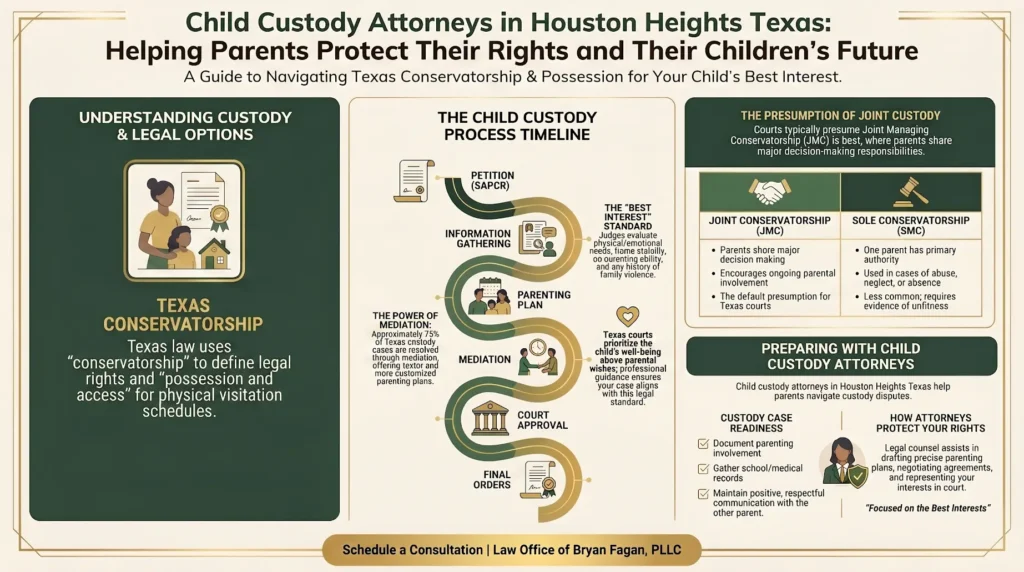
Texas law also begins with a strong presumption that children benefit from having both parents actively involved in their lives. Under Texas Family Code §153.131, courts generally presume that parents should be appointed Joint Managing Conservators whenever doing so serves the child’s best interests. Many parents mistakenly assume this means a guaranteed 50/50 schedule, but conservatorship and parenting time are separate issues. To better understand these distinctions, visit our guide to Conservatorship in Texas, which explains how decision-making rights and possession schedules work together.
Another surprise for many parents is what Texas courts do not consider. Section 153.003 prohibits judges from favoring one parent because of gender or marital status. Despite persistent myths, mothers do not automatically receive custody, and higher income does not automatically improve a parent’s position. What judges often evaluate instead is credibility. Parents who follow court orders, demonstrate cooperation, support the child’s relationship with the other parent, and maintain stability typically place themselves in a stronger position than parents focused solely on conflict.
In straightforward situations, parents may be able to resolve custody concerns through negotiation, mediation, and well-structured parenting plans. In more complex cases, where custody disputes become contested or involve relocation, CPS investigations, allegations of family violence, or significant disagreements about a child’s primary residence, the court’s analysis becomes much more detailed. These cases often involve additional evidence, procedural requirements, and strategic decisions that can significantly affect the outcome. Families seeking local court information and related resources may find our guide to Harris County Governmental Resources helpful as they navigate the process.
The parents who tend to achieve the best outcomes are not necessarily the wealthiest or the most aggressive. They are usually the ones who understand the legal standard early, remain focused on their child’s well-being, and make thoughtful decisions throughout the case. When you understand how Texas courts evaluate custody matters, the process becomes far less about uncertainty and far more about preparation, stability, and protecting your child’s future.
What this means for you
You begin a Texas custody case as a presumed joint managing conservator. You are not asking the court for permission to be a parent — the other side has to give the court a reason to limit you. That starting position is the single most important fact most Heights parents don’t know.
Conservatorship vs. Possession and Access
One of the biggest misconceptions parents have when meeting with Child custody Attorneys in Houston Heights Texas is believing that “custody” is a single issue. Under Texas law, custody is divided into two separate concepts: conservatorship and possession. Conservatorship determines which parent has specific rights and responsibilities, such as making educational, medical, and legal decisions for a child. Possession and access determine the parenting schedule—when the child spends time with each parent. Understanding the difference is critical because many custody disputes are actually disagreements about decision-making authority rather than parenting time.
In most Texas cases, courts begin with the presumption that both parents should remain actively involved in their child’s life. Texas Family Code §153.131 generally favors appointing parents as Joint Managing Conservators, while Texas Family Code §153.134 outlines factors courts consider when allocating parental rights and duties. Judges evaluate stability, communication, credibility, and each parent’s ability to place the child’s needs first. Parents who want a deeper understanding of how these rights are divided can learn more through our guide to Conservatorship in Texas, which explains the practical differences between parental authority and possession schedules.
Possession and access operate under a separate framework. For many families, the Standard Possession Order established under Texas Family Code §153.252 provides the starting point for visitation. Depending on the circumstances, this may include alternating weekends, midweek visitation, holiday schedules, and extended summer possession. In straightforward situations where parents live relatively close to one another, these schedules often provide consistency while preserving meaningful relationships with both parents. Practical concerns such as travel time, exchanges, and commuting between households can also affect how well a schedule works in the real world. Families navigating those issues may find helpful information in our guide to Transportation in Harris County.
Where custody disputes become contested, the focus often extends beyond the calendar itself. If your case involves relocation, disagreements over schooling, CPS involvement, allegations of family violence, or ongoing communication problems between parents, the court may need to make more detailed findings about what arrangement serves the child’s best interests under Texas Family Code §153.002. In these more complex cases, judges often place significant weight on a parent’s credibility, compliance with court orders, willingness to cooperate, and ability to support the child’s relationship with the other parent.
Perhaps the most important takeaway is that joint conservatorship does not automatically mean equal parenting time. Texas courts do not begin with a presumption of a 50/50 schedule. Instead, every parenting arrangement must be tailored to the child’s unique circumstances. Parents who understand the difference between conservatorship rights and possession schedules early in the process are often better positioned to make informed decisions, avoid common mistakes, and create long-term stability for their children.
The core breakdown
| Category | What Texas Law Says | Practical Impact |
|---|---|---|
| Conservatorship | §153.131 presumes joint managing conservators (2025) | Both parents usually keep decision-making rights |
| Primary residence | Court designates one home; may add geographic restriction | One parent’s address controls school zoning & daily life |
| Possession | Standard Possession Order, §153.252 (2025) | Sets the weekend/holiday/summer calendar |
| Best interest | §153.002 — always the primary consideration (2025) | Every contested issue is decided through this lens |
Listen to Our Texas Family Law Podcast
Prefer listening? In this episode, we discuss child custody in Houston Heights, Texas, including how courts decide what is best for your child, what factors may influence custody decisions, and what parents should know before moving forward.
What Harris County Judges Actually Weigh
For parents working with Child custody Attorneys in Houston Heights Texas, one of the most common questions is, “What does the judge actually care about?” The answer begins with Texas Family Code §153.002, which requires courts to make decisions based on the best interest of the child. In Harris County, judges often rely on the Holley factors, a set of guidelines developed by Texas courts that examine the child’s emotional and physical needs, the stability of each home, the parenting abilities of each parent, and any circumstances that could affect the child’s well-being. No single factor automatically determines the outcome. Instead, judges evaluate the complete picture of a child’s life and future.
In practice, stability carries significant weight. Courts look beyond promises and focus on patterns. Which parent consistently attends medical appointments? Who communicates with teachers, counselors, and caregivers? Who maintains routines and follows through on responsibilities? Judges often place substantial value on documented involvement because it provides a clearer picture of day-to-day parenting than courtroom testimony alone. Families seeking support services related to a child’s physical or mental well-being may also benefit from reviewing available Harris County Medical Resources, particularly when healthcare needs become relevant in a custody case.
Another factor courts evaluate is each parent’s willingness to cooperate and support the child’s relationship with the other parent. In straightforward situations, parents who communicate effectively and prioritize their child’s needs often resolve disputes with less court involvement. Where custody disputes become contested, however, judges may scrutinize communication records, compliance with temporary orders, and each parent’s credibility. A common mistake is assuming that criticizing the other parent will strengthen your case. More often, courts want to see evidence that a parent is focused on the child rather than the conflict.
For children who are at least 12 years old, Texas Family Code §153.009 allows the court to conduct a private interview regarding the child’s preference about primary residence. Many parents mistakenly believe this means the child gets to decide where they live. That is not the case. The child’s preference is only one factor among many. Judges continue to evaluate stability, safety, parental involvement, and the child’s overall best interests. Attempts to pressure, influence, or coach a child before these interviews frequently damage a parent’s credibility rather than help their position.
If your case involves relocation, special medical needs, CPS investigations, allegations of family violence, or significant disagreements regarding parenting decisions, the court’s analysis becomes far more detailed. In these higher-conflict situations, early decisions, procedural deadlines, and strategic planning can have long-term consequences. Understanding what judges actually weigh allows parents to focus their efforts on the factors that matter most: stability, credibility, cooperation, and creating an environment where their child can thrive.
Strategy that works
Start building your involvement record the day you sense a custody fight coming. A simple shared calendar showing the appointments you attend, the pickups you make, and the school events you show up to is more persuasive to a Harris County judge than any character witness. Document the ordinary — that is what best interest is built from.
Common Misunderstandings That Hurt Parents

Many of the mistakes that bring parents to Child custody Attorneys in Houston Heights Texas are not caused by bad intentions—they are caused by misinformation. One of the most persistent myths is that mothers automatically receive favorable treatment in custody cases. Texas law says otherwise. Under Texas Family Code §153.003, courts cannot make conservatorship or possession decisions based on a parent’s gender or marital status. Another common misconception is that the parent who earns more money is more likely to receive custody. While income can affect child support, conservatorship decisions are guided by the child’s best interests under Texas Family Code §153.002, not a parent’s paycheck.
Parents also frequently misunderstand how moves and living arrangements affect custody rights. Moving out of the family home does not automatically mean abandoning your rights as a parent, but making an impulsive move can create practical and legal complications, especially when temporary orders are being established. In straightforward situations, parents can often work through relocation and scheduling concerns cooperatively. In more complex cases involving geographic restrictions, disputes over a child’s primary residence, or plans for moving to Harris County, early planning can help prevent costly conflicts later in the case.
Another costly mistake is treating child support and possession as bargaining tools. Texas courts view these as separate obligations. A parent generally cannot withhold visitation because support has not been paid, nor can a parent stop paying support because visitation is being denied. Judges often view self-help remedies negatively because they create instability for children and demonstrate a lack of cooperation between parents. When disputes arise, the proper remedy is usually through enforcement proceedings rather than retaliation.
Where custody disputes become contested, credibility often becomes one of the most important factors in the courtroom. Judges pay close attention to whether parents follow court orders, meet deadlines, communicate appropriately, and prioritize their children’s needs. A parent who consistently demonstrates diligence and compliance is often viewed more favorably than one who acts impulsively or ignores procedural requirements. Small decisions made early in a case can have a lasting impact on how the court views a parent’s judgment and reliability.
Perhaps the biggest misunderstanding is believing that a final custody order can easily be changed later. Under Texas Family Code §156.101, modifications generally require a material and substantial change in circumstances, and courts do not revisit prior orders simply because a parent is unhappy with the result. If your case involves relocation, CPS involvement, family violence concerns, or significant disagreements regarding parenting decisions, strategic planning from the beginning becomes increasingly important. The custody order entered today may shape your family’s future for years, which is why understanding the law—and avoiding common mistakes—can make a meaningful difference in the outcome.
Avoid this mistake
Do not move the children out of Harris County, change their school, or cut off the other parent’s contact before you have a temporary order — even if you’re convinced you’re right. Unilateral moves are the fastest way to lose credibility with a judge and can trigger an emergency order against you. Get the order first.
What Matters Most in a Contested Case
Most contested custody cases in Harris County are won or lost at temporary orders, long before any final trial. Early in the case, the court enters temporary orders setting who lives where, who has the children when, and who pays what while the case is pending. Because judges value stability, the temporary arrangement often becomes the template for the final order — the status quo is hard to dislodge once it’s running. Treating the temporary orders hearing as “just a preliminary” is a serious error.
When the facts are genuinely in dispute, courts have tools beyond the parents’ testimony. Under §107.001 and related provisions (2025), a judge can appoint an amicus attorney or attorney ad litem to represent the child’s interests, or order a child custody evaluation. In high-conflict Heights cases — allegations of substance abuse, family violence, or alienation — these appointments often decide the case, because the evaluator’s report carries real weight.
The contested cases that go well share a pattern: the parent stayed calm, kept a clean documentary record, followed every temporary order to the letter, and let the other parent’s behavior speak for itself. The contested cases that go badly usually feature a parent who tried to win by making the other parent look bad and ended up looking unstable instead. In a best-interest world, the steadier parent has a structural advantage.
“Custody cases in Harris County are usually decided at temporary orders, not at final trial. The parent who treats the first hearing as the real one is the parent who wins.”
Mistakes, Risks, and Deadlines
The deadlines in a Texas custody case are unforgiving, and missing them costs you options. Once you’re served with a custody suit, you have a short window to file a written answer — generally by the Monday after 20 days from service — or you risk a default order entered without your input. If a temporary orders hearing is set, the evidence and witnesses you bring (or fail to bring) shape the order that may govern the next year of your life.
The most common self-inflicted wounds I see: parents who vent about the case on social media, parents who introduce a new partner to the children mid-case, parents who record the other parent illegally, and parents who skip the court-ordered mediation Harris County almost always requires before trial. Each one hands the other side ammunition. In a best-interest case, your own conduct during the case is evidence.
There is also a jurisdictional trap worth naming. Texas courts apply the Uniform Child Custody Jurisdiction and Enforcement Act, codified in Chapter 152 (2025), to decide which state has authority over the case. If one parent recently moved the children to or from Texas, the question of which state can even hear the case has to be settled first — and getting it wrong can void everything that follows.
How the Process Works in Harris County

For parents working with Child custody Attorneys in Houston Heights Texas, understanding the custody process can remove much of the uncertainty that comes with a family law case. Most custody matters begin with a Suit Affecting the Parent-Child Relationship (SAPCR), followed by requests for temporary orders that establish rules and expectations while the case is pending. These early hearings often occur quickly, and the decisions made during this stage can significantly influence the direction of the case. In straightforward situations, temporary orders simply create structure while parents work toward an agreement. In more contested cases, they can become one of the most important stages of the entire proceeding.
Texas courts make temporary and final custody decisions using the best-interest standard found in Texas Family Code §153.002. Judges evaluate factors such as stability, parental involvement, cooperation, and each parent’s ability to meet the child’s needs. Temporary orders may address issues including possession schedules, conservatorship rights, child support, and restrictions designed to preserve stability while the case progresses. A common mistake is assuming temporary orders are easily changed later. In reality, courts often view successful temporary arrangements as evidence of what is working for the child, making early preparation especially important.
Most contested custody cases in Harris County will also require mediation before a final trial. Mediation gives parents an opportunity to resolve disputes outside of the courtroom and often results in agreements that provide greater flexibility than a judge’s ruling. Parents who arrive prepared—with realistic goals, supporting documentation, and a focus on their children’s needs—are often in the strongest position to reach productive resolutions. Where custody disputes become contested, however, mediation may simply become another important step before litigation proceeds.
Throughout the process, standing orders typically take effect immediately after filing. These court orders often prohibit actions such as removing a child from the county, changing schools without agreement, interfering with possession schedules, or engaging in conduct that disrupts the child’s stability. Violating these requirements can damage a parent’s credibility and create unnecessary obstacles in the case. Families dealing with educational decisions, school transitions, or relocation concerns may find additional guidance through our resource on Educational Opportunities in Harris County, particularly when those issues intersect with custody planning.
If your case involves relocation, CPS investigations, family violence allegations, disputes regarding educational decisions, or significant conflict between parents, strategic planning becomes increasingly important. Procedural deadlines, court requirements, and early decisions can have long-term consequences for both parents and children. Understanding how the Harris County process works allows families to make informed decisions, avoid preventable mistakes, and focus on building the stability and clarity that courts look for when determining what serves a child’s best interests.
The process, step by step
| Step | Typical Timeline | Action Item |
|---|---|---|
| File / respond to petition (SAPCR) | Answer due ~20 days after service | Calendar the deadline immediately; never ignore service |
| Temporary orders hearing | Weeks after filing | Treat as decisive; bring documents and witnesses |
| Discovery & evaluations | Months | Preserve records; cooperate with any ad litem/evaluator |
| Mediation | Before final trial (usually required) | Arrive with a concrete parenting-plan proposal |
| Final trial & order | If no settlement | Present the best-interest record you’ve built all along |
Where Nearby Counties Differ
The Texas Family Code is the same statewide, but the courthouse experience changes the moment you cross a county line. A Heights family is almost always in Harris County, but custody disputes touch surrounding counties constantly — when a parent moves to Fort Bend, Montgomery, Galveston, or Brazoria, the case may shift, and local rules differ on scheduling, mediation requirements, and how associate judges are used.
Fort Bend and Montgomery County courts, for example, manage their dockets and temporary-orders practice differently than Harris County, and local standing orders vary in their exact terms. The substantive law — best interest, the joint-conservatorship presumption, the Standard Possession Order — does not change. What changes is procedure, timing, and the personalities on the bench, which is why local experience in the specific county matters more than parents expect.
If you or the other parent is contemplating a move to Sugar Land, The Woodlands, Katy, Spring, Pearland, or Cypress, raise it with your attorney before anyone relocates. A geographic restriction in your order — or its absence — can determine whether that move is even allowed, and the time to address it is in the order, not after.
Used the checker above and want a real read on your situation? Let’s map your case to the standard the court applies.
Schedule a Legal Strategy SessionWhat to Do If You’re Dealing With Custody in the Heights
Want this checklist turned into a plan for your case? Bring your facts and we’ll build the next 30 days.
Schedule a Legal Strategy SessionWhat I Tell Every Client Who Calls About Custody

Here is what I told the mother on 19th Street, and what I tell every Heights parent who calls scared: the law is not against you. Texas starts you as a presumed joint managing conservator, decides everything on the best interest of your child, and forbids the court from holding your gender, your income, or your work schedule against you. The fear you walked in with is almost always built on a myth.
But the clock is real. Temporary orders happen fast and tend to stick, deadlines are unforgiving, and the moves you make in the first two weeks — especially the impulsive ones — can shape the next several years. The parents who do well are not the angriest or the wealthiest; they’re the ones who understood the standard early and prepared around it. That preparation is entirely within your control.
If you’re dealing with a custody question in the Houston Heights right now, the right next step is a Legal Strategy Session before you do anything else — not after. Bring your situation, and I’ll show you exactly how Texas law applies to it and what to do this week. Call (281) 810-9760 or book a session online, and let’s get you off the back foot.
Get a clear read on your custody case before you make your next move.
Schedule a Legal Strategy SessionConclusion:
Divorce may change a family’s structure, but it does not have to define a child’s future. The decisions parents make during a custody case can have a lasting impact on a child’s sense of stability, emotional well-being, and academic success. Understanding how Texas courts evaluate these issues is an important first step, but applying that knowledge to your family’s unique circumstances is where thoughtful planning becomes essential. That’s why many families turn to Child custody Attorneys in Houston Heights Texas for guidance when navigating difficult decisions that affect both their children and their future.
In straightforward situations, parents may simply need help creating a parenting plan that promotes consistency and supports their child’s growth. In more complex cases, custody disputes can involve relocation requests, CPS investigations, family violence allegations, significant educational concerns, or disagreements about conservatorship rights and decision-making authority. If your case involves unique challenges or high-conflict issues, having the right level of legal guidance can make a meaningful difference in protecting both your parental relationship and your child’s long-term stability.
At The Law Office of Bryan Fagan, PLLC, we believe families deserve more than legal answers—they deserve clarity, education, and a strategy built around what matters most. Our goal is to help parents move forward with confidence, make informed decisions, and create solutions that support their children today while protecting their opportunities tomorrow.
Questions My Clients Ask About Child Custody in Houston Heights
Custody in Texas is determined by the best interest of the child under Texas Family Code §153.002 (2025). The court starts from a presumption that both parents should be joint managing conservators (§153.131), then weighs the Holley factors — the child’s needs, each parent’s abilities, the stability of each home, and any danger to the child. Income and gender are not deciding factors. I help clients build the record around the factors the judge actually applies.
Texas custody law lives in Chapter 153 of the Family Code (2025). It uses the term “conservatorship” for decision-making rights and “possession and access” for the schedule, presumes parents should share rights as joint managing conservators, and applies the best-interest standard to every contested issue. It also forbids deciding custody based on a parent’s sex or marital status under §153.003. The law is the same across Texas, but how it’s applied varies by county.
No. Texas Family Code §153.003 (2025) prohibits a court from deciding conservatorship or possession based on the sex of the parent. The “tender years” presumption that once favored mothers was abolished long ago. In Harris County, fathers and mothers start on equal footing, and the parent with the stronger best-interest record — involvement, stability, and good conduct during the case — has the advantage regardless of gender.
A child never gets to simply “decide.” Under §153.009 (2025), a child 12 or older may tell the judge their preference about which parent has the primary residence, and the judge must conduct that interview on request in certain cases. But the preference is one factor among many — the judge still rules on best interest. Coaching a child to express a preference tends to hurt the coaching parent.
Texas frames this as joint managing conservatorship versus sole managing conservatorship. Joint managing conservators share the major decision-making rights, even though one parent usually has the primary residence; this is the presumed arrangement under §153.131 (2025). Sole managing conservatorship gives one parent most of the major rights and is typically reserved for cases involving family violence, neglect, or a parent’s absence. “Joint” refers to rights, not equal time.
It varies with conflict level. Temporary orders are usually in place within weeks of filing, which sets the arrangement while the case proceeds. A case that settles at mediation can finish in a few months; a high-conflict case requiring evaluations and a contested trial can run a year or more. The practical takeaway: the temporary order shapes much of that time, so it deserves serious preparation early.
Yes, but the bar is higher than the first case. Under §156.101 (2025), modifying a final order requires showing a material and substantial change in circumstances since the order — such as a relocation, a change in the child’s needs, or a parent’s changed situation — and that the change serves the child’s best interest. It is not a chance to relitigate the original ruling. That higher bar is exactly why getting the first order right matters so much.
You’re allowed to represent yourself, but custody outcomes tend to track preparation, and the temporary orders stage moves fast. The parents who do well understand the best-interest factors, hit every deadline, and present a clean record — all easier with experienced help. At minimum, a Legal Strategy Session early gives you the framework before you make a move you can’t take back.
Usually not without permission. Standing orders that take effect when the case is filed typically prohibit removing the child from the county or the child’s school, and your final order may include a geographic restriction. Moving the child unilaterally during a case is one of the most damaging things a parent can do. If a move is necessary, address it through the court — before relocating.
It depends on conflict level and whether the case settles or goes to trial, but the honest driver of cost is how contested the case is — an agreed parenting plan costs a fraction of a fought trial with evaluations. Rather than guess, I’d rather show you the likely path for your specific facts in a Legal Strategy Session so you can plan around a realistic range instead of a number pulled from the air.
Still have a question that’s keeping you up at night? Bring it to a session and get a straight answer.
Schedule a Legal Strategy Session