
Alimony and Spousal Support Attorneys in Houston Heights, Texas: What You Actually Qualify For

The conversation usually starts the same way. Someone looking for Alimony and spousal support Attorneys in Houston Heights Texas calls my office expecting to talk about monthly payments, child support, or who gets the house. Then, almost without fail, the conversation takes a different turn. A parent tells me their son has gone from making A’s to barely passing. Another says their daughter’s teacher called because she has stopped participating in class. They thought the biggest challenge would be dividing their finances. Instead, they are worried divorce is changing their child.
Here is what most parents get wrong before they ever sit down with me. Divorce is not just a legal process that divides property and determines custody. It can also reshape a child’s daily routine, emotional well-being, and academic performance. Texas courts understand that reality. Under Texas Family Code §153.002, every conservatorship decision must be based on the child’s best interest, and stability is often one of the most important pieces of that analysis. A judge may never ask whether your child got a B instead of an A, but the court absolutely cares about the parenting arrangement most likely to keep your child emotionally secure, consistently attending school, and able to succeed.
I represented a Houston Heights family whose divorce became consumed by disagreements over finances. Both parents were convinced the most important issue was who would keep the family home and how the bills would be paid. Meanwhile, their eleven-year-old quietly stopped completing homework and began falling behind in school. Once we shifted our focus from “Who wins the divorce?” to “What helps your child succeed?” the entire case changed. We built a parenting plan around school routines, consistent expectations in both households, and open communication with teachers. The property issues still had to be resolved, but creating stability for their child became the foundation for resolving everything else.
This guide explains how Texas courts evaluate educational stability in custody cases, why financial decisions during divorce can affect a child’s success in the classroom, and what parents can do today to protect both their family’s future and their child’s opportunity to thrive. Understanding the law is important, but understanding how to use it to create stability for your children is where the real difference begins.
The Short Answer
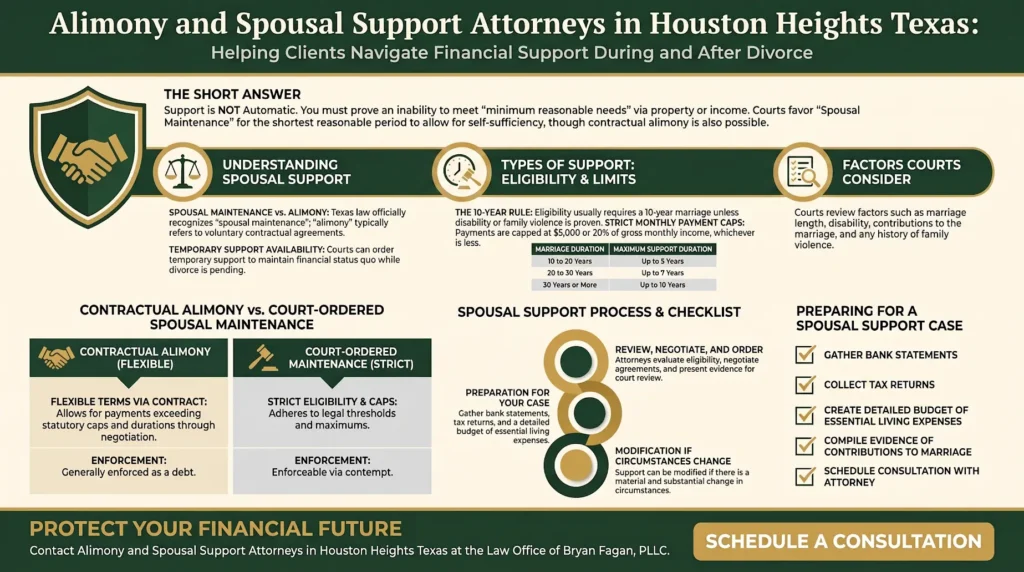
In Texas, spousal support means court-ordered spousal maintenance under Texas Family Code Chapter 8, and you qualify only if you will lack enough property to meet your minimum reasonable needs after divorce and meet one statutory ground — usually a marriage of 10+ years, family violence, or a disabling condition. Payments are capped at the lesser of $5,000 or 20% of the payer’s average monthly gross income (§8.055).
Key Takeaways
- Texas does not have automatic alimony. Eligibility under §8.051 requires both insufficient property to meet your minimum reasonable needs and a qualifying statutory ground. Length of marriage alone is not enough.
- There is a rebuttable presumption against maintenance. Under §8.053, the court presumes maintenance is not warranted unless you show you diligently tried to earn enough or develop the skills to meet your needs during separation and while the divorce was pending.
- Payments are hard-capped. Under §8.055, maintenance cannot exceed the lesser of $5,000 per month or 20% of the payer’s average monthly gross income — regardless of lifestyle during the marriage.
- Duration is tied to marriage length. Under §8.054, orders generally run up to 5, 7, or 10 years for marriages of 10–20, 20–30, and 30+ years respectively, with longer terms only for disability or a disabled child.
- Contractual alimony is the workaround. What the statute will not order, you can still negotiate. Settlement-based contractual alimony is not bound by the Chapter 8 caps and is often the real lever in a Harris County case.
- Texas is one of the stingiest alimony states in the country. Compared to California, New York, or Florida — where long-term or “permanent” support is common — Texas maintenance is shorter, capped, and presumed against.

Your Family’s Future Starts Here
Don’t navigate your legal journey alone. Schedule a consultation now and get the clarity and support you deserve.
Family lawyers and attorneys advise our clients of the immediate aftermath as well as the long-term effects of Family Law related issues, such as the following:
Trust us to help you with your Family Law Attorneys in the Houston Heights in Texas. Call (281) 245-1776 or contact us online today to schedule a free consultation with your Family Law Attorney in Humble, Texas.
What “Alimony” Actually Means in Texas

When people search for Alimony and spousal support Attorneys in Houston Heights Texas, one of the biggest surprises is learning that Texas does not recognize “alimony” the way many other states do. In reality, the term refers to two very different legal concepts: court-ordered spousal maintenance under Chapter 8 of the Texas Family Code and contractual alimony negotiated between spouses during a divorce settlement. Understanding which applies to your case is critical because each follows different rules, creates different opportunities, and can significantly affect your financial future. If you’d like a broader overview, see our guide to Texas spousal support and alimony.
Court-ordered spousal maintenance is intentionally limited. Under Texas Family Code §8.051, the spouse requesting support must prove they lack sufficient property to meet their minimum reasonable needs and satisfy one of the statute’s specific eligibility requirements. Even then, courts consider the factors listed in §8.052, apply the presumption against maintenance under §8.053, and follow strict limits on both the amount and duration of support under §§8.054 and 8.055. Simply earning less than your spouse—or being married for many years—does not automatically qualify you for maintenance.
Contractual alimony, on the other hand, is created through negotiation rather than judicial order. Because it is part of a settlement agreement, spouses have far greater flexibility to structure payments, negotiate longer support periods, arrange lump-sum buyouts, or tailor financial terms to fit their family’s needs. In straightforward situations, this flexibility often helps both parties reach an agreement without prolonged litigation. In more complex cases involving substantial assets, business ownership, disability, or disputed financial records, contractual alimony can become one of the most valuable tools for reaching a practical resolution.
Over the years, I’ve seen spouses reject strong settlement offers because they assumed a Harris County judge would award more through court-ordered maintenance. Too often, the law simply did not support that expectation. The strongest strategy is not deciding whether you want “alimony”—it is understanding whether your facts fit the statutory requirements for Chapter 8 maintenance or whether negotiating contractual alimony will better protect your future. That distinction often determines whether you approach your divorce with realistic leverage or unrealistic expectations.
From the Desk
When a settlement is realistic, contractual alimony almost always gives my clients more flexibility than a court order — longer terms, tax structuring, and amounts a judge could never order. We negotiate from the statute, but we rarely stop there.
Who Qualifies for Spousal Maintenance Under §8.051
One of the most common questions I hear from people searching for Alimony and spousal support Attorneys in Houston Heights Texas is, “Do I qualify?” The answer is rarely as simple as the length of your marriage or the difference between your income and your spouse’s. Under Texas Family Code §8.051, you must first prove that, after the divorce, you will lack sufficient property—including your separate property—to meet your minimum reasonable needs. Then you must establish at least one statutory basis for maintenance. If either requirement is missing, the court cannot award Texas spousal maintenance, regardless of how difficult your financial situation may seem. For a deeper look at situations where employment becomes an issue, see our guide on whether a spouse can quit working to avoid paying alimony.
Texas law recognizes four primary paths to eligibility. A court may award court-ordered spousal maintenance if the paying spouse was convicted of family violence within the statutory time period, if the requesting spouse has an incapacitating physical or mental disability, if the marriage lasted at least ten years and the requesting spouse cannot earn enough to meet their minimum reasonable needs, or if the requesting spouse cares for a child of the marriage whose disability prevents full-time employment. In Harris County divorce cases, the ten-year marriage provision is the most frequently raised, but it is also one of the most misunderstood. A decade of marriage opens the door to eligibility—it does not guarantee support.
Over the years, I’ve watched many spouses assume they qualified simply because they earned less than their husband or wife. Unfortunately, that assumption often leads to disappointment. Texas courts look beyond income and examine employability, available assets, financial records, education, work history, and whether the requesting spouse made diligent efforts to become self-supporting. Under Texas Family Code §8.053, there is a presumption against maintenance unless the requesting spouse can show they actively sought employment or developed job skills during the separation and while the divorce was pending. Documentation matters. Judges are persuaded by evidence, not assumptions.
In straightforward situations, gathering financial records and understanding the statutory requirements may be enough to evaluate whether maintenance is appropriate. In more complex cases involving contested eligibility, disability, business ownership, significant assets, or disputes over earning capacity, developing a thoughtful legal strategy early can make a meaningful difference. The strongest maintenance claims are built long before a final hearing, with organized financial documentation, credible evidence, and a clear understanding of how Chapter 8 applies to the specific facts of your case.
Strategy Note
The presumption in §8.053 is where most maintenance claims are won or lost. Start documenting your job search, training, or medical limitations the day you separate — not the week before trial. A judge wants to see diligence over time, not a paper trail assembled for the hearing.
How Much, and For How Long
One of the biggest misconceptions I hear from people searching for Alimony and spousal support Attorneys in Houston Heights Texas is that support is based on the lifestyle they enjoyed during the marriage. Texas law works very differently. Under Texas Family Code §8.055, court-ordered spousal maintenance is limited to the lesser of $5,000 per month or 20% of the paying spouse’s average monthly gross income. That means there is no “half your paycheck” rule and no guarantee that maintenance will preserve the standard of living you had during the marriage. Instead, Texas focuses on helping an eligible spouse meet their minimum reasonable needs within carefully defined statutory limits. If you’re exploring strategies and common misconceptions surrounding maintenance, our article on avoiding alimony in Texas provides additional insight into how these issues are evaluated.
The length of support is also controlled by statute. Under Texas Family Code §8.054, maintenance generally lasts no more than five years for marriages lasting at least 10 years but less than 20 years, seven years for marriages of 20 to less than 30 years, and ten years for marriages lasting 30 years or longer. Courts may order support for a longer period only in limited circumstances, such as when the receiving spouse has an incapacitating disability or is caring for a child whose disability prevents the spouse from becoming self-supporting. Even then, judges are directed to award maintenance only for the shortest reasonable period necessary for the recipient to become financially independent whenever possible.
Over the years, I’ve seen many spouses enter mediation believing a long marriage automatically means decades of support. In reality, Harris County judges closely follow Chapter 8’s statutory framework. They examine financial records, earning capacity, monthly budgets, and the evidence presented—not assumptions or expectations. In straightforward situations, the statutory limits provide a fairly predictable framework for negotiations. In more complex cases involving business ownership, significant assets, disputed income, or questions about earning capacity, determining the appropriate amount of maintenance often requires detailed financial analysis and a carefully developed litigation strategy.
The most successful maintenance cases begin with realistic expectations, organized documentation, and a clear understanding of what Texas law actually allows. Knowing the statutory caps before negotiations begin not only strengthens your position but also helps you focus on opportunities—such as contractual alimony or creative property division—that may provide greater long-term financial security than relying solely on what a court can order under Chapter 8.
| Category | What Texas Law Says | Practical Impact |
|---|---|---|
| Eligibility | §8.051: insufficient property for minimum reasonable needs + a statutory ground | You must prove both, not just one |
| Presumption | §8.053: presumed not warranted absent diligence | Document your efforts from day one |
| Amount cap | §8.055: lesser of $5,000/mo or 20% of avg monthly gross | Lifestyle during marriage is irrelevant to the cap |
| Duration | §8.054: up to 5/7/10 yrs by marriage length; longer for disability | Even a 25-year marriage is usually capped at 7 years |
“The number that matters is not what your spouse earned. It is what the statute allows and what the evidence supports. Those are usually two very different figures.”
$5,000
monthly maintenance cap (§8.055)
20%
of average monthly gross income
10 yrs
marriage length for the most common ground
The Misunderstandings That Cost People Support

One of the reasons people search for Alimony and spousal support Attorneys in Houston Heights Texas is because they’ve already received well-meaning—but often incorrect—advice from friends, family, or the internet. The same myths surface over and over again: that every marriage lasting ten years automatically qualifies for alimony, that the spouse with the higher income always has to pay, or that Texas courts will preserve the lifestyle enjoyed during the marriage. None of those statements accurately reflects Texas spousal maintenance law, and believing them can lead to costly decisions before your divorce is even underway. For a more detailed discussion of how Texas courts evaluate maintenance claims, see our guide to Texas spousal support and maintenance guidelines.
The ten-year rule is probably the most misunderstood. A marriage lasting at least ten years may satisfy one part of Texas Family Code §8.051, but it does not automatically entitle anyone to court-ordered spousal maintenance. The requesting spouse must still prove they cannot meet their minimum reasonable needs and overcome the presumption against maintenance established in §8.053. Likewise, simply earning more than your spouse does not automatically make you responsible for paying maintenance. Harris County judges focus on statutory eligibility, financial documentation, credibility, and each spouse’s actual circumstances—not assumptions based solely on income.
I’ve also seen many spouses walk into mediation convinced the court will require enough maintenance to preserve the home, vacations, and lifestyle they enjoyed during the marriage. Texas law simply does not work that way. Chapter 8 protects minimum reasonable needs, not a particular standard of living, and the amount of maintenance remains subject to the statutory limits in §8.055. In straightforward cases, understanding those limitations often helps spouses negotiate realistic settlements. In more complex divorces involving substantial assets, business interests, disputed income, or significant property division issues, contractual alimony frequently becomes a more valuable negotiating tool because it allows spouses to reach financial solutions beyond what a court could order.
The most successful maintenance claims begin with realistic expectations instead of common misconceptions. Waiting until the eve of trial to understand how Chapter 8 works can reduce your negotiating leverage and make avoidable mistakes much harder to correct. Whether you’re seeking maintenance or defending against a request, understanding what Texas law actually requires—and preparing the financial evidence to support your position—often has a greater impact on the outcome than any myth you’ve heard from someone else’s divorce.
Warning
Quitting your job or under-earning to look “needy” backfires. Texas courts can impute earning capacity, and the §8.053 diligence presumption is designed to catch exactly this move. Voluntary unemployment is one of the fastest ways to lose a maintenance claim.
What Disqualifies You From Alimony in Texas
Many people searching for Alimony and spousal support Attorneys in Houston Heights Texas assume the biggest challenge is proving they qualify for maintenance. In reality, I’ve seen just as many cases where someone who appeared eligible ultimately lost their claim because they overlooked one of Texas law’s disqualifying factors. Texas spousal maintenance is intentionally limited, and courts begin with the presumption that maintenance should not be awarded unless the requesting spouse satisfies every statutory requirement. Understanding what can disqualify you is often just as important as understanding what makes you eligible. For a more detailed discussion of the factors courts consider, see our guide to Texas spousal maintenance factors.
The most common disqualification begins with the property test under Texas Family Code §8.051. If the division of community and separate property leaves you with sufficient resources to meet your minimum reasonable needs, the court generally cannot order court-ordered spousal maintenance, regardless of how long you were married. Likewise, if the evidence shows you have the ability to become self-supporting through employment or training, the court may determine you do not qualify under the ten-year marriage provision. Judges in Harris County also closely examine the diligence requirement found in §8.053. If a spouse cannot demonstrate reasonable efforts to find work, improve job skills, or document a legitimate disability, that presumption against maintenance can become difficult to overcome.
I’ve also represented clients who were surprised to learn that qualifying for maintenance does not necessarily mean it lasts forever. Under Texas Family Code §8.056, maintenance generally terminates upon the death of either party, the recipient’s remarriage, or when the court finds the recipient is cohabiting with another person in a continuing romantic relationship. In straightforward cases, these rules provide predictable guidance for both spouses. In more complex cases involving disputed living arrangements, contested earning capacity, hidden assets, or significant financial resources, proving—or disproving—continued eligibility often requires detailed financial records, credible testimony, and a carefully developed litigation strategy.
The strongest maintenance cases are built on preparation rather than assumptions. Waiting until a hearing to gather employment records, financial documentation, or evidence supporting your eligibility can reduce your negotiating leverage and create avoidable obstacles. Whether you are requesting maintenance or responding to a claim, understanding the statutory disqualifiers early allows you to make informed decisions, negotiate from a position of strength, and avoid costly surprises as your divorce moves forward.
| Your Situation | Eligibility Test | What It Means for You |
|---|---|---|
| Married 10+ years, lower earner | §8.051(2)(B): lack ability to earn for minimum needs | Likely eligible — must still prove inability + diligence |
| Spouse convicted of family violence | §8.051(1): conviction/deferred within 2 yrs or during suit | Eligible regardless of marriage length |
| Disabling condition prevents work | §8.051(2)(A): incapacitating physical/mental disability | Eligible; duration can extend beyond standard caps |
| Adequate property after division | §8.051 property test not met | Disqualified — negotiate contractual alimony instead |
| Cohabiting with a new partner | §8.056: termination ground | Existing order can be terminated |
Listen to Our Texas Family Law Podcast
Prefer listening? In this episode, we discuss alimony and spousal support in Houston Heights, Texas, including who may qualify, how support is determined, and what factors courts consider when making these decisions.
What Matters When Spousal Support Is Contested
When people searching for Alimony and spousal support Attorneys in Houston Heights Texas ask me what actually determines the outcome of a contested maintenance case, my answer is usually the same: evidence beats emotion. Many spouses believe the person with the more compelling story wins, but Harris County judges are looking for something much more concrete. They carefully evaluate your financial documentation, your monthly budget, your efforts to become self-supporting, and how the factors in Texas Family Code §8.052 apply to your specific circumstances. If you want a broader understanding of how courts analyze these issues, our guide to Texas spousal maintenance factors offers additional insight.
The strongest maintenance cases begin with a well-documented picture of your minimum reasonable needs. Courts examine each spouse’s financial resources, education, employment skills, age, health, contributions as a homemaker, the length of the marriage, and, where applicable, evidence of family violence or marital misconduct. They also expect the requesting spouse to overcome the presumption against maintenance found in Texas Family Code §8.053 by demonstrating diligence in seeking employment or developing the skills needed to become financially independent. In straightforward situations, organized financial records and credible testimony may be enough to resolve the issue through negotiation or mediation. In more complex cases involving contested finances, business ownership, disability, or significant marital assets, the quality of the evidence often becomes the deciding factor.
Recent Texas case law has reinforced just how closely courts evaluate the numbers. In Mehta v. Mehta (Tex. 2025), the Texas Supreme Court clarified that when a custodial parent receives child support, courts must consider the child-related expenses that support is intended to cover instead of treating those payments as income available to meet the parent’s own minimum reasonable needs. For parents seeking court-ordered spousal maintenance, that means itemized budgets, accurate expense records, and documentation separating personal expenses from child-related costs have become more important than ever.
Over the years, I’ve found that contested maintenance cases are rarely won because someone argued louder—they are won because someone prepared better. Waiting until the final hearing to organize financial records, document expenses, or explain your earning capacity can weaken your negotiating position long before a judge hears your case. Whether your divorce involves a straightforward maintenance request or a high-conflict dispute over income, property, or financial need, building a thorough evidentiary record early often provides the strongest foundation for achieving a favorable outcome.
You likely meet a strong statutory ground
Family violence or a qualifying disability is one of the most direct paths to spousal maintenance eligibility under Texas Family Code §8.051 — and in disability cases, support can extend beyond the standard duration caps. The next step is building the evidence: the order still depends on proving your minimum reasonable needs. Let’s map your case.
You may qualify — the evidence will decide
Your situation opens the door to spousal maintenance under §8.051, but eligibility is not automatic. You’ll need to prove you lack the ability to earn enough for your minimum reasonable needs and overcome the §8.053 presumption against maintenance. This is exactly the kind of case where preparation determines the outcome — and where contractual alimony may give you more than a court order would.
Court-ordered maintenance is unlikely — but you still have options
If property division leaves you able to meet your minimum reasonable needs, you generally won’t qualify for statutory maintenance under §8.051, regardless of marriage length. That does not mean you walk away with nothing. Contractual alimony negotiated in settlement is not bound by the Chapter 8 caps, and a strong property division strategy may matter more for you than maintenance ever would.
Statutory eligibility looks unlikely on these facts
Without family violence, a qualifying disability, a 10-year marriage, or a disabled child in your care, the §8.051 grounds for spousal maintenance are hard to meet. But “unlikely” is not “impossible,” and the facts often look different once an attorney reviews them — and contractual alimony remains on the table in settlement. A short conversation will tell you whether there’s a path worth pursuing.
Do You Qualify for Spousal Support in Texas?
Texas spousal maintenance is narrow and capped — most people guess wrong about whether they qualify. Answer 6 quick questions to see where your situation likely lands under the Texas Family Code. No contact info required.
First: what is the main reason you’re asking about spousal support? I may need support after my divorce I may be asked to pay support I’m just trying to understand my optionsGot your result from the qualifier? The next step is mapping it to your actual numbers.
Book a Legal Strategy SessionHow Harris County Handles Spousal Maintenance

If you’re searching for Alimony and spousal support Attorneys in Houston Heights Texas, it’s important to understand that Harris County courts treat temporary support and final Chapter 8 maintenance as two very different issues. One of the biggest surprises for many spouses is that receiving temporary financial assistance early in the divorce does not mean you’ll receive long-term court-ordered spousal maintenance after the case ends. Temporary support is designed to preserve financial stability while the divorce is pending, whereas final maintenance must satisfy the strict eligibility requirements established in Chapter 8 of the Texas Family Code. Understanding that distinction from the beginning can help you avoid unrealistic expectations and make better strategic decisions throughout your case. For additional insight into how Texas courts evaluate maintenance, see our guide to Texas spousal maintenance essentials.
In my experience handling Harris County divorce cases, preparation consistently matters more than presentation. Family courts routinely expect organized financial disclosures, detailed monthly budgets, income documentation, and credible evidence supporting the statutory grounds for maintenance. Judges hear maintenance requests every day, and they are generally far more persuaded by well-prepared financial records than emotional testimony alone. In straightforward situations, that preparation often helps spouses resolve maintenance through negotiation or mediation before trial. In more complex cases involving disputed income, business ownership, high-value assets, or contested eligibility, careful financial analysis and early case preparation frequently become essential to protecting your interests.
Timing also plays a significant role in how maintenance cases develop. Temporary orders hearings often occur within the first few weeks after filing and establish who remains in the home, who pays ongoing household expenses, and whether temporary financial support will be ordered while the divorce proceeds. Many people underestimate the importance of that hearing, only to discover that the financial framework established early in the case influences negotiations for months afterward. Waiting until mediation or trial to organize financial records can significantly reduce your negotiating leverage.
Most contested maintenance disputes in Harris County ultimately resolve through mediation rather than a courtroom trial. That is often where contractual alimony becomes an especially valuable option because spouses have greater flexibility than a judge would have under the statutory limitations of Texas spousal maintenance. Walking into mediation with a complete budget, supporting documentation, realistic expectations, and a clearly defined strategy allows you to negotiate from a position of strength instead of reacting under pressure. In my experience, the spouses who prepare early are almost always in the best position to shape the outcome of their divorce rather than simply respond to it.
Where Nearby Counties Differ
Many people searching for Alimony and spousal support Attorneys in Houston Heights Texas are surprised to learn that while the law governing Texas spousal maintenance is the same across the state, the experience of moving through the court system can vary depending on where the divorce is filed. Whether your case is in Harris, Fort Bend, Montgomery, Galveston, or Brazoria County, the eligibility requirements under Chapter 8 of the Texas Family Code—including the amount and duration limits established by §§8.054 and 8.055—remain the same. What changes are the local procedures, scheduling practices, mediation expectations, and how quickly your case progresses. For a closer look at who may ultimately be responsible for paying maintenance, visit our guide on who may have to pay alimony in Texas.
Over the years, I’ve learned that understanding the local court is almost as important as understanding the statute itself. Harris County courts often move contested financial issues toward mediation before trial, while neighboring counties may have different scheduling timelines or procedural expectations. Some courts expect financial disclosures very early in the process, while others provide more flexibility. In straightforward situations, those differences may have little impact beyond the timing of your hearings. In more complex cases involving contested court-ordered spousal maintenance, business ownership, significant assets, or disputed financial records, local procedures can influence negotiation strategy, discovery deadlines, and overall case management.
Venue can also become an important strategic consideration. If more than one county is a proper place to file for divorce, the first filing may determine which court oversees your case from beginning to end. That decision does not change your eligibility for maintenance under Texas law, but it can affect the pace of litigation, mediation scheduling, and how quickly financial issues are resolved. Waiting until after a case is filed to evaluate venue options can eliminate opportunities that may have existed at the outset.
The most effective legal strategies account for both the statewide requirements of Chapter 8 and the practical realities of the local courthouse. Whether your divorce remains in Harris County or extends into a neighboring jurisdiction, early planning, organized financial documentation, and a clear understanding of local procedures help position you for more productive negotiations and better-informed decisions throughout the divorce process.
What to Do If You’re Dealing With Spousal Support in Texas
Working through that checklist is easier with someone who has run these cases in Harris County.
Book a Legal Strategy SessionWhat I Tell Every Client Who Calls About Spousal Support

Here is the clarity most people are missing: Texas spousal maintenance is narrow, capped, and presumed against — but it is winnable when you build the right record, and the statute is only half the game. The other half is contractual alimony, where the caps fall away and leverage decides the number. Knowing which lane fits your facts is the whole strategy.
The urgency is real. The §8.053 diligence presumption rewards documentation that starts the day you separate, not the week before trial. Voluntary unemployment, a careless cohabitation, or a missed venue can quietly disqualify you. The threshold question — do you lack enough property to meet your minimum reasonable needs, and do you meet a statutory ground — should be answered before you file or respond, not after.
If you are in Houston Heights and spousal support is on the table, do not guess your way through the most consequential financial decision of your divorce. Spousal maintenance rarely stands alone — it sits inside the larger Texas divorce process, alongside property division and, where children are involved, custody and support. Book a Legal Strategy Session, bring your numbers, and let us tell you exactly where you stand and what to do next.
Know exactly where you stand on spousal support before you make a move.
Book a Legal Strategy SessionConclusion:
Divorce is about more than dividing assets or determining whether spousal maintenance is appropriate—it is about building a stable future for the people who matter most. The financial choices you make today can influence where your children live, how consistently they attend school, and how confidently they move into the next chapter of their lives. Understanding your rights is the first step toward making informed decisions, and having the right legal strategy can make those decisions easier. If you’re searching for Alimony and spousal support Attorneys in Houston Heights Texas, remember that every family’s circumstances are different, and the best approach depends on your goals, your finances, and your children’s needs.
In straightforward situations, a clear explanation of Texas law and a well-structured settlement may be enough to help your family move forward. In more complex cases involving contested spousal maintenance, high-value assets, business ownership, custody disputes, or concerns about your child’s educational stability, developing the right legal strategy from the beginning becomes even more important. If your case involves questions about financial support, parenting arrangements, or protecting your family’s future, The Law Office of Bryan Fagan, PLLC is here to provide the clarity, education, and strategic guidance you need to move forward with confidence. Our goal is not simply to help you resolve a legal case—it is to help you protect what matters most and create a stronger foundation for the future.
Questions My Clients Ask About Alimony and Spousal Support in Texas
You must show two things under §8.051. First, that after the marital estate is divided you will lack sufficient property — including your separate property — to meet your minimum reasonable needs. Second, that you meet at least one statutory ground: family violence by your spouse, your own incapacitating disability, a marriage of 10 or more years paired with an inability to earn enough, or custody of a child who needs substantial care due to a disability. Both halves must be satisfied, and you must also overcome the presumption against maintenance in §8.053.
There is no official “average,” because Texas maintenance is capped rather than formula-driven. The ceiling under §8.055 is the lesser of $5,000 per month or 20% of the payer’s average monthly gross income, and many orders come in well below that cap because they are tied to your documented minimum reasonable needs, not your spouse’s income. In practice, the number is whatever the evidence of your needs supports, up to the statutory limit. If you want lifestyle-level support, contractual alimony negotiated in settlement is the only realistic route.
A non-working spouse is entitled to a just and right share of the community estate, which is separate from any maintenance question. Not working does not automatically entitle you to spousal support. You still have to qualify under §8.051 and show you lack the ability to earn enough for your minimum reasonable needs — the court can consider your earning capacity, not just your current income. A long marriage and homemaker contributions help under the §8.052 factors, but property division and maintenance are two different analyses.
Texas does not recognize legal separation, so there is no automatic separation support. However, once a divorce is filed, either spouse can ask the Harris County court for temporary spousal support to maintain the status quo while the case is pending. That temporary order is based on need and ability to pay and is not bound by the Chapter 8 cap. It also does not predict the final maintenance award, which is decided under the stricter §8.051 eligibility rules.
Texas does not use a calculator or percentage-of-income formula the way child support does. The court first decides whether you are eligible under §8.051, then sets an amount based on your minimum reasonable needs, subject to the §8.055 cap of the lesser of $5,000 or 20% of the payer’s average monthly gross income. The §8.052 factors — resources, employment skills, marriage length, health, contributions, and misconduct — shape the final figure. Two spouses with identical incomes can end up with very different orders depending on need and evidence.
Duration is governed by §8.054 and tied to marriage length: up to 5 years for marriages of 10 to under 20 years, up to 7 years for 20 to under 30 years, and up to 10 years for 30 years or more. The court is directed to order the shortest reasonable period that allows you to meet your needs. The main exception is disability — either your own incapacitating condition or a disabled child in your care — where support can continue as long as the condition persists.
You are disqualified if you fail the property test, meaning the divorce leaves you with enough to meet your minimum reasonable needs, or if you meet no statutory ground under §8.051. You can also lose a claim by failing to overcome the §8.053 presumption — for example, by not documenting any effort to find work or training. For existing orders, §8.056 terminates maintenance on the recipient’s remarriage, death of either party, or continuing romantic cohabitation. Voluntary unemployment to appear needy commonly backfires because courts can impute earning capacity.
Significantly. California and New York both allow long-term and, in some cases, effectively permanent spousal support, with formulas or guidelines that can produce substantial, lifestyle-oriented awards. Florida recently reformed its system but still permits longer durational support than Texas. Texas, by contrast, presumes against maintenance, caps it at $5,000 or 20% of gross, and limits duration by marriage length. If you moved here expecting California-style alimony, the Texas reality is usually a shock — which is exactly why contractual alimony negotiated in settlement matters so much here.
Yes. Under §8.057, a maintenance order can be modified if there is a material and substantial change in circumstances of either party — for example, a serious change in income, health, or employment. A modification can reduce the amount, but a court generally cannot extend the duration beyond what was originally permitted or increase it above the statutory cap. If your circumstances have shifted meaningfully, document the change and act promptly rather than simply stopping or withholding payments.
The so-called “10-year rule” refers to the most common eligibility ground in §8.051: a marriage that lasted 10 years or longer, where the spouse seeking support lacks the ability to earn enough to meet their minimum reasonable needs. It is widely misunderstood as guaranteeing support after a decade of marriage. It does not. The 10 years only opens eligibility; you must still prove inability to earn, overcome the §8.053 presumption, and clear the property test. Many 10-year marriages produce no maintenance at all.
Every Heights case is different on the facts, but the framework is the same. Let us apply it to yours.
Book a Legal Strategy Session