You may already be living like a married couple. You share a home, split bills, introduce each other as family, and make decisions together. Then a crisis hits. A breakup, a hospital stay, a death in the family, or a property dispute. That's usually when the question becomes urgent: are you legally married under Texas law, or not?
For many Texans, that uncertainty is extremely stressful. The relationship felt real. The commitment felt real. But without a marriage license or ceremony, people often don't know where they stand until they need to prove it.
Texas does recognize this kind of relationship, but only under a specific legal framework. If you're trying to understand your rights, the issue isn't whether your relationship was serious. The issue is whether it meets the legal test for an informal marriage. If you want a broader overview of recognition and legal consequences, this explanation of whether Texas recognizes common law marriage and what legal rights may follow is a helpful starting point.
Is It Love or Is It Law Understanding Your Relationship Status in Texas
A common situation looks like this. A couple has lived together for years. One partner is listed as the emergency contact. They may have bought furniture together, shared a phone plan, and told friends they were basically husband and wife. But they never had a wedding, never applied for a marriage license, and never thought they needed to.
Then they separate.
One person says, “We were married in every way that mattered.” The other says, “No, we were just living together.” That gap between personal reality and legal proof is where many disputes begin.
Texas law doesn't dismiss relationships just because there wasn't a formal ceremony. But it also doesn't assume every committed relationship is a marriage. The law asks a narrower question. Did the couple create an informal marriage under the Texas Family Code?
That distinction matters in real ways. It can affect whether property is divided in divorce court, whether a surviving partner has inheritance rights, and whether either person can walk away without filing anything. The emotional part of the relationship matters to you. The legal part matters to the court.
When clients ask whether they “count” as married, the answer usually turns on evidence, timing, and consistency, not just the length or seriousness of the relationship.
If you're worried that your situation is unclear, that concern is valid. Common law marriage Texas requirements sound simple when reduced to three elements. In practice, proving them can be much harder, especially when modern relationships leave mixed digital records instead of clean paper trails.
The Three Legal Pillars of a Texas Informal Marriage
Texas is one of the few states that still recognizes common law marriage, but it does so through an informal marriage framework. Under Texas legal guidance on common law marriage, Texas Family Code § 2.401 requires three things: the couple must agree to be married, they must live together in Texas as spouses after that agreement, and they must represent to others that they are married. The same guidance also states that both parties must be at least 18 years old, not closely related, and not married to anyone else when the informal marriage is created.
A visual summary helps:
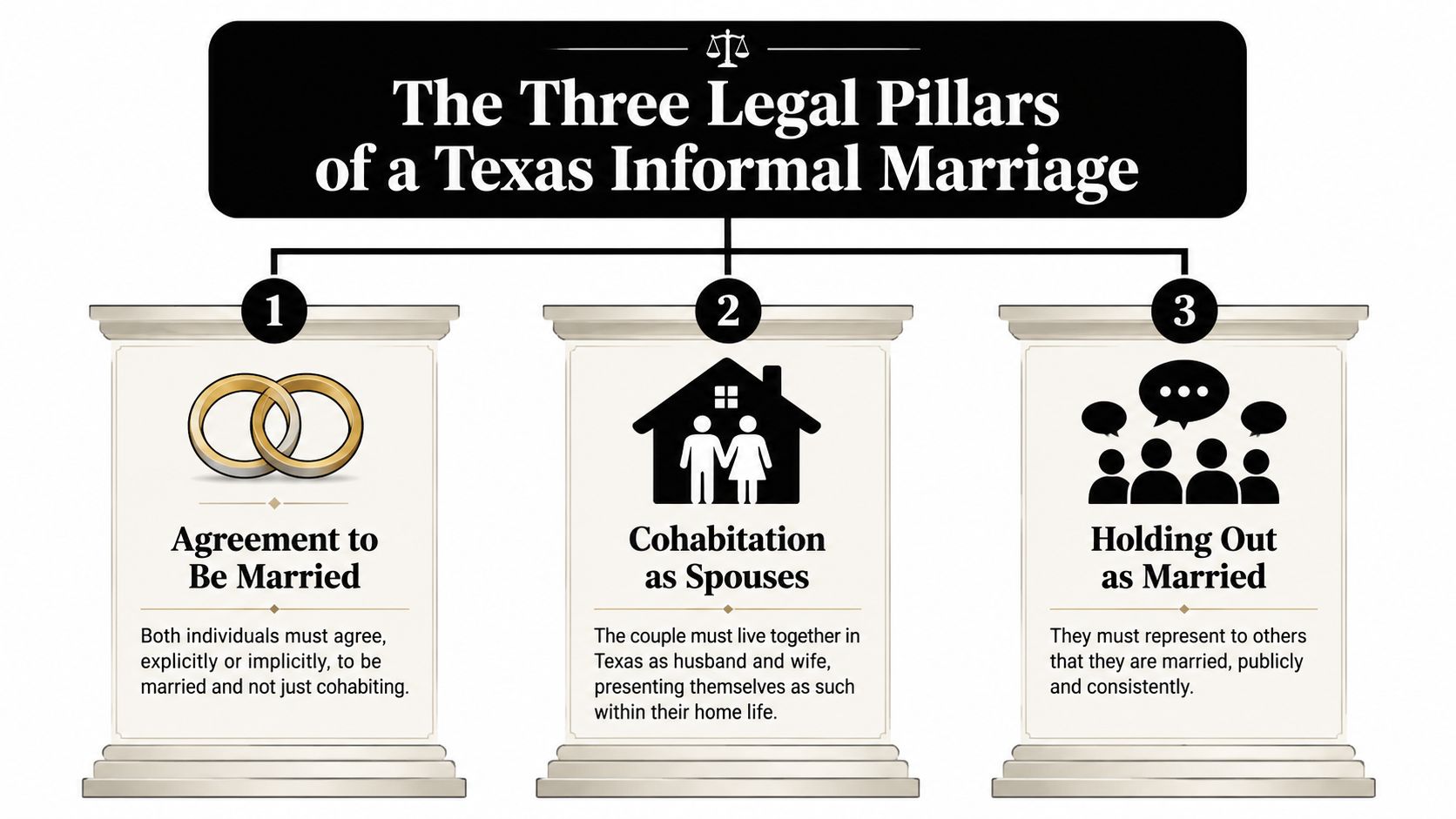
Agreement to Be Married
This is the part people often misunderstand. A future plan to marry is not the same as a present agreement that you already are married.
If one partner says, “We were going to get married someday,” that usually points to engagement, not marriage. By contrast, if both people treated themselves as already married, that supports the legal element. Courts look for conduct that shows a present marital agreement, not just affection, commitment, or long-term plans.
A simple way to think about it is this:
| Situation | What it may suggest |
|---|---|
| “We plan to get married next year” | Future intent |
| “We consider ourselves husband and wife now” | Present marital agreement |
| One partner believed they were married, the other did not | Likely disputed element |
Living Together in Texas as Spouses
The second element is more than sharing an address. Roommates live together. Dating partners live together. The statute asks whether the couple lived together in Texas as spouses after agreeing to be married.
That usually means the household functioned like a marriage rather than a convenient living arrangement. Daily life matters. Did they share responsibilities? Did they make major decisions as a unit? Did their home life reflect a marital relationship rather than separate parallel lives?
Facts become important. A couple can be devoted to one another and still fail this element if the evidence suggests they were only cohabiting.
Later in the section, this overview video may help reinforce the legal framework:
Holding Out to Others as Married
The third pillar is often the most contested. Texas courts want to know whether the couple represented to others that they were married.
That doesn't mean one isolated introduction at a party. It means a pattern of public conduct. Friends, relatives, employers, landlords, schools, insurers, and institutions may all become relevant witnesses or record sources.
Examples that may support holding out include:
- Introductions in public: Calling the other person “my husband,” “my wife,” or “my spouse.”
- Shared documents: Using marital language on applications, forms, or account records.
- Consistent social presentation: Acting in a way that tells the outside world you are married, not merely dating.
Practical rule: Courts tend to look for consistency across all three pillars. One strong fact rarely carries a weak case by itself.
Gathering Proof How Courts Evaluate Evidence of a Common Law Marriage
Once people understand the legal test, the next question is usually the hard one. How do you prove it?
Texas Law Help identifies traditional proof that courts may infer from, including joint tax filings, leases, insurance, loan applications, and holding-out behavior. It also leaves a practical gap that matters in real disputes: traditional evidence is listed, but newer digital proof and conflicting evidence are not fully addressed. That gap matters because many couples today leave a mixed record.
Traditional evidence still matters
Courts are comfortable with documents that clearly show how a couple presented themselves in formal settings. Those records are often easier to explain and harder to dismiss.
Common examples include:
- Tax records: Joint filings can strongly support a claim that the couple treated the relationship as a marriage.
- Housing records: A lease, deed, or application showing the parties as spouses may help.
- Insurance and loan paperwork: These records can show how the couple described the relationship when legal or financial accuracy mattered.
If you're trying to understand how these proof issues develop in real cases, this article on what an informal marriage is in Texas and how to prove and protect your rights adds useful context.
Digital evidence can help, but it rarely stands alone
Modern relationships often leave digital evidence instead of tidy paper files. That can include social media posts, shared streaming accounts, phone plan records, text messages, location history, or app-based household records. These details can support a larger story, but they can also cut both ways.
A shared Netflix account may show domestic life. It doesn't automatically show marriage. A text message saying “my wife” may help, but a later message denying the marriage may hurt. A social media anniversary post may support holding out, but profile settings listing “single” or separate names on official forms can weaken the claim.
That's why courts don't usually focus on one screenshot. They compare patterns.
| Evidence type | What it may show | Common weakness |
|---|---|---|
| Social media posts | Public presentation | Can be casual or inconsistent |
| Shared phone plan | Intertwined household | Doesn't prove agreement to marry |
| Text messages | Intent and language | Easy to dispute or contextualize |
| Location data | Cohabitation pattern | Doesn't prove holding out |
| Official forms | Formal representation | May conflict with personal behavior |
Contradictory evidence is often the real battleground
In contested cases, one party usually points to marital behavior while the other points to non-marital behavior. Both may be telling part of the truth.
For example, a couple may have introduced each other as spouses with friends but signed apartment paperwork as unmarried. They may have acted married inside the relationship while keeping legal distance outside it. Courts have to weigh those conflicts, and that means credibility matters.
A case becomes harder when the evidence says two different things. The legal question isn't whether the relationship was meaningful. It's whether the proof shows a marriage under Texas law.
When proof is mixed, it helps to organize evidence by each legal element rather than by date alone. Put every document, message, and witness under one of these headings: agreement, cohabitation as spouses, or holding out. That approach usually reveals where the case is strong, where it is thin, and where testimony will matter most.
The Legal Effects What Being Informally Married Really Means
A problem often starts like this. One person says, “We never had a wedding, so this is just a breakup.” The other says, “We lived as husband and wife for years.” In Texas, that disagreement can affect property, inheritance, medical authority, and whether a court case is required before either person can move on.
If an informal marriage existed, the law treats it as a real marriage. The absence of a license or ceremony does not reduce the legal consequences. What matters is whether the relationship met the legal standard, and whether you can prove it if someone challenges it later.
Property, divorce, and financial rights
The first practical effect is simple. You may need a divorce, not just an agreement to separate.
That changes the legal posture of everything acquired during the marriage. A house, vehicles, retirement contributions, debts, business interests, and even reimbursement claims can become part of a divorce analysis. People get into trouble when they act first and ask questions later. They transfer title, empty accounts, stop paying bills, or start a new relationship based on the assumption that no marriage existed. If a court later finds an informal marriage, those choices can become expensive evidence problems.
Common disputes usually center on points like these:
- Whether property is separate or marital in character
- Who stays in the home and who pays the bills during the case
- How joint debts, credit cards, and loans are allocated
- Whether one spouse may request spousal maintenance or temporary orders
- Whether a court must divide property before either person has final closure
The two-year presumption rule also matters here. If the relationship ended and no proceeding is filed within two years, Texas law creates a presumption that the parties did not agree to be married. That does not make proof impossible, but it does make the case harder. I often tell clients that delay helps the other side argue the relationship was serious, but not legal.
Inheritance, medical decisions, and end-of-life conflicts
These cases do not arise only in breakups. They also surface after a death, during a hospital crisis, or when family members disagree about who has authority to act.
A surviving partner may need to prove the marriage to assert rights tied to inheritance, funeral decisions, insurance matters, or access to information. In those situations, digital evidence can matter just as much as older forms of proof. A contact entry listed as “my wife,” beneficiary paperwork, shared online accounts, or messages with medical staff may support the claim. Conflicting records can hurt just as much. If one document says “spouse” and another says “single,” expect a fight over credibility.
If you are dealing with end-of-life planning or a dispute after a loss, understanding establishing legal next of kin can provide useful context alongside Texas family and probate advice.
Clear planning documents reduce risk. Wills, powers of attorney, beneficiary designations, and consistent records often prevent a family conflict from turning into a courtroom fight.
A valid informal marriage does not end informally
Once a valid informal marriage exists, separation alone does not end it. Moving out does not end it. Calling yourselves single does not end it.
A court order usually does.
That point matters more than many people realize. If you remarry without ending a valid informal marriage first, you can create a second layer of legal trouble. If you die without resolving the issue, the dispute may shift to probate. If you wait too long to address the relationship, the two-year presumption can weaken your position even if the facts once looked strong.
Get advice before making decisions that are hard to reverse. That includes selling property, changing beneficiaries, filing taxes inconsistently with your position, or relying on family assumptions about who has rights. Law Office of Bryan Fagan, PLLC may be one option for evaluating whether the facts support a divorce filing, a probate claim, or planning documents based on your specific situation.
Common Misconceptions That Can Jeopardize Your Rights
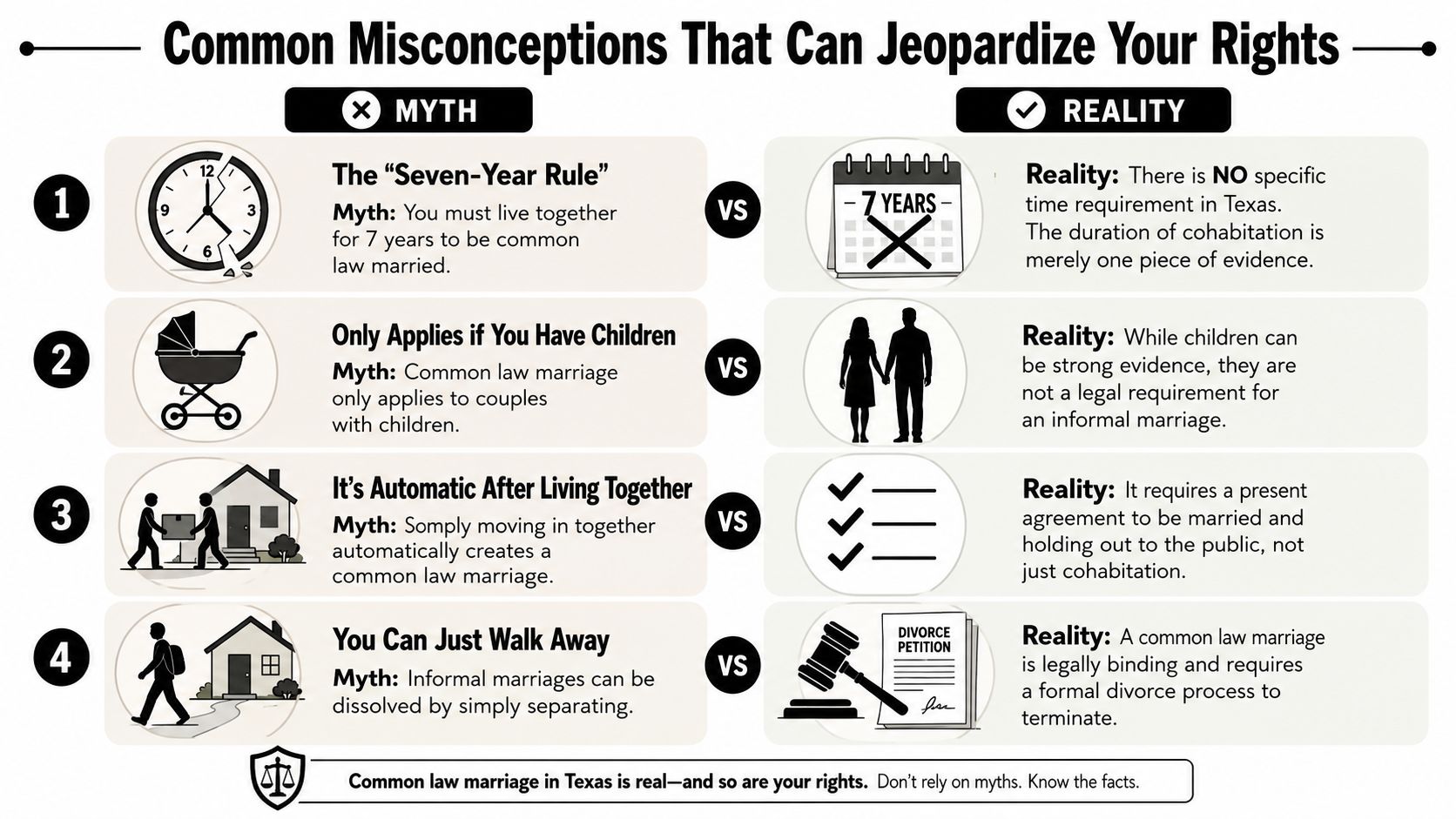
People often lose an advantage in these cases because they rely on myths instead of the statute and the evidence.
The seven-year rule is not the law
Many Texans have heard some version of this: if you live together long enough, especially for seven years, you automatically become married. That is not how Texas informal marriage works.
Time may provide more evidence. It does not replace the required legal elements. A couple can live together a long time and still not be married under the law. Another couple can create an informal marriage without a long period of cohabitation if the required facts are present.
This myth causes two opposite mistakes. Some people assume they have no rights because they haven't lived together “long enough.” Others assume they do have rights only because they have.
Children do not create an informal marriage
Having children together can be powerful evidence of a shared life, but it is not itself one of the legal requirements. Courts still examine whether there was an agreement to be married, cohabitation as spouses in Texas, and public representation of marriage.
A similar mistake happens with shared bills and household routines. Those facts matter, but they don't answer the full legal question by themselves.
Separation does not always end the problem
One of the most overlooked issues in common law marriage Texas requirements is timing after a breakup. According to Texas discussion of the two-year presumption rule in informal marriage disputes, if the parties separated for more than two years before suit and one party denies the marriage, Texas law presumes no informal marriage exists. That presumption can dramatically change the posture of a case.
What does that mean in plain terms? Delay can hurt.
If you separate and wait too long to file while the other person denies the marriage, your case becomes harder. The issue may no longer be just proving the relationship. You may first have to overcome a legal presumption against it.
The breakup date matters. So does the filing date. In contested informal marriage cases, those dates can shape the entire dispute.
You cannot safely “wait and see” in a disputed case
People often delay because they're hoping things calm down. Sometimes they want to avoid court. Sometimes they assume they can deal with property later. In informal marriage disputes, that waiting period can weaken evidence, blur witness memory, and complicate the legal path forward.
Here are common myths and the safer reality:
Myth about time: Living together for years automatically creates marriage.
Reality: Duration alone doesn't satisfy the legal test.Myth about children: Having a child together makes you common law married.
Reality: Children may be relevant evidence, but they are not a substitute for the required elements.Myth about separation: If you break up, the issue is over.
Reality: Separation can trigger timing problems, especially if a lawsuit is delayed.Myth about informality: An informal marriage is easy to prove or disprove.
Reality: These cases often turn on mixed evidence, conflicting testimony, and careful legal framing.
A Practical Checklist and Your Next Steps
If you're trying to accurately assess your situation, start with a simple checklist.
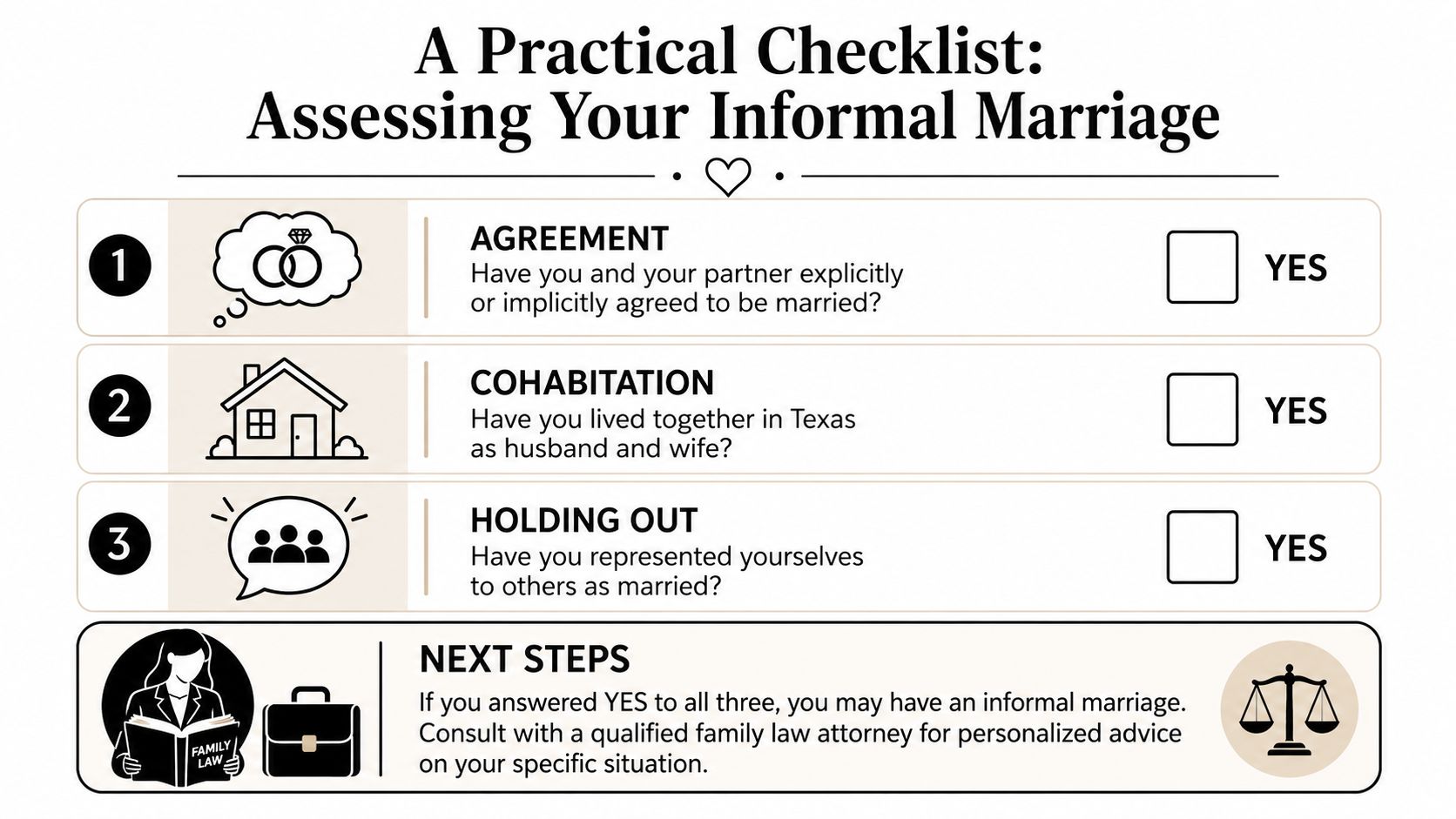
Ask these questions carefully
- Agreement: Did both of you agree that you were already married, not just planning to marry later?
- Cohabitation in Texas: Did you live together in Texas as spouses after that agreement?
- Holding out: Did you represent to other people that you were married?
If your answers are mixed, that doesn't automatically end the analysis. It means you need to look closely at the evidence supporting each element.
Gather documents before conflict gets worse
Start collecting anything that helps show how the relationship functioned in real life. Keep records in one secure place. Organize them by issue, not just by source.
Useful categories include:
- Formal paperwork: Tax, lease, insurance, loan, or benefit records
- Digital records: Messages, posts, account records, and shared service documentation
- Witnesses: Friends, relatives, neighbors, or coworkers who can describe how you presented the relationship
- Timeline notes: Key dates for moving in, major purchases, separations, and legal filings
If you want to take a proactive administrative step, Texas allows couples to file a Declaration of Informal Marriage with the county clerk. For a practical overview, review this guide on filing a Declaration of Informal Marriage in Texas. That filing doesn't fit every situation, but where appropriate, it can make the existence of the marriage easier to establish later.
Don't guess when your rights are on the line
Informal marriage cases often look simple from the outside and become technical very quickly. A few words on an application, a long delay after separation, or conflicting digital evidence can shift the entire case.
If you may be trying to establish a marriage, defend against one, end one through divorce, or plan for inheritance and medical decisions, personalized legal advice matters.
If you need help navigating divorce, custody, or estate planning in Texas, contact Law Office of Bryan Fagan, PLLC today for a free consultation.