
You may already be living like an adult. You get yourself to work, keep track of your money, handle school, and make day-to-day decisions without much help. Then a legal issue stops you cold. You can't sign a lease on your own, consent to certain care, or handle a contract the way an adult can.
That gap is where many teens and families start asking about emancipation in Texas requirements. Some are looking for stability. Others are trying to solve a serious family conflict. Some want the law to catch up to the independence they've already built.
Texas does allow a minor to ask a court to remove the disabilities of minority. But this process is narrower, more formal, and more demanding than many people expect. A judge won't grant it just because a teen is responsible or motivated. The court wants proof, structure, and a clear reason why legal independence is the right answer.
Feeling Ready for Independence Before You're Legally an Adult
A common situation looks like this. A mature teen is working, helping cover living costs, and trying to keep life on track. They may be figuring out practical milestones on their own, even things as ordinary as how to compare online drivers ed options Houston families often review when a young person is taking on more responsibility.
That teen may feel ready. In many ways, they may be ready.
But Texas law still treats them as a minor unless a court says otherwise. That means legal adulthood and personal maturity are not the same thing.
When readiness and legal status don't match
A teen can be dependable and still run into legal barriers that are frustrating and, in some cases, risky. A landlord may want an adult signature. A school issue may require a parent's involvement. A medical provider may hesitate without legal authority in place.
For some families, the question isn't whether the teen is responsible. It's whether emancipation is the safest and most workable legal path.
A judge isn't deciding whether you seem mature for your age. The judge is deciding whether the law should treat you as independent for real-world adult responsibilities.
That distinction matters. It also helps explain why some petitions succeed and others don't.
Why families often confuse independence with emancipation
Plenty of teens have more day-to-day freedom than people assume. That still isn't the same as having legal power to act as an adult. If your family is also dealing with custody tension or questions about a teen's voice in court, this discussion often overlaps with issues raised in understanding the legal rights of a 14-year-old in custody cases.
Emancipation is not a shortcut out of ordinary household conflict. It's a formal court process for limited situations where a minor can prove genuine independence and where the court believes that independence serves the minor's best interest.
That's why the practical question is not, “Do you want freedom?” It's, “Can you prove to a Texas judge that you can live with the consequences of legal adulthood right now?”
Understanding the Emancipation Requirements in Texas
Texas law calls emancipation the removal of the disabilities of minority. Under Chapter 31 of the Texas Family Code, a minor must be a Texas resident, must be 17 years old, or be at least 16 and living separate and apart from a parent, managing conservator, or guardian, and must be self-supporting while managing their own financial affairs. The court must also find that emancipation is in the minor's best interest, as explained by Texas Law Help's overview of emancipation of minors.
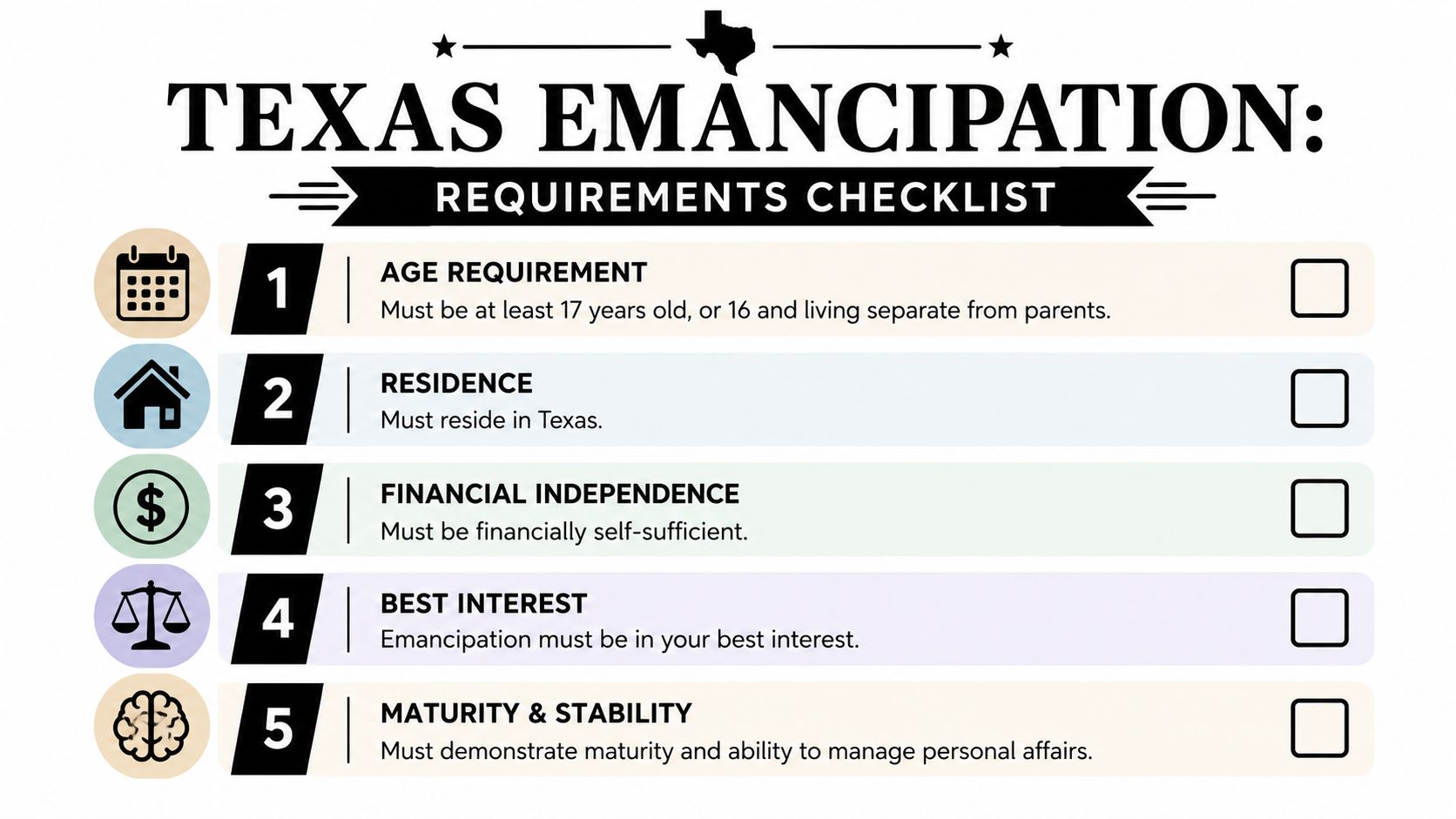
The checklist the court starts with
These are the core emancipation in Texas requirements a court will examine:
- Texas residence means the petition belongs in Texas, and the petition must be filed in the county where the minor resides.
- Age eligibility depends on the teen's exact circumstances. A minor who is 17 may petition. A minor who is 16 must also already be living separate and apart from a parent, managing conservator, or guardian.
- Financial self-support requires more than saying, “I have a job.”
- Managing financial affairs means the court wants to see that the teen handles money like someone taking on adult obligations.
- Best interest gives the judge room to deny a petition even if the basic boxes appear checked.
What each requirement means in real life
Residence sounds simple, but it matters procedurally. Filing in the wrong place creates delay and confusion before the judge ever reaches the merits of the case.
Age and living arrangement often trip people up. A 16-year-old can't usually petition based only on wanting to move out soon. The law requires that the teen already be living separate and apart from the parent, managing conservator, or guardian.
Self-support and money management are where many cases become difficult. A judge will look beyond income and ask whether the minor is functioning without parental support.
| Requirement | What the court is really asking |
|---|---|
| Texas resident | Does this court have the right case in the right county? |
| Age and living apart | Is this petition legally eligible right now? |
| Self-support | Can the minor realistically pay for daily life? |
| Managing finances | Does the minor understand bills, planning, and consequences? |
| Best interest | Will legal adulthood help more than it harms? |
The best-interest standard is the real gatekeeper
Families often assume that if a teen earns money and lives away from home, emancipation should follow. It doesn't work that way. The best-interest standard is where judges apply discretion.
A judge may ask questions such as:
- Safety and stability. Is the current living arrangement steady and appropriate?
- School and long-term plans. Will emancipation support education or make it harder to finish school?
- Decision-making. Does the teen show judgment under stress, not just in calm moments?
- Need for legal relief. Is emancipation solving a real legal problem, or is it being used as an answer to family disagreement?
Practical rule: If the petition reads like “I want more freedom,” it's weak. If it shows “I already live independently, manage adult obligations, and need legal capacity to function safely and consistently,” it is much stronger.
For a broader explanation of how Texas courts frame this issue, readers often find emancipation of a minor child in Texas helpful as a companion piece.
How to Prove You Are Ready for Emancipation
The hard part usually isn't learning the rule. The hard part is proving it.
Texas guidance makes clear that the financial-self-sufficiency test is a high bar. A judge needs to see proof of stable income, budgeting ability, and concrete plans for continued self-sufficiency, and the court will appoint an attorney to investigate those claims, as discussed in this explanation of how emancipation works for minors in Texas.

What convinces a judge
Judges don't just look for effort. They look for consistency.
A teen who says, “I work when I can and my friends help with expenses,” may be trying hard, but that statement raises concerns. A judge is more persuaded by a minor who can show a dependable work pattern, a realistic monthly budget, and a living arrangement that doesn't depend on uncertain favors.
Strong evidence often includes:
- Income records such as pay stubs, direct-deposit history, or employer letters showing steady work.
- Budget documents that show rent, food, transportation, phone, school costs, and emergency planning.
- Bank records reflecting responsible spending habits rather than frequent overdrafts or unexplained cash gaps.
- Housing proof such as a written rental arrangement, a stable agreement with another adult, or other documents showing where the teen lives.
- Future planning that explains how the teen will keep supporting themselves if work hours change or an expense appears unexpectedly.
What usually weakens a petition
Some facts don't automatically defeat a case, but they do make judicial approval harder.
For example, gig income can be real income, but it may be harder to present as stable if it changes sharply from week to week. Roommate arrangements can work, but the court may still want to know who is legally responsible for the housing and what happens if that arrangement falls apart. Family help can be the hardest issue of all. If a parent or relative is still covering major expenses, the court may reasonably ask whether the teen is self-supporting.
A practical approach is to build a paper trail before filing. A minor who has organized records, can explain a budget clearly, and can answer follow-up questions calmly appears much more prepared than someone trying to reconstruct life details at the last minute.
Courts often focus less on whether a teen earns money and more on whether that teen can absorb normal adult problems without immediately collapsing back into dependence.
Build your case like an adult would
One of the best habits is to prepare the same way any adult would prepare for a financial review. That means written records, not memory. If you're learning how to track recurring expenses, savings goals, and day-to-day spending, tools that help you achieve a clear financial future can also help you present a more credible emancipation case.
Ask yourself blunt questions:
- If rent increases, what is the backup plan?
- If work hours drop, what expense gets covered first?
- How will transportation be handled every week?
- Who pays for medical needs?
- Can you explain your monthly obligations without guessing?
If those answers are shaky, a judge will notice.
Once a teen appears eligible and has the proof to support the petition, the process moves into court. This stage feels formal because it is formal. Accuracy matters.

The petition starts the case
The case begins with a Verified Petition for Removal of the Disabilities of Minority. The petition should be complete, specific, and internally consistent. If the facts in the petition don't match the documents later presented, credibility becomes a problem quickly.
The filing has to happen in the county where the minor resides. In practice, that means you need to be prepared before filing, not hoping to fill in missing facts later.
Parents and notice still matter
Even when a parent disagrees with emancipation, that parent is still part of the legal picture. Proper notice is a core part of due process. If service is handled incorrectly, the case can stall or have to be redone.
This is one reason families shouldn't treat emancipation like a simple paperwork exercise. A valid request can still fail if procedure is sloppy.
Here is the broad flow individuals should expect:
- Prepare the petition carefully so the facts are clear and supported.
- File in the proper county where the minor lives.
- Give legal notice to the required parties.
- Cooperate with the court-appointed attorney's investigation.
- Organize evidence and witnesses, if needed.
- Appear at the hearing ready to answer direct questions.
A short explainer can also help if you want to hear the issue discussed in a more conversational format:
The attorney appointed by the court has an important role
Many teens are surprised to learn that the court appoints an attorney to investigate the case. That attorney is not there just to rubber-stamp the petition. The appointment itself tells you something important. Texas courts view emancipation as serious enough to require an independent check on the facts.
That attorney may ask about income, school, housing, family relationships, future plans, and practical risk. If the teen's story is solid, that investigation can help. If the story is inconsistent, incomplete, or overly optimistic, the investigation can expose weak points.
What works and what doesn't
What works is preparation. Documents are organized. Living arrangements make sense. The teen can explain daily life without hedging. The petition matches reality.
What doesn't work is filing too early, relying on vague promises from other adults, or treating the hearing as a chance to persuade the judge with emotion alone. Family conflict may explain why a teen wants change, but it usually won't replace proof of readiness.
What to Expect at Your Emancipation Hearing
Most emancipation hearings are quieter and more focused than people expect. The room may not look dramatic, but the questions are serious. The judge is trying to decide whether this teen can safely function with adult legal authority.

Who may be there
The people present often include the minor, the minor's attorney if one has been hired, the parents or guardians, any attorneys for the parents, and the court-appointed attorney. Each person has a different role, and the judge is listening not only to what is said but also to whether the full picture holds together.
A hearing often turns on credibility. That means the teen's tone, clarity, and honesty matter.
The questions tend to sound practical
Judges usually ask practical questions, not abstract ones. They may ask where the teen lives, who pays which bills, what the work schedule is, whether school is still part of the plan, and what the teen will do if income changes.
They may also ask why emancipation is necessary now. That question matters more than many families realize.
Here are the kinds of themes that often come up:
- Daily living. Where do you sleep, eat, and get transportation?
- Money. What expenses do you pay yourself, and how do you keep track of them?
- School and future plans. How will you finish school or continue training?
- Support system. If something goes wrong, who can you call?
- Reason for relief. Why is a court order needed instead of a less drastic arrangement?
Answer the question asked. Don't exaggerate. If there's a weakness in your case, it's usually better to explain it honestly than to pretend it doesn't exist.
How a teen should present themselves
The most persuasive minors usually do three things well. They stay calm. They answer directly. They show they've thought beyond the next week.
A strong presentation sounds grounded. It doesn't sound rehearsed for effect. If a teen says, “I know rent is due every month, I've planned for transportation, and I understand I'll be legally responsible for contracts I sign,” that tends to carry more weight than broad statements about wanting freedom or being tired of rules.
The court is not grading personality. It is evaluating judgment.
Alternatives to Emancipation and When to Hire an Attorney
Emancipation is powerful, but it isn't always the right tool. Some teens need a safer living arrangement, not full legal adulthood. Others need help with a narrow issue, such as school, medical decisions, or day-to-day care, without taking on every adult responsibility at once.
Other paths may fit better
If the main problem is instability at home, another custody-related proceeding may be more appropriate. In some families, a change in conservatorship or a guardianship arrangement addresses the immediate risk more effectively than emancipation. If that issue is on the table, how to get guardianship in Texas may be a useful starting point.
Alternatives often make more sense when:
- Income is inconsistent and the teen can't yet prove full self-support.
- Housing is temporary and depends on informal promises.
- The family's real need is supervision by another adult, not complete legal separation.
- The teen needs targeted authority, not the full weight of adult responsibility.
When legal help becomes especially important
A lawyer is often most helpful when the facts are close, the parents object, or the teen's situation is emotionally charged. An attorney can help decide whether emancipation is realistic, what evidence is missing, and how to present the best-interest argument in a way the court will take seriously.
That can include private counsel, legal aid in qualifying situations, or a family-law firm that handles Texas child-related court matters. The Law Office of Bryan Fagan, PLLC provides family law representation that includes guidance on child-related proceedings and related Texas court processes.
The biggest mistake families make is filing because emancipation sounds like the only way forward. Sometimes it is. Sometimes it isn't. Good legal advice helps you find out before time, money, and emotional energy are spent on a case that the court was unlikely to grant.
If you need help navigating divorce, custody, or estate planning in Texas, contact The Law Office of Bryan Fagan, PLLC today for a free consultation. If you're considering emancipation, worried about a teen's living situation, or trying to understand whether another legal option fits better, personalized advice can make the next step much clearer.