Losing a loved one can leave you with two very different burdens at the same time. You're grieving, and you're suddenly expected to make legal, financial, and practical decisions that feel far too heavy for the moment.
A common Houston Heights situation goes like this. A parent passes away, there's a home in the Heights, family members want answers, and someone has to figure out whether there's a will, what happens to the house, who pays the bills, and how to keep peace among siblings. Probate can feel cold when you first hear the word, but in reality, it's a legal process for honoring a person's wishes, protecting property, and making sure the right people handle the estate responsibly.
If you're in that position now, you don't have to solve everything at once. Probate works best when you take it one step at a time, with a clear understanding of what Texas law requires and where disputes usually begin. For many families, that's especially true in Houston Heights, where a house may be one of the estate's most important and emotionally charged assets.
Before a crisis happens, many families also look for practical ways to organize your estate for future generations, so fewer questions are left behind for the people they love.

You may be reading this from a kitchen table covered with paperwork. A death certificate, mortgage statements, a file drawer that no one has opened in years. One relative thinks the house should be sold. Another wants to keep it. Someone asks whether the bank account is frozen. No one is sure what happens next.
That uncertainty is where a Houston Heights probate attorney often becomes important. Not because every estate turns into a fight, but because the process has rules, deadlines, and duties that can affect your family's finances and relationships for years.
Probate isn't about reducing a life to documents. It's about creating an orderly path. The court identifies who has legal authority to act, debts are addressed, assets are gathered, and what remains passes to the people entitled to receive it. In many families, understanding that sequence lowers the stress right away.
Probate is often easier to handle when you stop viewing it as one overwhelming problem and start seeing it as a series of manageable decisions.
What Is Probate and Why Is It Necessary in Texas
Probate is the legal process that gives someone authority to step into a deceased person's financial shoes for a limited time. After a death, bills may still be due, a house may still have a mortgage, and accounts may need to be collected or closed. Probate gives the executor or administrator the court-approved power to handle those tasks lawfully.
In Texas, probate is governed by the Texas Estates Code. That distinction is important because probate is not merely a family agreement about who gets what. Banks, title companies, and buyers usually want formal proof of authority before they will release funds, transfer title, or accept a sale of property.
That issue often becomes sharper in Houston Heights than families expect. A house that seemed modest years ago may now represent a large share of the estate because Heights property values have risen so much over time. When one asset carries most of the estate's value, probate often becomes the process that determines who can protect it, sell it, maintain it, or distribute its value fairly.
The basic terms families need to know
These terms often cause early confusion:
- Executor means the person named in a will to carry out its instructions.
- Administrator is the person the court appoints when there is no valid executor able to serve, often because there is no will.
- Beneficiary is a person or entity named in a will to receive property.
- Intestate succession refers to the Texas rules that control distribution when someone dies without a will.
When there is no will, Texas does not let the family create its own distribution plan informally. The estate passes under the state's intestacy rules, and some estates require an heirship determination to establish who the legal heirs are. That can create real strain in Houston Heights cases involving real estate, especially when several relatives have different views about whether to keep a home, rent it, or sell it into a strong market.
Why probate is often necessary
A helpful way to view probate is as a legal toolbox. Without it, a family may know what should happen, but still lack the tools to make it happen.
Probate commonly serves four jobs:
- It identifies who has authority to act. Someone must be legally recognized to sign for the estate.
- It gathers the estate. Homes, bank accounts, personal property, and records have to be identified and valued.
- It addresses debts and legal obligations. Valid claims, taxes, and required filings cannot be ignored.
- It transfers what remains to the right people. The will controls if there is one. Texas law controls if there is not.
Real estate is where this usually becomes concrete. Suppose the estate includes a Houston Heights home that has increased substantially in value. One heir may want a quick sale to capture market value. Another may want to keep the property because it has been in the family for decades. A third may be living there already. Probate creates the legal structure for resolving who has decision-making authority and how the property can be handled without creating title problems later.
To understand how court supervision differs from other estate settlement methods, review this explanation of probate versus trust administration in Texas. Families who want a broader overview can also read about Probate and how estate administration works in Texas.
Practical rule: When an estate includes a house, a titled asset, or disagreement among relatives, do not assume family consensus alone is enough to transfer ownership.
The Harris County Probate Process Step-by-Step
A Harris County probate case often feels straightforward on paper and stressful in real life. In Houston Heights, that pressure can build fast when the estate includes a home that has risen sharply in value. While the family is still grieving, the court process keeps moving, property costs keep accruing, and disagreements about whether to sell, hold, or occupy the house can surface early.
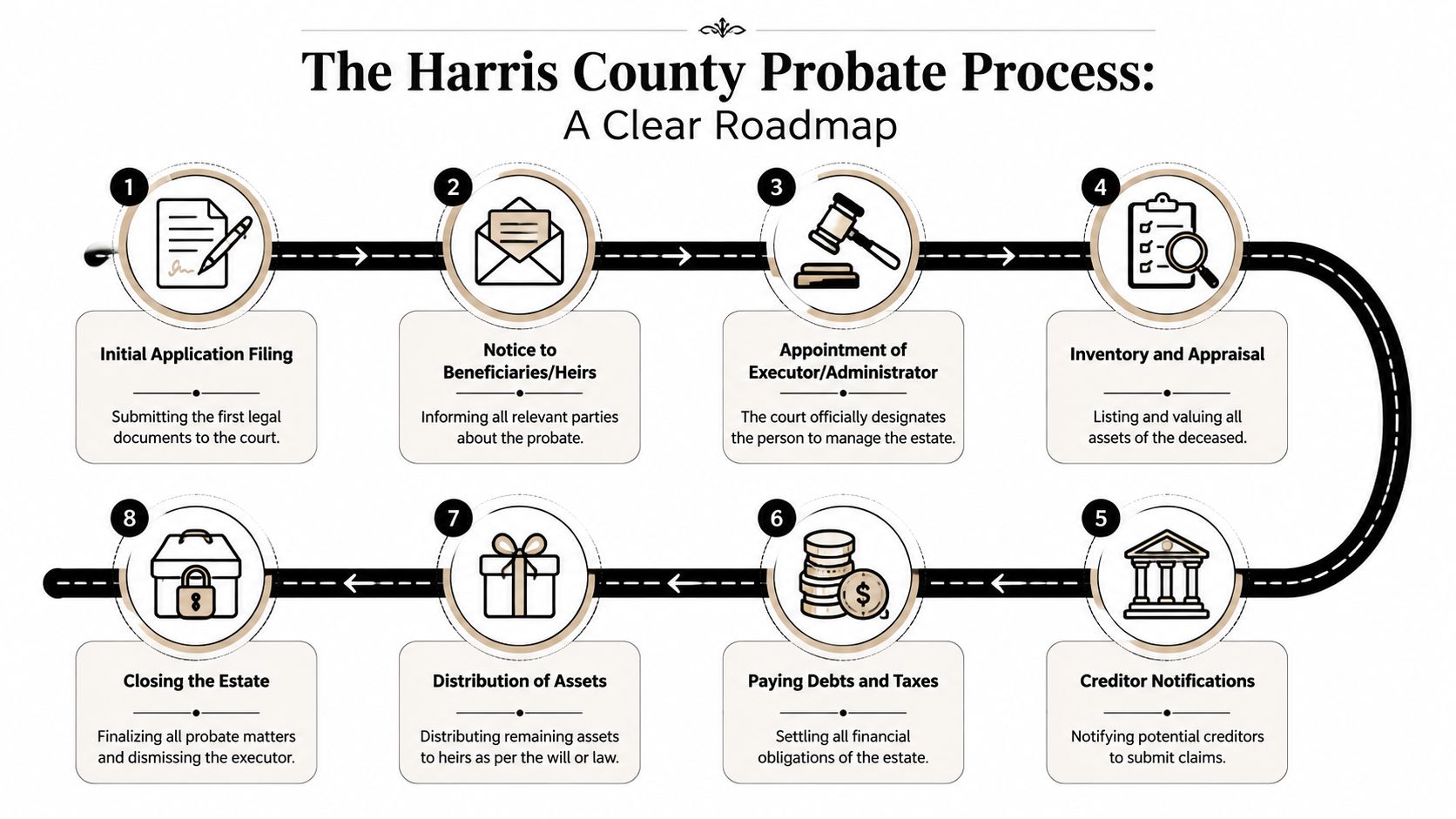
The good news is that probate follows a sequence. Once you see the order, it becomes easier to understand what has to happen now, what can wait, and where families in Houston Heights often run into trouble.
Filing the case and opening the estate
The process begins by filing an application in the proper Harris County probate court. If there is a will, the original will is usually filed with that application. If there is no will, the filing asks the court to appoint an administrator under Texas law.
This first step is about authority. A family may already agree on who should handle things, but banks, title companies, and buyers usually need court-recognized authority before they will deal with estate property.
That point matters even more when a Heights home is involved. If the market is active, one heir may push for a quick listing while another wants more time. Until the court appoints someone, the estate is like a car with no legal driver.
Notice and the court hearing
After the application is filed, required notice procedures must be completed and the court sets a hearing. At the hearing, the judge reviews the filing, confirms the legal requirements have been met, and decides whether to admit the will to probate or appoint an administrator.
If the judge approves the application, the court issues the documents that let the personal representative act for the estate. That changes the situation immediately. The executor or administrator can begin gathering information, securing property, and dealing with institutions that would otherwise refuse to cooperate.
Families often expect the hearing to resolve every issue.
It does not. The hearing opens the door. The administration work starts after that.
Gathering assets and protecting the estate
Once appointed, the personal representative begins collecting the estate and protecting it from loss. That usually includes locating financial accounts, forwarding mail, reviewing insurance coverage, securing vehicles, and making sure real estate is maintained.
For Houston Heights families, the house often requires the most attention. Property taxes, insurance, utilities, and basic upkeep do not pause because an owner died. If no one is clearly in charge, the estate can lose money while family members argue about whether to sell the property or keep it.
A representative usually needs to:
- locate accounts, deeds, titles, and tax records
- secure the home and personal property
- identify recurring bills and debts
- communicate with heirs and beneficiaries about the process
- keep records of money spent for the estate
Clear communication helps here. Silence tends to create suspicion, especially when one person has keys to a valuable house and another person lives out of state.
Inventory, creditors, and the formal court duties
Texas probate also requires formal follow-through. The personal representative may need to notify creditors, evaluate claims, and prepare an inventory or other court-approved alternative, depending on the case.
The inventory works like a snapshot of the estate. It identifies what the estate owns and gives the court and interested parties a clearer picture of what is being administered. If the estate includes Houston Heights real estate, valuation can become a pressure point. A rising market can make heirs more likely to challenge numbers, question timing, or argue that the representative is waiting too long or selling too quickly.
Families who want a broader explanation of fees tied to administration can review this guide on the cost of probate in Texas. For a comparison of how another state structures similar expenses, see Navigating 2026 Arizona probate fees.
Paying debts, handling property decisions, and making distributions
Before heirs receive property, the estate must handle valid debts, expenses, and required administration tasks. That includes deciding how to deal with assets that cannot be split, especially a single house.
Probate becomes practical when three heirs inherit one appreciating Heights property. The representative may need to determine whether the home should be sold, whether one heir can buy out the others, or whether the property can be distributed in a way that does not create title problems later. Those are legal and financial decisions, not just family decisions.
A typical sequence looks like this:
- File the probate application in the correct Harris County court.
- Complete notice requirements and attend the hearing.
- Receive appointment as executor or administrator.
- Collect records and secure estate property.
- Notify creditors and address claims as required.
- Prepare the inventory or other required filings.
- Pay approved debts, expenses, and administration costs.
- Distribute the remaining property according to the will or Texas intestacy law.
- Conclude the estate after the required duties are completed.
The executor's job is to follow the will, the court's orders, and the Texas Estates Code.
That structure protects the family. It also protects the title to valuable Houston Heights property, which can matter just as much as the final distribution. A rushed transfer, an informal side agreement, or an early possession fight can create expensive problems long after the probate case should have been finished.
Decoding Probate Costs and Timelines in Houston
A family may walk out of the Harris County courthouse relieved that probate has started, then feel a different kind of stress by the time they reach the parking lot. The questions change fast. How much is this going to cost, who pays the bills while the case is pending, and what happens if the Heights house keeps rising in value while everyone is waiting.
Those concerns are reasonable. Probate has legal deadlines, but it also has cash-flow pressure. In Houston Heights, that pressure can feel sharper because a home is often the estate's largest asset, yet it may not produce money until much later. Meanwhile, property taxes, insurance, utilities, yard care, and repair issues do not pause because a family is grieving.
For straightforward estates in Harris County, probate expenses usually start with court costs, filing-related charges, and attorney time. The exact total depends on the type of probate, whether a bond is required, and whether anyone disputes the handling of the estate. If you want a Texas-specific overview of how these expenses are commonly evaluated, this article on the cost of probate in Texas gives useful context.
What families are usually paying for
Probate costs are less like a single invoice and more like a series of gates. You clear one, then the next. Filing fees open the case. Additional charges may follow for inventories, certified copies, bond paperwork, publication, appraisals, and the legal work required to keep the estate in compliance with the court's rules.
Attorney fees also vary for a practical reason. A clean estate with an organized will, known assets, and cooperative heirs takes less work than an estate where someone questions values, delays signing documents, or challenges the personal representative's decisions.
Here is a simple planning snapshot:
| Expense Category | Typical Cost Pattern |
|---|---|
| Court filing and clerk charges | Required to open and process the case |
| Inventory and related filings | May apply depending on the estate and filings used |
| Bond-related costs | May apply if the court requires a bond |
| Attorney fees | Usually lower in uncontested estates and higher when disputes or unusual assets are involved |
| Property carrying costs | Taxes, insurance, maintenance, and repairs during administration |
That last category gets overlooked. It should not.
If the estate includes a Houston Heights home, time can affect value in two directions at once. The property may be appreciating, which can benefit the heirs on paper. At the same time, the estate may be paying monthly carrying costs while family members argue over whether to sell, hold, or arrange a buyout. A delay that looks harmless in a checklist can become expensive in real dollars.
Why one disagreement can stretch the timeline
Some probates move on a fairly direct track. Others slow down because one issue jams the entire process, much like a single stalled car backing up traffic behind it. The problem may be a creditor claim, a missing document, a dispute about who should serve, or a fight over the value of the house.
Real estate disputes often create the longest delays in Houston Heights. If one heir wants to sell quickly before expenses rise, another wants to wait for a stronger market, and a third wants to keep the property, the legal file may stay open while those positions get sorted out. During that period, the estate still has duties and often still has bills.
A contested estate can therefore cost more for two separate reasons. It requires more legal work, and it often stays open long enough for property-related expenses to keep accumulating. In a neighborhood where home values can change meaningfully over the life of a probate case, timing is not just an administrative issue. It can shape the final outcome each heir receives.
Families who are comparing probate expenses across states may also find broader fee discussions helpful, such as this guide on Navigating 2026 Arizona probate fees. The rules are different, but the basic pattern is similar. Probate expenses usually come from a stack of court costs, professional fees, and property-related costs rather than one flat charge.
In probate, the calendar affects the budget. In Houston Heights, it can also affect the value of the estate's largest asset.
In Houston Heights, probate often becomes a real estate problem before it feels like a legal one. The family home may hold emotional value, practical value, and a large share of the estate's total worth. That creates pressure fast.
Recent market projections for 2025 to 2026 indicate Houston Heights real estate appreciated by over 8%, which can push heirs to sell quickly. At the same time, families may run into the Texas requirement for court approval of sale when multiple heirs hold title, and that can lead to delay if the sale isn't handled carefully in the Houston Heights probate real estate context described here.
Why the house creates conflict
A Heights property can trigger competing goals:
- One heir wants liquidity because bills, taxes, or maintenance are piling up.
- Another heir wants to keep the house for sentimental reasons.
- Someone suspects the listing price is too low and worries another relative is rushing the sale.
- The executor feels stuck because every decision is being second-guessed.
That's where probate and property law collide. The issue isn't just who inherits. It's how to protect equity while following the court process correctly.
How to reduce the risk of co-heir disputes
If multiple heirs are involved, the safest path usually includes a documented valuation, clear communication about proposed sale terms, and attention to whether court approval is required before closing. Informal side deals create risk. So does allowing one family member to control access, showings, or sale negotiations without transparency.
Families also need to understand whether the home is separate property, community property, or tied to broader marital issues. This discussion of whether community property is subject to probate in Texas can help frame that analysis. Long before probate begins, Estate Planning often addresses these concerns through wills, trusts, and estate plans to protect assets and wishes.
A Houston Heights probate attorney adds value here because the legal work and the financial stakes are tightly connected. A mistake in selling estate property doesn't just slow the administration. It can lead to claims that an heir's share was reduced or mishandled.
When to Hire a Houston Heights Probate Attorney
A common turning point looks like this. The family agrees that probate should be simple, then the Heights home becomes the center of every hard decision. One heir wants to sell quickly before repairs pile up. Another wants to wait because values keep climbing. The executor is left wondering whether one wrong signature, one early distribution, or one poorly documented sale could lead to personal liability.
That is often the moment legal help stops feeling optional and starts looking practical.
Situations where legal help becomes important
Probate counsel is often worth serious consideration when the estate includes conflict, uncertainty, or assets that can change in value while the case is pending. In Houston Heights, appreciating real estate adds pressure fast. Delays can affect taxes, insurance, maintenance costs, and the amount each heir ultimately receives.
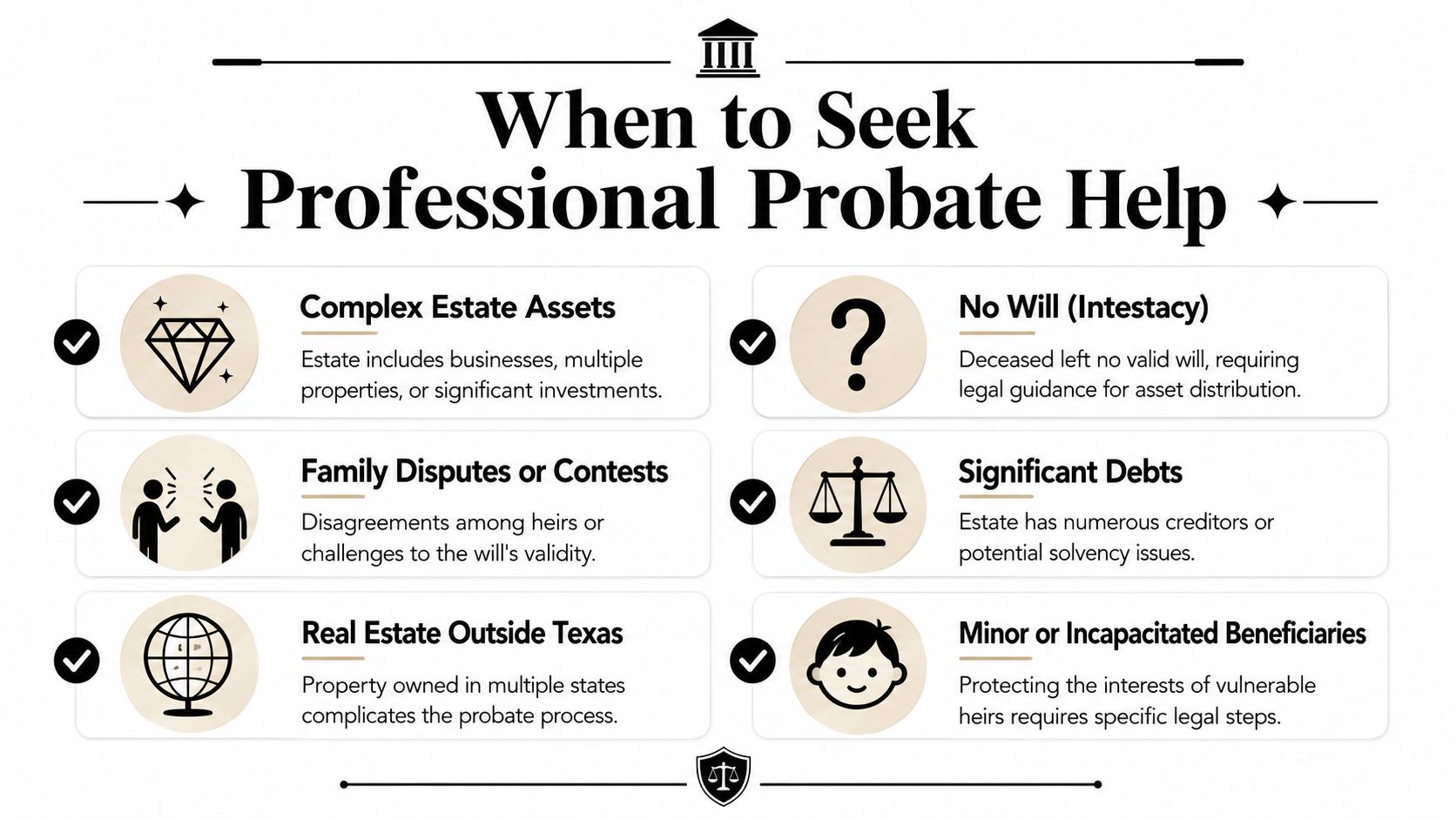
A Houston Heights probate attorney is especially useful when the estate involves any of the following:
- No will at all. Intestacy may require an heirship proceeding and careful proof of who inherits under Texas law.
- A house in Houston Heights or other valuable real estate. Rising property values can intensify disputes over whether to sell now, hold the property, rent it, or buy out another heir.
- Business interests or investment accounts. These assets raise valuation, management, and disclosure questions that many executors have never handled before.
- Claims of wrongdoing. Allegations involving fraud, forgery, self-dealing, or hidden assets often shift the case from administration to active dispute.
- Creditor pressure. Substantial or contested debts require careful timing and documentation before estate funds are distributed.
- Minor or incapacitated beneficiaries. Extra court oversight or protective arrangements may be needed before assets can be transferred safely.
The attorney's role is broader than filing papers
Many families assume a probate lawyer mainly prepares forms and appears in court. In practice, the job is closer to that of a guide and risk manager. The attorney helps the personal representative understand fiduciary duties, set the right order of tasks, respond to objections, and document decisions in a way that can withstand scrutiny later.
That guidance becomes more valuable when the estate includes a Heights property with competing opinions about price, possession, repairs, or timing. Probate law sets the rules. Real estate appreciation raises the stakes. A lawyer helps keep those two pressures from pulling the family in opposite directions.
Texas does allow some people to handle simpler probate matters without counsel. Yet families often decide to hire a lawyer once they realize the question is not whether forms can be filed. The harder question is whether the executor can protect the estate, satisfy legal duties, and avoid being blamed if an heir believes value was lost along the way.
In some matters, probate overlaps with other legal problems that need separate attention. If a child's inheritance becomes tied to a conservatorship dispute, families may also need guidance related to Child Custody, which involves custody and conservatorship representation, including high-conflict disputes. When a death also leads to separate civil litigation, it may help to understand Texas wrongful death expert testimony, especially if the estate case and a wrongful death claim are unfolding at the same time.
If the executor keeps asking, “How do I do this correctly and prove I handled it fairly,” getting legal advice before the next major decision is usually the safer course.
Frequently Asked Questions About Texas Probate Law
What if we find the will years after death
Families in Houston Heights often discover this problem after a house becomes the center of attention. A parent dies, one child stays in the home, another wants to sell, and then a will surfaces long after property values have climbed. By that point, the legal deadline matters just as much as the document itself.
Texas generally requires a will to be offered for probate within four years of death under Texas Estates Code §256.003. If that period has passed, the will may still be admitted as a muniment of title in limited circumstances, but only if the person asking the court to admit it can show they were not in default for the delay under this discussion of the Texas four-year rule.
The date of discovery usually does not reset the clock. That can create real financial pressure in Houston Heights, where a home may be worth far more now than it was at the time of death. The longer uncertainty continues, the more likely heirs are to disagree over whether the property should be kept, rented, repaired, or sold.
Can a beneficiary sue an executor for misconduct
Yes, if the executor has failed in a legal duty and the beneficiary can prove it. In many probate disputes, the claim involves breach of fiduciary duty, misuse of estate funds, concealment of information, or self-dealing as explained in this probate litigation summary.
In Houston Heights, misconduct claims often grow out of real estate decisions. An executor may be accused of selling a house too cheaply to end the case quickly, delaying a sale while the market changes, allowing one heir to live in the home without paying expenses, or spending estate money on repairs that other heirs never approved. The executor does not have to make every heir happy. The executor does have to act prudently, keep records, and treat beneficiaries fairly.
A good way to think about it is this. The executor is handling property that belongs to the estate, not handling personal property as if it were their own.
If you suspect misconduct, gather closing documents, account statements, repair invoices, tax records, and messages about the property. Those details often matter more than broad accusations.
How does an appreciating Houston Heights real estate market affect the executor's duties
It raises the standard of care in practical terms. The legal duties stay the same, but the consequences of a careless decision become more expensive.
If a Heights home is increasing in value while probate is pending, the executor should pay close attention to timing, valuation, carrying costs, insurance, taxes, and the condition of the property. A low listing price, a rushed off-market sale, or poor documentation can trigger disputes because the difference between a careful sale and a careless one may be substantial. In a neighborhood where values can shift quickly, heirs often question whether the estate received fair market value.
That does not mean an executor must wait forever for the perfect sale. It means the executor should make informed decisions, document the reasons, and be ready to show the court and the heirs that the process was fair.
What happens if heirs disagree about the sale price of a Heights home
This is common. One heir may want to cash out quickly. Another may believe a few repairs would justify a higher price. A third may want to keep the property because the neighborhood has been appreciating.
Probate law does not turn that disagreement into a family vote unless the will or court order requires it. The person with legal authority, often the executor or administrator, usually makes the decision subject to any court supervision that applies in the case. Still, disagreement should not be brushed aside. A current appraisal, a broker price opinion, repair estimates, and written explanations of the sale strategy can reduce suspicion before it hardens into litigation.
The house is often both an asset and a memory. That combination makes pricing disputes harder than they look on paper.
Do we always need a lawyer for probate
No. Some Texas estates are simple enough to handle without much conflict.
A Heights probate matter becomes harder when the estate includes a house with rising value, unclear occupancy, unpaid taxes, deferred maintenance, or heirs who disagree about timing and price. At that point, the legal work is not just filing forms. It is protecting the estate from avoidable loss and creating a clear record of why each decision was made.
If you need help with probate or related estate issues in Texas, contact The Law Office of Bryan Fagan, PLLC for a consultation.