
Losing a loved one can leave you holding paperwork, family questions, and deadlines at the exact moment you have the least energy for any of it. You may be staring at a will you don't fully understand, or worse, realizing there may not be a will at all. If you're searching for a Houston Heights probate lawyer, you're probably not looking for theory. You want to know what happens next, what mistakes to avoid, and how to protect your family.
Probate in Texas can feel intimidating, but it becomes more manageable when you break it into clear steps. That's especially true in Houston Heights, where local court procedure, family dynamics, and the condition of the estate can change the path forward. If you're grieving and confused, that reaction is normal. The legal system asks a lot from people during one of the hardest seasons of life.
A common situation looks like this. A parent dies, and an adult child suddenly becomes the person everyone calls. One sibling wants access to the house. Another wants to know where the bank accounts are. Someone finds a will in a drawer, but no one knows if it's the final version. Bills keep arriving. Grief sits in the background of every conversation.
That pressure can make even basic decisions feel risky. If you do too little, the estate stalls. If you do too much too quickly, you can create legal problems that take months to fix.

A helpful first move is to focus on role, not emotion. Who has legal authority to act? Is there a valid will naming an executor? If not, who may need to ask the court to appoint an administrator? A practical starting point is reviewing an executor duties checklist so you can separate urgent tasks from tasks that can wait.
Grief doesn't pause the probate process, but clear legal guidance can keep grief from turning into avoidable conflict.
What Is Probate and How Does It Work in Houston
A lot of families hear the word Probate and assume it means a long court fight. Often, it means something more basic. Probate is the legal process for identifying who has authority to act, what property is part of the estate, which debts must be handled, and who receives what is left under Texas law.
In other words, probate works like a legal transfer system. Title to a house, access to a bank account, and authority to deal with creditors do not automatically pass to the person the family trusts most. The court has to recognize the right person first.
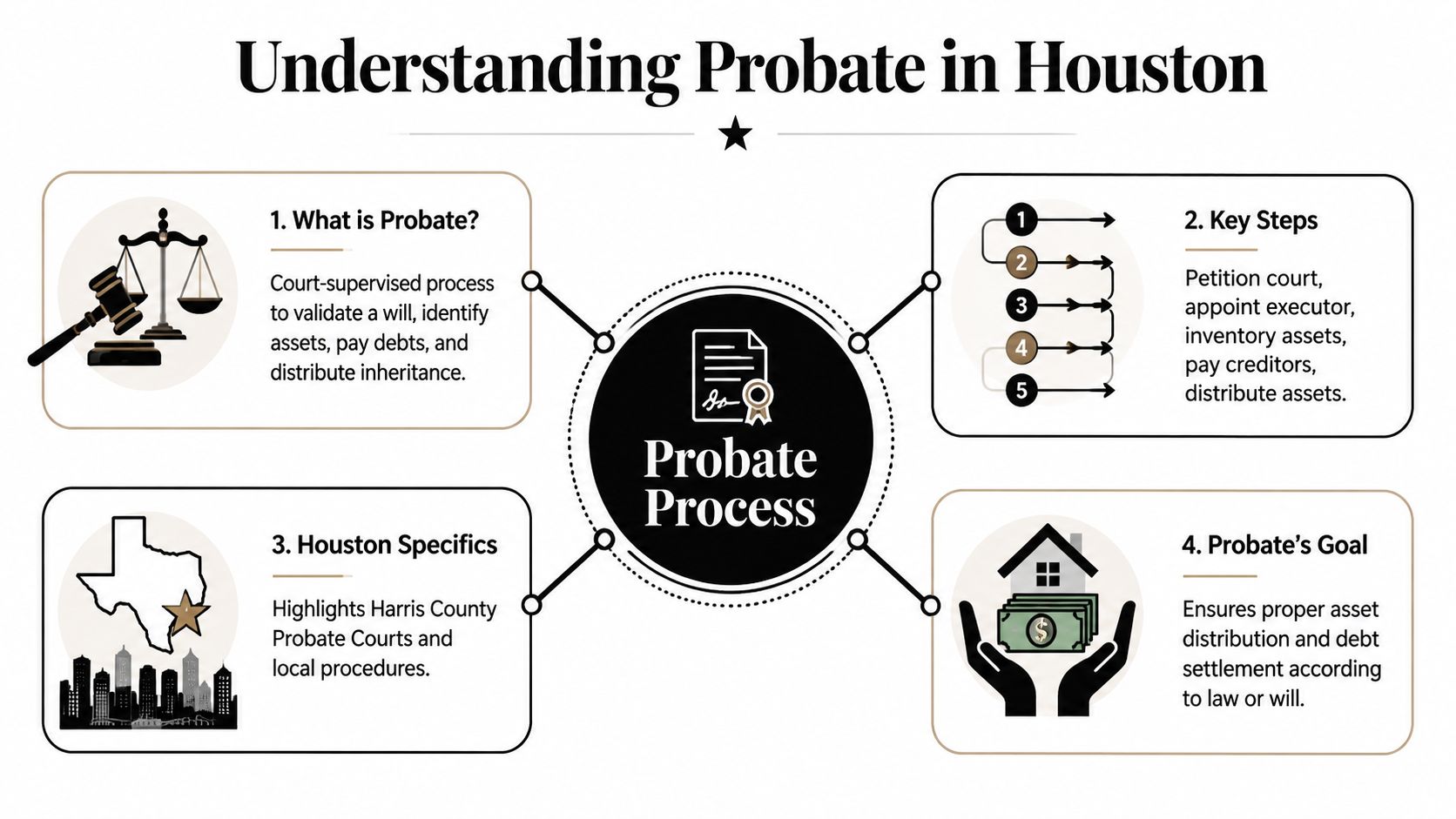
The basic probate path
For Houston Heights families, probate usually means filing in Harris County probate court. The court process can feel formal, but the underlying questions are straightforward. Who is in charge. What belongs to the estate. Who must be paid. Who inherits.
A typical case often follows this sequence:
-
Filing an application with the court
This starts the estate case and asks the court to appoint the proper person to act. -
Appointment of a personal representative
If there is a will, the court may appoint the executor named in that will. If there is no will, the court may appoint an administrator. -
Identifying and protecting estate property
The representative gathers information about real estate, bank accounts, vehicles, business interests, and personal property. Securing a home, preserving records, and locating account statements usually start here. -
Addressing debts, taxes, and expenses
Estate funds may need to be used for funeral costs, valid creditor claims, court costs, and other legal obligations before heirs receive distributions. -
Transferring property to the right people
If there is a valid will, property passes under that document. If there is no will, property passes under Texas intestacy rules.
If you want a broader overview of how probate works in Texas, it helps to compare the general rules with your family's specific facts before filing anything.
With a will and without a will
Probate can be a complex process for many Houston families. A probate case with a clear will is one kind of problem. A probate case without a will can become a very different kind of problem.
When someone dies with a will, the court usually needs to decide whether the will is valid and whether the named executor is qualified to serve. If the court admits the will to probate, the executor carries out its instructions within the limits of Texas law.
When someone dies without a will, the court may need an heirship proceeding to determine who the legal heirs are. Harris County probate court resources discuss heirship and related procedures in Harris County Probate Court legal resources. That process matters because family assumptions and legal inheritance rights are not always the same.
Blended families are a common example. A surviving spouse may assume all property passes to them. Adult children from a prior relationship may assume the opposite. A stepchild who was raised as a son or daughter may have no automatic inheritance rights unless there was a legal adoption or a valid will saying otherwise. Those are painful surprises, especially in Houston Heights families with older homes, remarriages, and property that has been treated as “the family house” for years without clear title planning.
What a Houston Heights probate lawyer actually helps with
A Houston Heights probate lawyer helps turn those court rules into practical next steps. That can include preparing the application, reviewing whether a will is likely valid, identifying whether the estate is testate or intestate, handling heirship issues, guiding the personal representative's duties, and helping with probate administration and estate settlement in Texas.
That guidance matters most when the facts are messy. Maybe no one can find the original will. Maybe one child lived in the home and believes that gives them special rights. Maybe a second spouse and children from a first marriage disagree about what is separate property and what is community property. Probate is the process the court uses to sort out those questions in an orderly way, so mistakes made during grief do not create bigger legal problems later.
Probate is about legal authority, orderly transfers, and protecting the estate while the court determines who has the right to receive it.
The Typical Probate Timeline and Associated Costs
A family in Houston Heights often calls with the same two questions within the first few minutes: How long is this going to take, and how much is this going to cost? If you are asking that now, you are not being cold or impatient. You are trying to make sense of a legal process while also dealing with loss.
The honest answer is that probate does not move on one fixed schedule, and it does not come with one fixed price. A straightforward estate with a valid will, organized records, and little conflict usually moves faster and costs less. An estate with no will, missing paperwork, questions about heirs, or tension inside a blended family usually takes more time and more legal work.
Probate works a lot like clearing title to a house before a sale. If the paperwork is clean, the transfer is usually orderly. If ownership is unclear, signatures are disputed, or one person says the property should pass a different way, everything slows down until those questions are answered.
What tends to shorten the process
Some estates are relatively direct. That usually means the family can quickly answer the court's basic questions.
A case often moves more efficiently when it includes:
- A will that can be found and appears valid
- A person ready to serve who can gather information promptly
- Assets that are easy to identify, such as a house, bank account, or vehicle
- Family members who agree on the basic facts, even if they are grieving in different ways
In those cases, the work is still important, but there are fewer points where the process can stall.
What tends to increase time and expense
Delays usually come from uncertainty, not from the court file itself.
Common issues that add work include:
- No will at all, which may require heirship proof and closer review of who inherits under Texas law
- Blended family disputes, especially when a surviving spouse, adult children from a prior relationship, and stepchildren have different expectations
- Questions about community versus separate property, which often matter when a Houston Heights home was owned before marriage but improved or paid for during marriage
- Missing or incomplete records, including deeds, account statements, beneficiary information, or the original will
- Conflict over who should serve, or suspicion that someone handled property improperly before death
This is one of the most underexplained parts of probate. Families often assume the biggest issue is whether there is money in the estate. In practice, the harder question is often who has legal rights to what, and whether everyone agrees on the answer.
That issue shows up often in intestacy cases. If there is no will, Texas law decides who inherits. In a blended family, that result can surprise everyone. A surviving spouse may not receive everything. A stepchild may receive nothing unless there was an adoption or a valid estate plan. Adult children from a prior marriage may have rights in property the current household viewed as shared. Those disputes can turn an otherwise ordinary estate into a much longer matter.
Where the costs usually come from
Probate costs usually come from a few different buckets: court costs, attorney time, and the added work created by complexity. The more uncertainty the estate contains, the more effort is required to identify assets, confirm heirs, prepare filings, respond to objections, and keep the administration on track.
If you want a clearer sense of how lawyers commonly structure fees, this overview of probate attorney fees in Texas can help you understand what may be fixed, what depends on the court, and what rises with conflict or extra investigation.
What this means for a Houston Heights family
For some families, probate is mostly a matter of gathering documents, filing the right application, and completing each required step in order. For others, it feels more like solving a puzzle where a few key pieces are missing.
If your situation involves no will, remarriage, a long-held family home, or disagreement between a surviving spouse and children from an earlier relationship, expect the timeline and cost to depend on how quickly those legal questions can be resolved. Clear answers early usually save time, money, and strain later.
Why You Need a Houston Heights Probate Lawyer
You may be the person everyone suddenly looks to after a death. One relative wants access to the house. Another asks when money will be distributed. Someone else says there is no need for court because “the family agrees.” In Houston Heights, that kind of pressure can build fast, especially if there is no will or the family includes a surviving spouse, adult children from a prior marriage, or relatives who have been out of contact for years.
A probate lawyer helps you sort legal duties from family assumptions. That matters because probate is not just paperwork. It is a court process with deadlines, notice rules, asset questions, and personal responsibility for the executor or administrator. If you start with the wrong procedure, or leave out the wrong person, the case can become slower, more expensive, and more tense than it needed to be.
Notice requirements are stricter than many families expect
Probate often looks simple from the outside. Then one rule changes everything.
Under Texas Estates Code §258.051, a probate application must list all heirs at law, and the applicant must send formal notice to every heir, including a statement that estate assets would pass directly to those heirs if the will is not admitted to probate. The applicant must also file a return of service confirming notice, as described in the Harris County Probate Court No. 4 frequently asked questions.
That can be straightforward in a small, close family. It gets harder when the facts are messy. A child from an earlier relationship may need notice even if the current household rarely mentioned them. An estranged half-sibling still matters. A person living out of state still matters. In an intestacy case, where there is no will, identifying the right heirs is often the center of the whole case, not a side task.
A lawyer helps you get that foundation right before the court hearing, rather than trying to fix it after someone objects.
A lawyer protects the representative and helps prevent family conflict
Serving as executor or administrator is a legal job. It works a lot like being a trustee for a group of people who do not always trust each other. You may have control over information, property, and timing, but you cannot use that control for your own convenience or one branch of the family over another.
That is where legal guidance becomes practical, not abstract. A probate lawyer may help by:
- Choosing the correct probate path based on whether there is a valid will, no will, real estate, debt, or family conflict
- Preparing and filing court documents in the form the Harris County probate court expects
- Advising you on what can wait and what cannot, such as securing property, gathering records, and avoiding premature distributions
- Handling notice, service, and hearing requirements so avoidable procedural mistakes do not create delays
- Addressing disputes early, including disagreements involving blended families, suspected omitted heirs, or conflicting views about separate versus community property
One early conversation can prevent a long series of corrections.
That is especially true in under-served situations that many articles skip over. If your loved one died without a will, the court may require heirship evidence, family history, and testimony that feels surprisingly detailed. If a second marriage and adult children from a first marriage are involved, the question is often not “Who loved the decedent more?” The key question is, “Which assets legally belong to the surviving spouse, and which pass to children under Texas law?” Those are different questions, and they need different evidence.
Practical rule: If there is no will, a blended family, unclear title to a Houston Heights home, or disagreement before filing, speak with a probate lawyer before anyone transfers property or promises an inheritance.
Some families compare firms before deciding who should help. One option may be a firm such as Law Office of Bryan Fagan, PLLC, which handles Texas estate planning and probate matters. The right attorney is one who can explain the process in plain language, spot risks early, and give you a clear plan for what to do first.
Common and Costly Probate Mistakes to Avoid
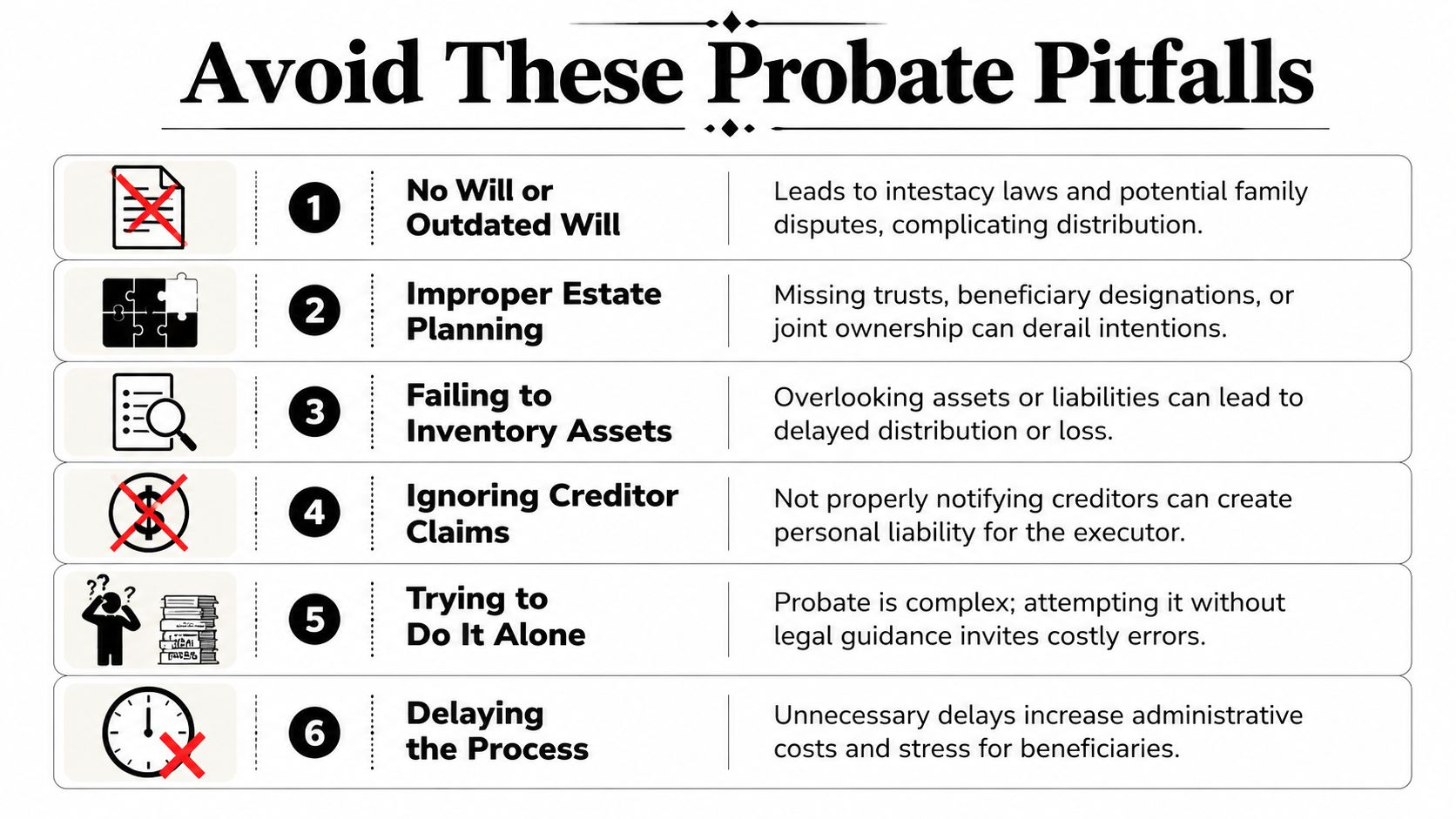
Many probate problems don't begin with bad intentions. They begin with assumptions. A family assumes a handwritten note is enough. An executor assumes they can distribute money early. A child assumes that because everyone agrees now, deadlines don't matter. Texas probate law is less forgiving than people expect.
Missing the filing deadline
Under Texas Estates Code §256.003, a will must be filed for probate within four years of the decedent's date of death, not the date someone later found the will or realized probate was necessary. If that deadline is missed, the will may be admitted only as a muniment of title if the applicant was not “in default,” as explained in this discussion of the Texas four-year probate rule.
That catches families off guard. A person may keep the will in a safe place, assume there's no urgency, and discover years later that the legal options have narrowed.
Distributing assets too early
Families often want to “keep things simple” by handing out personal property, selling a car, or transferring money before the estate is fully evaluated. That can create trouble if debts remain unpaid or if the wrong person receives property first.
A safer approach is to wait until the court process identifies authority and the estate's obligations are understood.
Here's a short video that helps illustrate common probate issues:
Acting like “family agreement” replaces legal procedure
Even close families can run into trouble when memories differ. One child remembers a promise about the house. Another recalls being told the bank account would be split equally. Those conversations may matter emotionally, but they don't automatically control probate.
Common mistakes include:
- Failing to secure property before others access it
- Ignoring written records that could identify ownership or beneficiaries
- Blurring personal and estate funds by using estate money informally
- Trying to manage heirship issues without court guidance in a no-will estate
The most expensive probate mistake is often the one a family made while trying to avoid “making it legal.”
Overlooking document changes in Texas law
In some cases, the original will or paperwork can't be found, which causes panic. Texas law has addressed part of that problem. Senate Bill 1448, effective September 1, 2025, updated the Texas Estates Code to allow a copy of a self-proving affidavit to render a will self-proved even if the original will is missing, eliminating the need for subscribing witnesses to appear in court, according to this overview of 2025 Texas probate updates. If your case involves damaged or lost will documents, that update may affect strategy.
Real-World Probate Scenarios in Harris County
Probate law becomes easier to understand when you can see how it plays out in real families. These examples are simplified, but they reflect the kinds of situations people in Houston Heights face.
A straightforward will-based estate
Maria's father dies owning a house, a car, and a checking account. He left a signed will naming Maria as executor and dividing property equally among his children. The siblings trust one another, and no one contests the will.
This kind of case is often the cleanest version of probate. The court reviews the application, Maria receives authority, she gathers records, and the estate moves through administration with relatively little conflict. The emotional burden is still real, but the legal path is clear.
A no-will estate with heirship questions
Derrick's mother dies without a will. He knows she wanted him to “take care of everything,” but there is no document appointing him. He also learns that a child from an earlier relationship may have inheritance rights even though the family hasn't been in contact for years.
Now the issue isn't just administration. It's legal identity. Who qualifies as an heir under Texas law, and who must receive notice? In this setting, an heirship proceeding may become the center of the case. The family's understanding of fairness may not match Texas intestacy rules, and that mismatch can create surprise and resentment very quickly.
A blended family dispute that turns personal
Carol remarried late in life. She had children from a prior marriage, and her surviving spouse has children of his own. After Carol's death, disagreement breaks out over whether some property belongs to the estate, whether the surviving spouse can remain in the home, and whether one child influenced Carol before she signed estate documents.
These cases are especially difficult because every legal argument can sound like a moral accusation. Independent legal resources indicate that underserved and blended families in Harris County face disproportionately higher rates of probate litigation due to unclear inheritance rights, as described by the Hispanic Bar Association of Houston legal resource page.
In a blended family probate case, the legal question and the family question are rarely the same. The court resolves the legal one. A lawyer helps you avoid making the family conflict worse while that happens.
In practice, these disputes may involve questions about separate versus marital property, unclear beneficiary intent, and whether a challenge to a will or heirship claim is likely to succeed. That's one reason probate and family-law thinking sometimes overlap. The family history matters, but the court still needs evidence and procedure.
How to Choose the Right Attorney and Take the Next Step
When you're searching for a Houston Heights probate lawyer, the right question isn't only “Who handles probate?” It's “Who can handle my kind of probate problem?” A straightforward will admission, an heirship case, and a blended-family dispute may all fall under the same broad label, but they require different instincts and different levels of court experience.
What to look for in your consultation
Bring the facts you have, even if they're incomplete. A useful first meeting often includes the death certificate, any will or copy of a will, a basic asset list, and the names of close relatives. You don't need a perfect file. You need enough information for the attorney to spot the issues.
Pay attention to how the attorney answers practical questions such as:
- Can you explain whether this is a will-based probate or an heirship case?
- What deadlines matter first in my situation?
- Who needs formal notice, and who may challenge the case?
- What should I avoid doing before the court gives authority?
Signs the fit may be right
Good probate guidance usually feels clarifying, not confusing. The attorney should be able to explain Texas Estates Code principles in plain language, identify immediate risks, and help you separate urgent tasks from tasks that can wait.
You should also listen for empathy. Probate clients are often grieving, not just problem-solving. A lawyer who talks to you like a human being can make the process less isolating and more manageable.
What you can do today
If you're overwhelmed, keep the next step small. Collect the core documents. Write down family relationships. Make a list of known property and known concerns. If there's a dispute, don't escalate it by making promises, transferring assets, or relying on verbal understandings that may not hold up in court.
Getting legal advice early often protects both the estate and the relationships around it. Even one focused consultation can help you understand whether your case is simple, sensitive, or likely to become contested.
If you need help navigating divorce, custody, or estate planning in Texas, contact Law Office of Bryan Fagan, PLLC today for a free consultation. If you're dealing with probate in Houston Heights, especially a no-will estate or a blended family dispute, a personalized conversation can help you understand your duties, protect your rights, and take the next step with confidence.