 Skip to content
A bad fall changes everything fast. One call from the hospital, one discharge planner asking who will help at home, and suddenly you're not dealing with a temporary setback, you're dealing with meals, bathing, medications, bills, and the hard question of how long your parent can stay safe on their own. In Texas, that's where long term care planning stops being theory and starts becoming the difference between a manageable transition and a family crisis.
Families don't need a lecture when they're sitting at the kitchen table with a parent who can't walk to the bathroom without help. They need a clear path. They need to know what care entails, what it costs, what the law can protect, and what decisions have to happen before capacity fades. That's the work of a good plan, and it's the kind of planning families often need most after a fall, a stroke, dementia symptoms, or the first real sign that living alone isn't safe anymore.
When a Texas Family Faces the Care Question
The call usually comes at the worst time. A daughter in Houston gets told her father fell at home, spent the night in the hospital, and is being discharged before anyone in the family has a real plan for what happens next. The hospital wants a safe discharge. Dad wants to go home. The family wants to do the right thing without making a mistake that drains savings or puts him at risk again.
That is where long term care planning starts. Not with a brochure, and not with a nursing home. It starts with the practical question of how a person will be helped when they can't manage daily life on their own, and how that care will be paid for without gutting the rest of the family's finances. The National Institute on Aging says long-term care is a range of services that help a person meet health or personal care needs when they can no longer perform everyday activities on their own, and the best time to plan is before care is needed, while the person can still take part in the decisions National Institute on Aging long-term care guidance.
A Texas family in this spot needs more than sympathy. They need a sequence. First, figure out what level of help the parent needs. Second, identify who can legally make decisions. Third, compare how care will be delivered at home, in assisted living, or in a nursing facility. That's also where legal documents, money, and family roles start to collide.
The families who handle this best don't wait for a second fall. They move quickly, get organized, and make decisions while the parent can still speak for themselves.
A firm like the Law Office of Bryan Fagan, PLLC fits into that moment as a steady legal resource for families who need estate planning, guardianship guidance, and decision-making documents lined up before the next emergency hits. If the care question is already on your kitchen table, you're not early. You're late, but you can still get ahead of the chaos.
What Long Term Care Planning Actually Means
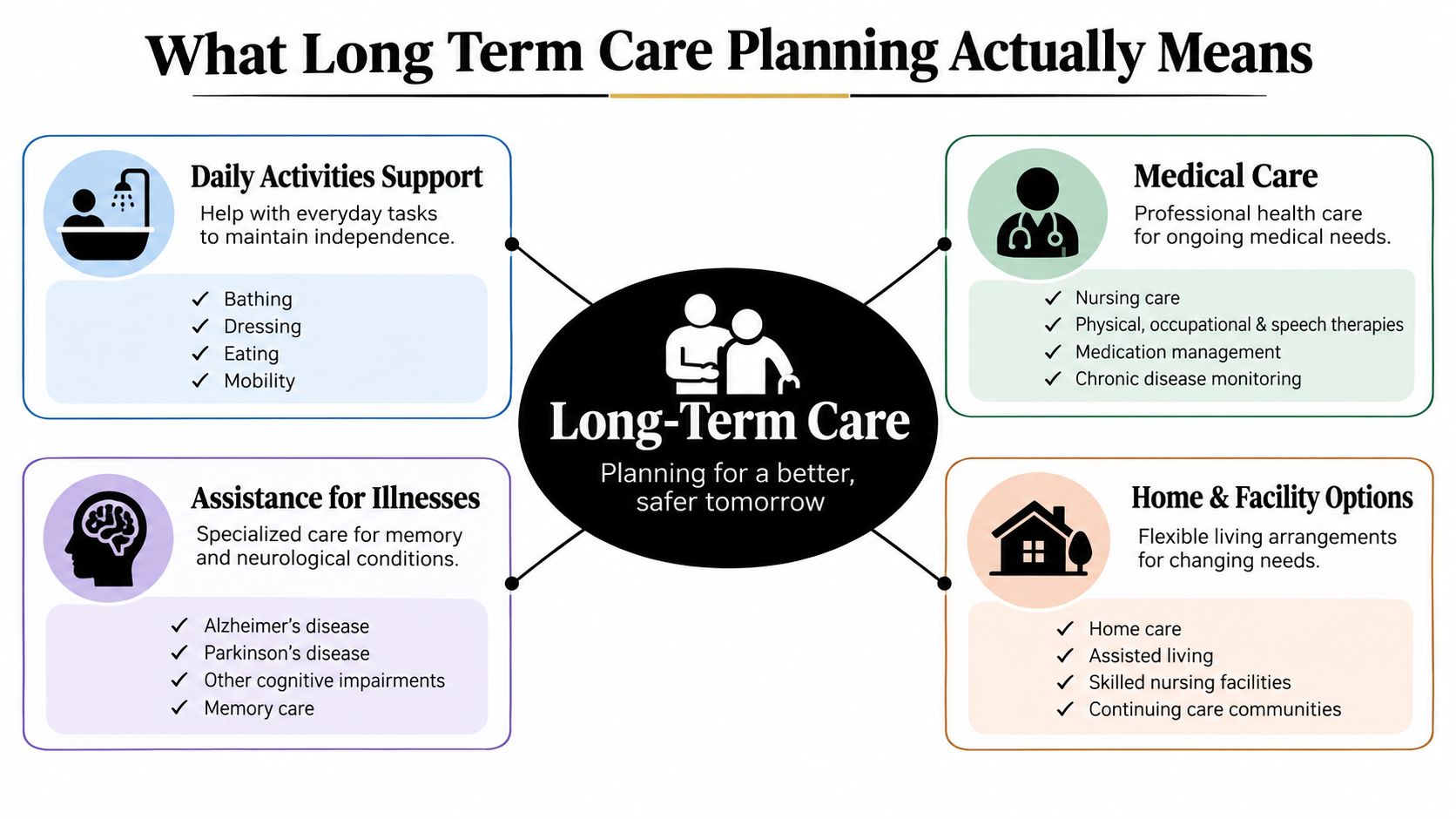
Start with the plain meaning. Long-term care is help with activities of daily living, things like bathing, dressing, eating, transferring, toileting, and continence. It also includes household support, supervision, memory care, nursing, and other services that help someone live safely when age, illness, or disability has taken away normal independence. It is not the same thing as a hospital stay, and it is not the same thing as the short-term medical care typically associated with “health insurance.”
That distinction matters because many families assume Medicare will take care of this problem. It usually won't pay for the kind of extended daily assistance a parent needs after a fall, especially if the need becomes ongoing rather than brief. In practice, Texas families usually end up combining family caregiving, paid home help, community services, assisted living, memory care, or skilled nursing depending on the person's condition and the home situation.
What gets planned first
The first legal question is simple. Who can help if Dad can't sign, decide, or coordinate care after the fall? The second is practical. Can he stay at home with support, or does he need a different setting? The third is financial. What funds are available now, and what legal tools exist to protect the rest of the estate?
You'll hear people talk about long-term care like it means only a nursing home. That's too narrow. It can mean a caregiver coming into the house, an adult child rearranging work schedules, a move into assisted living, or full-time supervision in a memory care setting. A Texas family should think in terms of support needs, not just facility names. That's the mindset that keeps the plan realistic.
A useful comparison point is Child Support, which involves establishment, modification, and enforcement of Texas child support. Different legal area, same lesson, the law works best when the family has clear facts and acts before a crisis hardens into a dispute.
What Long Term Care Costs in Texas and Why It Matters
The money side is where families usually get surprised. CareScout reports a national median cost of $35 per hour for a non-medical home caregiver, which comes out to about $80,080 per year if care is needed 44 hours per week. It also reports a national median cost of $129,575 per year for a private room in a nursing home and $114,975 per year for a semi-private room CareScout cost of care data. Fidelity separately notes that a private nursing-home room may cost about $127,750+ per person annually, and the average person needs care for roughly 3 years Fidelity long-term care planning.
Those numbers are enough to break a comfortable retirement if you don't plan. Even a home-care arrangement can become a six-figure obligation quickly, and institutional care can cross the $100,000 per year line without much difficulty. The point isn't to panic. The point is to stop pretending this is a small expense that can be handled casually from monthly cash flow.
The old idea that care only becomes expensive in a nursing home is wrong. The cost starts as soon as the family needs regular paid help, and it can keep going for years. HHS reported that in 2014 the national median annual cost was $77,380 for a semi-private nursing home room and $20 per hour for home health aide care HHS long-term care awareness and planning brief. The higher figures in the newer data show why timing matters. Costs move, and they usually move upward.
| Care Setting | Typical Unit | Approximate Annual Cost |
|---|---|---|
| Non-medical home caregiver | $35 per hour | $80,080 if care is needed 44 hours per week |
| Home health aide | $20 per hour | Not directly annualized in the source |
| Semi-private nursing home room | Annual room rate | $114,975 nationally |
| Private nursing home room | Annual room rate | $129,575 nationally |
How to stress-test a family balance sheet
I tell families to ask one hard question. If care starts next month and lasts several years, what happens to the house, the retirement accounts, and the spouse who's still living at home? If liquid assets and insured income can't absorb three to five years of high-acuity care, the family needs a written plan, not wishful thinking. Don't wait for a crisis to discover the gap.
Funding Options Every Texas Family Should Compare
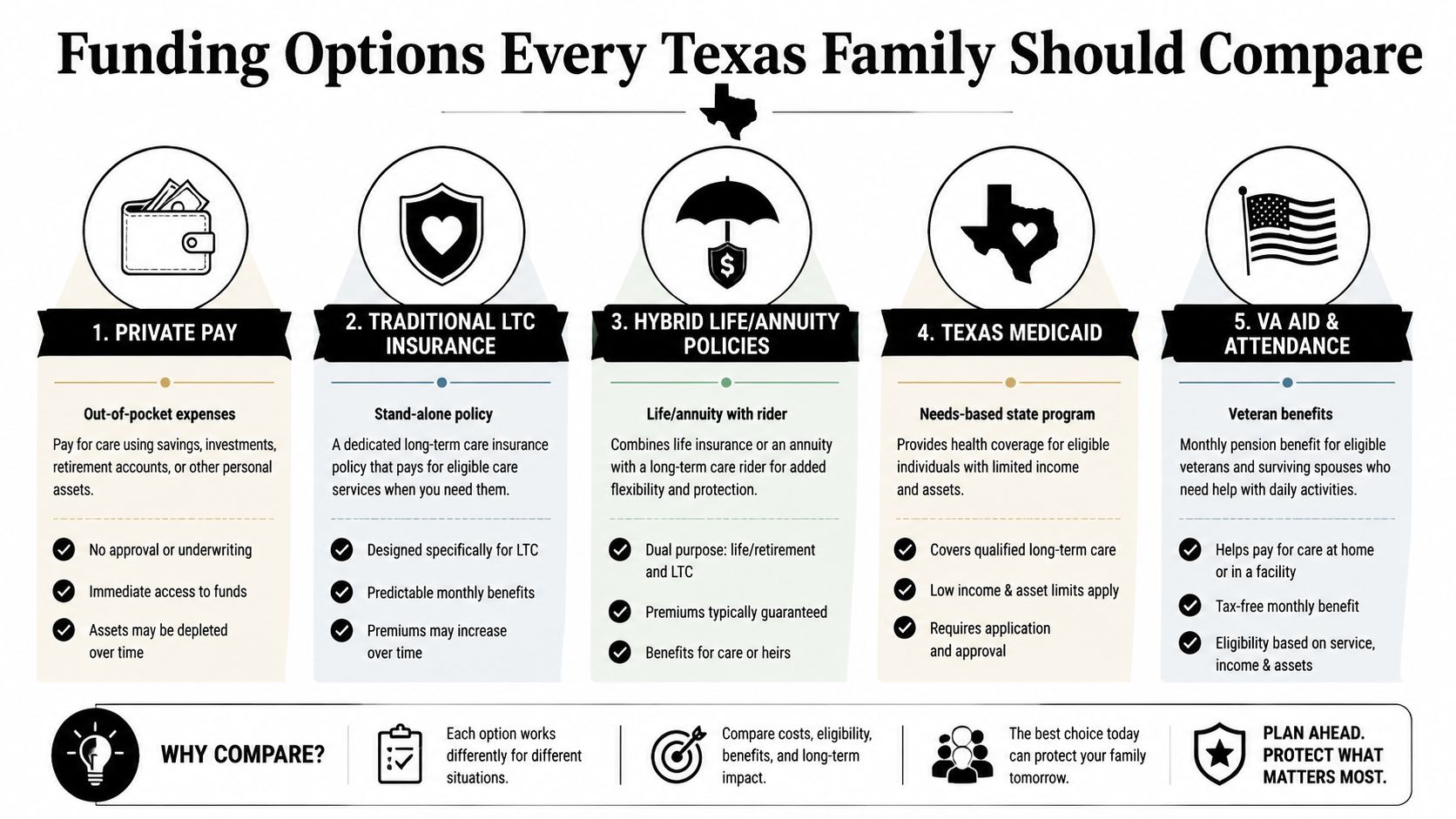
The right funding strategy depends on how much flexibility the family has now and how much control they want later. Private pay is the simplest path. You use savings, income, and assets directly, which gives you the most choice but also exposes the estate fastest. This works for families with substantial liquid resources and a clear willingness to spend them on care without trying to qualify for means-tested benefits.
Traditional long-term care insurance works differently. It's designed to pay for care when a qualifying need arises, but not every family can get it, and not every family should buy it late in life. A useful comparison of traditional vs hybrid long term care can help families understand the difference between stand-alone coverage and policies tied to life insurance or annuities. The decision usually turns on age, health, premium tolerance, and whether the family wants pure care coverage or a benefit that may still have value if care is never needed.
Hybrid life or annuity policies with long-term care riders fit families who dislike the “use it or lose it” feel of traditional coverage. They can be a more acceptable purchase for some households because the policy may still serve another estate-planning purpose. Texas Medicaid is the opposite end of the spectrum. It is needs-based and powerful, but it comes with eligibility rules, transfer rules, and a real penalty risk if the family made gifts or moved assets at the wrong time.
The Department of Health and Human Services notes that 48% of adults will receive some paid care over their lifetime, and the Center for Retirement Research found that only 3% of U.S. adults overall, and 15% of those 65+, have long-term care insurance HHS lifetime risk of needing long-term services and supports, Center for Retirement Research on long-term care planning. That means many families are still improvising.
Practical rule: If a family says, “We'll just spend down and figure out Medicaid later,” they already have a plan. It's just a bad one unless an attorney has checked the transfers, spouse protections, and timing.
VA aid and attendance can help some veterans and surviving spouses, but it's not a universal answer. It's one piece of a broader funding mix, not a replacement for the rest of the plan. Families should compare at least two or three options before a crisis, not after the first facility bill arrives.
The right funding decision is often simpler than people expect. A retired couple with solid savings may choose private pay plus a backup legal strategy. A middle-income family may need insurance plus asset protection documents. A veteran family may layer VA benefits with Medicaid planning. The key is to stop asking, “What's the cheapest option?” and start asking, “What combination works if care lasts years?”
Texas Legal Tools That Protect Assets and Decisions
The legal documents matter because care is not just a money problem. It is also a decision-making problem. A durable power of attorney under the Texas Estates Code lets a chosen agent handle finances if the parent can't do it anymore. Medical directives, advance directives, a living will, and the appointment of an agent for health care let the family make treatment decisions consistent with the parent's wishes while capacity is still intact. If these documents are missing, the family can get stuck waiting for a court process or arguing at the bedside.
That's why I tell clients to sign these documents while everyone is calm. Once a parent is confused, hospitalized, or frightened, the window for clean planning gets much smaller. A caregiver can't always wait for the perfect answer. They need authority to pay bills, speak with providers, and coordinate care right away.
Trusts and the last-resort safety net
For Medicaid planning, families often look at irrevocable trusts, including a Texas Medicaid Asset Protection Trust, and an irrevocable funeral trust. Those tools can protect certain assets when they're set up correctly and early enough, but they are not casual paperwork. They have to be funded properly, timed carefully, and coordinated with the rest of the estate plan. If you want a deeper breakdown of how one of those tools works, this discussion of what an irrevocable trust is in Texas is a useful companion.
Adult guardianship is the last resort, not the first move. Under Chapter XIII of the Texas Estates Code, guardianship can step in when a person lacks capacity and no less restrictive tool will do the job. Families should treat that as a safety net, not a substitute for planning. A court case is slower, more public, and more expensive than a signed set of documents.
For readers who want a plain-English overview of authority and decision-making, this guide to understanding POA in Texas is helpful context. The law is useful only if the family uses it before the crisis locks the door.
When a Texas family already has a parent with early memory loss, the smart move is to get the legal paperwork done before the diagnosis gets worse. That means naming trustworthy agents, reviewing beneficiary designations, and making sure the documents match the care plan. If the plan says “stay at home,” the legal tools should support that choice.
The Texas Medicaid Lookback and How It Plays Out
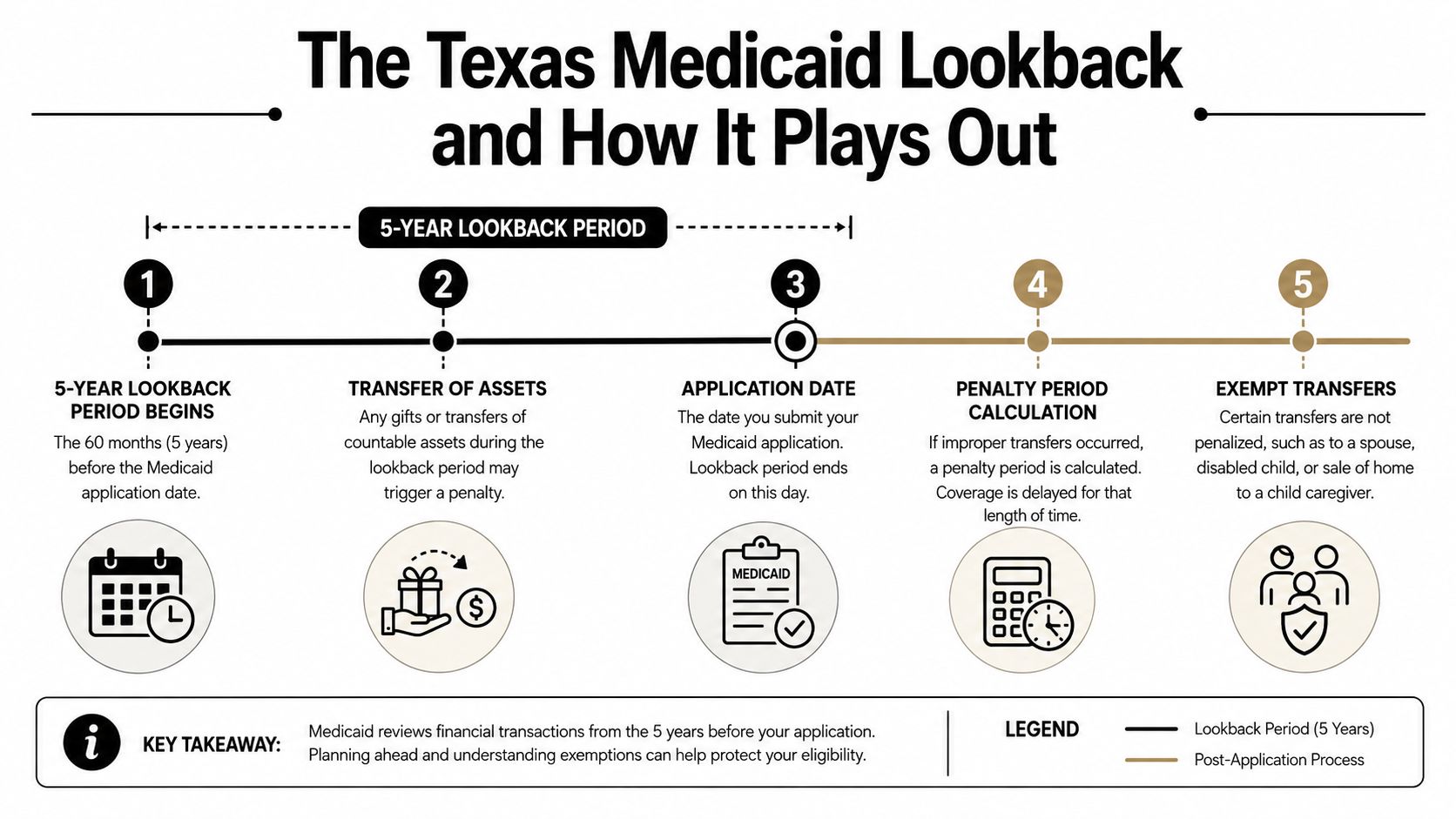
The five-year lookback period is where many families get tripped up. Texas Medicaid does not just ask what the applicant owns today. It asks what they transferred during the prior five years, and if the transfer was non-exempt, the state can impose a penalty period that delays coverage. That is why casual gifting is risky when a parent may need care soon.
A transfer to a spouse, a child under 21, or a disabled child is treated differently. But a check written to grandchildren, a deed changed too early, or money moved out of a parent's name without legal review can create a problem later. The penalty is not theoretical. It can block benefits right when the family needs help paying for care.
A Houston couple's mistake
Take a retired Houston couple. Three years before Mom's fall, Dad gave each grandchild $20,000. Everyone thought it was a generous family gesture, not a legal issue. After the fall, when the family starts Medicaid planning, that gift history becomes a problem because it sits inside the five-year lookback window.
That's the part families hate most. The money is gone, but the transfer still matters. The state can look back, identify the gift, and calculate a penalty period that delays coverage. If the family needed that coverage to help pay for care, the delay forces them to use other assets or private pay longer than they expected.
The practical lesson is blunt. If there's any chance a parent may apply for Medicaid in the next five years, stop informal gifting and stop moving assets without legal advice. The timing of the transfer matters more than the family's good intentions.
This is also why planning has to be coordinated. A trust funded too late, a deed changed without review, or a “we'll sort it out later” mindset can undo months of good work. A Texas elder-law attorney can time gifting, trust funding, and asset protection so the Medicaid plan and the estate plan don't fight each other.
Your Step-by-Step Long Term Care Plan at Every Stage
A good plan changes with age. A healthy adult in the 50s or early 60s should focus on underwriting, baseline documents, and honest family conversations. This is the window to compare insurance options, review assets, and make sure a durable power of attorney and health care directives are signed while capacity is clear. If one spouse gets sick later, the family won't be starting from zero.
For readers assisting elderly parents, the legal authority issue becomes immediate. This guide on power of attorney for elderly parents in Texas is worth reading before you try to manage accounts or care decisions on someone else's behalf.
What to do in each stage
- 50s and early 60s, build the foundation. Compare long-term care insurance and hybrid policies, gather financial statements, and name decision-makers who can handle pressure.
- Mid-60s and beyond, tighten the plan. Review existing coverage, revisit estate documents, and decide whether Medicaid planning or trust-based protection should be on the table.
- When needs start to rise, act fast. Pull records, document transfers, activate legal authority, and line up care before a second emergency forces bad choices.
Good rule: If the parent is still able to participate, that's the moment to finish the plan. If they can't participate anymore, the family has already lost flexibility.
A printed checklist for families
For healthy adults:
- Sign core documents. Durable power of attorney, medical directives, and beneficiary reviews belong here.
- Compare funding tools. Don't buy or dismiss insurance without seeing what private pay would really do to the estate.
- Talk to the family. The person who will help needs to know where the papers are.
For later life:
- Review care triggers. Falls, memory loss, and repeated hospital discharge notes deserve immediate attention.
- Organize records. Bank statements, deeds, insurance, and transfer history matter in every Medicaid review.
- Get legal review. A plan built before the crisis is always better than one built from the hospital hallway.
Common Questions and When to Call a Texas Attorney
People usually ask four questions after all of this. First, does Medicare cover long-term care? Not in the way most families mean it. Medicare is not a long-term solution for ongoing daily assistance, and that's why care planning has to stand on its own instead of depending on a hospital benefit that wasn't designed for years of custodial support.
Second, can a parent qualify for Texas Medicaid without impoverishing a spouse? Yes, but only with careful planning. The spouse at home has protections, but the numbers, transfers, and ownership structure have to be reviewed before the application goes in. That's not something to guess about from memory or from a neighbor's story.
Third, what if your loved one already gave away assets inside the lookback period? Don't panic, but do not hide it. The transfer has to be analyzed, documented, and timed correctly because the penalty rules can delay eligibility. The right fix depends on the transfer, the date, and the rest of the estate plan.
Fourth, is anyone too old to start? No. But the earlier you start, the more options you keep. A family with a parent in declining health still has planning choices, but the choices get narrower as capacity, transfer history, and care needs become more urgent.
If you want a broader legal overview of elder planning and authority issues, this article on elder law attorney Texas is a smart next read. The key takeaway is simple. Don't wait for the second fall, the second hospital stay, or the first denied benefit notice. Get the documents, the funding strategy, and the care plan lined up now.
If you need help navigating long term care planning in Texas, the Law Office of Bryan Fagan, PLLC can help you sort out Medicaid timing, estate documents, and the decisions that protect both your parent and the rest of the family. Visit Law Office of Bryan Fagan, PLLC to schedule a free consultation and get specific guidance for your situation.


