
Navigating your rights as a parent can be one of life's most difficult transitions—especially when you aren't married. But understanding your rights under Texas law can make the path forward less overwhelming and give you the confidence to protect your relationship with your child. It's a common misconception that parental rights are automatically equal from the start. They aren't.
Under the Texas Family Code, an unmarried mother is immediately granted both sole legal and physical custody of her child right at birth. For an unmarried father, the journey to securing parental rights involves a critical first step: legally establishing paternity.
Your Rights as an Unmarried Parent in Texas
Trying to figure out your parental rights when you're not married can feel like navigating a maze in the dark. It’s completely natural to feel a deep sense of anxiety, worrying if you'll be able to build and maintain that strong, stable relationship you want with your child. We see these concerns every day, and our goal is to light up the path ahead and give you a clear roadmap.
At the heart of every single custody decision in Texas is the “best interest of the child” standard. This isn't just a legal phrase; it's the guiding principle judges use to craft orders that truly support a child's emotional and physical well-being. For unmarried parents, this means the court process isn’t about picking a winner or a loser. It's about creating a formal, enforceable structure that brings stability and predictability to your child's life.
The initial distribution of rights at birth is where things really diverge:
- For Unmarried Mothers: You are automatically the sole managing conservator. This gives you the exclusive right to make crucial decisions about your child’s schooling, healthcare, and where they live, all without needing a court order.
- For Unmarried Fathers: You start with no legal rights to custody (what Texas calls conservatorship) or visitation (possession) until you are legally recognized as the father. Simply having your name on the birth certificate, while important, is not enough to grant you these enforceable rights.
This initial imbalance can seem unfair, especially for a father who is ready and eager to be an active parent. However, it's crucial to see this not as a roadblock, but as the starting line of a clearly defined legal process. By taking the correct steps—starting with establishing paternity—you can secure your rights and guarantee your place as a meaningful, constant presence in your child’s life. The law provides a straightforward path for dedicated parents to do just that.
Establishing Paternity is a Critical First Step
For any unmarried father in Texas, this is the starting line. Legally establishing paternity is the single most important action you can take. It’s the key that unlocks all of your parental rights.
Without this formal recognition, you have no legally enforceable claim to custody or visitation. It doesn't matter if you're the biological father or have been in your child's life since day one. In the eyes of Texas law, until paternity is established, you're a legal stranger.
The state offers two clear pathways to make it official. Each one is built for a different set of circumstances, but both get you to the same crucial destination: becoming a legally recognized parent.
This visual guide quickly shows the default legal status for unmarried parents the moment a child is born in Texas.
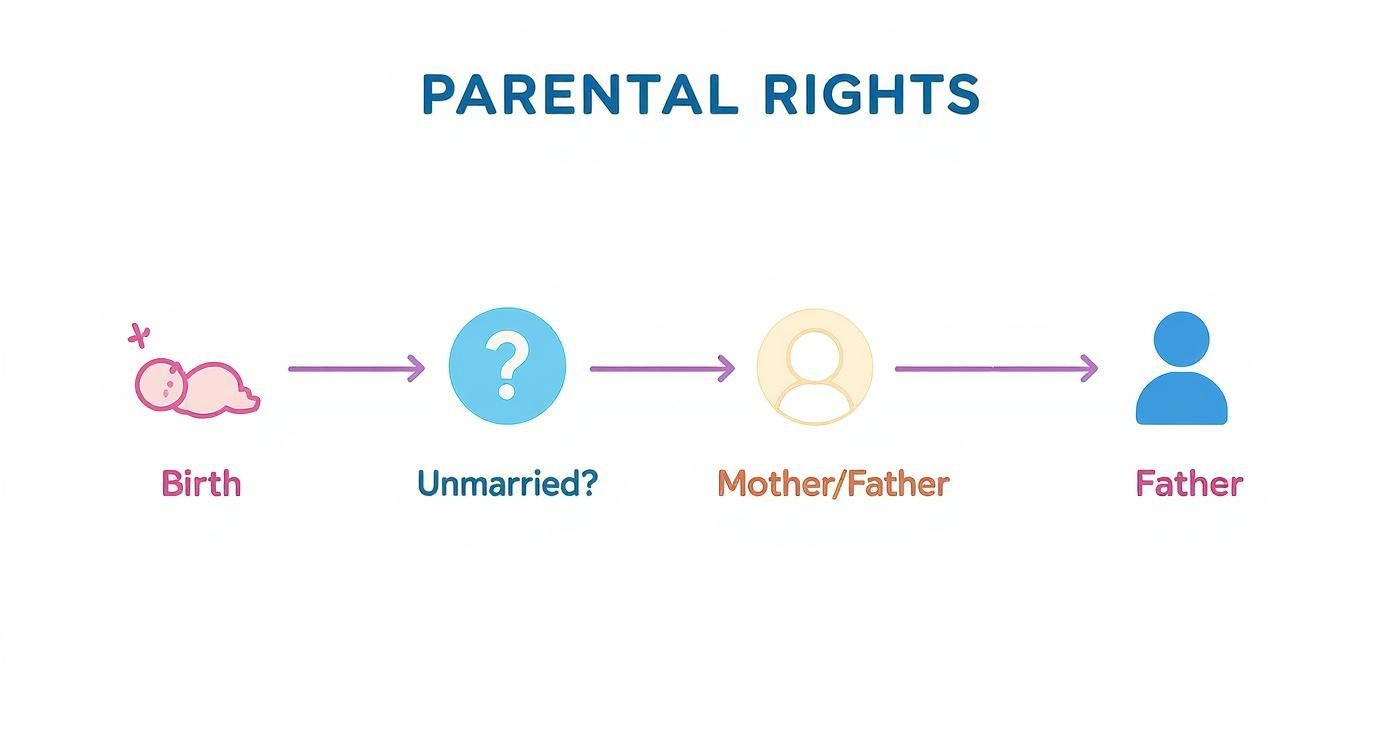
As you can see, a mother's rights are automatic. A father, on the other hand, has to take proactive legal steps to get his.
The Acknowledgment of Paternity (AOP)
The most direct route is signing a voluntary Acknowledgment of Paternity (AOP). This is a powerful legal document, typically offered to new parents right there in the hospital after the baby is born.
When both parents agree on who the biological father is, signing the AOP together is the simplest, most practical step. Once it's signed and filed with the Texas Vital Statistics Unit, it carries the full weight of a court order. It legally makes you the father, which gives you the standing you need to then go to court for custody and visitation orders.
An AOP is a sworn statement that the man signing is the biological father of the child. It is the simplest way to gain the legal rights and responsibilities of a parent, including the obligation of financial support.
Filing a Suit to Adjudicate Parentage
What happens if the AOP isn't signed at the hospital? Or what if there’s a disagreement about who the father is? In these cases, the path forward is a court action called a Suit to Adjudicate Parentage.
This is a formal lawsuit where you ask a judge to legally determine the child’s father. The process almost always involves court-ordered genetic testing (DNA) to get a conclusive answer. If the DNA test confirms you're the father, the judge will issue an order officially naming you as the legal father.
This court order accomplishes the same thing as a signed AOP: it establishes your legal parentage. From there, you can finally move forward to secure your rights to custody and visitation. It's more involved than signing an AOP, but for fathers who need to prove their relationship to their child, it's absolutely essential.
Two Paths to Establishing Paternity in Texas
To make sense of these two options, it helps to see them side-by-side. Each method is designed for a specific situation, but both lead to the same result: securing a father's legal rights.
| Method | Process | When It's Used | Key Outcome |
|---|---|---|---|
| Acknowledgment of Paternity (AOP) | Both parents voluntarily sign a legal form, usually at the hospital. The form is then filed with the state. | When both parents are in complete agreement about the child's paternity. | Establishes legal fatherhood with the force of a court order, allowing the father to pursue custody rights. |
| Suit to Adjudicate Parentage | A lawsuit is filed in court. The judge will likely order DNA testing to confirm the biological relationship. | When the AOP was not signed, or when one parent disputes who the father is. | A judge issues a court order that officially and legally names the man as the child's father. |
Ultimately, whether you sign an AOP or go through a court suit, the goal is the same. In Texas, custody laws for unmarried parents all hinge on this formal step, because without it, a father has no automatic legal rights to his child.
Filing a Suit Affecting the Parent-Child Relationship

Once paternity is legally established, you've unlocked the door to securing your parental rights. The next logical step is to walk through it by filing what's known as a Suit Affecting the Parent-Child Relationship, or SAPCR for short.
That name sounds formal and a little intimidating, but its purpose is incredibly practical and protective. A SAPCR is the official court case used in Texas to create legally enforceable orders for everything related to your child. It's the process that transforms handshake agreements and good intentions into a stable, court-ordered framework that everyone can rely on. Think of it this way: without a SAPCR, your parenting arrangement is built on trust and goodwill. With a SAPCR order, your arrangement is built on the solid foundation of Texas law.
What a SAPCR Order Establishes
This single court case tackles all the essential elements of co-parenting, providing clarity and predictability for everyone involved. For unmarried parents, filing a SAPCR isn't about starting a fight; it's about creating certainty for your child's future.
Here's a step-by-step breakdown of what a comprehensive SAPCR order defines:
- Step 1: Conservatorship (Custody): This determines who has the legal right to make important decisions for your child—things like where they go to school, non-emergency medical care, and religious upbringing.
- Step 2: Possession and Access (Visitation): This part creates a detailed, calendar-based schedule. It spells out exactly when the child will be with each parent, covering regular weeks, holidays, birthdays, and summer vacations.
- Step 3: Child Support: The court will calculate a monthly child support obligation based on the guidelines in the Texas Family Code, making sure the child’s financial needs are met by both parents.
- Step 4: Medical and Dental Support: The order will also specify which parent is responsible for providing health insurance for the child and how any out-of-pocket medical bills get divided up.
Let's look at a practical scenario. Imagine a dad who has established paternity and just wants a consistent, predictable schedule to see his daughter. He and the mother have a verbal agreement, but it keeps falling through, causing frustration for him and, more importantly, instability for the child. By filing a SAPCR, he can ask the court to issue a Standard Possession Order. This provides a clear, reliable schedule that both parents are legally required to follow. That legal framework protects his time with his daughter and gives the child the priceless gift of a dependable routine.
A SAPCR is the legal tool that turns an unmarried father's established paternity into tangible, enforceable rights to custody and visitation. It is the bridge between being a legal parent and having a court-protected parenting plan.
Ultimately, the entire goal is to create a stable environment where your child can thrive. A judge's main job is to approve or create orders that serve that one purpose. Understanding the role of judges in emergency custody decisions in Texas can give you even more insight into how the court always prioritizes a child's well-being. By filing a SAPCR, you are asking the court to help you build a reliable structure for your co-parenting relationship, one grounded in the best interest of your child.
How Texas Courts Decide Custody Battles
When unmarried parents just can’t see eye-to-eye on a custody agreement, the decision-making process shifts to the courtroom. It’s completely natural to feel a knot in your stomach at the thought of putting such a personal family matter in a judge’s hands. But getting a clear picture of how they make these calls can give you back a sense of control.
In Texas, every single custody determination boils down to one guiding principle: the best interest of the child. Think of this as the North Star for every judge, a mandate baked right into the Texas Family Code § 153.002. This isn't just a vague, feel-good idea; it’s a strict legal standard that forces the court to take a deep, factual dive into the lives of the child and parents involved.
The Holley Factors Guiding the Court
So, how does a judge figure out what's truly in a child's best interest? They don't just guess. Texas courts use a specific set of criteria called the "Holley Factors" to create a roadmap for their decision. These factors give the judge a framework to evaluate each parent's ability to provide a safe, stable, and nurturing home.
A judge will weigh all of these factors, though some might carry more weight than others depending on your family's unique circumstances.
Here is a practical list of what the court will look at:
- The child's emotional, physical, and developmental needs, both right now and for the future.
- Any potential emotional or physical danger the child might face.
- The parental abilities of each person asking for custody.
- How stable each parent’s home environment is.
- The programs or resources available to help parents promote the child’s best interests.
- Each parent's actions and specific plans for the child.
- Any reasonable explanations for a parent's actions or failures to act.
The judge’s ultimate goal is to piece together a living situation that provides the most positive and stable foundation for the child to grow and thrive. Your key to building a strong case is preparing to address these factors with clear, compelling evidence.
Does the Court Automatically Favor Mothers?
One of the most stubborn myths in Texas custody law for unmarried parents is the idea that courts automatically side with mothers. While statistics might show that mothers are more often named the primary parent, Texas law is explicitly gender-neutral. A judge cannot legally make a decision based on whether a parent is male or female.
The decision is almost always based on which parent has historically been the child's primary caregiver. This is the person who handled the day-in, day-out tasks—things like feeding, bathing, scheduling doctor's appointments, and helping with homework. In many families, that role has traditionally fallen to the mother, which naturally influences the outcome.
But the law looks at actions, not gender. A father who can clearly demonstrate that he has been an active, engaged primary caregiver stands an equal chance of being named the primary conservator. Your ability to provide a safe and loving home is what truly matters. The court is focused on the evidence of good parenting, no matter who provides it.
Understanding Child Support and New Texas Guidelines

Whether you're married or not, child support is a fundamental obligation. It’s designed to ensure both parents are financially contributing to their child’s needs. For unmarried parents, a court order for child support is a non-negotiable part of any Suit Affecting the Parent-Child Relationship (SAPCR).
Putting this formal order in place removes any guesswork. It creates a clear, predictable, and legally enforceable framework for financial support, giving your child the stability they absolutely deserve.
Here in Texas, the state follows a straightforward percentage-based model laid out in the Texas Family Code. The final amount hinges on two main things: the non-primary parent's net monthly resources and how many children are involved.
How Support is Calculated
Here is a step-by-step guide to how the court gets to the final number.
- Calculate Gross Income: The court starts by calculating the paying parent's total income from every source imaginable—wages, bonuses, side hustles, you name it.
- Determine Net Resources: Then, they subtract mandatory deductions like taxes and the cost of the child's health insurance to arrive at their net monthly resources.
- Apply the Percentage: From that net figure, a specific percentage is applied based on the number of children the order will cover.
Here’s the standard breakdown you'll see in court:
- One Child: 20% of net monthly resources
- Two Children: 25% of net monthly resources
- Three Children: 30% of net monthly resources
- Four Children: 35% of net monthly resources
- Five or More Children: 40% of net monthly resources
Keep in mind, these percentages can be adjusted if the paying parent is already legally obligated to support other children from a different relationship.
Major Changes Coming to Texas Child Support Laws
This is a big one. If you're an unmarried parent dealing with child support, you need to know about a major change hitting the Texas Family Code. As of September 1, 2025, the Texas Legislature is rolling out the single largest increase to the child support income cap in history. This "cap" is the maximum amount of a parent's income that the court can consider when applying those percentages.
The income cap is jumping from its current $9,200 per month all the way up to $11,700 per month. The legislature adjusted this to better match inflation and the very real increase in the cost of raising kids today.
What does this mean for you? For higher-earning parents, a larger chunk of their income will now be on the table for child support calculations. The goal is to make sure the support amount is more in line with the child's actual standard of living. Getting a handle on these upcoming changes is critical for both the parent paying support and the parent receiving it, as it will directly impact your financial planning for the future.
Common Questions About Unmarried Parents Rights
When you're an unmarried parent trying to figure out the legal side of things, it can feel like you're facing a mountain of urgent, overwhelming questions. You're worried about your child's future and your place in it, and getting clear, straightforward answers is the first step toward feeling like you're back in control. We hear these questions all the time from parents just like you, so let's walk through them one by one and get you the practical information you need to understand your rights under Texas law.
Does Being on the Birth Certificate Give Me Custody Rights?
This is easily one of the most common and critical questions we get from unmarried fathers. It makes sense to think that signing the birth certificate seals the deal, but in Texas, that's not the case. While it's a powerful and meaningful acknowledgment of your connection to your child, it does not grant you any enforceable custody rights.
To get the legal rights to custody (which Texas calls conservatorship) and visitation (possession), you have to take the next step and legally establish your paternity. This can be done by signing a voluntary Acknowledgement of Paternity (AOP) with the mother or by getting a court order. Once the law officially recognizes you as the father, the court can then create orders that spell out your specific rights and responsibilities.
What Is the Difference Between Joint and Sole Custody?
First, let's get the Texas terminology straight. What most people call "custody" is known as "conservatorship" here. The law starts with the strong belief that it's best for a child to have both parents actively involved in their life.
-
Joint Managing Conservatorship (JMC): This is the default arrangement in Texas and what courts aim for in most cases. It’s presumed to be in the child's best interest. As Joint Managing Conservators, you and the other parent share the power and responsibility to make important decisions for your child. However, one of you will usually be named the "primary" conservator, giving that parent the right to decide where the child lives and to receive child support payments.
-
Sole Managing Conservatorship (SMC): This is a much rarer outcome. A court will only grant one parent Sole Managing Conservatorship if there's evidence that having both parents involved would actually be harmful to the child. This is typically reserved for serious situations involving family violence, neglect, or substance abuse. The other parent is then named a Possessory Conservator, and their rights are often limited, sometimes to just supervised visitation.
Can We Make Our Own Custody Agreement Without a Court?
Absolutely. You and the other parent can—and many do—work out your own informal parenting agreement. It can be a great way to co-parent amicably. But you have to understand the major catch: this kind of agreement is not legally enforceable.
If one day the other parent decides to stop following the plan—say, by cutting off your scheduled visitation time—you have no legal way to force them to comply. The only way to truly lock in and protect your parental rights is to get your agreement approved by a judge and signed into a formal court order through a SAPCR. This is what turns your handshake deal into a legally binding document that gives both you and your child the stability you deserve.
If We Get Married After Our Child Is Born Do I Automatically Get Rights?
Getting married to your child's mother after the birth is a huge step, and under Texas law, it creates a legal "presumption of paternity." This is a big deal and puts you in a very strong legal position as the father.
However, it doesn't quite finalize your rights with the same concrete certainty as an AOP or a court order that officially adjudicates your parentage. For total legal security and to erase any possible doubt down the road, it's still highly recommended that you also sign an Acknowledgment of Paternity. Think of it as an extra layer of protection—a simple step that fully cements your legal standing and ensures your rights are protected no matter what life throws your way.
If you need help navigating divorce, custody, or estate planning in Texas, contact The Law Office of Bryan Fagan today for a free consultation.