
Facing a divorce can be one of life’s most difficult transitions, and the fear that your spouse is wasting or hiding your shared assets only adds to the stress. This isn't just a moral betrayal; it's a legal issue known as dissipation of assets, where one spouse intentionally spends, wastes, or conceals marital property to prevent the other from receiving their fair share.
If you suspect this is happening, please know you are not powerless. The good news is that Texas law provides strong protections for the wronged spouse and gives judges the tools to ensure financial misconduct does not derail a just and right property division.
Understanding Dissipation of Assets in a Texas Divorce

Navigating a divorce is overwhelming, but understanding your rights under Texas law can make the path forward feel much less intimidating. One of the most common and gut-wrenching fears we hear from clients is the suspicion that their spouse is playing games with their shared finances—spending recklessly or hiding money away.
Think of your marital estate as a joint savings account you and your spouse have built together over the years. Dissipation of assets occurs when one partner secretly makes self-serving withdrawals right before you’re supposed to divide the balance. The goal is almost always to shrink the financial pie, leaving you with a smaller slice than you are legally entitled to.
What Texas Law Says About Wasted Assets
Here in Texas, our courts do not take this issue lightly. These actions are legally defined as a "fraud on the community," which is the legal term for spending that is fundamentally unfair to the marital partnership. It represents a breach of the trust and good faith that spouses are expected to maintain when managing their shared property.
This concept is especially critical because Texas is a community property state. Under the Texas Family Code, any assets and debts acquired during the marriage are presumed to belong equally to both spouses. When one person intentionally drains that community estate for non-marital purposes without the other’s knowledge or consent, they are directly harming their partner’s financial stake.
The key takeaway is that Texas courts have the authority to correct this injustice. A judge can adjust the final property division to compensate you, the wronged spouse, ensuring you aren't penalized for your spouse's bad behavior.
How Dissipation Impacts Your Divorce Settlement
If a court finds that dissipation has occurred, it will not simply ignore the missing funds. Instead, the judge can legally "add back" the value of the wasted assets to the marital estate when calculating how to divide everything. For instance, if your spouse spent $50,000 of community funds on an affair, the court can treat the estate as if that money were still there for division purposes.
This means you could be awarded a larger portion of the remaining assets to make up for your share of the money that was squandered. The ultimate goal under Texas law is to achieve a "just and right" division of property, and holding a spouse accountable for dissipation is a core part of reaching a fair result.
How Texas Law Defines Financial Misconduct
When you suspect your spouse is draining your shared accounts, it's natural to wonder what Texas courts officially consider improper spending. Judges don't just look at a credit card statement; they analyze the fairness of each transaction. The law’s goal is to protect your rightful share of the marital estate from being unfairly diminished.
At the heart of a dissipation of assets claim is the concept of “fraud on the community.” This doesn’t require proof of criminal fraud. Instead, it’s a family law principle meaning one spouse has disposed of community property in a way that is unfair to the other, violating the special trust inherent in a marriage.
The Fiduciary Duty Between Spouses
During a marriage, each spouse owes the other a fiduciary duty. Think of it as being co-managers of a family business: every financial decision should serve the best interests of the marriage, not just one person’s selfish desires.
When a spouse uses joint funds to:
- Finance an extramarital affair
- Give a secret "loan" to a family member
- Gamble away the family's savings
they breach that duty. These secretive actions come at the expense of the community estate, laying the groundwork for a valid dissipation claim.
Understanding The Presumption Of Constructive Fraud
Texas law provides a powerful safeguard for the wronged spouse: a presumption of constructive fraud. If one spouse transfers community property to a third party without the other’s knowledge or consent, the court automatically presumes the transaction was unfair.
This legal presumption shifts the burden of proof. Instead of you having to prove the spending was malicious, your spouse must prove it was fair and legitimate.
For example, if you discover your spouse transferred $25,000 to a sibling right before filing for divorce, you don't have to prove it was a scheme to hide money. The court starts by assuming it was unfair. It is then up to your spouse to provide clear evidence—like a formal loan agreement with a repayment schedule—to justify the transaction.
This legal standard levels the playing field and forces scrutiny of suspicious financial moves. It’s not just about guarding against internal misconduct; broader economic forces can reshape asset values too. According to Moody’s, by 2050 the macroeconomic impact of physical climate risk could reach $41.4 trillion if no new policies are implemented. Read the full research about these macroeconomic risks to better understand long-term asset management.
By understanding these principles—fiduciary duty and constructive fraud—you are better equipped to protect your financial interests during a divorce. This knowledge empowers you to challenge misconduct and fight for the fair division of property you deserve.
Real-World Examples of Asset Dissipation
Legal concepts like "fraud on the community" can feel abstract. To help you understand what dissipation of assets looks like in real life, let’s explore some of the most common scenarios we see in Texas divorce cases.

Recognizing these patterns is the first step toward protecting your share of the marital estate. These examples demonstrate how seemingly personal choices can have significant legal and financial consequences when they unfairly drain the community property you both worked to build.
Spending Marital Funds on an Extramarital Affair
One of the most classic and clear-cut examples of dissipation is using community funds to finance an extramarital affair. This is not just an emotional betrayal; it is a financial one. When a spouse dips into a joint bank account or uses a shared credit card for purposes outside the marriage, they are wasting assets that belong to both of you.
This type of spending often includes:
- Lavish Gifts: Buying expensive jewelry, a car, or designer clothing for a new partner.
- Travel and Vacations: Paying for flights, upscale hotels, and romantic getaways.
- Financial Support: Covering rent for a secret apartment, paying a new partner's bills, or giving them cash.
Each of these expenses diminishes the community estate without your consent and for a purpose that provides zero benefit to the marriage. A Texas court will view this as a clear breach of the fiduciary duty owed between spouses.
Gambling and Reckless Financial Decisions
Spouses can have different appetites for financial risk, but there is a clear line between a poor investment and reckless financial behavior. When habitual or excessive gambling results in significant losses of community funds, it can absolutely be classified as dissipation. This isn’t about losing a few hundred dollars in a fantasy football league; it’s about a pattern of behavior that irresponsibly drains your shared savings.
For example, if a spouse secretly takes $75,000 from a home equity line of credit to cover gambling debts—all without the other spouse's knowledge—a court will almost certainly view that as dissipation. The key factor is that the spending served no legitimate marital purpose and was unreasonable under the circumstances.
Hiding or Transferring Assets to Third Parties
This is another common tactic, especially when divorce is imminent. It is a direct attempt to defraud the other spouse by moving money or property out of the marital estate to make it appear smaller than it actually is.
Common schemes include:
- "Gifts" to Family Members: Suddenly "gifting" a large sum of money, like $50,000, to a parent or sibling with a private understanding that it will be returned after the divorce is final.
- Fake "Loans" to Friends: Writing a check to a friend and creating a sham promissory note to make it look like a legitimate debt that must be paid from community funds.
- Overpaying the IRS: Intentionally overpaying income taxes to receive a large refund check issued in their name alone after the divorce is finalized.
These actions are not just dishonest; they are a direct violation of the legal and fiduciary duties spouses owe each other.
A Texas court has the authority to undo these transactions. A judge can "claw back" the value of these hidden or improperly transferred assets when dividing the community estate, ensuring the innocent spouse is made whole.
Finally, dissipation can also occur within a family-owned business. For example, a spouse might place a new romantic partner on the company payroll with an inflated salary or use business funds for personal luxuries unrelated to the company. This is another method of funneling community assets out of the business and into someone else's pocket, cheating you out of your rightful share.
How Courts Make Things Right in Property Division
Discovering that your spouse has wasted or hidden your shared assets can feel devastating. It's a profound betrayal, both emotionally and financially, and it’s natural to worry if you’ll ever recover what was lost. In Texas, the legal system is built to ensure fairness. Judges have powerful tools to make sure one spouse's misconduct doesn't leave the other financially vulnerable.
Texas is a community property state, meaning the law presumes most assets earned or acquired during the marriage belong to both of you. While the Texas Family Code does not require a rigid 50/50 split, it mandates a "just and right" division of property—one that is fair given all the circumstances. When one person has been wasting assets, a judge can step in to rebalance the scales.
The Power of a Reconstituted Estate
The primary tool a Texas court uses to remedy dissipation is the creation of a "reconstituted estate." While it may sound complex, the concept is simple and effective. A judge calculates the value of your marital estate as if the wasted money were still there.
Here’s a practical example: Imagine your marital estate has $500,000 in remaining assets, but you can prove your spouse wasted $100,000 on an affair. The judge will not base the property division on the $500,000 that is left; they will base it on a total value of $600,000. This $600,000 is the reconstituted estate—a legal way of adding the misappropriated funds back into the equation, at least on paper.
This approach ensures that the spouse who wasted the money is the one who bears the financial consequences of their actions. You are not punished for their poor decisions.
How Judges Adjust the Final Split
Once the court establishes the $600,000 value of the reconstituted estate, it proceeds with the "just and right" division. In this scenario, a fair division would likely entitle you to half of that total, or $300,000.
However, only $500,000 in actual assets remains. So, how does the judge make you whole? They can award you a disproportionate share of the remaining property.
- You would receive: $300,000 of the remaining assets.
- Your spouse would receive: The remaining $200,000.
In this outcome, the judge effectively made your spouse "reimburse" your half of the wasted funds ($50,000) from their share of the remaining community property. It is a powerful remedy that allows the court to achieve a fair outcome even after the money is gone. Shifting financial markets can also impact asset values during a divorce. For instance, recent trends show a decline in active assets under management for mutual funds from 65% in 2023 to 61% in 2024, representing a reallocation of roughly $1.7 trillion in flows. Discover more insights about these market shifts and what they mean for asset management.
This isn't about punishment; it's about reimbursement. A Texas judge's goal is to ensure the innocent spouse receives the share of the community estate they were entitled to before the waste occurred.
This process highlights why it is so critical to meticulously trace and prove every dollar that was wasted. When you provide your attorney with clear evidence, you give the judge the tools needed to accurately reconstruct the estate and award you a property division that is truly fair, protecting your financial future as you begin your next chapter.
Proving a Dissipation Claim in Your Divorce
Having a gut feeling that your spouse is wasting or hiding marital assets is one thing; proving it in a courtroom is another. A successful dissipation of assets claim depends on clear and convincing evidence. Building a strong case is a methodical process of piecing together a financial puzzle to show the court exactly where the money went and why its disappearance was improper.
While it can feel like a daunting task, this is the only way to protect your financial future. Your attorney will be your guide, but the process often begins with you acting as a financial detective, gathering every document you can find to paint a full picture.
Gathering the Essential Evidence
The foundation of any dissipation claim is solid documentation. The more detailed your financial records are, the stronger your case will be. Your attorney will use these documents to trace the money and identify transactions that served no legitimate marital purpose.
Key documents to start gathering include:
- Bank Statements: Review statements from all joint and individual accounts. Look for large cash withdrawals, frequent ATM visits, or transfers to unfamiliar accounts.
- Credit Card Statements: Scrutinize every charge. Red flags include expenses for hotels, expensive gifts, airline tickets, or fine dining that do not align with your shared lifestyle.
- Loan Applications: These documents can sometimes reveal hidden assets or debts your spouse incurred without your knowledge.
- Business Records: If your spouse owns a business, obtaining profit and loss statements, balance sheets, and expense reports is crucial. Personal spending is often disguised as business expenses in these records.
Proving a dissipation claim is an investigation. Having a grasp of financial due diligence processes can be a game-changer for uncovering hidden transactions or wasteful spending.
Using Legal Tools to Uncover the Truth
Realistically, a spouse trying to hide assets will not make it easy to find the truth. They are unlikely to simply hand over incriminating documents. This is where the formal legal process of discovery becomes essential.
Discovery is a court-supervised process that gives your attorney the legal authority to compel your spouse and third parties to provide information and documents. It is a powerful tool for cutting through resistance and getting the facts, especially if you suspect your ex is being dishonest. For more on this difficult situation, you can learn about what to do if your ex is lying about their assets.
The discovery process includes several key methods:
- Requests for Production: Your attorney sends a formal legal demand for specific documents, such as tax returns, bank records, and property deeds.
- Interrogatories: These are written questions that your spouse must answer under oath, which can be used to inquire about specific purchases or financial decisions.
- Depositions: This is a formal interview where your attorney questions your spouse or other relevant individuals (like a business partner or a new romantic interest) under oath, with a court reporter transcribing the entire testimony.
This visual illustrates how the legal process restores fairness when dissipation occurs, from identifying misconduct to reconstituting the estate for a just division.
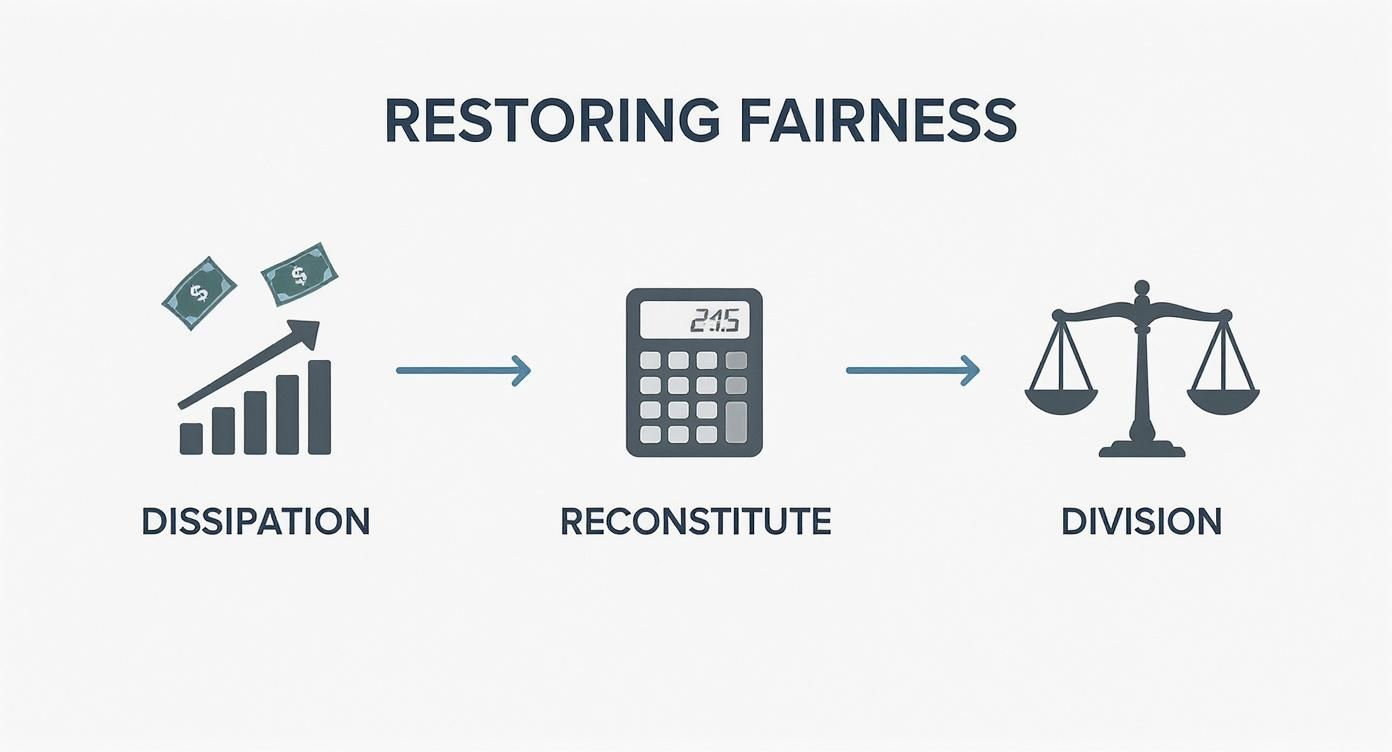
Essentially, the court adds the squandered money back into the marital pot before dividing it, making sure the innocent spouse gets their fair share.
The Role of a Forensic Accountant
In particularly complex financial situations—especially those involving a family business, hidden investments, or intricate money-laundering schemes—a forensic accountant is an invaluable member of your legal team.
These are not typical accountants; they are financial detectives trained to follow money trails, analyze complex data, and uncover hidden assets that might otherwise go unnoticed. A forensic accountant can prepare an expert report and testify in court, providing the judge with a clear, credible, and expert analysis of the financial misconduct and the total value of the wasted assets.
Taking Immediate Steps to Protect Your Finances

If you have that sinking feeling that your spouse is being irresponsible or deceptive with your money, it is critical to understand that time is not on your side. The longer the dissipation of assets continues, the more difficult it becomes to recover what you have lost. Acting quickly and strategically is the best way to protect your share of the marital estate and secure your financial future.
Your first step should be to gather information. Quietly make copies of important financial records, such as bank statements, credit card bills, and loan documents. Monitor any joint accounts for unusual withdrawals or transfers. These initial actions create a financial snapshot that will be invaluable later.
Legal Intervention to Freeze Assets
While collecting documents is a crucial start, the most effective way to stop the financial damage is through decisive legal action. Your family law attorney can petition the court for protective orders that effectively freeze your marital assets. This is not about being punitive; it is about pressing the pause button to preserve the community estate for a fair division.
In Texas, we use two primary legal tools for this purpose:
- Temporary Restraining Order (TRO): A TRO can be requested at the very beginning of a divorce filing. It is a court order that immediately prohibits both spouses from taking certain actions, such as selling property, draining bank accounts, or incurring new debt without the other's permission.
- Standing Orders: Many Texas counties have Standing Orders that automatically apply to every divorce case filed. These orders function similarly to a TRO, preventing either spouse from making significant financial moves while the divorce is pending.
Think of these court orders as a financial firewall. They stop a spouse from continuing to waste or hide assets and level the playing field, ensuring that major financial decisions are made transparently, often with a judge’s approval.
As you begin taking these protective measures, you might find our guide on how you can protect your finances in a divorce offers some additional valuable strategies.
Securing Your Financial Future
Taking control of your finances is an empowering step during a chaotic and difficult time. The global financial landscape is constantly evolving; in fact, recent analyses from McKinsey project that between $6 trillion and $10.5 trillion in assets could be in motion over the next five years as market shares shift. While your situation is personal, by taking immediate action with the help of an experienced attorney, you ensure your portion of the marital estate is shielded from reckless behavior and preserved for your future.
Common Questions About Wasted Assets in Divorce
Even after understanding the legal framework, it is completely normal to have questions about how the rules around the dissipation of assets might apply to your specific situation. These cases are rarely black and white, and getting answers to common concerns can help you feel more confident as you move forward.
Here are a few of the most frequent questions we hear from clients facing these challenging financial issues.
Is a Failed Business Investment Considered Dissipation?
This is a nuanced question, and the answer often depends on intent and reasonableness. A business investment made in good faith during the marriage that simply did not succeed is not typically considered dissipation. Spouses are permitted to take calculated risks together.
However, the analysis changes if the investment was outrageously reckless, made against your explicit wishes, or was clearly designed to benefit someone else (like a new romantic partner). The court will examine whether it was a legitimate business decision or merely a scheme to deplete community funds.
How Far Back Will a Court Look for Improper Spending?
While there is no strict statute of limitations in the Texas Family Code for this, courts generally focus on spending that occurred as the marriage was deteriorating or in the period leading up to the divorce. Although a judge could technically examine transactions from years prior, the most scrutinized period is almost always the one immediately preceding separation.
The key is demonstrating that the spending was connected to the breakdown of the marriage and was an attempt to drain the community estate before it could be divided.
What Is the Difference Between Dissipation and Poor Money Management?
This is a critical distinction. Dissipation involves an element of wrongdoing or bad faith. It is about spending community money for a purpose unrelated to the marriage in a way that unfairly harms the community estate.
Poor money management, on the other hand, simply means being financially irresponsible. If your spouse has always been a free spender or made questionable financial choices that were part of your marital dynamic, a court is unlikely to label it dissipation. The law is not designed to punish someone for being a poor money manager if that behavior was known and tolerated throughout the marriage.
The core difference comes down to fairness. Dissipation is a "fraud on the community"—it is spending that is intentionally selfish and often secretive. Bad financial habits, on the other hand, are typically viewed as part of the shared marital experience.
What Happens If There Are Not Enough Assets Left to Compensate Me?
This is a difficult but real possibility. A court can grant you a judgment awarding you a larger share of the remaining property, but it cannot create assets out of thin air. If your spouse has truly wasted everything and there is little left to divide, collecting the amount you are owed becomes a significant challenge.
In these situations, the judgment may need to be satisfied through other means in the future, such as garnishing future income or seizing other assets that may appear later. Your attorney can explore all available legal avenues for enforcement to help you recover as much as possible.
If you need help navigating divorce, custody, or estate planning in Texas, contact The Law Office of Bryan Fagan, PLLC today for a free consultation.