
When your marriage hits a rough patch, figuring out the next step can feel completely overwhelming. This can be one of life’s most difficult transitions, but understanding your rights under Texas law can make it less overwhelming. Many Texans start by asking how to file for a legal separation, only to discover a surprising fact: Texas doesn’t actually have a formal, standalone “legal separation” status.
But that doesn’t mean you’re out of options. Far from it. You can still achieve all the goals of a separation—like setting up financial boundaries, creating a custody schedule, and formalizing separate living arrangements—using other powerful legal tools available under Texas law. We are here to help you feel supported and understood as you explore these options.
Understanding Separation When Divorce Feels Too Final
Going through marital trouble is an emotional rollercoaster, and jumping straight to the finality of divorce isn’t always the right first move. You might need space to think, go to counseling, or just see if things can be worked out. We see this with our clients every day, and we know how important it is to have breathing room.
Fortunately, Texas law recognizes this need for a structured “in-between” phase. While you can’t file a petition for “legal separation,” you can use specific legal instruments to create an enforceable, court-ordered separation that protects you, your kids, and your assets.
This approach gives you the clarity and stability of a formal separation without pulling the plug on the marriage for good. It allows you and your spouse to live apart under a clear set of rules, giving you the breathing room to make thoughtful decisions about what comes next.
Why You Absolutely Need a Formal Separation Structure
Just moving into separate houses without a legal agreement is a huge risk. Think about it: with no court order in place, there are no rules for your money, your property, or your kids. That ambiguity can spiral into serious problems, fast.
For instance, one spouse could drain a joint bank account, sell the family car, or refuse to let the other parent see the children—and there would be no immediate legal consequence. A legally structured separation puts a stop to that potential chaos.
Here is the practical, actionable guidance we provide to clients to create a separation through Texas legal channels:
- Establish Clear Financial Boundaries: We’ll help determine who pays which bills (like the mortgage or car notes), how joint accounts are handled, and prevent either of you from racking up new debt in the other’s name.
- Create a Predictable Parenting Plan: A formal order will spell out a clear possession and access schedule, often following the Texas Family Code guidelines. This ensures both parents get consistent, guaranteed time with their children. No more guessing games.
- Calculate Support Obligations: The court can order temporary child support and, in some situations, spousal support. This provides crucial financial stability for the kids and the lower-earning spouse while you’re living apart.
- Protect Your Property: Temporary orders can stop either person from selling, hiding, or damaging community property until a final decision is made.
Your Separation Options in Texas at a Glance
So, what tools are actually on the table? Here’s a quick comparison of the legal tools Texas offers to help you structure a separation, highlighting their purpose and a common scenario for each.
| Legal Tool | What It Achieves | When to Use It |
|---|---|---|
| Temporary Orders in a Divorce Filing | Creates court-enforceable rules for custody, support, and property use during the divorce process. | You’ve decided divorce is likely but need immediate structure. This protects both parties while the case is pending. |
| Suit Affecting the Parent-Child Relationship (SAPCR) | Establishes legal custody, visitation, and child support orders for unmarried parents or married parents living apart without filing for divorce. | You’re not ready to divorce but need to formalize parenting arrangements and child support immediately. |
| Partition and Exchange Agreement | A contract that divides community property into separate property, even while you remain married. | You both agree on how to divide assets and want to separate your finances completely without yet filing for divorce. |
These instruments are designed to give you the practical benefits of a separation, creating a safe and structured environment for you to figure out your next steps.
Separation vs. Divorce: A Broader Look
While Texas guides couples toward using tools within a divorce proceeding to formalize a separation, the concept of “legal separation” is a real thing in many other places.
Globally, it’s much less common than divorce because it’s often not tracked as a distinct legal category. Here in the U.S., it’s estimated that only about 1.5–2% of married couples file for legal separation annually. That’s a tiny fraction compared to the 2.3–2.5 divorces per 1,000 people reported each year.
Where it is an option, the main appeal of legal separation is that it lets couples live apart and divide assets while staying legally married. This can be a big deal for things like maintaining health insurance coverage or for religious reasons. You can read more about divorce trends and statistics here.
Ultimately, the legal tools we have in Texas are designed to provide the same practical benefits, giving you a secure foundation from which to make your decision.
If you need help navigating divorce, custody, or estate planning in Texas, contact The Law Office of Bryan Fagan today for a free consultation.
Using Temporary Orders to Create a Legal Separation
When you and your spouse need a break but aren’t quite ready to pull the trigger on divorce, Texas law offers a really practical tool: Temporary Orders.
Think of these orders as a legally binding roadmap for your separation. They set clear, enforceable rules for everything from finances and property use to parenting schedules while your case is ongoing. This structure can bring much-needed stability and predictability during a very uncertain time.
The most common way to get these orders is by filing an Original Petition for Divorce and a Motion for Temporary Orders. Now, I know what you’re thinking—”But we aren’t sure about divorce!” That’s okay. Filing the petition is the legal step required to open the courthouse doors and allow a judge to formalize your separation. It’s the key that unlocks the court’s power to step in and bring clarity to the issues causing the most conflict.
This process can turn a chaotic, emotionally draining situation into a manageable one with court-ordered guidelines. The journey from confusion to clarity is what these legal tools are all about.
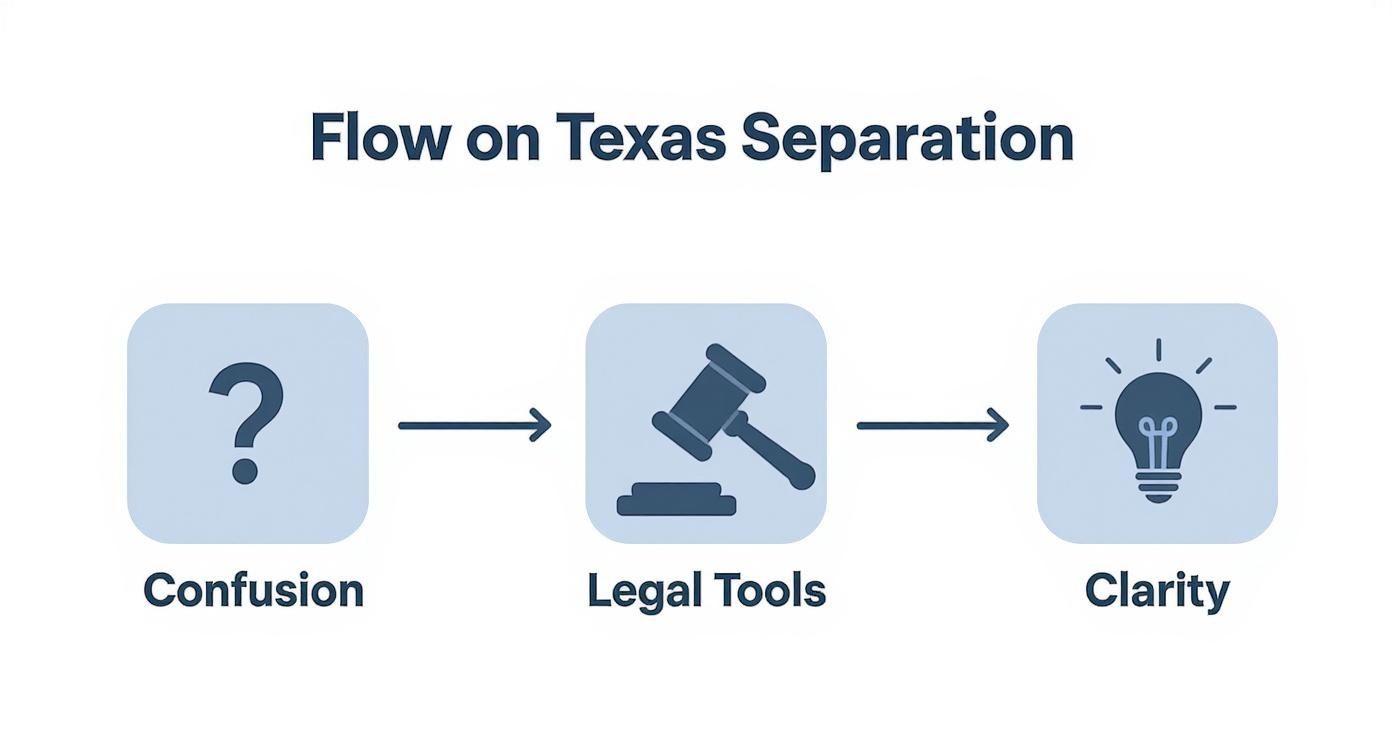
As you can see, the goal is to move your family from a place of instability to one of structure and mutual understanding, even while you’re living apart.
Getting the Ball Rolling in Court
Once you file the petition and motion, your case is officially open. The next step is making sure your spouse is formally notified through a process called service. This is a critical legal requirement; it ensures they know about the lawsuit and have a chance to respond. After service is complete, the court will set a hearing date for your Temporary Orders.
This hearing is where the real groundwork for your separation is laid. A judge will hear from both of you and make rulings on the most pressing issues. The objective isn’t to make any final decisions, but rather to maintain the status quo and make sure both spouses and any children are protected while you figure things out.
It’s worth noting that separation rules can look very different depending on where you are. The process varies wildly from state to state. While all 50 states permit some form of legal separation, the specifics can be night and day. For example, California lets couples file immediately, whereas Nevada—which has the highest divorce rate in the U.S. at about 4.0 per 1,000 people—handles separations through the same court system as divorce. You can find out more about nationwide divorce statistics to see how different states compare.
Gathering Your Essential Documents
Coming prepared for your Temporary Orders hearing is everything. To give the judge a clear financial picture and make the strongest case for your needs, you’ll need to get your documents in order. Your attorney will guide you through this, but you can get a head start by gathering these items:
- Financial Information Statement: This is a sworn court form where you list all your monthly income and expenses.
- Recent Pay Stubs: Usually from the last two or three months to show proof of income.
- Bank Statements: For every personal and joint account to show balances and cash flow.
- Credit Card Statements: To give a clear picture of monthly debts and spending.
- Household Budget: A realistic breakdown of your family’s monthly costs, from the mortgage and car notes to groceries and childcare.
Being transparent with your finances helps the judge make fair, well-informed decisions about who pays for what and whether temporary support is needed during the separation.
A Crucial Takeaway: Temporary Orders are not forever. They are specifically designed to create a stable and predictable environment for a limited time. These orders can remain in place for months or even longer, giving you the breathing room you need before making a permanent decision about your marriage.
Preparing for Your Temporary Orders Hearing
The hearing itself can feel pretty intimidating, but solid preparation will help you present your case with confidence. You and your lawyer will work together to present testimony and evidence about your family’s situation.
Your main goal is to show the judge what’s necessary to create a safe, stable environment for you and your kids while you’re living apart. This means proposing a clear parenting schedule, outlining your financial needs, and explaining who should have temporary use of the family home or vehicles. The judge will make decisions based on what’s in the best interest of the children and what is considered a “just and right” division of responsibilities for now.
Remember, these court-ordered rules are not just suggestions—they are legally binding. If your spouse ignores the Temporary Orders, like by not paying court-ordered support or refusing to follow the visitation schedule, they can be held in contempt of court. This comes with serious legal penalties, and it’s this enforceability that makes Temporary Orders such a powerful tool for creating a true legal separation in Texas.
Getting on the Same Page: What Goes into Your Separation Agreement
When you’re navigating a separation, the uncertainty can be overwhelming. That’s where a well-drafted set of Temporary Orders comes in. Think of these court-ordered protections as your formal separation agreement—a roadmap that creates a stable and predictable living situation while you and your spouse figure out what’s next for your marriage. Understanding what these orders cover is the first step toward getting back some control.
At their core, these orders are designed to answer the most immediate and often contentious questions. Who gets to stay in the house? How do the bills get paid? And, most importantly, how are you going to co-parent effectively while living apart? By tackling these issues head-on, the court puts a clear framework in place that protects everyone’s rights and responsibilities.

Creating a Stable Environment for Your Children
For any parent, the top priority is making sure the kids feel safe and secure during this transition. Temporary Orders address this directly by setting firm rules for custody and financial support so there’s no room for confusion.
First, a judge will establish a possession and access schedule. This is just a legal term for a detailed calendar that spells out exactly when the children will be with each parent. In many cases, this follows the Texas Standard Possession Order, which provides a consistent, predictable routine for holidays, weekends, and summer breaks. That predictability is absolutely crucial for a child’s well-being.
The court will also calculate child support based on the guidelines laid out in the Texas Family Code. The parent who doesn’t have the exclusive right to decide where the child lives (often called the non-primary parent) is typically ordered to pay monthly support to the primary parent. This ensures the children’s day-to-day financial needs are met without interruption.
Addressing Financial and Property Matters
Money worries are a huge source of stress during a separation. Temporary Orders are built to bring immediate financial stability and put a lock on your shared assets. Keeping your financial documents in order is critical when drafting these agreements, and it’s worth looking into how cloud-based legal case management software enhances document management to stay organized.
These orders will specifically tackle several critical financial areas:
- Exclusive Use of the Marital Home: The court will decide which spouse gets to continue living in the family house. This decision is often based on what’s best for the children and each spouse’s financial situation.
- Management of Bank Accounts: To prevent one spouse from draining shared resources, a judge might freeze joint accounts or specify how the funds can be used.
- Responsibility for Debts: The court will assign who is responsible for paying monthly bills like the mortgage, car payments, and credit cards. This ensures your credit doesn’t get tanked while the case is ongoing.
- Temporary Spousal Support: If one spouse doesn’t have enough property or earning power to cover their basic, reasonable needs, the court can order temporary spousal support in some situations.
Key Takeaway: Temporary Orders act as a crucial shield for your assets. They legally prohibit either spouse from selling or transferring community property, taking on new debt in the other’s name, or changing insurance beneficiaries. This provides essential peace of mind.
Setting Behavioral Expectations
Finally, these orders almost always include what are known as “injunctions.” These are simply rules for how you and your spouse must behave toward each other during the separation. And they aren’t just suggestions—they are enforceable court commands.
For instance, a judge will typically order both of you to stop any harassing, threatening, or disparaging behavior, especially in front of the children. These rules help lower the emotional temperature and encourage more respectful communication, creating a healthier environment for everyone as you navigate this difficult time. By defining every key term, from financial duties to parenting schedules, your separation can become a period of constructive decision-making instead of chaos.
Other Legal Options for Separation in Texas
When you’re facing a marital split in Texas, filing for divorce and getting Temporary Orders is the most well-trodden path. It’s the standard way to create structure around your separation. But it’s definitely not the only way.
Depending on your family’s unique situation and what you hope to achieve long-term, other powerful legal tools might make more sense. These options let you accomplish specific goals—like separating your finances or setting up a solid parenting plan—without pulling the trigger on the divorce process itself.
It’s always smart to understand all the avenues available. For some, the top priority is financial independence. For others, it’s all about locking in a stable co-parenting routine for the kids. The good news is, Texas law has distinct solutions for both scenarios.

For Financial Separation: The Partition and Exchange Agreement
Let’s say one spouse owns a growing business. They want to stay married for personal reasons but are worried about the business getting tangled up in their community estate. This is a classic scenario where a Partition and Exchange Agreement is the perfect tool.
This is a formal, legally binding contract that allows a married couple to convert their community property into separate property. In plain English, you and your spouse can agree to divide your assets and debts however you see fit. Once the agreement is signed, those assets legally belong to each of you individually, as outlined in the Texas Family Code.
This can be incredibly useful in a few different situations:
- Protecting Business Assets: Just like in the example above, it shields a business from any future community property claims.
- Estate Planning: It can make inheritance planning much simpler down the road by clearly defining what belongs to whom.
- Gaining Financial Independence: For couples who want to keep their financial lives separate for personal, religious, or even health insurance reasons, this agreement creates a clean legal boundary.
A Partition and Exchange Agreement lets you formally untangle your finances while remaining married, offering a level of asset protection that just living apart can’t provide. You can get a deeper dive into how Texas law handles property in our guide on community vs. separate property.
For Co-Parenting Without Divorce: The SAPCR
What if your main worry is creating a stable, enforceable plan for your kids, but divorce isn’t on the table right now? This is exactly where a Suit Affecting the Parent-Child Relationship (SAPCR) comes in.
A SAPCR (we pronounce it “sap-sir”) is a standalone lawsuit. Its sole purpose is to establish custody, visitation schedules, and child support without being tied to a divorce case. It’s the go-to legal tool for parents who were never married, but it’s also available to married couples who are living apart and don’t plan to divorce anytime soon.
A Real-World Example: I once worked with a couple who decided to live separately for the long haul. They got along fine but wanted a formal, court-ordered schedule to avoid future fights over holidays or summer vacation with the kids. Filing a SAPCR gave them a legally binding order that both parents had to follow, which brought a ton of stability to their children’s lives.
This route allows you to focus only on the children’s best interests. You’ll end up with the same detailed parenting plan and support orders you would in a divorce, but without officially starting the process to end your marriage. Globally, finances and demographics play a huge role in why marriages end. In the U.S., where the divorce rate is 2.3 per 1,000 people, many couples under economic stress see divorce as the only option. But some, especially older couples in “gray divorces,” might look for alternatives to protect tax or pension benefits. You can discover more insights about these U.S. divorce statistics here. A SAPCR is a powerful alternative that puts the kids first.
If you need help navigating divorce, custody, or estate planning in Texas, contact The Law Office of Bryan Fagan today for a free consultation.
What Happens After the Separation Period?
Think of a structured separation period, like one set up with Temporary Orders, as a much-needed timeout. It’s a chance to step back, get counseling, and think clearly without the day-to-day pressures that may have been straining your marriage.
Once you’ve had this space, you’ll find yourself at a crossroads with two main paths you can take. For some, the time apart makes it clear that the marriage can’t be saved, and divorce is the right choice. For others, it’s a time of healing that actually brings them back together. The legal groundwork you’ve already laid will help you move smoothly down whichever path you choose.
Moving Forward with Divorce
If you and your spouse agree that ending the marriage is the best decision, all the work you put in at the beginning gives you a major head start. Those Temporary Orders you’ve been living under? They often become the roadmap for your Final Decree of Divorce.
Because you’ve already figured out the toughest parts of living separately, the final steps of the divorce are often much simpler.
- Parenting Plans: The possession schedule you’ve been using for the kids can easily become the permanent plan.
- Support Orders: The temporary child and spousal support amounts you agreed on can be carried over into the final decree.
- Property Division: You’ve already been managing your own finances and living in separate spaces, which makes the final, official division of your community property far less complicated.
This foundation makes the final stages of your divorce so much smoother. You’re not starting from square one; you’re just making an arrangement you’ve already test-driven official. This typically means less conflict, lower legal bills, and a more peaceful transition for your family.
Our Goal Is a Smoother Transition: By using Temporary Orders to structure a separation, we aim to make the potential transition to divorce as seamless as possible. You’ve already done the heavy lifting, allowing the final steps to be more about paperwork than painful negotiation.
Choosing the Path of Reconciliation
Sometimes, a little space and structure are exactly what a marriage needs to get back on track. If you and your spouse decide to reconcile after your separation, the process to close out the legal case is refreshingly simple. Filing for divorce doesn’t lock you into it.
To officially end the divorce case, your attorney will file what’s called a Notice of Non-Suit. This is a straightforward document that tells the court you’re no longer moving forward with the divorce. Once the judge signs off on it, it’s as if the case was never filed in the first place.
Here’s what happens when you non-suit your case:
- The divorce case is officially closed.
- All Temporary Orders immediately become void and are no longer enforceable.
- You and your spouse go back to your legal status as a married couple, with no pending court case.
This gives you the freedom to choose reconciliation without any legal strings attached. It shows that a structured separation isn’t just a slow march toward divorce—it’s a tool to help you make the best possible decision for your family, whatever that future may be. You can learn more by reading our complete guide to the divorce process in Texas.
If you need help navigating divorce, custody, or estate planning in Texas, contact The Law Office of Bryan Fagan today for a free consultation.
Common Questions About Separation in Texas
When you’re starting to think about separating, a million practical questions can start swirling around. It’s a stressful time, and that uncertainty doesn’t help. Getting some clear, straightforward answers is the first step toward feeling like you have a handle on things. Here are some of the most common concerns we hear from clients when they’re figuring out how a legal separation works here in Texas.
Can I Date Someone While I’m Separated?
This is probably the number one question we get, and the answer is a bit tricky. Even though you’re living apart, you are still legally married until a judge signs that Final Decree of Divorce. Because of that, dating another person is technically considered adultery under the Texas Family Code.
Now, while adultery is a “fault ground” for divorce, it doesn’t always blow up the property division unless you’ve been spending marital money on the new relationship. The real danger is how it can complicate child custody. Your spouse could easily argue that your new relationship isn’t in your child’s best interest, and that’s something a judge will definitely listen to. It’s always best to talk to an attorney about your specific situation before you start dating.
How Long Can Temporary Orders Last?
There’s no expiration date stamped on Temporary Orders. They are designed to stay in place until one of two things happens: the court issues a new, modified order, or a final order like a divorce decree is signed.
This flexibility is exactly what makes them such a powerful tool for a long-term separation. We see many couples live under the rules of their Temporary Orders for months, sometimes even years, while they figure out what’s next for their marriage. Just be aware, it’s not a permanent fix. If a case sits inactive for too long, a court can eventually step in to push for a final resolution or even dismiss it for want of prosecution.
A Key Insight: The open-ended nature of Temporary Orders is what gives couples the breathing room they need. It creates a structured, stable separation that can last as long as necessary without the finality of an immediate divorce.
What Happens to Our Health Insurance During Separation?
Keeping health insurance coverage is a huge worry for most families, and for good reason. Thankfully, Temporary Orders almost always include a specific rule that prohibits either spouse from kicking the other or the kids off any existing health, dental, or vision plans.
Because you are still legally married during the separation, eligibility for a spouse’s plan typically continues without a hitch. This protection stays in place right up until the day your divorce is finalized. For many people, this is a major reason to choose a structured, longer-term separation over a quick divorce—it guarantees the whole family stays covered.
Do I Have to Move Out of the House?
No, not unless a judge orders it. In Texas, one spouse can’t just kick the other out of the marital home, even if the house is only in one person’s name. The issue of who gets “exclusive use” of the home during the separation is one of the biggest things decided at a Temporary Orders hearing.
A judge will hear both sides of the story and make a decision based on a few key things:
- The financial situation of each spouse.
- Which parent is going to be the primary caregiver for the children.
- What is in the overall best interest of the kids, which often means keeping them stable in the family home.
This court-driven process ensures no one is unfairly forced out of their home without careful consideration. You can get a deeper understanding of how property is handled by checking out our guide to community versus separate property in Texas.
If you need help navigating divorce, custody, or estate planning in Texas, contact The Law Office of Bryan Fagan, PLLC today for a free consultation.



