

When a child’s well-being is at stake and their parents are unable to fully care for them, whether due to incapacity, death, or other serious circumstances, the decision about who will step in becomes critical. For many families, understanding the various options for guardianship and care is essential. In Texas, multiple pathways exist to ensure that a minor-aged child has an adult who can make important decisions and act in the child’s best interests. This article offers a detailed examination of those options: what they are, how they differ, and what you should consider before selecting one.
Before diving into the specific types of guardianship and alternatives, we have to understand first what the law in Texas says about guardianship of minors, how “minor” is defined, and what the starting points are for families faced with this question. Then, we can move into comparing the different options, exploring benefits, drawbacks, legal requirements, and strategic considerations.
Understanding Guardianship of Minors Under Texas Law
First, it’s important to know what it means when we talk about guardianship of a minor under Texas law. A “minor” in Texas is someone under 18 years of age who has not been married or had their minority removed.
Texas law identifies natural guardians and court-appointed guardians. For example, under Texas Estates Code Section 1104.051, if the child’s parents live together, both are natural guardians of the person of the children, and one parent may be appointed as guardian of the estate if needed. If the parents do not live together, the court assigns guardianship of the minor children to one parent, considering only the best interests of the children.
In some cases the parents may die, or be unable to act, in which case the court turns to next of kin, or a person designated by the parents in a will or written declaration.
Thus any comparison of options must sit on the foundation of who currently holds care and decision-making authority for the minor, what legal rights that person has, and whether a court-ordered guardianship is necessary or just voluntary arrangements will suffice.
What Other Options are Worth Knowing?
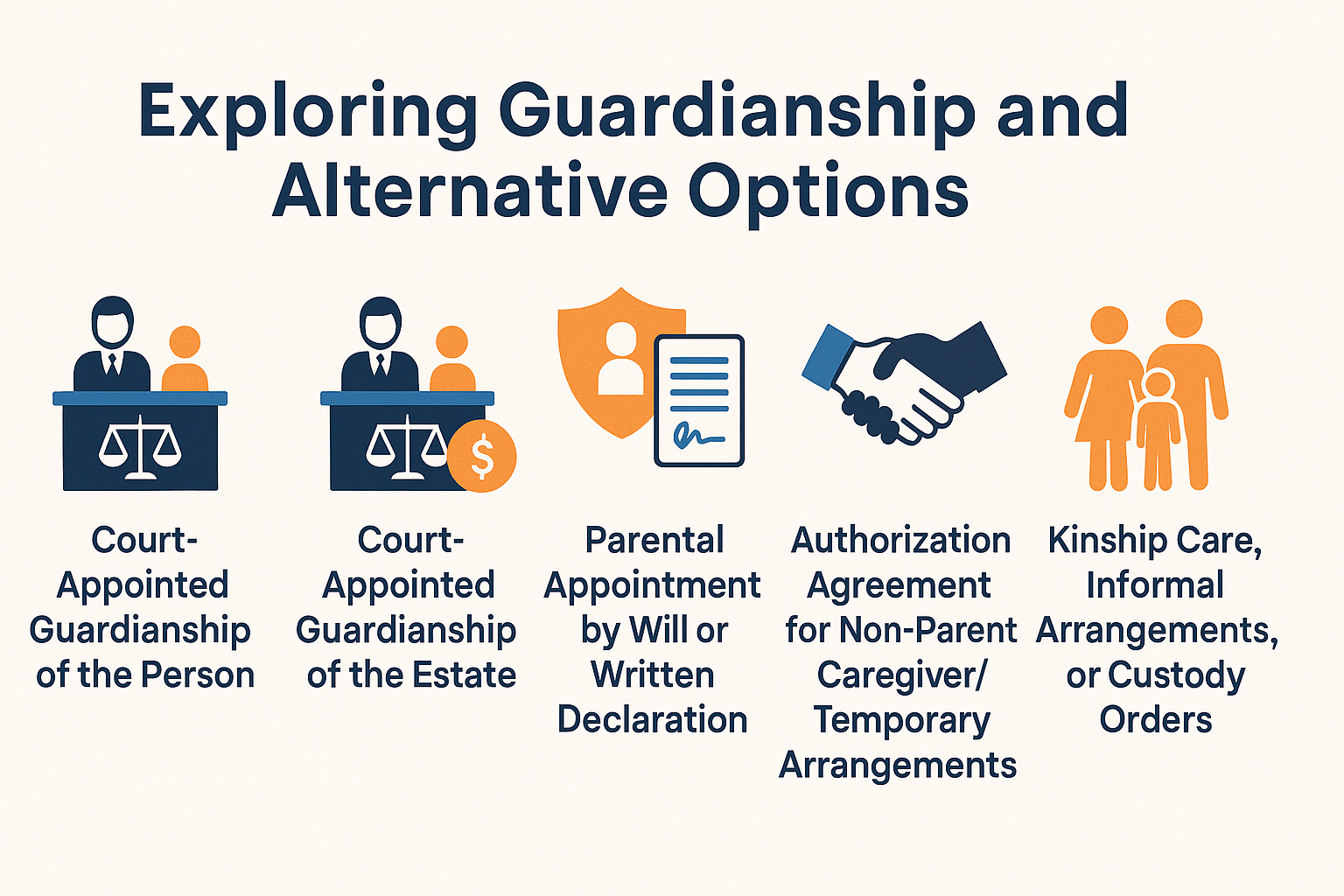
Let’s compare several of the main options for a minor’s care or decision-making authority in Texas, highlighting how they differ and what families should weigh.
Option A: Court-Appointed Guardianship of the Person
In this option a court formally appoints a guardian who has the legal authority to make decisions for the minor’s personal care: where they live, their schooling, medical decisions, welfare, etc. The guardian is responsible for the child’s well-being until the child turns 18 (or the court orders otherwise).
What to know:
- The process involves filing a petition in the appropriate Probate Court.
- The court will look to whether the minor’s best interests are served.
- A guardian may be required to report to the court, attend hearings, and possibly meet other oversight obligations.
- When one parent is deceased or absent, or parents are unable to act, this is often the route taken.
Pros:
- Offers a formal legal structure and clear authority for decision-making.
- Ensures oversight and protection of the minor’s rights.
- Particularly useful when the minor’s needs are complex or when there is no willing or able parent.
Cons:
- It can be costly, time consuming, and involves court proceedings and filings.
- Once in place, terminating or modifying guardianship may require court action.
- It may remove or diminish parental rights depending on circumstances and the court’s order.
Option B: Court-Appointed Guardianship of the Estate
When a minor has assets such as inheritance, trust funds, or other property, the court may appoint a guardian of the estate. That guardian’s role is to manage the minor’s financial assets, invest, safeguard, and report to the court.
Often, the same person or entity may serve both as guardian of the person and estate, but they can be separate.
Key considerations:
- Requires tracking of assets, potentially court-approval of expenditures, and financial reporting to the court.
- Ensures someone legally accountable manages the minor’s assets rather than a parent or informal caregiver who might not have access or oversight.
- If you anticipate a minor having significant assets (for example trust distributions, real estate, etc.), this option becomes especially relevant.
Option C: Parental Appointment by Will or Written Declaration
Parents in Texas may prepare in advance by naming a preferred guardian in their will or in a written declaration. Under Texas Estates Code Section 1104.053, a surviving parent may designate a person to serve as guardian of their minor children’s person or estate.
Why this matters:
- This approach gives parents direct control over their child’s future in case they become unable to act themselves.
- Courts will generally respect the parent’s designation unless disqualified, unwilling to serve, or not in the child’s best interest.
- It avoids or reduces disputes among family members when the parents are no longer able to act.
Limitations:
- It still may require court action to formalize the guardian appointment after the parent’s incapacity or death.
- If the designated person is unable or unwilling, the court must then select another person.
- This does not always address the estate-management side unless explicitly drafted.
Option D: Authorization Agreement for Non-Parent Caregiver/Temporary Arrangements
Not every situation requires full court-appointed guardianship. Texas law offers less formal options for non-parents to care for a child, such as an “Authorization Agreement for Nonparent Adult Caregiver” under Family Code Chapter 34.
What this can cover:
- A parent may sign a document authorizing another adult (e.g., grandparent, family friend) to make decisions for a child: medical treatment, school enrollment, insurance, job application, etc.
- The parent retains rights, and this arrangement can be canceled in writing.
- This can be useful when the parent is temporarily unable to act (military deployment, health issues, travel) but does not anticipate permanent incapacity or death.
Benefits:
- Less expensive, faster, more flexible than court-appointed guardianship.
- Provides legal authority for caregiver to act on child’s behalf without stripping parent’s rights.
Drawbacks:
- Because it is voluntary and revocable, it may not be sufficient if the parent loses capacity or dies.
- It does not provide the same level of court oversight and protection as guardianship.
- It may not cover estate management or long-term disability of the parent.
Option E: Kinship Care, Informal Arrangements, or Custody Orders
While not strictly labeled “guardianship,” many families rely on kinship (relatives) or informal caregiving arrangements when a parent is unable to care for a child. Some may seek a formal custody order through a Suit Affecting the Parent-Child Relationship (SAPCR).
Noteworthy points:
- If a child has lived with a caregiver for six months or longer, a caregiver might pursue legal custody rather than guardianship.
- These arrangements may preserve parental rights (or modify them) rather than fully replace them with a guardian.
- They may be less formal and less costly, but may not offer the full legal authority to act like a guardian would in all areas (especially estate management).
Choosing the Right Option: A Comparison
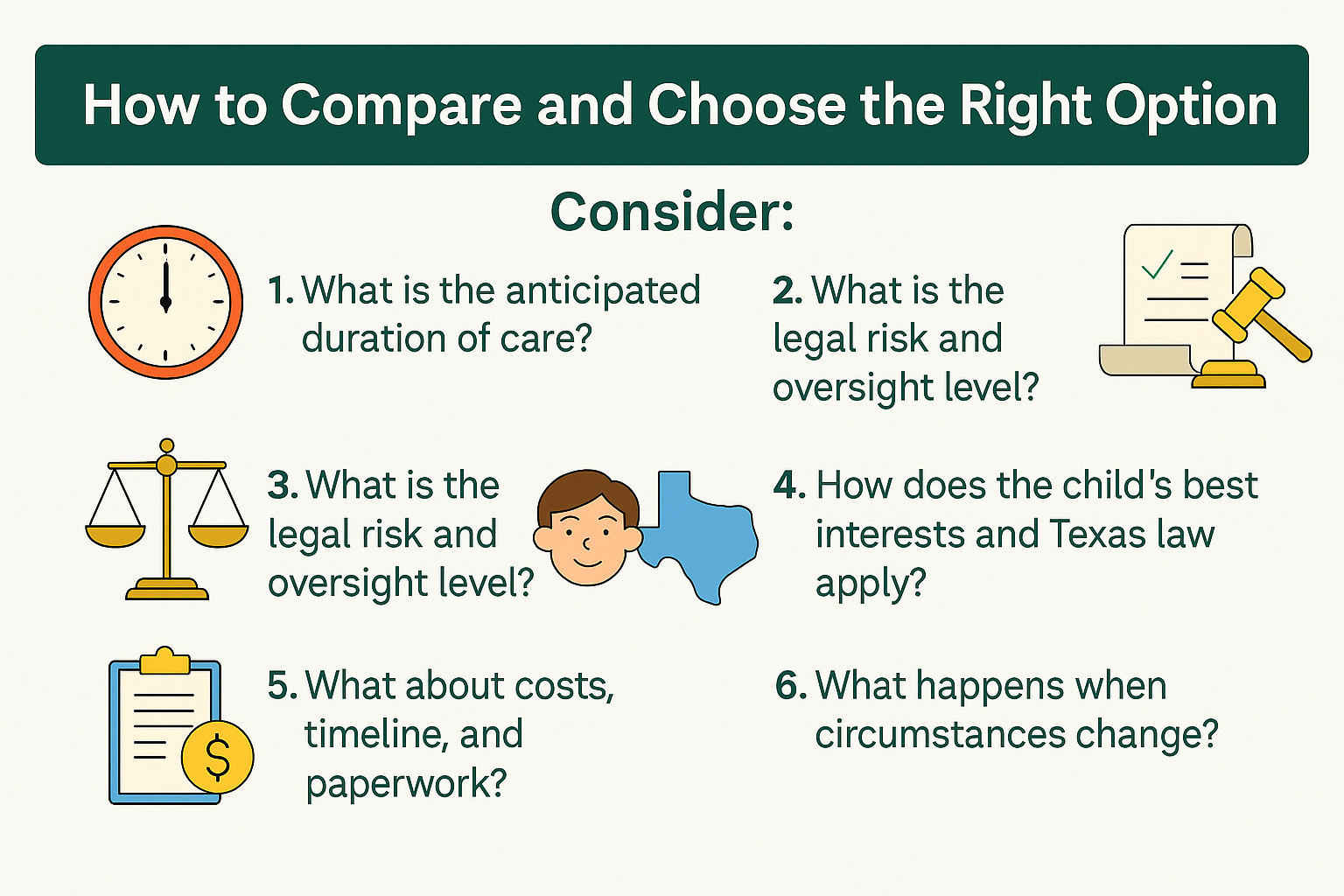
Given multiple viable options, families should consider several factors when deciding which arrangement makes the most sense.
1. What is the anticipated duration of care?
- If a parent is temporarily unavailable, an authorization agreement or kinship custody might suffice for short-term care.
- If a parent is incapacitated permanently or deceased, the stronger guardian or estate-guardian options may be more appropriate.
- If the minor has substantial assets, a guardian of the estate or combined guardian person/estate may be required.
- Does the child need someone to make daily care decisions (living arrangements, schooling, medical treatment)?
- Does the child have funds or property that need managing?
- If yes, make sure the option you choose grants those powers (estate guardian or combined guardian).
- If not, an informal alternative may be sufficient.
3. What is the legal risk and oversight level?
- A court-appointed guardian brings strong oversight (court filings, reports, reviews). This is a benefit if there is risk of mismanagement, but may bring cost and more formal requirements.
- Informal arrangements or authorization agreements offer speed and flexibility but less oversight and may leave gaps.
- Parents should weigh whether they want a formal legal structure or prefer speed and lower cost.
4. How does the child’s best interests and Texas law apply?
- Texas law dictates that guardianship decisions for minors must be made in the child’s best interests.
- If parents have already designated a guardian, the court will honor that designation so long as the person is qualified.
- Courts will review the suitability of the guardian to ensure it meets the child’s welfare, not just the guardian’s wishes.
5. What about costs, timeline and paperwork?
- Court-appointed guardianship typically requires filing fees, attorney fees (in many cases), documentation, background checks.
- Informal alternatives are lower cost but may leave gaps if circumstances change (e.g., parent becomes permanently incapacitated).
- Preparing ahead of time (e.g., via will or declaration) often reduces later delay and conflict.
6. What happens when circumstances change?
- If the minor turns 18, guardianship automatically ends in most setups for minors.
- If a parent recovers capacity, dies, or the guardian cannot serve, you may need to revisit the arrangement.
- If assets grow, or the child acquires needs (e.g., disability), you may revisit estate-guardian or special needs trust options.
Other Additional Considerations
Families should also consider these often-overlooked aspects:
- Standby Guardianship or Contingent Appointment: Although less common, designating a standby guardian who will take over if a trigger event occurs (e.g., prolonged illness) can help smooth transitions.
- Coordination with Estate Planning: Guardianship of a minor often intersects with a parent’s estate plan—trusts for a minor’s inheritance, the parent’s will naming a guardian, etc. Making sure all documents align avoids conflicts.
- Impact on Public Benefits and Minor’s Assets: If the minor is or may become eligible for government benefits, asset management becomes important. Appointment of a guardian of the estate may trigger reporting requirements or affect benefits. (See guidance for minors with assets in Texas).
- Transition Planning for When the Child Reaches Majority: While guardianship ends when the minor turns 18, planning ahead for a smooth transition—such as into independent living, educational support, or ongoing care—helps avoid caregiver gaps.
- Alternative Dispute Risk: If relatives or friends disagree about who should serve as guardian, it may lead to litigation or contested proceedings. Clear early designation and communication reduce this risk.
- Cultural or Geographic Considerations: A child residing out-of-state or with extended family in different jurisdictions may complicate guardianship. Consider whether guardianship orders from one state will be recognized elsewhere.
- Monitoring and Review Obligations: Some court-appointed guardians must file annual reports, financial accounts, or face oversight. Understanding these ongoing duties is vital for the guardian and the family.
Making the Decision: Next Steps
When it is time to move from consideration to action, here are practical next steps you can follow:
1. Clarify the child’s current situation: Who is the parent(s)? Are they able to care for the child now or only temporarily? Is the child’s residence stable? Does the child have assets or special needs?
2. Identify potential guardians: List trusted individuals like relatives, close family friends, who know the child, are willing to assume responsibility, and meet basic qualifications (e.g., adult, no disqualifying record).
3. Review current documents and parents’ wishes: Is there a will or written declaration naming a guardian? Is there a trust for the child’s assets? Do parents want to specify decision-making guidelines for the child’s care or assets?
4. Evaluate options: Based on duration of care needed, decision-making authority, cost, oversight, choose which guardian option fits best (court guardian, authorization agreement, custody order, etc.).
5. Consult legal advice: Consultation with a family lawyer, especially in Texas, is wise. They can confirm eligibility, filing requirements, forms, and help you choose the best structure for guardianship.
6. Prepare documentation: If using an authorization agreement, ensure parents sign with appropriate formalities (notarization, certified mailing to other parent as required). If court guardianship, gather forms, background check information, asset documentation if estate guardian.
7. Implement and revisit periodically: After the set arrangement is in place, update as circumstances change (child moves, guardian becomes unable, new assets arise, minor develops special needs). Review at least once a year or after major life events.
Conclusion
Choosing how a minor will be cared for and protected when their parents cannot act is a deeply meaningful decision. Whether you decide on a court-appointed guardian of the person, a guardian of the estate, a parental designation in a will, an authorization agreement for a caregiver, or an informal custody/kinship arrangement, you should proceed with full awareness of the implications, rights, and responsibilities.
By carefully comparing the options and aligning your choice with the child’s best interests, you will help establish a secure, dependable environment for the minor. With thoughtful planning and appropriate legal steps, you set a foundation for stability and care that serves the child today and into their future.
Other Related Posts
- Why You Need an Attorney for Living Will Decisions and Planning
- Finding the Right Texas Special Needs Trust Lawyer for Your Family’s Future
- Is a Living Will Legally Binding and How It Works in Real Situations
- Key Benefits of Minor Guardianship in Texas: Legal Protection and Parental Support
- Creating a Living Will: A Clear Legal Framework for Your Future Care
- How to File for Temporary Guardianship the Right Way: What You Need to Know
- Understanding the Cost of Special Needs Trust for Long-Term Planning
- How to Set Up a Living Will: Step-by-Step Legal Planning Guide
- Texas Guardianship Attorney Services: Essential Legal Support for Families
- Special Needs Trust Medicaid Guide: Protecting Benefits Without Sacrificing Support
- Advance Directives vs Living Will: A Practical Comparison for Medical Planning
- Texas Court Guardianship Evaluation Process: How It Works and What to Expect
Frequently Asked Questions
A guardian of the person is authorized to make decisions about the minor’s daily care, education, living arrangements, and medical treatment. A guardian of the estate manages the minor’s assets, investments, property, or any financial interests. Sometimes one person may hold both roles, but each addresses different aspects of the minor’s care or finances.
Yes. In Texas, a parent may designate a person to serve as a guardian of the child’s person or estate in a will or in a written declaration. The court will typically honor that designation unless the designated person is unwilling or unsuitable.
Not always. An authorization agreement (under Family Code Chapter 34) allows a non-parent adult to make decisions for the child (such as school, healthcare, and insurance) but the parent retains the right to cancel the agreement and it might not cover estate/financial issues. If the parent becomes incapacitated or the minor acquires assets, a court-appointed guardian may still be necessary.
A court may appoint a guardian when parents are deceased, unavailable, or unable to care for the child, or when the child’s assets require management. Under Texas law the court assigns guardianship by considering the best interests of the children.
In Texas, guardianship of a minor typically ends when the child reaches the age of majority (18 years old) or when the court determines the guardianship is no longer needed. For minors, the duration is generally limited to their minority period.