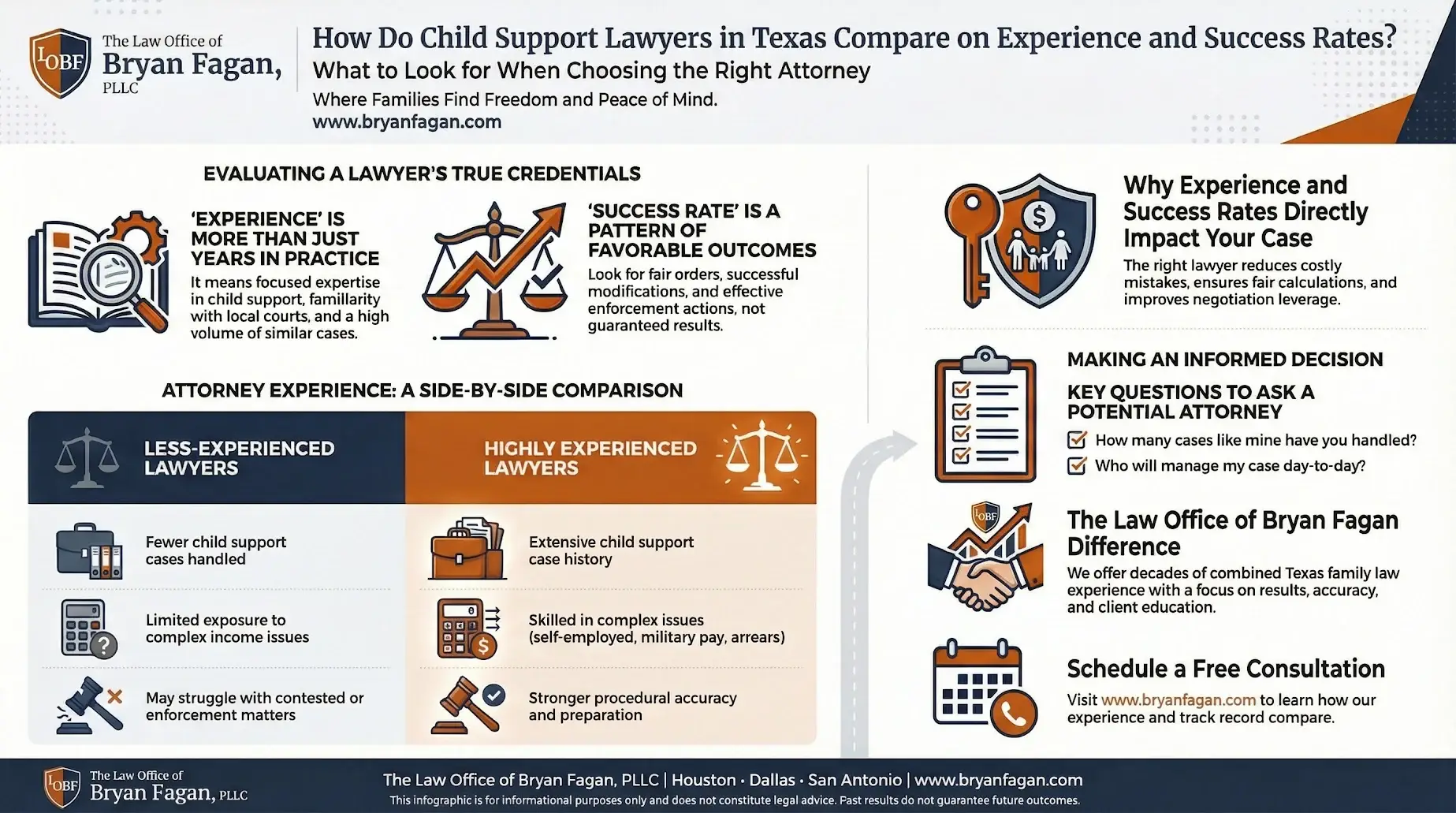

How Do Child Support Lawyers in Texas Compare on Experience and Success Rates is a question many parents begin asking at a quiet, unguarded moment—like when the kids are finally asleep and the weight of everything you are carrying settles in. You may be staring at two calendars that no longer line up, a budget that suddenly feels tighter, or a custody schedule that looks reasonable on paper but feels overwhelming in real life. In those moments, the question is not just “Do I need a lawyer?” It is “Does the right lawyer actually make a difference for my family?”
In Texas, child support is about far more than monthly payments. It is about stability during a season of change. Texas courts are guided by the “best interest of the child” standard under Texas Family Code §153.002, and judges know that financial consistency and reduced conflict help children feel secure when family structures shift. An experienced child support lawyer understands how to balance legal precision with human reality—how to apply the law in a way that protects both a child’s needs and a parent’s peace of mind.
At The Law Office of Bryan Fagan, PLLC, we believe families deserve more than legal answers—they deserve clarity, compassion, and a steady path forward. Led by Bryan Joseph Fagan, a South Texas College of Law graduate and recognized authority on Texas divorce and custody law, our Houston-based firm is built on a simple purpose: empowering people to reclaim freedom and peace of mind during life’s hardest transitions. In the sections ahead, you will learn what truly distinguishes child support lawyers in Texas, how experience shapes outcomes long after a case ends, and why choosing the right legal guide can bring calm and confidence back into your home.
Key Takeaways
- Experience depth matters more than years licensed—look for attorneys who focus specifically on child support cases within Texas family law rather than general practitioners
- Success rates cannot be measured by simple percentages; evaluate lawyers based on their approach to strategy, preparation, and realistic goal-setting
- Board-certified family law attorneys represent only about 10% of Texas family lawyers and typically achieve better outcomes in complex cases
- Ask specific questions about case volume, enforcement experience, and familiarity with complex income scenarios before hiring
- The right attorney will help you understand Texas Family Code guidelines while managing expectations about judicial discretion

Your Family’s Future Starts Here
Don’t navigate your legal journey alone. Schedule a consultation now and get the clarity and support you deserve.
How Do Child Support Lawyers in Texas Compare on Experience and Success Rates? (Short Answer)
How Do Child Support Lawyers in Texas Compare on Experience and Success Rates is a question many parents want answered quickly, but the reality deserves a thoughtful explanation grounded in Texas law and real-world practice. While years licensed can matter, the true differentiator is focused experience. A lawyer with 15 years devoted almost entirely to Texas family law will generally be far more effective than someone with decades in general practice who only occasionally handles child support matters. Specialization leads to sharper strategy, fewer missteps, and better long-term outcomes for families navigating high-stakes financial and parenting issues.
One of the clearest dividing lines between average and exceptional attorneys is mastery of the Texas Family Code. Chapter 154 governs child support calculations, starting with guideline percentages based on net resources. While the baseline formula appears simple, recent updates—such as the increase to the guideline cap on net monthly resources to $11,700 under Texas Family Code §154.125(a-1), effective September 1, 2025—have added layers of complexity. Experienced child support lawyers know how to address issues like self-employment income, Schedule C deductions, bonus and commission averaging, and income imputation under §154.066 when a parent is voluntarily underemployed. They also understand when courts may deviate from guidelines and how to present evidence that supports a fair and legally sound result.
When parents compare lawyers based on “success rates,” it is important to look beyond win–loss statistics. Meaningful success is often achieved long before a judge takes the bench. Skilled attorneys focus on meticulous financial documentation, strategic negotiation, and realistic goal-setting informed by how local courts apply the law. This approach not only protects clients financially but also reduces conflict, which is often in a child’s best interest under Texas Family Code §153.002. When litigation is unavoidable, courtroom experience matters. Familiarity with enforcement tools such as wage withholding under Chapter 158, license suspension under Chapter 232, and contempt proceedings can make the difference between an order that exists on paper and one that actually works in real life.
Families seeking deeper insight into how legal experience translates into results may also find value in reviewing related resources like Comparing Success Rates Among Texas Child Custody Attorneys, which explores how preparation and specialization shape outcomes in closely related custody matters. By understanding how How Do Child Support Lawyers in Texas Compare on Experience and Success Rates in practice—not just in marketing claims—parents are better equipped to choose representation that protects stability today and safeguards their family’s future.

Why Experience Matters in Texas Child Support Cases
Experience directly impacts results in ways that parents rarely appreciate until they are deep into their case. Consider the difference between an attorney who has handled hundreds of child support matters and one who handles a few each year.
Familiarity with Texas Family Code Guidelines
Texas child support guidelines, formalized in 1987 and refined through amendments like House Bill 409 in 2019, require nuanced interpretation. Experienced attorneys understand that while guidelines provide starting points, judges retain discretion in specific circumstances. They know when deviations are likely and how to build evidence supporting adjustments.
The 2019 amendments refined income calculations for self-employed parents, mandating detailed Schedule C scrutiny and sometimes requiring forensic accounting. Attorneys who began practicing before these reforms may overlook nuances that post-reform specialists handle routinely. This technical knowledge directly affects child support calculations and the money families receive or pay.
Understanding Judicial Discretion
Every Texas judge applies the law somewhat differently. Experienced attorneys know which judges favor strict guideline adherence (some Dallas courts show 92% guideline adherence based on local court analytics) and which are more open to considering factors beyond the formula. This understanding shapes strategy from the initial consultation through final resolution.
Handling Complex Income Scenarios
When one parent owns a business, receives irregular bonuses, or works commission-based jobs, calculating net resources becomes complicated. The non custodial parent’s income might require forensic analysis to determine accurately. Texas Family Code Section 154.066 allows courts to impute income for voluntarily underemployed parents—sometimes establishing minimums of $7,500 monthly—but proving voluntary unemployment requires specific evidence that experienced attorneys know how to gather.
Enforcement Experience
When a parent fails to pay child support, enforcement options include wage garnishment under Family Code Section 158, license suspension per Section 232, and contempt proceedings. Texas recovered $1.2 billion in unpaid support statewide in 2022 through these mechanisms. Attorneys who regularly handle child support enforcement understand how to use these tools effectively, often recovering the full amount owed more quickly than less experienced counsel.
Types of Experience That Distinguish Child Support Lawyers
Child Support Focus vs. General Practice
Family law specialists handle the nuances of child support cases daily. They understand how child support interacts with child custody arrangements, how property division in divorce proceedings affects support calculations, and how to structure child support agreements that protect their clients long-term.
General practitioners who occasionally handle family law matter miss these connections. They may not recognize when a custody arrangement affects child support obligations or understand how joint managing conservatorship versus sole managing conservatorship impacts financial arrangements.
Board certification by the Texas Board of Legal Specialization in Family Law marks elite performers. Only about 10% of Texas family attorneys hold this certification. Studies suggest board-certified lawyers achieve favorable deviations from guidelines 2-3 times more often than generalists, directly affecting the money their clients pay or receive.
Case Volume and Case Variety
Attorneys handling hundreds of child support cases develop pattern recognition that others lack. They have seen how specific circumstances play out across different judges and jurisdictions. They recognize potential problems before they materialize.
Look for attorneys experienced with all three major case types:
- Establishment cases: Setting initial support orders, often in divorce proceedings
- Modification cases: Adjusting orders when there is a substantial change in circumstances
- Enforcement cases: Compelling payment when orders are violated
Each requires different skills and strategies. An attorney excellent at establishing orders may struggle with enforcement, and vice versa.
Courtroom and Negotiation Experience
One reality that often surprises parents is how much courtroom readiness influences outcomes long before a judge ever hears testimony. When families ask How Do Child Support Lawyers in Texas Compare on Experience and Success Rates, one of the most important distinctions is whether an attorney is genuinely prepared to take a case to trial if needed. Lawyers who are confident litigators tend to negotiate from a position of strength. Opposing parties and counsel recognize that preparation, and settlement discussions are often more productive as a result. This approach aligns with the Texas Family Code’s emphasis on reaching orders that serve the child’s best interest under §153.002 while still complying with the statutory child support framework in Chapter 154.
It is true that roughly 75–85% of Texas child support cases resolve through negotiation or mediation rather than a full trial. However, that statistic can be misleading without context. A settlement reached because an attorney is uncomfortable in the courtroom is very different from one achieved after thorough preparation and strategic leverage. Experienced Texas family law practitioners understand how recent updates—such as the increased guideline cap on net monthly resources under Texas Family Code §154.125(a-1), effective September 1, 2025—affect negotiations and know when it is appropriate to push for trial-ready terms versus compromise. This level of preparation often results in agreements that are more durable, enforceable, and less likely to require future modification.
For parents evaluating legal representation, it can also be helpful to explore how experience impacts related areas of family law. Resources like Comparing Success Rates Among Texas Child Custody Attorneys provide additional insight into how preparation and specialization shape outcomes across custody and support matters. By working with seasoned Texas family law counsel who combine negotiation skill with true trial readiness, families are better positioned to secure results that protect both financial stability and long-term peace of mind.

How “Success Rates” Should Be Evaluated
Parents often ask about success rates, but this metric is more complicated than it appears. Texas courts retain discretion in applying guidelines, and confidentiality rules prevent attorneys from publishing detailed case outcomes. More importantly, “success” means different things in different cases.
Defining Meaningful Success
Consider what success might look like in your specific circumstances:
- Obtaining fair guideline support based on accurate income calculations
- Successfully modifying an outdated order after a substantial change in circumstances
- Preventing excessive or inflated support obligations when income is complex
- Enforcing unpaid support efficiently through wage garnishment or other mechanisms
- Protecting parental rights while ensuring the child’s well being
An attorney who reduced a client’s monthly obligation from an inflated $2,000 to a proper guideline amount of $1,200 achieved a significant victory. But that same “reduction” would represent failure for the parent receiving support if the higher amount was justified.
Warning Signs About Success Claims
Be cautious of any firm promising guaranteed outcomes. Texas Disciplinary Rules prohibit attorneys from making such guarantees, and Texas law gives judges significant discretion. Any attorney promising specific results either does not understand Texas family law or is willing to make promises they cannot keep.
Instead of asking for success rates, ask about success indicators:
- How does the attorney measure success?
- What percentage of cases settle versus go to trial?
- How does the attorney handle cases that become difficult?
- What past clients say about their experience and outcomes?
Review platforms like Avvo aggregate client feedback—over 9,300 reviews for Texas child support lawyers—providing valuable personal experience insights. Top-rated attorneys typically maintain ratings of 4.8-5.0 based on client satisfaction with both process and outcomes.
Key Factors That Influence Child Support Case Outcomes
Understanding these factors helps you evaluate whether an attorney has the experience to manage them effectively.
Financial Documentation Quality
Child support calculations depend on accurate income determination. This requires complete financial records, tax returns, pay stubs, and documentation of benefits. Self-employed parents require additional scrutiny—about 25% of Texas parents have non-W2 income according to IRS data.
Experienced attorneys know exactly what documentation to request and how to verify accuracy. They understand when forensic accounting is necessary and how to present financial evidence persuasively.
Complexity of Income Sources
When families ask How Do Child Support Lawyers in Texas Compare on Experience and Success Rates, the distinction often comes down to how effectively an attorney handles complex income issues under Texas law. While W-2 employment generally allows for straightforward calculations, many parents earn income through self-employment, bonuses, commissions, investments, or multiple revenue streams that must be accurately identified and combined. Texas Family Code §154.062 defines “net resources” broadly, requiring careful analysis of tax returns and business records, while the updated Texas Family Code §154.125 reflects the increased guideline cap on net monthly resources now used by Texas courts. Attorneys with deep, Texas-specific experience know when forensic accounting is necessary and how to present detailed financial evidence in a way that supports fair and accurate child support determinations.
Cooperation between parents is another critical factor influencing child support outcomes, as high-conflict cases often last six to twelve months longer than those where parties can work together reasonably. Experienced Texas family law counsel understand how to protect a client’s interests while managing difficult opposing parties, recognizing when mediation is likely to succeed and when litigation becomes unavoidable. This strategic judgment is especially important given the discretion allowed under Texas Family Code §154.123, which permits courts to deviate from guideline support amounts in appropriate circumstances. Families facing additional complexities, such as military service, may benefit from the firm’s educational resource on preparing for the legal challenges of military family law cases, which emphasizes how preparation can reduce uncertainty and improve outcomes.
Judicial discretion and local court practices further separate experienced representation from general practice. Although Texas judges must apply the Family Code, individual courts vary in how they weigh documentation, efficiency, and potential deviations from guideline support under §154.123. Attorneys who regularly practice in specific Texas counties understand these local preferences and tailor their approach accordingly. Parents seeking additional insight into how these laws are applied in real cases may find helpful guidance in the firm’s overview of Texas child support laws and guidelines, which explains how statutory standards are applied in everyday family law matters while reinforcing the firm’s commitment to educating families and protecting futures.

Questions Parents Should Ask When Comparing Texas Child Support Lawyers
When families are evaluating counsel and asking How Do Child Support Lawyers in Texas Compare on Experience and Success Rates, the most productive starting point is a focused, informed consultation. Asking the right questions helps parents determine whether an attorney’s experience aligns with the realities of their case under the Texas Family Code. Because child support matters in Texas can involve establishment, modification, and enforcement under Texas Family Code Chapters 154 and 158, attorneys should be able to explain how frequently they handle child support cases each year, what percentage of their practice is devoted specifically to these matters, and whether they routinely work with enforcement tools such as income withholding orders, license suspension, or contempt proceedings authorized by Texas Family Code §158.001 and related sections.
Experience is not just about volume, but about the type of cases handled. Texas Family Code §154.062 defines “net resources” broadly, which means cases involving self-employed parents, business owners, bonuses, commissions, or multiple income streams require a higher level of financial analysis. Attorneys should be able to discuss their experience with modifications under §156.401, enforcement actions, and complex income scenarios, as well as how they evaluate success beyond simple dollar amounts. Measuring success often includes long-term compliance, enforceability of orders, and outcomes that reflect the court’s discretion under §154.123, particularly after recent updates to guideline caps and evolving court interpretations. An attorney who can walk through a recent challenging case and explain their strategy in practical terms demonstrates both competence and transparency.
Local knowledge and case management also matter significantly in child support outcomes. Judges apply the same statutes statewide, but local procedures and judicial preferences can influence strategy, timelines, and presentation of evidence. Asking about an attorney’s experience in your specific county, who will manage the case day-to-day, how communication is handled, and how legal fees are structured helps set realistic expectations from the start. Families navigating these decisions during or after divorce may also find broader context helpful, including the firm’s analysis of Texas family trends in marriage and divorce rates across the state, which highlights how frequently child support issues arise and why informed legal guidance matters.
Ultimately, experienced Texas family law attorneys answer these questions confidently and with specific examples grounded in the Texas Family Code. Vague or generalized responses often signal limited hands-on experience. The attorneys at this Texas-focused family law firm believe education empowers families, and asking thoughtful questions during your consultation is one of the most effective ways to protect your future and your child’s financial well-being.

Common Mistakes Parents Make When Choosing a Child Support Lawyer
Choosing Based on Cost Alone
Choosing the right legal representation is an investment in your child’s long-term financial stability, not just a short-term expense. Parents often ask How Do Child Support Lawyers in Texas Compare on Experience and Success Rates, and the answer frequently comes down to focus and depth of practice. Attorneys who concentrate exclusively on Texas family law understand how child support is calculated under Texas Family Code §154.062, which defines net resources, and §154.125, which sets the guideline amounts. Staying current matters, especially after the most recent update effective September 1, 2025, which increased the child support guideline cap on net monthly resources to $11,700. That kind of up-to-date knowledge can significantly affect outcomes over the life of a child support order, where even small calculation errors can compound into major financial consequences for families.
Parents are often tempted to save money by hiring a general practitioner who “also does family law,” but child support cases demand far more precision than that approach allows. Issues like prorating bonuses, analyzing commission income, or evaluating self-employment earnings require familiarity with how Texas courts apply discretion within the Family Code framework. Lawyers without a consistent child support caseload may miss these nuances, leading to miscalculations that directly affect children’s financial support. Families seeking a clear explanation of how Texas law applies in real cases can review our comprehensive Texas child support overview, which walks through these rules in plain language.
Experience should also be measured by relevance, not just years licensed. An attorney who handles child support matters daily will often have greater practical insight than someone with decades in practice but limited exposure to family law. That experience shapes case strategy from day one, whether the matter involves negotiation, modification, or enforcement. Equally important is communication. Child support cases can last months or reappear years later through modifications or enforcement actions, making clear, responsive communication essential to reducing stress and uncertainty.
Families benefit most when their attorney combines strategic planning with compassionate guidance. Asking specific questions about how your case will be approached—and receiving thoughtful, individualized answers—signals that your lawyer is prepared to advocate effectively within Texas law. To further educate yourself, our firm encourages parents to explore resources like our in-depth articles on Texas child support modifications, which explain how changing circumstances can legally affect support obligations. By blending legal precision with education and empathy, our team remains committed to protecting children’s futures and empowering Texas families to make informed decisions.
Why the Law Office of Bryan Fagan PLLC Stands Out
When Texas parents ask How Do Child Support Lawyers in Texas Compare on Experience and Success Rates, families seeking clarity often look for more than slogans—they want proof of legal knowledge, real courtroom experience, and an attorney who understands how Texas law actually works in practice. At The Law Office of Bryan Fagan, PLLC, our approach is rooted in educating families and protecting futures, especially during moments when financial stability and a child’s well-being are on the line. Our perspective is shaped not only by thousands of child support cases, but also by broader family trends in Texas, including shifting marriage and divorce patterns that directly influence child support disputes, as discussed in our analysis of Texas marriage and divorce rates.
Extensive experience matters because Texas child support is driven by precise statutory rules. Our attorneys regularly apply Texas Family Code §154.062, which defines “net resources,” and Texas Family Code §154.125, which establishes guideline child support amounts. Staying current is critical—especially after the most recent legislative update effective September 1, 2025, which increased the guideline cap on net monthly resources to $11,700. This knowledge allows our legal team to provide realistic expectations instead of outdated estimates, whether a case involves straightforward W-2 income or complex self-employment and investment earnings. Parents who want a deeper explanation of how these statutes apply can explore our detailed Texas child support overview.
What truly separates experienced child support counsel from general practitioners is the ability to handle financial complexity and conflict. Business owners, commission-based earners, and parents with multiple income streams require a careful analysis of tax returns, Schedule C filings, and financial disclosures. Our attorneys know when standard documentation is insufficient and when forensic accounting becomes necessary to comply with Texas Family Code requirements and withstand judicial scrutiny. Just as important, we understand how judges exercise discretion in contested cases, particularly when parents cannot cooperate and court intervention becomes unavoidable.
Rather than relying on a single viewpoint, our firm uses a collaborative, team-based model so that each child support case benefits from collective experience and careful review. This structure helps prevent oversights and strengthens preparation, whether the goal is negotiation or courtroom advocacy. Success is measured by informed clients, legally sound strategies, and outcomes that align with Texas law while protecting children’s financial security. Through compassionate guidance and practical legal education, our team remains committed to helping Texas families move forward with confidence and stability.

Actionable Checklist for Readers
Checklist: Comparing Child Support Lawyers in Texas
Use this checklist when evaluating potential attorneys:
☐ Verify Family Law Specialization
- Is the attorney board-certified in family law?
- What percentage of their practice involves child support specifically?
☐ Ask About Case Volume
- How many child support cases did they handle last year?
- Do they have experience with your specific case type (establishment, modification, or enforcement)?
☐ Discuss Experience with Similar Cases
- Have they handled cases with income complexity similar to yours?
- What experience do they have with your local courts?
☐ Evaluate Communication
- How responsive were they during initial contact?
- Who will communicate with you throughout your case?
☐ Understand Billing and Strategy
- Are legal expenses clearly explained?
- Can they articulate a strategy specific to your circumstances?
☐ Choose Experience Over Price
- Remember that lower fees often mean less expertise
- Consider the long run financial impact of your support order
Conclusion
Choosing a child support lawyer in Texas is rarely just a legal decision. It is a family decision—one that can shape daily routines, emotional balance, and long-term peace of mind. Experience matters not because it sounds impressive, but because it shows up in the details: clearer guidance, steadier strategy, and fewer surprises along the way. When parents understand what truly separates one attorney from another, they are better equipped to protect what matters most during an already difficult transition.
If you are feeling uncertain or overwhelmed, that is completely normal. Texas family law is complex, and no one should be expected to navigate it alone. Working with an experienced Texas family law attorney can bring clarity to confusing choices and help reduce the stress that often follows families long after paperwork is signed. The right legal partner does more than advocate in court—they help you move forward with confidence and stability.
At The Law Office of Bryan Fagan, PLLC, we believe informed families make stronger decisions. Whether you are just starting to explore your options or facing a child support issue that has been weighing on you for some time, taking a moment to ask thoughtful questions and seek reliable guidance can make all the difference. If nothing else, let this be your reminder that you do not have to have everything figured out today. Sometimes, the most powerful first step is simply choosing support—and giving yourself permission to move forward with a little more peace of mind.
Frequently Asked Questions
In many situations, yes. A child support lawyer is especially valuable when income is disputed, one parent is self-employed, payments are not being made, or an existing order needs to be modified. An experienced Texas family law attorney helps ensure support is calculated correctly under the Texas Family Code and that court orders are written clearly and enforceable, reducing the likelihood of repeated court battles.
Letting emotions dictate decisions is the most common and damaging mistake. Texas judges focus on the child’s best interest under Texas Family Code §153.002, not which parent is angrier or louder. Refusing to cooperate, ignoring court orders, or trying to “win” at all costs often hurts credibility and can negatively impact custody outcomes.
Effective September 1, 2025, Texas increased the child support guideline cap on net monthly resources from $9,200 to $11,700 under Texas Family Code §154.125(a-1). This change primarily affects higher-income cases and may result in higher guideline support amounts where applicable.
Costs vary depending on the complexity of the case, the county, and whether the matter involves enforcement, modification, or contested hearings. Most Texas family law attorneys charge hourly rates and require a retainer. While cost is important, experience often saves families money long-term by avoiding future disputes or poorly written orders.
Yes. Experienced lawyers understand how judges evaluate evidence, how to present income accurately, and how to draft orders that are clear and enforceable. A knowledgeable Texas family law attorney can reduce conflict, improve efficiency, and help families reach more stable outcomes.
Avoid exaggerations, insults, or statements that suggest you do not want to support your child. Judges respond best to calm, factual explanations supported by documentation. Emotional outbursts or accusations without proof can seriously damage credibility.
Missing visitation, ignoring temporary or final court orders, speaking negatively about the other parent to the child, or using the child as a messenger all reflect poorly. Courts want to see consistency, cooperation, and behavior that supports the child’s emotional stability.
The “7-7-7 rule” is an informal term some parents use to describe a rotating possession schedule. It is not an official rule under Texas law. Whether such a schedule works depends on the child’s age, routines, parental cooperation, and distance between households.
Avoid absolute or inflammatory language such as “always,” “never,” “crazy,” or “deadbeat” unless you can back up the claim with evidence. Courts prefer specific facts, timelines, and documentation over emotionally charged statements.