
Divorce can be one of life’s most difficult transitions—but understanding your rights and the potential costs under Texas law can make it less overwhelming. It's one of the first, and most pressing, questions people ask: “What is this actually going to cost me?” The honest answer is, there's no single price tag. The true cost of filing for divorce in Texas isn't one number but a wide spectrum. A simple, uncontested case might run a few thousand dollars, while a complex, high-conflict divorce can easily climb into the tens of thousands, or even more.
Understanding the Financial Reality of a Texas Divorce
Ending a marriage is a challenging journey, and the financial side of it is a huge source of anxiety for most people, mainly because it’s full of unknowns. This guide is designed to pull back the curtain on the costs involved, providing you with the clarity and practical guidance you need to make informed decisions for your future.

Creating Your Financial Roadmap
Think of this article as your financial roadmap for a Texas divorce. We're going to walk through every potential expense you might encounter, breaking down the financial journey into manageable, understandable pieces. Our goal is to demystify the numbers so you can turn that anxiety into a concrete plan.
We will explain the key financial components, including:
- Initial Filing Fees: These are the non-negotiable court costs required just to get your divorce case started.
- Attorney Fee Structures: We'll break down how lawyers charge for their time and expertise so there are no surprises.
- Variable Expenses: These are the "it depends" costs, like mediation, expert witnesses, and discovery, that hinge on how complex your situation is.
- The Impact of Conflict: This is the biggest driver of cost. We'll show you how cooperation—or fighting over every detail—directly impacts the final bill.
By the time you're done reading, you’ll have a much clearer picture of the financial landscape ahead. You'll understand where the money goes and, just as importantly, learn practical, actionable ways to keep those costs under control. In this process, knowledge is your single greatest asset, and it's what will help you build a stable financial foundation for the next chapter of your life.
The Foundational Costs of Every Texas Divorce
Every single divorce in Texas, no matter how simple or complex, kicks off with a few costs you just can’t get around. Understanding these foundational expenses is the very first step in putting together a realistic budget for what's ahead. It’s all about making sure there are no major financial surprises right out of the gate.
These initial expenses really boil down to two main categories: court filing fees and attorney fees.
The Initial Court Filing Fee
Think of the court filing fee as the official start of your divorce proceedings. It's a non-refundable, mandatory cost you pay to the county clerk just to open your case and get it on the court’s calendar. Without paying this fee, your divorce legally cannot begin.
To get things started, one spouse has to file a document called an Original Petition for Divorce, as outlined in the Texas Family Code. This is the formal legal paperwork that tells the court you want to dissolve the marriage and lays out what you're asking for when it comes to property, children, and other matters. You can get a deeper understanding of this critical first step by reading our guide on what an Original Petition for Divorce entails.
The price for filing this petition can differ a bit from one Texas county to the next, but you can generally expect it to land somewhere in the $300 to $400 range. This fee is purely for the administrative side of things—the court processing your paperwork and giving you a case number. It's a fixed cost, but an absolutely essential one.
Understanding How Divorce Attorneys Charge for Services
Let's be direct: the largest and most unpredictable part of your divorce budget will almost certainly be what you pay your attorney. An experienced lawyer is your guide, your advocate, and your strategist through this process, and that expertise comes at a price. Knowing how they bill for their time is crucial for your financial planning.
In Texas, family law attorneys generally use one of three main fee structures.
- Hourly Rate: This is the most traditional and common model. Your lawyer bills for the actual time they put into your case, usually broken down into small increments (like tenths of an hour). Every phone call, email, document drafted, and court appearance is tracked and billed.
- Retainer Fee: A retainer isn't the total cost of your divorce. It's more like a down payment or a security deposit for future work. You pay a lump sum that goes into a trust account, and as your lawyer works on your case, they deduct their hourly fees from that fund. If the money runs out, you'll likely need to add more to the account.
- Flat Fee: For straightforward, uncontested divorces—where you and your spouse agree on all the major issues from the start—some attorneys offer a flat fee. This is a single, pre-determined price that covers all the work needed to finalize your divorce. It gives you cost certainty right from the beginning.
National data shows a huge cost difference depending on how much conflict is involved. Research suggests a simple, no-contest divorce might average around $4,100. But if disagreements pop up, especially over thorny issues like alimony, that average can skyrocket to nearly $16,000.
Figuring out the right fee model really depends on your specific situation. Here’s a quick look at the common fee models to help you understand how they work and which might be the best fit for your case.
Typical Divorce Attorney Fee Structures in Texas
| Fee Structure | How It Works | Best For |
|---|---|---|
| Hourly Rate | You pay for the exact amount of time the attorney spends working on your case, billed in increments. | Contested or complex cases with unpredictable twists and turns that require ongoing legal strategy and support. |
| Retainer Fee | An upfront deposit that the attorney bills their hourly rate against. It ensures the firm is paid for initial work. | Most divorce cases, especially those expected to involve negotiation, discovery, or potential court appearances. |
| Flat Fee | A single, all-inclusive price for a defined scope of legal services from start to finish. | Simple, uncontested divorces where both spouses are in complete agreement on all terms before filing. |
Choosing the right lawyer and fully understanding how they bill is one of the most important decisions you'll make. This initial investment secures the professional guidance you need to protect your rights, your finances, and your future as you move forward.
Planning for the Hidden and Variable Divorce Expenses
Beyond the initial court filing fees and your attorney’s retainer, the real cost of a divorce can start to creep up. These are the expenses people rarely see coming, and they can quickly turn a manageable budget into a major source of stress. Getting a handle on these potential costs right from the start is absolutely critical. It lets you and your attorney map out a solid strategy that avoids any nasty financial surprises down the road.

It's worth noting that many of these costs are directly tied to how much you and your spouse disagree and how complicated your finances are. The more you can find common ground, the fewer of these extra expenses you're likely to rack up.
Common but Often Overlooked Divorce Costs
As your divorce moves forward, you'll find that several necessary services have their own price tags. Some are small, but others can add up fast, making it vital to factor them into your financial game plan.
-
Process Server Fees: After you file the Original Petition for Divorce, the Texas Rules of Civil Procedure demand that your spouse be formally notified. We call this "service of process." It's usually handled by a professional process server or a sheriff's deputy who hand-delivers the paperwork. This typically runs between $75 and $200, depending on your location and how tough it is to find your spouse.
-
Mediation Costs: Before you can get a final trial date, most Texas courts will require you and your spouse to attend mediation. This is a confidential meeting where a neutral third-party mediator helps you hash out a settlement. The cost is usually split between you and can range from $500 to over $2,000 per person for a full-day session, depending on the mediator’s experience.
-
Discovery Expenses: "Discovery" is the formal legal process of swapping information and documents—think bank statements, tax returns, and 401(k) details. While a lot of this is just emailing files back and forth, costs can pop up from depositions (which are formal interviews under oath). You'll have to pay for a court reporter and transcripts, which can range from a few hundred to several thousand dollars.
A big question that comes up is who pays the attorney's fees when one spouse makes significantly more money. In some cases, a judge can order one person to help cover the other's legal bills. For a deeper dive, you can learn more about how interim attorney's fees work in a Texas divorce.
When You Have to Call in the Experts
In more complex divorces, especially ones with major assets or heated custody battles, you might need to hire expert witnesses. These are professionals who bring specialized analysis to the table and can even testify in court for you. Their job is to help the judge make smart, informed decisions on issues that go beyond simple legal arguments.
Hiring these experts is a significant financial commitment, but their insight can be absolutely invaluable for protecting your financial future or your children's well-being.
Types of Experts You Might Need
Here are a few common situations where bringing in an expert becomes a necessity:
-
Real Estate Appraiser: If you and your spouse own a house or other property but can't agree on what it's worth, you'll need a certified appraiser. They provide an unbiased valuation, which is a must for a fair property division. A standard appraisal usually costs between $500 to $1,000.
-
Forensic Accountant: This expert is your go-to if your divorce involves a family business, suspicions of hidden assets, or a complicated investment portfolio. A forensic accountant can trace money, determine the value of a business, and untangle messy financial records to make sure every last marital asset is accounted for. Their services can run anywhere from $5,000 to $25,000 or even more, depending on how deep they have to dig.
-
Child Custody Evaluator: In a really contentious custody fight, a judge might appoint a child custody evaluator or a guardian ad litem under the Texas Family Code. This is a mental health professional who does a deep dive—interviewing parents, the children, teachers, and more—to recommend a custody arrangement they believe is in the child's best interest. This is one of the biggest potential expenses, often costing between $7,500 and $15,000.
Thinking about these variables ahead of time lets you have a realistic conversation with your attorney about the potential total cost of your divorce. It’s not about bracing for the worst; it's about being prepared for anything so you can stay in control of your case and your finances.
How Conflict Drives Divorce Costs: A Tale of Two Cases
Why can one divorce cost just a few thousand dollars while another spirals into the tens of thousands? While every family's situation is unique, the single biggest factor that inflates the final bill is conflict. The level of disagreement between you and your spouse directly fuels the amount of time, energy, and legal work needed to get to the finish line.
To make this crystal clear, let’s walk through two very different scenarios. These stories show just how dramatically your choices and the level of cooperation can impact your wallet.
Scenario One: The Uncontested Divorce
Meet Mark and Sarah. They’ve been married for eight years and don't have any children. Both have steady jobs, rent their apartment, and share a couple of car loans, a joint savings account, and their own retirement accounts. After a lot of honest conversation, they’ve mutually decided to go their separate ways and are both committed to keeping things as amicable as possible.
Their shared goal is simple: finalize the divorce efficiently and affordably.
- Initial Steps: They sit down together at the kitchen table and make a straightforward list of their assets and debts. They easily agree on how to split the savings account, who gets which car (and the loan that comes with it), and how to divide up their furniture and personal belongings.
- The Legal Process: Mark hires an attorney on a flat-fee basis to draft all the necessary paperwork, including the Original Petition for Divorce and the Final Decree. Because Sarah is in complete agreement with everything laid out in the documents, she simply signs a waiver of service. This small step avoids the cost and hassle of having a formal process server deliver the papers.
- The Outcome: With no disagreements to resolve, they skip expensive discovery, depositions, and mediation altogether. Their case is wrapped up in just a few months. Their total cost is predictable and manageable—just the court filing fee and the attorney's flat fee.
Mark and Sarah’s story shows that cooperation is the ultimate cost-saving tool in a divorce. By working together, they kept attorney involvement to a minimum and sidestepped the costly machinery of litigation entirely.
Scenario Two: The Contested Divorce
Now, let’s look at a different situation with James and Lisa. They've been married for 15 years, have two school-aged children, and own a home. To complicate matters, James is a partial owner of a successful family business. Their decision to divorce was far from mutual and is clouded by hurt feelings and a deep lack of trust.
They disagree on almost everything: who should have primary custody of the kids, the true value of the family business, and whether Lisa should receive spousal support. This is where the costs really start to add up.
The hard truth is that contested divorces—those with disputes the court must resolve—are responsible for some of the highest divorce costs. National statistics show the average cost can range from $11,000 to $25,000, with many cases that go all the way to trial costing nearly $30,000.
Because of their high level of conflict, James and Lisa’s divorce involves numerous expensive steps that Mark and Sarah were able to avoid completely:
- Temporary Orders Hearing: They can't even agree on a temporary parenting schedule or who will pay the mortgage while the divorce is pending. This forces their attorneys to prepare for and attend a court hearing just to get some ground rules in place, adding thousands in legal fees right from the start.
- Extensive Discovery: Lisa’s attorney suspects James is lowballing the value of the family business. This kicks off a long and expensive discovery process, which includes formal depositions of James, his business partners, and their accountant.
- Expert Witnesses: To settle the dispute over the business's value, they each have to hire a forensic accountant to pour over the company's financials. On top of that, their disagreement over the children’s best interests leads the court to appoint a child custody evaluator. These experts alone can add $20,000 or more to their total bill.
- Multiple Mediations: They are required to attend mediation, but the first session ends in a stalemate. This means they'll have to pay for a second, full-day session down the road, doubling that expense.
If you want to understand more about how ongoing disagreements escalate costs, especially when kids are involved, there are great resources on high-conflict co-parenting scenarios.
The financial difference between these two cases is staggering. Let's look at a sample breakdown to see how the numbers can stack up.
Estimated Cost Comparison: Uncontested vs. Contested Texas Divorce
The table below provides a sample breakdown of potential expenses, illustrating just how much conflict can impact the final cost of a divorce. These are estimates, but they paint a clear picture.
| Expense Category | Uncontested Divorce (Estimate) | Contested Divorce (Estimate) |
|---|---|---|
| Court Filing Fees | $350 – $450 | $350 – $450 |
| Service of Process | $0 – $100 (or waived) | $100 – $250 |
| Attorney's Fees | $2,500 – $5,000 (Flat Fee) | $10,000 – $25,000+ (Hourly) |
| Mediation Fees | $0 (Not needed) | $1,500 – $5,000+ (Multiple sessions) |
| Discovery Costs | $0 (Not needed) | $2,000 – $7,500+ |
| Expert Witness Fees | $0 (Not needed) | $5,000 – $20,000+ (Valuators, etc.) |
| Total Estimated Cost | $2,850 – $5,550 | $19,000 – $58,000+ |
As you can see, the uncontested divorce was finalized for a predictable, relatively low cost. The contested case, on the other hand, accumulated fees at every single point of disagreement. Each argument over property or parenting time translated directly into more hours on their attorneys' invoices and more checks written to outside experts.
These stories make one thing abundantly clear: while you can't control every aspect of a divorce, choosing cooperation over conflict is the single most important financial decision you can make.
If you need help navigating divorce, custody, or estate planning in Texas, contact The Law Office of Bryan Fagan today for a free consultation.
Practical Strategies to Manage and Reduce Divorce Costs
While some divorce expenses are set in stone, you have far more control over the final bill than you might think. The choices you and your spouse make can either send your legal fees soaring or keep them firmly on the ground. By taking a smart, proactive approach, you can dramatically lower the overall cost of your divorce and steer things toward a faster, more amicable resolution.
This chart paints a pretty clear picture of the huge financial gap between a cooperative, uncontested divorce and a high-conflict, contested battle.
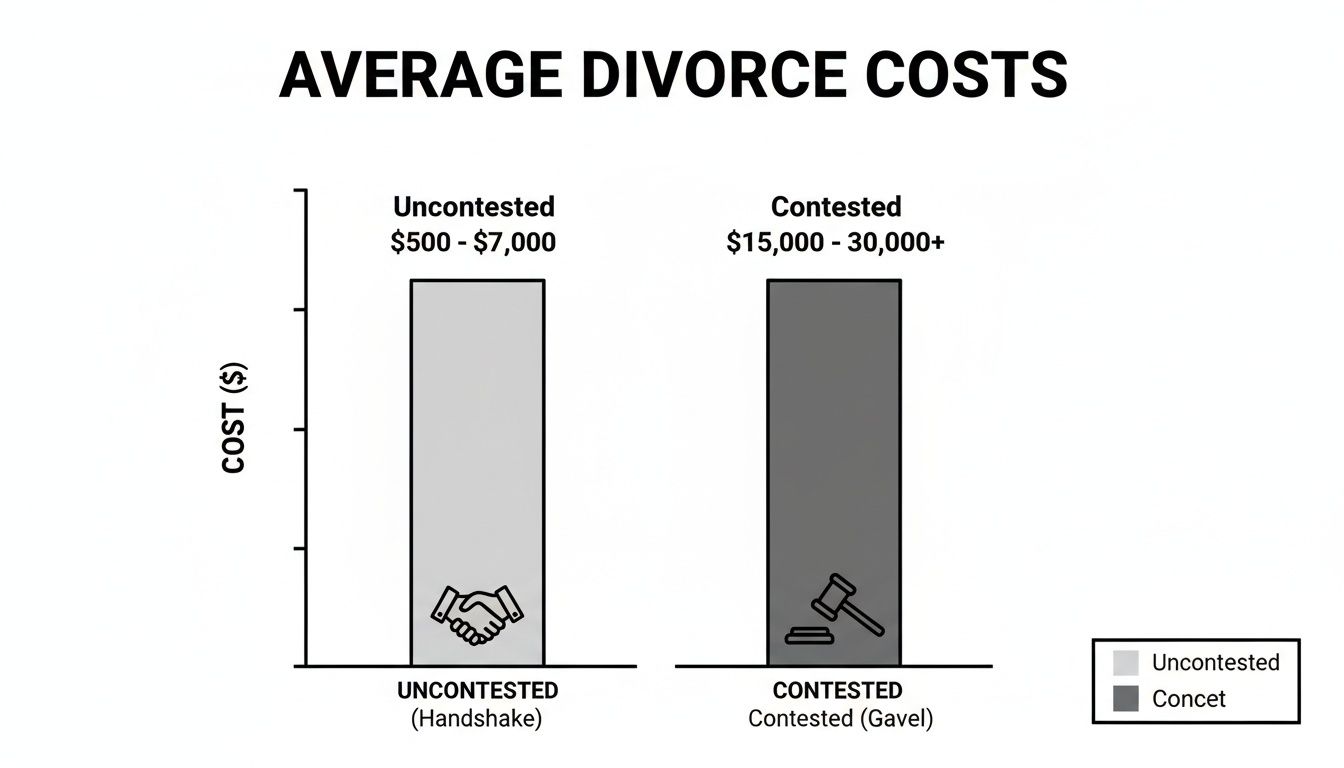
The takeaway here is impossible to ignore: cooperation is the single most powerful cost-saving tool you have at your disposal.
Come Prepared and Get Organized
One of the easiest ways to save money is to reduce the administrative work your attorney has to do for you. Your lawyer's time is valuable, and every minute they spend hunting down a bank statement is a minute you're paying for.
Before you even walk into your first consultation, try to gather as much financial paperwork as you can find. This practical, actionable step empowers your attorney to give you solid advice right from the very beginning.
Start by collecting these essential documents:
- Proof of Income: Recent pay stubs for both you and your spouse.
- Tax Returns: At least the last two years of your federal income tax returns.
- Bank Statements: Statements for every checking, savings, and investment account.
- Debt Information: Statements for your mortgage, car loans, credit cards, and any other debts.
- Retirement Accounts: The most recent statements for any 401(k)s, IRAs, or pensions.
Getting organized doesn't just save you money; it helps you and your lawyer build a crystal-clear financial picture, which is the foundation for any fair negotiation. For more practical guidance, check out these ideas to help pay for your Texas divorce.
Choose Your Battles Wisely
It’s completely normal to feel emotional during a divorce. But letting those emotions drive your legal strategy is a surefire way to end up with a staggering bill. Fighting over every single piece of furniture or sweating every minor detail of the parenting schedule can cost you hundreds, if not thousands, in attorney fees—way more than those items are actually worth.
The clients who come out of a divorce in the best financial shape are the ones who can treat it like a business transaction. They stay focused on the big picture—a fair split of the major assets and a stable future for their kids—and they’re willing to compromise on the small stuff.
Sit down with your attorney and figure out what really matters to you. Is it keeping the family home? Securing a specific visitation schedule? Protecting your retirement savings? Pour your energy and financial resources into those key goals, and be ready to let the less critical issues go.
Explore Alternatives to the Courtroom
Without a doubt, the most expensive part of any divorce is going to court. The good news is that Texas law actually encourages methods designed to keep you out of a courtroom showdown. These processes, known as Alternative Dispute Resolution (ADR), are built to be less confrontational, more private, and a whole lot more affordable than traditional litigation.
Two of the most powerful options are:
- Mediation: This is the most popular form of ADR in Texas. You, your spouse, and your lawyers meet with a neutral third-party mediator. The mediator’s job isn’t to make decisions, but to guide the conversation and help you find common ground to reach a settlement agreement. It's an incredibly effective way to resolve disputes without a judge having to make the call.
- Collaborative Divorce: This is a more formal process where you and your spouse each hire a lawyer who has been specially trained in collaborative law. Everyone signs a contract committing to resolve all issues outside of court. If the process breaks down and someone decides to litigate, both attorneys have to withdraw. This creates a powerful incentive for everyone to cooperate and find solutions together.
By getting organized, communicating clearly, and exploring alternatives to a court battle, you can take real control over the cost of your divorce. Doing so paves the way for a much more stable and secure financial future.
The potential price tag on a Texas divorce can feel overwhelming, but breaking it down is the first real step toward taking back control. As we've walked through, the biggest factors driving the final cost aren't the fixed court fees. It's the level of conflict and complexity that is unique to your situation.
The good news? You have more influence over those costs than you might think. Getting prepared, communicating clearly, and having strategic legal guidance in your corner can make this process far more manageable and affordable.
Building Your New Beginning
Don't forget that right now, knowledge is your most powerful asset. You're not just ending a marriage; you're laying the financial foundation for the rest of your life. Before you even step into the legal process, taking the time for some financial housekeeping, like getting your financial house in order, will pay dividends down the road.
This is all about creating a stable launchpad for your next chapter. When you have the right information and support, you can make empowered decisions that protect your future.
Your goal isn't just to get through the divorce. It's to emerge on the other side with financial clarity and the confidence to move forward. Every single step you take toward getting organized and seeking cooperation is a direct investment in yourself.
If you have questions swirling or you feel like you're ready to figure out what's next, our team is here to help. We can provide the clear, straightforward guidance you deserve.
If you need help navigating divorce, custody, or estate planning in Texas, contact The Law Office of Bryan Fagan today for a free consultation.
A Few Final Questions About Divorce Costs in Texas
When you're facing divorce, the big-picture costs are one thing, but it's the specific, nagging questions that often keep you up at night. Let's tackle a few of the most common ones we hear from clients to give you a bit more clarity and peace of mind.
Can I Make My Spouse Pay My Attorney Fees?
It’s possible, yes. In Texas, a judge has the power to order one spouse to cover some, or even all, of the other spouse's attorney fees. This usually comes up early in the case through a request for interim attorney's fees.
The purpose of this is to level the playing field, especially when one person has controlled the family finances and the other has limited access to funds. It’s not about punishment; it’s about ensuring both sides can afford proper legal representation. But remember, it's never a guarantee—the final decision is up to the judge, who will look closely at each spouse's financial situation and needs.
What if I Cannot Afford the Court Filing Fee?
Don't let the initial filing fee be a roadblock. If paying it would create a genuine financial hardship, Texas law provides a solution. You can file a document called a "Statement of Inability to Afford Payment of Court Costs."
This is a sworn statement you'll submit to the court clerk along with your divorce petition. You'll need to provide details about your income, any assets you have, and whether you receive government benefits. If the judge approves it, all mandatory court costs, including the initial filing fee, will be waived for you.
Is a Military Divorce More Expensive?
A military divorce often does end up being more expensive, but not because of different court fees. The higher cost comes from the extra layers of complexity that civilian divorces just don't have. These cases have to follow specific federal laws, like the Uniformed Services Former Spouses' Protection Act (USFSPA), which has its own unique rules for dividing military retirement benefits.
On top of that, other issues can drive up the time and effort required:
- Jurisdiction: Just figuring out which state has the authority to handle the divorce can get complicated, especially with frequent moves.
- Service of Process: Serving divorce papers to a spouse who is deployed overseas isn't as simple as knocking on a door; it involves special legal procedures.
- Parenting Plans: Creating a possession schedule that works around deployments, training, and potential relocations takes a lot more strategic thinking and careful drafting.
All this extra work means more time for your attorney to get it right, which can, in turn, increase the overall cost of the divorce.
Here, we'll answer some of the most common financial questions that come up during a Texas divorce, offering clear, straightforward answers to help you plan your next steps.
Common Questions About Divorce Expenses
| Question | Answer |
|---|---|
| How much does an "average" Texas divorce cost? | There's no true "average," as costs vary wildly. An uncontested divorce might cost $1,500 – $5,000, while a contested divorce can easily reach $15,000 – $30,000 or more, especially if a trial is necessary. |
| Can I file for divorce without a lawyer to save money? | Yes, you can file "pro se" (representing yourself). It's the cheapest option but is only recommended for very simple, 100% uncontested cases with no children or significant assets. The risk of making a costly mistake is high. |
| Is the person who files for divorce responsible for all the costs? | Not necessarily. While the petitioner pays the initial filing fee, how attorney fees and other costs are ultimately divided is a point of negotiation or can be decided by the judge. |
| Do I still have to pay my lawyer if we reconcile and stop the divorce? | Yes. You are responsible for paying for the legal services you have already received up to the point you withdraw the case. Your attorney worked on your behalf, and that time is billable. |
Hopefully, these answers provide some initial direction. Every situation is unique, so getting advice tailored to your specific circumstances is always the best path forward.
If you need help navigating divorce, custody, or estate planning in Texas, contact The Law Office of Bryan Fagan, PLLC today for a free consultation.