
You may have just learned two things at once. You're pregnant, and your marriage may be ending. That combination can make even simple questions feel heavy. Can I move out? Can I file now? Will the court make me stay married until the baby is born? What happens if I need support, insurance, or protection right away?
A lot of people in Texas hit the same point of confusion. They hear that you “can’t get divorced while pregnant” and assume that means they can’t do anything. That isn’t true. You can file for divorce while pregnant. The catch is that in Texas, the court won't sign the final divorce decree until after the baby is born so paternity, custody, and support can be handled correctly. More broadly, DivorceNet explains that no U.S. state explicitly prohibits filing for divorce while pregnant, but at least five states, including Texas, delay finalization until after birth.
Think of that rule less like a brick wall and more like a red light at an intersection. You may have to pause before the final step, but that doesn't mean the whole trip stops. You can still begin the case, ask the court for temporary protection, organize your finances, prepare for birth, and make smart decisions that protect you and your child.
I want to walk you through this the way I would in an office meeting with a pregnant client who feels scared, tired, and unsure what comes next. The law matters, but so does your day-to-day life. You need clarity, not legal noise. You need a plan.
A common scenario looks like this. A woman is in her second trimester, trying to keep up with prenatal appointments, work, and daily stress. At the same time, her spouse has become distant, controlling, or impossible to live with. She finally decides she needs a divorce, then learns that Texas won't let the judge finalize it until after the baby is born. Her first reaction is often panic.
That reaction makes sense.
When you're already carrying the emotional and physical weight of pregnancy, the idea of a legal delay can feel unfair. It can also sound like you're trapped. In practice, though, the delay usually means one narrow thing. The marriage can't be fully dissolved by final decree until after birth. It doesn't mean you're powerless, and it doesn't mean the court can't help you before then.
Why this feels so confusing
Divorce is often treated as a single event. Legally, it's a process with stages. You file the case. You exchange information. You ask for temporary orders if needed. You negotiate or litigate unresolved issues. Then, at the end, the judge signs the final decree.
Pregnancy affects that last stage in Texas because courts need the child to be born before they can fully address child-related issues. That's where many readers get stuck. They hear “not final yet” and assume “nothing can happen yet.”
Practical rule: If you're pregnant in Texas, don't wait for the birth to start protecting yourself. Use the waiting period to build a case plan, a safety plan, and a financial plan.
A calmer way to think about the months ahead
If your situation is peaceful, this period can help you organize paperwork, shape a co-parenting framework, and work toward settlement. If your situation is not peaceful, this period can be the time to request temporary court orders, secure housing, preserve health insurance, and create a safety strategy.
Either way, knowledge reduces fear. Once you understand what Texas allows now, what must wait until birth, and what steps matter most, the path becomes more manageable.
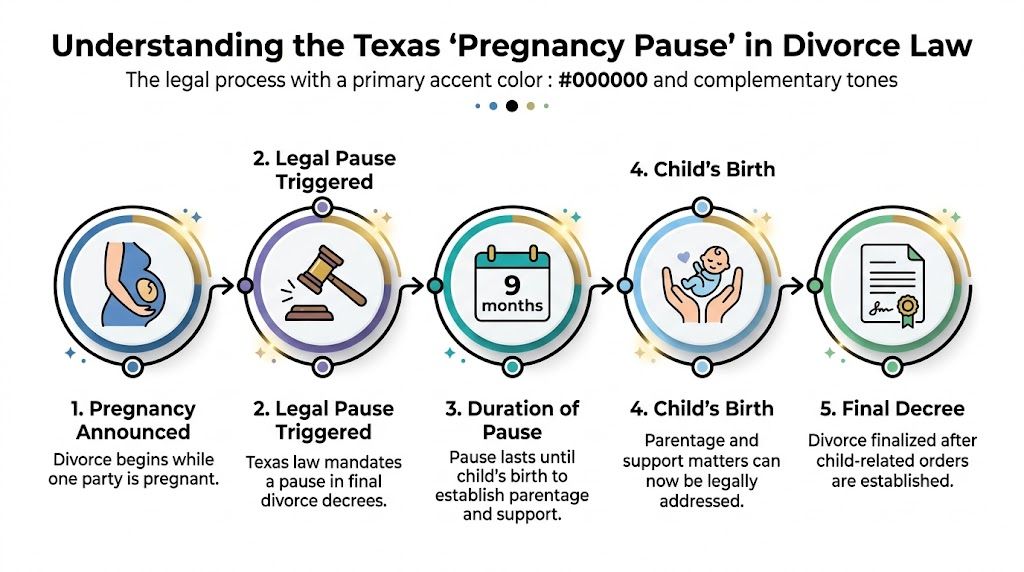
Understanding the Texas 'Pregnancy Pause' in Divorce Law
Texas treats pregnancy in divorce cases as a legal pause, not a prohibition on filing. The key distinction is between starting the divorce and finishing it. You can start. You just can't complete the final decree while the wife is pregnant.
Filing is allowed, finalizing is not
Texas courts are statutorily prohibited from finalizing a divorce while the wife is pregnant. BetterHelp's discussion of divorce during pregnancy notes that the delay exists so paternity can be established after birth before custody or support orders are entered, and it also notes that Temporary Restraining Orders under Texas Rule of Civil Procedure 680 may still be used during the case.
That distinction matters because a lot can happen between filing and final decree. Your attorney can prepare the petition, serve the other spouse, begin discovery, identify property issues, and request temporary relief. If you're trying to understand how this fits with Texas's ordinary waiting rules, this overview of the Texas divorce waiting period gives helpful background.
Why Texas presses pause
The simplest explanation is this. Courts can't make final orders about an unborn child the same way they can about a child who has already been born. A judge needs a legally recognized child, a legally identified father, and a real-world situation to address.
Texas family law also works from a strong presumption of paternity. If a child is born during a marriage, the husband is generally presumed to be the father unless that presumption is properly addressed. That presumption can affect conservatorship, possession, access, and support. A court doesn't want to sign a final decree, then reopen the case because parentage wasn't handled correctly.
It's like trying to finish a blueprint before one room has been built. The court can draft around many issues, but it can't finalize a complete plan for the child until the child legally exists outside the womb and the parentage question is properly handled.
What can still happen during the pause
The pause doesn't freeze your case. It creates a period for groundwork. During that time, parties often deal with issues such as:
- Living arrangements: Who stays in the home, who pays which bills, and whether one spouse gets exclusive use of the residence.
- Property protection: Whether either spouse should be restrained from draining accounts, hiding records, or selling community assets.
- Health coverage: Whether current insurance must stay in place while the case is pending.
- Case preparation: Gathering financial records, valuing accounts, and identifying disputed issues before the birth.
A simple analogy that helps
Pressing pause on a movie doesn't erase the movie. It just stops the final scene from playing until the missing facts are available. In a Texas divorce while pregnant, the final decree is that last scene.
The legal pause exists to prevent avoidable mistakes in paternity, custody, and support. It doesn't prevent you from taking meaningful legal action right now.
For many families, especially those with complex finances, business interests, or interstate concerns, this period can create useful time to prepare carefully instead of rushing toward an incomplete final order.
The Critical First Step After Birth Establishing Paternity
Once the baby is born, one issue becomes the key that opens up the rest of the child-related case. That issue is paternity.
If the husband is the biological father and no one disputes that, the path may be relatively straightforward. If he isn't the biological father, or if anyone is unsure, the process can become more technical. Either way, the court needs legal clarity before it can finish the divorce with final child-related orders.
When the husband is the biological father
In many marriages, this part isn't contested. The husband is both the presumed father and the biological father. In that situation, the case usually moves forward after birth with conservatorship, possession, and support addressed in the final decree or related orders.
Even then, don't treat this step casually. Your decree needs to match reality and include workable language for the child. A rushed agreement can create confusion later about decision-making, exchanges, medical coverage, and support obligations.
When the husband is not the biological father
Many people understandably get confused, as Texas doesn't automatically switch legal fatherhood to the biological father just because everyone “knows” who he is. Legal parentage has to be established correctly.
There are two common paths after birth:
Voluntary paperwork
The biological father and mother may be able to sign an Acknowledgment of Paternity. In situations involving a husband who is the presumed father, related paperwork may also be needed to address that presumption.Court-ordered determination
If anyone disputes paternity, or the paperwork route isn't available or appropriate, the court may need to decide parentage. That can include genetic testing and additional pleadings.
If you want a broader explanation of how legal fatherhood issues can affect rights and responsibilities, this discussion of biological father rights and the birth certificate can help frame the issue.
Why paternity matters so much
Paternity isn't just about a name on paperwork. It determines who may have legal rights and legal duties concerning the child. Those questions affect:
| Issue | Why paternity matters |
|---|---|
| Conservatorship | The court needs to know who may seek parental rights and duties |
| Possession and access | Parenting schedules depend on legal parent status |
| Child support | Support orders require a legally recognized parent-child relationship |
| Medical decision-making | Authority usually flows from legal parentage |
What you should do at the hospital and shortly after
The period around delivery can feel chaotic, so it helps to prepare in advance. Ask your attorney what documents may be needed depending on your facts.
A practical checklist often includes:
- Confirm identity details: Make sure legal names are correct on all birth-related paperwork.
- Flag paternity issues early: If the husband may not be the biological father, tell your lawyer before delivery if possible.
- Request copies: Keep copies of any forms signed at the hospital.
- Follow through fast: After birth, your attorney can use the new facts to move the divorce toward completion.
If paternity is unclear, don't guess and don't rely on informal understandings. A clean legal record now prevents years of conflict later.
The birth changes the legal situation. Before birth, the court is waiting for a child-related issue to become justiciable. After birth, the court can address the child directly. That is why this step matters so much.
Using Temporary Orders to Protect You and Your Unborn Child
If you're pregnant and your marriage is unstable, temporary orders can be the difference between chaos and structure. They don't end the divorce, but they can create rules that protect you while the case is pending.
In plain terms, temporary orders are the court's way of saying, “Until we reach the final outcome, here is how things will work.”

What temporary orders can do
A spouse who controls money, threatens to cancel insurance, or creates conflict at home can make pregnancy much harder than it already is. Temporary orders can address immediate concerns before the final decree.
For example, a court may be asked to address:
- Use of the home: If living together is unsafe or intolerable, one spouse may seek exclusive use of the residence.
- Bill payment: The court can establish temporary expectations for mortgage, rent, utilities, and other household expenses.
- Access to funds: Temporary support or rules about account use may help prevent one spouse from cutting the other off financially.
- Conduct restrictions: Temporary restraining relief may prohibit hiding property, destroying records, or disturbing the peace of the other spouse.
If you're preparing for one of these hearings, this guide on what to expect in a temporary orders hearing can give you a practical sense of the process.
Health insurance deserves special attention
For many pregnant clients, the single biggest fear isn't the divorce itself. It's losing medical coverage in the middle of prenatal care.
That concern is valid. Prenatal appointments, testing, labor, delivery, and postpartum care all create medical and financial pressure. If you're currently covered through your spouse's plan, your attorney should address that issue early. Temporary orders may help preserve the status quo while the divorce is pending.
A good working list to gather for your lawyer includes:
- Insurance cards and policy details
- Upcoming appointment schedule
- Current doctors and hospital choice
- Any written threat to cancel coverage
A realistic example
Suppose your spouse moved money out of a joint account, says you need to leave the house, and threatens to remove you from insurance. You may not be able to finalize the divorce before birth, but you may still ask the court for immediate structure. That can mean freezing harmful behavior, setting temporary financial expectations, and preserving stability while the legal process continues.
Urgent takeaway: If your spouse is using pregnancy as leverage, don't wait for things to get worse before asking about temporary orders.
Why quick action often helps
Temporary orders don't solve everything, but they can lower the temperature. They create a baseline. Once there are enforceable rules, people often have fewer opportunities to manipulate housing, money, and medical access.
That matters in any divorce while pregnant. It matters even more if your spouse has a pattern of intimidation, unpredictability, or financial control.
Strategic Planning for Safety Health and Finances
At 2:00 a.m., the questions tend to arrive all at once. If the divorce cannot be finished yet, how do you stay safe? How do you keep prenatal care steady? How do you make sure the bills get paid when the baby is on the way?
That period before birth can feel like a red light that will not turn green. In practice, it is often a work zone. The court may not be ready to enter final orders about the baby, but you can still use this time to put guardrails around your safety, your health, and your finances. For many pregnant clients, that shift in mindset matters. Waiting feels powerless. Preparing creates options.

Safety planning deserves immediate attention
Pregnancy can increase risk in a relationship that is already marked by control, threats, stalking, or violence. A spouse who senses change may become more unpredictable during separation. That is especially true where there has already been intimidation around money, medical care, transportation, or where you live.
As noted earlier, the period before a divorce can be finalized may create a dangerous gap for survivors. If your spouse is using the pregnancy as a tool for control, treat that as a warning sign, not a misunderstanding.
A practical safety plan usually answers four questions: Who knows what is happening? Where can you go? What documents do you need? How will you communicate safely?
Consider building that plan around these basics:
- Trusted contacts: Choose one or two people who can check on you regularly and help in an emergency.
- Safe access to records: Keep identification, insurance cards, medications, prenatal records, and a few essentials where you can reach them quickly.
- Exit options: Identify a safe place to stay if you need to leave on short notice.
- Legal protection: Ask whether a protective order, police report, or other emergency legal step fits your situation.
Use caution with shared phones, tablets, email accounts, cloud storage, and car location services. If someone has been monitoring you, a private device or a new password can matter as much as any legal document.
Health planning means reducing avoidable disruption
Your pregnancy does not pause because the divorce process slows down. Prenatal care, testing, delivery planning, and postpartum recovery all keep their own schedule. It helps to treat your medical plan like a travel checklist. You want to know where you are going, what you need to bring, and what backup plan is in place if something changes.
Start by organizing the practical pieces in one place. Confirm your doctors, your hospital, your prescription information, and how each service is being billed. If coverage may change after separation or after the divorce is complete, it helps to understand what counts as an insurance qualifying life event. That can help you plan for a transition instead of scrambling during late pregnancy or right after delivery.
Keep a short written record of missed reimbursements, cancelled appointments, blocked access to transportation, or interference with care. In some cases, those details help your lawyer show the court why stronger temporary protections are needed.
Financial planning turns fear into a workable map
Uncertainty is expensive. It drains attention and makes every decision feel harder than it should.
Texas community property rules can affect income, debts, savings, and property acquired during the marriage. You do not need to solve the final division right now. You do need a clear snapshot of the household as it exists today. That snapshot works like a photograph taken before furniture starts getting moved around. Once accounts change, money disappears, or online access is cut off, it becomes harder to reconstruct the picture.
Try to gather:
- Income information: pay stubs, tax returns, benefit statements, and records of irregular income
- Bank and card statements: checking, savings, credit cards, retirement accounts, and investment accounts
- Monthly expenses: housing, food, gas, child-related costs, insurance, and medical bills
- Property records: vehicle titles, mortgage statements, lease documents, loan balances, and business records if relevant
If you can do it safely, open an individual email account for legal and financial communication, change passwords that are not shared, and download copies of key statements. Do not violate court orders or empty accounts based on fear alone. Get legal advice before making major financial moves.
Stress affects legal decisions too
Many pregnant clients try to push stress aside so they can keep functioning. I understand that instinct. But stress is not just a feeling. It can interfere with memory, sleep, appointments, work, and your ability to make careful decisions at the exact moment careful decisions matter.
Support is part of planning, not a sign that you are falling apart.
Useful support may come from:
- A therapist or counselor
- Your OB-GYN or other medical provider
- Faith community support
- A trusted friend or relative
- A lawyer who can turn a pile of worries into a clear list of next steps
Here is a short video that may help you think through the planning side of this stage:
A simple way to organize the next week
If everything feels urgent, sort your tasks into three folders. One for safety. One for health. One for money. That method helps you stop carrying every problem in your head at once.
| Folder | What goes inside |
|---|---|
| Safety | Incident notes, emergency contacts, screenshots, copies of protective paperwork |
| Medical | Insurance details, provider list, appointment calendar, hospital information, prescription details |
| Financial | Statements, bills, budget notes, tax returns, property records |
A family law attorney can help coordinate temporary orders, paternity planning after birth, and preparation for the final decree. One available option for Texas residents is Law Office of Bryan Fagan, PLLC, which handles family law matters including divorce, custody, and property issues.
Child Custody and Support What to Expect After Birth
Once the baby is born and parentage is in place, the court can turn to the issues most parents worry about. Who will make decisions? When will each parent have time with the child? How will support be handled?
Texas uses terms that can sound technical, but the ideas are easier to understand than they first appear.
Conservatorship, possession, and the child's best interest
In Texas, what many people call custody is usually discussed as conservatorship. That refers to parental rights and duties, including decision-making. Possession and access refers to the parenting schedule. Texas Family Code § 153.002 states that the best interest of the child is the court's primary consideration in determining issues of conservatorship and possession.
For a newborn or infant, that best-interest analysis is very practical. Judges look for plans that fit the child's developmental needs, feeding schedule, medical needs, and the parents' actual ability to cooperate.
Why planning during pregnancy can help later
The waiting period isn't just legal downtime. It can be used to reduce conflict after the child arrives. Custody X Change reports emerging data that high maternal stress during a prolonged divorce can increase the risk of preterm birth by 20-30%, and that proactively creating a joint legal custody plan during pregnancy can reduce post-birth conflict by as much as 40%.
That doesn't mean every family should force a joint plan immediately. If abuse, intimidation, or severe conflict is present, safety comes first. But in workable cases, discussing pediatric care, exchange logistics, communication methods, and overnight expectations before birth can prevent avoidable disputes later.

Infant schedules are usually more tailored
A lot of parents expect a standard schedule right away. With infants, schedules are often more customized. Frequent shorter visits may make more sense than long blocks, depending on the circumstances. Feeding, sleep, transportation distance, and each parent's caregiving history can all matter.
A useful way to think about this is that the court isn't trying to reward one parent or punish the other. The court is trying to create a stable structure for a very young child.
Child support in Texas
Texas child support usually follows guideline percentages based on the obligor's net monthly resources. For one child, the guideline is 20% of net resources, as noted in the verified Texas pregnancy-divorce material above. The court still needs the child to be born and parentage to be established before entering final child support orders tied to that child.
A post-birth support discussion often includes:
- Base child support: The guideline amount, unless facts justify a different result.
- Medical support: Who provides health insurance and how uninsured costs are addressed.
- Practical expenses: Childcare, work schedules, and transportation may also affect the larger parenting conversation.
A reasonable newborn parenting plan is usually detailed, calm, and realistic. It isn't built from slogans. It's built from feeding times, doctor visits, sleep patterns, and parents who know what they can actually do.
Frequently Asked Questions About Divorce and Pregnancy in Texas
Can we agree to finish the divorce before the baby is born
No. Agreement doesn't let the court skip a legal requirement. If the wife is pregnant, the judge won't sign the final decree before birth. Even a fully cooperative couple has to wait for the child-related issues to become legally ready for final orders.
If my spouse and I are on good terms, should I still file now
Sometimes yes. Filing can create a case structure, preserve your position, and allow temporary relief if circumstances change. It can also give you time to organize property issues before the baby arrives. Whether filing now makes sense depends on safety, finances, and how much conflict you expect.
Can my husband deny paternity just to speed things up
Not effectively, if the legal requirements for parentage haven't been met. Informal denial doesn't replace proper legal steps. Texas courts need paternity handled correctly, not casually, before they enter final child-related orders.
What if I move to another state while pregnant
Interstate questions can become complicated fast. Divorce jurisdiction and child-related jurisdiction don't always work the same way, especially when a child hasn't been born yet. Before moving, speak with a lawyer about venue, notice requirements, practical safety issues, and how relocation could affect the case after delivery.
Does the longer timeline change how property is divided
The delay can affect timing, strategy, and documentation, but it doesn't mean the court ignores property issues until after birth. In many cases, spouses can still exchange documents, negotiate, and narrow disputes while the case is pending. For some people, that extra time is frustrating. For others, it's useful because it allows a more careful review of accounts, debts, retirement assets, or business interests.
What if I'm afraid of my spouse right now
Treat that as urgent. The inability to finalize the divorce before birth does not mean you must remain unprotected. Temporary restraining relief, protective orders, safe housing planning, and careful communication strategies may all be available depending on the facts.
A short checklist for readers who feel stuck
- Write down what feels urgent: Housing, safety, money, insurance, or medical access.
- Collect key documents: ID, insurance information, financial records, and any threatening messages.
- Ask focused questions: Can I file now, do I need temporary orders, and what happens after birth in my case.
- Get legal advice early: Delay in finalization should not become delay in protection.
Your Next Steps and How a Lawyer Can Help
A pregnancy-related divorce case often feels like standing at a red light when you need to get somewhere fast. The court may not let the case finish yet, but that does not mean you have to sit still. This period can be used to make careful decisions that protect your health, your finances, and your child’s future.
Start by turning one large fear into a short list of concrete tasks. A good legal plan works like a checklist before a storm. You secure the things that matter most before conditions get harder.
Focus on these priorities:
- Personal safety: If your spouse has threatened you, controlled you, stalked you, or hurt you, ask a lawyer right away about protective orders, temporary orders, and a safe communication plan.
- Medical stability: Gather insurance cards, prenatal records, provider contact information, and any paperwork that affects your access to care.
- Financial control: Copy account statements, tax returns, pay stubs, debt records, and proof of household expenses. If money has been restricted, document that clearly.
- Birth preparation: Ask what will need to happen at the hospital, what paternity documents may matter, and what steps should be taken soon after delivery.
- Parenting planning: If the case is safe enough for co-parenting discussions, begin identifying practical issues such as feeding schedules, transportation, and who will make medical decisions.
If family violence is part of your story, this waiting period deserves special attention. Pregnancy can increase risk. A lawyer can help you address that risk with a plan for housing, privacy, communication, court protection, and evidence preservation, instead of leaving you to react one crisis at a time.
Legal help is often less about courtroom drama and more about putting the pieces in the right order. First comes immediate protection if needed. Then document gathering. Then temporary relief, property strategy, birth-related planning, and child-related terms that reflect real newborn care rather than vague promises.
That kind of structure can bring real relief.
If you need help with divorce, custody, or estate planning in Texas, contact Law Office of Bryan Fagan, PLLC today for a free consultation. A confidential conversation can help you understand your options, protect your pregnancy, and prepare for what comes next.


