
It usually starts with something small—standing in your driveway, watching your child buckle into the other parent’s car, wondering if you packed everything, said everything, or handled the moment the “right” way. What Does Visitation Mean in Texas becomes more than a legal question in that moment—it becomes about time, connection, and how your child experiences life between two homes. For many parents, the paperwork feels overwhelming, filled with unfamiliar terms like “possession” and “access,” while emotions run high and the future feels uncertain.
In Texas, these arrangements are structured under the Texas Family Code, where courts focus on one guiding principle: the best interest of the child. That means creating a framework that promotes stability, consistency, and meaningful relationships with both parents whenever possible. At The Law Office of Bryan Fagan, PLLC, we’ve helped thousands of families across Houston and throughout Texas navigate these exact moments. Led by Bryan Joseph Fagan, a South Texas College of Law graduate and a trusted authority in Texas family law, our firm is committed to helping parents understand not just what the law says, but how it applies to real life.
In this article, you’ll gain a clear understanding of how visitation works in Texas, what courts consider when creating schedules, and how you can move forward with confidence. Because when you understand your rights and your options, you can begin to rebuild structure, reduce uncertainty, and create a path forward that protects what matters most—your relationship with your child.
Key Takeaways
- In Texas, visitation is legally referred to as “possession and access”—understanding this terminology helps you navigate court documents and communicate with attorneys effectively.
- The Standard Possession Order is the default visitation arrangement for non-custodial parents, providing specific schedules for weekends, weekdays, holidays, and summer vacation.
- To obtain visitation rights in Texas, a parent must file a petition with the family court in the county where the child lives and notify the other parent—this is the formal legal process required to establish court-ordered visitation.
- The Texas Attorney General and the access and visitation hotline can provide resources and support for enforcing or understanding visitation rights, especially if the other parent is non-compliant or if you need guidance on your options.
- Texas courts determine visitation based on the best interest of the child, considering factors like safety, parental abilities, and the child’s emotional and physical needs.
- Visitation orders can be modified when there has been a material and substantial change in circumstances, such as relocation, work schedule changes, or evolving needs of the child.
- Violations of court-ordered visitation carry serious consequences, including contempt of court, makeup visitation time, fines, and potentially jail time.

Your Family’s Future Starts Here
Don’t navigate your legal journey alone. Schedule a consultation now and get the clarity and support you deserve.
What Does Visitation Mean in Texas? The Short Answer
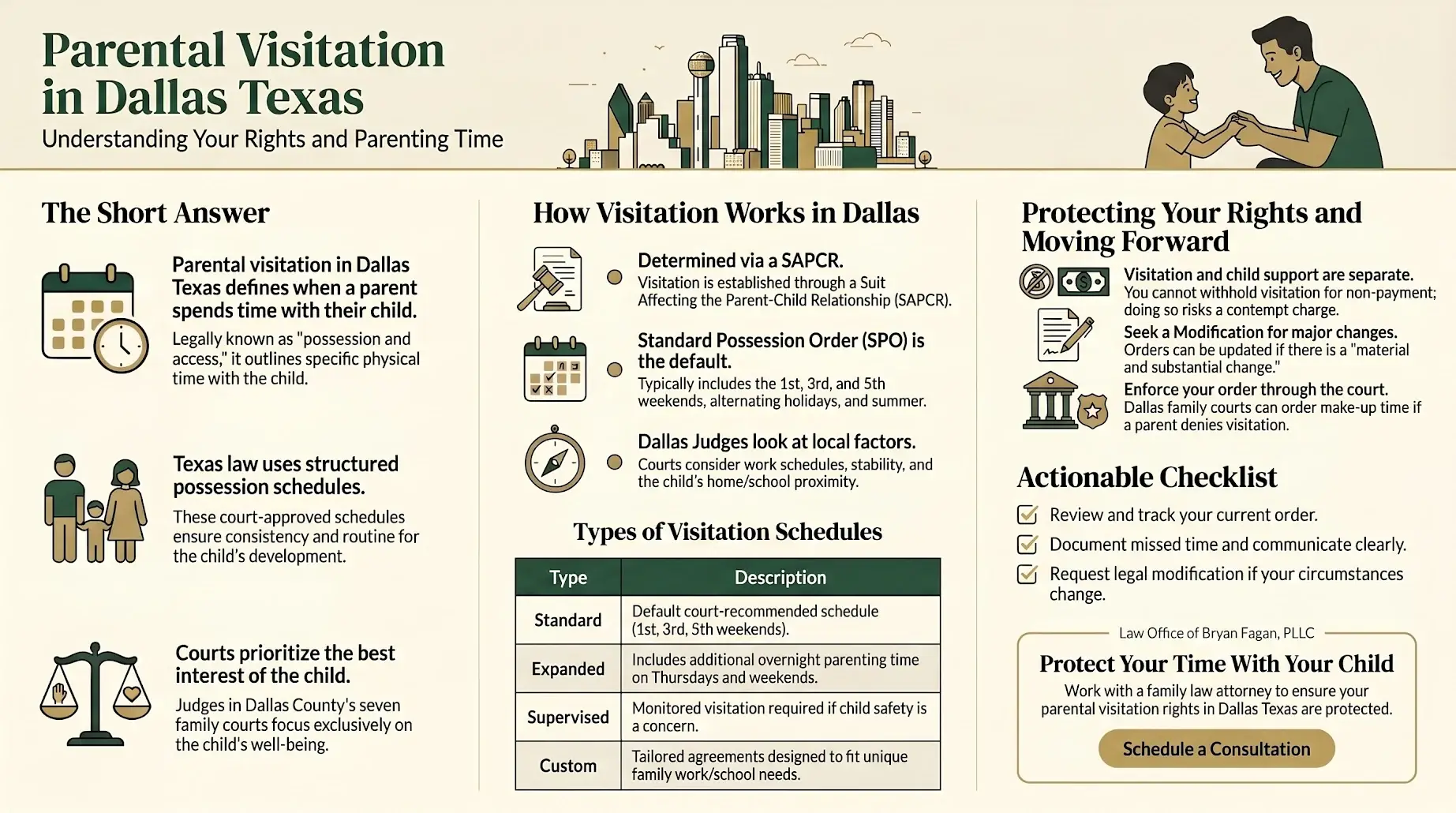
What Does Visitation Mean in Texas is a question many parents ask when they are trying to understand what life will actually look like after a separation. In Texas, visitation is legally referred to as “possession and access,” and it defines when a parent has physical time with their child and how they stay involved in that child’s life. While the terminology may feel unfamiliar at first, the goal is simple: to create a structured, predictable schedule that supports stability and preserves the child’s relationship with both parents. Under Texas Family Code §153.002, courts are required to focus on one guiding principle—the best interest of the child—when determining these arrangements.
To establish visitation rights, a parent must typically file a petition with the family court in the county where the child resides, and the other parent must be properly notified. From there, the court may issue a possession order that outlines specific weekends, weekdays, holidays, and summer periods. Many families follow a version of the Standard Possession Order in Texas, which provides a consistent framework designed to promote routine and minimize conflict. Judges often evaluate how well a proposed schedule supports the child’s day-to-day stability, how effectively parents communicate, and whether the structure encourages a healthy, ongoing relationship with both parents.
In straightforward situations, where parents are cooperative and aligned on expectations, a standard schedule may be enough to create consistency and move forward smoothly. In more complex cases—especially if your situation involves missed visits, communication breakdowns, or major life changes like relocation—a more customized approach may be necessary. When schedules start to break down or confusion leads to conflict, that is often the point where legal guidance becomes critical. Understanding visitation is the first step, but building a plan that actually works for your family is what creates long-term stability and peace of mind.

What Is the Legal Term for Visitation in Texas?
Under Texas law, visitation is officially called “possession and access.” This terminology comes directly from Chapter 153 of the Texas Family Code, which governs all matters related to conservatorship, possession, and access in Texas custody cases.
Why does Texas use different language than other states? The distinction matters because Texas law separates two different concepts: possession refers to the actual time a parent spends physically with the child, while access refers to the right to interact with the child through other means—such as phone calls, video chats, attending school events, or accessing medical records.
For Texas families, this means your court order will likely never mention “visitation rights.” Instead, you’ll see references to your “periods of possession” or your “access” to your child. Understanding this terminology helps you read your custody order accurately and communicate more effectively with your co-parent, attorneys, and the court. Texas courts generally prioritize parents’ rights while ensuring the child’s relationship with both parents is preserved, as long as it serves the child’s best interest.
Visitation vs Custody (Conservatorship) in Texas
Understanding What Does Visitation Mean in Texas starts with recognizing how Texas law separates two concepts that many parents assume are the same: custody and visitation. In Texas, courts use the term “conservatorship” instead of custody, and that distinction matters more than most people realize. When a case is filed, the court does not just decide where the child lives—it also determines who has decision-making authority and how parenting time will be structured. Under Texas Family Code §153.002, every one of these decisions must serve the best interest of the child, with a strong focus on stability, consistency, and maintaining meaningful relationships with both parents.
Conservatorship addresses who makes major decisions in a child’s life, including education, medical care, and overall welfare. In many cases, parents are named joint managing conservators, meaning both share responsibility for important decisions, even if one parent has the exclusive right to determine the child’s primary residence. Courts often evaluate how well parents can communicate, cooperate, and prioritize the child’s needs when making these determinations, as outlined in Texas Family Code §153.134. Judges are not just looking at legal rights—they are assessing which arrangement creates the most stable and supportive environment for the child’s day-to-day life.
Possession and access—what most people refer to as visitation—focuses on when each parent spends time with the child. This is where schedules become critical. A parent may share decision-making authority but still follow a structured parenting schedule that outlines weekends, holidays, and extended time. Many families rely on a version of the Texas Standard Possession Schedule, which is designed to create predictability and reduce conflict. Courts tend to favor arrangements that provide consistent routines, minimize disruption, and support the child’s emotional well-being.
In straightforward situations, where parents communicate well and follow agreed schedules, this structure can work smoothly and provide a clear path forward. In more complex cases—especially if your situation involves ongoing conflict, missed exchanges, or disagreements about decision-making—a deeper legal strategy may be necessary to protect both your rights and your child’s stability. When schedules begin to break down or misunderstandings create tension, those issues can quickly escalate into larger disputes. That is often the point where experienced legal guidance becomes essential, helping you move from uncertainty to a structured plan that truly works for your family.

Table 1: Visitation vs Custody (Conservatorship) in Texas
| Term | Meaning in Texas Law | Key Difference |
|---|---|---|
| Managing Conservator | Parent with legal authority to make major decisions: primary residence, education, medical care, religious training | Determines decision-making power, not necessarily physical time with child |
| Possessory Conservator | Parent with court-ordered periods of possession and access | Has scheduled time with child but may have limited decision-making authority |
| Joint Managing Conservatorship | Both parents share decision-making responsibilities | Most common arrangement; both parents involved in major decisions |
| Possession and Access | Specific schedule of when parent spends time with child | Defines physical time, separate from legal decision-making authority |
Consider this real-world example: Two parents share joint managing conservatorship, meaning both participate in major decisions about their child’s education and healthcare. However, one parent is designated to determine the child’s primary residence, while the other parent follows the Standard Possession Order for their time with the child. Both parents have parental rights and responsibilities—they’re just exercised in different ways.
How Visitation Schedules Are Determined in Texas
Texas courts determine visitation based on the best interest of the child. This isn’t just a phrase courts use casually—it’s a legal standard established in Texas Family Code §153.002, which explicitly states that the child’s best interest is the primary consideration in all conservatorship, possession, and access decisions.
When determining what visitation schedule serves the child’s best interest, Texas courts consider numerous factors, including:
- The child’s age and developmental stage
- The child’s emotional and physical needs at their current age
- Each parent’s abilities and parenting stability
- The child’s relationship with each parent and other family members
- The importance of maintaining relationships with family members who play a significant role in the child’s life
- The child’s school schedule and educational needs, routines, and community connections
- The distance between parents’ homes
- Any history of domestic violence, sexual abuse, or safety concerns
- Each parent’s willingness to support the child’s relationship with the other parent
Texas courts recognize the importance of allowing a child to spend time with both parents and other significant family members, as these relationships are vital to the child’s life, development, and overall well-being.
If there are safety concerns—such as credible evidence of physical or sexual abuse, domestic violence, substance abuse, or untreated mental illness—Texas courts may order supervised visitation. Supervised visitation is a court-ordered arrangement where a parent’s time with their child is monitored by a third party, typically ordered when there are concerns about the child’s safety or emotional well-being. The supervising adult or organization must usually remain present for the entire visit during supervised visitation, and they often provide a report to the court documenting interactions.
The Standard Possession Order (SPO) in Texas
Understanding What Does Visitation Mean in Texas often starts with the Texas Standard Possession Order, commonly referred to as the SPO. This is the default visitation framework Texas courts use in many cases involving a noncustodial parent. Under Texas Family Code §153.252, the law presumes that a Standard Possession Order is in the best interest of a child age three or older unless evidence shows a different arrangement would better serve the child. That presumption ties directly back to §153.002, where courts are required to prioritize the child’s stability, emotional development, and ongoing relationship with both parents.
The Standard Possession Order is designed to create consistency. It typically includes parenting time on the first, third, and fifth weekends of each month, along with Thursday evening visits during the school year, depending on how far apart the parents live. It also outlines holidays and extended summer periods to ensure both parents remain actively involved. You can explore a detailed breakdown of how this schedule works in real life through this guide to the Texas Standard Possession Order. Judges often favor this structure because it provides predictability, reduces conflict, and supports a routine that children can rely on week after week.
It is also important to understand that visitation and child support are separate legal obligations. A parent cannot deny visitation because support has not been paid, and a parent cannot stop paying support because visitation is being denied. Courts take compliance seriously on both sides, and when schedules begin to break down, it can quickly lead to enforcement issues that disrupt the child’s sense of stability.
In straightforward situations, where parents communicate effectively and follow the established schedule, the Standard Possession Order can work well without significant modification. In more complex cases—especially if your situation involves long-distance parenting, repeated missed exchanges, or ongoing conflict—a standard schedule may not be enough. When consistency starts to slip or disagreements escalate, that is often when a more customized plan or legal intervention becomes necessary. Understanding how the SPO works is a strong starting point, but knowing when to adapt that structure to fit your family’s needs is what ultimately protects both your rights and your child’s well-being.

Table 2: Standard Possession Order Overview
| Schedule Type | Typical Time | Notes |
|---|---|---|
| Regular Weekends (within 50 miles) | 1st, 3rd, and 5th weekends; Friday 6 PM to Sunday 6 PM | Most common arrangement for parents living close together |
| Thursday Evenings (within 50 miles) | Thursday during school term; 6 PM to 8 PM | Provides midweek contact with non-custodial parent |
| Summer Possession (within 50 miles) | 30 days during summer vacation | Extended time during school break; specific dates in order |
| Distance Schedule (100+ miles apart) | 1st, 3rd, and 5th weekends OR monthly weekend | Thursday visits typically eliminated; summer extended to 42 days |
| Holiday Possession | Alternating holidays: Thanksgiving, Christmas, Spring Break | Specific years assigned (odd/even) in court order |
| Birthday | Time with child on their birthday | Often included in holiday provisions |
The Standard Possession Order also specifies exactly how holidays are divided. Parents alternate Thanksgiving, Spring Break, and portions of Christmas vacation. The order typically designates which parent has the child during odd-numbered years versus even-numbered years for each holiday.
For the Texas Attorney General’s Office and Texas courts, this standardized approach helps ensure consistency and reduces conflict by providing clear expectations. However, parents can agree to different arrangements if they better serve their family’s needs.
Variations in Visitation Schedules
A custom possession order is a personalized visitation schedule tailored to fit the specific needs of the child and parents, often created when the Standard Possession Order does not adequately serve the family’s circumstances. Under Texas law, such orders require court approval and can be customized for irregular work schedules, long distances, or other unique factors affecting parenting arrangements. When parents agree on a modified schedule and the court approves it as serving the child’s best interest, that custom arrangement becomes the enforceable order.
Age-Based Adjustments: For children under three years old, courts often create specialized visitation schedules based on the child’s developmental needs. The Standard Possession Order may not be appropriate for very young children, particularly if the non-custodial parent had limited contact before the court case. Courts may require more gradual, frequent, and shorter visits to build the parent-child bond safely.
Distance Considerations: When parents live more than 100 miles apart, the standard visitation schedule adjusts significantly. Midweek Thursday visits may be eliminated due to impracticality, while summer possession often extends to 42 days instead of 30. Weekend possession may become monthly rather than every other weekend.
Expanded Standard Possession: Many parents today seek more equitable time-sharing arrangements. Options like 50/50 custody arrangements or 2-2-3 schedules (where the child alternates spending 2 days with one parent, 2 days with the other, then 3 days rotating) require court approval but are increasingly common when both parents live nearby and can manage the logistics.
Supervised Visits: When safety concerns exist, the court may order supervised visitation at supervised visitation centers, in a parent’s home, or at a neutral location, and may require a neutral third party or court-approved individual to be present during all visits. These supervised visitation arrangements are designed to balance the child’s safety with the parent’s time and rights. Courts may transition to unsupervised visits if it is determined that it is safe for the child, allowing for increased parental access as circumstances improve. This arrangement helps protect children while still allowing the parent-child relationship to continue under safe conditions.
What Happens If Visitation Orders Are Violated
Parents can enforce visitation rights through court orders, which may require compensation for missed time or other penalties. Texas Family Code Chapter 157 provides the legal framework for enforcement when either the custodial parent or non-custodial parent violates a possession order.
If visitation rights are denied, the custodial parent can face legal consequences, including fines or jail time, for not complying with court-ordered visitation schedules. Common violations include:
- The custodial parent refusing to surrender the child at designated times
- The non-custodial parent failing to return the child on time
- Either parent interfering with the other parent’s access to the child
- Denying phone calls or other forms of access
When filing a motion for enforcement, you must document each specific violation—including the date, time, and circumstances. The court may order:
- Contempt of court: The violating parent may be held in contempt
- Makeup possession time: Additional periods of possession to compensate for denied time
- Attorney’s fees: The violating parent may be ordered to pay your legal costs
- Fines or jail time: In serious cases, courts may impose financial penalties or incarceration
Important: Never take matters into your own hands. If your co-parent is violating the court order, document everything carefully and work with legal counsel to pursue proper enforcement through the court system. If you are experiencing difficulties enforcing visitation orders, you can also contact the visitation hotline or the access and visitation hotline for guidance and support.
How to Modify Visitation in Texas
Understanding What Does Visitation Mean in Texas also means recognizing that visitation orders are not always permanent. Life changes—and when it does, Texas law allows parents to request a modification of an existing possession and access order. Under Texas Family Code Chapter 156, a court may modify a visitation arrangement if there has been a material and substantial change in circumstances and the modification would serve the best interest of the child, consistent with §153.002.
These changes often reflect real-life challenges families face. A new job with a different schedule, a move to another city, or evolving needs of a growing child can all impact how a visitation schedule functions. Courts may also consider factors such as a parent’s remarriage, a child’s extracurricular demands, health concerns, or even a child aged 12 or older expressing a preference regarding their living situation. Judges are not just reviewing paperwork—they are evaluating whether the current arrangement still provides stability, consistency, and a supportive environment for the child.
In straightforward situations, where both parents agree that a change is necessary and can communicate effectively, modifying a visitation order may be a relatively smooth process. In more complex cases—especially if your situation involves relocation, ongoing disputes, or concerns about missed visits or safety—modification becomes more strategic. Courts will closely examine each parent’s credibility, willingness to co-parent, and ability to maintain a consistent schedule that supports the child’s well-being. You can learn more about how these schedules are structured by reviewing this guide to Standard Possession Orders in Texas, which often serves as the starting point for many modification discussions.
The process itself requires filing a petition with the court that issued the original order, as that court typically maintains continuing, exclusive jurisdiction. Parents must provide evidence of the change in circumstances, notify the other party, and present their case at a hearing. If your situation involves ongoing conflict or disagreement about what changes are appropriate, this is often where legal guidance becomes essential. When schedules begin to break down or changes are handled informally without court approval, it can create risk and confusion for both parents and children.
Knowing when a modification is appropriate—and how to approach it correctly—can make the difference between continued disruption and long-term stability. Whether your situation is relatively simple or requires a more structured legal strategy, taking the right steps at the right time helps protect your rights while keeping the focus where it belongs: on your child’s best interest and future.

Common Visitation Challenges and Solutions
Understanding What Does Visitation Mean in Texas also means recognizing that even well-structured schedules can run into real-life challenges. Parenting plans are designed to create stability, but life does not always follow a perfect schedule. When issues arise, how parents respond can either preserve consistency or create additional stress for the child. Under Texas Family Code §153.002, courts continue to focus on the child’s best interest—even when conflicts develop—placing a strong emphasis on stability, routine, and each parent’s ability to work together.
Scheduling conflicts are one of the most common issues families face. Work demands, travel, and changing routines can interfere with possession periods. In straightforward situations, parents may be able to communicate and adjust schedules informally while keeping the child’s routine intact. In more complex cases, where missed time becomes frequent or disagreements escalate, those small changes can turn into larger disputes. When schedules start breaking down repeatedly, it may signal the need for a more structured approach or even a formal modification to protect long-term consistency.
Communication breakdowns can quickly make even simple exchanges difficult. Courts often look closely at how well parents communicate and whether they can support a cooperative co-parenting relationship, as outlined in Texas Family Code §153.134. Using written communication—such as texts, emails, or co-parenting apps—can help reduce misunderstandings and create a clear record of agreements. If your situation involves ongoing conflict or tension during exchanges, this is often where structured legal guidance becomes important to prevent misunderstandings from escalating into enforcement issues.
Another challenge many parents face is when a child resists transitioning between homes. This can happen after long gaps in visitation or during periods of conflict. In these situations, courts typically favor solutions that gradually rebuild consistency while protecting the child’s emotional well-being. Working with a counselor or adjusting the schedule temporarily may help ease transitions. However, if resistance continues or is tied to deeper concerns, it may require a more thoughtful legal strategy to ensure the arrangement remains in the child’s best interest.
Holiday and vacation planning can also create tension, especially when expectations are unclear. Most possession orders include detailed holiday schedules, but conflicts can still arise when plans overlap or communication is lacking. Reviewing your court order carefully and planning ahead can help avoid disputes. You can also explore how visitation schedules are structured in more detail through this guide on parental visitation in Texas, which highlights how courts aim to create predictable and balanced arrangements.
Safety concerns require immediate attention. If you believe your child may be at risk during visitation, it is critical to document those concerns and seek legal guidance right away. Texas courts have the authority to modify orders, require supervised visitation, or implement protective measures when supported by evidence. In situations involving safety, delays or informal decisions can create serious legal risk, making it essential to take the appropriate legal steps.
Every family’s situation is different. In straightforward cases, many of these challenges can be resolved with communication and flexibility. In more complex situations—especially where conflict, repeated violations, or safety concerns are involved—a more strategic legal approach may be necessary. Recognizing where your situation falls is key, because the right level of support can help you maintain stability, reduce stress, and protect what matters most—your child’s well-being.

How a Texas Family Law Attorney Can Help
Navigating visitation matters in Texas requires understanding complex legal terminology, following precise procedures, and advocating effectively for your relationship with your child. A Texas family law attorney can help with:
- Creating effective parenting plans that address your family’s specific needs while meeting legal requirements
- Drafting or reviewing court orders to ensure possession schedules are clear and enforceable
- Enforcing visitation rights when the other parent violates court orders
- Modifying existing orders when circumstances change
- Protecting your child by presenting evidence of safety concerns appropriately
- Explaining your rights so you understand exactly what “What Does Visitation Mean in Texas” for your specific situation
- Utilizing resources from the Texas Attorney General and the Child Support Division, which can assist with opening cases, enforcing orders, and providing resources for custody, visitation, and child support matters, including support in contested cases and situations involving family violence
At the Law Office of Bryan Fagan, we help parents understand their rights under Texas law and work toward arrangements that protect the child’s well-being while preserving meaningful parent-child relationships.
Conclusion
Understanding What Does Visitation Mean in Texas gives you more than legal knowledge—it gives you a clearer path forward as a parent. When you know how possession and access work, you can make decisions that create stability, reduce conflict, and protect your relationship with your child. In straightforward situations, a clear understanding of the law and a well-structured agreement may be enough to keep things on track. In more complex cases—especially if your case involves conflict, schedule disruptions, or concerns about consistency—you may need a more strategic approach to ensure the arrangement truly supports your child’s well-being.
That’s where the right guidance makes a difference. At The Law Office of Bryan Fagan, PLLC, our role is to help you move from confusion to clarity, so you can make confident decisions about your family’s future. Whether you’re navigating a relatively simple visitation schedule or facing a more challenging situation that requires careful legal strategy, having the right level of support matters. If you’re unsure where your situation falls or what your next step should be, speaking with an experienced Texas family law attorney can help you protect what matters most and move forward with confidence.
Checklist: What Does Visitation Mean in Texas
- Review your court order carefully: Understand every provision regarding possession times, holidays, and summer schedules
- Learn the terminology: Remember that Texas uses “possession and access” rather than visitation
- Understand your schedule: Know exactly when you have possession and when transitions occur
- Track all visitation: Keep a calendar documenting when the child is with each parent
- Communicate clearly: Use written communication with your co-parent about schedule matters
- Document any issues: Keep records of missed visits, late pickups, or denied access
- Stay compliant with orders: Follow your possession schedule exactly as written
- Prepare for modification if needed: Gather evidence of changed circumstances before filing
- Know enforcement options: Understand that violations can result in court action
- Contact the access and visitation hotline: If you need help enforcing visitation orders or have questions about your rights, call the access and visitation hotline for guidance and resources
- Consult a family law attorney: Get professional guidance for complex situations
Frequently Asked Questions
In Texas, visitation refers to the time a parent spends with their child following a divorce, separation, or custody determination. Texas law officially calls this “possession and access” rather than visitation, and it is typically outlined in a court order that specifies exact dates, times, and conditions.
Possession refers to the actual time a parent spends physically with the child, while access refers to the right to interact with the child through other means. Access includes things like phone calls, video chats, attending school events, and obtaining medical records about the child.
Texas courts determine visitation based on the best interest of the child, as required by Texas Family Code §153.002. Courts consider factors including each parent’s abilities, the child’s needs, safety concerns, and the distance between parents’ homes before establishing a possession schedule.
The Standard Possession Order is the default visitation schedule Texas courts use for non-custodial parents. It typically provides for the first, third, and fifth weekends of each month, Thursday evenings during the school year, alternating holidays, and at least 30 days during summer vacation.
Yes, visitation orders can be modified when there has been a material and substantial change in circumstances. Common reasons include relocation, work schedule changes, the child’s evolving needs, or safety concerns. You must file a modification case with the court that issued the original order.
Violations of court-ordered visitation can result in contempt of court, which may lead to fines, makeup possession time, payment of the other parent’s attorney fees, or even jail time in serious cases. The affected parent can file a motion for enforcement under Texas Family Code Chapter 157.
In Texas, anyone with a relationship to a child, including grandparents and other family members, can request visitation rights, but the court must determine if it is in the child’s best interest. Grandparent visitation cases require meeting specific legal standards and filing a petition with the family court.
While you can represent yourself, working with a Texas family law attorney helps ensure your rights are protected and procedures are followed correctly. An attorney can help create effective parenting plans, enforce existing orders, or modify arrangements when circumstances change.
To obtain visitation rights in Texas, a parent must file a petition with the family court in the county where the child lives and notify the other parent of the request. The Texas Attorney General and the Child Support Division can assist parents with the legal process, provide resources, and help address safety concerns, especially in contested cases or those involving family violence.
If your visitation rights are being denied, you can contact the visitation hotline or the Access and Visitation Hotline for guidance and enforcement support. These resources, along with the Texas Attorney General’s office and the Child Support Division, offer assistance in resolving disputes and ensuring court-ordered visitation is upheld.