
It usually doesn’t happen all at once. One night, you’re sitting in a quiet house after everyone has gone to bed, replaying the same conversation in your head for the hundredth time. You start searching, almost hesitantly, How Do I Start a Divorce in Dallas Texas, not because you’re certain—but because you need clarity, direction, and a way forward that doesn’t feel overwhelming. In Texas, the process begins with meeting residency requirements and filing an Original Petition for Divorce, but the real starting point is understanding your rights, your options, and what this decision means for your future.
For many families, this moment comes after months—or even years—of trying to hold things together. Maybe communication has broken down, or the tension in the home has become impossible to ignore. Whatever brought you here, you are not alone in feeling uncertain about what comes next. Divorce is not just a legal process—it is a deeply personal transition that affects your home, your finances, and your sense of stability. Texas law provides a structure through the Texas Family Code, but navigating that structure without guidance can feel confusing and intimidating.
At The Law Office of Bryan Fagan, PLLC, we understand that people don’t just need legal answers—they need reassurance that they can move forward with confidence. Founded by Bryan Joseph Fagan, a South Texas College of Law graduate and a recognized authority in Texas family law, our firm has helped thousands of families across Texas take that next step with clarity and purpose. We focus on simplifying complex legal issues, protecting what matters most, and helping you make informed decisions during one of life’s most difficult transitions.
This article will walk you through what it actually means to begin the divorce process in Dallas, what to expect at each stage, and how to approach this decision in a way that protects your future—because the goal is not just to start the process, but to move through it with clarity, strength, and peace of mind.
Key Takeaways
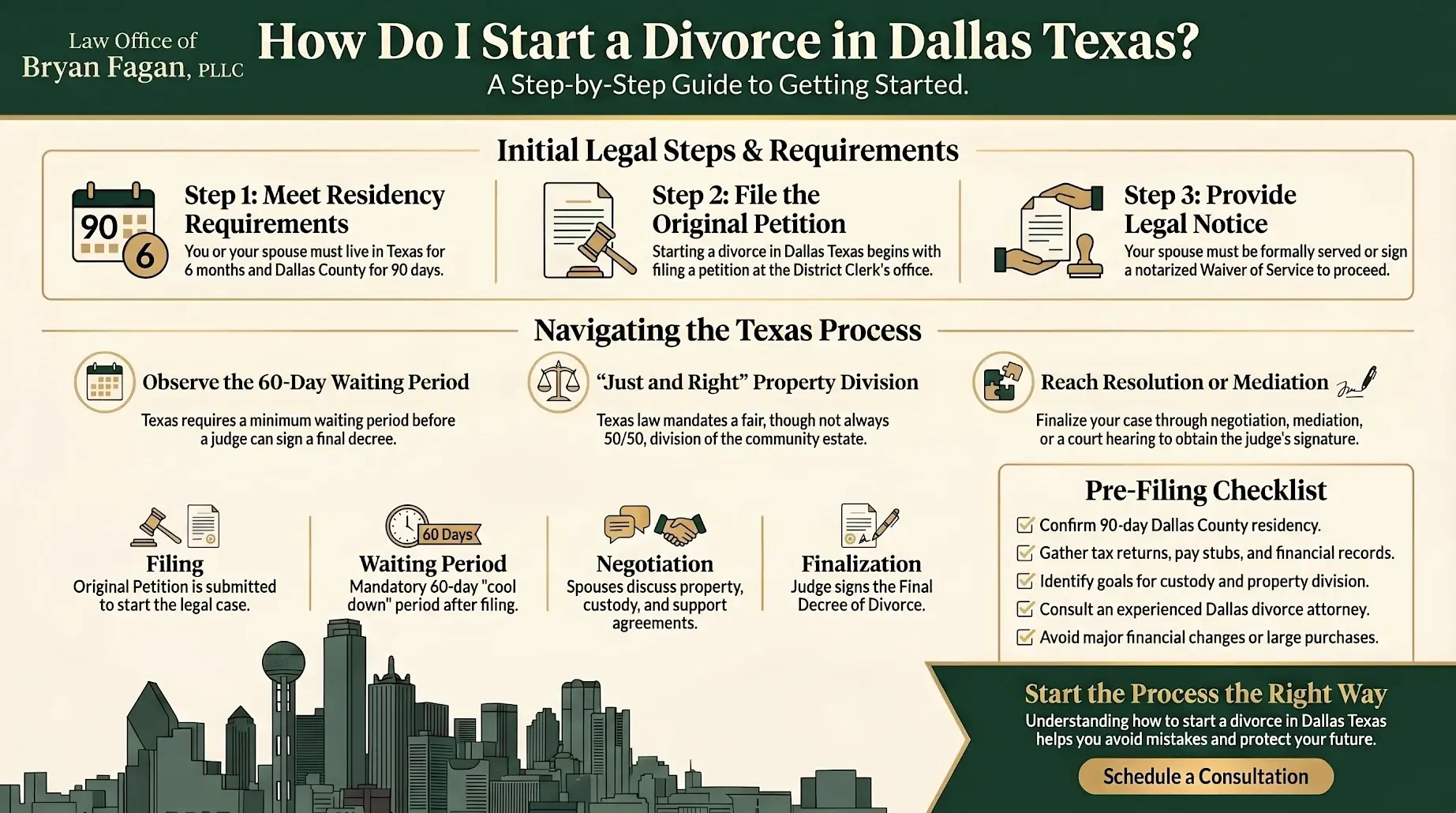
- You can file for divorce in Dallas County if you or your spouse has lived in Texas for six months and Dallas County for 90 days
- Texas requires a mandatory 60-day waiting period after filing before your divorce can be finalized
- Divorce cost in Dallas County varies depending on whether your case is contested or uncontested, and cooperation between spouses can help reduce overall expenses
- Divorce procedures and required forms differ if minor children are involved; custody and support issues must be addressed when children under 18 are part of the case
- The divorce decree is the final legal document that officially ends your marriage and contains all terms of your settlement
- A divorce attorney in Dallas Texas helps navigate complex property division, child custody, and legal requirements
- Contested divorces involving disagreements require more time and legal expertise than uncontested cases
- Proper preparation with financial documents and legal guidance protects your rights throughout the process

Your Family’s Future Starts Here
Don’t navigate your legal journey alone. Schedule a consultation now and get the clarity and support you deserve.
Divorce Attorney in Dallas Texas: The Short Answer
If you’re asking How Do I Start a Divorce in Dallas Texas, one of the first decisions you’ll face is whether—and when—to involve a divorce attorney. The legal process begins with filing an Original Petition for Divorce in Dallas County and meeting the residency requirements under Texas Family Code §6.301, but how you start often shapes how your case unfolds. Taking the time to understand your rights, your options, and the procedural steps early on can help you avoid delays, reduce stress, and make more confident decisions.
A divorce attorney helps guide you through each stage of the process, from preparing and filing documents to ensuring compliance with Texas Family Code requirements, including the mandatory 60-day waiting period under §6.702. In straightforward situations—where both spouses agree on property division, support, and parenting arrangements—you may only need limited legal guidance to ensure everything is done correctly. However, even simple cases can go sideways if key details are overlooked, especially when it comes to final decree language or long-term financial obligations.
In more complex cases, legal guidance becomes far more important. If your case involves children, courts apply the “best interest of the child” standard under §153.002, with a strong focus on stability, consistency, and each parent’s ability to meet the child’s daily needs. Judges in Dallas County often evaluate which parent is organized, prepared, and thinking about long-term outcomes—not just short-term disagreements. If your case involves disputes over custody, property, or support—or if you are dealing with significant financial assets—the need for a clear, structured strategy becomes critical.
If your situation includes conflict, high-value property, or the need for temporary orders, the process is no longer just about filing paperwork. It becomes about building a position that is credible, well-documented, and aligned with how courts evaluate these cases. Understanding how divorce works across the state can provide helpful context, and resources like this guide to divorce in Texas or insights for those moving to Dallas can help you better understand both the legal process and the local landscape.
Ultimately, starting a divorce is not just a legal step—it is a strategic decision that affects your finances, your family, and your future. Whether your situation is straightforward or more involved, recognizing when to seek guidance—and what level of support your case requires—can make all the difference in how confidently you move forward.

What Does a Divorce Attorney Do?
A divorce attorney handles every legal aspect of your divorce case from start to finish. This includes providing legal advice about Texas Family Code requirements, ensuring you understand your rights regarding property division, child custody, and spousal maintenance.
Your attorney drafts and files all required paperwork with the Dallas County District Clerk’s office, including the Original Petition for Divorce and Civil Case Information Sheet. They manage service of process, ensuring your other spouse receives proper legal notice through a constable, sheriff, or process server.
During divorce proceedings, your lawyer negotiates settlements on property division, conservatorship arrangements, and child support. When spouses agree on major issues, your attorney drafts the agreement and prepares the final decree. When disputes arise, your attorney represents you in Dallas County district courts, presenting evidence and arguments to protect your interests. Building a compelling case with thorough preparation and strong evidence is especially crucial in custody disputes, as Texas courts prioritize the child’s best interests.
When Do You Need a Divorce Attorney?
Legal representation is advised during divorce proceedings, which are a type of family law case that may involve multiple legal issues such as property division, child custody, and support. Although individuals can represent themselves, certain situations strongly warrant professional guidance.
Complex cases involving significant assets or business interests require an attorney who understands Texas community property law. When substantial real property, retirement accounts, or business valuations are involved, mistakes can cost you thousands of dollars.
Cases involving children and custody disputes benefit tremendously from experienced representation. Texas courts determine child custody based on the “best interest of the child” standard, and an attorney ensures your parental rights receive proper protection.
Property disputes and disagreements over community property division often require legal intervention. When domestic violence or safety concerns exist, an attorney can help obtain protective orders and navigate sensitive legal territory. Even when both parties believe they have an agreed divorce, attorney review prevents costly errors in property rights and support obligations.
Texas Divorce Basics
Understanding the foundational requirements helps you plan your timeline and expectations. Under Texas law, at least one spouse must have lived in Texas for at least six months before filing for divorce, and in the county where the divorce is filed for at least 90 days (Texas Family Code Section 6.301). Texas law establishes specific rules about who can file, where to file, and how long the process takes.
Additionally, Texas does not recognize legal separation as a formal legal status. Instead, during divorce proceedings, courts can issue temporary orders to address issues like spousal support and child custody until the divorce is finalized.
Residency Requirements Under Texas Family Code §6.301
If you’re asking How Do I Start a Divorce in Dallas Texas, one of the first—and most important—steps is making sure you meet the residency requirements under Texas Family Code §6.301. Before a court in Dallas County can hear your case, at least one spouse must have lived in Texas for a minimum of six months and in Dallas County for at least 90 days. This requirement is not just a technicality—it determines whether your case can move forward at all, and filing too early can lead to delays or even dismissal.
In straightforward situations, meeting these requirements is clear and easy to prove. A Texas driver’s license, lease agreement, utility bills, or voter registration often provide sufficient documentation to show where you have been living. However, in more complex cases—especially when one spouse has recently relocated, travels frequently, or lives out of state—establishing residency can require a more careful, well-documented approach. Courts in Dallas County look closely at consistency and credibility, including where you actually sleep most nights and how stable your living situation appears.
If your case involves a spouse living outside of Texas, you may still be able to file in Dallas County as long as the other spouse meets the six-month state requirement. This is particularly relevant for military families or individuals who split time between locations. In these situations, preparation becomes critical. Judges evaluate not only whether the legal threshold is met, but also whether the case has been filed in the appropriate venue with accurate and complete information.
Understanding local logistics can also help you navigate the process more smoothly. Filing typically occurs at the George L. Allen, Sr. Courts Building in downtown Dallas, and factors like commuting, scheduling, and access to the courthouse can impact your experience—especially if hearings or filings require in-person attendance. For additional context on navigating the city, this resource on transportation in Dallas can be helpful as you prepare.
If your situation is simple and uncontested, meeting residency requirements may be just one quick step before moving forward with filing. But if your case involves disputes, children, or questions about where to file, getting it right from the beginning matters. Early missteps can slow your case down or create complications that are difficult to fix later. Taking the time to confirm your eligibility and prepare properly helps ensure your divorce starts on solid ground—and moves forward with clarity and confidence.

The 60-Day Waiting Period Under Texas Family Code §6.702
In Texas, there is a mandatory 60-day waiting period from the date the Original Petition for Divorce is filed before a divorce can be finalized. The 60-day waiting period is designed to allow for potential reconciliation between the spouses.
If the 60th day of the waiting period falls on a weekend or holiday, the divorce can be finalized on the next business day. There are only two exceptions to the 60-day waiting period in Texas, which may allow for a divorce to be finalized sooner—both involve situations where the respondent has been convicted of family violence or where protective orders are in place.
No-Fault and Fault-Based Grounds
Texas is a no-fault divorce state, meaning that spouses can file for divorce without proving wrongdoing by the other party, with the most common ground being “insupportability.” This simply means the marriage has become insupportable due to discord or conflict with no reasonable expectation of reconciliation.
In addition to no-fault grounds, Texas law recognizes fault-based grounds for divorce, including adultery, cruelty, abandonment, and felony conviction, which can affect property division and other outcomes. Under Texas law, “alimony” is referred to as spousal maintenance (Texas Family Code § 8.001), and it may be awarded if one spouse cannot meet their minimum reasonable needs due to lack of sufficient property or income, such as in cases involving disability, long-term marriage, or family violence. You do not have to choose fault grounds to file; most Texas divorces proceed on insupportability alone.
Contested vs Uncontested Divorce
If you’re trying to understand How Do I Start a Divorce in Dallas Texas, one of the most important early distinctions is whether your case will be contested or uncontested. This single factor can shape your timeline, your costs, and how much involvement the Dallas County courts will have in your case. Knowing where your situation falls helps you plan more effectively and avoid unnecessary delays.
In straightforward situations, an uncontested divorce offers a more efficient path forward. This means both spouses have reached agreement on all major issues, including property division, debt allocation, and—if applicable—child custody and support under Texas Family Code §§153.002 and 153.134. When there is alignment, the process typically involves filing the required documents, observing the 60-day waiting period under §6.702, and presenting a final agreement to the court. These cases often move faster, cost less, and allow both parties to maintain greater control over the outcome.
In more complex cases, even a single disagreement can shift your divorce into contested territory. If your case involves disputes over custody, financial assets, or support obligations, the court may need to step in to resolve those issues. Judges in Dallas County evaluate factors such as each party’s credibility, preparedness, and ability to provide stability—especially when children are involved. If your case includes disagreements about parenting arrangements, the court will focus heavily on what serves the child’s best interest, often looking at consistency, involvement, and long-term impact on the child’s daily life.
If your case involves high-value assets, business interests, or ongoing conflict, the process may require additional steps like discovery, mediation, or even trial. These situations demand more than basic paperwork—they require a structured approach that anticipates how the court will evaluate evidence and testimony. Access to reliable local information can also help you navigate the process more confidently, and resources like governmental resources in Dallas can provide helpful context as you move forward.
Understanding whether your case is contested or uncontested is not just about labeling your situation—it is about recognizing what level of preparation and guidance is appropriate. Acting too quickly without a clear plan can lead to complications, while waiting too long to address disagreements can increase costs and stress. Whether your situation is simple or more involved, taking the time to assess your circumstances early can help you move forward with clarity and protect what matters most.

Table 1: Contested vs Uncontested Divorce Comparison
| Feature | Contested Divorce | Uncontested Divorce |
|---|---|---|
| Agreement Level | Disagreement on one or more issues | Full agreement on all issues |
| Court Involvement | Judge decides disputed matters | Minimal court intervention |
| Timeline | 6-24 months typically | 61-90 days possible |
| Average Cost | $15,000-$30,000+ | $300-$5,000 |
| Children Impact | Custody hearings may be required | Parents create approved parenting plan |
| Stress Level | Higher due to litigation | Lower with cooperative resolution |
The Divorce Process in Dallas County
The divorce process in Texas officially begins when one spouse files an Original Petition for Divorce—commonly called a divorce petition—at the district clerk’s office in the appropriate county. The clerk’s office is responsible for processing your legal paperwork, and you must pay a filing fee at the time you submit your petition; the exact amount can vary, so it’s wise to confirm with the clerk beforehand. E-filing is also available for submitting divorce documents electronically through eFileTexas.gov, which offers convenience for both attorneys and individuals representing themselves. If your divorce will involve children or minor children, be aware that forms and procedures differ, and you will need to address custody and support issues as part of your case. Here is a step-by-step breakdown of what happens in Dallas County.
Filing the Original Petition
The divorce process in Dallas County begins when you file the Original Petition for Divorce, also known as the divorce petition, which is the legal document that officially starts your case. Documents required for filing include the divorce petition (Original Petition for Divorce) and a Civil Case Information Sheet. Dallas County also requires you to attach the Standing Order Regarding Children, Pets, Property and Conduct to your initial pleadings. Self-represented litigants can conveniently submit the divorce petition and related documents through e-filing using eFileTexas.gov, or file them in person at the Pearl C. Smith Civil File Desk.
Filing fees for divorce in Dallas County typically range from $300 to $350. If you cannot afford the filing fees, you can request a fee waiver by submitting a Statement of Inability to Afford Payment of Court Costs.
Service of Process
If a spouse does not sign a Waiver of Service, the other spouse must have them served by a constable, sheriff, or private process server. In amicable cases, a Waiver of Service can be signed by the spouse to avoid formal delivery of the divorce papers.
The responding spouse has until the first Monday following 20 days after service to file an answer. Failure to respond may result in a default judgment.
Temporary Orders
Either party can request temporary orders to address urgent needs while the divorce is pending. These orders may cover temporary conservatorship, possession schedules, child support, spousal support, exclusive use of the marital residence, and payment of bills.
Discovery and Mediation
In contested cases, both parties exchange financial documents and information through formal discovery. Dallas County district courts often require mediation before trial, where a neutral third party helps spouses reach agreement on disputed issues.
Final Hearing
A prove-up hearing is required to finalize the divorce, where the parties present the signed divorce decree to a judge. The divorce decree is the final order that legally ends the marriage and contains all the terms and conditions of the settlement, including agreements on property division and child custody arrangements if applicable.
Table 2: Divorce Process Overview
| Step | What Happens | Timeline |
|---|---|---|
| Filing Petition | File Original Petition with Dallas County District Clerk | Day 1 |
| Service of Process | Serve spouse or obtain Waiver of Service | Days 1-14 |
| Response Period | Spouse files answer or waiver | 20+ days after service |
| Temporary Orders | Request immediate relief if needed | Early in process |
| Discovery | Exchange financial information | Ongoing |
| Mediation | Attempt settlement with neutral third party | Before trial |
| 60-Day Waiting Period | Mandatory waiting period expires | Day 61 minimum |
| Final Hearing | Present decree to judge | After waiting period |

Property Division in Texas
Texas Family Code §7.001 requires courts to divide the marital estate in a manner that the court deems “just and right,” giving due regard to the rights of each party and any children.
Community Property vs Separate Property
Texas is a community property state. Property acquired during marriage generally belongs equally to both spouses. Separate property—assets owned before marriage, inheritances, or gifts given specifically to one spouse—remains with that spouse.
When separate property is commingled with community funds or used for community benefit, tracing becomes necessary to establish ownership. Courts may award reimbursement when community funds enhanced separate property or vice versa.
The “Just and Right” Standard
Courts do not have to divide community property exactly 50/50. The “just and right” standard allows inequality when warranted by factors including: duration of marriage, health and earning capacity of each spouse, custodial responsibilities, fault grounds if proved, disparity in income, and tax consequences.
Child Custody and Child Support
Texas Family Code §153.002 explicitly requires that the best interest of the child is always the primary consideration in determining conservatorship, possession, and access. In divorce cases that involve children or minor children, the court must address important issues such as custody, visitation, and child support as part of the process.
The Best Interest Standard
Texas courts determine child custody based on the “best interest of the child” standard, which considers factors such as the child’s emotional and physical needs, each parent’s ability to provide care, and the stability of each home environment.
In Texas, child custody arrangements can be established through mutual agreement between parents or by court order if an agreement cannot be reached. Texas law allows parents to create a parenting plan that outlines custody and visitation arrangements, which must be approved by the court to ensure they serve the child’s best interests.
Child Support Under Chapter 154
Texas Family Code Chapter 154 establishes guidelines for calculating child support based on the obligor’s net monthly resources. Percentages apply depending on the number of children: approximately 20% for one child, 25% for two, and 30% for three.
Courts may deviate from standard guidelines when circumstances warrant, considering factors like income level, other children, and the custody schedule.
Temporary Orders and Mediation
If you’re working through How Do I Start a Divorce in Dallas Texas, understanding temporary orders and mediation is essential—especially if your case is not fully agreed from the beginning. These early steps often shape how your case progresses and can directly impact your finances, your living situation, and, if applicable, your parenting arrangement.
In more complex cases, temporary orders act as the foundation for stability while the divorce is pending. These court orders can address where each spouse lives, who pays which bills, and how child custody and possession schedules will function under Texas Family Code §§153.002 and 153.134. Judges in Dallas County often look closely at which party is organized, prepared, and focused on maintaining consistency—particularly for children. If your case involves custody concerns, the court will prioritize routines that support the child’s well-being, including school schedules, daily structure, and each parent’s involvement. This means the decisions made during temporary orders can influence not only your short-term situation but also how the court views long-term arrangements.
In straightforward situations, where both parties are cooperative, mediation offers a practical and less stressful path to resolution. A neutral third party helps guide discussions so both sides can reach agreement without prolonged court involvement. Mediation is commonly required in Dallas County before trial, and when an agreement is reached, it can be formalized into a binding settlement. This approach often leads to faster outcomes, lower costs, and greater control over the final terms—especially compared to litigation.
If your case involves ongoing conflict, disagreements about custody, or disputes over property or support, mediation becomes more than just a step—it becomes a strategic opportunity to resolve issues before they escalate. In high-conflict situations, failing to prepare properly for temporary orders or mediation can lead to outcomes that are difficult to reverse. For individuals navigating complex legal or personal challenges, including situations involving safety concerns or heightened conflict, understanding your options early is critical. Resources like West Dallas legal issues and safety considerations can provide broader context about navigating difficult circumstances in the area.
Ultimately, temporary orders and mediation are not just procedural steps—they are opportunities to create structure, reduce uncertainty, and move your case forward with purpose. Recognizing whether your situation is simple or requires a more strategic approach can help you avoid delays, reduce stress, and protect your future as your case progresses.

How to Choose the Right Divorce Attorney
Finding the right Dallas divorce lawyer requires evaluating several factors beyond advertising claims.
Experience with Dallas County courts and Texas family law matters significantly. An attorney familiar with local judges, court procedures, and opposing counsel navigates your case more efficiently.
Communication style and responsiveness affect your experience throughout the process. You want an attorney who returns calls, explains developments clearly, and keeps you informed.
Strategy approach for contested vs uncontested cases should match your situation. Some attorneys prefer aggressive litigation; others emphasize negotiation. Understand your attorney’s philosophy.
Reputation and track record in similar Dallas divorce cases provides insight into likely outcomes. Ask about experience with cases similar to yours.
Fee structure and cost transparency prevents surprises. Understand whether your attorney charges hourly rates, flat fees, or retainers, and what services those fees cover.
What to Bring to a Consultation
Preparing for your initial consultation helps your attorney assess your case accurately.
Gather financial documents including the last two to three years of federal income tax returns, recent pay stubs, W-2s, bank statements, and retirement account statements. For self-employed individuals, bring profit and loss statements.
Prepare a list of marital assets and debts: homes, vehicles, bank accounts, investments, business interests, credit cards, mortgages, and loans. Document any separate property with proof of pre-marital ownership or inheritance.
Bring information about children including birth certificates, school records, medical records, and current caregiving arrangements.
Prepare questions about your specific situation and goals. What custody arrangement do you want? Which assets matter most? What concerns you about the process?
Bring any existing court orders or marital agreements, including prenuptial agreements, postnuptial agreements, or protective orders.
How a Dallas Divorce Attorney Can Help You
Strategic guidance tailored to your specific Dallas County case makes the difference between favorable outcomes and costly mistakes. Your attorney understands Texas Family Code requirements and applies that knowledge to protect your interests.
Legal representation protects your rights throughout divorce proceedings. From ensuring proper service of process to presenting compelling cases for property division or custody, your attorney advocates for your position. Building a compelling case means thorough preparation and effective presentation of evidence to the court, which is essential for persuading the judge and securing favorable custody or property outcomes.
Professional handling of complex procedures reduces stress during an already difficult time. Instead of navigating unfamiliar court forms and deadlines yourself, you focus on your family and future while your attorney manages legal details.
A divorce attorney in Dallas Texas works toward fair outcomes in property division and child custody arrangements. Whether through negotiated settlement or courtroom advocacy, experienced representation helps achieve results that protect your financial security and parental relationship.

Checklist: Divorce Attorney in Dallas Texas
Use this checklist as you prepare for your divorce:
- [ ] Identify your goals for custody, property, and support
- [ ] Gather financial documents including tax returns and pay stubs
- [ ] Create a list of all marital assets and debts
- [ ] Understand Texas residency requirements
- [ ] Prepare questions for your attorney consultation
- [ ] Stay organized with a dedicated folder for divorce documents
- [ ] Avoid major financial decisions without legal guidance
- [ ] Consult an attorney before filing if possible
- [ ] Plan your living arrangements and budget
- [ ] Focus on your children’s stability throughout the process
Conclusion
Starting a new chapter is rarely simple, but understanding How Do I Start a Divorce in Dallas Texas gives you something most people are missing at the beginning—clarity. When you know the steps, the legal framework, and how your decisions shape the outcome, the process becomes less about fear and more about control. In straightforward situations, where both spouses are cooperative and agreements are within reach, the path forward can be efficient and relatively smooth. In more complex cases—especially if your case involves children, significant assets, or disagreements about custody or property—the decisions you make early can have lasting consequences that deserve careful, strategic guidance.
At The Law Office of Bryan Fagan, PLLC, we believe every family deserves a path forward that protects their future and restores peace of mind. Whether you are navigating a simple, agreed divorce or facing a more contested situation that requires experienced advocacy, the right level of support makes all the difference. Our role is not just to handle the legal process, but to help you understand it, make informed decisions, and move forward with confidence. When you are ready to take the next step, having a team that prioritizes clarity, strategy, and your long-term stability can turn uncertainty into a plan—and a plan into progress.
Frequently Asked Questions
A divorce attorney guides clients through the legal process of ending a marriage under Texas law. They file required court documents, manage the divorce case from start to finish, negotiate settlements on property and custody issues, and represent clients in Dallas County district courts when necessary.
Texas law mandates a minimum 60-day waiting period from filing before finalization. Uncontested divorce cases may conclude shortly after day 61, while contested divorce cases typically take 6-12 months or longer depending on complexity and court schedules.
Legal representation is advised during a family law case such as divorce, although individuals can represent themselves. An attorney is particularly important when children, significant assets, or disagreements are involved.
Divorce cost in Dallas County includes attorney fees, court costs, and the filing fee, which typically ranges from $300 to $350. In a contested divorce case, legal fees can average more than $10,000 for each spouse. Uncontested divorces with attorney assistance typically cost $1,000-$5,000 total. The overall divorce cost varies based on the complexity of the divorce case, whether it is contested or uncontested, and the level of cooperation between spouses.
The divorce process begins when one spouse files an Original Petition for Divorce with the district clerk’s office, initiating the divorce case. After service of process and the 60-day waiting period, parties either present an agreed decree or proceed through discovery, mediation, and potentially trial, until the court issues a final order resolving all issues.
Yes. Most Dallas divorce cases settle through negotiation or mediation without trial. A prove-up hearing is required to finalize the divorce, but this brief court appearance simply presents your agreed decree to the judge for approval.
Under Texas Family Code §6.301, at least one spouse must have lived in Texas for six months and in Dallas County for 90 days before filing. If you live outside Texas, you can still file in Dallas County if your spouse meets these requirements.
Texas is a community property state. Under Texas Family Code §7.001, courts divide marital property in a “just and right” manner, which does not always mean 50/50. Factors include earning capacity, custody responsibilities, and fault grounds if applicable.
A final order in a Texas divorce case is the court’s legally binding decision that resolves all issues, such as property division, child custody, and support. Once signed by the judge, the final order is enforceable and marks the official end of the divorce case.
Yes, divorce is a type of family law case governed by the Texas Family Code. Divorce cases involve legal proceedings related to the dissolution of marriage, property division, and issues involving children.
Texas does not recognize legal separation as a formal legal status. However, during a divorce case, courts can issue temporary orders to address spousal support, child custody, and other matters until the final order is entered.