
If you've built substantial wealth in Texas, you may be in a familiar position right now. Your home has appreciated, your investment accounts have grown, perhaps you own a business, and you want your family protected without creating confusion or unnecessary tax exposure. That's where careful estate tax planning starts to matter.
For many families, the challenge isn't just “How do I avoid tax?” It's “How do I pass wealth to the right people, at the right time, with the least disruption?” Good planning answers both questions. It also takes into account Texas law, federal tax rules, family dynamics, and the practical reality that a strategy that helps on paper can still hurt your heirs if it's used at the wrong time.
Understanding the Federal Estate Tax in 2026
Federal estate tax planning tends to matter most for larger estates, not for the average household. The Tax Policy Center estimated total U.S. estate tax liability at $22.7 billion in 2022 and $24.0 billion in 2023, which shows the tax is still economically significant even though it applies to a small share of decedents, as summarized by the Tax Policy Center estate tax overview. For the families it does affect, the consequences can be substantial.
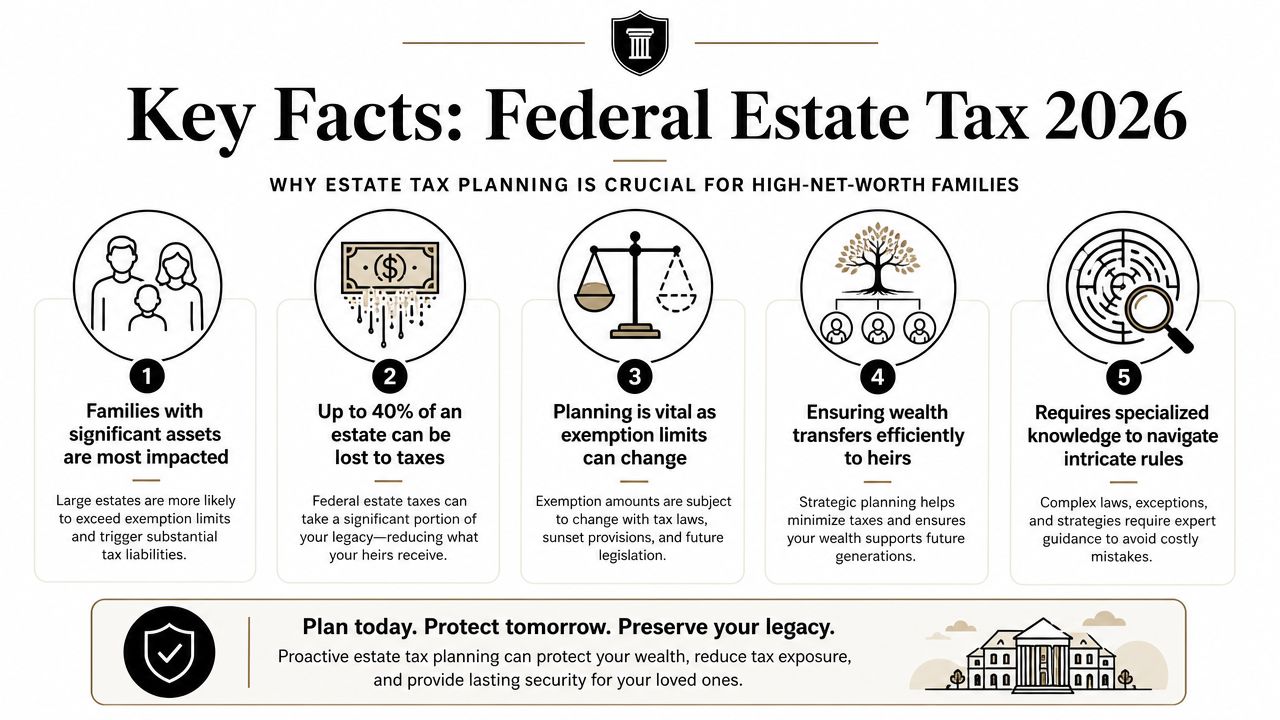
In simple terms, the federal estate tax is a tax on wealth transferred at death. What usually surprises people is not that the tax exists, but how steep it can be once an estate rises above the available exemption. The federal top estate tax rate is 40%, which means every planning decision around timing, ownership, and asset transfer deserves close attention.
What the 2026 exemption means
A projected federal exemption of $15 million per individual in 2026 means a married couple could potentially shield about $30 million with proper planning, according to the 2025 estate planning guide from NBC Securities. If your estate is comfortably below that range, federal estate tax may not be your main concern today.
If your estate is near or above that level, or may reach it because of business growth or real estate appreciation, this becomes a planning issue now, not later. Waiting until a health event or death occurs usually removes the most useful options.
Practical rule: Estate tax planning works best before there's pressure. Once a crisis starts, families usually have fewer choices and less flexibility.
Who should pay close attention
You should take a harder look at estate tax planning strategies if your wealth includes:
- A closely held business that could rise in value or create liquidity issues at death
- Appreciated real estate that has grown far beyond its original purchase price
- Concentrated investment holdings where future appreciation may push the estate higher
- Life insurance proceeds that may increase the taxable estate depending on ownership structure
One area that confuses many readers is the difference between an estate being “valuable” and an estate being “taxable.” Those aren't always the same thing. Your estate may be valuable enough to require advanced planning even if tax isn't due this year, because the law can change and your assets can appreciate.
A second point matters just as much. Estate tax planning isn't only about lowering a tax bill. It's also about protecting family control, preserving liquidity, and reducing the risk that heirs will have to sell assets at the wrong time.
Strategic Gifting to Reduce Your Taxable Estate
Gifting is often the first strategy families understand, and for good reason. It's straightforward, flexible, and can be repeated over time.
For 2026, an individual can give $19,000 per recipient per year without gift tax implications, and a married couple can combine exclusions to give $38,000 per recipient, according to Thrivent's estate tax planning guidance. Done consistently, that can move meaningful value out of an estate.
Annual gifts versus larger lifetime transfers
These are two different tools.
Annual exclusion gifts are the smaller gifts you can make each year without using lifetime exemption. Families often use them to help children, grandchildren, or other loved ones while reducing the taxable estate gradually.
Lifetime exemption gifts are larger transfers. These are often used when a family wants to move a business interest, investment asset, or other appreciating property earlier, rather than waiting until death.
A practical example helps. A married couple with adult children and grandchildren may choose to make annual gifts each year. That doesn't just move current dollars out of the estate. It can also remove future appreciation on those transferred assets.
Why gifting works over time
The main tax benefit isn't only the gift itself. It's what happens next.
- Principal leaves the estate so that amount is no longer part of the taxable base.
- Future growth shifts too if the gifted asset appreciates after the transfer.
- Control can be matched to the goal by gifting cash, marketable securities, or interests in a business or real estate entity, depending on the plan.
For many Texans, gifting becomes part of a broader Estate Planning approach that includes wills, trusts, and estate plans to protect assets and wishes.
Smaller annual gifts can look modest in isolation. Used regularly, they become one of the simplest ways to reduce a future taxable estate without waiting for a last-minute solution.
The common mistake is assuming all gifting is automatically wise. Sometimes it is. Sometimes it isn't. The type of asset matters, and later in this article we'll discuss why giving away highly appreciated property can create an income tax problem for heirs if you sacrifice a stepped-up basis.
Using Trusts to Protect and Control Your Assets
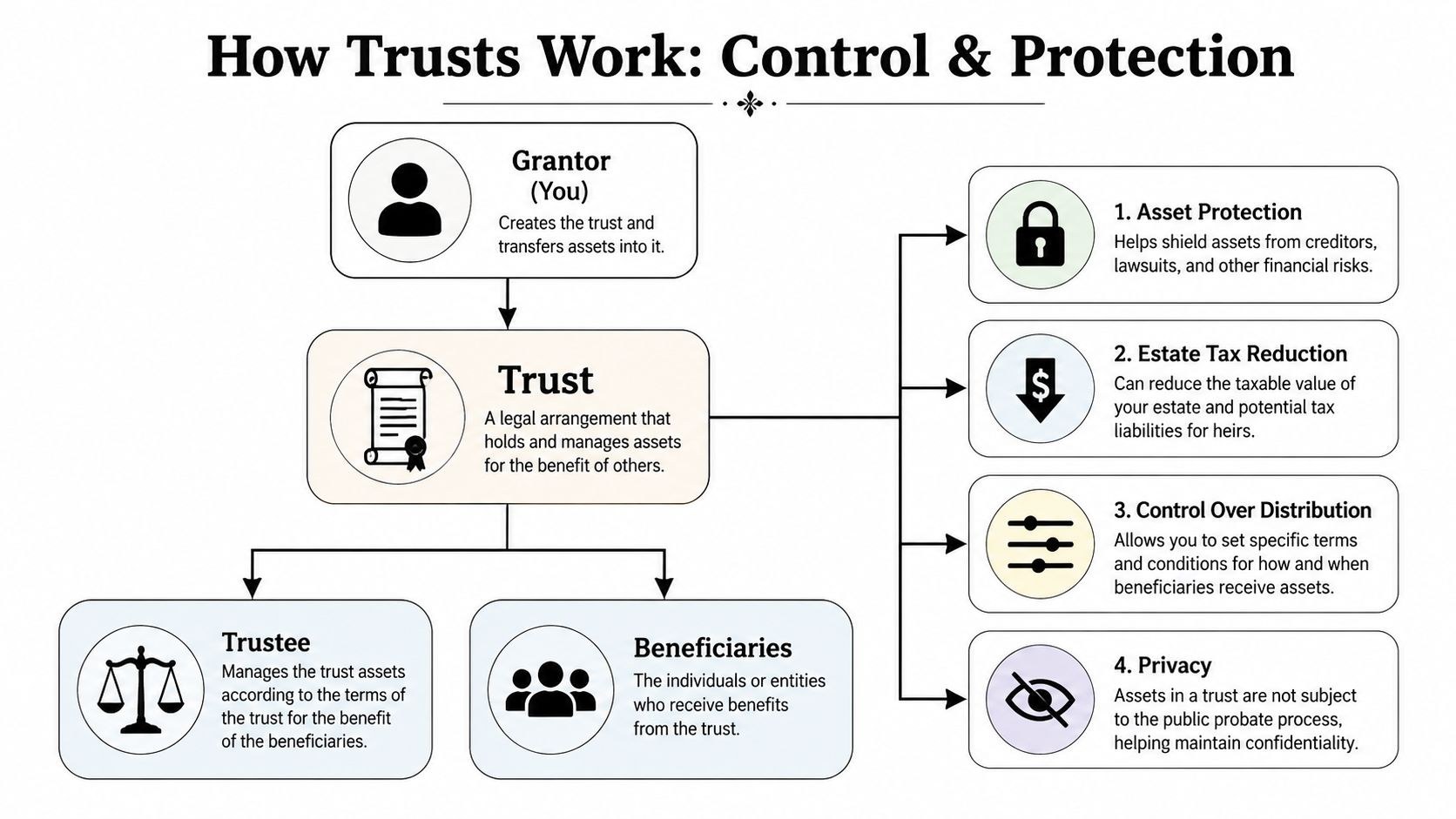
Trusts are where estate planning becomes more customized. A trust can address taxes, but it can also address control, privacy, creditor exposure, and the timing of distributions to beneficiaries.
When Texas families hear the word “trust,” they sometimes assume it's a single document with a single purpose. In practice, trusts solve different problems. A revocable trust may help with probate administration and management during incapacity. An irrevocable trust is often the more important tool when estate tax exposure is part of the discussion.
Why irrevocable trusts matter
Advanced planning often involves placing appreciating assets, such as real estate or business interests, into an irrevocable trust. This technique removes the current value of the asset from the taxable estate and shifts future growth outside the estate, as discussed in this overview of estate tax planning tools.
That feature is especially useful when a family expects an asset to rise sharply in value.
Here's the basic comparison:
| Trust type | Main use | Tax impact |
|---|---|---|
| Revocable trust | Management, probate avoidance, privacy planning | Usually doesn't remove assets from the taxable estate |
| Irrevocable trust | Asset transfer, control, protection, tax planning | Can remove transferred assets and future appreciation from the taxable estate |
Different trusts solve different family problems
A Spousal Lifetime Access Trust, often called a SLAT, is commonly used by married couples who want to move assets out of one spouse's estate while preserving indirect access through the beneficiary spouse.
An Irrevocable Life Insurance Trust, or ILIT, is used when life insurance proceeds themselves could create estate tax exposure or when the family wants liquidity outside the taxable estate. If you want a plain-English overview of how these work, this Guide to ILITs is a useful starting resource.
A trust may also be designed for a child who isn't ready to inherit outright, a beneficiary with special needs, or a family business that shouldn't be fragmented among heirs.
For readers who want a more Texas-specific overview of formation issues, this article on setting up a trust in Texas explains the state-law side of the process.
Trusts and family control
The most valuable feature of many trusts isn't tax reduction alone. It's control.
A trust lets you decide who manages assets, when beneficiaries receive distributions, and under what conditions. That can be critical after a remarriage, in a blended family, or when one heir is financially responsible and another is not.
Texas families dealing with changing marital circumstances often see how financial planning and family law overlap. For example, Alimony & Spousal Support addresses spousal maintenance and alimony claims and defenses, which can become relevant when support obligations and estate planning need to be coordinated after divorce.
A short video can help if you're comparing trust options and trying to understand how they function in real life.
Advanced Strategies for High-Net-Worth Texans
Once an estate grows beyond basic gifting and standard trust planning, the discussion usually broadens. The right plan may combine portability, charitable planning, and business succession tools rather than relying on a single strategy.
Portability and married couples
Portability allows a surviving spouse to use a deceased spouse's unused federal estate tax exemption if the proper election is made. In practical terms, portability can preserve a large amount of unused exemption for the surviving spouse.
That's valuable, but it's not a substitute for planning. Portability doesn't solve every issue involving appreciation, liquidity, or asset control. It also doesn't replace a properly drafted plan for business interests, family real estate, or asset protection.
Charitable planning with tax efficiency
Some families want part of their legacy to support a charitable cause while still providing income or flexibility during life. A charitable remainder trust can be one way to accomplish that.
According to the verified planning guidance provided, a charitable remainder trust can convert appreciated property into an income stream while potentially avoiding immediate capital gains tax on liquidation, with the remainder later passing to charity outside the estate. That makes it a tool worth discussing when a family owns highly appreciated assets and has charitable goals.
Good planning isn't about choosing between family and charity. In some cases, the legal structure lets you support both.
Family business succession
Business owners often face a separate challenge. They don't just need to reduce tax. They need to preserve operations, maintain management continuity, and avoid a forced sale.
Family limited partnerships are commonly used in estate tax planning because they can help centralize ownership and facilitate gradual transfer of family wealth. They're especially relevant when the family wants one generation to retain control while the next generation receives ownership interests over time.
If your estate includes a company, ranch interests, commercial property, or a portfolio of rental assets, the tax question can't be separated from the succession question. This article on how to minimize estate taxes in Texas provides a helpful companion read on that broader issue.
Some readers dealing with major family transitions are also managing personal safety or urgent legal issues at the same time. In those circumstances, Protective Orders address domestic violence and family safety matters, which may need immediate attention before long-range estate planning can move forward.
How Texas Law Impacts Your Estate Plan
Texas gives residents one major advantage. Texas doesn't impose a state estate tax or a state inheritance tax. That simplifies planning compared to states where families must account for both a state-level transfer tax and the federal system.
Still, that doesn't mean Texas families can ignore estate planning. Federal rules still apply, and state law controls many of the documents and procedures used to carry out the plan.
Texas law still governs the structure
Your will, trust administration, powers of attorney, and probate process all operate within Texas law. The Texas Estates Code governs many of the rules around wills, estate administration, independent administration, nonjudicial matters, and fiduciary duties. Those rules affect how efficiently your family can act after death or incapacity.
For example, a will can direct asset distribution, but probate may still be required. A properly funded trust may help avoid probate for assets titled in the trust. That matters because probate can create delay, paperwork, and public filings your family may prefer to avoid.
If you'd like a Texas-specific overview of how wills and trusts fit together, this article on estate planning, wills, and trusts is a helpful reference.
Property ownership matters in Texas
Texas is also a community property state under the Texas Family Code. That matters because spouses may not own property in the way they assume they do. Separate property, community property, beneficiary designations, and trust ownership all need to be coordinated carefully.
Here's where confusion often starts:
- A family home may have estate implications depending on title and whether it's separate or community property.
- Business interests acquired during marriage may require a closer ownership analysis.
- Investment accounts and beneficiary designations can override what a will says.
Property taxes are a separate issue from estate taxes, but Texans often look at both when planning around real estate holdings. For readers who want a plain-language overview on that topic, this guide can help you understand Texas property taxes with INTELLI.
Federal tax rules may drive the strategy, but Texas law often determines how smoothly your family can carry it out.
Common Pitfalls and the Stepped-Up Basis Tradeoff
One of the biggest mistakes in estate tax planning is assuming that every lifetime gift is a tax win. It isn't.
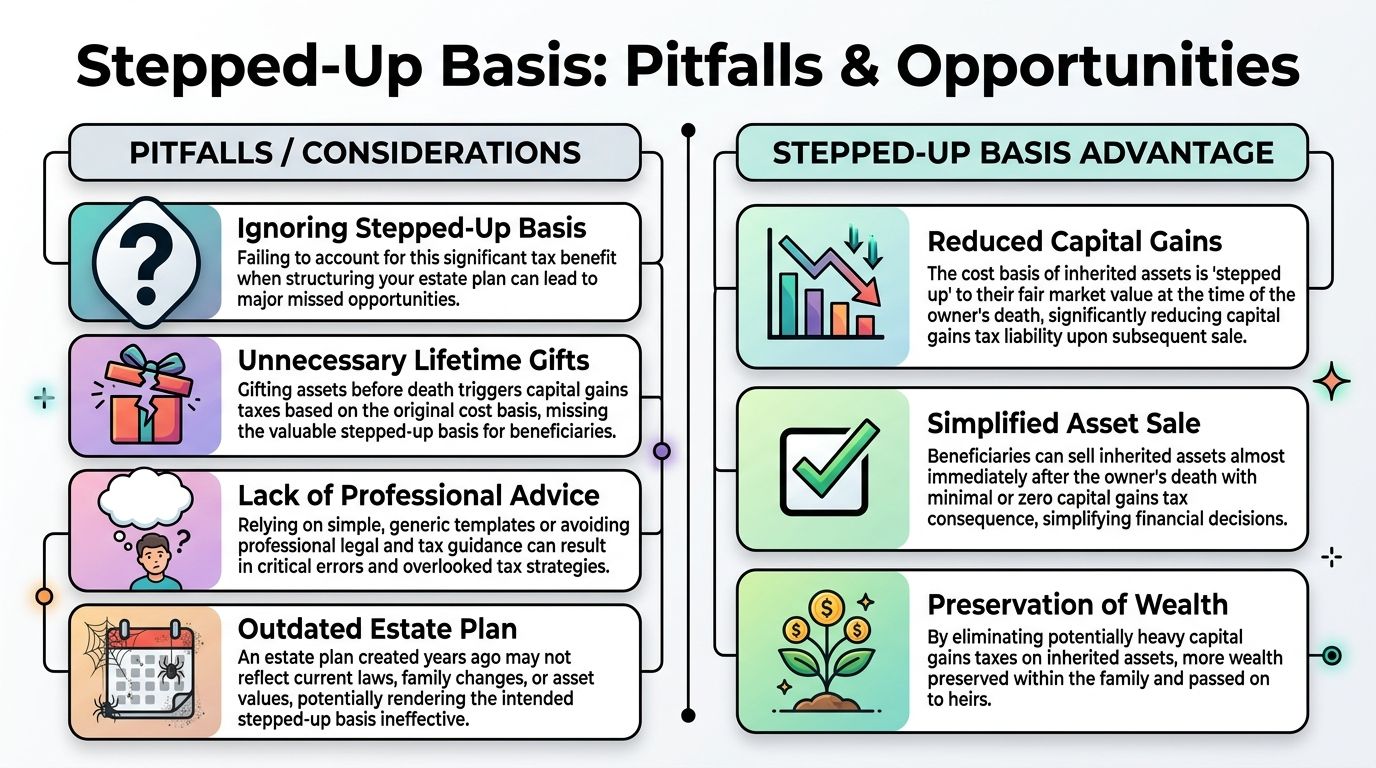
Stepped-up basis proves critical. For many families, holding appreciated property until death can be the better move because inherited assets generally receive a basis adjustment to market value at death. As explained in the Financial Planning Association discussion of post-reform estate planning, that stepped-up basis can eliminate decades of taxable capital gains for heirs.
Why this tradeoff confuses people
Estate tax planning focuses on removing assets from the estate. Income tax planning may point in the opposite direction for highly appreciated assets.
If you gift appreciated stock or real estate during life, the recipient generally takes your carryover basis. That means the built-in gain goes with the asset. If the recipient later sells it, capital gains tax may apply to appreciation that built up during your ownership.
If instead the asset is held until death and receives a stepped-up basis, that built-in gain may largely disappear for income tax purposes.
A practical comparison
Consider the difference in concept:
| Decision | Possible estate tax effect | Possible income tax effect for heirs |
|---|---|---|
| Gift appreciated asset during life | May reduce the taxable estate | Heir may inherit your low basis |
| Hold appreciated asset until death | Asset remains in estate | Heir may receive stepped-up basis |
That's why the “give everything away early” approach can backfire. The best estate tax planning strategies look at the family's total tax picture, not just one column on one return.
Sometimes the smarter strategy is to gift cash or low-growth assets during life and hold highly appreciated assets for a later step-up in basis.
Other common planning mistakes
Families also run into problems when they:
- Fail to update old documents after divorce, remarriage, or major asset changes
- Ignore beneficiary designations on retirement accounts and insurance policies
- Use trusts without funding them properly so the assets never move into the intended structure
- Focus only on tax reduction and overlook management, liquidity, and family conflict risks
For many higher-net-worth Texans, the right answer is a blended strategy. Some assets are good lifetime gift candidates. Others are better held until death. The distinction depends on appreciation history, expected growth, liquidity needs, and family goals.
Why Proactive Planning Before the 2026 Sunset Is Crucial
The current planning window is unusual because the high federal exemption is temporary. Under the Tax Cuts and Jobs Act, the exemption is scheduled to be cut by approximately 50% on January 1, 2026, according to this discussion of advanced estate planning strategies and the 2026 change.
That makes delay risky for families with significant estates. A “wait and see” approach can sound reasonable, but many of the most effective strategies require action while the higher exemption is still available.
Why acting sooner matters
Large lifetime gifts and funding certain irrevocable trusts generally need to happen before the lower exemption environment takes effect if your goal is to use today's larger transfer opportunity. Once the law changes, that opening may narrow considerably.
This doesn't mean every family should transfer assets immediately. It means every high-net-worth family should evaluate the options now, while flexibility still exists.
What a timely review should include
A serious pre-2026 review usually looks at:
- Current net worth and likely future appreciation
- Whether annual and lifetime gifting should be used now
- Which assets should stay in the estate for basis reasons
- Whether trusts, portability, or charitable tools fit the family's goals
- How Texas probate and title issues may affect implementation
The right plan is rarely one-size-fits-all. A business owner, a remarried couple, and a family with concentrated real estate holdings may all need very different answers, even if their net worth appears similar on paper.
If you need help navigating divorce, custody, or estate planning in Texas, contact Law Office of Bryan Fagan, PLLC today for a free consultation. Thoughtful estate tax planning strategies can protect your family, preserve your legacy, and help you make informed decisions before the law changes.