
Hearing that your visits with your child must be supervised can feel like a punch to the chest. Most parents immediately worry about the same things. Am I losing my child? Does this mean the judge thinks I'm a danger? Will I ever get normal time back?
Those fears are real. They also don't tell the whole story.
In many Texas custody cases, supervised visitation is a protective structure, not the end of the parent-child relationship. The court is trying to create a setting where contact can continue while concerns are addressed. That may feel restrictive, and it is. But it also means the court has not cut off contact altogether.
If you're asking what are supervised visits, the short answer is this: they are visits between a parent and child that happen in the presence of another approved adult who is there to protect the child and make sure the court's rules are followed. The details matter, though. Who supervises, where the visit happens, what the supervisor can do, and how you move past supervision all depend on the court order and the facts of your case.
Texas family law puts the child's best interest at the center of these decisions. That standard appears throughout the Texas Family Code, including the provisions governing conservatorship, possession, and access. A judge can place limits on visitation if the evidence shows those limits are needed to protect a child's physical safety or emotional welfare.
You can get through this. The key is to understand the order, follow it carefully, and treat every visit as an opportunity to show the court stability, judgment, and consistency.
An Empathetic Introduction to Supervised Visitation
A lot of parents first hear the phrase “supervised visitation” in a courtroom, at mediation, or in temporary orders. They leave with more anxiety than answers. That's understandable. The term sounds harsh, and it often arrives during one of the most painful periods in a family's life.
What supervised visitation means in practice is more specific than commonly understood. It usually means you still have parenting time, but the court has decided that time must happen under controlled conditions for now. In Texas, judges have broad authority to shape possession orders to protect a child when needed under the Texas Family Code, including sections dealing with temporary orders and possession arrangements.
That distinction matters. Supervised visits are different from no contact. The order limits how contact happens, but it still preserves contact.
Supervision is often temporary. What you do during this period can strongly affect what happens next.
Parents also get confused because the phrase can describe several different setups. One family may use a professional visitation center. Another may use a mutually approved relative. One case may involve full supervision during the visit. Another may only require a monitored exchange so the parents don't interact at pickup and dropoff.
A calm, practical approach helps. Read the exact wording of the order. Look for who may supervise, where visits may occur, how long they last, whether calls or video contact are allowed, and what conduct is prohibited. If the order is vague, that's a problem worth addressing early because confusion leads to missed visits, arguments, and bad documentation.
What Supervised Visits Mean in Texas Family Law
In plain language, supervised visitation is a court-ordered form of possession and access where another adult must be present for the parent's time with the child. In higher-risk situations, the supervisor must keep the child within hearing and sight at all times and can direct or terminate the visit if rules are broken, which makes supervision an active safety tool rather than passive observation, as described in this overview of supervision levels.
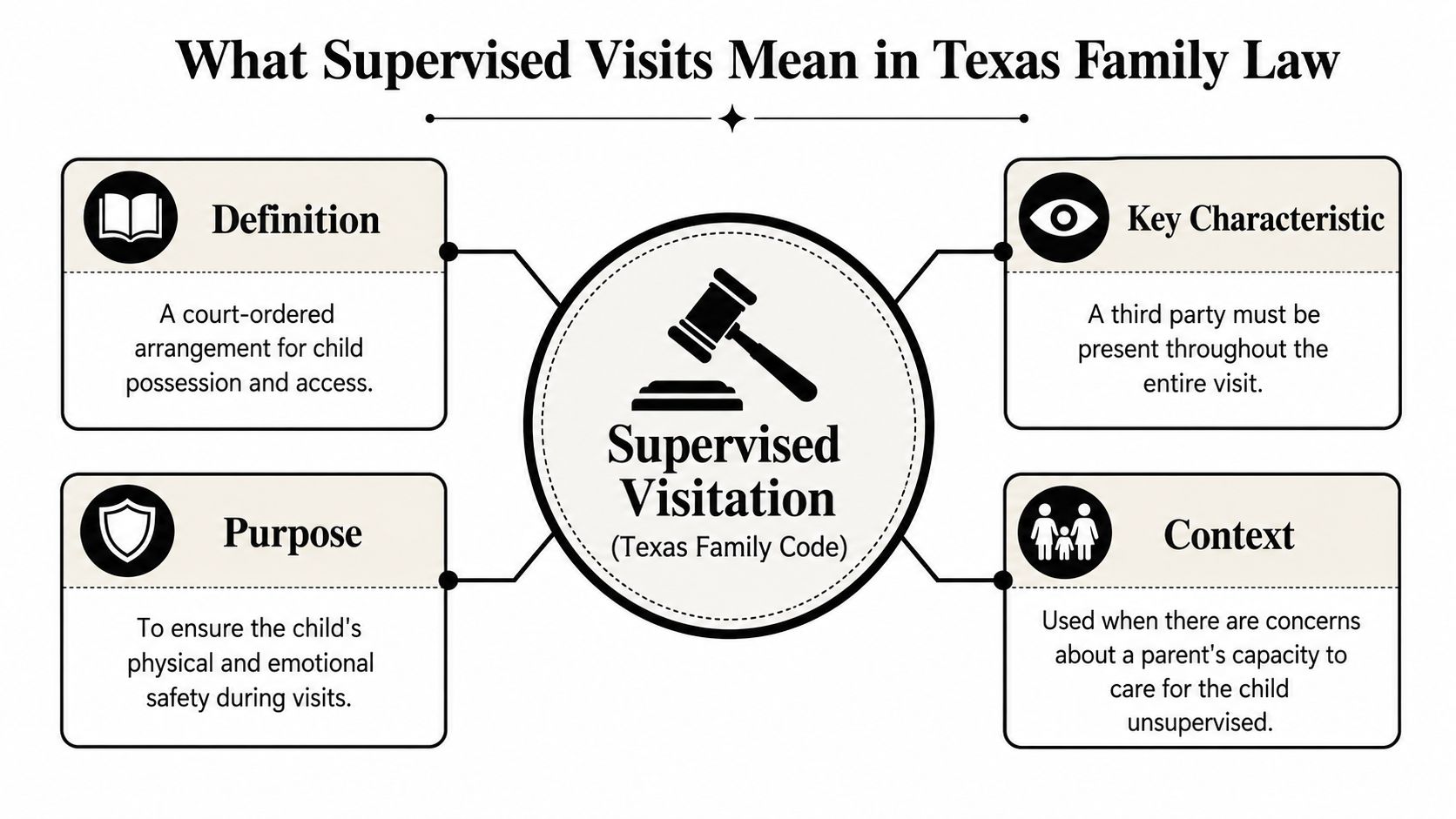
What the court is trying to do
Texas courts don't use supervision to make a moral statement. They use it to manage risk while preserving a relationship when possible. Under the Texas Family Code, judges must focus on the child's best interest when deciding conservatorship and possession issues. If the court believes unrestricted parenting time could expose a child to harm, the judge can narrow the terms of visitation instead of cutting it off completely.
That's why supervised visitation often appears in temporary orders. The judge may need a safer structure while the case develops, while services are completed, or while the court gathers more information.
If you're comparing your situation to a more typical schedule, this discussion of Texas standard visitation rights helps show how supervised possession differs from the usual possession framework.
What supervised visitation is not
It isn't the same as termination of parental rights. It also isn't always permanent. A supervision requirement can reflect current concerns without deciding that things will never improve.
It's also different from broader custody decision-making. If you're dealing with conservatorship disputes, Child Custody covers custody and conservatorship representation, including high-conflict disputes.
Here's a straightforward definition:
| Arrangement | What it means |
|---|---|
| Unsupervised visitation | The parent spends time with the child without a monitor present |
| Supervised visitation | The parent sees the child only with an approved adult present |
| Monitored exchange | The supervisor oversees only the handoff, not the full visit |
| No visitation | The parent has no court-allowed contact at that time |
When parents ask, “What are supervised visits really telling me?” my answer is usually this: the court is saying contact may continue, but only inside clear boundaries.
Why a Texas Judge Might Order Supervised Visitation
Parents often assume a judge ordered supervision based on accusation alone. Sometimes allegations start the issue, but judges are looking for evidence that a child may face physical or emotional risk without safeguards. The court doesn't impose this lightly because supervised possession is more burdensome, less private, and harder to schedule than ordinary parenting time.
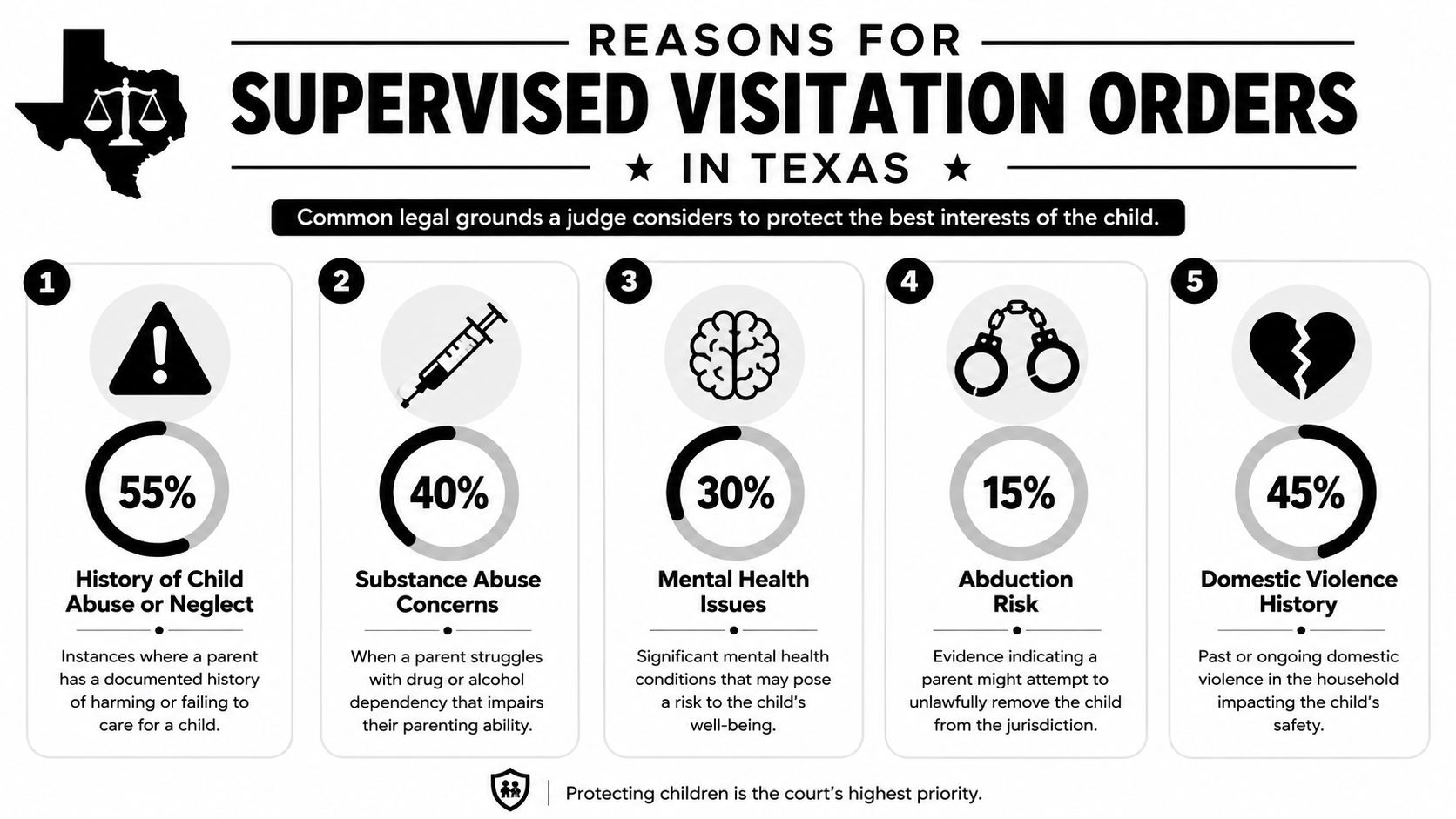
Common concerns judges look at
Several patterns show up often in Texas family cases:
Family violence allegations
If the court sees evidence of violence between parents, or violence that affected the child, supervision may be ordered to create immediate safety controls.Substance use concerns
A parent doesn't have to be convicted of a crime for this issue to matter. Failed tests, erratic behavior, or incidents involving impairment can change the visitation structure.Mental health instability
The key question isn't whether a parent has a diagnosis. The question is whether unmanaged symptoms affect safe parenting.Abduction or non-return risk
If the other parent believes a child may not be returned after a visit, the judge may require supervision or structured exchanges.Extended absence from the child's life
Sometimes the concern isn't danger in the classic sense. It's whether a child needs a gradual reintroduction after a long separation.
A growing part of the supervision picture involves domestic violence. A national dataset found that referrals involving domestic violence concerns rose from 9% to 31% during one twelve-month period, showing how often supervised visitation is now used as a safety response in reactive cases, according to the Children's Law Center national analysis.
The court's practical choices
Once a judge decides some level of oversight is needed, the court still has to choose how that supervision will happen. Those choices matter.
| Option | Strengths | Tradeoffs |
|---|---|---|
| Professional supervisor | Neutrality, structure, formal observations | More expensive, less flexible |
| Family member or friend | More familiar, sometimes easier to schedule | Bias concerns, less training |
| Center-based visit | Controlled environment, clear rules | Can feel formal or stressful |
| Community-based visit | More natural interaction | Harder to supervise consistently |
If your case involves abuse allegations, evidence and verification matter. Even basic screening questions about identity and records can become important when a family is proposing a third-party monitor, and this online identity verification guide can help you think through what information should be confirmed before anyone is presented to the court as a supervisor.
For readers dealing with state investigations and parent-child contact restrictions, these CPS visitation rules can provide added context. In some cases, related safety issues also overlap with Protective Orders, which address protective orders in domestic violence and family safety matters.
The judge is asking one central question: what setup protects the child while still allowing appropriate contact?
Types of Supervision Arrangements and Locations
The practical setup of supervised visitation can change the entire experience. Two parents may both have “supervised visits” on paper, but one may check in at a formal center with staff notes while another spends time with the child at a park while a grandparent observes.
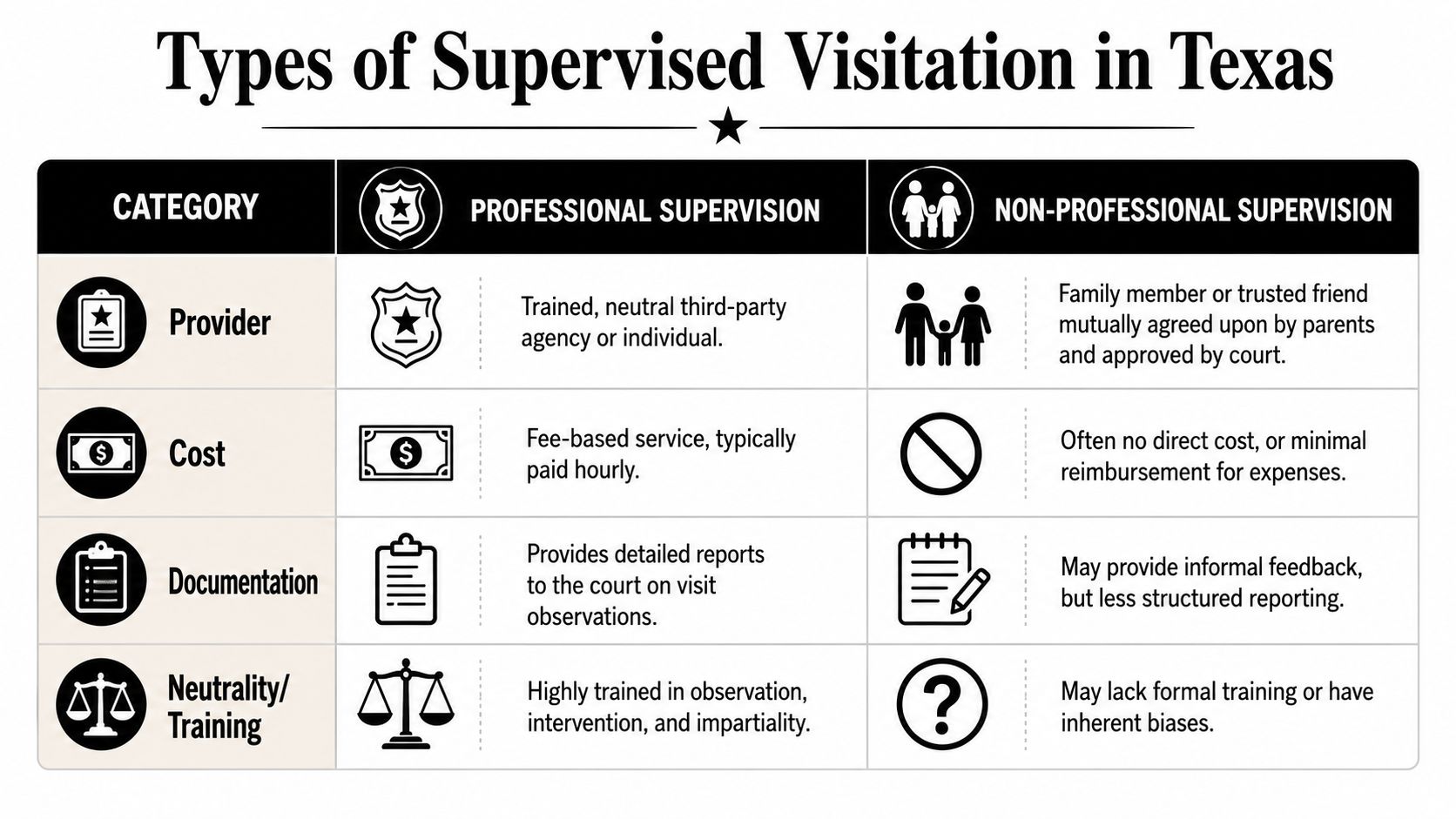
Professional supervision
A professional arrangement usually means a center or trained provider handles intake, scheduling, rules, and observation. These settings tend to be the most neutral. That can help in high-conflict cases because neither parent has to argue later about what happened.
A typical center-based visit might work like this. The visiting parent arrives first, checks in, reviews the rules, and waits in an assigned area. The child arrives separately with the other parent or custodian. Staff control the entry and exit so the adults don't have to interact if the order limits contact.
During the visit, the supervisor watches the interaction. Depending on the order, that person may stay close, remain in the same room, or accompany the family through the visit location. If a rule is broken, the supervisor may redirect behavior or end the session.
Non-professional supervision
Sometimes a court allows a relative or trusted family friend to supervise. This can make visits feel less clinical. It may also be easier for a child who's nervous or very young.
But this option only works if the supervisor is reliable, calm, and willing to follow the court order. A loving aunt who wants everyone to get along may still be a poor fit if she can't enforce boundaries or write objective notes.
Here are the usual tradeoffs:
Comfort for the child
A familiar person can reduce stress, especially during reunification.Scheduling flexibility
Family-based supervision may allow visits around school, work, or travel constraints.Neutrality problems
If the supervisor is loyal to one side, the arrangement can collapse quickly.Limited documentation
Informal supervisors may not record events in a way that helps in court.
In some families, a grandparent becomes part of the discussion. That doesn't mean a grandparent will automatically be approved, but in the right case a relative may be proposed. Questions about family roles can overlap with Grandparent's Rights, which concerns custody and visitation rights for grandparents.
Common locations
The order may allow visits in several places:
- Visitation center
- Public spaces like parks or libraries
- A private home
- A limited virtual format if the court approves that structure
If your case is tied to abuse or neglect allegations, the supervision details may also overlap with Child Protective Services Defense, which involves defense for families facing CPS investigations and allegations.
What Happens During a Typical Supervised Visit
The unknown is often what scares parents most. Once you know the rhythm of a supervised visit, the process usually feels less mysterious and more manageable.
Arrival and the first few minutes
Most visits begin with separate arrivals. That helps reduce conflict between adults. The supervisor may confirm identities, review the session rules, and note whether anyone arrived late, upset, or unprepared.
The visit itself is often shorter than parents expect. A structural study of supervised visitation programs found that 1.5 hours was the average duration reported by 38% of programs, according to this study of visitation program structure.
That shorter window means preparation matters. Bring age-appropriate activities. Focus on the child. Don't waste the first half of the visit complaining about the case.
What the supervisor is watching
The supervisor usually isn't there to help you “win” or to coach you through parenting. The supervisor is watching whether the visit stays safe, appropriate, and compliant with the order.
That often includes whether you:
- Stay child-focused instead of discussing adult conflict
- Follow directions from the supervisor without argument
- Use safe discipline and appropriate language
- Respect physical boundaries and timing
- Avoid coaching the child about court, the other parent, or where the child wants to live
A good visit is often a simple visit. Show up calm, stay engaged with your child, and leave on time.
Rules that surprise parents
Some rules are obvious. Others catch parents off guard. Depending on the provider or order, you may be told not to give the child gifts that haven't been approved, not to pass notes, not to discuss the lawsuit, and not to make negative remarks about the other parent or household.
If the order calls only for a monitored exchange, the supervisor's role is narrower. In that setup, the monitor handles the transfer of the child from one parent to the other and stays present to prevent conflict, but doesn't remain for the entire visit. That can be useful when the concern is conflict at handoff rather than concern about the parent-child interaction itself.
Documentation starts immediately. If the parent arrives prepared, behaves appropriately, and responds well to the child, that usually helps. If the parent argues, appears impaired, or tries to test boundaries, that can hurt later.
Understanding Costs Documentation and Court Reports
Supervised visitation creates practical pressure. The burden isn't just emotional. It can affect work schedules, transportation, and finances. Every family wants to know the same thing. Who pays?
In many cases, the court places the cost on the parent whose visits require supervision. Sometimes the parents share costs, and sometimes the order is silent, which can create conflict that needs clarification. Because orders vary, you should never assume the other side must pay unless the signed order says so.
Why documentation matters so much
The supervisor's notes can become some of the most important evidence in your case. Professional providers often keep observations about arrival time, demeanor, interaction with the child, compliance with rules, and any incident that disrupted the visit.
That documentation cuts both ways. If things go badly, the record can support keeping or tightening restrictions. If things go well over time, the same record can support a future request for more parenting time.
Think of the notes as your running report card. Not a perfect one, but a real one.
Use the system strategically
Parents sometimes resent the structure and treat the supervisor as the enemy. That usually backfires. A better approach is to treat each visit as a chance to build a clean, steady record of appropriate parenting.
Helpful habits include:
- Confirm every visit in writing so there's less room for confusion
- Arrive early because tardiness often gets documented
- Bring simple activities that fit the child's age and interests
- Stay polite with staff even if you think the process is unfair
- Keep your own records of attendance, receipts, class completion, and compliance
If you later need to ask the court to change the order, those records matter. So does the formal case path for Custody & Support Modifications, which concerns modifying existing custody, visitation, and support orders.
How to Modify or End a Supervised Visitation Order
Most parents want to know one thing above all else. How do I get out of supervised visits? The answer is usually not quick, but it is often possible.
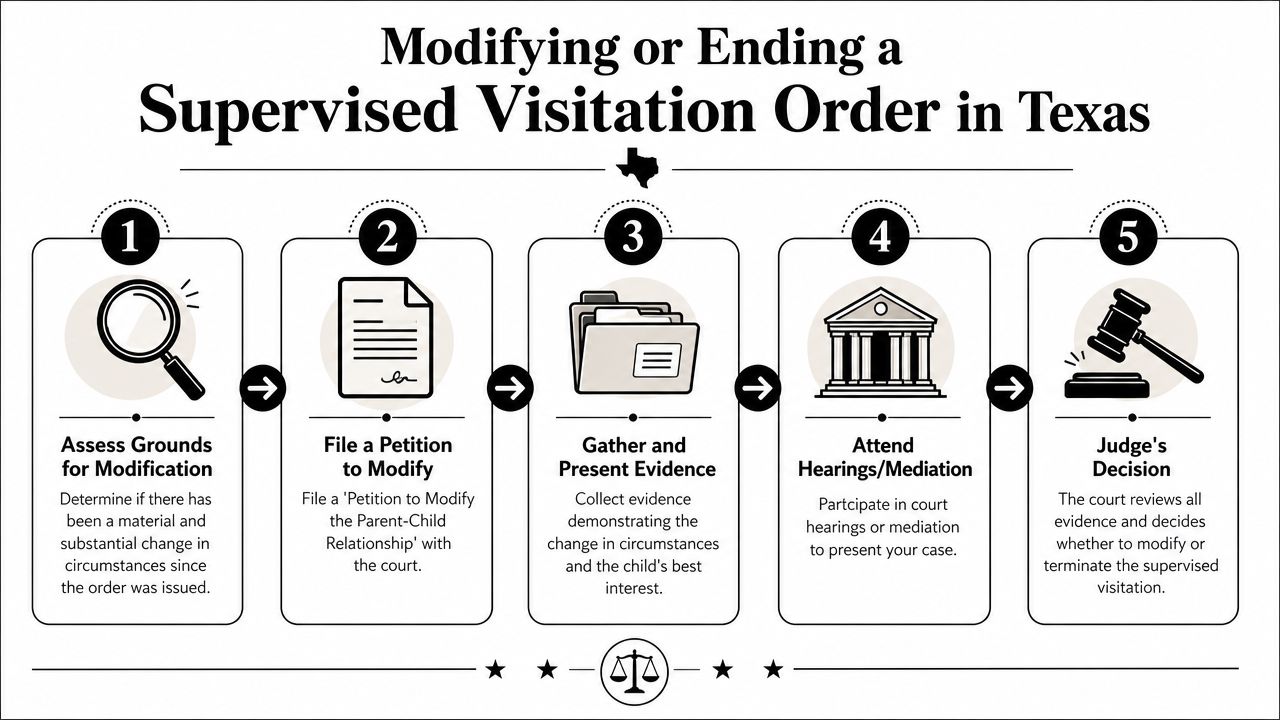
Texas courts generally require a formal request to change an existing order. That usually means filing a suit to modify, often called a Petition to Modify the Parent-Child Relationship, and showing the court why the change is now in the child's best interest under the Texas Family Code. In many cases, the parent must also show that circumstances have materially and substantially changed since the prior order.
What evidence usually helps
Moving from supervised to unsupervised contact often involves a formal modification request supported by evidence such as completion of parenting classes, reunification therapy, proof of sobriety, and a history of positive supervised visits, as discussed in this explanation of supervised visitation and transitions.
That means your proof should be concrete. Judges usually respond better to records than promises.
Useful evidence may include:
- Positive supervisor records showing consistent, appropriate visits
- Completion certificates for parenting, anger management, or similar programs
- Treatment records or therapist letters when mental health care is part of the issue
- Negative drug or alcohol tests if sobriety has been a concern
- Stable housing and work information when life instability affected the prior order
A realistic step-by-step path
Many cases move forward in stages rather than one giant leap. A judge might move a parent from a center to a neutral family supervisor, then to longer visits, then to unsupervised daytime possession, and only later to overnights.
That's one reason careful legal planning matters. This guide on modifying a child custody order in Texas is a useful starting point if you're preparing for that process.
This video may also help you understand how custody and visitation modifications are approached in practice.
What parents should do right now
If you want the court to reduce supervision, start acting today like that future hearing matters. Because it does.
Don't tell the judge you've changed. Build a record that shows it.
Take these steps seriously:
Read the current order carefully
Follow the exact terms, even if you think they are unfair.Complete every service the court expects
If classes, counseling, or testing are part of the concern, finish them and save proof.Protect the visit record
Show up on time. Stay calm. Don't argue with the supervisor. Don't pull the child into adult conflict.Gather your documents early
Waiting until the week before a hearing usually means missing records that could help.Talk with a Texas family law attorney about timing
Filing too early can waste money and credibility. Filing too late can prolong unnecessary restrictions.
The Law Office of Bryan Fagan, PLLC is one option for Texans dealing with family law orders involving possession, access, and modification issues.
If you need help navigating divorce, custody, or estate planning in Texas, contact Law Office of Bryan Fagan, PLLC today for a free consultation. If you're facing supervised visitation, a Texas family law attorney can review your order, explain what the judge expects, help you document compliance, and prepare a modification strategy built around your child's best interest.