
When CPS contacts you, fear takes over fast. Most parents don't hear “investigation” and stay calm. They think, “Can they take my child today? Do I have to let them in? What happens if I say the wrong thing?”
Take a breath. In Texas, CPS has serious authority, but it does not have unlimited power. Under the Texas Family Code framework described by Texas Law Help's overview of CPS investigations, CPS generally cannot remove a child without a court order unless there is an immediate threat to the child's safety, and parents have the right to challenge CPS actions in court. That matters. It means the system is supposed to run through legal rules, evidence, and judicial review, not the personal opinions of a caseworker.
If you're searching for answers about what CPS can and cannot do in Texas, the most useful approach is simple: know your rights early, act carefully, and get legal help before panic causes avoidable mistakes.
A Knock at the Door Understanding Your Initial Reaction to CPS
A knock at the door from CPS can make even a good parent feel like they've already been judged. That reaction is normal. You may feel angry, ashamed, confused, or frozen.
Don't let panic make your decisions for you.
Your first job is to slow the moment down
CPS investigations feel urgent because they are serious. But serious is not the same as unlimited. Texas law places real limits on the agency. CPS investigates allegations of abuse or neglect. It does not get to ignore court oversight, your rights as a parent, or the legal standards that control removal and continued separation.
Practical rule: The parent who stays calm usually protects the family better than the parent who argues at the door.
That means your first response should be controlled and polite. Ask who the worker is. Ask why they're there. Ask for identification. If they want to talk, you can listen without volunteering every detail of your life on the spot.
What most parents get wrong
Many parents think they only have two choices:
- Total cooperation: Let CPS inside, answer everything, sign whatever is handed over.
- Total resistance: Slam the door, argue, refuse all communication.
Both approaches can backfire.
Smart parents cooperate carefully. They stay respectful. They avoid lying. They avoid making admissions out of fear. And they don't hand over rights they don't have to surrender.
A CPS case is easier to handle when you understand the process from the beginning. If you want a broader look at how these cases usually unfold, read what happens in a CPS investigation in Texas.
The right mindset
You don't need to outsmart CPS. You need to stay organized and disciplined.
Keep these three points in mind:
- CPS has a job to do. Treat the investigator professionally.
- You have rights. Use them.
- A judge matters. In Texas, major intrusions and removals are tied to legal standards and court review, not just agency preference.
That mindset changes everything. You stop reacting like someone trapped. You start responding like a parent protecting a family.
The First 24 Hours Your Rights During a CPS Investigation
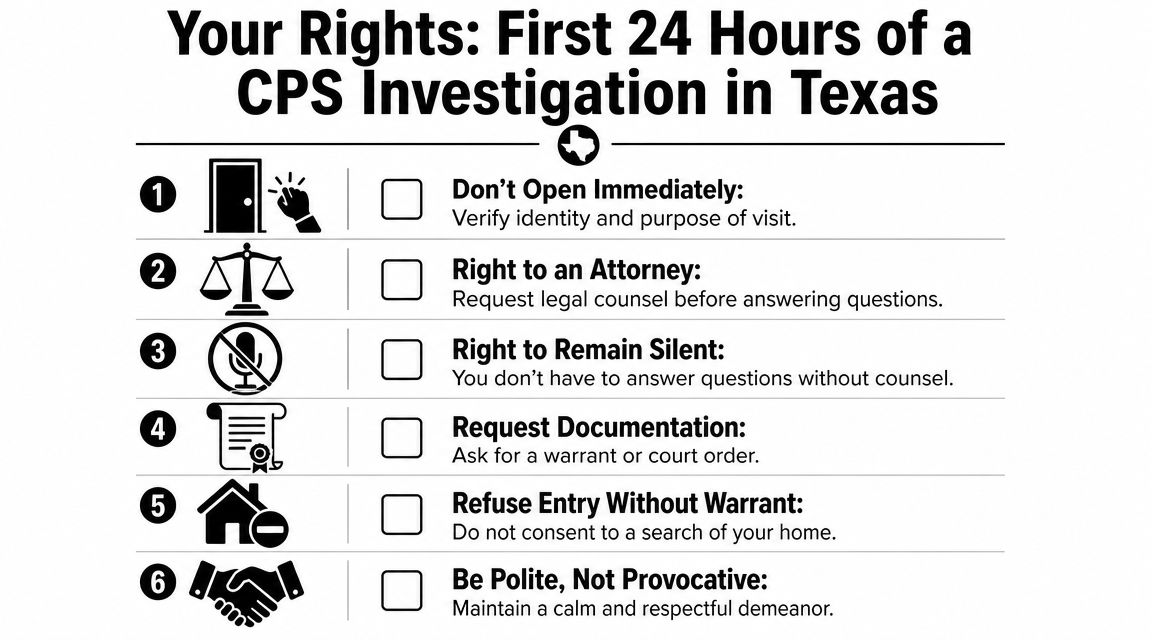
The first day matters more than parents realize. What you allow in those early conversations can shape the entire case. If a CPS worker shows up at your home, think of your front door like a locked gate. You control that gate unless CPS arrives with a legal reason that overrides your refusal.
Texas follows a consent-or-court-order approach for home entry and intrusive investigative steps. DFPS states in its handbook that a caseworker must obtain new consent each time they seek to enter a home, that consent must be voluntary, and a parent can revoke it at any time, as explained in the DFPS CPS handbook on home entry and consent.
Here's a quick visual summary you can keep in mind:
What to say at the door
You do not need to be rude. In fact, don't be. Calm language works better.
You can say something like:
I want to cooperate, but I'm not consenting to entry or a search of my home right now. If you have a court order, I'll review it. Otherwise, I'd like to speak with an attorney first.
That response does three important things:
- It shows composure
- It avoids unnecessary escalation
- It protects your rights
Cooperate without surrendering control
There's a big difference between speaking with someone and opening your home for inspection. Those are not the same thing.
You can choose measured cooperation, such as:
- Verifying identity: Ask for the caseworker's name, title, and contact information.
- Asking for the allegation: Request a plain explanation of what they're investigating.
- Speaking outside: If you decide to talk briefly, do it on the porch or another neutral setting.
- Requesting time: Tell them you want to consult counsel before interviews or home access.
Later in the day, remind yourself that every additional entry into your home requires its own legal basis or fresh consent. Prior permission is not a blanket pass.
This video gives helpful context on handling early CPS contact:
What not to do in the first day
Parents often damage their cases in preventable ways.
- Don't lie: A weak allegation can become a credibility problem if your story shifts.
- Don't sign quickly: Safety plans, releases, and written statements can carry consequences.
- Don't invite a full walkthrough: Once a worker is inside, they will observe everything.
- Don't lose your temper: Anger gets written down. So does hostility.
If you're dealing with this right now, the safest move is usually simple: be polite, be brief, and get legal advice before the case expands.
What CPS Can Legally Do in Texas
Parents are often so focused on what CPS cannot do that they fail to prepare for what CPS can do. That's a mistake. You need to know the playbook.
CPS can investigate allegations of abuse or neglect
At the core, CPS has authority to investigate reports that a child may be unsafe. That investigation can involve contacting parents, gathering information, and trying to assess whether the child is at risk.
In practical terms, a caseworker may try to:
- Interview parents
- Speak with relatives or other household members
- Contact people who have relevant information
- Observe the child's living situation if lawful access is obtained
This is why your first impression matters. A parent who is calm, prepared, and consistent is easier to defend than a parent who reacts impulsively.
CPS can seek information from multiple directions
A CPS case rarely stays confined to one conversation at your front door. Investigators often build a picture from many sources. They may try to talk to your child, contact schools, review records they're legally able to pursue, and ask questions about the adults around the child.
That doesn't mean every request is mandatory. It does mean you should assume the investigator is collecting information from more than one channel.
Knowing the scope of an investigation helps you prepare your response instead of getting blindsided by it.
What that means for your strategy
You should act as though every statement may be compared against something else later. If you tell CPS one version of events, and a teacher, relative, or document suggests another, the issue may become your credibility instead of the original concern.
Use a disciplined approach:
- Get the allegation clearly stated
- Write down every contact
- Preserve records that help your position
- Identify supportive witnesses early
- Speak carefully, not casually
A simple example
Suppose CPS receives a report that a child is frequently absent from school, appears unbathed, and has mentioned being left alone. The investigator may try to speak with the parent, gather school information, ask about supervision, and evaluate whether the concern reflects neglect or a misunderstanding.
A parent who responds with organized school records, childcare details, and a calm explanation is in a far better position than a parent who panics and starts making inconsistent statements.
This is why I tell parents not to treat a CPS investigation like an informal conversation. It's an evidence-building process. You should respond accordingly.
The Limits of Power What CPS Cannot Legally Do
This is the part parents need to hear clearly. CPS is not law enforcement with unlimited access to your home, your body, your child, and your choices. There are hard limits.
CPS cannot simply do whatever it wants
Without your consent, a court order, or a true emergency, CPS cannot treat your home like open territory. It also cannot manufacture authority by acting as if prior cooperation means permanent permission.
Parents often feel pressured because the caseworker sounds confident. Confidence is not legal authority.
If a CPS worker asks for something intrusive, your next question should be, “Am I required to do this, or are you asking for my consent?”
That question changes the conversation.
A quick-reference comparison
Here is the practical distinction parents need to understand:
| Action | Requires Court Order? | Notes |
|---|---|---|
| Entering your home over your objection | Yes, unless there is a true emergency | Consent must be voluntary. You can refuse entry absent lawful authority. |
| Re-entering your home after a prior visit | Yes, unless you give new consent or an emergency exists | Prior consent does not automatically carry forward. |
| Removing a child from the home | Generally yes, unless there is immediate danger | Removal is tied to danger and court oversight, not convenience. |
| Forcing you to sign releases or plans | No authority to force mere signature without legal basis | Never sign documents you don't understand. |
| Compelling intrusive steps without consent | Usually requires lawful authority | Ask whether the request is voluntary or court-ordered. |
| Asking to speak with you | No court order required to ask | You can still choose to consult counsel before answering. |
What parents should refuse without review
You should be very cautious before agreeing to anything intrusive on the spot.
- Home searches: Don't allow broad inspection just because a worker asks.
- Written statements: These can lock you into language that hurts later.
- Open-ended releases: Read every line before sharing private information.
- Safety plans with vague terms: If it's unclear, it can be used against you.
What CPS also cannot do
CPS cannot bypass the judge when the law requires judicial review. It cannot make removal decisions casually and then sort out the details later. It cannot rely on intimidation to replace legal process.
That is the heart of understanding what CPS can and cannot do in Texas. A request is not the same thing as a command. Pressure is not the same thing as lawful authority.
When parents learn that distinction early, they make better choices.
Emergency Child Removal The Highest Legal Standard
It is 8:30 at night. A caseworker is at your door, your child is scared, and you hear the words no parent wants to hear: “We may need to remove your child tonight.”
That is the moment to get disciplined. In Texas, emergency removal is reserved for immediate danger to the child, not a messy home, not a worker's irritation, and not your refusal to agree with every request on the spot.

Removal requires more than concern
The legal question is urgency. CPS must be able to point to a present danger serious enough that waiting for normal court process would put the child at risk.
Parents need to understand that distinction because it shapes your response. If the alleged problem is immediate, you address the immediate facts. If the worker is stretching ordinary parenting issues into an emergency, you challenge that framing right away.
A cluttered house, missed appointments, or tension with the investigator can lead to scrutiny. Those facts do not automatically justify taking a child that day. Immediate removal arguments usually center on conditions such as serious impairment, active violence, abandonment, untreated medical danger, or no safe adult able to protect the child.
Focus on the claim being made right now
Do not argue in general terms. Pin CPS down.
Ask these questions plainly:
- What exact danger are you claiming exists at this moment?
- Who says they observed it?
- When was it observed?
- What less drastic option did you consider before removal?
- Is there a safe relative available right now?
Those questions do two things. They force the agency to state a concrete basis for removal, and they help you identify the weak points in the case.
Give solutions, not speeches
If removal is being discussed, your job is to present safe alternatives fast.
Name relatives who can take the child immediately. Give full names, phone numbers, addresses, and explain why that person is safe. Identify sober adults in the home. Point out working utilities, food, medication, school attendance records, or anything else that rebuts a claim of present danger. Keep your voice calm and your answers short.
This is not the time to vent about how unfair CPS is. It is the time to build a record that your child can stay safe without being taken.
What to do in the next hour
Treat a threatened removal like a legal emergency.
- Call a lawyer immediately.
- Start a written timeline of what happened that day.
- Save texts, photos, medication records, and names of witnesses.
- Contact safe relatives and tell them to stay available.
- Do not sign anything you do not understand.
If you need a more direct explanation of when CPS can take your child without notice in Texas, read that before you assume the worker has unlimited power.
The biggest mistake parents make here is freezing. The better move is simple. Get facts. Get names. Get help.
Your child has been removed, and now you are standing in a courtroom while CPS presents its version of your family to a judge. That moment feels overwhelming. It is also the moment when procedure starts to matter as much as facts.
If you remember one thing, remember this. Court deadlines come fast, and silence hurts parents.
The hearing that matters first
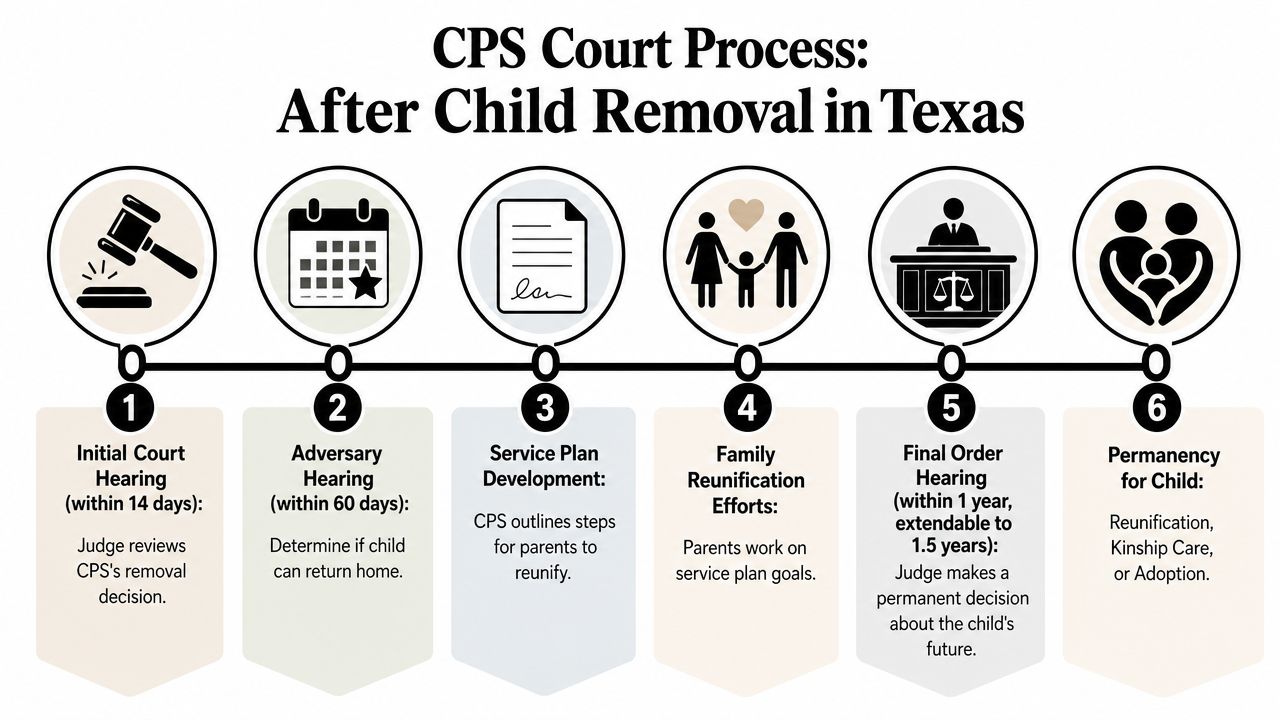
After an emergency removal, the first major court fight usually happens at the early adversary hearing, often called the 14 day hearing. The judge decides whether CPS had a legal basis to keep your child out of the home while the case continues.
Treat that hearing like a real contest. Because it is one.
The judge is not there to rubber stamp the removal. The judge wants facts. Your job is to show the court, with documents and testimony, that your child can be kept safe through less drastic options, including return home or placement with a safe relative.
Bring proof, not outrage. Bring school records, medical records, drug test results, text messages, photos of the home, names of witnesses, and the contact information of relatives who can step in immediately. If CPS claims danger, force the claim into specifics. What danger. When. Who saw it. What was done to verify it.
What the court process usually looks like
Parents do better when they stop viewing the case as one long blur and start treating it as a series of deadlines.
Initial court review
The court quickly reviews the emergency removal and the reasons CPS gave for it.Early adversary hearing
The judge decides whether the child should remain out of the home while the case is pending.Service plan phase
CPS usually asks the parent to complete services, evaluations, classes, testing, or counseling. Read the plan carefully. Some tasks help your case. Some need to be challenged, clarified, or narrowed.Status and review hearings
The court checks whether parents are complying, whether CPS is doing its job, and whether the child's placement still makes sense.Final hearing or trial
The judge decides whether the child returns home, the case is extended, or parental rights face more serious risk.
What parents should do at each stage
Do not wait for CPS to define the whole case. Start building your own record from day one.
- Organize every document: Keep a binder or digital folder with notices, court papers, service referrals, drug test results, visitation logs, and communications with the caseworker.
- Track your compliance: Save certificates, sign-in sheets, payment receipts, and screenshots showing you completed what was ordered.
- Push relative placement early: Give the court full names, phone numbers, addresses, and reasons the relative is safe.
- Correct the record fast: If a report is wrong or incomplete, tell your lawyer immediately and gather proof.
- Show stability: Housing, employment, sobriety treatment, counseling attendance, and school involvement all matter when a judge decides whether a child can return.
Judges notice patterns. A parent who appears prepared, truthful, and consistent has a stronger chance than a parent who shows up angry and empty-handed.
If your goal is reunification, read these steps to get your child back from CPS in Texas and start matching your actions to what the court will want to see.
The mistake that costs parents time
The biggest courtroom mistake is passive compliance. Parents sign up for services, attend some of them, miss others, and assume effort alone will carry the day. It will not. The court cares about proof, progress, and whether the original safety concerns have been addressed.
You need a defense plan. That means knowing what CPS must prove, knowing what the judge has ordered, and showing your progress in a way the court can verify. Fear is normal. Delay is dangerous.
How to Respond and When to Get Legal Help
A CPS investigator is at your door, your phone is buzzing, and you feel pressure to fix everything in one conversation. Slow down. The first goal is not to talk your way out of the case. The first goal is to protect your child and protect yourself from avoidable mistakes.
Parents get in trouble when fear takes over. They start explaining, guessing, agreeing, and signing before they understand what CPS is asking for and whether they even have to agree. A better approach is simple. Be respectful, be organized, and make every decision on purpose.
Your response plan
Start here.
- Stay calm: Your tone and behavior will end up in the investigator's notes.
- Tell the truth: Do not guess, exaggerate, or try to smooth over bad facts.
- Ask direct questions: Find out what allegation was made, what CPS wants, and whether the request is voluntary or court-ordered.
- Read before signing: Safety plans, releases, and written statements can affect your case immediately.
- Document everything: Keep names, dates, call logs, emails, text messages, and copies of every paper you receive.
- Limit casual talking: Small talk often turns into evidence.
- Call a lawyer early: Early advice helps you avoid mistakes that are hard to undo.
One smart sentence can protect you: “Is this request voluntary, or has a judge ordered it?” Ask that every time CPS wants entry, signatures, testing, interviews, or records.
When you absolutely need a lawyer
Get legal help right away if CPS does any of the following:
- Shows up at your home and asks to come inside
- Requests to interview your child
- Asks you to sign a safety plan or release
- Demands drug testing
- Says your child may be removed
- Files a case in court
- Contacts relatives about placement
Do not wait for the situation to get worse. In Texas CPS cases, delay usually costs parents time, credibility, and options. A lawyer can tell you what you must do, what you can refuse, what needs to be corrected in the record, and how to present your side before the agency defines the case for you.
If your child has already been removed or reunification is the goal, read these steps to get your child back from CPS in Texas and start building proof, not just good intentions.
Your rights only help if you use them fast. Be polite. Be careful. Get legal advice before one bad day turns into a long court case.