
Divorce can be one of life's hardest transitions. When your marriage includes a business, investment accounts, equity compensation, or multiple properties, the stress often grows because every decision can affect your financial future for years. If you live in Houston Heights and you're trying to understand what comes next, clear information can make this feel less overwhelming.
Many people in this area are balancing demanding careers, family responsibilities, and assets that don't fit neatly into a simple spreadsheet. A couple may own a home, retirement accounts, a growing company, and startup equity that hasn't fully vested yet. Another couple may both earn strong incomes, but one spouse receives bonuses, partnership distributions, or irregular compensation that raises difficult questions about property division and support. Those details matter.
A common Houston Heights situation looks like this. One spouse helped launch a tech company while the other built a strong career in medicine, finance, consulting, or another profession. They bought a home, saved for retirement, invested regularly, and structured compensation in ways that made sense during the marriage. Then the relationship breaks down, and what first sounds like “just filing for divorce” quickly becomes a far more detailed financial process.

Under Texas practice, a divorce is generally treated as a high-asset case when the marital property exceeds $1 million, and that level of wealth usually brings more scrutiny and broader financial disclosure requirements, as discussed in this Texas high-asset divorce overview. That doesn't mean anyone has done something wrong. It means the court expects a fuller picture before dividing substantial property.
What often surprises people is that a high-asset divorce isn't just a regular divorce with larger account balances. It can involve tracing separate property, valuing private business interests, reviewing tax returns, analyzing compensation packages, and deciding whether an asset belongs to one spouse, both spouses, or partly to each. In Houston Heights, where many families include entrepreneurs and dual-income professionals, those questions come up often.
Practical rule: The earlier you organize financial records, the easier it becomes to protect your position and reduce avoidable conflict.
If you're still deciding whether you need legal guidance, this overview on working with a Houston divorce lawyer and free consultation options can help you think through the first step. Calm, informed preparation usually leads to better choices than rushing into a settlement you don't fully understand.
Defining a High-Asset Divorce in Texas
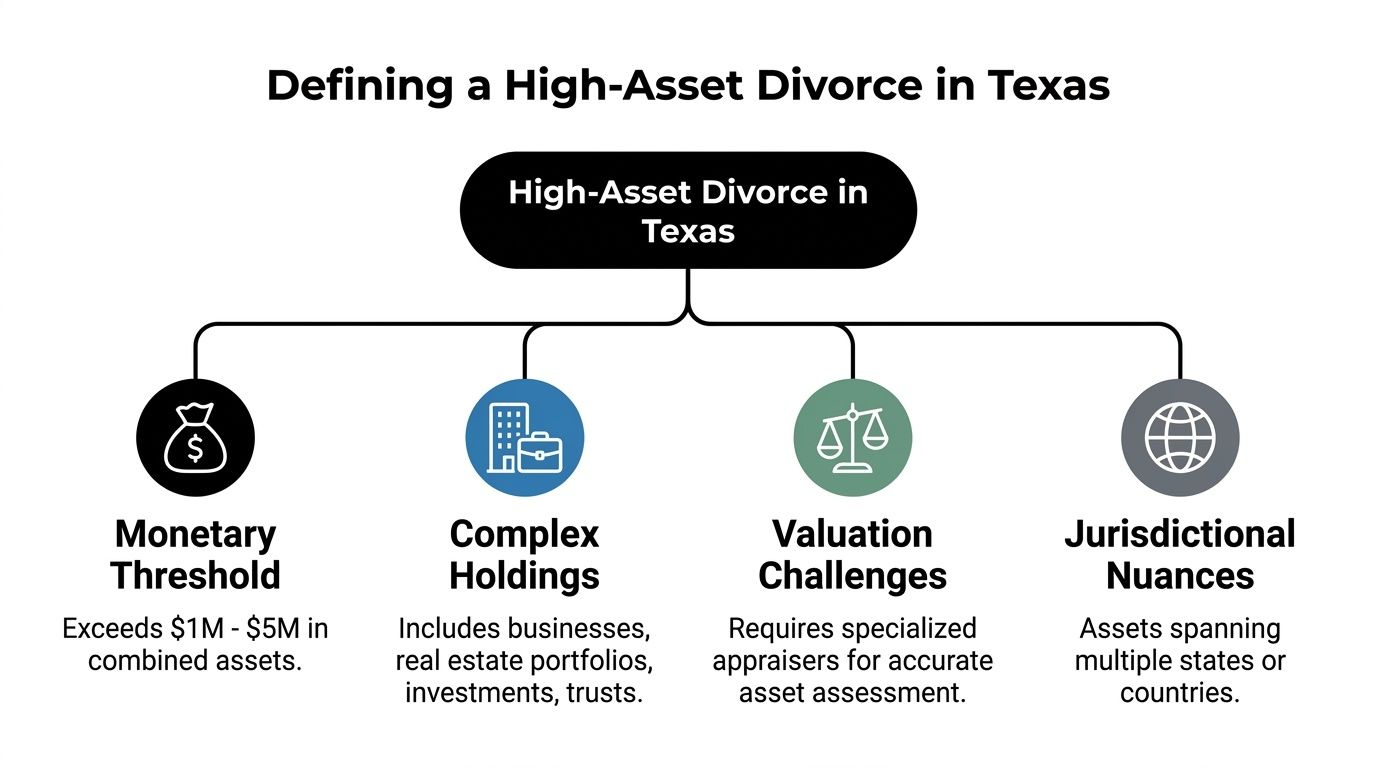
Some people hear “high-asset divorce” and assume it only applies to celebrities or ultra-wealthy families. In Texas, the more practical benchmark is simpler. A high-asset divorce typically involves a net worth over $1 million, and these cases often require forensic accountants and business valuation professionals to value and trace assets such as closely held businesses, stock options, and professional practices, as explained in this Houston high-asset divorce reference.
What makes these cases different
Think of a standard divorce as sorting a few labeled boxes. A high-asset divorce is more like sorting a room full of boxes where some labels are missing, some items belong in two places at once, and some values change depending on timing.
The complexity usually comes from the type of assets, not just the amount. Common examples include:
- Business interests that don't have a public market price.
- Investment portfolios with mixed funding sources.
- Retirement accounts that may include both premarital and marital components.
- Real estate holdings with separate and community claims tied to improvements or mortgage payments.
- Trust-related interests that raise ownership and access questions.
- Equity compensation such as stock options tied to vesting schedules.
Why expert input often matters
If a spouse owns part of a company, the value of that interest may depend on revenue, liabilities, ownership restrictions, and whether the business grew during the marriage. If the asset is stock compensation, the analysis may turn on grant dates, vesting terms, and the purpose of the award. If one spouse claims a separate property interest, documentation becomes critical.
That's why many families exploring a high-net-worth divorce guide eventually realize they need a lawyer who can work with financial professionals, not just draft pleadings. In practical terms, High-Net-Worth Divorce matters when the estate includes complex property division involving businesses, investments, and high-value assets.
A strong legal strategy in these cases starts with identifying what exists, who claims it, how it should be characterized, and what evidence supports that position.
A simple way to assess your situation
You may be in high-asset territory if your divorce involves one or more of the following:
- A privately owned business or professional practice
- Compensation beyond regular salary
- Multiple significant accounts or properties
- Disagreement over what is separate versus marital
If those issues sound familiar, your case likely needs more than a basic checklist approach.
How Texas Divides Property in a High-Asset Divorce
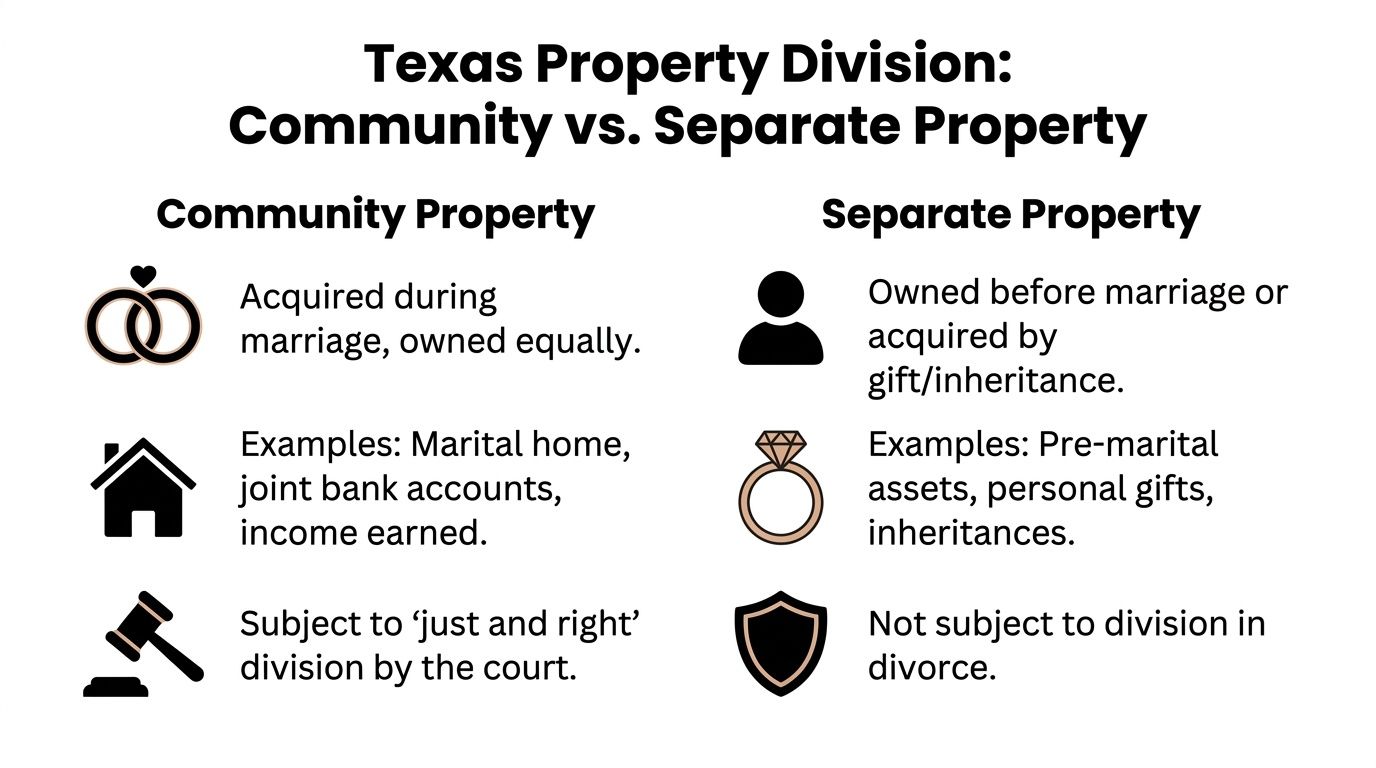
Texas follows a community property system. The core rule comes from Texas Family Code Title 1, Chapter 7, which requires the court to divide community property in a manner that is “just and right.” That does not mean an automatic equal split. Texas courts have discretion to make a disproportionate division, including a 60/40 split, based on factors such as fault, earning disparity, or child custody, as outlined in this Texas property division overview.
Community property and separate property
In plain language, community property usually includes assets acquired during the marriage. Separate property generally includes property owned before marriage or acquired by gift or inheritance. Those categories sound simple until real life gets involved.
A spouse may have started an investment account before marriage, then added marital income later. A home may have been purchased by one spouse before marriage, but the mortgage may have been paid down with marital funds. A business may have existed before the wedding but grown substantially during the marriage.
That's where confusion starts. Ownership and division are not always the same question.
What “just and right” means in daily life
A court doesn't have to split community property evenly. Instead, the judge looks at what is fair under the circumstances. If one spouse earns much more, has primary responsibility for children, or can show financial misconduct by the other spouse, the result may be unequal.
Here's a simple example. A Houston Heights couple owns a marital home, brokerage accounts, and an interest in a consulting firm. One spouse paused a career to support the household and now has lower earning capacity. The other spouse still controls the business and has greater future income potential. A court may decide that a larger share of certain community assets should go to the lower-earning spouse. That's why many people are surprised when a “Texas is 50/50” assumption turns out to be incomplete.
For a closer look at that issue, this article on how property is divided in a Texas divorce is a useful companion.
Here is a short video that helps frame the property division discussion:
A practical way to protect your claims
When high-value property is involved, your case often turns on records. Keep and organize:
- Account statements showing balances and funding sources
- Business documents such as ownership records and financial statements
- Real estate records including deeds, mortgage history, and improvement costs
- Gift and inheritance evidence that supports a separate property claim
If your divorce involves Property Division, the legal work often centers on the division of community property, debts, and complex assets. That's especially true when a Houston Heights high asset divorce lawyer has to sort out layered financial histories instead of a single bank account and a house.
Common Challenges in High-Net-Worth Divorce Cases
High-net-worth divorces in Texas are often harder because of disputes over separate versus community property, the need for extensive financial discovery, and the valuation of assets such as businesses, stock options, and trusts, all of which can extend litigation, as noted in this Texas high-net-worth divorce discussion. Those challenges are manageable, but they require careful legal and financial analysis.
Business valuation issues
A privately held business is often the most disputed asset in the case. Unlike publicly traded stock, there isn't always an easy number to pull from the market. Lawyers and valuation professionals may need to review financial statements, compensation patterns, debt, ownership restrictions, and whether part of the company's value is tied to personal goodwill or future labor.
A common point of confusion is this: a spouse may say, “I built this business, so it's mine.” That may feel true emotionally, but the legal analysis is more specific. The court will ask when the business was created, how it grew, whether community labor or money increased its value, and what part of the business interest is subject to division.
Characterizing complex property and trusts
Trusts, inherited funds, and mixed accounts can create some of the hardest disputes in a high-asset divorce. One spouse may believe an asset is clearly separate because it came from family money. The problem is that separate property claims often weaken when funds are mixed into joint accounts or used in ways that blur the paper trail.
This is also where family dynamics can complicate the case. Grandparents may be involved in childcare, family gifts, or trust planning, and those facts sometimes overlap with broader custody concerns. In some families, separate legal issues may also raise questions about Grandparent's Rights, which concerns custody and visitation rights for grandparents.
When records are incomplete, the dispute usually becomes more expensive and more stressful. Documentation often decides the outcome.
Tax consequences that change the real value
Two assets can look equal on paper and still produce very different results after taxes. A retirement account, a brokerage account, and a business interest may all carry different future tax consequences. That matters when spouses are comparing settlement options.
Tax debt can also follow people into divorce in ways they didn't expect. If you're concerned about liability tied to joint filings or unpaid obligations, this resource on divorce and tax debt issues gives a helpful overview of one issue people often overlook.
Discovery and strategy
In a simpler divorce, exchanging basic financial documents may be enough. In a high-asset case, discovery may involve subpoenas, business records, tracing work, and detailed review of spending patterns. That process can feel invasive, but it is often necessary.
Some people evaluating counsel also look for firms with a dedicated focus on complex financial cases. One example is the Law Office of Bryan Fagan's high-net-worth divorce service, which addresses complex property division involving businesses, investments, and high-value assets. The key question in any case is whether the attorney can assemble the right team and present the financial story clearly.
What to Look for in a Houston Heights High Asset Divorce Lawyer
Choosing a lawyer for this kind of divorce is not just about finding someone who handles family law generally. You need someone who understands complicated financial structures and can translate them into a clear legal position. That matters everywhere in Texas, but it matters especially in Houston Heights.
The local economic profile changes the kinds of disputes that show up in these cases. Houston Heights includes many tech entrepreneurs and dual-income professionals, so divorces here often involve startup equity vesting schedules and non-traditional income streams, which call for more specialized legal strategies than a general practice approach usually provides, as described in this Houston Heights divorce discussion.
Why local knowledge matters
A lawyer who regularly works with Houston Heights families is more likely to recognize issues such as:
- Equity-based compensation that may vest over time rather than arrive as salary
- Irregular income from consulting, partnerships, bonuses, or business draws
- Dual-career households where both spouses have substantial earning power but very different compensation structures
- Business ownership overlap between marital finances and company operations
Those facts affect strategy from the beginning. If your spouse has startup equity, the lawyer should know how to ask the right questions about grant documents, vesting, and whether the award compensates past work, present work, or future work. If both spouses are high earners, the lawyer should understand that a cash-flow analysis may matter as much as a balance sheet.
Credentials and case handling to ask about
The right fit often becomes clearer when you ask practical questions, not just broad ones. During a consultation, consider asking:
- What kinds of complex assets have you handled before?
- How do you work with forensic accountants or valuation experts?
- How do you approach separate property tracing?
- Have you handled cases involving equity compensation or business ownership?
- What is your approach to mediation versus litigation?
- Who will be doing the day-to-day work on my case?
A good consultation should leave you with more clarity, not more confusion.
Signs of a mismatch
Be cautious if an attorney treats your case like a routine divorce, avoids discussing experts, or gives easy answers to hard valuation questions. High-asset divorce work requires patience, detail, and a willingness to dig into documents.
If you're searching for a Houston Heights high asset divorce lawyer, local familiarity plus financial fluency is often more important than polished marketing language.
Understanding the Process Timeline and Fee Structures
One of the biggest sources of anxiety is not knowing what happens next. High-asset divorce cases rarely move in a straight line, but the process usually follows a recognizable pattern. Knowing those phases can help you prepare emotionally, financially, and practically.
The typical phases
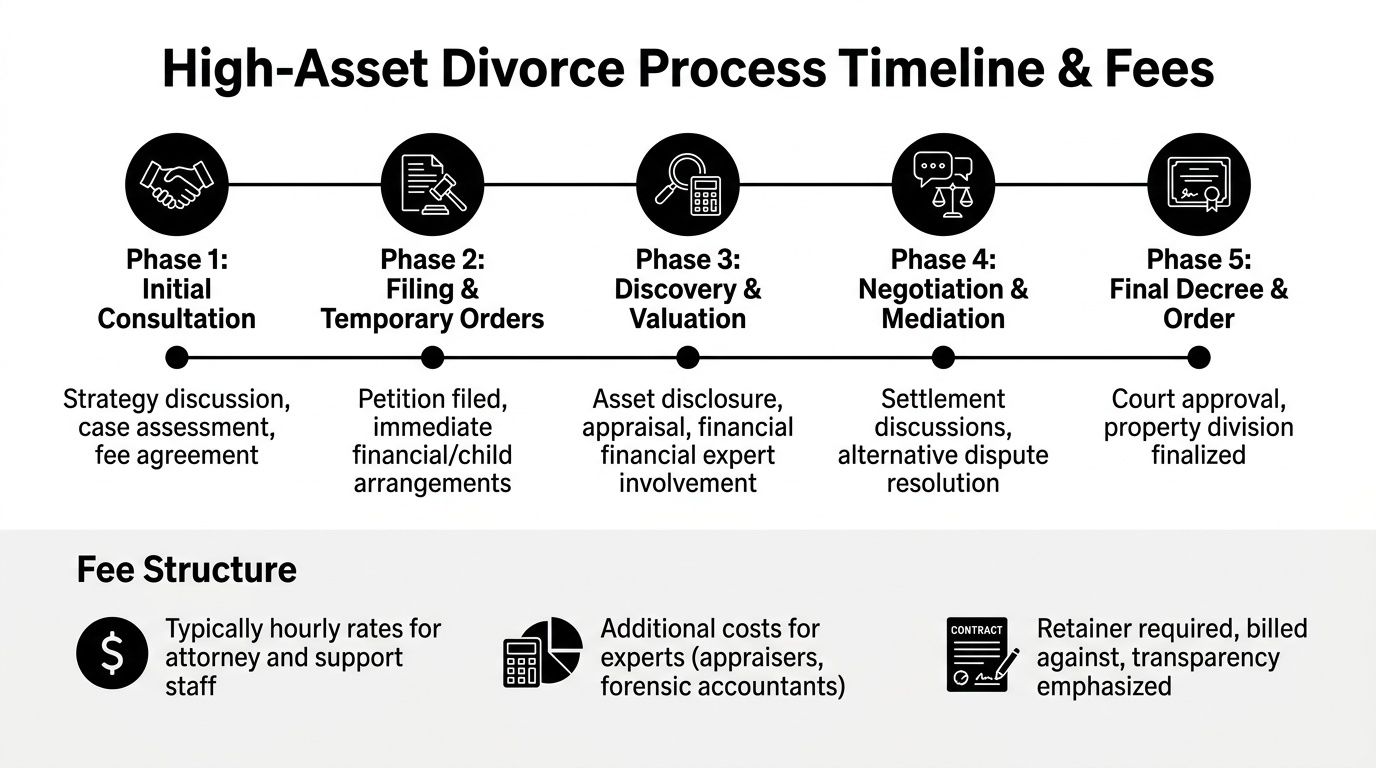
Initial consultation and strategy
You and your attorney identify the major assets, immediate concerns, and likely pressure points.Filing and temporary orders
The case formally begins. Temporary arrangements may address finances, use of property, or parenting issues while the divorce is pending.Discovery and valuation
This is often the longest part in a high-asset case. Financial records are gathered, property is analyzed, and experts may become involved.Negotiation or mediation
Many complex cases settle after the facts are developed well enough for both sides to assess risk realistically.Trial and final orders if needed
If settlement doesn't happen, the court decides the unresolved issues.
Why costs tend to be higher
High-asset cases usually cost more because they demand more attorney time, more document review, and more expert involvement. Fees can also rise when one spouse controls the records or when property characterization is heavily contested.
Here's a simple framework for understanding common billing models.
| Fee Structure | How It Works | Best For |
|---|---|---|
| Hourly billing | The attorney and staff track time spent on the case and bill for the work performed | Cases with disputed assets, ongoing discovery, or unpredictable litigation needs |
| Retainer | You pay an advance deposit, and fees are billed against that amount as work is completed | Clients who want a structured starting point for a complex divorce |
| Expert fees | Separate charges may apply for appraisers, business valuation professionals, or forensic accountants | Cases involving businesses, tracing issues, or complicated financial analysis |
Questions to ask about fees
Before hiring counsel, ask for clarity on these points:
- What work is billed at the attorney rate and what is delegated?
- How are expert costs handled?
- How often will I receive billing statements?
- What events tend to increase fees in a case like mine?
Transparent conversations about cost don't make the process feel easy, but they do help you plan.
Your Questions Answered about High-Asset Divorce
How can I protect my privacy during a high-asset divorce
You can't make a divorce entirely private, but you can take steps to reduce unnecessary exposure. Ask your attorney early about limiting public conflict, using mediation when appropriate, and handling sensitive financial records carefully. Privacy planning works best when it starts at the beginning of the case, not after damaging disclosures have already happened.
What happens if I suspect my spouse is hiding assets
Tell your lawyer immediately and gather whatever records you can access lawfully. Sudden transfers, unexplained account changes, unusual debt, or missing statements can all justify closer review. In a high-asset case, formal discovery and financial analysis often uncover issues that aren't obvious at first glance.
Is mediation realistic in a financially complex divorce
Yes, often it is. Mediation can work well even when the estate is large and complicated, but only after the facts are developed. If business value, trust issues, or equity compensation are still unclear, mediation may happen too early. Once both sides understand the financial situation, mediation can be an effective way to reach a practical resolution.
If you're looking for more family law guidance, the firm's Texas family law blog offers additional educational resources, and the Houston family law services page outlines the types of cases handled.
If you need help navigating divorce, custody, or estate planning in Texas, contact Law Office of Bryan Fagan, PLLC today for a free consultation.