
You don't need a legal crisis to deserve straight answers. If you're sitting at the kitchen table in Shady Acres with divorce papers, a tense co-parent, or a stack of probate mail after a death in the family, the first problem is usually the same. You need to know what matters, what doesn't, and who can help without making things worse.
A Shady Acres family lawyer should do more than file paperwork. Family law reaches into your children, your home, your money, and sometimes a business or inheritance that took years to build. That's why the right lawyer has to be practical, calm, and experienced enough to handle both the legal rules and the family pressure sitting behind them.
Why Shady Acres Families Need a Local Family Lawyer
A parent gets served papers on a Tuesday night and suddenly the whole house feels different. A spouse opens the tax return and realizes the numbers can't stay shared much longer. A widow starts asking what happens to the home, the accounts, and the family business now that the steady partner is gone. These aren't just legal problems, they're life problems, and they hit all at once.
Family law is different because it rarely stays in one lane. Divorce in the United States remains a major legal issue, with 672,502 divorces recorded in 2023, a divorce rate of 2.4 per 1,000 people, and roughly 40% of marriages still ending in divorce according to Clio's family-law statistics, which also notes that the average divorce can cost $15,000 to $20,000 and contested custody disputes can push total costs above $100,000. Those numbers matter because they show why timing, preparation, and good counsel are not luxuries. They're protection. Clio family law statistics
The Law Office of Bryan Fagan, PLLC works across Texas with more than 100 years of combined legal experience, including divorce, custody, property division, mediation, and estate planning. For families in and around Shady Acres, that kind of depth matters more than a glossy promise. You want someone who knows how Texas courts work, how to calm a volatile case, and how to keep the process moving.
Practical rule: the earlier you get legal guidance, the more options you usually keep. Waiting until tempers flare or deadlines pass narrows the field fast.
Core Family Law Services That Matter in Texas

Texas family law covers more ground than many expect. A lawyer may be handling a divorce one day and a custody modification the next, then turning around and helping a client update a will or settle an estate. That overlap matters because one family event often triggers another.
Divorce can be contested, uncontested, or high-conflict. If the spouses agree on the main terms, the process is simpler. If they don't, a lawyer helps with filings, temporary orders, discovery, negotiations, and trial strategy. Divorce
Child custody and visitation in Texas usually turn on conservatorship, possession schedules, and decision-making rights. A lawyer helps put the parenting plan into language the court can enforce and the family can follow.
Child support matters when income, possession time, or special needs change the numbers. If the existing order no longer fits real life, the right move is often a modification, not improvisation.
Spousal maintenance and property division usually travel together. When one spouse has a weaker financial position, the court may need to look closely at the full household picture.
Mediation is often the point where many cases either settle or harden. Good counsel prepares you for it instead of treating it like a formality.
Prenuptial and postnuptial agreements are for couples who want clarity before conflict starts. They're not about assuming failure, they're about setting rules while people can still talk.
Modifications and enforcement come into play after a final order exists. If someone ignores the court's orders, or life changes enough that the old terms no longer work, the case is not over.
The same firm also handles wills, trusts, powers of attorney, guardianships, and probate administration. That's important for families who want one legal team to help during a divorce, after a death, or while planning ahead.
When to Hire a Family Lawyer in Shady Acres
There are a few moments when you should stop second-guessing yourself and make the call. If you've been served with divorce papers, hire a lawyer now. If custody arguments are getting written, hostile, or tied to school pickups and emergency calls, hire a lawyer now. If a child support number looks wrong, hidden income is suspected, or someone is refusing to follow an existing order, don't wait for the problem to cure itself.
The same rule applies on the estate side. A new marriage, a new child, aging parents, a family business, or a will that hasn't been touched in years are all signs that the paper trail may not match the family anymore. In Texas, probate and estate planning aren't just for wealthy families. They're for anyone who wants less chaos later.
Don't wait until the other side controls the paperwork. By then, you're reacting instead of planning.
If the issue involves domestic violence or immediate safety concerns, speak with counsel right away and look at protective-order options. If the issue involves a custody or support order that no longer fits reality, bring every prior order, income record, and school or medical document you have. If the concern is an estate, gather the will, account statements, deeds, and a list of debts before meetings start.
The hardest cases usually don't get easier with time. They get more expensive, more emotional, and harder to undo. That's why the smart move is to get advice as soon as you see a pattern, not after the damage has spread.
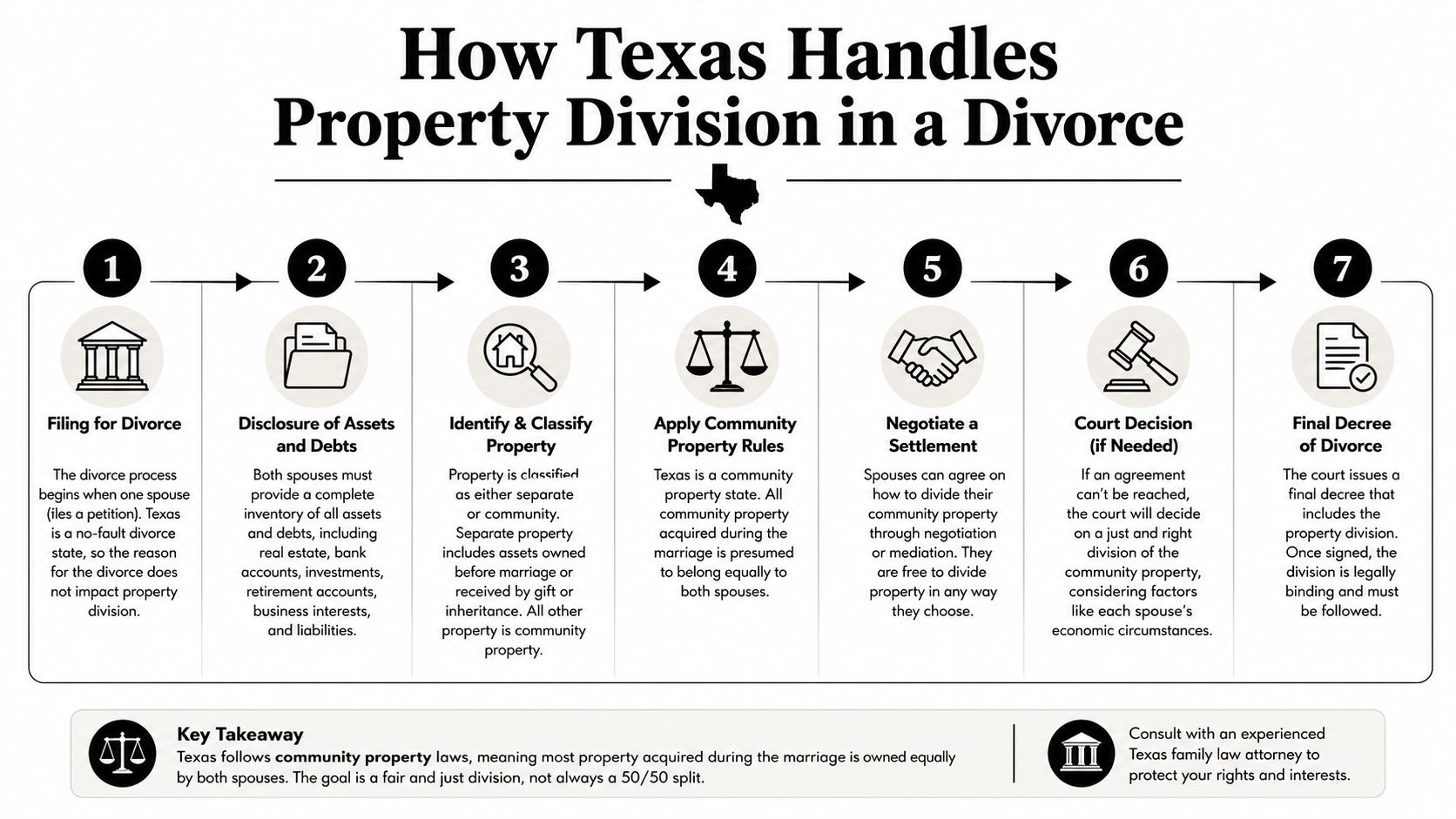
How Texas Handles Property Division in a Divorce
Property is where divorces in Texas get serious fast. A family home, a retirement account, and a small business can create more conflict than the marriage itself. The law is clear enough to follow, but the proof is what changes the outcome.
Community property and separate property
Texas treats property acquired during the marriage as community property in most situations, while property owned before marriage or received by gift or inheritance is usually separate. The fight is often not about the label in theory, it's about tracing the money and proving what came from where. When the records are thin, the argument gets harder.
Just and right division
Texas courts divide community property under a “just and right” standard, not an automatic 50/50 split. In other words, the judge looks at fairness under the facts, and that can support an unequal division when the evidence calls for it. As noted in Texas Family Code discussions, the court has discretion to divide the estate in a manner it deems just and right, with regard for each spouse's rights. Texas Family Code and property division discussion
Here's a simple example. One spouse may keep the house so the children can stay put, while the other spouse receives a larger share of retirement funds or another asset. That kind of result doesn't happen by accident. It happens because someone documented the finances and argued the evidence.
The tricky part is the valuation work. Businesses, pensions, stock options, restricted stock units, and 401(k) plans all bring separate questions about value, tax treatment, and timing. A lawyer who knows how to work with appraisers and records can change the result in a way that plain emotion never will.
What to collect early
- Income records: Pay stubs, tax returns, and bank statements show the financial baseline.
- Debt information: Credit cards, loans, and mortgage records matter just as much as assets.
- Retirement documents: Account statements and plan summaries help with division.
- Ownership papers: Business records, deeds, and titles help with tracing and valuation.
Choosing Between a Local and a Specialized Texas Family Lawyer
A lot of people assume the closest lawyer is the safest choice. In a rural or lower-density area, that's often wrong. Public-policy research from the State Bar of California recognizes that rural communities can be underserved enough that states consider incentives to attract attorneys, which is a real access-to-justice problem, not a theory. Attorney desert policy brief
Shady Acres readers need to think differently. In family law, the better question is not just who is nearby, it's who handles cases like yours in the courts that matter. A lawyer with regular custody, support, and property division experience may be worth the drive if the alternative is a generalist who doesn't know the local court culture.
What proximity gives you
A nearby lawyer can make in-person meetings easier. If you're juggling work, kids, and court deadlines, that convenience helps. It also matters when someone needs to sign documents quickly or bring original records to an office.
What specialization gives you
Specialization usually gives you sharper judgment on custody disputes, modifications, and high-conflict divorce. It also matters when your case crosses county lines, involves a military family, or depends on a judge who expects clean evidence and tight procedure. That's where a firm like The Law Office of Bryan Fagan, PLLC fits naturally, because the firm's work spans divorce, custody, support, and broader Texas family-law matters.
A smart client asks about remote consultations, secure document exchange, and whether the lawyer regularly appears in the relevant court system. If the answer is vague, keep looking. The law doesn't reward convenience by itself. It rewards preparation.
Good question to ask: “Who will actually know my case, and how often do you handle cases in this county?”
What to Expect on the Timeline From Consultation to Resolution

The first meeting is usually a free consultation, where you lay out the facts and hear what the law allows. After that comes the retainer and engagement process, then filing or response, and often temporary orders if the case needs immediate structure. Those early decisions shape everything that follows.
Discovery is where a lot of cases slow down. That's the stage where financial records, messages, account statements, and other documents get exchanged. If one side is hiding assets or fighting over parenting facts, the timeline stretches. Interstate issues and military-related concerns can also add layers that a simple local case doesn't have.
Mediation often arrives before trial and, for many families, that's where settlement gets done. If settlement fails, the case moves toward final hearing or trial, depending on what the dispute still covers. An uncontested divorce can move faster than a contested custody or property case, but every file still needs real attention.
The point is to expect movement, not miracles. The legal process has steps, and skipping them usually creates problems later. Good counsel keeps the case moving while protecting the details that matter.
Fees, Consultations, and Questions Worth Asking
Money can make people freeze up, so be direct about it. In Texas family law, some matters are handled with flat fees, especially simpler uncontested work and straightforward estate planning. Contested cases often use hourly billing, and some lawyers also offer hybrid or limited-scope arrangements depending on what the client needs.
Cheap is not the same thing as affordable. A low quote can turn expensive if the lawyer is hard to reach, unprepared, or unfamiliar with the court handling your case. Paying more for clarity and competent strategy can save money when the dispute turns messy.
Bring a short list of questions to the consultation:
- Who will handle the work: Make sure you know whether the attorney, a paralegal, or another lawyer will be doing the day-to-day tasks.
- How billing works: Ask what gets billed, when invoices go out, and what costs come on top of fees.
- What the realistic range is: You want a plain answer about outcomes, not a sales pitch.
- What experience they have in your county: Local court practice still matters.
- How you'll communicate: Phone, email, portal, and response times should all be clear.
If your issue involves custody changes or a protection issue, ask whether the firm regularly handles those exact matters. If it's estate planning, ask how wills, powers of attorney, and probate administration fit together. Transparency at the first meeting tells you a lot about how the case will feel six months later.
Mediation, Estate Planning, and Other Questions Shady Acres Families Ask
Mediation is not always required, but it's often worth taking seriously because it can narrow disputes without handing everything to a judge. If your custody or support order no longer fits your life, a modification may be the right fix, especially when job changes, moves, or parenting shifts are real. A Texas family still needs a will, because without one the state's rules decide more than many realize.
For families who can't always drive into the city, remote communication can help a lot. A firm that uses calls, email, and document exchange can still move a Texas case forward without forcing every conversation to happen in person. That matters in a state this large.
Texas probate also deserves attention before a crisis hits. In estate matters, independent administration can reduce court supervision and simplify settlement when the will authorizes it or the heirs agree, which can help families dealing with a home, bank accounts, or a small business. Texas independent administration and probate discussion
If you're unsure whether your issue belongs in divorce, custody, estate planning, or probate, don't guess. Get the facts, ask the hard questions, and make the next move with a lawyer who handles these problems every day.
If you need help navigating divorce, custody, or estate planning in Texas, contact The Law Office of Bryan Fagan today for a free consultation. The team helps Shady Acres families with family law, probate, and planning issues that need careful handling, clear advice, and steady follow-through. Visit Law Office of Bryan Fagan, PLLC to talk through your next step and get answers that fit your situation.