Skip to content

A Texas family can be doing everything right on paper and still get pulled into a fiduciary dispute. A trustee signs off on trust investments, a 401(k) committee approves fees, or an executor makes a distribution decision, and then a beneficiary, participant, or regulator starts asking whether the person acted with proper care. That's where fiduciary liability insurance enters the picture, because the problem is usually not the business itself, it's the personal exposure of the person making the fiduciary decision.
What Fiduciary Liability Insurance Actually Protects
A trustee in Texas can follow the trust terms, keep records, and still get named in a breach-of-duty claim. A retirement plan committee member can act in good faith and still face a lawsuit over fees or plan administration. In both settings, the risk isn't just losing the dispute, it's paying for the defense while the dispute is unfolding.
The plain-English version
Fiduciary liability insurance is third-party coverage for claims that a fiduciary breached a duty or made an error in plan administration. In the employee-benefit context, it can help pay defense costs, settlements, and judgments up to policy limits. It's not legally required, but it's often treated as part of a broader risk-management plan because fiduciary claims can be expensive long before anyone reaches the merits of the case, as explained in fiduciary duty insights.
The cleanest way to think about it is this. A fidelity bond protects against theft or fraud by plan officials, while fiduciary liability insurance protects against allegations that a fiduciary made the wrong decision or handled administration improperly. Those are different risks, and they're often confused.
Practical rule: if the claim is “you stole from the plan,” think bond. If the claim is “you mishandled the plan,” think fiduciary liability coverage.
What it is not
This policy doesn't excuse intentional wrongdoing or personal profit. It also doesn't replace broader business insurance, and it doesn't automatically cover every decision a trustee, employer, or committee member makes. A family trust dispute, for example, may involve separate issues from an employer's benefit-plan exposure.
That distinction matters in Texas estate planning too. A person can be a fiduciary because they control assets for someone else, not because they hold a special title. If you're organizing a trust, reviewing beneficiary instructions, or coordinating with a probate lawyer, the legal question is often less about labels and more about who had control and what duty came with that control. For readers working through trust formation, setting up a trust in Texas is a useful place to see how fiduciary roles can start before anyone expects a lawsuit. For families who also need probate help, the Probate process is where those duties often become visible in real time.
Who Qualifies as a Fiduciary Under Texas and Federal Law
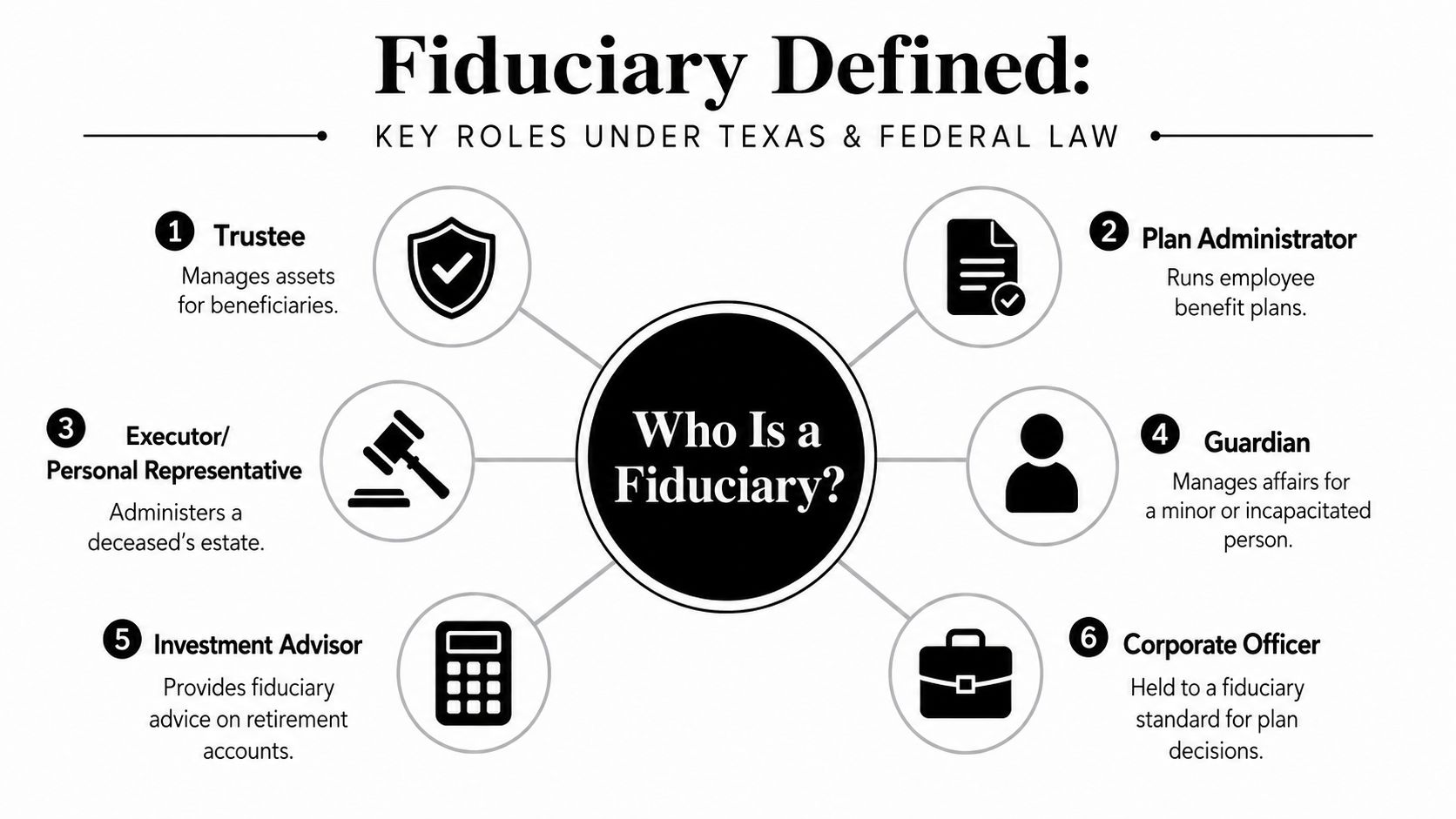
People often think fiduciary status only applies to someone with “trustee” in the title. That's too narrow. In Texas, fiduciary duties can attach in trust administration, probate administration, guardianship, and financial decision-making. Under federal ERISA rules, fiduciary status can also apply to the people who manage or advise an employee benefit plan.
The roles that most often create exposure
A trustee named in a trust agreement can become personally exposed if the trust assets are mishandled or records are poorly kept. An independent executor under the Texas Estates Code has similar practical duties when administering a deceased person's estate, and a guardian appointed by a probate court has to act carefully for a minor or incapacitated adult. An agent under a power of attorney can also cross into fiduciary territory when handling financial decisions for someone else.
A small-business owner can face fiduciary exposure too. If that owner serves on a 401(k) committee, chooses investments, approves the plan's administration, or helps hire service providers, the person may be acting as an ERISA fiduciary. The legal standard is different from ordinary business judgment, because fiduciary decisions are measured by loyalty and prudence, not just profitability.
Why people get surprised
Fiduciary status often shows up without much fanfare. A parent may step in to manage a sibling-held trust, or an adult child may become the executor of a Houston estate after a parent dies. No one feels like a “fiduciary” in the abstract, but the law may still treat them that way.
That's why standards-of-care resources can be helpful when a person is trying to separate ordinary financial service from fiduciary responsibility. Readers who want a comparison of advisory models can look at advisor standards of care explained to see how duties change depending on the role. The same basic idea shows up in Texas estate administration. A person's title doesn't always match the duty the court or plan documents impose.
A fiduciary isn't just someone with authority. It's someone whose decisions are supposed to be made for another person's benefit, and that changes the personal-risk analysis immediately.
That's why Estate Planning in Texas and Grandparent's Rights can sit in the same broader conversation. Family law, probate, and retirement-plan administration all involve decision-makers who may not realize how quickly personal responsibility can attach.
Common Claims and Exposures That Drive Demand for Coverage
The litigation picture has become more concentrated in a few places. In the employee-benefit world, excessive-fee and forfeiture claims are taking up more space. In Texas probate and trust disputes, beneficiaries can still bring breach-of-trust and breach-of-fiduciary-duty claims when they think a trustee, executor, or guardian crossed a line.
What the filing trend tells you
WTW reports 51 excessive-fee class actions in the first 10 months of 2025, compared with 47 in all of 2024 and 43 in 2023. WTW also reports that forfeiture-related class actions reached 43 in the first 10 months of 2025, compared with 30 in all of 2024 and just 5 in 2023. In the same research, a claims dataset found that 59.2% of motions to dismiss were allowed to proceed to discovery in 2023, rising to 62.5% in the first half of 2024. Those figures matter because they show why defense costs can mount early, even before the underlying claims are resolved. WTW's fiduciary liability outlook is a useful reference point for that trend.
| ERISA Class Action Filings by Claim Type | 2023 full year | 2024 full year | 2025 first 10 months |
|---|---|---|---|
| Excessive-fee class actions | 43 | 47 | 51 |
| Forfeiture-related class actions | 5 | 30 | 43 |
The claims that don't make headlines
Not every claim starts with a dramatic accusation. Sometimes it starts with a missed notice, a poor recordkeeping decision, an imprudent investment change, or a failure to monitor a third-party administrator. Cybersecurity issues can also spill into fiduciary disputes when plan records or participant data are mishandled.
A Texas trustee can face similar pressure in a different courtroom. A beneficiary may argue that the trustee mixed family conflict with investment judgment, or that an executor delayed administration and created loss. For an attorney who reads these disputes regularly, the pattern is familiar. The complaint often begins with a simple accusation, then turns into a document-heavy fight about decisions, timelines, and who had authority.
If you want a deeper view of how fiduciary duties are framed in litigation, Kons Law fiduciary duty claim is a helpful comparison point because it shows how these disputes are often built around alleged breaches rather than simple mistakes. The core lesson is the same in Texas probate and ERISA matters, personal liability is often the pressure point.
How Fiduciary Liability Insurance Differs From D&O, E&O, and Fidelity Bonds
A lot of people buy insurance in bundles and assume one policy will catch everything. That's where mistakes happen. Fiduciary liability insurance, D&O, E&O, and an ERISA fidelity bond all serve different jobs, and the differences matter when a claim lands.
Side-by-side thinking
| Policy type | Primary focus | Typical trigger | What it usually doesn't replace |
|---|---|---|---|
| Fiduciary liability insurance | Fiduciary breaches of duty | Breach of ERISA or trust duty | D&O, E&O, fidelity bond |
| D&O | Directors' and officers' personal liability | Corporate mismanagement claims | Fiduciary plan coverage |
| E&O | Professional service errors | Client negligence lawsuits | Management-liability coverage |
| Fidelity bond | Employee theft and fraud | Dishonest acts causing loss | Breach-of-duty defense coverage |
The Texas business owner with a 401(k) plan often needs both D&O and fiduciary coverage, because a board decision and a plan decision are not the same thing. A trust company or family trustee may need a different structure altogether, especially if the risk comes from administration rather than corporate governance.
The ERISA bond question
The ERISA fidelity bond is first-party coverage. It protects the plan against theft or fraud by people who handle plan funds. Fiduciary liability insurance is different, because it is generally third-party coverage for defense and loss arising from alleged fiduciary misconduct.
That distinction is one reason buyers get confused. A bond can be mandatory in ERISA settings, but it doesn't solve a breach-of-duty claim. A fiduciary liability policy can help with that kind of dispute, but it doesn't protect against every dishonest-act loss.
Why the boundary matters in Texas
Texas families often see the same problem in estate administration. A trustee can need protection for fiduciary acts, while the family's broader business or professional liability coverage is aimed somewhere else entirely. If a family business owns the plan sponsor and also runs a trust, the coverage map gets even more important.
Legal review matters here. A policy can look broad and still miss the exact risk you're worried about. In trust and estate planning, that's the same reason Probate and related documents have to be matched carefully to the facts, not just bought because they sound complete.
Typical Policy Terms, Limits, and Exclusions to Watch
A policy summary can look reassuring until you slow down and read the structure. Then the questions start. Does it cover fiduciary acts only, or also voluntary compliance? Are defense costs inside the limit? Does the insurer require consent before settlement? Those details determine whether the policy helps when someone sues.
The structure that usually matters most
Many fiduciary policies separate Coverage A for fiduciary acts from Coverage B for settlement programs or voluntary compliance. Modern forms can also respond to administrative duties, vicarious liability tied to third-party administrators, and claims connected to the insured's fiduciary status. A practical handbook on policy structure describes common grants as breach of fiduciary duty, negligence in administration, voluntary compliance programs, and regulatory penalties, which gives buyers a useful map of what they're reading before they sign. Fiduciary liability policy basics is a good plain-language reference for that structure.
Watch the exclusions closely. Intentional dishonest acts, personal profit, and settlor-function business decisions are common pressure points in fiduciary forms.
What to ask before you bind coverage
- Defense costs: Ask whether legal defense erodes the limit or sits outside it.
- Allocation: Ask how the policy handles a claim that mixes covered and uncovered allegations.
- Consent to settle: Ask whether the insurer can force settlement or needs your approval.
- Exclusions: Ask about dishonest acts, profit exclusions, and settlor-function carveouts.
- Other coverage overlap: Ask where cyber, D&O, and fidelity-bond issues start and stop.
For limit sizing, one industry source says many companies benchmark fiduciary liability limits at about 10% to 20% of total plan assets, with smaller plans often starting around $1 million. The same source warns that legal defense, expert witness fees, and settlements can consume coverage quickly, even when plan assets themselves are modest. How much fiduciary liability insurance do I need is a practical starting point for that sizing discussion.
| Sizing Fiduciary Liability Limits | ||
|---|---|---|
| Plan Asset Range | Common Limit Range | Key Cost Components to Budget For |
| Smaller plans | Often around $1 million | Defense costs, settlement exposure, expert review |
| Larger plans | Roughly 10% to 20% of plan assets | Defense, settlement, expert witnesses, allocation issues |
For Texas families with trusts and business interests, policy wording should be reviewed alongside the governing documents. If your estate plan already includes Estate Planning for Business Owners, it's easier to make sure the insurance matches the way authority is divided.
What Drives Premiums and Which Plans Are Hard to Insure
Insurers don't price fiduciary coverage by guesswork. They look at the size of the plan, the complexity of the investment menu, the number of participants, prior claims, and how well the committee documents its decisions. They also look closely at newer pressure points like cybersecurity, ESG-related decision-making, and ongoing excessive-fee litigation.
Why some plans get tougher treatment
WTW's market guidance for 2023 showed rate increases of roughly +10% to +40% for large public and nonprofit plans, while underwriters also narrowed attention to defined contribution plans above $250 million in assets. Some carriers won't quote plans above $1 billion, and the market response has often been reduced limits and higher retentions rather than simple premium increases. WTW's 2023 fiduciary liability market guidance is a strong signal that the hardest issue isn't just price, it's access to meaningful coverage.
That's especially true for ESOPs and some multiple-employer plans. Those structures can be harder to place, and not every carrier wants the risk. If a plan is large or unusual, the buyer should expect more underwriting questions and narrower terms.
What actually helps in underwriting
Clean committee minutes, clear fee review processes, and documented advice help. So does a regular review of investment menus and service-provider agreements. When the insurer sees a sponsor that can show how decisions were made, the conversation is usually better than when the file is thin and the process is informal.
The legal point is simple. A fiduciary dispute is not only about the final decision, it's about the process that led there. That's why Texas employers and trustees should think about insurance and governance together, not separately.
How to Evaluate and Purchase the Right Coverage for Your Situation
The easiest way to buy the wrong coverage is to start with price alone. The better approach is to gather your documents, define the actual fiduciary roles involved, and then compare policies line by line. That's true whether you're handling a family trust, a probate estate, or an employer-sponsored retirement plan.
A practical buying checklist
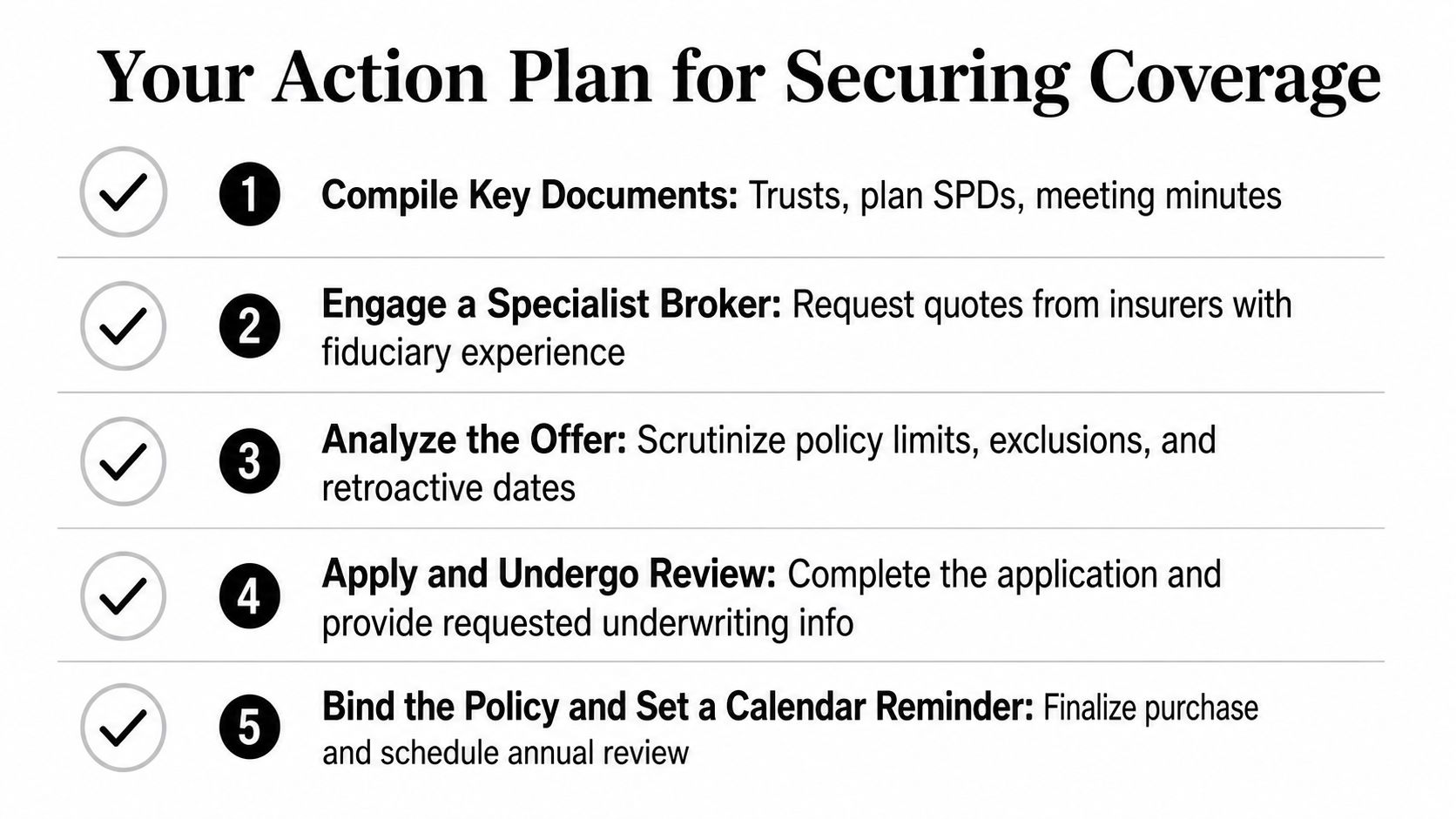
Start with the documents that show who had authority. Trust instruments, plan summaries, committee minutes, beneficiary notices, and service-provider contracts all help the broker and counsel see where the risk sits. Then ask a specialist broker for quotes from carriers that understand fiduciary and ERISA-exposed risks.
A good broker conversation should cover these questions:
- Trigger: Is the policy claims-made, and how does notice work?
- Defense treatment: Do legal fees erode limits, or are they outside them?
- Exclusions: What's carved out for settlor acts, dishonesty, or profit?
- Retroactive dates: Are earlier acts covered, or only new conduct?
- Overlap: How does the policy interact with cyber, D&O, and bond coverage?
If you're a Texas trustee, executor, guardian, or plan sponsor, bring in legal counsel before you bind coverage if the underlying authority documents are unclear. That review can be especially important when the estate plan, business structure, and retirement plan overlap. For a business-owner context, Law Office of Bryan Fagan, PLLC can help coordinate fiduciary questions with the documents that create the duty in the first place.
The right policy won't fix weak governance, but it can keep a hard case from becoming a personal financial crisis.
Revisit the policy each year. Asset growth, committee changes, and new litigation trends can change the insurance answer faster than many families expect.
If you need help navigating divorce, custody, or estate planning in Texas, contact The Law Office of Bryan Fagan today for a free consultation. Our team can help you review fiduciary exposure in trusts, probate administration, and business planning, then coordinate the legal documents and risk controls that support them. Visit Law Office of Bryan Fagan, PLLC to schedule your free consultation and get guidance for your Texas situation.