
Picture this: it’s Saturday morning, and you’re juggling laundry, groceries, and a birthday party that starts in an hour—but the child support check that was supposed to cover the cake and party supplies hasn’t shown up. Stressful, right? That’s exactly why Enforcement of Child Support Payments matters. It’s not just about a line item in a court order—it’s about making sure kids have what they need when they need it, and that parents aren’t left scrambling to fill in the gaps.
In this blog, we’ll walk through how Texas courts handle enforcement, the tools available when payments stop, and why enforcement is so closely tied to stability for families. You’ll learn about remedies most people don’t even realize exist, hear stories of how enforcement turned things around for real families, and get practical advice you can start applying today—whether it’s documenting missed payments, setting up a catch-up plan, or knowing when to call in an experienced attorney.
So if you’ve ever felt the frustration of waiting for support that doesn’t come, keep reading. We’ll give you both the legal insight and the everyday strategies that can help restore consistency to your family’s life—because at The Law Office of Bryan Fagan, PLLC, our mission is simple: educate families and protect futures.
Would you like me to make this story a bit lighter and more playful (closer to the “hook with humor” style), or keep it serious and empathetic to better reflect the emotional weight of enforcement?
Key Takeaways
- Child support enforcement in Texas relies on various legal tools, primarily facilitated by the Texas Attorney General’s Child Support Division, to ensure compliance with court-ordered financial obligations.
- Effective strategies for enforcement include income withholding, license suspensions, and documentation of unpaid support, where thorough evidence gathering is essential for successful actions.
- Mediation and structured negotiated catch-up plans can provide alternative solutions to address missed payments, fostering cooperation between co-parents and improving child outcomes.

Your Family’s Future Starts Here
Don’t navigate your legal journey alone. Schedule a consultation now and get the clarity and support you deserve.
Understanding Child Support Enforcement in Texas
Enforcement of Child Support Payments in Texas encompasses the court’s tools to secure compliance with support orders—covering ongoing obligations, arrears, statutory interest, and, when appropriate, contempt for willful nonpayment. Missed support can quickly destabilize a household and threaten essentials like housing, food, childcare, and school-related costs, so our team approaches these matters with empathy and precision to restore stability while protecting your rights and your child’s best interests.
Texas law provides robust remedies grounded in the Texas Family Code. Under Chapter 157 (including §157.001 for motions to enforce, §157.166 for enforceable judgments, and §157.265 for interest on arrearages), courts can confirm arrears, enter judgments with interest, and impose contempt where appropriate. Income withholding for current and delinquent support is authorized by Chapter 158, property liens and levies are available under Chapter 157, Subchapter G, and driver’s, professional, and recreational licenses may be suspended for serious delinquency under Chapter 232. These mechanisms, reflecting the latest updates to Texas law, prioritize the child’s needs and promote timely, consistent payments.
When agency processes aren’t moving fast enough—or your situation calls for a tailored strategy—experienced counsel can make a meaningful difference. Our attorneys guide clients through documentation, courtroom advocacy, and practical solutions, from immediate wage withholding to structured payment plans, lien enforcement, and targeted contempt relief. For a deeper dive into options and next steps, explore our Texas Child Support Resource and learn how we can help you navigate Enforcement of Child Support Payments with trusted, compassionate representation.

What is Child Support Enforcement?
Enforcement of Child Support Payments in Texas uses a coordinated set of remedies to keep orders reliable and kids’ needs front and center. Courts can initiate or complement actions brought through the Attorney General’s Child Support Division and have broad authority under the Texas Family Code to confirm arrears and enter money judgments with interest (Tex. Fam. Code §§157.263, 157.265–.266), enforce through contempt when willful nonpayment is proven (§157.001; §157.166), and tailor relief to your family’s circumstances. Income withholding may be ordered or updated under Chapter 158, child support liens may attach to nonexempt real and personal property under Chapter 157, Subchapter G, and—when delinquency persists—license suspension remedies are available under Chapter 232. These tools, applied with current statutory updates, aim to reduce conflict, promote timely payments, and protect a child’s stability.
Effective enforcement is built on documentation and strategy. Payroll records, payment histories, and communications help your attorney frame a precise motion to enforce under §157.001 and ensure any resulting order meets the enforceability requirements of §157.166. From there, counsel can pursue the right sequence for your facts—wage withholding adjustments (Chapter 158), reduction of arrears to judgment with post-judgment interest (§§157.263, 157.265–.266), targeted liens and levies (Chapter 157, Subchapter G), negotiated payment plans, or contempt where appropriate—always with an eye toward minimizing disruption for your child. For a practical, step-by-step overview of proven tactics, see our effective methods for enforcing Texas child support orders.
At this Houston-based family law practice, we combine clear legal guidance with compassionate advocacy so parents know what to expect at each stage and children receive consistent support. If you’re ready to understand your options from establishment through collection and modification, explore our comprehensive Texas Child Support Resource, then let us help you craft an enforcement plan that aligns with the latest Texas Family Code and your family’s goals—because meaningful Enforcement of Child Support Payments is ultimately about protecting your child’s future.
Role of the Texas Attorney General’s Child Support Division
The Texas Attorney General’s Child Support Division is pivotal in enforcing child support payments. This division collaborates with private attorneys to streamline support enforcement cases, making the process more efficient. It is essential to open a case promptly when support payments are not being made to ensure timely enforcement actions.
Timelines for enforcement actions can vary, but the Attorney General’s office strives to proceed with efficiency to support the financial stability of the child. By working closely with this division, parents can leverage the full spectrum of legal tools available to enforce child support orders and secure the necessary financial support for their children.
Common Enforcement Remedies in Texas
Enforcement of Child Support Payments in Texas is about restoring stability for children when a support order isn’t being followed. While the Texas Attorney General’s Child Support Division can initiate actions, courts retain broad powers to compel compliance and recover past-due amounts, interest, costs, and fees. Under the Texas Family Code, judges may confirm arrears, enter money judgments (with interest that continues to accrue until paid), and use contempt when nonpayment is willful, ensuring that the child’s needs remain the priority.
Texas law provides multiple, coordinated remedies. Chapter 158 authorizes income withholding so current and delinquent support can be taken directly from wages in court or Title IV-D proceedings. Chapter 157 supplies the core enforcement toolkit—motions to enforce, reduction of arrears to judgment, and Subchapter G child support liens that attach to nonexempt real and personal property until the full obligation (including interest and fees) is satisfied. For chronic nonpayment, Chapter 232 permits suspension of driver’s, professional, and recreational licenses after specific delinquency and notice thresholds are met. Together, these provisions—applied in line with the latest statutory updates—give families practical, graduated paths to compliance.
If you’re weighing your options or need to move quickly, our attorneys can help you choose the right sequence—immediate wage withholding, lien and levy strategy, a judgment with interest, or targeted contempt—based on your case history and the other parent’s assets and employment. For a step-by-step overview of tools and timelines, see effective methods for enforcing Texas child support orders, and explore our broader Texas Child Support Resource for guidance on establishing, modifying, and collecting support. We’re here to pair clear legal strategy with compassionate advocacy so you can secure what your child is owed under Texas law.
Income Withholding Orders
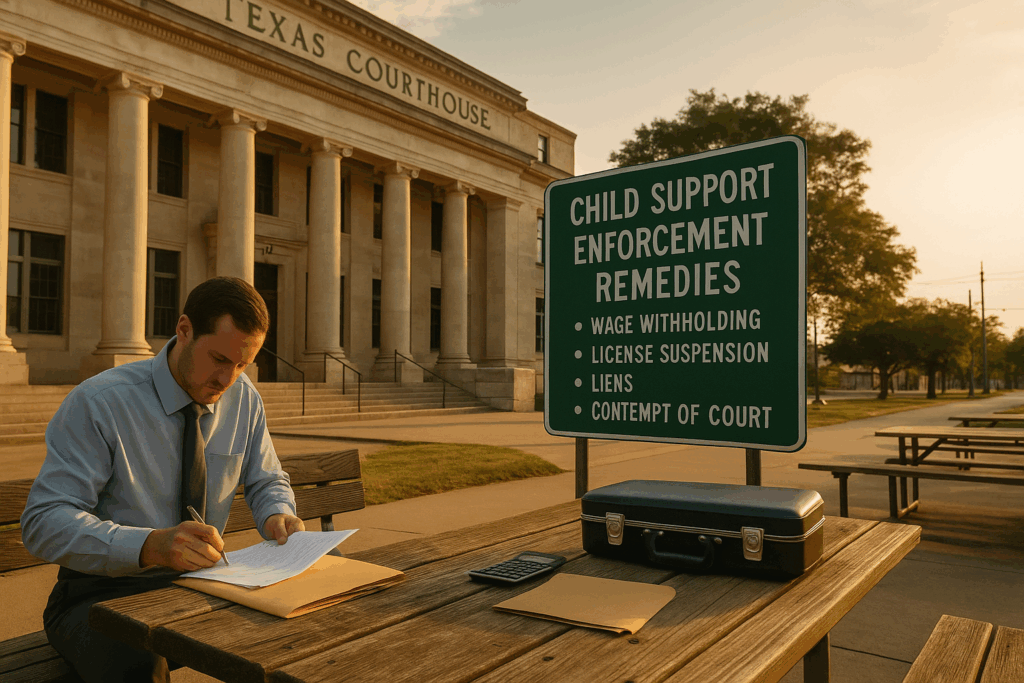
Income withholding orders are one of the most effective tools in the enforcement of child support payments. These orders require employers to automatically deduct child support payments from an employee’s paycheck, ensuring timely and consistent payments. In fact, about 80% of child support payments are facilitated through wage withholding.
The Texas Attorney General’s Child Support Division ensures compliance with these orders through enforcement actions, making sure that the support payments reach the custodial parent as intended. This automatic deduction process simplifies the payment process and significantly reduces the likelihood of missed payments.
License Suspension
License suspension is another powerful enforcement remedy used to encourage compliance with child support payments. The Texas Attorney General can suspend various licenses, including drivers’, professional, and recreational licenses, for failure to pay child support. This enforcement action can significantly impact individuals, limiting their ability to work and function in daily life until they resolve their child support obligations.
The administration of these suspensions is handled by the Attorney General’s office, making it a straightforward process to implement this enforcement action. By targeting essential licenses, this remedy effectively pressures non-compliant parents to fulfill their support obligations, as the agency oversees the enforcement.
Liens and Levies
Liens and levies are also utilized in Texas to enforce child support payments. Texas law allows for placing liens on the personal property of individuals who fail to pay child support. This includes assets like bank accounts and properties, which can be seized to satisfy overdue child support obligations.
By placing liens on various assets, the state can recover unpaid child support, ensuring that financial obligations are met. This method serves as a powerful deterrent against non-compliance, as it directly impacts the financial standing of the non-custodial parent.
Evidence Required for Enforcement Actions
Strong documentation is the foundation of effective Enforcement of Child Support Payments in Texas. Before filing, gather clear proof of what was ordered and what was (or wasn’t) paid—payment ledgers from the state disbursement unit, bank and payroll records, messages regarding support, and invoices for medical or childcare costs. The Texas State Disbursement Unit, administered through the Attorney General’s Child Support Division, provides centralized, time-stamped transaction histories that help verify arrears and credits, reduce disputes, and keep the focus on your child’s needs.
Once the evidence is organized, Texas courts can apply targeted remedies under the Texas Family Code. Motions to enforce are brought under Tex. Fam. Code §157.001, and any resulting order must meet the enforceability requirements of §157.166. Arrearages can be confirmed and reduced to a cumulative money judgment with interest under §§157.263, 157.265–.266, while current and delinquent support can be collected through income withholding authorized by Chapter 158. To secure payment beyond wages, courts may perfect and execute child support liens on nonexempt real and personal property under Chapter 157, Subchapter G, and for chronic nonpayment, driver’s and professional license suspensions are available under Chapter 232. Thorough records make these tools more precise, minimize courtroom conflict, and help ensure consistent support for your child.
If you’re ready to turn your documentation into results, explore our practical overview top legal support for Texas child support needs for strategy and next steps, and review our comprehensive Texas Child Support Resource for guidance on establishing, modifying, and collecting support. Our Houston-based team pairs meticulous record review with compassionate advocacy, aligning your case with the latest updates to the Texas Family Code so enforcement actions protect your child’s stability and future.
Gathering Payment Ledgers and Bank Records
Building strong cases often involves gathering comprehensive documentation and evidence to support claims for child support. Payment ledgers and bank records serve as critical pieces of evidence. Attorneys utilize real-time data to locate non-custodial parents, which significantly aids in establishing and enforcing child support orders.
Leveraging updated public records and social media can also help gather evidence of a non-custodial parent’s location. These strategies are essential for creating a clear and undeniable record of owed payments, facilitating the enforcement process and ensuring compliance.
Communication History
Records of communications, including Mail and texts, can serve as critical evidence in support enforcement. Text messages and Mail can establish communication regarding child support obligations on behalf of providing a timeline and context for claims, including the date of those communications, and may also include a sign of agreement. Additionally, it is important to maintain a record of contact for future reference.
These communication logs are particularly useful in family court, provided they meet necessary legal standards for relevance and authenticity. Ensuring that all communications are documented and preserved can strengthen a case and support enforcement actions and write enforcement actions.
Medical and Childcare Invoices
Documenting medical and childcare invoices is crucial for enforcing child support, providing clear evidence of necessary expenses for the child. These invoices include:
- Health care payments
- Childcare fees
- Educational costs
- Other relevant expenses vital for the child’s well-being.
Thorough documentation of these expenses supports claims for reimbursement and ensures that financial needs associated with child support are met. This evidence forms a critical component of effective enforcement actions, highlighting the direct impact of unpaid support on the child’s daily life.
Defenses and Complications in Enforcement Actions
Enforcing child support is not without its challenges. Common defenses and complications can arise, such as:
- Job loss claims
- Self-employment income
- Under-the-table payments
- Informal side agreements
These issues can complicate the enforcement subject process, requiring careful navigation and substantial evidence to address referral on this site page report at the federal level. Note that these complexities can impact outcomes. Notice that these complexities can impact outcomes.
Understanding these defenses and complications is essential for effectively countering them. By anticipating potential challenges and preparing accordingly, parents can strengthen their enforcement actions and ensure compliance with support obligations.
Job Loss Claims
A significant drop in income, such as job loss, can serve as grounds for requesting a modification of child support obligations. However, child support payments do not automatically decrease with job loss; a modification petition must be filed, and the parent must present evidence of their changed financial situation to the court.
Parents are legally required to continue making child support payments unless a modification has been approved by the court. Choosing to leave a job or take a lower-paying position typically does not qualify for child support modification without court approval. Ensuring that all changes are legally documented helps maintain compliance and accountability.
Self-Employment Income
Tracking child support payments from self-employed individuals can be challenging due to irregular income and lack of consistent payment records. Self-employed individuals often have fluctuating earnings that make it difficult to determine a consistent child support obligation.
Clear income documentation through tax returns and business records is crucial for effective enforcement. Involving a forensic accountant may assist in accurately determining self-employment income when tracking payments. Accurate documentation of a self-employed person’s income can serve as vital evidence in enforcement actions against non-compliance.
Informal Side Agreements
Informal side agreements occur when one parent proposes an arrangement that is not approved by the court, usually in an effort to modify the terms of child support payments. These informal agreements can create legal complications, such as disputes over the actual amounts owed or the terms of support.
If the terms of informal side agreements are not documented or agreed upon in court, they may not be enforceable, making it difficult to compel payment in the event of a default. It is crucial for parents to form any agreements related to child support in court to ensure enforceability and legal protection, or they may terminate their rights to enforce those agreements.
Step-by-Step Guide to Enforcing Child Support Payments
Enforcement of Child Support Payments in Texas is a structured process that prioritizes your child’s stability while ensuring court orders are followed. Courts, working alongside the Attorney General’s Child Support Division, have broad authority under the Texas Family Code to confirm arrears and enter money judgments with interest (Tex. Fam. Code §§157.263, 157.265), compel payment through income withholding (Chapter 158), place child support liens on nonexempt property (Chapter 157, Subchapter G), suspend driver’s and professional licenses for chronic nonpayment (Chapter 232), and, where willful noncompliance is proven, use contempt remedies consistent with due process (§157.001; §157.166).
A practical roadmap typically includes gathering proof (payment histories, payroll records, communications), consulting counsel, filing and serving a motion to enforce, attending the hearing, and pursuing post-judgment collection. At the same time, defenses and credits must be evaluated promptly—Texas law recognizes affirmative defenses to contempt such as true inability to pay when the obligor lacked the ability to comply and exhausted reasonably available resources (§157.008), and allows prospective clarification when an order is too ambiguous to enforce (§§157.421–157.426). For a clear, client-focused overview of what to expect if you’re on the receiving end of an enforcement case, read our guide to defending against an enforcement action in Texas.
Whether you need swift wage withholding, a judgment with interest, a lien strategy, a structured payment plan, or targeted contempt relief, our Houston-based team will tailor a plan aligned with the latest updates to the Texas Family Code and your family’s needs. For broader context on establishing, modifying, and collecting support, explore our Texas Child Support Resource, and let us help you move from confusion to a clear, enforceable path forward.

Consulting an Attorney
Securing reliable child support often requires more than paperwork—it calls for skilled legal advocacy. In Texas, the Enforcement of Child Support Payments is governed by detailed provisions of the Texas Family Code, including §157.001 (motions to enforce), §157.166 (requirements for enforceable orders), and §157.263–157.266 (judgments for arrears and interest). Courts may order income withholding under Chapter 158, child support liens under Chapter 157, Subchapter G, or even license suspensions under Chapter 232 when obligations remain unpaid. With these tools available, professional legal guidance ensures your case is presented clearly and in compliance with the latest statutory updates.
Experienced counsel can help you determine which remedies fit your situation, prepare the necessary documentation, and advocate effectively in court. From building a motion with accurate payment histories to pursuing judgments that include interest and costs, legal representation significantly improves the chances of obtaining meaningful enforcement. Our attorneys not only explain the law but also provide practical strategies to reduce stress and keep the focus on protecting your child’s well-being. For a clear overview of rights and responsibilities, visit our Texas Child Support Resource, which outlines the core framework for establishing and enforcing obligations.
At the Law Office of Bryan Fagan, we know these cases involve more than numbers—they impact trust, security, and a child’s future. That’s why our team blends technical knowledge of the Texas Family Code with compassionate guidance, helping parents take decisive steps while feeling supported throughout the process. To learn more about enforcement remedies and practical solutions for your family, explore our article on child support in Texas and let us guide you toward an outcome that prioritizes both legal compliance and family stability.
Filing and Serving a Motion
Filing an enforcement motion typically involves submit required documents to the court and ensuring they are served to the other party. To initiate enforcement, one must properly file a motion with the court and ensure it is served to the non-compliant parent.
It’s essential to ensure that the motion to enforce child support is properly filed with the court and served to the non-compliant parent. Proof of service is often required to demonstrate that the other parent received the motion for enforcement.
Following these procedures ensures that the enforcement process is legally sound and effective.
Attending a Hearing and Post-Judgment Collection
During the hearing, both parties present their cases and evidence before the judge, who will then decide on the enforcement action in the interest of justice. Preparation for the hearing can include gathering witnesses or documents that support the enforcement claim.
The outcome of a hearing can lead to various enforcement actions based on the judge’s ruling, including post-judgment collection methods such as wage garnishment and bank levies to secure owed payments. Understanding court protocols and being well-prepared can significantly impact the outcome of the hearing, especially if a court order is issued.
Tracking and Documenting Child Support Payments
Accurate financial records help establish compliance with child support obligations. Tracking and documenting payments using the state disbursement unit, banking apps, credit, and ledgers is essential for ensuring compliance and facilitating enforcement actions.
Accurate record-keeping through both the SDU and other tracking methods is essential for enforcing child support payments and ensuring that all parties comply with court orders. These records provide a clear payment history, reducing conflicts and supporting enforcement claims.
Using the State Disbursement Unit
The state disbursement unit (SDU) is responsible for processing and tracking child support payments in Texas, providing a centralized method to manage financial transactions. Using the SDU facilitates timely payments and provides a clear record of transactions, helping to reduce conflicts between parents regarding payment history in the department.
In addition to the SDU, banking apps and ledgers can be used as supplementary tools to maintain accurate records of all account payments made and received. This comprehensive approach ensures that all financial transactions are documented and traceable, supporting enforcement actions.
Banking Apps and Ledgers
Banking apps can provide convenience and real-time access to payment information and payment records, aiding in efficient tracking and management of child support payments. Accurate payment ledgers are critical as they serve as official records of transactions and support enforcement actions when disputes arise.
Utilizing banking apps and maintaining accurate ledgers not only enhance the tracking process but also strengthen the ability to enforce child support obligations effectively. This combination of technology and meticulous record-keeping provides a robust framework for managing child support payments.
Mediation and Negotiated Catch-Up Plans
Mediation is a voluntary process that allows parents to resolve child support disputes collaboratively without court intervention. When both parties are willing to communicate and negotiate in good faith, mediation can save time and reduce conflict.
Negotiated catch-up plans offer structured agreements that allow parents to catch up on missed payments over time, accommodating financial realities. Using mediation and negotiated catch-up plans can lead to more amicable solutions, improving relationships between co-parents and ensuring the child’s needs are met efficiently.
When to Consider Mediation
Engaging in mediation allows for flexible solutions tailored to both parties’ needs, which can be more efficient than litigation. Mediation can significantly cut legal costs compared to traditional court proceedings, making it a financially viable option for parents.
The mediation process prioritizes children’s well-being, helping parents focus on amicable arrangements rather than adversarial disputes. Mediation may be beneficial when both parties are willing to communicate and compromise on child support issues.
Negotiated Catch-Up Plans
Crafting a catch-up payment plan can help parents catch up on missed child support without the need for immediate court intervention. Negotiated catch-up plans allow parents to create tailored agreements for repaying missed child support payments, ensuring financial obligations are met.
Such plans can include flexible payment arrangements based on a parent’s income and circumstances, facilitating compliance and accountability. Agreements made through negotiated catch-up plans can help parents systematically address and settle missed child support payments.
Interstate Enforcement of Child Support Orders
Enforcement of Child Support Payments across state lines is possible under Texas’s adoption of the Uniform Interstate Family Support Act (UIFSA), codified in Texas Family Code Chapter 159. UIFSA’s framework lets a Texas court register and enforce another state’s support order while respecting continuing, exclusive jurisdiction rules (Tex. Fam. Code §159.205) and streamlined registration and enforcement procedures (§§159.601–159.607; §§159.501–159.507). Once an order is properly registered, Texas courts may utilize the state’s full enforcement toolkit—confirming arrears and entering judgments with interest under Chapter 157 (including §§157.263, 157.265), implementing income withholding under Chapter 158, and, where appropriate, pursuing license-suspension remedies under Chapter 232—so children receive consistent, timely support no matter where a parent resides.
If you need to initiate a case, the process typically starts by gathering payment records, confirming the controlling order, and determining the proper forum under UIFSA before filing. In Texas, motions to enforce support obligations are brought under Tex. Fam. Code §157.001, and the resulting orders must meet the requirements of §157.166 to be enforceable. When interstate issues are involved, your lawyer will often file to register a foreign support order (§§159.601–159.607) and then seek Texas-based remedies—like wage withholding (Chapter 158) or a child support lien on nonexempt property (Chapter 157, Subchapter G)—to secure payment. For a step-by-step walkthrough of the filing stage, see our how to file a motion for enforcement in Texas .
Whether you’re registering an out-of-state order or pursuing Texas remedies after registration, our Houston-based team aligns your strategy with the latest updates to the Texas Family Code and the realities of interstate enforcement. Explore foundational guidance in our Texas Child Support Resource, and when you’re ready, we’ll help you navigate UIFSA registration, evidence preparation, and courtroom advocacy—so your family has a clear path to reliable support and effective Enforcement of Child Support Payments.

Basics of UIFSA
To register an out-of-state child support order in Texas, one needs a certified copy of the order and must file a registration request in the appropriate Texas county. This process ensures that the order is recognized and enforceable in Texas, facilitating the collection of support payments.
The Uniform Interstate Family Support Act (UIFSA) facilitates the enforcement of child support orders across state lines, allowing states to honor and enforce valid orders from other jurisdictions. This legal mechanism is crucial for maintaining consistent support payments when parents live in different states.
Steps for Interstate Enforcement
To enforce a child support order across state lines, no registration is needed in the nonissuing state, simplifying the process. This streamlined approach ensures that enforcement actions can be initiated promptly, securing the necessary support for the child.
One successful case involved locating a non-custodial parent through social media clues, facilitating the required financial support for a child with medical needs. This example highlights the effectiveness of interstate enforcement in ensuring that children receive the support they need.
Real-Life Impact of Unpaid Child Support
Unpaid support doesn’t just strain budgets—it can also erode co-parent trust and a child’s sense of security. In Texas, the duty to support a child is grounded in Tex. Fam. Code §154.001, and consistent payments help maintain stable routines for schooling, healthcare, and daily needs. When obligations aren’t met, timely Enforcement of Child Support Payments can lower conflict and restore predictability for everyone involved, aligning financial compliance with the child’s best interests reflected across Chapter 154.
Texas courts have a clear, updated toolkit to secure compliance. Motions to enforce are brought under Tex. Fam. Code §157.001, and enforceable orders must meet the requirements of §157.166; arrears are confirmed and reduced to judgment with interest under §§157.263, 157.265–.266. Judges may order income withholding pursuant to Chapter 158, record child support liens on non-exempt real and personal property under Chapter 157, Subchapter G, and suspend driver’s or professional licenses for chronic nonpayment under Chapter 232. These mechanisms—applied to the facts of your case—support steady payments, reduce friction between co-parents, and keep the focus on your child’s well-being.
If you’re navigating the human side of support during or after divorce, our Houston-based team blends compassionate counsel with decisive action. For perspective on the emotional dynamics that can accompany enforcement, read our Child Support and Divorce: Beyond Business—Embracing Empathy, and for nuts-and-bolts guidance on establishing, modifying, and collecting support, explore our Texas Child Support Resource. We’ll help you choose the right sequence—from wage withholding and liens to structured payment plans and targeted contempt—so Enforcement of Child Support Payments supports stability and protects your child’s future.

Housing and Healthcare
Failure to pay child support can lead to serious consequences for the financial stability of custodial parents, impacting their ability to provide for children’s basic needs. Unpaid child support can significantly disrupt a child’s basic needs, influencing their access to housing and healthcare.
Custodial parents may struggle to provide adequate housing due to financial constraints caused by unpaid child support. This financial instability can lead to housing instability, making it difficult for custodial parents and noncustodial parents to secure adequate living conditions for their children.
Co-Parenting Stability
Unpaid child support may lead to significant challenges in accessing healthcare services, resulting in delays or lack of necessary medical care for children. The lack of financial support may restrict access to necessary healthcare services for children, affecting their overall well-being.
Stable routines are crucial for children’s development, and timely enforcement of child support payments helps maintain these routines. Ensuring consistent child support payments is vital for providing children with stable access to healthcare, ultimately supporting their overall health and well-being.
Success Stories from Bryan Fagan’s Family Law Attorneys
Bryan Fagan’s Family Law Attorneys build strong enforcement cases by:
- Gathering essential evidence, including payment ledgers and communication history.
- Coordinating with the Office of the Attorney General to streamline the enforcement process.
- Securing judgments on arrears and interest effectively.
The focus remains on child-centered outcomes, ensuring that compliance plans are structured around the well-being of the child. Potential clients are invited to schedule a consultation for personalized Enforcement of Child Support Payments strategies.
Building Strong Cases
Building strong cases for child support enforcement involves detailed documentation and thorough preparation. Attorneys collaborate closely with the Texas Office of the Attorney General to ensure that enforcement actions are effective and aligned with legal standards.
Efficient enforcement strategies prioritize child-focused outcomes, balancing legal procedures with the best interests of the child. Case studies illustrate how attorneys have successfully recovered arrears and established compliance plans, contributing to better child support enforcement.
Anonymized Case Studies
One client’s child support case resulted in recovering significant arrears, demonstrating the firm’s ability to create effective compliance plans. Testimonies from clients reveal increased satisfaction with the outcomes achieved, especially regarding the recovery of owed child support payments.
These anonymized case studies highlight the effectiveness of Bryan Fagan’s Family Law Attorneys in securing child support payments and ensuring compliance. Clients can trust that their cases will be handled with the utmost professionalism and dedication to achieving the best possible outcomes for their children.
Conclusion:
At the end of the day, child support isn’t just about dollars—it’s about stability, routines, and making sure kids don’t miss out on the things that help them feel safe and thrive. When payments fall behind, the stress can spill into every corner of family life. The good news? Texas law gives you real tools to hold the other parent accountable, and you don’t have to figure it all out alone.
If you’ve found yourself wondering how to take the next step—whether that’s documenting missed payments, exploring enforcement remedies, or simply getting clarity on your rights—this is exactly where an experienced Texas Family Law Attorney can help. At The Law Office of Bryan Fagan, PLLC, our team is here to educate, guide, and advocate for you, always with your child’s best interests at the center.
So maybe the real takeaway is this: child support enforcement isn’t about creating more conflict; it’s about creating consistency. And sometimes, consistency is the very thing that makes family life feel manageable again. If you’re ready to explore your options, we’d be glad to walk that path with you. After all, protecting your child’s future is too important to leave to chance.
Would you like me to also craft a short call-to-action snippet (about 2–3 sentences) you can use at the very end of the blog—something that feels inviting and clickable, like a natural bridge to your consultation page?
How to enforce child support payments in Texas?
You can enforce child support by filing a Motion to Enforce in the court that issued your order (Texas Family Code ch. 157), requesting income withholding (ch. 158), seeking license suspension (ch. 232), recording child support liens and levies, and asking the court for contempt remedies. The Texas Attorney General’s Child Support Division can also assist with administrative enforcement and interstate actions under UIFSA.
Can you sue child support enforcement?
You generally do not “sue” the Texas Attorney General’s Child Support Division for damages due to sovereign immunity. However, you can challenge or request review of enforcement actions, seek court relief if you believe an action is incorrect, and you can pursue your own court-based enforcement against the other parent. An attorney can help you choose the best forum and remedy.
How far behind in child support before a warrant is issued in Texas?
There is no fixed number of months. A warrant (capias) may be issued by the court if you are ordered to appear and fail to do so, or after a contempt finding for violating the support order. Arrears, missed payments, and noncompliance documented in a Motion to Enforce can lead to a hearing and, if warranted, a capias or other sanctions.
What is the deadbeat dad law in Texas?
“Deadbeat dad law” is a non-legal nickname for Texas’s child support enforcement tools. Texas uses civil and administrative remedies—income withholding, license suspension, liens, credit reporting, and contempt—as well as potential criminal nonsupport under Penal Code §25.05 for intentionally or knowingly failing to support a child. The laws apply to any obligated parent, regardless of gender.
What happens when a dad doesn’t pay child support in Texas?
Consequences can include wage withholding, interception of tax refunds, license suspension, property liens, money judgments with interest, and court-ordered contempt that may involve fines, community supervision, or jail time. Ongoing nonpayment can also impact credit and trigger additional enforcement until arrears are satisfied.
How to file a motion to enforce?
Gather proof of missed payments (state disbursement records, ledgers, bank statements, messages, invoices). Draft a Motion to Enforce specifying the violated provisions, dates, and amounts. File it in the issuing court, obtain a hearing date, and properly serve the other parent. At the hearing, present evidence and request remedies such as a money judgment, contempt, and specific enforcement terms.
How much back child support is a felony in Texas?
Texas does not set a dollar threshold that automatically makes arrears a felony. Civil enforcement handles most nonpayment. However, criminal nonsupport under Texas Penal Code §25.05 is a state jail felony if a person intentionally or knowingly fails to support a child they are legally obligated to support. Prosecutors decide whether to file criminal charges based on the facts.
How to file a complaint for nonpayment of child support?
You have two main paths: (1) open or update your case with the Texas Attorney General’s Child Support Division and request administrative enforcement; and/or (2) file a Motion to Enforce in the issuing court. Document every missed payment and expense. An attorney can help you choose strategies that move fastest and protect your rights.
Who gets back child support after the child is 18 in Texas?
Arrears remain owed even after the child turns 18. Past-due support is typically paid to the obligee (the parent or person who was entitled to receive support) or to the State if benefits were assigned. Payments continue until the arrears and interest are fully satisfied.