Skip to content

Ever try coordinating a bedtime routine between two homes? At Mom’s, it’s story time and lavender lotion. At Dad’s, it’s a wrestling match over who gets the tablet charger. Same kid, same toothbrush, totally different worlds. Texas Child Custody Laws Explained is more than a legal headline—it’s the behind-the-scenes playbook for how families like yours make this work.
In Texas, custody isn’t even called “custody”—it’s “conservatorship,” and it affects everything from who picks up your child on Thursday nights to who decides if they get braces. Understanding these laws means understanding how to create stability, consistency, and peace of mind for your child (and yes, for you too).
In this post, we’ll walk you through exactly how Texas courts approach custody—what “best interest of the child” really means, how to structure parenting plans that hold up in real life, and what happens when things need to change. You’ll get practical tips, real stories from Texas families, and legal insights you can actually use—straight from the trusted attorneys at The Law Office of Bryan Fagan, PLLC.
If you’re going through a divorce, modifying an old order, or just trying to co-parent without losing your mind, this is the place to start. Let’s break it down together.
Key Takeaways
- Texas custody law utilizes the concept of ‘Conservatorship,’ categorized mainly into Joint Managing Conservatorship (JMC) and Sole Managing Conservatorship (SMC), defining the decision-making authority of each parent.
- Possession and access arrangements, including Standard Possession Orders and customized parenting plans, are crucial for maintaining a stable co-parenting environment and ensuring both parents remain actively involved in their child’s life.
- The ‘Best Interest of the Child’ principle guides all custody decisions in Texas, considering factors like parental stability and history of domestic violence or substance abuse, and allowing for modifications in custody if circumstances change.

Your Family’s Future Starts Here
Don’t navigate your legal journey alone. Schedule a consultation now and get the clarity and support you deserve.
Understanding Conservatorship in Texas
In Texas, what most people refer to as “custody” is legally known as conservatorship—a term that defines each parent’s rights and duties regarding their child. As our attorneys frequently advise, conservatorship isn’t just about where your child lives—it governs who can make critical decisions about education, medical care, and overall welfare. Under Texas Family Code § 153.005, this legal framework is the foundation of custody cases and is central to how courts protect a child’s best interests. That’s why having Texas Child Custody Laws Explained clearly and compassionately matters.
There are two primary types of conservatorship in Texas: Joint Managing Conservatorship (JMC) and Sole Managing Conservatorship (SMC). In a JMC, both parents typically share decision-making authority, reflecting the legal presumption that involvement from both parents benefits the child—unless factors like domestic violence or neglect suggest otherwise, as detailed in Texas Family Code § 153.131. SMC, on the other hand, grants one parent exclusive rights in specific areas when shared authority could compromise the child’s safety or stability.
Our legal professionals have helped many families navigate these decisions with clarity and purpose. To learn more about the differences between JMC and SMC, and how to structure a parenting plan that supports your goals, visit Texas Child Custody Attorney. You can also explore this in-depth custody article for practical examples and current legal insights.

Joint Managing Conservatorship (JMC)
Joint Managing Conservatorship (JMC) is a common custody arrangement where both parents share custody decision-making responsibilities regarding their child’s upbringing. This arrangement encourages cooperation and communication, vital for the child’s overall well-being, especially when both parents act as joint managing conservators and maintain joint custody. In this context, being a joint managing conservator can enhance the effectiveness of the custody arrangement.
While both parents are involved in making significant decisions, their rights may be limited in certain areas, such as educational and psychological decisions related to the child’s education. Nonetheless, the structure of JMC is designed to ensure that the child maintains strong relationships with both parents, fostering emotional and social development in the parent child relationship.
The court order outlining a JMC arrangement will specify the roles and responsibilities of each parent, ensuring clarity and reducing potential conflicts. This setup not only supports the child’s well-being but also encourages positive interaction between the parents, which is vital in any custody and visitation scenario.
Sole Managing Conservatorship (SMC)
Sole Managing Conservatorship (SMC) grants one parent primary decision-making authority over the child. This arrangement is often awarded in cases where one parent is deemed more capable of making decisions in the child’s best interest, such as situations involving domestic violence or substance abuse, including cases where sole custody may be considered.
With SMC, the conservator has the exclusive right to make significant decisions regarding the child’s education, healthcare, and overall welfare. This centralization of authority can streamline decision-making processes, ensuring that the child’s needs are met promptly and effectively.
However, the non-conserving parent may have limited input in these critical areas, which can impact their involvement in the child’s life, especially when there is only one parent involved. This setup is designed to protect the child’s best interests, especially in cases where the law presumes the other parent’s behavior may pose a risk to the child’s safety and well-being.
Possession and Access
In Texas family law, possession and access are the legal terms used to describe a parent’s right to spend time with their child. As our attorneys frequently advise, this isn’t just about marking dates on a calendar—it’s about preserving meaningful relationships and providing the child with consistency across both households. These arrangements are formalized through a Possession and Access Order, which may follow the Standard Possession Order as set out in Texas Family Code §§ 153.3101–153.317, or may be customized based on the family’s unique needs.
A thoughtfully crafted schedule outlines when the child will be with each parent—covering everything from weekday routines and weekend visits to holidays and summer break. This structure supports a cooperative co-parenting environment, reduces potential conflicts, and helps children adjust more easily to living in two homes. As we’ve seen in our work with Texas families, clearly defined possession schedules are essential in maintaining stability and fostering trust between parents and children alike.
To explore how possession and access schedules are determined and enforced, we invite you to read our in-depth article, What Parents Need to Know About Custody in Texas. As part of our commitment to having Texas Child Custody Laws Explained clearly and compassionately, The Law Office of Bryan Fagan, PLLC is here to help you understand your rights, protect your time with your child, and move forward with confidence. You can also learn more about how parenting time is managed in our resource on visitation and parenting plans.

Standard Possession Order
Texas courts typically utilize a Standard Possession Order for parenting schedules, designed for children aged three and older. This order provides different custody schedule options depending on the distance between parents’ homes, affecting visitation details.
The standard possession order allows for flexible scheduling of weekday and weekend visits based on the distance between parents’ primary residence. For instance, parents living within 100 miles of each other will have a different schedule compared to those living further apart.
Holiday visitation arrangements are also determined by the standard possession order, ensuring both parents have time with the child during holidays. These visitation orders help maintain a balanced and fair approach, allowing both parents to share significant moments with their visitation order.
Customizing Parenting Plans
While the Standard Possession Order provides a baseline, parents can tailor their parenting plans to accommodate their specific family dynamics and situations. This customization is crucial in addressing the unique needs of each family, promoting a more cooperative co-parenting environment.
Parents can create personalized parenting plans that fit their family’s needs, provided both parties agree on the arrangement. This flexibility allows adjustments for changes in work schedules, children’s needs, or other relevant factors, fostering a more adaptive and supportive environment for parents reach the child. The parental kidnapping prevention act plays a crucial role in ensuring these arrangements are respected.
Collaborating on a customized parenting plan ensures the child’s well-being remains the top priority, reflecting the family’s evolving needs and circumstances.
Best Interest of the Child
In every Texas custody case, one principle rises above all others: ensuring decisions are made in the best interest of the child. Under Texas Family Code § 153.002, this legal standard requires judges to prioritize a child’s emotional and physical needs, developmental stability, and overall well-being above parental preferences. As we’ve seen in our work with Texas families, applying this principle often means looking beyond surface-level arguments and digging into what truly supports a child’s growth—academically, emotionally, and socially.
While a child’s preference may be considered—particularly once they reach age 12, as noted in Texas Family Code § 153.009—it’s not the final word. Courts weigh many factors, including each parent’s ability to provide a stable home, meet the child’s daily needs, support their education, and maintain healthy relationships. The goal is always to foster consistency and security during what can be an uncertain and emotional chapter in a child’s life.
If you want to better understand how courts apply this standard or how to advocate for your child’s needs in a custody case, explore our detailed article on the guiding principle behind Texas custody decisions. This resource is part of our broader effort to have Texas Child Custody Laws Explained in a way that’s approachable, current, and aligned with the most recent updates to the law. At The Law Office of Bryan Fagan, PLLC, we’re committed to helping families make informed, confident choices—because every child deserves a future shaped by care, not conflict.

Factors Considered by Courts
In Texas, the well-being of the child is the primary consideration for judges when making Texas child custody decisions. The Texas court evaluates various aspects such as the stability of each parent’s home environment and their involvement in the child’s life.
The welfare of the child is the primary consideration in Texas custody disputes, often assessed by the emotional stability of the home and each parent’s engagement in the child’s life, including their responsibilities regarding child support and the child’s residence.
Additionally, a history of domestic violence or substance abuse significantly influences custody decisions, often leading courts to prioritize the child’s physical safety and emotional health. These family matters and other factors are crucial in ensuring the child’s overall well-being is protected.
Impact of Domestic Violence or Substance Abuse
Evidence of domestic violence or substance abuse can lead courts to decide against Joint Managing Conservatorship. In these situations, a Sole Managing Conservator is often appointed to safeguard the child’s safety and welfare, while a possessory conservatorship may also be considered.
These critical considerations highlight the need for a thorough evaluation of each parent’s behavior and its potential impact on the child’s upbringing. The court’s priority is to protect the child and provide a stable, safe environment.
The Role of the Child’s Preference
In Texas:
- A child must be at least 12 years old to express a preference regarding custody and visitation.
- Judges may alter custody arrangements if a child over 12 indicates a desire to change living arrangements.
- The child’s preference does not automatically determine the court’s ruling under child custody laws.
While a child’s preference is considered, the final decision must always be in the best interest of the child. This ensures the child’s well-being remains the top priority, even if their child’s wishes differ from the court’s final decision.
Modifying Custody Orders
Life doesn’t stand still—and neither do the needs of your child. As we’ve seen in our work with Texas families, custody arrangements that once worked well may need to evolve. Under Texas Family Code § 156.101, a parent may seek to modify an existing custody order (conservatorship or possession and access) if there has been a material and substantial change in circumstances. This could include job relocations, changes in the child’s health or needs, one parent’s remarriage, or concerns about the child’s safety or stability.
To initiate this process, the parent must file a formal request with the court outlining the specific modifications being sought. In urgent situations—such as those involving family violence, neglect, or unsafe conditions—courts may issue temporary emergency orders under Texas Family Code § 105.001 to ensure the child’s protection until a final hearing is held. According to our family law team, emergency relief can be a powerful legal tool when a child’s immediate well-being is at risk and swift intervention is necessary.
If you’re considering a modification or need to respond to one, we encourage you to explore this helpful guide on custody changes. Having Texas Child Custody Laws Explained in plain language helps you navigate the legal process with confidence. For additional support and resources, visit our section on child custody modifications. At The Law Office of Bryan Fagan, PLLC, we’re here to help you protect what matters most—your child’s future and well-being.

Reasons for Modification
Legal measures such as protective orders against a parent involved in domestic violence and family violence can significantly impact custody issues and decisions. Substance abuse issues can lead to severe restrictions in custody rights, including possible loss of custody.
Changes such as a parent’s inability to care for a child due to health issues or substance abuse can justify modifying custody. Significant changes in circumstances, such as job changes or relocations, can also warrant a modification of custody.
Additionally, a child’s evolving needs or preferences can be a basis for modification. These factors ensure that the custody arrangement remains in the child’s best interest as their situation changes.
Legal Process and Evidence
Filing a modification suit typically requires demonstrating a substantial change in circumstances since the last order. When requesting a modification, further evidence showing a substantial change in circumstances must be presented to the court determines.
This ensures any modifications are justified and in the child’s best interest, providing stability and support.
Enforcing Custody Orders
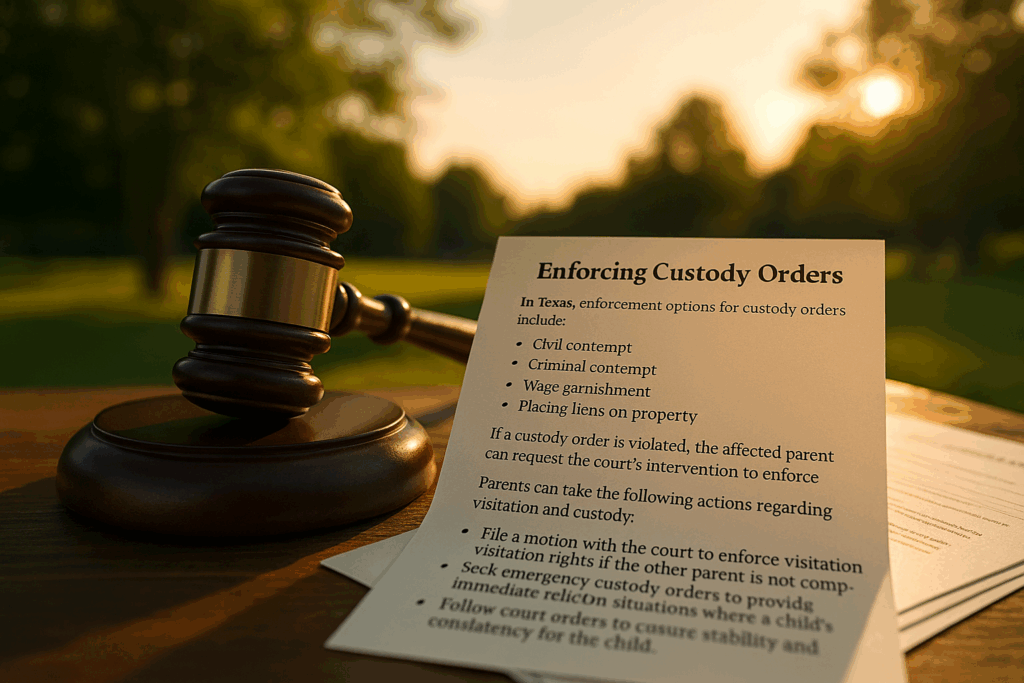
When a custody order is in place, it’s not just a guideline—it’s a legally binding directive. As our attorneys frequently advise, when one parent violates that order, the other has the right to seek court enforcement under Texas Family Code §§ 157.001–157.066. Enforcement options may include civil or criminal contempt, wage garnishment, or even placing liens on the noncompliant party’s property. These remedies exist to protect not just parental rights, but the child’s right to a stable, court-approved routine.
If the other parent is not honoring the terms of your possession and access schedule, you can file a motion to enforce visitation through the court. In more urgent cases—such as those involving safety concerns—emergency custody orders may be requested under Texas Family Code § 105.001. These temporary orders are designed to provide immediate protection for the child while a more permanent solution is reviewed. According to our family law team, taking swift legal action can prevent prolonged emotional stress for both the child and the affected parent.
For a more comprehensive look at your enforcement options and how to safeguard your parenting time, we encourage you to explore Texas Child Custody Arrangements Made Simple. It’s part of our broader effort to have Texas Child Custody Laws Explained with clarity, compassion, and up-to-date legal accuracy. You can also visit our resource page on enforcing child custody orders in Texas. At The Law Office of Bryan Fagan, PLLC, we’re committed to helping parents understand their rights—and take the right steps to protect their children.
Seeking Professional Help
In high-conflict custody cases, seeking experienced legal guidance isn’t just helpful—it’s essential. As we’ve seen in our work with Texas families, disputes involving parenting time, conservatorship, or Child Protective Services (CPS) can escalate quickly and become emotionally overwhelming. That’s why consulting with a skilled custody attorney is one of the most important steps you can take to protect your child’s well-being and assert your legal rights under Texas Family Code §§ 153.001–153.138, which govern conservatorship, possession, and access.
Our legal professionals have helped many clients understand the complexities of custody law—from contested modifications to CPS investigations. We recognize that no two families are alike, and no two custody matters should be approached the same way. An experienced attorney can assess your situation, explain how the court may interpret the best interest of the child under § 153.002, and help develop a strategy that aligns with your child’s needs and the law. This is particularly critical in cases involving allegations of abuse, substance misuse, or noncompliance with a court order—where legal missteps can have lasting consequences.
If you’re facing a contested custody issue or navigating a CPS-related case, start by reading this guide on custody consultations for parents. Having Texas Child Custody Laws Explained by a trusted attorney can offer clarity and peace of mind during an otherwise uncertain time. For more support, visit our dedicated page on Texas child custody consultations. At The Law Office of Bryan Fagan, PLLC, we’re here to educate families, protect futures, and advocate fiercely for the best interests of your child.
Emergency Orders
Emergency orders are provisions that can be requested in custody cases to address urgent situations where a child’s safety is at risk. These orders may be necessary in circumstances such as domestic violence, substance abuse, or other critical safety concerns impacting the child.
Given the complexities and urgency surrounding emergency orders, consulting a Texas law custody attorney is crucial to ensure the proper legal actions are taken swiftly.
Relocation Cases
In custody matters, moving away can complicate arrangements, making legal assistance important for both requesting and contesting relocations. Legal assistance is vital in relocation cases to navigate custody law complexities when a parent wishes to move.
It is recommended to seek assistance when requesting or fighting a relocation.
Parenting Plans and Visitation
A parenting time schedule helps parents manage co-parenting responsibilities, covering exchange times, visits, holidays, and special events. Visitation schedules can be tailored based on the family’s unique needs and are meant to facilitate the child’s stability.
Creating an effective parenting plan is essential for managing co-parenting responsibilities and ensuring the child’s well-being. Considerations for holiday divisions and summer visitation arrangements are crucial in ensuring equitable parenting time.

Weekday and Weekend Schedules
The standard possession order in Texas permits the noncustodial parent to have the child on Thursday evenings and every first, third, and fifth weekend of the month. Parents can customize their visitation schedules as long as both agree; otherwise, the court-enforced standard possession order will prevail.
For parents living more than 100 miles apart, the noncustodial parent can choose one weekend per month or follow the standard weekend schedule. This flexibility ensures that the parenting plan meets the needs of both parents and the child.
Holiday Divisions
Holidays are typically divided in a way that allows both parents to have equitable opportunities to spend time with their child. This ensures that both parents have fair access to their children during significant times of the year.
Holidays are often divided according to specific guidelines, ensuring that both parents have equitable opportunities to spend time with their children during parents divorce special occasions.
Summer Visitation
Summer visitation arrangements can be tailored to fit the overall parenting plan, allowing flexibility for both parents while prioritizing the child’s needs. Summer visitation is included in custody agreements and can vary in duration and frequency based on the parents’ agreements and court orders.
These arrangements can provide extended time for one parent, allowing for vacations and family gatherings, ensuring a balance between both parents.
Right of First Refusal
The right of first refusal in Texas custody arrangements mandates:
- Parents must consult each other before arranging alternative childcare when one parent is unavailable.
- This right aims to prioritize parental care for the child.
- It ensures that a parent has the opportunity to take care of the child before others are considered, as outlined in the Texas family code.
While beneficial for maintaining parental involvement, the right of first refusal is not a legal requirement in Texas parental rights custody orders. Parents can negotiate specific terms for the right of first refusal, including defining the circumstances under which it applies, such as unavailability for a certain number of hours.
Conclusion:
Custody doesn’t come with a manual—but understanding how Texas approaches it gives you something even better: a roadmap to stability, clarity, and peace of mind for your family. Whether you’re drafting a parenting plan for the first time or trying to adjust one that no longer fits your life, knowing your rights (and your options) is a powerful first step.
If you’re feeling overwhelmed, that’s completely normal. Parenting through divorce or separation is one of the hardest things you’ll ever do—but you don’t have to do it alone. At The Law Office of Bryan Fagan, PLLC, we’re here to make the legal side of things less confusing and a whole lot more manageable, so you can focus on what matters most: your kids.
If something in this article hit home—or sparked a few questions—consider that your sign to reach out. Whether you need help protecting your child’s routine, modifying an outdated order, or simply understanding where you stand, our team is just a call away.
And if you’re still deciding what comes next, that’s okay too. Just remember: stability doesn’t happen by accident—it’s built on informed choices, strong plans, and the right support at the right time. Let’s make that happen together.
Frequently Asked Questions About Texas Child Custody
How does Texas determine child custody?
Texas determines child custody based on the best interest of the child, as outlined in Texas Family Code § 153.002. Courts evaluate factors such as the child’s physical and emotional needs, each parent’s ability to care for the child, and any history of family violence or substance abuse.
What is the most common child custody arrangement in Texas?
The most common arrangement is Joint Managing Conservatorship (JMC), where both parents share decision-making rights and responsibilities. However, this doesn’t always mean equal parenting time, which is addressed through possession and access schedules.
What is rule 11 in child custody in Texas?
Rule 11 refers to an agreement between parties in a legal case that is made in writing and filed with the court or made in open court. In child custody cases, a Rule 11 Agreement can temporarily outline terms related to conservatorship, possession, and access, but it must be approved by the judge to become enforceable.
What do judges look at when deciding custody in Texas?
Judges consider the best interest of the child. They look at each parent’s involvement, home stability, parenting abilities, emotional and physical needs of the child, and any risks posed by either parent, including family violence, neglect, or drug use.
What makes a parent unfit for custody in Texas?
A parent may be deemed unfit if there is evidence of abuse, neglect, substance abuse, mental instability, or behavior that endangers the child’s well-being. Courts prioritize safety and may limit or supervise access for an unfit parent.
What are the new custody laws in Texas 2025?
As of 2025, updates to Texas custody laws emphasize transparency in shared parenting and require courts to provide more detailed findings when deviating from equal possession schedules. These changes aim to promote co-parenting and reduce litigation.
What does a father need to win custody in Texas?
To win custody, a father must show that awarding him conservatorship is in the child’s best interest. Demonstrating active involvement, a stable home environment, and a commitment to the child’s well-being are all critical. Courts do not favor one parent based on gender.
What is the 2 2 3 custody schedule in Texas?
The 2-2-3 schedule is a co-parenting arrangement where the child spends two days with one parent, two days with the other, then three days back with the first parent. The schedule rotates weekly and is designed to provide frequent, consistent contact with both parents.
What type of custody is best for a child?
The best custody arrangement is one that supports the child’s emotional, physical, and educational needs. For many families, this means shared custody through a Joint Managing Conservatorship, but in some cases, Sole Managing Conservatorship may better protect the child’s well-being.