
When you are facing a divorce or separation, the uncertainty about your child's future can be one of life's most difficult transitions. Understanding your rights and your child's rights under Texas law is the first step toward building a stable, positive path forward. In Texas, the law begins with a powerful and reassuring principle: it is almost always in a child’s best interest for both parents to remain actively involved in their life.
This co-parenting arrangement, commonly known as joint custody, has a specific legal name in our state: Joint Managing Conservatorship.

Divorce and separation are tough, filled with uncertainty about what your family's future will look like. When children are involved, the stakes feel a thousand times higher, and a mountain of legal jargon only adds to the stress.
Here at The Law Office of Bryan Fagan, PLLC, we believe that knowledge is your greatest asset. Our goal is to cut through the confusion and give Texas parents a clear, practical roadmap. This guide is designed to do just that—to bring you clarity and confidence when you need it most. We will walk you through what the court system really means by "joint custody" and explain exactly how your rights and responsibilities are laid out in the Texas Family Code.
What You Will Learn
When you understand the legal landscape, you can advocate much more effectively for your child’s well-being. Throughout this guide, we are going to break down the essentials to help you feel prepared for what lies ahead.
- Core Legal Concepts: We will translate complicated terms like Joint Managing Conservatorship into simple, everyday language so you know what it means for your day-to-day life.
- The Decision-Making Process: You will learn how judges use the "best interest of the child" standard as their guide and what specific factors they look at when making a ruling.
- Parenting Schedules: We will unpack the Standard Possession Order (SPO)—the default schedule in Texas—and discuss how you can create a custom plan that fits your family's unique situation.
- Your Rights and Duties: We will clarify how parents share the authority to make big decisions about their child's education, healthcare, and general upbringing.
You do not have to navigate the complexities of a joint custody case in Texas on your own.
If you need help navigating divorce, custody, or estate planning in Texas, contact The Law Office of Bryan Fagan today for a free consultation.
What Joint Managing Conservatorship Really Means
When parents in Texas talk about sharing custody, the term that usually comes up is "joint custody." But in the courtroom, you will hear a different, more specific phrase: Joint Managing Conservatorship. This is not just legal jargon; it is a term that gets to the heart of what Texas family law believes is best for children—that both parents should remain actively and meaningfully involved in their lives.
Think of it less as a stopwatch splitting time 50/50 and more like a co-CEO arrangement for raising your child. The primary focus is on sharing the power to make significant life decisions. Under a Joint Managing Conservatorship (often abbreviated as JMC), you and your co-parent are both legally responsible for making key choices about your child’s health, education, and overall well-being.
In a typical JMC arrangement, parents are expected to work together on the major issues that will shape their child's future. It is a partnership. These shared responsibilities usually give both parents the power to:
- Decide where the child goes to school.
- Consent to major medical, dental, or surgical treatments.
- Agree to any psychiatric or psychological care for the child.
- Make decisions about the child's religious upbringing.
The court expects you to communicate and try to find common ground on these critical matters. This entire framework is designed to give your child a sense of stability and consistency, even after the family structure changes. To see how these responsibilities work in daily life, you can learn more by exploring our detailed guide on what joint custody means in practical terms.
The Role of the Primary Conservator
Even when you are sharing the big decisions, one parent is usually named the "primary" conservator. This is the parent who has the exclusive right to decide where the child lives, though this is often restricted to a specific geographic area, like a county or school district. The other parent is then called the possessory conservator.
It is a common myth that "joint custody" means a perfect 50/50 time split. The primary conservator's job is to provide a stable home base, which is crucial for things like school enrollment and community ties.
The primary conservator is also the parent who usually receives child support payments. This structure ensures the child's day-to-day needs are funded while confirming that both parents keep their fundamental rights and responsibilities.
Joint Managing Conservatorship vs Sole Managing Conservatorship
To truly understand what Joint Managing Conservatorship means, it helps to see it side-by-side with its alternative, Sole Managing Conservatorship (SMC). While JMC is the default in Texas, SMC is reserved for situations where appointing one parent as the sole decision-maker is in the child’s best interest, often due to issues like family violence or substance abuse.
| Feature | Joint Managing Conservatorship (JMC) | Sole Managing Conservatorship (SMC) |
|---|---|---|
| Decision-Making | Both parents share the right to make most major decisions together. | One parent has the exclusive right to make most major decisions. |
| Primary Residence | One parent is designated "primary" and establishes the child's home. | The Sole Managing Conservator establishes the child's home. |
| Court Presumption | Texas courts presume JMC is in the child's best interest. | Awarded only when JMC is proven not to be in the child's best interest. |
| Parental Involvement | Encourages active, ongoing co-parenting and communication. | The other parent (Possessory Conservator) still has rights to possession. |
| Common Scenarios | The vast majority of Texas custody cases. | Cases involving family violence, neglect, substance abuse, or extreme conflict. |
This table highlights the core difference: JMC is about partnership, while SMC is about one parent having the final say to protect the child.
Exclusive vs Independent Rights
While most of the major life decisions are shared in a JMC, the court order will also spell out certain rights that one parent can exercise on their own.
For example, each parent almost always has the independent right to consent to routine, non-invasive medical care when the child is with them. You do not need to call your ex-partner for permission to take your child to the doctor for a cold.
According to the Texas Family Code, judges start with the assumption that a JMC is what is best for the child. They will only deviate from that if there is solid proof that it would be harmful. But remember, "joint" refers to decision-making, not necessarily a 50/50 split of time. The actual possession schedule can look very different depending on the family's logistics and the child's needs.
How Texas Courts Determine Your Child's Best Interest
In every Texas custody case, every argument, every piece of evidence, and every decision boils down to one guiding principle: the "best interest of the child." This is not just a legal catchphrase; it is the bedrock of Texas family law. It is the standard a judge must use for every single ruling they make about your family's future.
But what does "best interest" really mean when you are standing in a courtroom? It is not as simple as who has the bigger house or the higher-paying job. The court takes a much broader, more holistic view, digging into what will truly help your child thrive physically, emotionally, and developmentally. To make this determination, judges in Texas lean heavily on a framework known as the "Holley Factors."
The Holley Factors Explained
The Holley Factors stem from a landmark Texas Supreme Court case, Holley v. Adams. Think of them as the judge’s checklist—a set of key questions they use to evaluate a family's unique situation and figure out what environment will best serve a child.
Getting familiar with these factors is like getting a roadmap to your case. It shows you what the judge is looking for and helps you focus on proving what truly matters: your ability to meet your child's needs.
Here are the core factors the court will scrutinize:
- The child's needs, now and in the future. This covers everything from a safe and stable home to emotional support and love.
- Any potential danger to the child. The court will look closely at any history of abuse, neglect, family violence, or substance abuse from either parent.
- Each parent’s abilities. Who has historically been the primary caregiver? Who demonstrates the skills and temperament to parent effectively day-to-day?
- Resources available to help parents. Is a parent willing to take parenting classes, go to counseling, or use other services to become a better parent?
- Each parent’s plan for the child. A judge wants to see that you have thought seriously about your child's future and have a practical plan for their upbringing.
- The stability of the home. Children thrive on routine and consistency. A judge will always favor the more stable living situation.
- A parent's actions (or inaction). The court will consider any behavior that suggests the parent-child relationship is not a healthy one.
- Any justification for those actions. If there are explanations for a parent's past behavior, the court will consider them.
This is not an exhaustive, all-or-nothing list. A judge can weigh any other relevant information they feel impacts your child's well-being. When thinking about your child's emotional needs, external resources can be incredibly helpful. For instance, a parent's guide to counseling for kids can provide great insight into how to support your child through this difficult transition.
How a Child's Preference Is Considered
One of the first questions parents ask is, "Can my child just tell the judge who they want to live with?" The answer is yes, but with an important caveat.
Under Texas Family Code § 153.009, a child who is 12 years of age or older has the right to speak with the judge in private about their wishes. The judge will listen to what they have to say.
However, the child’s preference is not the final word. It is just one piece of the puzzle that the judge will consider alongside all the other Holley Factors.
A judge will give a child's wishes serious consideration, but their primary duty is still to make a decision that is in the child's overall best interest. The maturity of the child and the reasons for their preference will be carefully weighed.
For example, if a teenager wants to live with one parent because they have fewer rules, a judge will not give that much weight. But if a child expresses a thoughtful desire to live with a parent because of a deep emotional connection and a need for stability, that preference will carry much more influence.
Proving Your Case in Court
Building a compelling custody case means showing, not just telling. You cannot simply walk in and say you are a great parent; you have to prove it with evidence that directly relates to the Holley Factors.
Often, judges appoint a neutral third-party expert to help them understand the family dynamics. This is called a child custody evaluation, where a mental health professional meets with everyone, observes interactions, and provides a detailed report and recommendation to the court.
Knowing how to navigate this process is critical. In fact, preparing for a child custody evaluation is one of the single most important things you can do to strengthen your position.
Ultimately, demonstrating your unwavering commitment to your child's safety, stability, and happiness is the key to achieving a positive outcome in court.
Designing Your Parenting Time Schedule
Once a judge determines the rights and responsibilities for your child—what we call conservatorship—the next big piece of the puzzle is the Possession Order. Think of this as the official calendar that maps out exactly when your child is with each parent. For most families navigating a Texas custody case, this process starts with something called the Texas Standard Possession Order (SPO).
The SPO is a detailed, year-round schedule that the state has developed to create predictability and consistency for everyone involved. Courts often lean on it as the default because it is legally presumed to be in the child's best interest. It lays out a clear plan for weekends, major holidays, and summer breaks, making sure both parents get regular, meaningful time. But it is crucial to remember that it is a starting point, not a rigid rule that fits every family.
The Texas Standard Possession Order Explained
The way the SPO works in practice comes down to one simple factor: how far apart the parents live. The rules are designed to be realistic, aiming to reduce the travel burden on the child while still maximizing time with both parents.
-
When Parents Live 50 Miles Apart or Less: The non-primary parent (the possessory conservator) typically has the children on the first, third, and fifth weekends of a month. The schedule also splits major holidays like Thanksgiving and Christmas year by year and gives that parent a solid 30-day stretch during the summer.
-
When Parents Live Over 100 Miles Apart: When distance is a major factor, the schedule adapts. The non-primary parent can choose to have possession every spring break and for a longer 42-day summer vacation. For weekends, they can either take one designated weekend a month or stick with the standard first, third, and fifth weekend plan if that is more practical.
This timeline gives you a good visual of the core factors a court will always come back to when making these decisions.
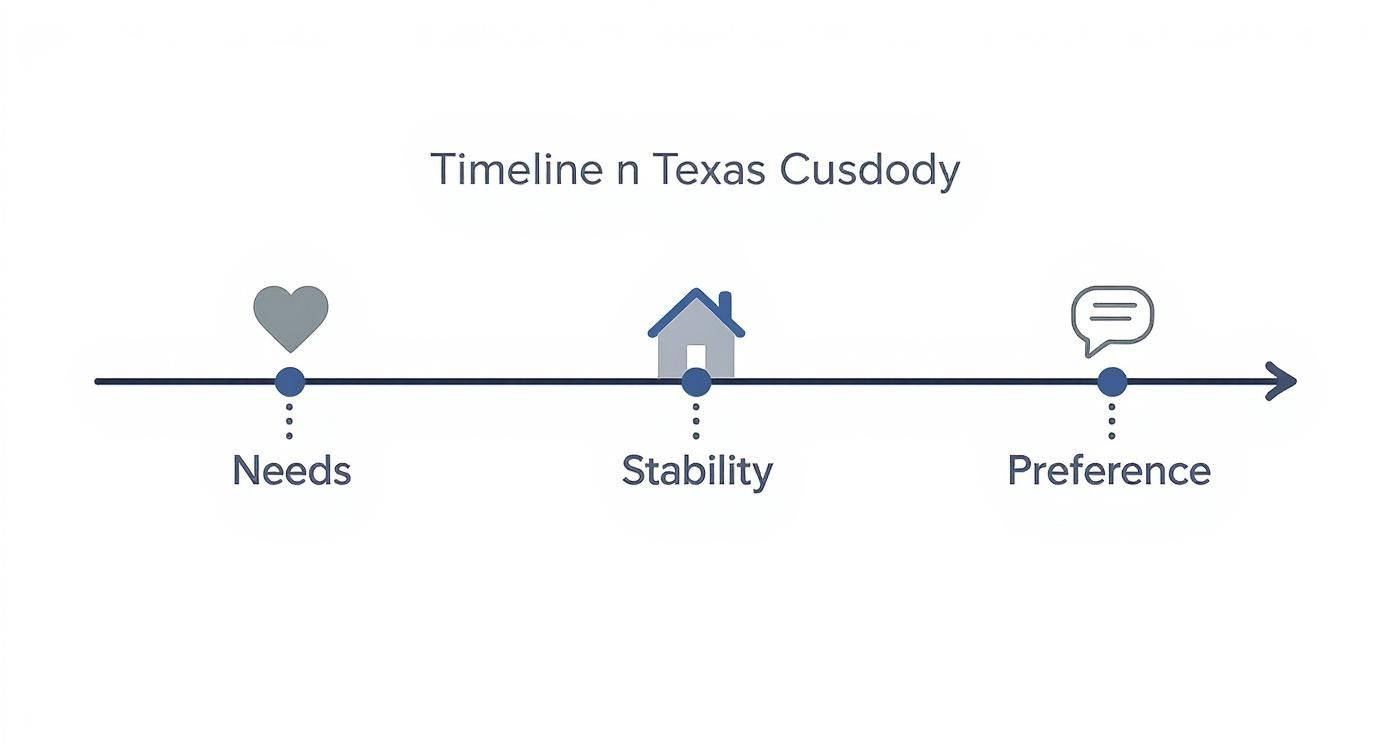
As you can see, everything circles back to the child's needs, the stability of their home life, and—especially for older children—their own preferences.
Getting a handle on the nuts and bolts of the SPO is a game-changer. You can get a much deeper dive by reading our guide on what a Standard Possession Order is and how it works. This knowledge will empower you to either make the standard schedule work for your family or argue effectively for a custom plan that better fits your child's life.
Moving Beyond the Standard Possession Order
While the SPO is the default, Texas law actually encourages parents to work together and create their own possession schedule. If you and your co-parent can reach an agreement, you have the flexibility to design a plan from the ground up that accounts for your child’s school and extracurricular activities, your specific work schedules, and your family's unique rhythm.
The best parenting plan is often one that parents create together, as it reflects a deep understanding of their child's life. A judge will almost always approve a schedule that both parents agree is in their child's best interest.
Increasingly, we see families looking for schedules that offer a more even split of time. These 50/50 possession schedules are gaining traction because they allow both parents to be deeply involved in the day-to-day routines—not just the "fun" weekend activities.
Some common 50/50 arrangements include:
- Week-On/Week-Off: Each parent has the child for a full seven days at a time. This provides long, stable periods with each parent but also means longer stretches of time apart.
- 2-2-5-5 Schedule: Parent A has Monday and Tuesday, Parent B gets Wednesday and Thursday, and then you alternate the three-day weekend (Friday-Sunday). This model ensures that no parent goes more than a few days without seeing their child.
Is a 50/50 Schedule Right for Your Family?
It is important to know that a true 50/50 split of physical time is not the automatic standard in Texas, even though it is becoming more common when parents agree on it. The reality is that courts need to see that it is workable and truly in the child's best interest.
Things like the distance between the parents' homes, the child’s age, and the need to maintain stability at school can make a strict 50/50 split seem impractical to a judge. What works for a toddler who is not in school yet might be chaotic for a teenager with a packed schedule. In the end, the goal is always to create a predictable and supportive routine that allows your child to thrive and maintain a strong, healthy relationship with both parents.
Handling Complex Issues in Custody Cases
Life rarely sticks to a script, and even the most well-thought-out custody plan can be turned upside down by unexpected events. A dream job offer in another state, a military deployment, or the difficult reality of family violence can quickly complicate a co-parenting arrangement. Knowing how Texas law handles these high-stakes situations is vital for protecting both your child's well-being and your rights as a parent.
At The Law Office of Bryan Fagan, PLLC, we have seen firsthand how emotionally draining and legally tangled these issues can become. We are here to offer the steady, experienced hand you need to navigate the path forward.

Geographic Restrictions and Relocation
Most custody orders in Texas are not just about time; they are also about place. They almost always include a geographic restriction, which is a legal boundary defining where the primary parent can live with the child. Usually, this is limited to the current county and those directly bordering it.
The purpose of this restriction is to keep the child close enough for the other parent to easily maintain a strong, consistent relationship. But what if a life-changing opportunity—a new job, a new marriage, or the need for family support—requires the primary parent to move outside that boundary?
To make the move legally, the parent must get one of two things: the other parent's written permission or a judge's approval through a formal modification lawsuit. The burden of proof falls entirely on the parent who wants to relocate. They have to show the court that:
- A material and substantial change in circumstances has occurred since the last order was signed.
- Lifting the restriction and allowing the move is truly in the child's best interest.
A judge will carefully balance the potential benefits of the move for the child against the very real harm of disrupting the relationship with the parent staying behind.
Special Rules for Military Families
Military service introduces its own set of unique challenges into a joint custody state of texas case. The realities of deployments, frequent relocations, and unpredictable schedules demand specific legal safeguards for both service members and their children.
The Texas Family Code directly addresses these situations. For instance, if a parent's military duties temporarily prevent them from seeing their child during their scheduled time, they can designate someone else—like a grandparent or their new spouse—to step in and exercise that possession time for them.
Most importantly, under Texas Family Code § 153.706, a court is forbidden from using a parent's past or future deployment as the only reason to change a custody order. This provision protects military members from being punished for serving our country.
Federal laws, like the Servicemembers Civil Relief Act (SCRA), also provide crucial protections, such as the ability to pause court proceedings if military duties make it impossible for a parent to appear in court.
When Family Violence Is a Factor
Texas law starts with a strong presumption that naming both parents as joint managing conservators is what’s best for a child. But this is a presumption, not an unbreakable rule. A history of family violence can completely shatter it.
If a judge finds credible evidence that one parent has a history or pattern of family violence or child abuse, the law prohibits them from appointing the parents jointly. In these situations, the child's safety becomes the court’s absolute top priority. The judge will almost certainly name the non-abusive parent as the sole managing conservator.
Recent legislation has further fortified these protections. A new law requires that protective orders be consolidated into any ongoing divorce or custody cases, which helps streamline the legal process for keeping families safe. This ensures that all issues of violence are handled together in one comprehensive case. You can learn more about how these 2025 Texas law changes impact custody cases on melonelawpc.com.
If you need help navigating divorce, custody, or estate planning in Texas, contact The Law Office of Bryan Fagan today for a free consultation.
Your Path Forward with Texas Joint Custody
Getting a handle on Texas family law is the first, most important step you can take toward building a stable, positive future for you and your children. By now, you should have a much clearer picture of what a joint custody order in Texas actually looks like in practice.
You’ve learned the legal terminology, like Joint Managing Conservatorship, and you understand the single most important rule that guides every decision: the "best interest of the child." You also have a better sense of how a possession schedule—the calendar that dictates parenting time—is put together. This knowledge is your starting point, giving you the power to make smart decisions and advocate for what your family truly needs.
Taking the Next Step with Confidence
While the legal road can feel winding and complicated, you do not have to walk it alone. Every family's story is unique, and a guide like this can only cover the basics. You probably have specific questions that relate directly to your situation, and you might be feeling ready to finally get a custody order in place or modify an old one.
That’s where we come in. Our team at The Law Office of Bryan Fagan, PLLC, is here to offer the personalized guidance and dedicated support you deserve. We firmly believe that every parent should have access to clear, compassionate legal advice to protect their child’s future and their own peace of mind.
Your family’s well-being is our top priority. We are committed to helping you build a legal strategy that reflects your goals and fiercely protects your child's best interests, every single step of the way.
We hope you use the understanding you have gained from this guide as a springboard for action. Taking control of your situation starts with a simple conversation.
If you need help navigating divorce, custody, or estate planning in Texas, contact The Law Office of Bryan Fagan today for a free consultation.
Common Questions Parents Ask About Joint Custody in Texas
Even after getting the basics down, you probably have a few practical questions about how joint custody really works day-to-day. The legal system can feel like a maze, but getting clear answers to common questions can make a world of difference. Here are practical, step-by-step explanations for some of the questions we hear most often.
If We Have Joint Custody, Does Anyone Pay Child Support?
Yes, absolutely. This is one of the biggest misconceptions about joint custody in Texas. A Joint Managing Conservatorship order almost never means that child support goes away. In nearly every case, the court will order one parent to pay child support to the other.
Here’s a step-by-step of why:
- Conservatorship vs. Support: The court views possession schedules and child support as two separate issues.
- Primary Parent: The parent designated as the "primary" conservator (the one who establishes the child's residence) is typically the one who receives support.
- Income-Based Calculation: Support is calculated using the Texas Family Code's guidelines, which are primarily based on the paying parent's income and the number of children. Even in a 50/50 possession schedule, the parent with the higher income will likely be ordered to pay support to ensure the child’s standard of living is consistent in both homes.
Can My Child Choose Which Parent to Live With?
While a child's wishes are important, they are not the deciding factor.
Here is the process under the Texas Family Code:
- Age Requirement: A child who is 12 years of age or older can speak privately with the judge about their preference. This is a right outlined in Texas Family Code § 153.009.
- The Judge Listens: The judge will interview the child in their chambers to understand their wishes and the reasons behind them.
- Best Interest Standard: The child’s preference is just one of many "Holley Factors" the judge must consider. The final decision must be based on the child’s overall best interest, taking into account their maturity level, stability, and parental fitness. The judge, not the child, makes the final ruling.
What’s the First Step to Get a Custody Order?
To establish a legally binding custody arrangement, you must initiate a formal court case. A verbal agreement is not enforceable.
Here is the practical guidance:
- For Unmarried Parents: You must file a Suit Affecting the Parent-Child Relationship (SAPCR). This is the legal petition that asks a judge to issue formal orders for conservatorship (custody), possession (visitation), and child support.
- For Married Parents: If you are divorcing, the custody issues are addressed within your Original Petition for Divorce.
- Why it Matters: Filing the petition officially starts the legal process. Without a formal court order, you have no legal recourse if the other parent violates your informal agreement. A court order provides stability, predictability, and legal enforceability.
Can We Change Our Custody Order if Something Changes?
Yes, custody orders can be changed, but it requires a formal legal process.
Here is the step-by-step guidance for modification:
- File a Petition to Modify: You must go back to court and file a petition asking to change the existing order.
- Prove a "Material and Substantial Change": You must demonstrate to the judge that a significant change in the circumstances of the child or one of the parents has occurred since the last order was signed. Examples include a parent's relocation, a major change in work schedule, or the changing needs of a growing child.
- Show It's in the Child's Best Interest: You must also prove that the change you are requesting is in your child's best interest. The court's primary focus remains on the child's well-being.
If you need help navigating divorce, custody, or estate planning in Texas, contact The Law Office of Bryan Fagan, PLLC today for a free consultation.