 Skip to content
Divorce can be one of life’s most difficult transitions—but understanding your rights under Texas law can make it less overwhelming. The prospect of dividing years of shared life and assets is daunting, and it's completely natural to be worried about what your financial future will look like. In Texas, the law is built on the idea of community property, which means most of what you and your spouse earned or bought during the marriage belongs to both of you. But it's not always a simple 50/50 split. The law calls for a "just and right" division, and many different factors can tilt the scales.
How Property Division Works in a Texas Divorce
Understanding how property division works in a Texas divorce is the first step toward clearing the fog and regaining control. The process can feel like a tidal wave, especially when you're already dealing with the emotional weight of a separation. Knowing your rights and the legal principles involved provides a solid foundation as you begin to make critical decisions for your future.
Divorce is a reality for many Texas families. In a single recent year, Texas saw around 111,202 divorces. This statistic tells you two things: first, the courts have extensive experience in untangling marital estates of all kinds. Second, it highlights just how important it is to have clear, fair rules to guide everyone through this process. You can explore these numbers and their implications for Texas families on versustexas.com's state divorce statistics page.
Key Principles to Understand
The journey begins by taking inventory of your marital estate and sorting everything into the correct legal categories. Here are the core concepts that will shape your property settlement:
- Community Property: This is the default classification for nearly everything acquired by you or your spouse from your wedding day until the day you finalize your divorce. This includes income, the home you bought together, vehicles, and the retirement funds you built up over the years.
- Separate Property: This category includes assets that belong solely to one spouse. It covers anything you owned before the marriage, as well as any gifts or inheritances you received during the marriage that were specifically given to you alone.
- The "Just and Right" Standard: This is where a judge’s discretion becomes critical. Instead of a rigid 50/50 rule, Texas courts aim for fairness based on the specific circumstances of your case. They will consider factors like fault in the breakup, differences in earning power, and the needs of your children when deciding what "just and right" means for your family.
This guide is designed to walk you through each step, from distinguishing between community and separate property to navigating complex assets like a family business or real estate. For instance, the marital home is often the largest asset and a major point of contention. To better understand your options, we encourage you to read our guide on handling real estate in a Texas divorce. Our goal is to provide the straightforward, practical guidance you need to move forward with confidence.
Defining Community and Separate Property
If there is one concept you must grasp in a Texas divorce, it’s the distinction between community and separate property. The entire property division process is built on this foundation.
Think of your marriage as a partnership. Every asset the partnership acquires during its operation—from paychecks to the family home purchased with those earnings—is considered community property. Conversely, anything you owned before the partnership began is your separate property. The same applies to any gift or inheritance you personally received during the marriage.
The Community Property Presumption
Here in Texas, the law starts with a powerful default setting known as the "community property presumption." The Texas Family Code states that any property you and your spouse possess when you file for divorce is presumed to belong to the community estate.
What does this mean for you? It means the burden isn't on your spouse to prove an asset is shared—it's on you to prove it's yours alone. The legal standard for this is high. You must provide "clear and convincing evidence," a much tougher standard than the typical "preponderance of the evidence." If you cannot meet this standard, the court will treat the asset as community property and divide it accordingly.
This flowchart provides a helpful visual overview of how courts make these crucial decisions.
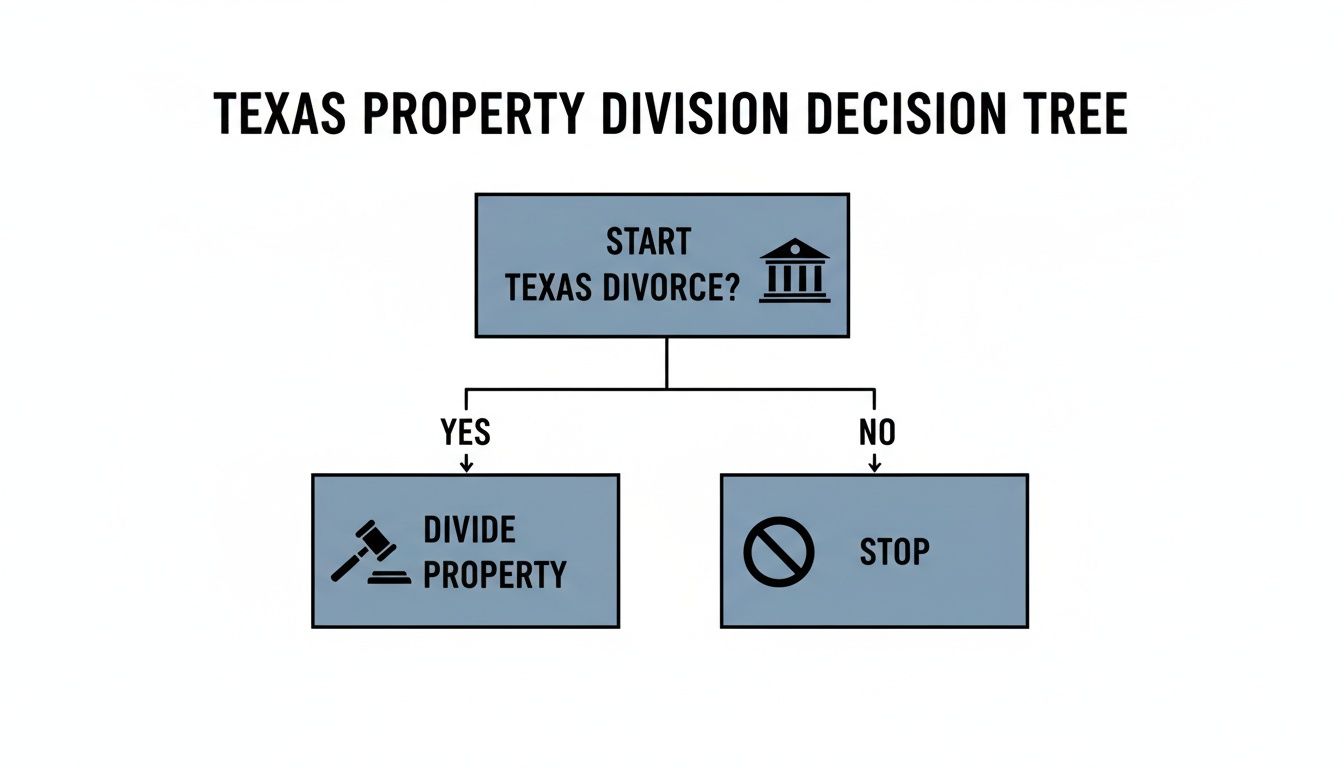
As you can see, classifying assets is the very first step. Getting this right is critical to protecting your financial future.
Practical Examples of Property Classification
Legal definitions are one thing, but let's see how this plays out in real-world scenarios we frequently encounter with our clients:
- Scenario 1: The Pre-Marriage Car. You bought a pickup truck and paid it off five years before getting married. That truck is your separate property. Even if your spouse drove it daily, its origin as a pre-marital asset keeps it in your column.
- Scenario 2: The Work Bonus. Two years into the marriage, you receive a large performance bonus from your job. Even though the check is in your name, the money was earned during the marriage. This makes it community property and subject to division.
- Scenario 3: The Inheritance. Your grandmother passes away and leaves you her house in her will. Because it was an inheritance specifically for you, the house is your separate property. However, be cautious. If you sell that house and deposit the proceeds into a joint checking account where they mix with marital funds, you risk "commingling" the funds. Once commingled, it can become nearly impossible to untangle, and you may lose its separate character.
Key Takeaway: Timing is crucial. The central question is always: Was the asset acquired before the marriage or during it? This is the starting point for determining where it belongs.
To help clarify, here's a table outlining some common examples.
Community Property vs Separate Property Examples
| Asset Type | Generally Classified as Community Property If… | Generally Classified as Separate Property If… |
|---|---|---|
| Marital Home | Purchased during the marriage using income earned by either spouse. | Purchased by one spouse before the marriage, or purchased during the marriage with documented separate funds. |
| Retirement Accounts | The portion of the account that grew from contributions and earnings during the marriage. | The balance of the account that existed on the date of marriage, plus any subsequent growth on that specific portion. |
| Vehicles | Purchased and paid for with funds earned during the marriage. | Purchased and fully paid for before the marriage, or received as a personal gift or inheritance. |
| Bank Accounts | A joint account, or an individual account funded with paychecks or other income earned during the marriage. | An account that existed before the marriage and had no community funds deposited into it, or an account holding only inherited funds. |
| Inheritance/Gifts | (Rarely community) Perhaps if the gift or inheritance was explicitly given to both spouses together. | Received by one spouse individually as a gift or through a will or trust. |
This table provides a general guide, but remember, every situation is unique and can have its own complexities.
Tracing and Reimbursement Claims
Proving an asset is separate property isn't as simple as just saying so. It often requires a detailed financial investigation called tracing. This involves gathering historical documents to create a clear paper trail that follows an asset from its separate origin to the present day.
For example, if you used $50,000 from an inheritance (your separate property) as a down payment on the marital home (a community asset), you would need bank statements and closing documents to trace those exact funds.
This brings up another key concept: reimbursement. When funds from one estate (your separate property) are used to benefit another (the community estate), you may have a right to be paid back. Learning more about how a Texas separate property reimbursement claim works can show you how these complex situations are handled. Successfully navigating these claims requires meticulous financial analysis and a strong legal strategy to ensure your contributions are recognized and accounted for.
What Does a "Just and Right" Division Really Mean?
One of the biggest myths we often clarify for our clients is the idea that Texas "community property" law means everything is automatically split 50/50. While it's a logical assumption, it's not how it works in a Texas courtroom. The law, specifically the Texas Family Code § 7.001, instructs judges to divide the marital estate in a manner that is "just and right."
That simple phrase changes everything. It grants the court a significant amount of discretion, meaning the final division could be far from an even 50/50 split.
Understanding this "just and right" principle is absolutely critical. It transforms property division from a simple math problem into a nuanced evaluation of your marriage's entire history. The court isn't just looking at a spreadsheet; it's considering the human factors that led to the divorce and the practical realities each of you will face moving forward.
This is precisely where having skilled legal representation becomes invaluable. An experienced family law attorney knows how to gather the right evidence and present it as a compelling narrative that shows the court what a truly fair and equitable division looks like in your specific situation.
So, What Factors Does a Judge Look At?
When a judge determines what is "just and right," they don't simply pick a number. They weigh a collection of factors, many of which stem from a landmark Texas case and are often called the Murff factors. While not a rigid checklist, these are some of the most powerful considerations that consistently arise:
- Disparity in Earning Capacity: The court closely examines each spouse's ability to support themselves after the divorce. If one person has a much lower earning potential—perhaps they paused their career to raise children—the court might award them a larger share of the estate to help ensure their financial stability.
- Fault in the Breakup of the Marriage: Texas is not a pure "no-fault" state. If one spouse’s behavior, such as adultery, cruelty, or abandonment, is the reason the marriage is ending, the judge can award the other spouse a disproportionate share of the assets.
- Health of the Spouses: The physical and mental health of each person is relevant. If one spouse has a chronic illness that will result in significant, ongoing medical expenses, the court can allocate more assets to them to help cover those future costs.
- Benefits the Innocent Spouse Would Have Received: The court may also consider the future benefits a spouse lost because the marriage ended, particularly if the other spouse was at fault for the divorce.
A Critical Point to Remember: A "just and right" division is not about punishing someone. It is about achieving a fair and equitable outcome based on the unique circumstances of your marriage and what each person will need to move forward.
How Bad Behavior Can Lead to an Unequal Split
Financial misconduct can significantly tip the scales. For example, if one spouse wasted community funds on a gambling addiction, an affair, or a series of reckless investments without the other's consent, this is known as "dissipation" or "waste" of community assets.
When this occurs, the court can "reconstitute" the estate, essentially pretending the wasted money is still there. The judge can then award the innocent spouse a larger percentage of the remaining assets to compensate for what was lost. It is the court’s way of ensuring one person’s poor decisions do not unfairly harm the other.
While Texas is a community property state, the "just and right" standard gives judges incredible flexibility. We see it all the time. Appellate courts regularly uphold unequal splits when the evidence supports them. In some cases, courts have affirmed divisions where one spouse receives 70% of the community estate due to factors like proven misconduct and fraud. As you can see in this analysis of a recent Texas property division case, a judge's power under this standard can lead to results that are far from 50/50. This is precisely why building a clear, evidence-based case is so important.
Handling Complex Assets and Financial Claims
Marriage and finances are rarely simple, and untangling them during a divorce can feel overwhelming. While the basic principles of community and separate property provide a starting point, real life is often more complicated. You may have retirement accounts, family businesses, and bank accounts that don't fit neatly into a single category.
This is where the detailed work begins, and understanding how Texas law handles these complex situations is essential to protecting your financial future. Getting this right requires patience, thorough documentation, and a solid strategic plan from the outset. Issues like commingled funds or accurately valuing a business can dramatically change what a "just and right" division looks like in the end.

Commingling and Reimbursement Claims
One of the most common challenges we see is commingling. This is a legal term for what happens when separate property gets mixed with community property, blurring the lines until it is difficult to distinguish between the two.
For instance, let’s say you inherited $50,000 (your separate property) and deposited it into a joint savings account where you and your spouse also deposit your paychecks. As you pay bills and add more money over the years, that initial $50,000 becomes difficult to identify. If you cannot "trace" it back with clear and convincing evidence, a court is likely to classify the entire account as community property.
This leads to another key concept: reimbursement claims. A claim for reimbursement arises when money from one marital estate (like your separate property) is used to benefit another estate (like the community).
- A classic example: You use that same $50,000 inheritance to pay for a major kitchen remodel on the home you and your spouse own together (a community asset). While the house is community property, your separate estate may have a right to be "reimbursed" for the $50,000 it contributed.
To succeed with a reimbursement claim, you need a rock-solid paper trail. This includes bank statements, canceled checks, receipts—any documentation that proves where the money came from and exactly where it went.
Valuing Difficult Assets Like Businesses and Retirement Accounts
Some assets don't have a simple price tag. When dealing with a family-owned business or a 401(k), you need specialized expertise to determine a fair valuation.
Business Valuation
If you or your spouse owns a business, determining its value is a critical step. It’s not as simple as checking the company's bank account. A proper valuation considers everything—assets, debts, goodwill, and its future earning potential. We almost always engage a neutral, third-party expert, such as a forensic accountant, to conduct a thorough analysis and provide a professional valuation. This process can be intricate, and you can learn more by reading our guide to the valuation of a company for divorce.
Retirement Accounts (401(k)s, Pensions)
With retirement accounts, only the portion earned during the marriage is considered community property. For example, if you had $100,000 in your 401(k) on your wedding day and it's worth $400,000 when you file for divorce, that initial $100,000 (plus any growth on that portion) is your separate property. The remainder is community property that must be divided. Splitting these accounts requires a special court order called a Qualified Domestic Relations Order (QDRO), which directs the plan administrator on how to distribute the funds without triggering significant tax penalties.
A Word of Caution on Hiding Assets: In the emotional turmoil of a divorce, some individuals may be tempted to hide assets or misrepresent their income. This is a serious mistake. If discovered—and it usually is—a judge can impose severe penalties. They might award your spouse a much larger portion of the estate and even order you to pay their attorney's fees. Full and honest financial disclosure is not optional; it is required by law.
When one person wants to keep the marital home, navigating options like a loan assumption during divorce can be a crucial part of the settlement. It is just one more example of the complex financial maneuvers that must be handled with care to protect everyone's credit and financial health.
Your Step-by-Step Guide to the Division Process
Going through a divorce is stressful enough without feeling lost in a legal maze. Fortunately, the process of dividing property in Texas follows a structured path with clear, predictable stages. Understanding this roadmap can empower you to feel in control rather than simply reacting to events as they unfold.
The system is designed to ensure both you and your spouse have a complete and accurate financial picture before any final decisions are made. It is a methodical approach aimed at achieving a "just and right" division based on facts and transparency, not guesswork.

Step 1: Financial Discovery
First, we enter a phase called discovery. This is the formal, court-supervised process where you and your spouse exchange all relevant financial information through your attorneys. Think of it as putting all your financial cards on the table. After all, you cannot divide what you don't know exists.
During discovery, we will request and provide documents that create a complete financial picture of your marriage. This is where we lay the groundwork for identifying every piece of community and separate property.
Commonly exchanged documents include:
- Bank and investment account statements
- Credit card statements and loan documents
- Tax returns from the last several years
- Recent pay stubs and other proof of income
- Deeds to real estate and titles for vehicles
- Retirement and pension plan statements
Being organized and thorough at this stage is absolutely critical. The information we gather becomes the foundation for everything that follows.
Step 2: Inventory and Appraisement
Once all the documents are exchanged, the next step is to create a Sworn Inventory and Appraisement. This sounds complex, but it is essentially a detailed spreadsheet that lists every single asset and debt you and your spouse own.
On this document, you will list each item, assign it a value, and state whether you believe it is community property or your separate property. Your spouse will do the same. This master list becomes the starting point for all negotiations, clearly identifying areas of agreement and disagreement.
This isn't just a casual to-do list; it's a sworn legal document. You sign it under penalty of perjury, confirming that it is a complete and honest representation of your finances. Honesty is non-negotiable.
Step 3: Mediation
With the financials fully disclosed and inventoried, the vast majority of Texas divorces proceed to mediation. In fact, most judges in Texas require a good-faith attempt at mediation before they will set a case for trial.
Mediation is a formal negotiation session guided by a neutral third-party mediator. The goal is simple: to help you and your spouse find common ground and reach a settlement you can both accept, without a judge making the decisions for you. It is a confidential process that keeps you in control. A successful mediation ends with a Mediated Settlement Agreement (MSA), a legally binding contract that is submitted to the court to finalize your divorce.
Step 4: Trial
If negotiations and mediation cannot resolve every issue, the final step is a trial. This is where you hand control over to a judge. Your attorney will present evidence and testimony, your spouse’s attorney will do the same, and the judge will make the final, binding decisions on how to divide your property.
Going to trial is almost always the most expensive, time-consuming, and emotionally draining part of a divorce. It removes your control over the outcome and places it entirely in the court's hands. While sometimes unavoidable, it is truly a last resort. This is why the earlier steps of discovery and mediation are so crucial—they offer the best opportunity to resolve your case on your own terms.
To help you keep track of these steps, here’s a quick overview of the timeline and what to focus on at each stage.
Property Division Timeline and Key Actions
| Stage | Key Objective | Actionable Steps for You |
|---|---|---|
| Discovery | Gather and exchange complete financial information. | Start gathering all financial documents. Be responsive and honest with your attorney. |
| Inventory & Appraisement | Create a comprehensive list of all assets and debts. | Review the inventory carefully. Provide accurate values and claims for separate property. |
| Negotiation/Settlement | Attempt to reach an agreement outside of court. | Keep an open mind. Prioritize your goals and be willing to compromise on less critical items. |
| Mediation | Reach a formal, binding agreement with a mediator's help. | Prepare with your attorney beforehand. Participate actively and in good faith. |
| Trial (If Necessary) | Have a judge make the final decisions. | Work closely with your attorney to prepare evidence and testimony. Be prepared for a lengthy process. |
This table serves as a basic roadmap. Your attorney will guide you through the specifics of each phase, ensuring you’re prepared for what lies ahead.
When Things Get Complicated: High-Asset and Military Divorces
While the same fundamental Texas property division rules apply to every divorce, some cases are inherently more complex. The standard rules are the basic toolkit, but for certain situations, you need specialized instruments. High-net-worth and military divorces are two such situations, each with its own unique challenges and legal frameworks.
Approaching these cases with a generic strategy is a recipe for costly, long-term financial damage. These cases are not just about splitting a larger estate; they involve complex valuation issues and the interplay between state and federal laws. A meticulous, custom-tailored strategy is non-negotiable from day one.
When a substantial marital estate is involved, the process of property division in a Texas divorce becomes far more intensive. The challenge extends beyond simply listing assets; it involves accurately determining the true value of assets that don't have a simple price tag.
In high-asset divorces, you are often dealing with items that require a specialist's expertise to value correctly, such as:
- Professional Practices: A medical office, law firm, or dental practice is worth more than its physical assets. We must calculate its "goodwill"—the intangible value tied to its reputation and client base.
- Family Businesses and Partnerships: Valuing a closely-held family business is not straightforward. It requires a deep forensic analysis of financial records, market position, and operations.
- Trusts and Complex Investments: Untangling a web of trusts, stock options, and other sophisticated investment vehicles is a job for a financial expert.
- Luxury Real Estate and Collections: Appraising a vacation home, a classic car collection, or a portfolio of fine art requires certified appraisers who specialize in those specific markets.
This is where a forensic accountant becomes one of the most valuable members of your legal team. These financial detectives are experts at tracing money, uncovering hidden assets, and providing solid, court-admissible valuations for complex business interests. Their work is essential to ensure every dollar is accounted for before negotiations begin.
Understanding Military Divorce and Retired Pay
Military divorces are governed by a unique blend of rules where federal law and Texas community property law intersect. The most significant financial asset in these cases is often the service member's military retired pay.
The division of military retirement is controlled by a federal law called the Uniformed Services Former Spouses’ Protection Act (USFSPA). This act does not automatically grant an ex-spouse a share of retirement pay. Instead, it authorizes Texas courts to treat disposable retired pay earned during the marriage as community property and divide it accordingly.
A common point of confusion is the "10/10 Rule." Many people mistakenly believe a couple must be married for at least 10 years, overlapping with 10 years of military service, for the former spouse to receive any retirement pay. This is false. The 10/10 Rule is purely administrative; it only determines whether the Defense Finance and Accounting Service (DFAS) can pay the former spouse directly from the retirement check.
Even if the marriage lasted less than 10 years, a Texas judge can still award a portion of the military retirement to the non-military spouse. The only difference is the payment method. Instead of DFAS sending a check, the service member would be responsible for making those payments directly. Getting these details right is crucial for both service members and their spouses to protect their rights and achieve a fair outcome.
Your Top Questions About Texas Property Division, Answered
When you're facing a divorce, questions about who gets what can feel overwhelming. This is completely normal. We hear these same concerns from our clients every day, so let’s walk through some of the most common ones to provide you with a clearer picture.
How Is Debt Handled in a Texas Divorce?
This is a critical question. Just like your assets, any debts incurred during the marriage are also subject to division. This includes the mortgage, car loans, and credit card balances—they are all generally considered community debt.
This means both of you are typically responsible for these liabilities, and they will be part of the "just and right" division. It usually doesn't matter whose name is on the account; if the debt was acquired while you were married, it is typically community debt.
What Happens if My Spouse Wasted Our Money?
It's a painful scenario we see all too often: one spouse intentionally spends community funds on an affair, a gambling habit, or other reckless purchases without the other's knowledge. In Texas law, this is known as "dissipation" or "fraud on the community."
The good news is that a judge can hold your spouse accountable. If you can prove that this happened, the court may award you a larger share of the remaining community property to compensate for what was unfairly lost.
Is a 50/50 Split Guaranteed in Texas?
Absolutely not. This is one of the biggest misconceptions about Texas divorce law. While a 50/50 division is a common starting point, the Texas Family Code mandates a "just and right" division, which does not always mean equal.
While many divorces, especially amicable ones, end with a division close to 50/50, it is far from guaranteed in a contested case. Appellate courts have upheld divisions of 70/30 or even more when factors like fault in the breakup, fraud, or significant differences in earning potential are proven. You can find real-world examples of these unequal property divisions in Texas on mcclure-lawgroup.com.
Key Insight: A Texas court's primary goal is fairness, not perfect mathematical equality. The unique facts and circumstances of your case are what truly matter.
These answers provide a solid starting point, but remember, no two divorces are the same. Your specific situation requires a personalized strategy to ensure your financial future is protected.
If you need help navigating divorce, custody, or estate planning in Texas, contact The Law Office of Bryan Fagan, PLLC today for a free consultation. Our experienced attorneys are here to provide the clear, compassionate, and authoritative guidance you deserve.


