 Skip to content
Navigating a divorce or separation can be one of life’s most difficult transitions, especially when children are involved. Your primary goal is ensuring their well-being and stability, and a well-structured parenting plan is the foundation for that future. Many Texas parents find that an equal possession schedule, often called a 50/50 custody schedule, provides the consistency and frequent contact children need to thrive post-separation.
However, the concept of '50/50' is not a one-size-fits-all solution. Under the Texas Family Code, all custody decisions are guided by the "best interest of the child" standard. This means the ideal schedule must align with your family's unique circumstances, from your children's ages and school activities to parental work schedules and the distance between homes. This guide is designed to educate you and help you feel supported by breaking down several practical examples of 50 50 custody schedules, complete with their strategic advantages and potential drawbacks. We will explore how different arrangements work in the real world to help you identify a structure that fosters stability for your children.
Understanding these options is the first step toward creating a possession order that works for everyone. This article will provide the detailed insights you need to confidently move forward and build a co-parenting future that supports your child's happiness and well-being.
1. Week-On/Week-Off Schedule
The Week-On/Week-Off schedule is one of the most straightforward and popular examples of 50 50 custody schedules. In this model, each parent has possession of the child for seven consecutive days. Exchanges typically happen at a consistent time and place, often on a Friday or Sunday evening to prepare for the school week ahead. This structure provides long, uninterrupted periods for both parent and child, fostering stability and reducing the number of exchanges.
This schedule is particularly effective for school-aged children who can adapt to a consistent weekly routine. It minimizes disruptions during the school week and allows each parent to be fully involved in daily activities like homework, extracurriculars, and bedtime routines for an entire week at a time. The simplicity of this arrangement can significantly lower conflict between co-parents who live in the same school district and have predictable work schedules.
Strategic Breakdown and Implementation
- Pros: This schedule is easy to manage and remember. It provides children with a sense of stability by giving them a full week in one home, reducing the back-and-forth that can be stressful.
- Cons: A full week away from one parent can be difficult for very young children or those with separation anxiety. It requires parents to live relatively close to one another to manage school and activity logistics.
- Best For: Families with school-aged children, parents with stable Monday-to-Friday work schedules, and co-parents who communicate effectively about school and health matters.
Practical Guidance for Success
To make this schedule work, especially when incorporating variations for summer and holidays, precision is key.
Key Tactic: Your parenting plan should explicitly define the "school year" schedule versus the "summer" schedule, including exact start and end dates based on the school district's calendar. For example, specify that the summer schedule begins the day after school is released for summer break and ends the Sunday before school resumes.
Additionally, plan for holidays well in advance. Instead of a simple 50/50 split, assign specific holidays to each parent in alternating years (e.g., Parent A has Thanksgiving in even years, Parent B in odd years). This prevents last-minute conflicts. Using a shared digital calendar app can be invaluable for tracking these arrangements. To understand more about the legal framework for these arrangements in Texas, you can find valuable information on getting 50/50 time with your children.
2. 2-2-3 Schedule (Two Days/Two Days/Three Days)
The 2-2-3 schedule is another one of the most common examples of 50 50 custody schedules, prized for its ability to prevent long gaps between a child and either parent. In this model, the child spends two days with Parent A, then two days with Parent B, followed by a three-day weekend with Parent A. The following week, the pattern flips, giving Parent B the three-day weekend. This two-week rotation ensures frequent contact and guarantees each parent has weekend time every other week.
This schedule is highly effective for younger children, particularly toddlers and preschoolers, who may struggle with the long separations inherent in a week-on/week-off plan. The constant contact helps maintain strong bonds with both parents. It can also work well for co-parents with flexible or non-traditional work shifts, as the frequent exchanges can be planned around their schedules.
Strategic Breakdown and Implementation
- Pros: This schedule ensures a child never goes more than a few days without seeing each parent, which is beneficial for very young children. It also splits weekend time equally over a two-week period.
- Cons: The number of exchanges is high, which can be disruptive and stressful for children and parents alike. This model requires a high degree of organization and amicable communication between co-parents.
- Best For: Families with toddlers or preschool-aged children, parents who live very close to one another, and co-parents with a low-conflict relationship who can manage frequent handoffs.
Practical Guidance for Success
To prevent chaos with the 2-2-3 schedule, proactive planning and clear communication are non-negotiable.
Key Tactic: Create a shared visual calendar specifically for the child. Use color-coding for each parent’s days so the child can easily see where they will be sleeping each night. This provides predictability and reduces anxiety associated with the frequent transitions.
To minimize the logistical burden, maintain duplicate sets of essential items like clothes, toothbrushes, and medications at both homes. This reduces the amount of packing required for each exchange. Establishing a consistent, neutral location for handoffs, like school or daycare, can also reduce tension. Managing this complex arrangement requires excellent co-parenting skills, and you can learn more about how to co-parent effectively even with a difficult ex.
3. 3-4-4-3 Schedule
The 3-4-4-3 schedule is a balanced and consistent option among examples of 50 50 custody schedules. It operates on a two-week rotating cycle: in week one, a child spends three days with Parent A and four days with Parent B. In week two, the schedule flips, and the child spends four days with Parent A and three days with Parent B. This arrangement ensures that neither parent goes longer than four days without seeing the child, which can be beneficial for younger children.
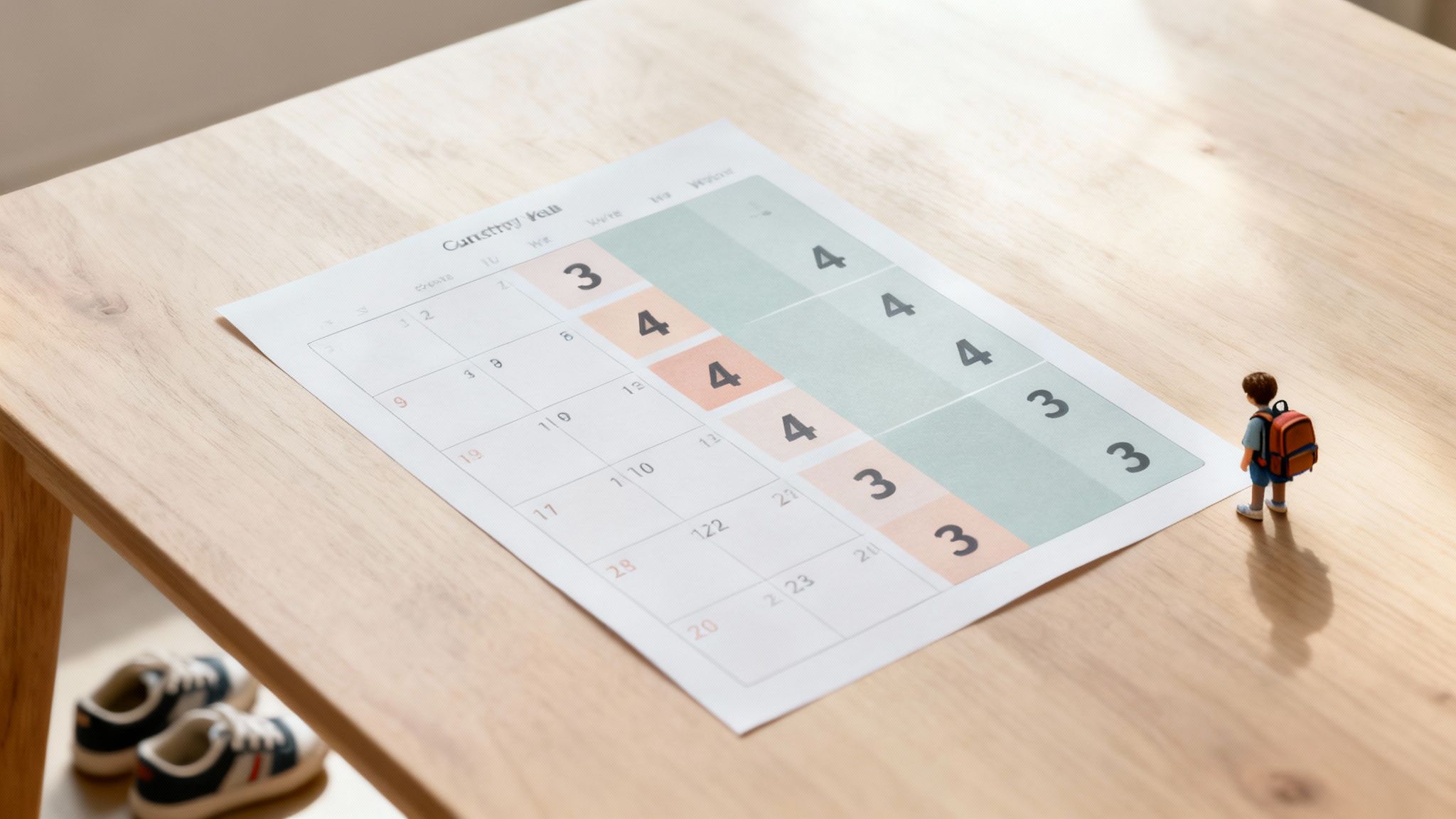
This schedule provides a middle ground between the frequent exchanges of a 2-2-3 schedule and the longer periods of a week-on/week-off plan. For professional parents in Houston with standard Monday-to-Friday work schedules, this can be ideal. It allows for one parent to consistently have a long weekend with the child every other week, which is great for planning short trips or special activities.
Strategic Breakdown and Implementation
- Pros: This schedule is highly predictable and provides children with frequent contact with both parents. The rotation ensures each parent gets an equal number of weekends over time.
- Cons: The schedule involves mid-week exchanges, which can be disruptive to school routines if not managed carefully. It requires more coordination than a simple week-on/week-off plan.
- Best For: Families with school-aged children, parents who work traditional schedules, and co-parents who desire more frequent contact with their children than a weekly exchange allows.
Practical Guidance for Success
To successfully implement a 3-4-4-3 schedule, clarity and organization are paramount. Your custody order should be precise to prevent confusion.
Key Tactic: Define the exchange days and times clearly. For example, your order can state that the three-day block always begins on Monday morning (e.g., at school drop-off) and ends on Wednesday evening, with the four-day block covering the rest of the week and weekend. This creates a predictable pattern.
Using shared digital calendars with automated reminders is essential to keep track of the rotating schedule. For the child's benefit, post a laminated, color-coded calendar in their room showing the full month's schedule. This visual aid helps them feel secure by knowing where they will be on any given day. If life circumstances change and this schedule no longer serves your child's best interests, it may be necessary to pursue a change. You can learn more about how to navigate modifying a child custody order in Texas to better understand the legal process.
4. Alternating Weekends with Mid-Week Overnight
This schedule is a variation designed to give one parent primary physical custody during the school week while ensuring the other parent maintains frequent, meaningful contact. In this setup, one parent has the child from Monday after school until Friday morning. The other parent has the child every other weekend, from Friday evening to Sunday evening, plus one overnight visit during the middle of the week, typically on a Wednesday. This model is another effective example of how examples of 50 50 custody schedules can be adapted to prioritize school stability.

This schedule works well for families where one parent's work schedule makes a true 50/50 split difficult. It provides the child with a consistent home base for school nights, which can simplify homework and morning routines. The mid-week overnight prevents a long gap between visits with the other parent, helping the child stay connected. For Texas families, this structure can be a practical modification to the Standard Possession Order, balancing routine with frequent contact.
Strategic Breakdown and Implementation
- Pros: This schedule offers excellent stability for school routines. The mid-week overnight breaks up the time a child is away from the non-primary parent, reducing potential anxiety. It is highly predictable and easy for children to follow.
- Cons: One parent carries the primary responsibility for school-related activities and homework, which can create an imbalance. The mid-week exchange can be disruptive if not handled smoothly.
- Best For: Families where one parent has a non-traditional work schedule (e.g., works weekends), school-aged children who thrive on a consistent weekday routine, or parents who live close enough to make the mid-week exchange logistically simple.
Practical Guidance for Success
Success with this schedule hinges on clear communication and shared responsibility for school matters, even if one parent handles the day-to-day logistics.
Key Tactic: Your parenting plan must ensure both parents have equal access to school information. Per the Texas Family Code, both parents have the right to be listed as contacts on all school forms and have access to online portals for grades and announcements. This prevents the weekday parent from becoming an unintentional gatekeeper of information.
To balance involvement, create a shared digital calendar to track school events, parent-teacher conferences, and extracurriculars. Agree in advance to alternate attendance at these events or attend them together. This ensures both parents remain active participants in the child’s academic life, reinforcing the co-parenting dynamic.
5. 5-2-5-2 Schedule (Five Days/Two Days Repeating)
The 5-2-5-2 schedule offers a unique approach among examples of 50 50 custody schedules by assigning consistent weekdays to one parent and consistent weekends to the other. In this model, Parent A has the children for five consecutive days (e.g., Monday morning through Friday afternoon), and Parent B has the children for two days (e.g., Friday afternoon through Sunday evening). The pattern then flips the following week, so Parent B has the weekdays and Parent A has the weekend.
This arrangement is highly beneficial for families prioritizing educational stability and a predictable school-week rhythm, while ensuring each parent gets weekend time. It allows the weekday parent to manage the daily logistics of school, homework, and weekday extracurriculars without interruption. Meanwhile, the weekend parent can focus on quality time, recreation, and family activities. This schedule works well for co-parents who want to minimize exchanges during the busy school week.
Strategic Breakdown and Implementation
- Pros: This schedule provides exceptional stability for children during the school week, mirroring a more traditional household routine. It simplifies logistics for the weekday parent and reduces daily handoffs, which can lower conflict.
- Cons: Over a two-week cycle, the schedule is balanced, but the parent with only weekend time in a given week may feel disconnected from the children's daily school life and weekday activities. It requires excellent communication to stay in sync.
- Best For: Families with school-aged children where parents want to alternate full responsibility for school weeks and weekends. It's also effective for co-parents who agree on prioritizing a stable school-week environment above all else.
Practical Guidance for Success
To ensure both parents remain fully engaged and the schedule feels balanced, clear communication and proactive planning are essential.
Key Tactic: The parenting plan should grant both parents full access to school portals, teacher communications, and attendance rights at school events. This ensures they stay informed and involved, even if they aren't managing daily homework. Schedule a weekly "handoff call" or use a shared messaging app on Friday to discuss the past week's school progress and upcoming events.
To make this schedule successful, establish a consistent exchange time, such as Friday after school, to create a clear transition into the weekend. Both parents should keep a basic set of essentials (clothing, toiletries, favorite toys) at their homes to minimize the need to pack a large bag for every exchange. Using a shared digital calendar can help both parents track school projects, appointments, and weekend plans effectively.
6. Every-Other-Weekend with Flexible Weekday Arrangements
The Every-Other-Weekend with Flexible Weekday Arrangements schedule is a hybrid model that provides a fixed weekend rotation combined with adaptable weekday possession. This is one of the more customizable examples of 50 50 custody schedules, where each parent has the child on alternating full weekends (e.g., Friday after school to Sunday evening), while weekday overnights and visits are tailored to accommodate dynamic work lives, like those of first responders or self-employed professionals. The core of this schedule is its blend of predictability and adaptability.
This structure is ideal for co-parents who have non-traditional or unpredictable work schedules but can communicate effectively to manage the fluid weekday component. For example, a parent with shift work might have two overnights one week and one the next, balancing the time to achieve a near-equal split over a month or quarter. It allows parents to maintain strong weekend bonds while ensuring weekday involvement in school and activities isn't sacrificed due to demanding careers. This model requires a high degree of cooperation and trust to succeed.
Strategic Breakdown and Implementation
- Pros: Offers maximum flexibility to accommodate irregular work schedules (e.g., on-call doctors, military personnel, freelance workers). It ensures each parent gets consistent weekend time.
- Cons: The lack of a fixed weekday schedule can lead to confusion or conflict if communication breaks down. It may be too unstable for children who thrive on a rigid routine.
- Best For: Parents with variable or non-traditional work hours, co-parents who communicate exceptionally well, and families where proximity allows for easy weekday transitions.
Practical Guidance for Success
To prevent this flexible schedule from becoming a source of contention, it is crucial to establish clear ground rules and document everything.
Key Tactic: Your parenting plan should define the fixed weekend exchange times precisely and establish a "default" weekday schedule. Also, include a clause specifying a minimum number of guaranteed weekday overnights per month for each parent to ensure the 50/50 division is maintained.
Use a shared digital calendar to propose and confirm weekday possession changes in real-time. It is also wise to document the actual possession schedule each month to verify that the time is truly being split equally. If you need help drafting a Texas possession order that balances structure with necessary flexibility, our attorneys can help you create a plan that works for your unique situation.
7. Split Week Schedule (Alternating Tuesday–Thursday and Friday–Monday Blocks)
The Split Week Schedule is another highly structured approach within the various examples of 50 50 custody schedules, designed to give each parent both weekday and weekend time in a recurring two-week cycle. In a common version of this plan, one parent has the children from Tuesday morning until Friday morning, and the other parent has them from Friday morning until Tuesday morning. This rotation ensures neither parent goes more than a few days without seeing the children and equitably divides coveted weekend time over the month.

This schedule is often favored by co-parents who prioritize frequent contact and want a mathematically precise 50/50 split of overnights. It can be particularly effective for professionals with flexible work arrangements or for any co-parents with excellent communication skills who live close to one another. The frequent exchanges, however, demand a high level of organization and cooperation to avoid logistical friction and ensure stability for the children.
Strategic Breakdown and Implementation
- Pros: This schedule provides children with frequent contact with both parents, reducing the long absences found in week-on/week-off plans. It also guarantees that both parents share weekday responsibilities and weekend fun equally over time.
- Cons: The frequent transitions (twice a week) can be disruptive for some children and place a heavy organizational burden on parents. It requires parents to live in close proximity and communicate almost daily about schoolwork, supplies, and logistics.
- Best For: Younger children who benefit from seeing each parent every few days, co-parents with low conflict and superior communication skills, and families where parents live very near each other.
Practical Guidance for Success
To prevent this schedule from feeling chaotic, meticulous planning and clear protocols are essential. Establishing consistency is the key to making the frequent exchanges manageable.
Key Tactic: Designate specific, non-negotiable exchange times and locations. For example, exchanges always occur at school pickup; on Tuesdays, Parent A picks up, and on Fridays, Parent B picks up. This eliminates ambiguity and reduces potential conflict points.
Furthermore, minimize the items that travel between homes. Keep duplicate sets of essential supplies like toiletries, pajamas, and basic clothing at each residence. The child's school backpack can serve as the primary vessel for transferring homework and important notices, reducing the risk of forgotten items. Using a shared digital calendar to track the schedule and log expenses is nearly essential for this arrangement to succeed long-term.
8. Customized Hybrid Schedule with Scheduled Flexibility
The Customized Hybrid Schedule is one of the more advanced examples of 50 50 custody schedules, designed for co-parents who can cooperate effectively. It starts with a foundational schedule, such as the 2-2-3 or week-on/week-off, but builds in specific provisions that allow for agreed-upon adjustments. This model acknowledges that life is unpredictable and provides a structured way to handle changes for work travel, a child's extracurricular activities, or special family events without constant conflict.
This approach is highly effective for parents with demanding but flexible careers, or for military families who need to adapt to deployment schedules. It balances the child's need for a predictable routine with the parents' need for adaptability. The key is that the flexibility itself is scheduled and governed by clear rules, preventing one parent from feeling that the other is making constant, last-minute demands.
Strategic Breakdown and Implementation
- Pros: Offers the ultimate flexibility to adapt to changing needs while maintaining a 50/50 possession baseline. It promotes communication and cooperation between co-parents.
- Cons: This schedule is not suitable for high-conflict relationships. It can become unbalanced if one parent consistently requests more changes than the other.
- Best For: Amicable co-parents, families with older children involved in multiple activities, and parents with irregular or demanding work schedules who are committed to equitable co-parenting.
Practical Guidance for Success
To prevent disputes, the rules for flexibility must be meticulously detailed in your parenting plan.
Key Tactic: Your possession order should define the process for requesting a schedule change. Specify the required notice period (e.g., 72 hours for a non-emergency), the method of communication (e.g., via a co-parenting app), and a time frame for the other parent to respond.
Establish clear boundaries to maintain fairness. For instance, you could agree that no more than four days can be "swapped" per quarter to ensure the schedule doesn't deviate too far from the 50/50 baseline. Using a shared digital calendar to propose, accept, and track these swaps creates a transparent record. To ensure your customized plan is legally sound and enforceable under the Texas Family Code, it is wise to have it reviewed by a family law attorney.
8 50/50 Custody Schedule Comparison
| Schedule | Implementation complexity 🔄 | Resource / coordination ⚡ | Expected outcomes 📊 | Ideal use cases 💡 | Key advantages ⭐ |
|---|---|---|---|---|---|
| Week-On/Week-Off (with Extended Summer/Holiday Provisions) | Low — simple weekly swap; moderate for holidays | Low ongoing; moderate planning for summer/holidays | Stable routine; deep parent–child bonding | Same-district parents; traditional Mon–Fri workweeks; older children | Predictable; fewer transitions; extended quality time |
| 2-2-3 (Two/Two/Three) | High — frequent mid-week exchanges | High — needs apps, duplicate supplies, close proximity | Frequent contact; reduces separation anxiety for young kids | Younger children (2–7); flexible schedules; amicable co-parents | Keeps both parents regularly involved; balances weekends |
| 3-4-4-3 | Moderate — two-week rotation, clearer than 2-2-3 | Moderate — calendar use and coordination | Balanced contact vs. stability; quality weekend time | School-age children (8–14); standard work schedules | Fewer transitions than 2-2-3; more regular contact than weekly |
| Alternating Weekends with Mid-Week Overnight | Low — straightforward weekend focus + one overnight | Low–Moderate — ensure school communication for both parents | Strong school stability; weekend-focused quality time | One primary weekday caregiver; weekend workers; military | Minimizes school disruption; simple handoffs |
| 5-2-5-2 (Five/Two repeating) | Low — weekly pattern, predictable handoff | Low–Moderate — weekly coordination; backpack at both homes | Approximately 50/50; minimal weekly transition | School-age kids; parents with traditional workweeks | Simple; predictable weekly rhythm; consistent weekends |
| Every-Other-Weekend with Flexible Weekday Arrangements | Variable — baseline simple, weekdays can be complex | High — ongoing negotiation; tech/tools required | High customization; risk of weekday uncertainty | Self-employed, shift workers, military needing flexibility | Highly adaptable; predictable weekends with customizable weekdays |
| Split Week (Tue–Thu / Fri–Mon) | High — multiple transitions per week | High — close proximity and excellent communication needed | True 50/50 overnights; equal weekend involvement | Co-parents with strong communication; older children; nearby homes | Equal parenting time; both parents share school responsibilities |
| Customized Hybrid with Scheduled Flexibility | Moderate–High — baseline + formal flexibility rules | High — tracking swaps, notice periods, periodic reviews | Structure plus adaptability; avoids frequent litigation if managed | Professionals with variable demands; activity-heavy families | Balances stability and flexibility; encourages cooperation |
From Examples to Your Reality: Crafting a Legally Sound Parenting Plan
Navigating the transition to a co-parenting dynamic is a significant emotional and logistical undertaking. We have explored a variety of examples of 50 50 custody schedules, from the straightforward week-on/week-off rotation to more complex hybrids like the 3-4-4-3 or 2-2-3 systems. Each option presents unique benefits and challenges, highlighting that there is no single "perfect" schedule; there is only the schedule that is best for your unique family.
The core takeaway is that these templates are building blocks, not final blueprints. The most successful co-parenting arrangements are those that are customized to fit your children’s ages, temperaments, school schedules, and your ability as parents to communicate and coordinate effectively. A schedule that works wonderfully for a teenager might be too disruptive for a toddler who needs more frequent contact with both parents.
Key Insights for Your Next Steps
As you move forward, remember these critical points:
- Customization is Key: The best schedule is one that prioritizes your child's stability and well-being. Feel empowered to adapt these examples, combining elements to create a hybrid plan that genuinely serves your family’s needs.
- Communication is Non-Negotiable: Regardless of the schedule you choose, consistent, respectful, and business-like communication is the foundation of successful co-parenting. To further simplify coordination and reduce potential conflicts, consider exploring options for choosing the best co-parenting schedule app to support your agreed-upon arrangements.
- Put It in Writing: An informal agreement is not enough. Under the Texas Family Code, a detailed, court-approved Possession Order is essential. This legal document turns your agreement into an enforceable plan, protecting both parents and providing the predictability your children need.
From a List to a Lasting Plan
Ultimately, mastering these concepts is about more than just dividing time; it is about building a stable and secure future for your children in a new family structure. A well-crafted parenting plan minimizes future conflict, reduces stress, and allows your children to thrive by knowing what to expect. It provides a clear road map for handling holidays, vacations, and daily logistics, preventing small misunderstandings from escalating into major legal disputes.
Transforming these examples into a legally binding and practical reality requires careful thought and legal expertise. An experienced family law attorney can help you anticipate potential pitfalls, draft clear and unambiguous language, and ensure your final order complies with Texas law, truly reflecting your child's best interests. This proactive step is an investment in your family’s long-term peace and stability.
If you need help navigating divorce, custody, or estate planning in Texas, contact The Law Office of Bryan Fagan today for a free consultation. We can guide you in selecting and customizing from the many examples of 50 50 custody schedules to create a plan that works for you and is designed to protect your child. For a compassionate and knowledgeable assessment of your situation, contact the Law Office of Bryan Fagan, PLLC today for a free consultation.


