
It often starts in an ordinary moment. The house is quieter than it used to be. One parent is packing boxes, the other is staring at a kitchen table covered in bank statements, and the children are off in another room sensing that something big is changing—even if no one has said it out loud yet. Divorce rarely feels dramatic in real life. It feels uncertain, emotional, and deeply personal. A Texas Divorce Property Settlement may sound like a technical legal step, but for families living through this transition, it is one of the most important tools for restoring stability, predictability, and peace of mind.
At The Law Office of Bryan Fagan, PLLC, we understand that property division is never just about “who gets what.” As a Houston-based family law firm led by Bryan Joseph Fagan, a South Texas College of Law graduate and widely recognized authority on Texas divorce and custody law, we’ve seen how unresolved financial stress can ripple through a family long after the divorce papers are signed. Texas law, including Texas Family Code §7.001, requires property to be divided in a manner that is “just and right,” but what feels just and right to a family often goes far beyond numbers. It includes the ability to maintain routines, reduce conflict between parents, and give children a sense that life is still anchored, even when everything feels different.
This article is here to help you make sense of that bigger picture. You’ll learn how a Texas Divorce Property Settlement fits into the broader goals of custody, parenting, and long-term family stability—and how thoughtful legal planning can ease emotional strain for everyone involved. Our mission is to empower families with clarity and confidence, using compassionate counsel and practical education to simplify complex legal issues. As you continue reading, you’ll see how the right legal guidance can help your family move forward with less fear, less conflict, and a stronger foundation for the future.
Key Takeaways
- A Texas divorce property settlement is a legally binding agreement that divides community property, confirms separate property, allocates debts, and resolves financial matters—but it must be incorporated into your Final Decree of Divorce to be enforceable.
- Texas is a community property state, meaning all property acquired during the marriage belongs equally to both spouses and is subject to division, while separate property (owned before marriage or received by gift or inheritance) remains with its original owner if properly documented.
- Most Texas divorces settle through negotiation, mediation, or collaborative processes because settlements offer control, speed, and significantly lower costs compared to litigation.
- Common mistakes—including incomplete financial disclosure, vague asset descriptions, ignoring tax consequences, and mishandling retirement accounts—can render settlements unenforceable or create costly post-divorce disputes.
- A qualified Texas divorce attorney protects your interests by properly classifying property, valuing complex assets, drafting bulletproof settlement language, and ensuring compliance with the Texas Family Code.

Your Family’s Future Starts Here
Don’t navigate your legal journey alone. Schedule a consultation now and get the clarity and support you deserve.
What Is a Texas Divorce Property Settlement?
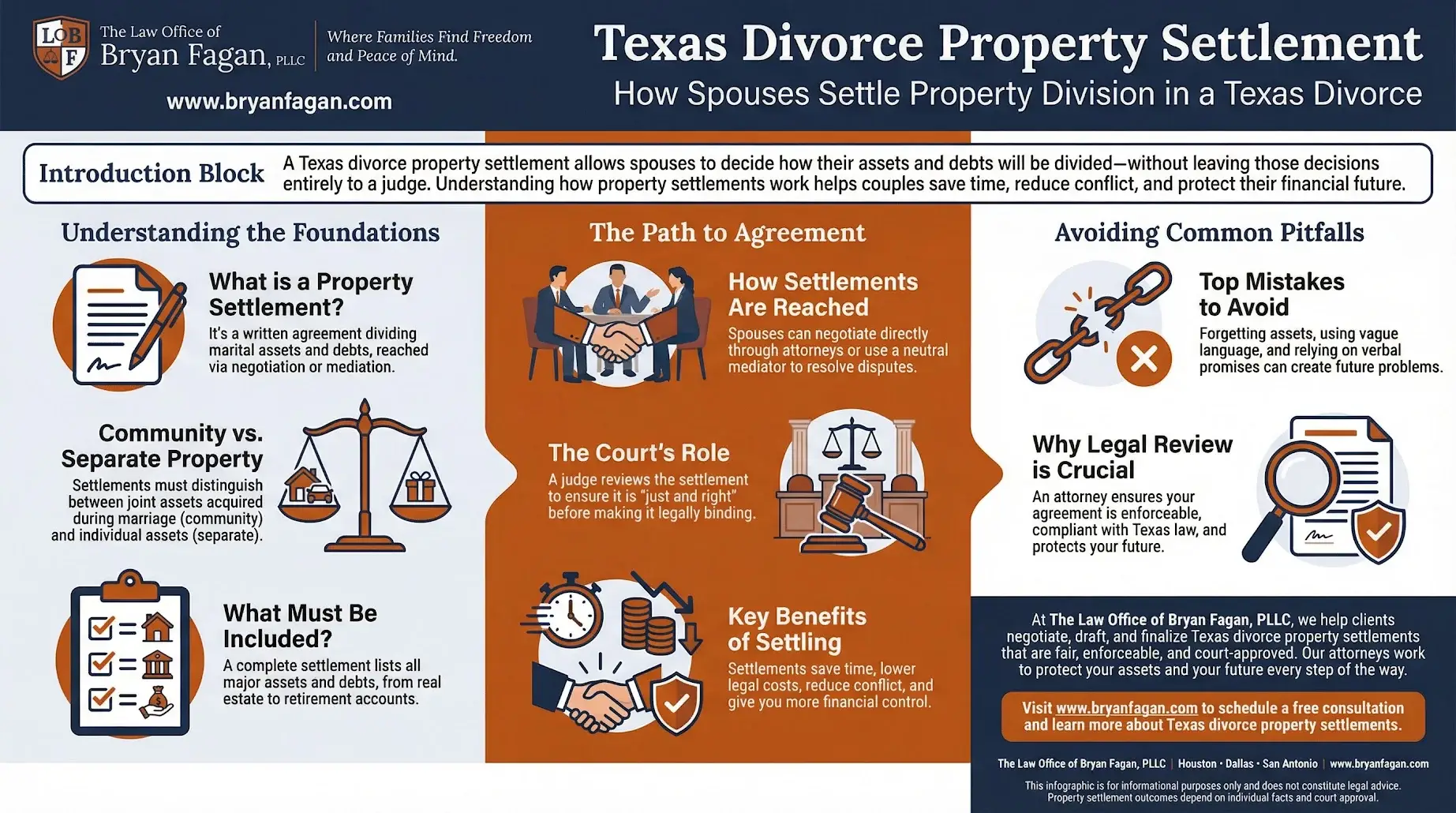
A Texas Divorce Property Settlement is a written, legally binding agreement that allows spouses to resolve all financial issues arising from their divorce in a clear and enforceable way. This includes the division of community property and debt, confirmation of separate property, allocation of retirement accounts, and, in some cases, agreements related to spousal maintenance. Under Texas Family Code §7.001, courts are required to divide the marital estate in a manner that is “just and right,” but Texas law strongly favors settlements reached by agreement. When spouses resolve these issues voluntarily, judges typically approve the agreement and incorporate it into the Final Decree of Divorce, giving the settlement the full force of a court order.
From the perspective of experienced Texas family law attorneys, a property settlement functions as a practical roadmap for untangling a shared financial life. It addresses major assets such as the marital home, bank and investment accounts, vehicles, retirement benefits governed by ERISA and Texas law, business or professional interests, and outstanding liabilities like credit cards, loans, and mortgages. Once the court signs off on the decree, enforcement provisions under Texas Family Code §9.001 apply, meaning the agreement is no longer a private promise between spouses but an order that can be enforced by Texas district courts if one party fails to comply.
To put this into real-world terms, a settlement might award one spouse the marital residence while offsetting that award by granting the other spouse a larger share of retirement assets or other property. Provided the agreement is clearly drafted and complies with Texas law, those terms are binding. If a spouse refuses to transfer property, refinance debt, or carry out required actions, the other party has the right to seek enforcement through the court system. The legal team at Bryan Fagan’s firm often emphasizes that clarity at the settlement stage prevents conflict later, which is why careful drafting and informed negotiation are so important.
Families considering settlement often benefit from understanding the process before negotiations begin. The firm regularly encourages clients to educate themselves using trusted resources, including its own guidance on resolving divorce cases outside of court. For a step-by-step breakdown of how negotiated resolutions work in Texas, readers may find the article Want to Settle Your Divorce? Follow These Steps especially helpful. Additional insights on property division and enforcement can also be found throughout the firm’s extensive Texas divorce resource library, such as the Texas Divorce Process Overview, which explains how settlements fit into the larger framework of Texas Family Code requirements.

How Property Settlements Are Reached in Texas Divorces
Texas law provides multiple pathways for spouses to negotiate a fair settlement, and most couples find resolution without ever stepping inside a courtroom for trial. Direct negotiation between spouses—sometimes with attorney guidance—remains the most straightforward approach. When communication is difficult, mediation offers a structured alternative where a neutral third party helps facilitate agreement.
Direct Negotiation works best when spouses agree on major issues and can communicate respectfully. Each party identifies what matters most to them, and negotiations proceed until both sides accept a balanced outcome.
Mediation involves working with a trained mediator who guides discussions without taking sides. Mediation often produces what’s called a Mediated Settlement Agreement (MSA), which carries special enforceability protections under Texas law.
Collaborative Divorce uses a team-based approach where both spouses, their attorneys, and sometimes financial professionals or counselors work together to resolve issues without litigation threats.
Pretrial Settlement Conferences occur when cases are already filed but spouses want one last opportunity to settle before trial.
Why do most Texas divorces settle? The answer is practical: litigation costs typically range from $15,000 to $30,000 or more per party, takes months or years to complete, and ultimately hands decision-making power to a judge. Settlements preserve control, reduce conflict, and allow customized solutions that courts might not order.
Legal Requirements for a Valid Texas Divorce Property Settlement
For a property settlement to be valid and enforceable under Texas law, it must meet several fundamental requirements. First, both spouses must enter the agreement voluntarily, without fraud, duress, or coercion. Second, each party must provide full financial disclosure of all assets and debts. Third, the agreement must contain clear, specific descriptions of every asset and debt being divided. Fourth, the settlement must comply with the Texas Family Code and be approved by the court.
Vague language destroys settlements. Describing a vehicle as “the car” instead of providing the year, make, model, and VIN creates enforcement nightmares. Similarly, real property requires legal descriptions found on deeds at county clerk offices. For retirement accounts, the settlement must specify whether a Qualified Domestic Relations Order (QDRO) is needed to divide 401(k)s or pensions without triggering tax penalties.
Perhaps most importantly, verbal agreements mean nothing in Texas divorce law. That promise your spouse made about paying off the credit card or letting you keep the furniture? Unless it’s written into your signed property settlement agreement and incorporated into the final decree, it’s unenforceable.
Mediated Settlement Agreements (MSAs) and Property Settlements
A Texas Divorce Property Settlement reached through mediation can take on added legal strength when it is formalized as a Mediated Settlement Agreement (MSA). Under Texas Family Code §6.602, an MSA carries enhanced enforceability that goes beyond an ordinary negotiated agreement. Once properly executed, Texas courts are required to approve the agreement and incorporate it into the Final Decree of Divorce unless there is clear evidence that a party lacked legal capacity or signed under duress. This statutory framework reflects Texas lawmakers’ intent to encourage resolution through mediation while giving families certainty and finality.
From a practical standpoint, MSAs must meet very specific requirements to receive this “super-enforceable” status. The agreement must contain bold, capitalized language stating that it is not subject to revocation and that it resolves all issues in the case, including property division. Both spouses must sign the document, and if either party is represented, their attorneys must sign as well. When these requirements are satisfied, the court’s discretion is extremely limited, even if the resulting property division is uneven. This makes MSAs especially useful in complex divorce cases involving businesses, retirement accounts, or creative financial trade-offs that might not fit neatly into a judge’s idea of a typical division.
As attorneys at Bryan Fagan’s firm often explain to clients, this enforceability can be a powerful tool when used thoughtfully. For example, spouses may agree in mediation that one party will assume responsibility for most or all marital debt in exchange for receiving a greater share of a closely held business or other high-value asset. Although a court might hesitate to impose such a result on its own, an MSA finalized under Texas Family Code §6.602 locks in those terms and prevents later second-guessing simply because the outcome appears unequal. This is why preparation before mediation matters so much, including having a clear understanding of goals and priorities going into settlement discussions.
Families considering mediation are encouraged to think carefully about what they want to achieve and how settlement fits into their broader financial and personal future. The legal team at The Law Office of Bryan Fagan, PLLC regularly points clients toward educational resources that help clarify this process, including guidance on defining settlement objectives found in the article What Do You Want to Get Out of Settlement Negotiations?. For additional context on how mediation and enforceable agreements fit into Texas divorce law, readers may also find value in reviewing the firm’s overview of the Texas Divorce Process, which explains how negotiated settlements align with current Texas Family Code requirements.

How Texas Courts Review Divorce Property Settlements
When a Texas Divorce Property Settlement is presented to the court, Texas district judges review the agreement through the lens of the “just and right” standard set out in Texas Family Code §7.001. While the court has a duty to ensure the division of the marital estate is legally sound, Texas law also reflects strong respect for agreements that spouses reach voluntarily. Judges understand that no court hearing—often limited in time and scope—can fully capture the nuances of a family’s finances, history, and priorities. As a result, negotiated settlements are generally given significant deference when they are properly drafted and entered into freely.
That said, courts do retain the authority to reject or require changes to a settlement in certain circumstances. Agreements may be scrutinized if they are unconscionably one-sided, such as leaving one spouse with virtually no property after a long marriage, or if there is evidence of fraud, including the concealment of assets or misleading financial disclosures. Settlements obtained through duress or coercion, where one party was pressured or threatened into signing, can also be set aside. Additionally, vague or poorly drafted agreements that make enforcement under Texas Family Code Chapter 9 impractical may be sent back for clarification or revision. These safeguards exist to protect families from unfair outcomes while still honoring the principle of voluntary resolution.
In real-world practice, however, Texas courts approve the overwhelming majority of negotiated property settlements. Freedom of contract remains a cornerstone of Texas family law, allowing spouses wide latitude to structure creative and individualized solutions that a judge might not impose on their own. This is especially true when settlements are reached through mediation and memorialized clearly, as discussed in the firm’s in-depth analysis of mediation enforceability found in Binding Beyond Ink: The Durability of Mediation Agreements in Texas. Attorneys at Bryan Fagan’s firm often emphasize that clarity, full disclosure, and thoughtful drafting are the best protections against judicial concerns.
Families who want to understand how courts balance fairness with deference to settlement agreements can also benefit from reviewing the firm’s broader educational resources, such as the Texas Divorce Process Overview, which explains how property division fits into the overall structure of a Texas divorce case. When a settlement is clear, complete, and grounded in current Texas Family Code requirements, courts are far more likely to approve it without hesitation—allowing families to move forward with confidence and finality.
Common Mistakes in Texas Divorce Property Settlements
Even well-intentioned spouses make errors that undermine their settlements, often leading to costly post-divorce litigation. Statistics suggest that 20-30% of Texas divorces involve post-judgment enforcement motions—many stemming from preventable drafting mistakes.
Failing to Disclose All Assets or Debts Hiding bank accounts, cryptocurrency holdings, or business interests constitutes fraud. Courts can void settlements and impose sanctions when hidden assets surface later.
Ignoring Tax Consequences Dividing a retirement account without a QDRO triggers immediate taxation and penalties. Similarly, unvested stock options and other deferred compensation carry tax implications that affect true asset values.
Improper Handling of Retirement Accounts Federal ERISA rules require specific procedures to divide 401(k)s, pensions, and similar retirement benefits. A settlement that simply says “wife gets half the 401(k)” without addressing QDRO requirements creates enforcement problems.
Vague Language in the Decree Phrases like “fair share” or “equitable portion” mean nothing without specific metrics. Every asset needs precise identification; every debt needs clear assignment with payment responsibility.
Relying on Verbal Agreements Side deals about furniture, college expenses, or future support that aren’t written into the decree are worthless. One appellate ruling specifically held that verbal promises regarding children’s college education were unenforceable because they weren’t part of the written agreement.
Failing to Address Unique Texas Assets Mineral rights, oil royalties, livestock, and ranch interests require specialized language and often professional valuation. Overlooking these assets—common in Texas divorces—leads to disputes.
Community vs. Separate Property in Settlements
Understanding property classification remains essential even when settling, because misclassifying assets can create legal problems or unfair outcomes. Under Texas community property laws, all property acquired during the marriage is presumed to be community property and is typically considered community property unless proven otherwise. Separate property includes assets owned before marriage, received by gift, or inherited—and remains the spouse’s separate property if properly traced.
The challenge arises when separate property money gets commingled with community funds. For example, if you deposited an inheritance into a joint savings account and then used that account for household expenses, tracing your separate property requires clear and convincing evidence—bank records, account statements, and sometimes forensic accounting.
Settlements can allocate property however spouses agree, even if that means confirming separate property to one spouse while dividing community property unevenly. However, mislabeling assets in the agreement (calling something separate when it’s actually community, or vice versa) can invite challenges. Work with a Texas divorce attorney to properly classify every asset before finalizing your settlement.
Enforcing a Texas Divorce Property Settlement
Once finalized and incorporated into the Final Decree of Divorce, a Texas Divorce Property Settlement is no longer just an agreement between spouses—it becomes a binding court order enforceable under Texas Family Code §9.001 and related enforcement provisions. This means that if one spouse fails to follow through on required actions, such as transferring property, refinancing debt, or making agreed-upon payments, the other spouse has clear legal remedies available through the Texas courts. The enforcement framework exists to provide certainty and accountability, helping families move forward without lingering financial disputes.
Under current Texas law, courts have broad authority to enforce property division orders. Remedies may include contempt proceedings for willful noncompliance, which can carry serious consequences, as well as writs of execution to seize property or funds owed under the decree. In appropriate cases, courts may authorize wage garnishment for ongoing financial obligations, impose liens against real property owned by the noncompliant spouse, or appoint a receiver to manage and transfer complex assets. These enforcement tools are designed to ensure that court-ordered settlements are respected and carried out, not ignored or delayed indefinitely.
From the perspective of attorneys at Bryan Fagan’s firm, the best enforcement strategy is prevention through careful drafting. Settlement terms should clearly identify each asset and debt, set firm deadlines for transfers or payments, and include indemnity and hold-harmless provisions to protect each spouse from liabilities assigned to the other. When agreements anticipate potential problems and address them directly, enforcement becomes far more straightforward if issues arise later. This is why understanding everything that goes into a family law settlement is so important before finalizing an agreement.
Families seeking clarity on the full scope of settlement terms often benefit from reviewing educational resources provided by the firm, including the detailed discussion found in What All Goes Into a Family Law Settlement?. For additional context on how Texas courts handle enforcement and post-divorce obligations, readers may also find value in the firm’s overview of Texas Divorce Decree Enforcement, which explains how these legal tools are applied in real-world cases.

How a Texas Divorce Attorney Helps Secure a Fair Property Settlement
Attempting to navigate a Texas Divorce Property Settlement without experienced legal guidance can expose families to unnecessary risk and long-term consequences. Texas divorce law is highly technical, and while it is possible to reach an agreement on your own, even small mistakes can lead to unfair outcomes or costly enforcement disputes later. Texas Family Code §7.001 requires courts to divide community property in a manner that is “just and right,” but knowing how that standard is applied in real cases—and how to protect yourself within it—often requires the insight of a seasoned Texas divorce attorney.
From the perspective of attorneys at Bryan Fagan’s firm, one of the most critical roles counsel plays is properly identifying and classifying property. Under Texas Family Code §§3.001 and 3.003, all property possessed during the marriage is presumed to be community property unless proven otherwise. Attorneys know how to trace separate property through bank records, deeds, and financial documentation, ensuring that assets owned before marriage or received by gift or inheritance are not mistakenly divided. This step alone can significantly affect the financial outcome of a divorce.
Legal guidance is also essential when valuing complex assets. Businesses, professional practices, mineral interests, retirement accounts, and deferred compensation often require expert analysis to determine their true value. Divorce attorneys regularly coordinate with CPAs, forensic accountants, and valuation professionals to ensure assets are accurately assessed and properly addressed in the settlement. Without this level of support, spouses risk agreeing to divisions that look fair on paper but fall short in reality.
Negotiation is another area where experienced representation makes a measurable difference. Attorneys who regularly handle Texas divorce cases understand how judges interpret “just and right” divisions and can advocate for settlements that are both fair and enforceable. Thoughtful negotiation helps balance financial security with practicality, reducing the likelihood of post-divorce conflict. For readers interested in understanding this process more deeply, the firm offers guidance in Negotiating a Divorce Case: A How-To Guide for Texans, which explains how preparation and strategy shape successful outcomes.
Equally important is the drafting of the Final Decree of Divorce. Every provision matters, especially when enforcement under Texas Family Code §9.001 is considered. Attorneys draft clear, precise language that anticipates future disputes, sets deadlines, and includes protections such as indemnity clauses. Finally, legal counsel looks beyond the immediate division of property to safeguard long-term financial stability, taking into account tax implications, retirement planning, insurance coverage, and future earning capacity. Additional insight into these considerations can be found in the firm’s Texas Divorce Process Overview, which places property settlements within the broader framework of Texas family law.
Together, these layers of guidance reflect the firm’s commitment to educating families and protecting futures, ensuring that each settlement supports not just the end of a marriage, but the beginning of a more secure next chapter.
Why Choose The Law Office of Bryan Fagan, PLLC
At The Law Office of Bryan Fagan, PLLC, we’ve guided countless Texas families through the property settlement process with compassion, clarity, and strategic precision. Our team brings deep knowledge of Texas Family Code property provisions combined with practical, real-world negotiation experience.
We understand that dividing property and debt involves more than spreadsheets—it affects your financial independence, your children’s stability, and your future security. That’s why we take time to understand your complete situation before recommending strategies.
Our attorneys handle complex valuations, draft enforceable settlements, and represent clients statewide in divorce proceedings. Whether your case involves significant assets, business interests, retirement accounts, or contested property classification, we have the experience to protect your interests.
We believe every family deserves clear communication and honest guidance during divorce negotiations. You won’t find pressure tactics or empty promises here—just straightforward legal guidance designed to help you achieve the fair settlement you deserve.
Checklist: Texas Divorce Property Settlement
- Identify all assets and debts comprehensively, including bank accounts, retirement accounts, real property, vehicles, and personal property
- Confirm community vs. separate property classification for each asset
- Fully disclose financial information to the other party (and require the same disclosure in return)
- Address tax implications and retirement account division requirements, including QDRO needs
- Have a Texas divorce attorney review the settlement before signing
- Ensure settlement language is clear, specific, and includes precise asset descriptions
- Verify the settlement complies with Texas Family Code requirements
- Confirm the settlement will be incorporated into the final divorce decree
Conclusion
Divorce can make life feel like it’s on pause, but the truth is, the decisions you make now are shaping what comes next—for you and for your family. A thoughtfully handled property settlement isn’t about winning or losing. It’s about creating a foundation that reduces conflict, restores a sense of control, and allows everyone involved to start moving forward again with a little more certainty and a lot less stress.
If there’s one thing to take away from this discussion, it’s that clarity matters. When finances are addressed carefully and expectations are clearly defined, families often find it easier to co-parent, communicate, and focus on healing instead of fighting. You don’t have to have every answer today, but having the right guidance can make the path ahead feel far less overwhelming.
At The Law Office of Bryan Fagan, PLLC, we believe families deserve honest information, compassionate support, and practical legal solutions—especially during moments that feel heavy or uncertain. Working with an experienced Texas family law attorney can help you avoid costly mistakes and make decisions that protect what matters most in the long run. If you’re considering your next steps or simply want to understand your options, reaching out for a conversation can be a powerful first move.
And if nothing else, remember this: change doesn’t have to mean chaos. With the right plan and the right support, it can be the beginning of something steadier, healthier, and more hopeful than you expected.
Frequently Asked Questions
In Texas, a wife is not automatically entitled to a fixed percentage of marital property. Texas follows community property law, which means most property and debt acquired during the marriage is presumed to belong to both spouses. The court divides that property in a manner that is considered “just and right,” not necessarily equal. Separate property—such as assets owned before marriage or received by gift or inheritance—generally remains with the original owner if it can be clearly proven and traced.
Moving out of the marital home can unintentionally weaken your position in a divorce, especially when children or valuable property are involved. It may affect day-to-day parenting routines, temporary custody arrangements, and negotiations over who keeps the home. It can also increase financial strain by creating two households. While leaving is sometimes necessary for safety or court-ordered reasons, it’s usually wise to talk with a Texas family law attorney before making that decision.
The 10-10-10 rule is a decision-making framework rather than a legal rule. It encourages you to consider how a decision will affect your life in 10 days, 10 months, and 10 years. During divorce, this perspective can help you avoid making choices driven purely by emotion and instead focus on long-term stability, especially when negotiating property division or parenting arrangements.
Assets considered separate property are generally not divided in a Texas divorce. These include property owned before marriage, gifts, inheritances, and certain personal injury recoveries. However, the key issue is proof. If separate property is mixed with community funds or cannot be clearly traced, it may lose its protected status. Documentation and proper classification are critical.
Rather than focusing on “winning,” a strong settlement request prioritizes security and clarity. This often includes a clear division of assets and debts, correct handling of retirement accounts, protection from future debt tied to a former spouse, and enforceable deadlines for transfers or payments. When children are involved, workable parenting arrangements and financial stability should also be central to settlement discussions.
Divorce usually impacts both spouses financially because one household becomes two. The spouse with lower income may experience a sharper lifestyle adjustment, while the higher earner may face ongoing financial obligations and reduced flexibility. In many cases, prolonged conflict and litigation cause the most financial damage. Well-planned settlements tend to preserve more resources for both parties.
Many people reference research on relationship conflict patterns known as the “Four Horsemen”: criticism, contempt, defensiveness, and stonewalling. These behaviors, when persistent, are strongly associated with relationship breakdown. While divorce is rarely caused by a single factor, recognizing these patterns can still be helpful—especially when learning how to communicate more effectively during settlement negotiations or co-parenting.
“Never” can be misleading. In some situations, leaving the home is necessary or unavoidable. However, moving out without a plan can affect leverage in property negotiations, access to personal belongings, and temporary parenting arrangements. Because the decision can have long-term legal and financial consequences, it’s best to get guidance from a Texas family law attorney before making that move.