
Have you ever found yourself lying awake at night, replaying a tense argument or worrying about how a single legal document could change your family’s sense of safety overnight? For many Texas families, that anxiety spikes when someone mentions court orders for protection—especially when the terminology itself feels confusing and overwhelming. One of the most common questions we hear in our Houston office is about the difference between a Texas protective order vs restraining order, and what each one actually means for your rights, your children, and your future.
At The Law Office of Bryan Fagan, PLLC, we understand that these questions rarely arise in calm moments. They often surface during divorce, custody disputes, or situations involving fear, conflict, or uncertainty. Texas law treats protective orders and restraining orders very differently, with each serving a distinct purpose under the Texas Family Code. Knowing which applies to your situation can bring immediate clarity—and, just as importantly, peace of mind. Drawing on decades of combined experience and the leadership of Bryan Joseph Fagan, a South Texas College of Law graduate and recognized authority in Texas divorce and custody law, our firm has guided thousands of families through these high-stakes decisions with compassion and precision.
This article is designed to educate and empower you, not intimidate you. We’ll break down how Texas courts use protective orders and restraining orders, when each applies, and how they can affect custody, possession, and your family’s day-to-day life. Our goal reflects our core mission: to help you reclaim stability and confidence during life’s hardest transitions through clear guidance, practical insight, and trusted legal advocacy. As you continue reading, you’ll gain the knowledge you need to make informed decisions—and the reassurance that you don’t have to navigate this alone.
Key Takeaways
- CPS opens investigations in Texas when reports meet specific legal definitions of child abuse or neglect under Texas Family Code Chapter 261
- Anyone can report suspected abuse or neglect to Texas CPS, but certain professionals—including teachers, doctors, and counselors—are legally required to report
- CPS must investigate qualifying reports regardless of the source, including anonymous reports
- Understanding why CPS gets involved helps families respond appropriately and protect their parental rights throughout the investigation process
- Most CPS investigations do not result in child removal—they focus on safety assessment and connecting families with support services

Your Family’s Future Starts Here
Don’t navigate your legal journey alone. Schedule a consultation now and get the clarity and support you deserve.
Why CPS Opens Investigations in Texas: The Legal Foundation
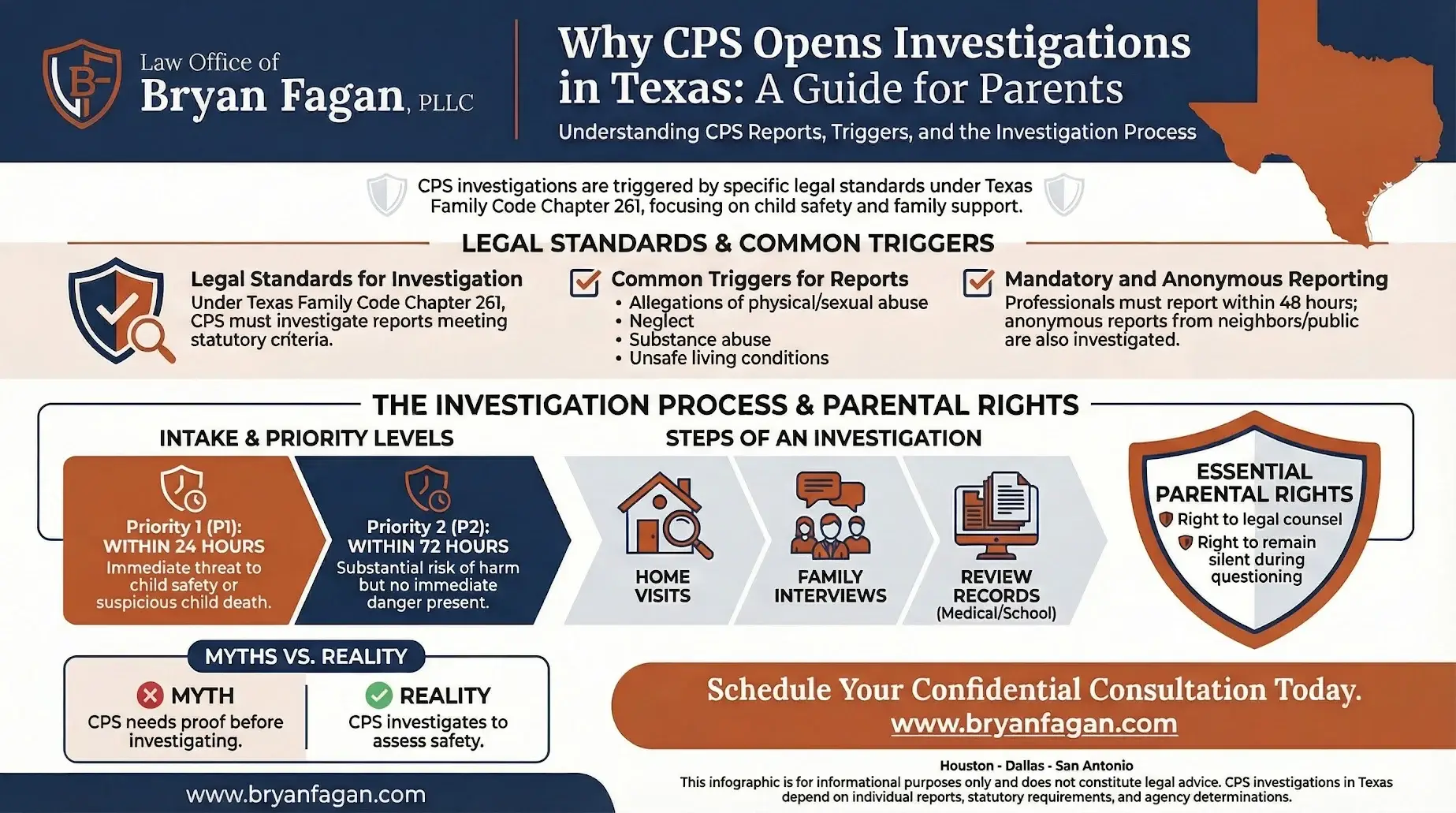
Why CPS Opens Investigations in Texas is based on a clear statutory mandate, not guesswork, personal judgment, or assumptions about a family’s intentions. Under Texas Family Code Chapter 261—most notably §§261.001, 261.101, and 261.301—the Texas Department of Family and Protective Services is legally required to investigate reports that allege child abuse, neglect, or exploitation as those terms are precisely defined by law. This framework establishes what constitutes reportable harm and outlines the procedures CPS must follow once a report provides reasonable cause to believe a child’s physical or mental health or welfare may be at risk. Recent updates to the Texas Family Code have reinforced reporting standards and investigative timelines, underscoring that CPS action is driven by legal obligation rather than discretionary choice.
Because of this structure, Texas Child Protective Services does not open cases arbitrarily or investigate families based on rumors, parenting style differences, or personal opinions. Every investigation begins because a report met the statutory threshold required by Chapter 261, triggering a mandatory response. CPS’s role is protective, not punitive, and its focus is on assessing child safety and potential risk rather than determining criminal guilt. Understanding this distinction often brings relief to parents who fear that an investigation automatically means wrongdoing has been established.
This legal distinction matters deeply for Texas families facing CPS involvement. CPS investigations are civil proceedings designed to evaluate allegations and immediate safety concerns, not to prove abuse or neglect beyond a reasonable doubt. CPS investigates reported concerns, not established facts, and a report that meets the statutory criteria must be investigated even if the allegations are later ruled out or determined to be unfounded. Texas law intentionally sets this lower threshold to allow early intervention when a child may be at risk, while still preserving parental rights throughout the process.
Understanding this legal foundation helps families recognize that CPS involvement does not equal guilt. It simply means someone made a report that satisfied the legal requirements for review under Texas law. Attorneys at the Law Office of Bryan Fagan, PLLC—often described by clients as trusted Texas family law advocates—regularly guide families through this process with clarity and compassion. Parents seeking a deeper understanding of how caseworkers evaluate allegations may find additional insight in the firm’s educational resource on what CPS looks for during an investigation, which reflects the firm’s ongoing commitment to educating families and protecting futures across Texas.

What Legally Triggers a CPS Investigation in Texas
Under Texas law, CPS opens investigations when reports allege specific types of harm or risk to children that meet statutory definitions. The Texas Family Code defines several categories of conduct that trigger mandatory investigation.
Physical abuse under Texas Family Code §261.001(1) involves physical injury intentionally, knowingly, or recklessly caused to a child by a parent, guardian, or caregiver. This excludes reasonable discipline but includes injuries like unexplained bruises, burns, or fractures that suggest non-accidental harm.
Sexual abuse encompasses offenses including indecency with a child, sexual assault, or aggravated sexual assault as referenced in §261.001(5). Reports of inappropriate sexual contact or exposure involving minors automatically meet investigation thresholds.
Neglectful supervision occurs when a child faces substantial risk due to inadequate oversight—such as leaving young children home alone, failing to protect them from dangerous situations, or exposing them to environments where harm becomes likely.
Medical neglect involves failure to provide necessary medical care, leading to harm or significant risk. This includes refusing treatment for serious conditions or repeatedly missing critical medical appointments.
Emotional abuse triggers investigation in limited circumstances where mental or emotional injury causes observable, material impairment in a child’s growth, development, or psychological functioning.
Domestic violence exposure and substance abuse by caregivers also prompt CPS involvement when these situations create imminent serious harm to children present in the home.
Statistics from DFPS show that neglect comprises approximately 70-80% of Texas CPS cases, with physical abuse representing 15-20% and sexual abuse accounting for 5-10%.
Who Can Report Suspected Abuse or Neglect in Texas
Why CPS Opens Investigations in Texas is closely tied to who is legally allowed—and legally required—to report suspected child abuse or neglect. Texas law makes a clear distinction between individuals who may report concerns and professionals who must report them. Under Texas Family Code §261.101(a), certain professionals who regularly interact with children are classified as mandated reporters, meaning they are legally obligated to make a report if they have reasonable cause to believe abuse or neglect has occurred. This category includes teachers and school staff, doctors and nurses, licensed counselors and therapists, childcare providers, and law enforcement officers. Recent updates to the Family Code continue to reinforce this duty and maintain criminal penalties for professionals who knowingly fail to report, reflecting the Legislature’s intent to prioritize early intervention when warning signs appear.
This mandatory reporting requirement exists because these professionals are often the first to notice indicators such as unexplained injuries, behavioral changes, academic decline, or concerning disclosures by a child. Once a report is made, CPS is legally required to evaluate it, regardless of the reporter’s intent or relationship to the family. Parents are often surprised to learn that a report does not need to come from a disgruntled ex-spouse or neighbor; it frequently originates from a school, hospital, or counseling office acting under a legal duty rather than personal suspicion. Families who want to understand how to respond during these initial interactions may find guidance in the firm’s resource explaining your rights when CPS comes to your house, which walks through practical steps parents can take to protect themselves while cooperating appropriately.
Texas law also allows non-mandated reporters to contact CPS. Family members, neighbors, friends, and other concerned individuals may report suspected abuse or neglect, and Texas Family Code §261.101(b) expressly permits anonymous reports through the Texas Abuse Hotline. CPS may not dismiss or discount a report simply because the caller chose not to identify themselves. In practice, anonymous reports make up a significant portion of CPS intakes, and DFPS must apply the same screening standards to these reports as it would to one filed by a teacher or physician.
What matters most under the law is not who made the report, but whether the allegations meet the statutory definitions that require investigation. CPS must evaluate all qualifying reports without bias toward the source, following the same intake and risk-assessment process each time. Attorneys with the Law Office of Bryan Fagan, PLLC—often referred to by clients as trusted Texas family law advocates—regularly help families understand this process and respond strategically. For parents seeking broader context on CPS investigations, the firm’s educational article on what CPS looks for during an investigation offers additional insight into how these reports are evaluated and why early legal guidance can make a meaningful difference.

How Texas CPS Screens and Accepts Reports for Investigation
CPS employs a structured intake process to determine whether reports warrant full investigation. This screening typically occurs within 24-48 hours of receiving a report.
During intake, caseworkers assess whether the allegations meet Texas Family Code §261.203 criteria for abuse or neglect. They evaluate the specific claims against statutory definitions, ruling out vague concerns or situations that don’t describe actual harm or risk to children.
Reports meeting legal thresholds receive priority classifications:
| Priority Level | Response Timeframe | Criteria |
|---|---|---|
| Priority One | Within 24 hours | Imminent danger to child |
| Priority Two | Within 72 hours | High risk but not immediate danger |
| Non-emergency | Standard processing | Concerns requiring assessment |
Data indicates that 50-60% of reports received by Texas CPS proceed to full investigation. Screened-out reports typically lack sufficient evidence of harm, describe situations outside DFPS jurisdiction, or don’t meet the legal definition of abuse or neglect.
During intake, caseworkers may run preliminary checks including DFPS history and criminal background information to assess the report’s context and credibility. This initial review helps determine appropriate response levels and investigation strategies.
Common Real-World Situations That Lead to CPS Involvement
Understanding Why CPS Opens Investigations in Texas often begins with recognizing the real-world situations that commonly lead to reports. CPS involvement does not arise in a vacuum; it is usually triggered by observable concerns reported by professionals or community members who believe a child’s safety or well-being may be at risk. Texas Family Code Chapter 261, particularly §§261.001 and 261.301, requires the Department of Family and Protective Services to investigate when allegations meet statutory definitions of abuse or neglect, even when those concerns stem from misunderstandings rather than intentional harm.
School-related issues are among the most frequent sources of CPS reports. Chronic absences, repeated tardiness, or sudden academic decline may raise concerns about educational neglect under Texas law. Unexplained injuries noticed by teachers or school nurses, as well as behavioral changes or alarming statements made by children, often prompt mandated reporters to contact CPS pursuant to Texas Family Code §261.101. Educators are legally obligated to report when they have reasonable cause to believe abuse or neglect may be occurring, regardless of whether they know the full story.
Medical circumstances also commonly lead to CPS involvement. Frequent emergency room visits can raise questions about supervision or home safety, while missed appointments for chronic conditions may be interpreted as medical neglect. Texas Family Code §261.001 includes medical neglect within its definitions, particularly when delayed or denied care places a child at substantial risk. Even well-meaning parents may find themselves under investigation when medical professionals lack context for a child’s injury or treatment history.
Custody disputes are another frequent trigger, especially during high-conflict divorces. One parent may file a CPS report against the other as a strategic move, forcing CPS to investigate if the allegations meet statutory thresholds. While CPS must follow the law and investigate qualifying reports, experienced caseworkers are trained to recognize patterns that suggest retaliation rather than genuine child welfare concerns. Families facing these dynamics often benefit from understanding the investigative process in greater detail, such as the guidance provided in A CPS Investigation: An In-Depth Examination, which explains how CPS evaluates allegations from intake through resolution.
Domestic disturbances also frequently result in CPS referrals. When law enforcement responds to a home where children are present, officers may report concerns about exposure to violence or unsafe living conditions, triggering CPS review under Chapter 261. Similarly, accidental injuries can be misinterpreted by third parties when bruises or marks from normal childhood activities appear suspicious to those unfamiliar with the circumstances. Texas law does not require certainty—only reasonable cause—to initiate an investigation.
Broader social factors have also influenced CPS involvement patterns in recent years. Educational neglect reports increased following the COVID-19 pandemic due to virtual learning gaps and reduced school oversight, highlighting how systemic disruptions can unintentionally draw families into CPS investigations. Attorneys at the Law Office of Bryan Fagan, PLLC—often described by clients as trusted Texas family law advocates—help parents navigate these scenarios with clarity and reassurance. For families seeking additional perspective on CPS procedures and parental rights, the firm’s educational resource on what CPS looks for during an investigation offers practical insight rooted in current Texas law and real-world experience.
How Prior CPS History Affects New Investigations
Prior CPS history significantly influences how caseworkers approach new reports. DFPS reviews past cases to identify patterns that might indicate ongoing risk to children.
Previous investigation outcomes fall into three categories:
Ruled Out means CPS found no evidence supporting the allegations. This disposition suggests the prior report was unfounded.
Unable to Determine indicates insufficient evidence existed to confirm or rule out the allegations. This finding often leads to heightened scrutiny if new reports emerge.
Reason to Believe means CPS found sufficient evidence that abuse or neglect occurred. This substantiated finding creates a documented history affecting future interactions with the agency.
Families with CPS history account for 30-40% of new investigations. Repeat involvement correlates with higher removal rates—approximately 25% compared to 10% for families with no prior CPS contact.
A family with a prior “unable to determine” neglect finding facing new allegations involving drug exposure might receive Priority One classification and faster response due to concerning patterns. Prior history provides context for risk assessment but shouldn’t create unfair bias against families whose situations have genuinely improved.
Families should request copies of prior investigation findings and challenge any inaccuracies. Outdated history without current context can unfairly amplify scrutiny during new investigations.
Common Myths About Why CPS Opens Investigations in Texas
Misconceptions about CPS investigations often create unnecessary fear and can prevent families from responding in ways that protect both their rights and their children. Understanding Why CPS Opens Investigations in Texas allows parents to replace panic with clarity and approach the process with confidence instead of fear. Texas law is intentionally structured to prioritize child safety while preserving due process, and separating fact from fiction is a critical first step in navigating CPS involvement.
One common myth is that CPS only investigates parents who are already “guilty.” In reality, CPS investigates allegations that meet statutory thresholds, not proven misconduct. Under Texas Family Code §261.301, the Department of Family and Protective Services is required to investigate when there is reasonable cause to believe a child’s physical or mental health or welfare may be adversely affected. This legal standard explains why a significant percentage of CPS investigations close without findings of abuse or neglect. An investigation is a risk assessment, not an accusation.
Another widespread misunderstanding is that anonymous reports are ignored. Texas Family Code §261.101 expressly permits anyone to report suspected abuse or neglect, including anonymously, and CPS may not disregard a report based on the identity—or lack of identity—of the reporter. If the allegations meet statutory definitions, CPS must evaluate them using the same intake and screening criteria applied to reports made by teachers, doctors, or other professionals.
Parents are also often surprised to learn that CPS does not need proof before opening an investigation. The governing standard is “reasonable cause to believe,” not evidence beyond a reasonable doubt. This lower threshold reflects the Legislature’s intent to allow early intervention before potential harm escalates. The investigation itself is the process through which CPS gathers information, interviews relevant parties, and determines whether the allegations are supported by evidence.
Perhaps the most fear-driven myth is that a single report automatically leads to child removal. Texas Family Code Chapter 262 imposes strict limits on removal, allowing it only when there is immediate danger and no less intrusive means to protect the child. In practice, removal is the least common outcome. Most cases resolve with no services or with voluntary Family-Based Safety Services designed to stabilize the family without court involvement.
Attorneys with the Law Office of Bryan Fagan, PLLC—often described by families as trusted Texas family law advocates—regularly help parents navigate these misconceptions with steady guidance and compassion. Families looking for a deeper, step-by-step understanding of how to protect themselves during a CPS case may find valuable insight in the firm’s comprehensive resource, Ultimate Guide to Surviving a CPS Investigation, which reflects the firm’s ongoing commitment to educating families and protecting futures across Texas.

What Happens After CPS Opens an Investigation in Texas
Once CPS opens an investigation, a structured process begins with specific timeframes and procedures.
Initial contact occurs within 24-72 hours depending on priority classification. A CPS caseworker will attempt to reach the family, visit the child’s home, and begin gathering information about the allegations.
Interviews involve speaking with the child, parents, and other relevant parties. Caseworkers may interview children at school, which can occur without prior parental notification in some circumstances. Parents have the right to legal representation during their own interviews.
Home visits allow caseworkers to assess living conditions, observe family interactions, and evaluate the child’s environment for safety concerns. Parents can refuse entry without a court order, though cooperation often facilitates faster case resolution.
Safety assessments evaluate risk factors including child vulnerability, caregiver capacity, substance use, domestic violence history, and home conditions. These assessments determine whether children can safely remain home or require protective intervention.
Investigation timelines typically span 30 days, though extensions up to 90 days may occur with supervisory approval for complex cases.
Possible outcomes include:
- Case closure with no findings and no services required
- Referral to Family-Based Safety Services for voluntary support
- Court involvement for families unwilling to address identified safety concerns
- Emergency removal in rare cases involving immediate danger
Statistics confirm that over 85% of CPS cases close without removal, reflecting the agency’s focus on family preservation whenever safely possible.
Understanding Your Rights During a CPS Investigation
Texas parents retain important constitutional and statutory protections throughout CPS investigations.
You have the right to legal representation at any stage. Contacting a Texas CPS defense attorney early in the process provides guidance on your rights and helps prevent unintentional waivers of important protections.
CPS caseworkers cannot enter your home without consent, a court order, or emergency circumstances involving imminent danger to a child. You may refuse entry, though caseworkers may seek court orders for access if denied.
Regarding child interviews, CPS may interview children at school without parental consent in many circumstances. However, parents can request to be present for home interviews and can challenge interview procedures that violate their rights.
You have the right to documentation. Request written clarification of allegations against you. Document all interactions with CPS caseworkers including dates, times, and conversation summaries.
If CPS makes a “reason to believe” finding, you have appeal rights to challenge that determination through the DFPS administrative process.
What Texas Families Should Do When CPS Opens an Investigation
Practical steps help families navigate CPS investigations while protecting their rights and demonstrating cooperation.
Stay calm and cooperative while remaining informed about your rights. Hostility or evasiveness often escalates situations unnecessarily, while blind compliance may waive important protections.
Request written information about the specific allegations prompting the investigation. Understanding exactly what CPS is investigating helps you respond appropriately.
Document all interactions carefully. Record dates, times, caseworker names, and summaries of conversations. Keep copies of any documents CPS provides.
Avoid over-sharing or speculation during interviews. Answer questions truthfully but don’t volunteer information beyond what’s asked. Speculation about what might have prompted the report rarely helps your situation.
Contact an experienced Texas CPS attorney promptly. Early legal guidance helps families understand their rights, prepare for interviews, and navigate the investigation process effectively. Practice insights suggest that early attorney involvement reduces escalation risks significantly.
Follow through on reasonable requests from CPS. If caseworkers recommend services or safety plan modifications that address legitimate concerns, cooperation demonstrates your commitment to your child’s well-being.
Why Choose The Law Office of Bryan Fagan, PLLC for CPS Investigations
Families seeking to understand Why CPS Opens Investigations in Texas benefit from working with legal counsel who understands not only the statutory framework, but also the emotional weight these cases carry. Attorneys with the Law Office of Bryan Fagan, PLLC have extensive experience representing parents and caregivers throughout CPS and DFPS investigations, guided by a deep command of Texas Family Code Chapter 261 and related provisions governing reporting, investigation standards, and parental rights. This includes staying current with legislative updates that continue to refine investigative timelines, reporting obligations, and due-process protections for Texas families.
The firm’s approach is intentionally family-focused and strategic. Under Texas Family Code §§261.301 and 262.001, CPS investigations and any resulting court actions must balance child safety with the constitutional rights of parents. Legal advocates from the firm work to protect those rights while prioritizing outcomes that support stability and long-term well-being for children. Clear communication, preparation for interviews and home visits, and proactive documentation are central to ensuring families are not overwhelmed or mischaracterized during the investigation process.
When CPS involvement arises from questionable or retaliatory allegations, knowledgeable guidance becomes even more critical. Parents facing this situation may find clarity in the firm’s educational resource on how to fight a false CPS report, which explains how Texas law addresses false or unfounded allegations and what steps families can take to protect themselves. This resource complements broader guidance found in other firm publications, such as its overview of what CPS looks for during an investigation, helping parents understand both the legal standards and the practical realities they may face.
Above all, families navigating CPS involvement need counsel who understands both the law and the human stakes involved. Legal professionals at the firm provide compassionate, steady guidance during one of the most stressful experiences a family can face, combining legal precision with empathy and education. With statewide reach across Texas, experienced CPS defense is accessible to families wherever they are, reinforcing the firm’s commitment to educating families and protecting futures when it matters most.

Actionable Checklist: Understanding Why CPS Opens Investigations in Texas
- [ ] Understand what specific allegations trigger CPS involvement under Texas Family Code Chapter 261
- [ ] Know who can legally report concerns and recognize mandatory reporting requirements for professionals
- [ ] Recognize how prior CPS history affects current investigation scrutiny and request copies of past findings
- [ ] Document all CPS interactions carefully with dates, times, caseworker names, and conversation details
- [ ] Request written clarification of allegations and investigation procedures
- [ ] Contact a qualified Texas CPS attorney early in the process for legal guidance
- [ ] Understand your rights regarding home entry, interviews, and investigation procedures
- [ ] Follow through on reasonable safety recommendations while protecting your legal rights
Conclusion
Family law issues have a way of showing up at the most inconvenient—and emotional—moments. When you’re trying to protect your children, your peace of mind, and your future, clarity matters. Understanding how Texas courts treat protective orders and restraining orders isn’t about legal jargon or paperwork; it’s about knowing what tools exist to keep your family safe and your life moving forward without unnecessary fear or confusion.
If this topic raised questions or hit close to home, that’s completely normal. These situations are deeply personal, and no two families experience them the same way. What does make a difference is having accurate information and the support of someone who understands both the law and the human side of what you’re facing. Working with an experienced Texas family law attorney can help you avoid missteps, protect your rights, and create solutions that actually fit your life—not just your case file.
At The Law Office of Bryan Fagan, PLLC, our goal has always been simple: to help families regain stability and confidence during uncertain times. If you’re feeling unsure about your next step, consider this your reminder that asking questions is a sign of strength, not weakness. Whether you’re ready to speak with an attorney or just need guidance to think things through, we’re here to help you move forward with clarity, calm, and a little less weight on your shoulders.
Frequently Asked Questions About CPS Investigations in Texas
CPS may arrive with a police officer when there are safety concerns, allegations involving serious physical harm or sexual abuse, or a need to keep the situation calm during an initial visit. Law enforcement may also assist if CPS has a court order, needs help accessing a child, or is responding to a welfare check. The presence of police does not automatically mean a child will be removed, but it often signals that CPS is treating the report as high priority.
Texas CPS investigates reports of alleged child abuse or neglect as defined under the Texas Family Code. This includes physical abuse, sexual abuse, emotional abuse that causes measurable harm, neglectful supervision, medical neglect, substance exposure, and unsafe living conditions that place a child at substantial risk. CPS’s focus is on child safety and future risk, not punishing parents.
An unstable home is generally one where a child’s safety, basic needs, or supervision are not consistently met. This may include frequent moves, lack of food or utilities, untreated substance abuse, domestic violence, dangerous caregivers, or chronic school absences tied to home conditions. CPS typically looks for ongoing patterns rather than isolated mistakes unless there is immediate danger.
Many CPS investigations close with no findings and no services required. Other cases may result in voluntary Family-Based Safety Services, a safety plan to address specific concerns, or court involvement if CPS believes legal oversight is necessary. Child removal is one of the least common outcomes and usually occurs only when immediate danger cannot be managed through other means.
Neglect-related concerns are the most common reason CPS becomes involved. These cases often involve supervision issues, unsafe environments, substance use concerns, or unmet basic needs. Many CPS cases are driven by safety gaps rather than intentional harm.
CPS can open an investigation based on a report that reasonably suggests abuse or neglect may have occurred—proof is not required at the intake stage. During the investigation, CPS may rely on interviews, medical records, school records, photographs, home observations, and collateral witnesses. Parents’ documentation, such as calendars, messages, and receipts, can also play an important role.
Most CPS investigations are designed to be completed within approximately 30 days, though more complex cases may last 60 to 90 days. The timeline depends on factors such as the seriousness of the allegations, availability of information, cooperation of the parties, and whether there are related criminal or medical investigations.
A messy house alone is not child neglect. CPS is concerned with conditions that pose real safety risks, such as exposed hazards, accessible drugs or weapons, lack of running water, unsafe sleeping arrangements for infants, infestations, or extreme filth. The focus is on risk to a child’s health or safety, not housekeeping standards.
To begin an investigation, CPS needs enough information to reasonably believe a report could meet the legal definition of abuse or neglect. To make a formal finding or seek court involvement, CPS must gather credible evidence during the investigation. The standard is lower than in criminal cases, which is why early guidance from an experienced Texas family law attorney can be critical.