Divorce can feel like everything is moving at once. You may be thinking about your children, your home, your bank accounts, your future, and the simple question of what happens next. That uncertainty is often the hardest part.
The good news is that the texas divorce process step by step follows a recognizable path. Once you understand that path, the process becomes less mysterious and easier to manage. You still have hard decisions to make, but you won't be making them in the dark.
Understanding the Road Ahead in a Texas Divorce
Most people don't come into a divorce wanting a legal education. They want stability. They want a plan. They want to know what the court expects and how to protect themselves without making the situation worse.
That's the right place to start. A Texas divorce is both a legal process and a life transition. The legal side deals with filing, notice, negotiation, property division, parenting arrangements, and final orders. The human side deals with stress, grief, anger, relief, and the practical task of building a new routine.
Those two sides affect each other. When you're overwhelmed, it's easier to miss deadlines, sign documents too quickly, or agree to terms that create problems later. When you understand the process, you make better decisions.
Practical rule: Good divorce strategy is rarely about moving fastest. It's about making the next correct decision.
For many families, the first real relief comes when they can see the sequence clearly. If you want a broader overview of timing, filing, and what to expect at each stage, this Texas divorce timeline and procedures complete guide to filing process and expected timeframes is a helpful companion to what you're reading here.
What this process really asks of you
A divorce case usually asks you to do four things well:
- Get organized
- Stay measured
- Disclose truthfully
- Negotiate with purpose
If you do those things, even a difficult case becomes more manageable. If you ignore them, even a simple case can become expensive and exhausting.
Preparing for a Texas Divorce Eligibility and First Steps
Before anyone files anything, we need to answer a basic question. Can the Texas court hear your case at all?
Under Texas Family Code §6.301, one spouse must have lived in Texas for at least six months and in the county where the case will be filed for at least 90 days. Premature filing without meeting those residency requirements leads to dismissal in an estimated 15 to 20% of cases filed without an attorney, according to the Texas State Law Library divorce filing guide.

That requirement isn't a technicality. It decides whether the court has authority to act. If you file too soon, you can lose time, pay filing costs again, and start a stressful process over from the beginning. If you've recently relocated, this guide on whether you can file for divorce after moving to Texas and how residency works can help you evaluate timing.
What to gather before filing
Clients often think filing comes first and document collection comes later. In practice, the opposite works better. Preparation before filing usually gives you more control.
Start with records that show the financial picture of the marriage:
- Income records such as pay stubs, tax returns, and bonus information
- Bank and investment statements for individual and joint accounts
- Debt information including credit cards, loans, and mortgages
- Property records such as deeds, closing papers, and vehicle titles
- Retirement documents for pensions, 401(k)s, IRAs, and similar accounts
A simple example helps. If one spouse has always handled the finances, the other spouse may know there is a retirement account, but not where it is, how it is titled, or whether contributions happened during the marriage. Gathering documents early reduces the chance that important details get lost or disputed later.
No-fault and fault-based divorce
Texas allows both no-fault and fault-based divorce grounds. Most cases proceed on a no-fault basis because it usually lowers the emotional temperature and keeps the focus on workable outcomes. Fault grounds can matter in certain cases, but they should be raised carefully and for a reason, not merely because emotions are high.
The strongest filing position is often the calmest one. Judges usually respond better to clear facts than to anger.
First steps that actually help
Before filing, focus on actions that create stability:
| Step | Why it matters |
|---|---|
| Open a secure email account | Keeps legal and financial communication private |
| Copy key documents | Preserves records before accounts or access change |
| Build a basic budget | Helps you evaluate support, housing, and cash flow |
| Avoid secretive transfers | Sudden money movement often creates distrust and conflict |
What doesn't help is social media venting, threatening messages, or trying to "win" the first week. Those choices often become exhibits later.
The Official Start Filing Your Petition and Serving Papers
The case begins when one spouse files an Original Petition for Divorce with the court. The spouse who files is the Petitioner. The other spouse is the Respondent. Those labels don't decide who is right or wrong. They identify who started the case.
The filing itself is straightforward in concept, but it has consequences. The petition opens the lawsuit, tells the court what relief is being requested, and starts the formal timeline.
Filing the petition
In Texas, the petitioner files in the district court of the proper county. The petition identifies the parties, states the marriage should be dissolved, and addresses whether there are children and what issues will need to be resolved.
At this stage, many people want to include every grievance from the marriage. That usually isn't useful. A strong petition is accurate, complete, and strategic. It preserves your claims without turning the opening document into an emotional statement.
If you're handling a large volume of paperwork, intake, and document organization, some firms and self-represented parties also look for administrative support options such as Hire Legal assistants, especially when the challenge is managing forms and communication rather than making legal decisions.
Service versus waiver
After filing, the respondent must receive legal notice of the case. There are two common paths.
Waiver of service
If your spouse is cooperative and willing to sign the correct paperwork, a waiver can avoid formal service. This is often the cleaner option in amicable or low-conflict cases. It reduces embarrassment and can help preserve a more workable tone.
Formal service
If cooperation is unlikely, formal service is the right move. A process server, sheriff, or other authorized method delivers the papers. It may feel confrontational, but sometimes clarity matters more than comfort. If someone is avoiding the case, delaying service only gives the problem more room to grow.
Here is the practical difference:
- Use waiver when both spouses are communicating and trust is still workable.
- Use formal service when there is avoidance, hostility, or a real concern that one spouse won't participate in good faith.
The waiting period starts here
Texas law requires a 60-day waiting period from the date the Original Petition for Divorce is filed before a judge can sign the final decree. That waiting period is designed to give couples time to reconsider or negotiate terms without rushing, and exceptions are generally limited to cases involving documented family violence, as explained in this overview of what happens during a Texas divorce.
That rule frustrates some people, especially when both spouses agree on everything. But in practice, the waiting period often gives families useful breathing room. It allows time to gather records, review proposals, and avoid signing a decree that creates avoidable problems.
Filing starts the case. It doesn't finish the crisis. The next part of the process is about creating order.
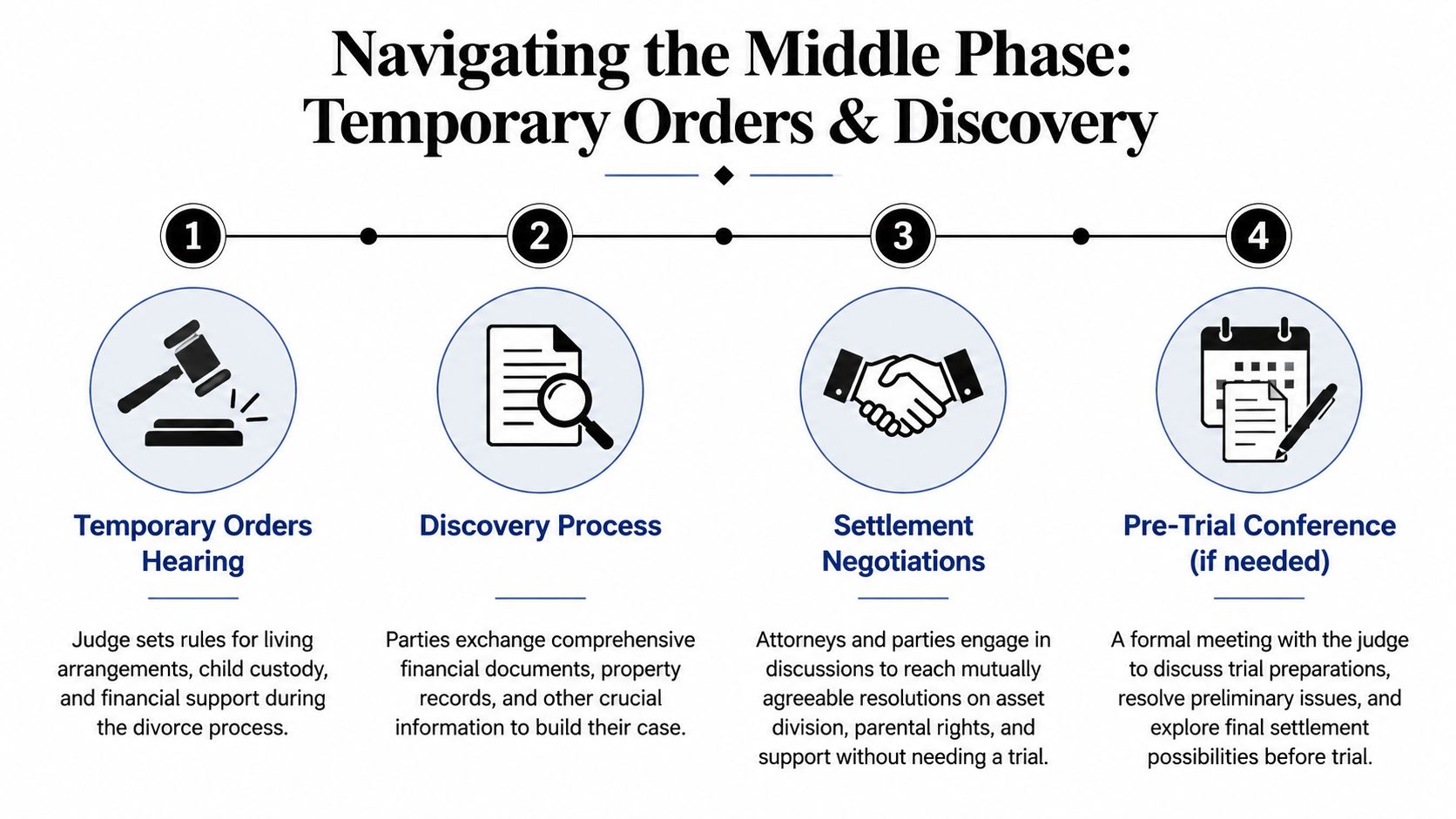
For many clients, this is the hardest stretch. The divorce is pending, but life still has to function. Bills still arrive. Children still need routines. Someone still needs to decide who stays in the home, who pays which expenses, and how parenting time will work next week, not six months from now.
That is why temporary orders matter.
Temporary orders create short-term stability
Temporary orders are court orders that govern life while the case is pending. They can address possession of the home, payment of debts, temporary support, use of vehicles, and parenting arrangements for the children.
A common scenario looks like this. One spouse moves out, both are anxious, and neither knows who should pay the mortgage or when the children will spend time with each parent. Without temporary orders, every disagreement becomes a fresh argument. With temporary orders, there is a framework.
What temporary orders can address
Not every case needs a fight over temporary orders, but many cases need clear temporary rules.
Home and household expenses
The court can decide who stays in the residence and who covers certain ongoing bills while the case is active.Parenting schedules
Temporary conservatorship and possession arrangements often provide immediate structure for children.Use of property
Vehicles, accounts, and household items may need temporary assignment so daily life can continue.Conduct rules
Courts can enter orders designed to prevent harassment, asset misuse, or disruption.
When temporary orders are well drafted, they don't just keep the peace. They give both sides a platform for realistic settlement talks.
Discovery is how facts replace assumptions
Once temporary stability is in place, the case often moves into discovery. Discovery is the formal exchange of information. It exists for one reason. Neither spouse should negotiate blind.
If one person says, "There isn't much money," or "That business isn't worth much," discovery is the process that tests those statements against documents and sworn responses.
Common discovery tools
Discovery can include several methods, depending on the case:
| Tool | What it does |
|---|---|
| Interrogatories | Written questions answered under oath |
| Requests for Production | Requires documents such as statements, tax returns, contracts, and records |
| Requests for Disclosure | Identifies basic legal and factual information relevant to the case |
| Depositions | Sworn testimony taken before trial, often in more complex disputes |
In a straightforward divorce, discovery may be limited because both spouses voluntarily exchange documents. In a more difficult case, discovery can be the difference between a fair settlement and a significantly uneven one.
What works and what backfires
Clients often ask whether they should "hold back" documents until they know what the other side is doing. That usually backfires. Courts expect disclosure. Delays and incomplete responses increase costs and damage credibility.
What works better is disciplined, organized production. Label documents clearly. Separate premarital records from marital records when possible. Keep a list of missing items. If a business interest or unusual asset exists, flag it early rather than waiting for a hearing.
There are also cases where outside professional help makes sense. High-asset divorces may require a business valuation or tracing analysis. Cases involving fluctuating income often need deeper review of compensation records. A family law firm such as the Law Office of Bryan Fagan, PLLC handles these issues as part of Texas divorce representation, but the larger point is that complex facts usually need careful structure, not guesswork.
The human side of this phase
This middle part of the texas divorce process step by step can feel invasive. You're being asked to produce private records while also managing daily life. That feeling is normal.
Try to see discovery for what it is. Not punishment. Not an accusation. A process that helps everyone negotiate from the same set of facts. In the long run, that usually lowers conflict rather than increasing it.
Finding Common Ground The Role of Mediation in Texas Divorce
Most divorcing spouses don't want a judge who has never met their family making intimate decisions about property, parenting, and support. They want resolution without surrendering control. In many Texas cases, mediation is the best chance to do exactly that.

In Texas, 75 to 80% of uncontested divorces reach their final terms through negotiation, and mediation has a settlement rate of up to 95%, according to the Texas Office of Court Administration data discussed here. Those numbers matter because they reflect something clients feel immediately. Negotiated outcomes are usually more durable than orders imposed after a fight.
What mediation actually looks like
Mediation is a structured settlement process led by a neutral third party. The mediator doesn't act as a judge. The mediator helps the parties test proposals, narrow disagreements, and move toward agreement.
A typical mediation day involves each side arriving with drafts, financial information, and a clear sense of priorities. Sometimes everyone sits together briefly. More often, the parties remain in separate rooms while the mediator moves back and forth carrying proposals and counterproposals.
That setup helps. It lowers the temperature and gives each side room to think.
Why mediation often produces better outcomes
Judges must follow the law, but judges also work within limits. They don't redesign your budget, your holiday routines, or the practical details of co-parenting in the way you and your spouse can.
Mediation gives you room to solve problems creatively:
- Property issues can be resolved through specific tradeoffs instead of all-or-nothing rulings.
- Parenting plans can account for work schedules, school needs, and transportation realities.
- Debt allocation can be addressed in ways that fit actual cash flow, not just theory.
A mediated solution is often stronger because the parties helped build it. People are more likely to follow terms they had a hand in shaping.
If you want a deeper look at how the process works, this guide to divorce mediation in Texas is a useful next read.
A short video can also make the process easier to visualize before you walk into mediation or a settlement conference.
What happens if you settle
If mediation succeeds, the parties usually sign a Mediated Settlement Agreement, often called an MSA. That document becomes the blueprint for the final divorce decree. Once signed, it can carry significant legal force, which is why preparation matters.
Come to mediation knowing your absolute requirements, your preferred outcome, and the points where you're willing to compromise. The clients who get the most from mediation aren't the loudest. They're the most prepared.
The Final Decree and Life After Divorce
At the end of the case, the court signs the Final Decree of Divorce. This is the document that legally ends the marriage, but from a practical standpoint, it does more than that. It becomes the operating manual for your post-divorce life.
If the decree is vague, missing terms, or inconsistent with the agreement, problems tend to appear quickly. If it is careful and complete, the transition is usually smoother.

What the final decree should cover
The decree typically addresses the subjects that mattered throughout the case:
| Area | What the decree should do |
|---|---|
| Property division | State who receives which assets and debts |
| Parenting terms | Set out conservatorship, possession, and exchange details |
| Support obligations | Include child support or spousal maintenance terms if applicable |
| Implementation steps | Address transfers, deadlines, and required signatures |
For many families, there is also a short final hearing called a prove-up. It is often brief, but it still matters. The judge confirms the legal requirements have been met and signs the decree if everything is in order.
A practical post-divorce checklist
Finalizing the divorce doesn't automatically update the rest of your life. You still need to carry the decree into the world.
Review your estate plan
Update your will, powers of attorney, and related documents so they reflect your current wishes.Check beneficiary designations
Life insurance, retirement accounts, and payable-on-death accounts often pass outside a will.Handle title and account transfers
If the decree awards a home, vehicle, or financial account, complete the transfer paperwork promptly.Address retirement division correctly
Some retirement accounts require a separate court order, often a QDRO, before division can occur.Keep certified copies available
You'll often need them for financial institutions and administrative changes.
The decree ends the marriage. Your follow-through is what turns the decree into a stable new beginning.
What clients often feel at this stage
Some people expect relief the moment the decree is signed. Others feel grief, exhaustion, or even numbness. All of that is normal.
The legal process gives structure, but emotional adjustment takes its own course. Give yourself room for both.
Divorce Costs and Special Situations in Texas
Cost is one of the first questions clients ask, and it should be. You need a realistic sense of what this process may require financially.
According to 2026 statistics from USA TODAY, the average cost of a Texas divorce is $15,600 without children and $23,500 with children, ranking Texas as the fifth most expensive state for divorce in both categories, as reported in this discussion of Texas divorce statistics and process. Those figures don't mean every case will cost that amount. They do show how quickly conflict, children, and litigation can increase the expense.
What usually drives cost
The most important cost factor is often whether the case stays cooperative or becomes heavily contested.
A case generally becomes more expensive when it involves:
- Repeated hearings over temporary issues
- Extensive discovery because records are incomplete or disputed
- Custody conflict that requires detailed evidence and negotiation
- Complex assets such as businesses, executive compensation, or tracing claims
- Trial preparation when settlement efforts break down
A simpler, organized, negotiated case usually costs less because the work is more efficient. A disorganized and combative case often costs more because every issue takes longer to resolve.
Special situations that need tailored handling
Not every divorce follows a standard pattern. Some cases require additional legal and financial analysis from the beginning.
High-net-worth divorce
If the marital estate includes business interests, investment structures, or claims that property is separate rather than community, valuation and tracing issues can shape the entire case. These divorces need precise records and careful drafting.
Military divorce
Military families face additional questions involving jurisdiction, service-related schedules, and the treatment of military benefits and retirement issues. Timing and compliance matter.
Cases involving children
When children are involved, the court's focus shifts beyond property and onto workable parenting terms. The strongest parenting plans are practical. They address exchanges, school schedules, holidays, communication, and decision-making in enough detail to reduce future conflict.
A grounded way to think about cost
The cheapest short-term decision isn't always the least expensive overall. A rushed agreement that fails to divide assets correctly or leaves parenting terms vague can create years of enforcement and modification problems.
A better question is this. What level of legal help gives you the best chance of reaching a durable result the first time?
If you need help navigating divorce, custody, or estate planning in Texas, contact Law Office of Bryan Fagan, PLLC today for a free consultation. We can help you understand where you are in the texas divorce process step by step, identify the decisions that matter most, and build a strategy that fits your family, finances, and long-term goals.