
If you're reading this late at night, worried about where your child will sleep next month, whether a judge will believe you, or whether your co-parent is about to make a move that changes everything, you're not alone. Custody cases in Houston Heights rarely feel like legal puzzles. They feel personal, urgent, and heavy.
Texas law can help bring order to that uncertainty. Once you understand the rules, the process gets less intimidating. You can start making decisions based on what protects your child and your position, instead of reacting out of fear. A custody case is really about two connected questions. Who will make important decisions for your child, and what will the parenting schedule look like?
Texas uses terms that can sound colder than the actual experiences families live every day. Conservatorship means decision-making authority. Possession and access means time with the child. Consider it a team. One part of the order sets each parent's role in major decisions. The other part sets the calendar.
Parents in Houston Heights often need guidance that is local, practical, and calm. The legal standards are statewide, but how a case unfolds in Harris County matters. If you want a broader overview of family law issues that often overlap with custody, this Houston Heights family lawyer resource is a useful starting point.
An Empathetic Introduction for Houston Parents
A custody case can make ordinary moments feel loaded. School pickup becomes evidence. A missed call turns into an argument. A short text exchange suddenly feels like something that could end up in court. That stress is real, and it often hits parents before they've had time to learn the rules.
What helps is getting grounded in the basics early. In Texas, custody isn't framed as "who wins the child." Courts divide the issue into legal responsibilities and parenting time. That shift matters because it gives you something concrete to work with.
The two ideas you need first
Conservatorship deals with rights and duties. It covers issues like education, medical decisions, and access to records.
Possession and access deals with the schedule. It answers when the child is with each parent, how exchanges happen, and what holidays or summer periods look like.
Practical rule: Parents often hurt their case by focusing on punishment. Judges are usually more interested in stability, follow-through, and whether you can support your child's relationship with the other parent.
A Houston Heights child custody lawyer should help you translate your daily parenting reality into legally relevant facts. That means showing routines, not just frustration. It means documenting involvement, not just making accusations.
What worried parents usually need most
Most parents don't need more legal jargon. They need clear answers to questions like these:
- What should I be doing right now: Keep records, stay child-focused in communication, and avoid making informal side deals you can't enforce later.
- What counts in court: Consistency, credibility, and whether your proposed plan works in your child's real life.
- How do I prepare without escalating things: Organize information, follow temporary arrangements carefully, and get legal guidance before responding emotionally.
Understanding Texas Child Custody The Core Concepts
Texas custody law starts with vocabulary, but the words only matter if you understand how they affect your daily life. Courts don't issue vague parenting promises. They issue orders that assign authority, define time, and create rules a judge can enforce later.
A useful overview appears in this discussion of Texas child custody laws. The important point is that a custody order usually answers three practical questions. Who makes major decisions. Where the child primarily lives. When each parent has time with the child.
Conservatorship, possession, and access
Conservatorship is about decision-making rights and duties. Parents may share many of those rights, or one parent may receive exclusive authority over specific major decisions.
Possession refers to physical time with the child. Access includes the ability to visit, communicate, and stay involved.
In many families, both parents remain active and capable, but conflict exists around communication or logistics. In others, the court may need to limit one parent's authority because of safety concerns, severe instability, or a pattern of conduct that undermines the child's well-being.
Joint vs. Sole Managing Conservatorship in Texas
| Aspect | Joint Managing Conservatorship (JMC) | Sole Managing Conservatorship (SMC) |
|---|---|---|
| Decision-making | Parents share some or many major rights and duties | One parent holds exclusive rights over key decisions |
| Day-to-day structure | Often works when parents can follow clear boundaries and routines | Often used when shared authority would create instability or risk |
| Court focus | Whether both parents can support the child's needs within a workable framework | Whether one parent needs primary legal control to protect the child's interests |
| Other parent's role | Usually still has court-ordered possession and access | May still have possession and access, but rights can be more limited |
What judges look for in real life
Legal labels don't decide cases by themselves. Facts do. Courts pay attention to who handles ordinary parenting responsibilities reliably. That includes school communication, medical appointments, transportation, routines at home, and whether a parent can put the child's needs ahead of conflict.
Under Texas law, mothers and fathers begin on equal legal footing. Texas Family Code §153.003 prohibits courts from favoring a parent based on gender. That's important because many parents still walk into a consultation assuming one parent starts with an advantage. The law says otherwise.
A strong custody case usually looks ordinary from the outside. The parent knows the teachers, keeps appointments, follows routines, and communicates without creating chaos.
In some families, custody planning also intersects with future planning outside the courtroom. Estate Planning covers wills, trusts, and estate plans to protect assets and wishes. That can matter if you want to name guardians, organize responsibilities, or reduce uncertainty for your child if something happens to you.
The Best Interest of the Child Standard in Texas Courts
The rule that controls custody decisions in Texas is simple to state and difficult to apply. Under Texas Family Code §153.002, every child custody decision in Houston Heights and across Harris County must be based on one sole guiding principle: the best interest of the child. This statutory mandate applies universally in all custody proceedings, as discussed in this best-interest overview for Houston Heights custody matters.
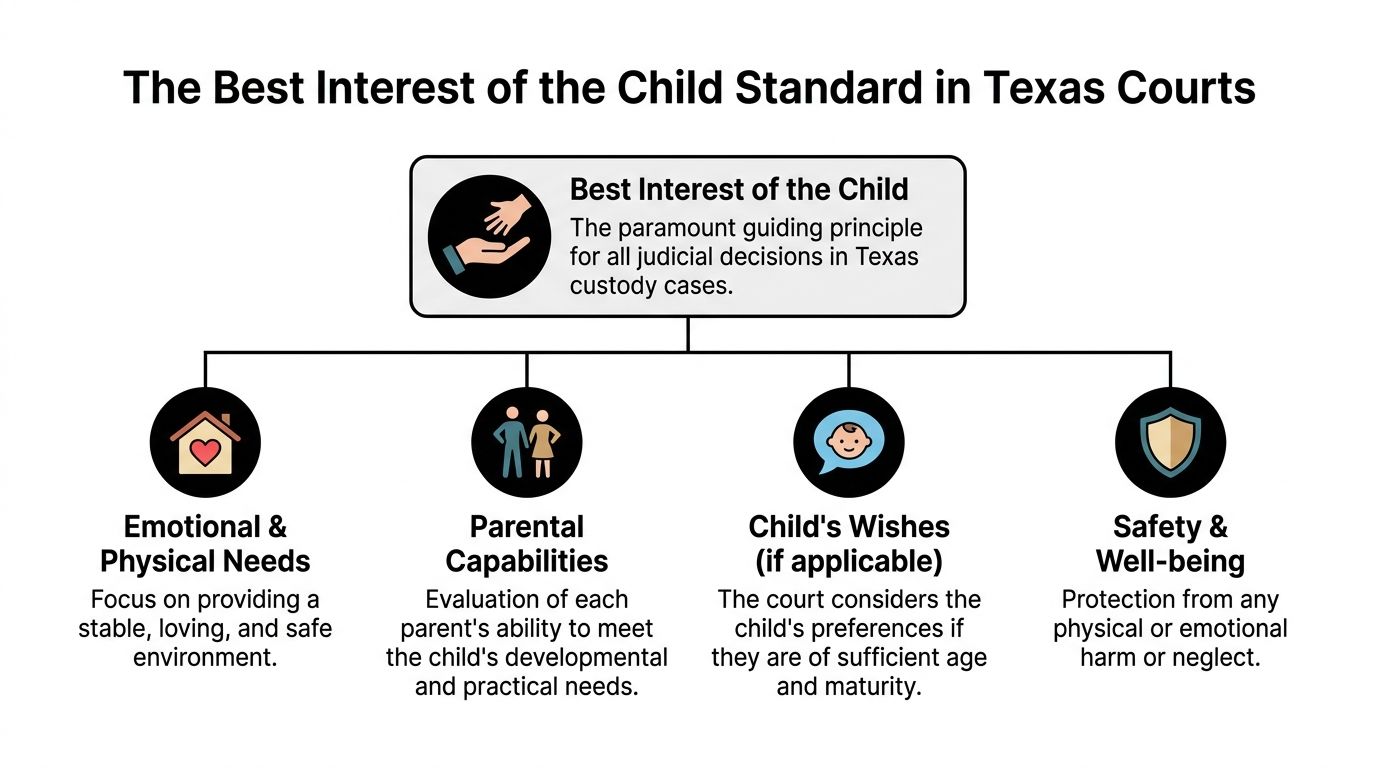
That standard applies whether you're negotiating, mediating, asking for a modification, or preparing for trial. It isn't a slogan. It's the measuring stick for nearly every fact the court considers.
How judges turn a broad standard into a real decision
Parents often hear "best interest" and assume it means the judge will choose the nicer parent or split time evenly. That's not how these cases work. Judges look at concrete facts that show how each parent functions in the child's life.
They may consider:
- Daily involvement: Who handles school issues, doctor visits, meals, bedtime, and transportation.
- Home stability: Whether the child has consistency, predictable routines, and a household that stays on track.
- Emotional and physical needs: Whether each parent can meet the child's developmental, educational, and health needs.
- Co-parenting conduct: Whether a parent supports the child's relationship with the other parent or tries to interfere with it.
In contested cases, courts may review witness testimony, school records, medical documentation, and parent communications over time. That means one angry hearing doesn't usually decide the whole story. Patterns matter.
What helps and what hurts
Parents sometimes make the mistake of building a case around the other parent's flaws without building proof of their own reliability. That's backward. The better approach is to show the court a workable plan, supported by evidence, that protects the child's routine.
Keep your messages readable in a courtroom. If a judge saw every text you sent for the last three months, would those messages make you look steady or reactive?
If your case also involves financial support, Child Support addresses establishment, modification, and enforcement of Texas child support. Custody and support are separate issues legally, but they often move through the same family court process and affect the daily realities of parenting.
A practical way to prepare
Start with a simple file. Put school records, medical records, calendars, communications, and notes about parenting responsibilities in one place. Then ask a harder question. Does your proposed schedule match your child's real routine, or only what feels fair to you?
That distinction matters. Judges usually respond better to specific, child-centered plans than to broad claims about what a parent "deserves."
A Harris County custody case often starts in the middle of real life. School drop-off still has to happen. One parent may have moved out. A child may already be asking where they will sleep on Friday night. Parents usually feel less stressed once they understand what the court will require, what can wait, and which early decisions can affect the rest of the case.
Most cases begin with a Suit Affecting the Parent-Child Relationship, or SAPCR. That filing asks the court to make orders about conservatorship, possession, access, and often child support. If the parents were never married, a SAPCR is commonly the case that creates enforceable custody orders in the first place. Harris County courts expect parents to bring a schedule the judge can use, not broad statements about fairness.
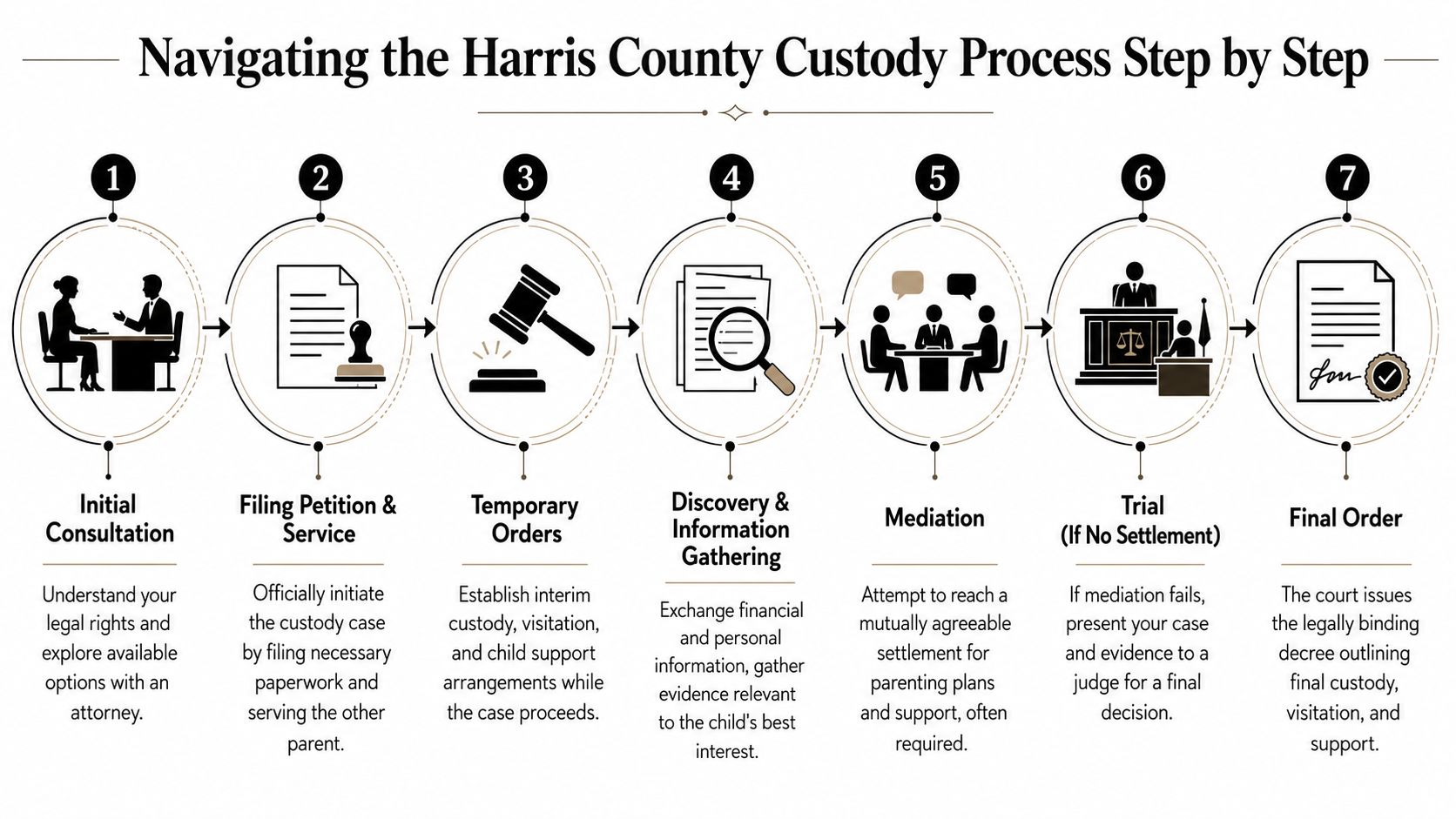
If you want a filing roadmap before you start, this step-by-step guide to filing for child custody in Texas lays out the paperwork and sequence in plain language.
Step one through three
Filing the SAPCR
The petition opens the case and tells the court what orders you want. In practice, strategy starts with the petition. A vague petition can limit momentum early, while a clear request gives the court a workable starting point.Service and response
The other parent must receive formal notice and a chance to respond. This step feels procedural, but mistakes here can slow the case, increase cost, or create enforcement problems later.Temporary orders
If parents disagree about where the child will stay, who makes decisions, or how bills will be handled while the case is pending, the court may enter temporary orders. In Harris County, these early orders matter a great deal because they often become the routine everyone lives under for months. Judges watch who follows them.
Parents sometimes underestimate temporary orders because they are not the final ruling. That is a mistake. If you want the court to trust you with a stable long-term schedule, start by showing that you can follow short-term rules under pressure.
Before moving deeper into the process, it helps to hear the steps explained visually:
Discovery and mediation
After the court addresses immediate issues, the case usually moves into discovery. This is the evidence-gathering stage. Parents may exchange documents, answer written questions, produce phone records, provide school or medical records, and in some cases sit for depositions. In a high-conflict case, discovery often changes the tone of settlement discussions because it tests each parent's story against actual records.
Mediation is also common in contested Harris County family cases. A judge may require it before trial, and even when it is not formally ordered right away, many cases still pass through mediation because settlement is usually less expensive and less disruptive for children than trial. Some sessions are short. Others take most of a day or continue in stages if the issues are complex, especially when the dispute involves mental health concerns, family violence allegations, substance abuse, or a military parenting schedule affected by orders and leave time under newer 2026 guidance.
Mediation works when the proposal fits the child's real week. School start times, commute length, after-school care, counseling, drill weekends, and exchange logistics matter more than what sounds equal on paper.
Trial or settlement
A large share of custody cases resolve before trial, but settlement does not happen by accident. It usually happens after both sides have enough information to measure risk. If a case does go to trial, the judge will need specifics. General complaints are hard to turn into enforceable orders. Clear terms are easier to approve and easier to enforce later.
A parenting plan should address practical points such as:
- Exchange details: The exact location, time, and transportation arrangement.
- Holiday language: Clear start and end times, including odd and even year schedules.
- Decision-making terms: Who has the right to make educational, medical, and extracurricular decisions, and whether that right is joint, independent, or subject to consultation.
- Communication rules: How parents will share school notices, medical updates, and emergency information.
- Backup procedures: What happens if a parent is called away for work, deployed, or cannot exercise time as scheduled.
That level of detail is not overkill. It prevents avoidable fights.
In Harris County, the parents who present the strongest cases usually do one thing well. They give the court a plan a child can live under on Monday morning, not just a list of grievances about the other parent.
Common Custody Scenarios and Unique Challenges
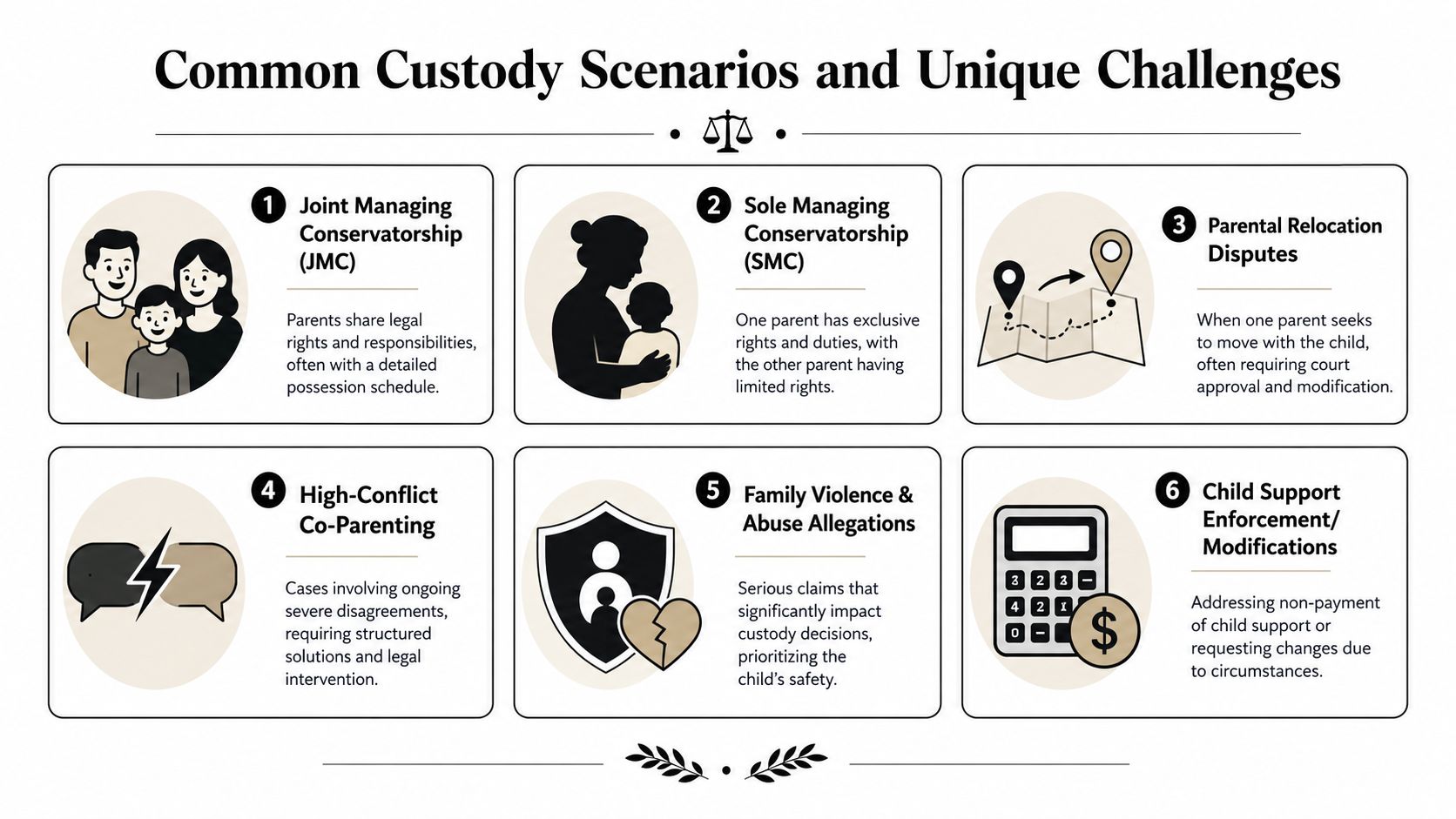
No two custody cases look exactly alike, but certain patterns appear again and again in Houston Heights. Relocation fights, communication breakdowns, military orders, and age-specific parenting needs can all change strategy fast. Consequently, generic online advice usually fails. A good legal plan has to match the facts on the ground.
Relocation and military families
A parent may receive a job opportunity, family support may exist in another city, or military service may bring new orders. Those situations can be legitimate, but they can also disrupt the child's school, routine, and relationship with the other parent.
Recent Texas Family Code amendments effective in 2025/2026 explicitly require courts to consider military deployment and relocation as a primary factor in determining the child's best interest, as discussed in this Texas military custody update. If you're a military parent or co-parenting with one, you shouldn't assume older guidance still fits your case.
A practical example helps. Suppose one parent is stationed in Texas now but may be relocated across state lines. The court isn't just asking whether the move benefits that parent. The court is looking at how deployment cycles, travel, school continuity, and the child's need for stability all interact. A proposed plan needs to address those realities directly.
High-conflict co-parenting
Some cases aren't about distance. They're about dysfunction. One parent may withhold information, provoke arguments in writing, or try to turn the child into a messenger. In that setting, broad orders usually don't help. Specificity does.
A Houston Heights child custody lawyer adds value here by pushing for structure. That can include detailed exchange terms, narrow communication channels, school-information requirements, and tightly written possession language that leaves less room for manipulation.
The higher the conflict, the more precise the order needs to be.
Parents often think they can "stay flexible" and work things out informally later. That rarely works in a high-conflict case. Ambiguity becomes fuel for the next dispute.
Children under three need different scheduling
Many parents are surprised to learn that a very young child can change the legal analysis. If a child is under three years of age, the legal presumption that the Standard Possession Order is in the child's best interest does not apply. Judges must tailor possession schedules based on the child's past contact with each parent, as explained in this Houston child custody discussion for younger children.
That matters because a schedule that works for a school-aged child may be a poor fit for an infant or toddler. Feeding routines, sleep patterns, daycare logistics, and the child's existing attachment history all become more important.
What a lawyer actually does in these situations
In complicated cases, legal representation isn't just paperwork. It often includes work like this:
- Testing the facts: Separating what can be proven from what only feels unfair.
- Building a plan: Drafting a schedule that a Harris County judge can realistically enforce.
- Managing evidence: Organizing texts, school records, calendars, and witness accounts so the court can follow the story.
- Protecting against avoidable mistakes: Stopping a parent from sending the message, making the threat, or accepting the informal deal that later harms the case.
When conflict is serious, one option for representation is the Child Custody service, which addresses custody and conservatorship representation, including high-conflict disputes.
How a Houston Heights Child Custody Lawyer Protects You
A parent in Houston Heights may walk into court believing the judge will quickly see who has been more reliable, who gets the child to school on time, and who has followed the routine. Harris County custody cases rarely work that cleanly. The court sees what is properly presented, what is documented, and what can be turned into an order a judge can sign and enforce.
That is where legal help often changes the case.
A child custody lawyer protects a parent by bringing order to a stressful process. In practice, that means identifying the facts that matter under Texas law, cutting distractions that weaken credibility, and building a possession and conservatorship plan that fits the family's real life. In high-conflict cases, it also means preparing for false allegations, communication traps, and requests for temporary orders that can shape the case long before final trial. For military families, 2026 Texas updates make careful drafting even more important when deployment, relocation, or changing duty schedules affect possession terms.

What protection looks like in practice
A lawyer usually protects you in several concrete ways:
- Framing the case around the child: Judges respond better to clear facts about school stability, medical care, routines, and co-parenting conduct than to broad claims that the other parent is difficult.
- Choosing evidence carefully: Texts, attendance records, counseling records, calendars, photos, and witness statements only help if they are organized and tied to a specific legal issue.
- Drafting orders that can be enforced: Vague pickup terms, unclear holiday language, and informal makeup-time promises often create the next lawsuit.
- Preparing for mediation with a plan: Many Harris County cases settle, but settlement only helps if the language is specific and the trade-offs make sense for your child and your schedule.
- Protecting temporary orders: The first hearing can affect possession, child support, communication rules, and who decides school or medical issues while the case is pending.
- Addressing special situations: Military service, family violence concerns, substance abuse allegations, interstate moves, and repeated denial of parenting time all require different strategies.
Good legal work is often quiet. It shows up in a cleaner affidavit, a better parenting proposal, a more careful response to a provoking text, or an order that still works six months later.
Mistakes lawyers help parents avoid
Parents under stress often make predictable mistakes. They agree to a loose schedule to keep the peace, assume a mediator will fix missing details, or send angry messages that distract from legitimate concerns. A lawyer helps stop those errors before they become exhibits.
That matters even more in high-conflict cases. One bad exchange can shift attention away from the child's needs and toward a parent's judgment. One poorly worded agreed order can create months of confusion about exchanges, holidays, or electronic contact.
A seasoned custody lawyer also gives honest advice about trade-offs. Pushing every issue to the edge can increase fees and harden the other parent's position. Settling too quickly can leave a parent with an unworkable order. The job is to choose the fights that protect the child and the parent's long-term position.
A lawyer's job is to reduce avoidable risk, present reliable proof, and help secure orders that work in everyday life, not just on hearing day.
The Law Office of Bryan Fagan, PLLC handles family law matters including custody disputes, divorce, mediation, and related issues under Texas law. For many parents, the value of counsel shows up early, before temporary orders are entered, before mediation positions harden, and before preventable mistakes shape the rest of the case.
Frequently Asked Questions About Houston Custody Cases
Can my child choose where to live?
A child's wishes may be considered if the child is mature enough, but the court still decides based on the child's best interest. A preference is a factor, not a veto.
What is a Standard Possession Order
A Standard Possession Order, often called an SPO, is a common Texas possession framework that sets out when each parent has time with the child. It often serves as a starting point, but not every family should use it without changes.
What if my child is very young
If your child is under three, the legal presumption that the SPO is in the child's best interest doesn't apply. Judges tailor schedules based on the child's past contact with each parent and the child's actual routine. That's why parents of infants and toddlers should be careful about using a school-age schedule by default.
Can a custody order be changed later
Yes, but don't rely on side agreements. If circumstances change and the current order no longer fits your child's needs, seek a formal modification so the new arrangement is enforceable.
Do I need a lawyer if we plan to settle
Often, yes. Settlement is still a legal process. A lawyer helps make sure the agreement is complete, realistic, and drafted in a way the court can enforce.
If you need help navigating divorce, custody, or estate planning in Texas, contact The Law Office of Bryan Fagan, PLLC today for a free consultation. A Houston Heights child custody lawyer can help you understand your options, protect your relationship with your child, and build a parenting plan that is practical and effective.