
Parental Alienation Attorneys in Rockwall County, Texas
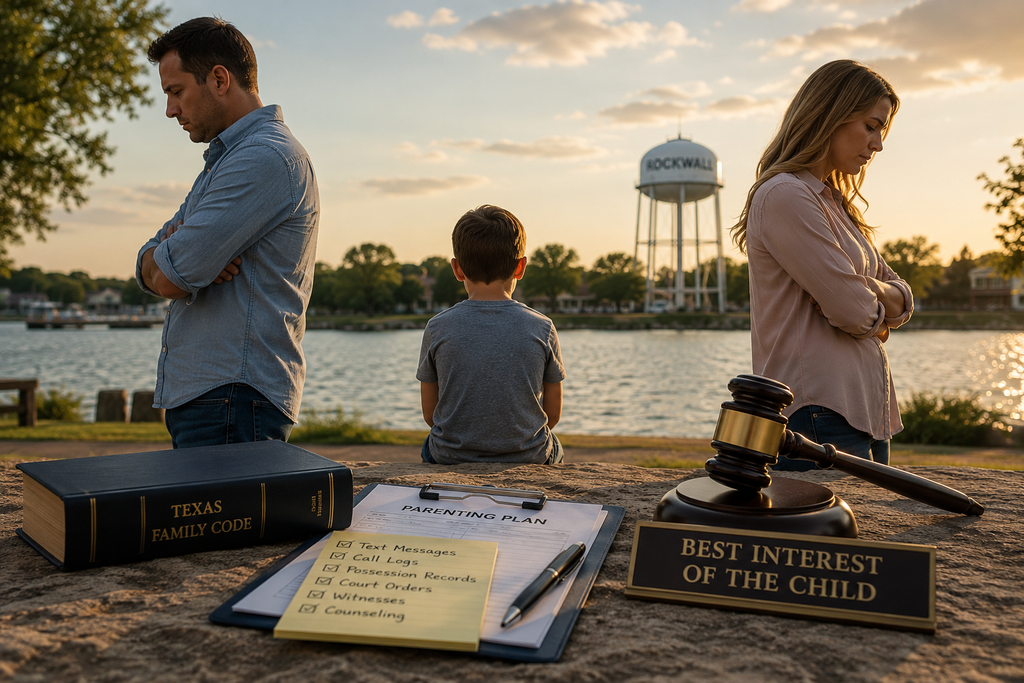
Texas has no statute called parental alienation — but conduct that undermines or interferes with a child’s relationship with the other parent can have real consequences in a Texas custody case. Parental Alienation Attorneys in Rockwall County Texas help parents understand how that conduct fits within the laws governing conservatorship, possession, counseling, modification, enforcement, and the best interest of the child.
If you have searched the Texas Family Code for a parental-alienation statute, there is a reason you cannot find one. Chapter 153 does not define parental alienation as a separate cause of action or give courts a single remedy for it. Instead, Texas law addresses the conduct behind the allegation. Section 153.002 makes the child’s best interest the court’s primary consideration, while §153.134 directs courts considering joint managing conservatorship to examine factors that include whether each parent can encourage and accept a positive relationship between the child and the other parent.
That distinction matters. A parent does not prove a case simply by calling the other parent’s behavior “alienation.” The stronger question is what actually happened. Were possession periods repeatedly frustrated? Were calls blocked? Was important information withheld? Was the child placed in the middle of adult disputes or encouraged to reject the other parent? And, just as importantly, is there another legitimate explanation for why the child’s relationship with that parent has changed?
An alienation case is therefore built from the facts outward. Messages, possession records, dates, witnesses, counseling history, court orders, and patterns of conduct can help show what is happening and how it is affecting the child. Depending on the circumstances, those facts may become relevant to an original conservatorship determination, a request for counseling, a modification under Chapter 156, or enforcement of an existing order under Chapter 157.
At the Law Office of Bryan Fagan, PLLC, we believe parents facing these disputes need clarity before conclusions. The goal is not simply to put a label on the other parent’s behavior. It is to understand what you can prove, what Texas law allows a court to do about it, and what course of action best protects your child and your relationship with them. For Rockwall County parents concerned about parental alienation, that is where the analysis should begin.
Quick Answer
Texas has no statute called parental alienation. What Chapter 153 has instead are provisions written for other purposes that an alienation case must run through: §153.002 makes the child’s best interest the primary consideration, §153.134(a) asks whether each parent can encourage and accept a positive relationship between the child and the other parent, and §153.010 lets a court order family counseling where it finds the parties have a history of conflict over conservatorship, possession or access. Our Rockwall office represents clients in family-law matters in Rockwall County.
Schedule a Consultation Or call (972) 379-9791Key Takeaways
- There is no Texas parental-alienation statute. The term appears nowhere in the Family Code as a cause of action.
- The argument runs through §153.002 best interest and §153.134(a)’s factor on whether each parent can encourage and accept the child’s relationship with the other parent.
- §153.010 lets a court order family counseling on a finding of a history of conflict. H.B. 3783 amended it in 2025 to limit certain counseling orders and also addressed modification of certain pre-existing possession and access orders.
- Alienation is presented as conduct and its effect on the child, not as a diagnosis. The label does not by itself decide conservatorship, possession or best interest.
- Evidence is usually the central practical issue. Assertions about the other parent are common; records, dates, communications and relevant third-party observations give a court evidence it can evaluate.
- After an order exists, the vehicles are modification under Chapter 156 and enforcement under Chapter 157 — different standards, different filings.
Our Rockwall Office
Law Office of Bryan Fagan, PLLC — Rockwall Office
908 N. Goliad Street, Rockwall, TX 75087 · Rockwall County
Coming to see us? For directions, arrival information, and what to expect when you visit, see our Plan Your Visit – Rockwall Office guide.
What Does Texas Law Say About Parental Alienation?

Texas does not recognize parental alienation as a separate cause of action. Instead, Parental Alienation Attorneys in Rockwall County Texas evaluate the specific conduct behind the allegation and how it may affect conservatorship, possession and access, counseling, modification, enforcement, and the child’s best interest.
The starting point is Texas Family Code §153.002, which makes the child’s best interest the court’s primary consideration in conservatorship and possession decisions. Texas Family Code §153.134 also allows a court considering joint managing conservatorship to examine whether each parent can encourage and accept a positive relationship between the child and the other parent. That means repeated interference with possession, blocked communication, or conduct designed to undermine a parent-child relationship may matter even though the Family Code never labels that conduct “parental alienation.”
The distinction becomes especially important during a divorce in Rockwall County. Saying that the other parent is alienating your child is a conclusion; a judge still needs facts. Messages, missed exchanges, call logs, witness observations, parenting-app records, and other evidence can help establish what actually happened and whether there is a pattern affecting the child.
Just as importantly, a child pulling away from a parent does not automatically prove parental interference. Abuse, family violence, legitimate safety concerns, ordinary parent-child conflict, or other circumstances may explain the change. The better question in a Rockwall County child custody case is therefore not simply, “Is this parental alienation?” but “What does the evidence show, and how does that evidence affect the child’s best interest under Texas law?”
Is Parental Alienation Illegal in Texas?
Not as a crime.
But it is not without consequence either. There is no offence called parental alienation, and no provision makes it punishable by itself. It surfaces instead as conduct a court weighs when deciding conservatorship, when deciding whether to modify an existing order, and when deciding whether to restrict a parent’s rights. A related type of conduct does have its own statutory treatment. Section 153.013 addresses a knowingly false report of child abuse made by a party to a pending suit against another party: evidence of such a report is admissible on conservatorship, and the section attaches its own consequences.
The practical answer is narrower than the legal one. A court cannot punish a parent for alienation as such. A court can change who holds which rights, change the schedule, order counseling, and take conduct into account in ways that are far more consequential than a penalty would be.
How Do You Prove Parental Alienation in Texas?
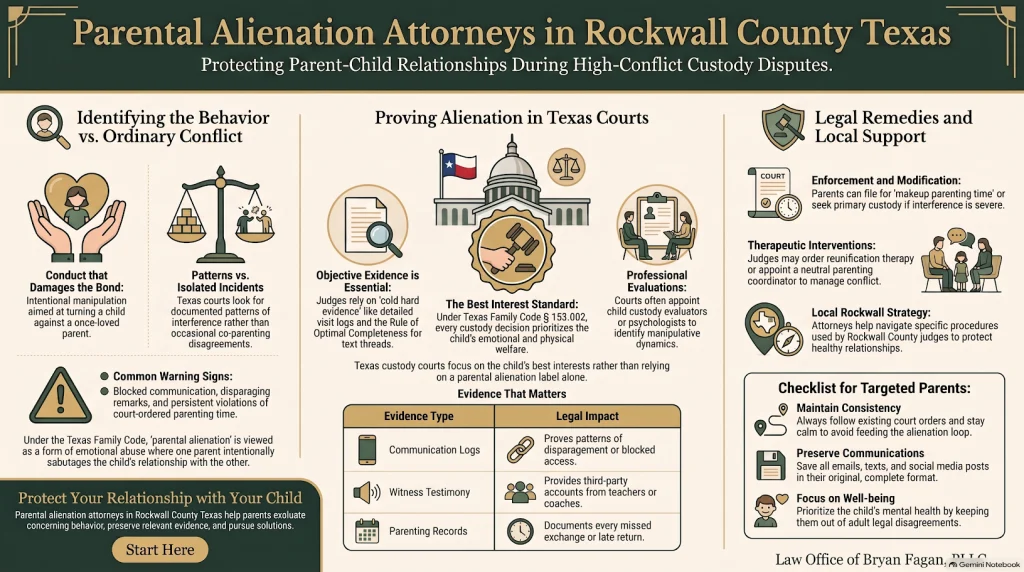
With a record, not a characterisation. This is the practical part of an alienation case a parent can prepare for before ever speaking to a lawyer.
Useful evidence is often contemporaneous and specific: dates and times of missed or refused exchanges, messages in their original form, a record of what was said in front of the child and by whom, changes in the child’s language that track an adult’s phrasing, and observations from non-parties — teachers, coaches, counselors, physicians.
Section 153.009 provides a mechanism for a court to interview a child in chambers in specified circumstances; the interview does not transfer the best-interest decision to the child. Counseling under §153.010 and evidentiary evaluation are different functions and should not be conflated.
What a court can actually act on
Not Sure What You Can Actually Prove?
Tell us what has been happening and what you have kept a record of, and we can help you work out which provisions your case runs through — and what a court would need to see.
Schedule a ConsultationWhat Do Texas Appellate Courts Show About Proving Alienation?

Texas appellate decisions show that calling conduct “parental alienation” is not enough—the evidence must establish what actually happened and persuade the judge or jury deciding the facts. For Parental Alienation Attorneys in Rockwall County Texas, that makes documentation, corroborating evidence, competing explanations, and witness credibility more important than the label itself.
In Douglas v. Douglas, a father alleged that the mother had alienated their children from him, pointing to missed possession and disparaging remarks. But the evidence was conflicting. The mother denied interfering with the relationship and presented evidence that she had encouraged the children to see their father. The First Court of Appeals recognized that the jury was responsible for weighing that competing evidence and deciding which account it believed.
In re Marriage of Koenig illustrates what a stronger evidentiary record can look like. A court-appointed psychologist and social-study investigator described specific conduct involving the children, adult issues being drawn into the parent-child relationship, alignment with one parent’s agenda, and interference with the other parent’s contact. The Fourteenth Court of Appeals concluded that the evidence supported the trial court’s finding of a course of conduct intended to alienate the children and upheld the modification.
For a Rockwall County parent, the practical lesson is straightforward: document conduct, not conclusions. Missed exchanges, original text messages, parenting-app communications, call records, witnesses, and repeated patterns may help establish what occurred, while contradictory evidence may weaken the allegation. If the dispute also involves threats, violence, or allegations of physical harm, those issues require a separate analysis under Texas family and criminal law, including issues addressed in Rockwall County assault cases. In a contested custody case, what ultimately matters is what the admissible evidence supports and what the factfinder finds credible.
Which Family Code Provisions Actually Apply?
Several provisions can matter, but four do especially important jobs. An alienation case is assembled rather than pleaded, so it helps to know what each piece contributes.
- §153.002 — best interest of the child as the primary consideration. Everything else is argued in service of this.
- §153.134(a) — among the factors for court-ordered joint managing conservatorship is whether each parent can encourage and accept a positive relationship between the child and the other parent. That factor can be particularly relevant where the alleged conduct involves interference with the child’s relationship with the other parent.
- §153.010 — family counseling, available on a finding of a history of conflict in resolving conservatorship, possession or access. The counselor must have a background in family therapy and a mental health license requiring at least a master’s degree. Amended in 2025 to add protections involving family violence and limits on what a counseling order may require.
- §153.004 — history of domestic violence or sexual abuse, which governs where allegations go beyond hostility.
Chapter 153 also contains provisions on interviewing a child in chambers (§153.009), false reports of child abuse (§153.013), and visitation exchange facilities (§153.014). Whether any of those fits a particular case is a question for your attorney rather than an article.
What Can a Court Actually Do About It?
Texas law does not provide a single remedy called a parental-alienation order. Courts use the remedies the Family Code already supplies — conservatorship, possession terms, counseling where authorized, modification and enforcement — depending on what the evidence and procedural posture support.
Counseling under §153.010 is the most direct, and its threshold is the reason it matters: the court needs a finding of a history of conflict, not proof of a diagnosis. Conservatorship is the most consequential. A court may consider a parent’s ability to encourage and accept a positive relationship between the child and the other parent as part of the broader §153.134 analysis of court-ordered joint managing conservatorship, and the allocation of rights can change. The schedule can be restructured so that fewer decisions require cooperation that is not there.
Where an order already exists, changing it is modification under §156.101, which requires the statutory grounds for modification and the child’s best interest. One statutory pathway involves a material and substantial change in circumstances. H.B. 3783 also contains a special provision addressing that component for certain pre-existing possession or access orders. Making an existing order work is enforcement under Chapter 157. Modification and enforcement are separate proceedings with different standards and remedies.
Can a Texas Court Order Reunification or Family Counseling?

Yes. Texas courts may order family counseling when the requirements of Texas Family Code §153.010 are satisfied, but the law now places important limits on what that counseling can require. For Parental Alienation Attorneys in Rockwall County Texas, the key question is not simply whether counseling might help rebuild a parent-child relationship, but whether the requested counseling is authorized and appropriate under the facts of the case.
Under Texas Family Code §153.010, a court may order family counseling when it finds a history of conflict in resolving conservatorship, possession, or access issues. Parents may call this “reunification counseling,” but when a court orders it under §153.010, the counseling must remain within the statute’s authority and restrictions. House Bill 3783, effective June 20, 2025, added significant safeguards governing these orders.
Those safeguards become especially important when family violence or sexual abuse is alleged. Under §153.010, the court must consider evidence of family violence or sexual abuse in accordance with §153.004. When credible evidence is presented, the statute restricts joint counseling between a victim and perpetrator and addresses who may be required to pay counseling costs. It also limits court-ordered counseling practices involving measures such as isolating a child from a parent or family member or requiring certain overnight or multi-day stays.
These distinctions matter in a Rockwall County child custody case because a child’s resistance to contact does not automatically prove parental alienation. In more complex cases, allegations may involve family violence, substance use, or other safety concerns that require separate evaluation. For example, an alcohol-related arrest or allegation may raise issues beyond the alienation claim; readers dealing with that situation can learn more about DWI and DUI matters in Rockwall County.
The practical takeaway is that family counseling can be one tool in a high-conflict custody case, but it is not an automatic remedy for an allegation of parental alienation. The court must consider the statutory requirements, the evidence, the child’s best interest, and any legitimate safety concerns before determining whether counseling is appropriate—and what that counseling may legally require.
Existing Orders
Have an Older Counseling or Possession Order?
H.B. 3783 did more than change §153.010 going forward. Section 3 of the Act provides that the change in law made by the Act to §153.010 constitutes a material and substantial change of circumstances sufficient to warrant modification of a court order or portion of a decree that provides for the possession of or access to a child rendered before the effective date of the Act. That addresses the material-and-substantial-change component. It does not make modification automatic — best interest and the ordinary procedural requirements still apply, and whether the provision reaches a particular order depends on that order and the posture of the case.
How Do Texas Courts Treat “Parental Alienation Syndrome”?
The label does not decide the case.
Alienation is better presented as evidence of conduct and its effect on the child than as a diagnostic label. A label does not establish what happened, and it does not by itself decide conservatorship, possession or best interest. The more useful legal focus is the conduct and its effect on the particular child — what was said, in front of whom, and what changed afterwards.
This is not a reason to be quieter about what is happening. It is a reason to describe it in terms a court can act on: a dated account of a specific statement, who made it, who was present, and what the child said or did afterwards. A diagnostic label, on its own, does not give a court that.
Where Does This Sit Next to Custody and Possession?
Alienation is an argument. Custody and possession are the orders it affects. Questions about who is appointed conservator, which parent holds which decision-making rights, and how best interest is weighed belong to child custody in Rockwall County. Questions about the schedule itself — the standard possession order, the expanded beginning and ending times, and the distance rules — belong to parental visitation in Rockwall County.
Before You Call
Preparing to Talk With an Attorney About Alienation
If you are getting ready to discuss an alienation concern, it helps to organize:
- ›any current order, and the decree it came from
- ›a dated record of missed, refused or shortened exchanges
- ›messages in their original form rather than summarised
- ›specific things the child has said, when, and to whom
- ›names of non-parties who have observed the child — teachers, coaches, counselors, physicians
- ›any counseling or evaluation already underway, and who ordered it
- ›what outcome you believe needs to change
What matters in a particular case depends on the facts. This is simply a practical starting point for organizing the conversation with your attorney.
Meet Lisa Kreider, Your Rockwall Family Law Attorney
Alienation cases are decided on the record a parent builds and on how credibly it is presented. That makes them intensely fact-specific: what was said, when, in front of whom, and what changed afterwards. For a Rockwall County case, that makes local execution as important as knowing the statewide framework.
Your Rockwall Attorney
Lisa Kreider
Rockwall Family Law Attorney · Rockwall Office
Lisa Kreider represents clients in family-law matters from our Rockwall office. Her family-law experience includes temporary-order hearings, contested evidentiary matters, mediation and final trials. Her approach is to listen first, identify what is actually disputed, pursue resolution where appropriate, and prepare for court when necessary.
She has been licensed in Texas since 2017.
Read Lisa’s Full ProfileWhat Local Rules Apply in a Rockwall Alienation Case?
Rockwall County has a Standing Order Regarding Children, Property and Conduct, effective 31 July 2020 and adopted by the 382nd and 439th District Courts and County Courts at Law No. 1 and No. 2. The standing order takes effect upon filing and remains operative according to its terms unless modified or superseded by the court. Its provisions yield to a protective order.
That can matter in an alienation dispute, because a standing order governs conduct while the case is pending and conduct during that window may itself become relevant evidence. The county also has a Standing Order Regarding Parenting Class, effective 7 June 2019, which applies in qualifying divorce and original SAPCR matters and requires a certificate of completion before finalization.
Not sure what kind of help you need?
Answer a few short questions about what is happening — what the matter involves, where you are in the process, and what has already been ordered — and your answers help us identify the type of help you may need and the appropriate local team. For Rockwall County matters, that may include our Rockwall office. It takes about a minute, and there is no obligation.
Start Here — Answer a Few Questions Or schedule a consultationSources and Legal Resources
Statutory provisions cited on this page were checked against current Texas legislative materials and the most recent amendment history available for each section. Current as of August 2026; statutes change, so the current text should be confirmed before it is relied on.
- Texas Family Code Chapter 153 — official full-chapter text from the Texas Legislature (PDF): conservatorship, possession and access, including best interest, family counseling and the joint-conservatorship factors
- Texas Office of Court Administration — Rockwall County court documents — the county’s standing orders
- Rockwall County District Clerk — Civil and Family — local court and filing information
- Texas Legislature — H.B. 3783, enrolled version — 2025 legislation amending §153.010’s family-counseling provisions and addressing modification of certain pre-existing possession and access orders
Conclusion:
Parental alienation disputes are decided by facts, evidence, the existing court order, and the child’s best interest—not by the label alone. Parental Alienation Attorneys in Rockwall County Texas can help determine whether the conduct points toward better documentation, enforcement of an existing possession order, a custody modification, counseling, or a more complex strategy involving competing allegations and child-safety concerns.
In straightforward situations, the next step may be preserving messages, documenting denied possession, and understanding exactly what the current parenting plan requires. In more complex cases, repeated interference may overlap with allegations of family violence, abuse, CPS involvement, requests for temporary orders, or efforts to change conservatorship and decision-making rights. When allegations involve extremely serious violence or criminal conduct, the family-law and criminal issues must be evaluated separately; our resource on homicide cases in Rockwall County explains the criminal-law side of those extraordinary circumstances.
You do not need to diagnose your family as an “alienation case” before seeking guidance. Bring your current orders, preserved communications, possession history, timeline, and the questions you cannot yet answer. The Law Office of Bryan Fagan, PLLC can help you understand what the evidence actually supports, identify the level of legal strategy your situation requires, and determine what Texas law allows you to pursue—so the next decision is based on clarity and preparation while keeping your child and your relationship with them at the center of the case.
Listen to Our Texas Family Law Podcast
Prefer listening? In this episode, we discuss parental alienation in Texas custody cases for Rockwall families, including common warning signs, how it may affect custody disputes, and what parents can do to protect their relationship with their child.
About the Author
Bryan Fagan
Founder & Managing Attorney
Texas Family Law · Licensed in Texas Since 2012
Bryan Fagan founded the Law Office of Bryan Fagan, PLLC in 2012 and practices Texas family law, including divorce, child custody, property division, and related family-law matters. He built the firm around helping families understand the legal process, make informed decisions, and have a clear strategy for what comes next.
J.D., South Texas College of Law · Licensed by the State Bar of Texas since 2012
About Our Firm
The Law Office of Bryan Fagan, PLLC serves families across Texas through a growing network of local offices, including our Rockwall office. That structure is the point: you have access to a Rockwall-based family-law attorney, backed by one of the largest family law firms in Texas and its 170+ legal professionals.
For the firm’s history, values, and full attorney roster, see about the Law Office of Bryan Fagan. For Rockwall specifically, start with the attorneys at our Rockwall office.
Frequently Asked Questions
No. The Texas Family Code contains no cause of action called parental alienation and no section defining the term. Alienating behaviour is addressed through provisions written for other purposes — principally §153.002 on the child’s best interest and §153.134(a)’s factor on whether each parent can encourage and accept a positive relationship between the child and the other parent.
A court can change the allocation of rights, and alienating behaviour can weigh heavily in that decision, but not as an automatic consequence. Under §153.134(a) a parent’s inability to encourage and accept the child’s relationship with the other parent is a factor bearing on whether joint managing conservatorship is appropriate. Whether that produces a change depends on the whole best-interest analysis under §153.002.
Because parental alienation is not a defined claim, there is no separate statutory evidentiary test for proving it. Useful evidence is often contemporaneous and specific: dated records of missed or refused exchanges, messages in their original form, particular statements made in front of the child, and relevant observations from people who are not parties. A characterisation of the other parent is not evidence of it.
Alienation is better presented as conduct and its effect on the child than as a diagnostic label. A label does not establish what happened, and it does not by itself decide conservatorship, possession or best interest. The more useful legal focus is the conduct and its effect on the particular child.
Yes, subject to limits added in 2025. Section 153.010 permits a court to order a party to participate in counseling where it finds at the time of a hearing that the parties have a history of conflict in resolving an issue of conservatorship or possession of or access to the child. H.B. 3783, effective 20 June 2025, amended the section to require the court to consider evidence of family violence or sexual abuse under §153.004, to bar counseling in which a victim participates in sessions together with the perpetrator where credible evidence is presented, and to prohibit counseling that requires specified practices such as isolating the child.
It depends on what you want. Changing the terms of an existing order is a modification under §156.101, which requires the statutory grounds for modification and the child’s best interest. One statutory pathway involves a material and substantial change in circumstances. Making an existing order work is an enforcement matter under Chapter 157. Modification and enforcement are separate proceedings with different standards and remedies.
Where to go from here
What You Can Show Decides What a Court Can Do.
Our Rockwall office can help you work out which provisions your case runs through, what a court would need to see, and whether the right filing is a modification or an enforcement.
Schedule a Consultationor call (972) 379-9791
This page provides general information about Texas conservatorship, possession and access and about our services. It is not legal advice, and reading it does not create an attorney-client relationship. No attorney can promise a particular outcome in a family-law case; what we commit to is representation, preparation, and clear communication about where your case stands.