
Legacy Planning Attorneys in Rockwall County Texas

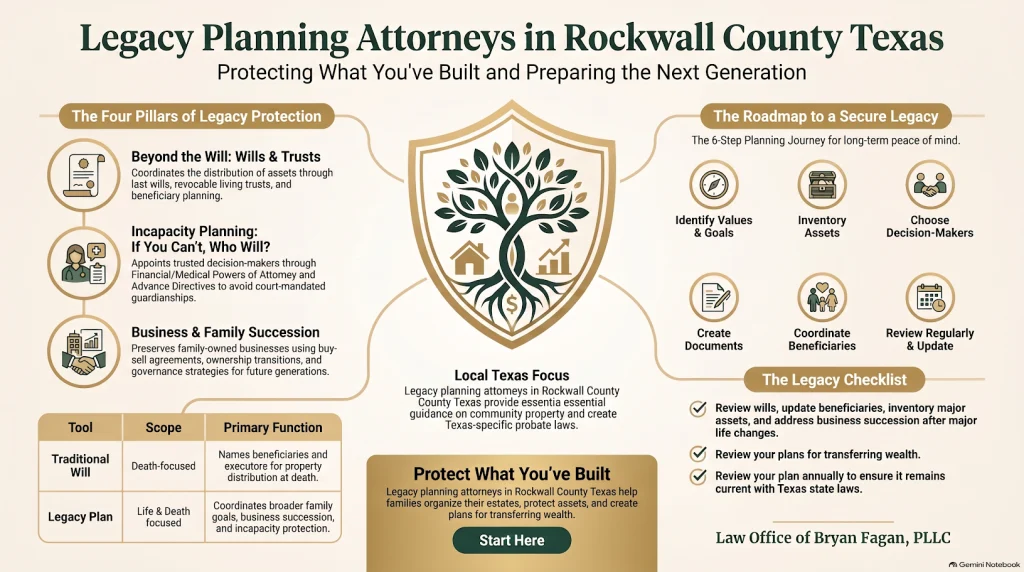
Legacy planning is the work of deciding what happens to your property, your decisions, and your responsibilities before your family needs the answers. The legacy planning attorneys in Rockwall County, Texas at the Law Office of Bryan Fagan help people put those decisions in writing, so a spouse, child, trustee, executor, or named agent is not left guessing during an illness, a period of incapacity, or the administration of an estate.
The legal framework sits primarily in the Texas Estates Code, the Texas Trust Code, and the Texas Health and Safety Code. Together, those laws govern many of the wills, trusts, powers of attorney, medical directives, guardian designations, and property-transfer arrangements used in a Texas plan. Other assets—including retirement benefits, life insurance, payable-on-death accounts, and property subject to contractual beneficiary provisions—may follow federal law or the governing account documents instead. Effective planning is the work of identifying those separate pieces and making them point in the same direction.
Led by Bryan Joseph Fagan, a South Texas College of Law graduate who has practiced Texas law since 2012, The Law Office of Bryan Fagan, PLLC helps families understand how divorce and estate planning intersect. Our purpose is not merely to replace names on old forms. It is to help you regain clarity and peace of mind by deciding who should act for you, who should receive your property, and how the people you care about will be protected if you cannot be there.
In the sections ahead, you will learn which documents should be reviewed after divorce, why beneficiary designations require separate attention, how trusts can protect an inheritance, and what steps can prevent your former life from controlling your family’s future. You do not need every answer before you begin. You need a careful review, clear guidance, and a plan that reflects the life you have now.
Quick Answer
Legacy planning coordinates the legal documents that direct your property and your decisions with what you actually want to happen. In Texas that can include a will, a trust, a durable power of attorney, a medical power of attorney, a directive to physicians, a guardian designation, and the beneficiary designations and deeds that move property outside a will. Legacy planning and estate planning substantially overlap. “Legacy planning” is often used to describe the broader process of coordinating estate-planning documents, asset transfers, incapacity planning and family goals. Our Rockwall office is at 908 N. Goliad Street.
Key Takeaways
- If you do nothing, Texas law supplies the plan. Intestate succession decides who inherits, and it may not match what you would have chosen.
- A will is only one part of a complete plan. It directs property that passes through probate, and not everything does.
- Beneficiary designations and property titles can control assets outside the will. Those belong in the review alongside the documents, not after them.
- Incapacity planning requires documents that operate during life. A will has no effect while you are alive.
- Trusts can solve particular planning problems, but they must be properly funded and coordinated. A trust governs only what is actually transferred into it.
- A plan should be reviewed when family, property, business ownership or the law changes.
Our Rockwall Office
Law Office of Bryan Fagan, PLLC — Rockwall Office
908 N. Goliad Street, Rockwall, TX 75087 · Rockwall County
(972) 379-9791 · Monday–Friday 8:00 AM – 6:00 PM
What Is Legacy Planning?

Legacy planning is the process of deciding who should receive your property, who should act for you if you cannot make decisions, and how those instructions will be carried out under Texas law. Legacy Planning Attorneys in Rockwall County Texas help families turn those choices into coordinated documents and transfer arrangements instead of leaving relatives, courts, and financial institutions to supply the answers.
A complete plan usually involves more than a will. It may coordinate a trust, durable power of attorney, medical power of attorney, directive to physicians, guardian designation, beneficiary designations, deeds, retirement accounts, and business agreements. Each instrument has a different job, and a will generally does not control property that passes through a trust, beneficiary designation, survivorship arrangement, or valid transfer-on-death deed.
Family changes also matter. A marriage, death, remarriage, or divorce in Rockwall County can change property rights, fiduciary choices, beneficiary arrangements, and continuing obligations. Updating one document does not necessarily update the others.
In straightforward situations, planning may focus on a will, trusted agents, and coordinated beneficiaries. In more complex plans involving minor children, blended families, a beneficiary with disabilities, business interests, family land, or property in multiple states, additional trust and succession planning may be appropriate. Without that coordination, Texas law and existing account documents may produce a result the family never intended.
Legacy Planning vs. Estate Planning: What’s the Difference?
There is no separate body of Texas law called legacy planning, and the two terms substantially overlap. Both draw on the same legal instruments. The difference is in how the words are used, not in what the statutes do — and usage varies from firm to firm.
| Term | One useful way to think about it | What it covers |
|---|---|---|
| Estate planning | The legal tools and structures used to carry out the plan | Wills, trusts, powers of attorney, medical directives, beneficiary designations, deeds |
| Legacy planning | The wider process those documents are built to carry out | The broader coordination of those tools with family, property, incapacity and continuity goals |
Worth Being Clear About
Some firms describe legacy planning as being about values, traditions or family stories rather than law. That framing is not wrong, but it is not a legal distinction. Values and family goals can shape a legacy plan, but legal effect comes from the documents, ownership arrangements, beneficiary designations, governing agreements and applicable law that carry those goals out.
What Happens Under Texas Law If You Do Nothing?
Texas supplies a default. If you die without a valid will, the intestate succession rules in Chapter 201 of the Estates Code determine who inherits. The outcome depends on whether you were married, whether you had children, whether those children are also your spouse’s, and whether the property is community or separate.
That last distinction does real work in Texas. Community and separate property are characterized under the Texas Family Code, and intestacy treats them differently — so an assumption that a surviving spouse simply receives everything may not hold, particularly in a family where either spouse has children from a prior relationship.
Two further consequences follow from having no plan. You have named no one to administer the estate, so who serves is determined under the Estates Code rather than by your choice. And you have named no agent to act for you while you are alive but unable to act. Texas law provides some decision-making mechanisms that can apply without advance documents, but they are narrower than the authority a person can grant in advance, and a guardianship proceeding may become necessary where no adequate alternative is available.
Homestead and Family Protections
Texas also provides homestead rights and exempt-property protections that operate independently of a will, under Chapter 102 and Chapter 353 of the Estates Code. These can protect a surviving spouse or minor children, and they can materially affect how property is treated after death, independent of what a will says.
What Legal Tools Make Up a Texas Plan?
Each document below does one job. Confusion in planning can come from expecting one of them to do another one’s work.
| Tool | What it does |
|---|---|
| Will | Directs property that passes through probate, and can name an executor and a guardian for minor children. Attested-will requirements are in §251.051; a handwritten will is governed by §251.052. |
| Revocable living trust | Holds and manages property during life and directs it afterward. It governs only what is actually transferred into it. A settlor’s power to revoke or amend comes from Property Code §112.051. |
| Testamentary trust | Created by the will and taking effect at death. Can hold property for a young beneficiary rather than distributing it outright. |
| Durable power of attorney | Gives an agent authority over financial matters, including during incapacity. Governed by Estates Code Chapter 751, with the statutory form in Chapter 752. |
| Medical power of attorney | Gives an agent authority to make health-care decisions when you cannot. See Health and Safety Code §166.151. |
| Directive to physicians | States your wishes about life-sustaining treatment. See §166.031. |
| Declaration of guardian | Designates who should serve as guardian — for yourself in advance of need under §1104.051, or for a minor child under §1104.151. |
| Beneficiary designation | Certain assets may pass to the person named on the account or policy rather than under the will, subject to the governing account or plan terms and, for some assets, federal law. Multiple-party accounts and payable-on-death designations are addressed in Chapter 113. |
| Transfer on death deed | Can pass Texas real property at death if executed and recorded as §114.055 requires. It is revocable and nontestamentary. |
How These Fit Together
A complete plan is more than one document. A will and a trust do different jobs; a financial agent and a medical agent hold different authority; and the accounts with beneficiaries attached are not controlled by either. The point of planning is that the pieces point the same direction.
Do You Need a Will, a Trust, or Both?

For many Texas plans, a will is a foundational document. A trust can address additional planning needs, but not every estate requires the same trust structure.
Texas law provides procedures that can reduce court involvement in qualifying estates, including independent administration and, when the statutory requirements are met, probate of a will as a muniment of title. Section 257.001 permits a muniment of title where the court is satisfied the estate owes no unpaid debt other than one secured by a lien on real estate, or finds there is no necessity for administration.
When a trust may be worth considering
- You own real property in more than one state, which could otherwise mean a proceeding in each.
- You want property managed for a beneficiary over time rather than handed over at once.
- Privacy of the dispositive terms is an important planning consideration for you.
- You want a successor trustee able to step in during incapacity without a court appointment.
- Your family situation is one where you expect the plan to be questioned.
What a trust does not do by itself
A trust controls what it holds. Property never transferred into the trust is not governed by it. A pour-over will can direct probate assets into the trust at death, but those assets generally still pass through probate before reaching the trust. Creating the trust and funding it are therefore separate parts of implementing a trust-based plan.
How Do Beneficiary Designations and Deeds Fit Into the Plan?
A will directs probate property, and that is narrower than it sounds. Assets governed by beneficiary designations, survivorship arrangements, deeds, trusts or other transfer mechanisms may pass outside the will.
Many assets — including life insurance, retirement accounts, annuities and payable-on-death accounts — may pass under beneficiary designations or governing account documents rather than under a will. Those designations should be reviewed alongside the estate plan, particularly after a marriage or a divorce. Retirement plans can also involve federal requirements and the plan’s own governing documents, so a designation on that kind of account is worth reviewing with counsel rather than assumed.
The transfer on death deed, and an important limitation
Texas allows a transfer on death deed for real property under the Texas Real Property Transfer on Death Act. It is revocable during life under §114.052 and it is nontestamentary. One important limit appears in §114.054(b): a transfer on death deed may not be created through use of a power of attorney, so an agent cannot put one in place on the principal’s behalf. To be effective, §114.055 requires that it contain the formalities of a recordable deed, state that the transfer occurs at the transferor’s death, and be recorded before the transferor’s death in the deed records of the county clerk’s office in the county where the property is located.
Why This Matters
A Will Cannot Revoke a Transfer on Death Deed
Section 114.057(b) states it directly: a will may not revoke or supersede a transfer on death deed. Revocation generally requires an instrument satisfying §114.057 and recorded before the transferor’s death. A new will that appears to leave the same house to someone else does not change where the house goes.
Two related provisions are worth knowing. Under §114.057(c), if a marriage to a named beneficiary is later dissolved, the divorce judgment revokes the deed as to that beneficiary only if notice of the judgment is recorded before death. And under §114.103, a beneficiary must survive the transferor by 120 hours.
A transfer on death deed also does not put the property beyond the estate’s obligations. Under §114.104 a beneficiary takes subject to existing liens and encumbrances, and under §114.106 a personal representative may enforce liability against the transferred property to the extent the estate cannot satisfy claims, administration expenses, estate tax, or an allowance in lieu of exempt property or a family allowance. So a transfer on death deed changes how property passes; it does not by itself decide who bears the estate’s debts.
Separately, §123.001 addresses the effect of divorce on provisions in a will for a former spouse. Divorce, remarriage, a birth, a death and a property purchase are all events that can put a plan out of step with its own paperwork.
The Practical Step
Ask for a list of every account and policy that names a beneficiary, and every deed on Texas real property you own. Then check whether those names and those titles match the plan you think you have. That reconciliation can identify conflicts between the documents and the actual transfer arrangements.
Before Your Family Needs It
Start With What You Want to Protect
You do not need every answer before the first conversation. Bringing what you already have — and what you are unsure about — is enough to begin.
Schedule a ConsultationWhat Happens If You Become Incapacitated?

A will does nothing while you are alive. Authority during incapacity comes from separate documents, and there are two kinds of authority, held under two different statutes.
Financial authority
A durable power of attorney under Estates Code Chapter 751 lets a named agent act on financial matters. The statutory durable power of attorney form appears in Chapter 752. Which powers the agent holds depends on what the document grants, so the drafting is not a formality.
Medical authority
A medical power of attorney under Health and Safety Code §166.151 names an agent for health-care decisions when you are unable to make them. A directive to physicians under §166.031 states your own wishes about life-sustaining treatment. They are different instruments: one appoints a decision-maker, the other records a decision.
What happens without them
If adequate advance authority or another less restrictive alternative is unavailable, a guardianship proceeding may become necessary. Texas guardianship is a court proceeding, with a filing, a hearing and ongoing reporting. Advance planning can reduce the circumstances in which a court-supervised guardianship becomes necessary, although it cannot eliminate that possibility in every case.
Our Rockwall office also handles incapacity planning and elder law and Medicaid matters.
How Do You Plan for Minor Children?
Two separate questions, and they need two separate answers: who raises them, and who manages what they inherit.
A will can nominate a guardian, and a parent can also sign a declaration designating a guardian for a minor child in advance. Neither removes the court’s role, but a designation tells the court what the parent wanted, which is a materially different starting point from silence.
The money is a separate question, and one that can go unaddressed. Property left outright to a minor has to be managed by someone, and without a structure that can mean a court-supervised arrangement, or property that becomes distributable outright when the child reaches legal adulthood, depending on how it is held. A testamentary trust created in the will, or a revocable trust with terms for young beneficiaries, lets you name a trustee and set when and how funds are used.
A Coordination Gap
Naming a minor child directly as the beneficiary of a life insurance policy or retirement account can work against the trust structure built in the will, because the asset may pass under the designation and the governing account or plan terms rather than under the will. Where a trust is intended to receive those funds, the designation and the plan’s own requirements both need to support that.
How Do You Plan in a Blended Family?
This is where the Texas default may diverge sharply from what a person actually wants. When one or both spouses have children from a prior relationship, intestate succession divides community and separate property in ways that may not match expectations, and the result can leave a surviving spouse and the children of a first marriage holding interests in the same house.
The tension is structural rather than personal: providing for a spouse for life and preserving something for children from an earlier marriage are two goals that compete for the same assets. Planning tools exist for exactly that — trust structures that support a spouse during life and then pass to named children, clear characterization of separate property, and beneficiary designations that match the plan instead of contradicting it.
For example, a person may want a surviving spouse to remain in the home for life while ultimately preserving the property for children from a prior marriage. Different structures can address competing goals of that kind, and which one fits depends on how the property is characterized and held.
Where a prior divorce decree imposed obligations — life insurance for a child, a retirement interest awarded to a former spouse — those obligations survive and have to be reconciled with the new plan rather than written over.
What If You Own a Business, a Farm, or Family Land?
Ownership and management are two different things, and a plan needs an answer for both. If you die or become unable to act, the questions are who holds the ownership interest, who has authority to run the operation the following week, and whether any governing document — a company agreement, a partnership agreement, a buy-sell arrangement — already answers the question in a way your will cannot override.
Family land carries its own issues. Property held by several heirs as co-owners can become difficult to manage or sell as each generation adds owners, and homestead and characterization questions attach to real property in ways they do not to a brokerage account.
The firm addresses these through family-owned businesses and farms and asset protection and business planning.
What Happens to Digital Assets?
Texas adopted the Texas Revised Uniform Fiduciary Access to Digital Assets Act as Chapter 2001 of the Estates Code, effective September 1, 2017. It sets out when an executor, trustee or agent may access a person’s electronic accounts and communications, and it interacts with the account provider’s own terms of service.
The practical consequence is that authority over digital accounts is not assumed — it is granted. A plan can address it expressly in the will, the trust and the power of attorney rather than leaving a family to negotiate with a platform. Section 351.106 addresses a personal representative’s access to digital assets.
Why Does Proper Execution Matter?
Texas sets requirements for how a will is signed and witnessed, and meeting them is what lets the document be proved when it is offered for probate. Attested-will requirements are in §251.051, and §256.204 sets the period for contesting a will. Potential disputes can concern capacity at signing, whether the statutory requirements were met, or whether someone exerted influence over the person’s decision.
Execution matters because the document has to be proved after the person who signed it is no longer available to explain it. A properly self-proved will under §251.101 can reduce the need for witness testimony concerning execution when the will is offered for probate. No plan is immune from challenge; clear documents, properly executed, are what make a person’s intent easier to establish.
When Should a Plan Be Reviewed?

A legacy plan should be reviewed whenever your family, property, fiduciaries, business interests, or governing law changes. Legacy Planning Attorneys in Rockwall County Texas can help determine whether an existing plan still produces the result you intend or whether one changed detail has placed the documents out of alignment.
Natural times for a review include:
- A marriage, divorce, or death of a spouse or beneficiary.
- The birth or adoption of a child.
- A child reaching an age that no longer fits existing trust terms.
- The purchase or sale of Texas real estate.
- Acquiring property in another state.
- Starting, selling, or restructuring a business.
- Moving into or out of Texas.
- An executor, trustee, guardian, or agent becoming unwilling or unable to serve.
- A change in the law affecting a document or transfer arrangement.
Divorce deserves particular attention because Texas law may change the effect of certain provisions involving a former spouse, but it does not rewrite the entire plan. Beneficiary designations, deeds, retirement benefits, trust provisions, and alternate fiduciary appointments still require individual review.
A named fiduciary’s circumstances can also change. If an executor, trustee, guardian, or agent becomes incapacitated, moves away, develops serious financial problems, or faces a legal matter such as a Rockwall County assault charge, consider whether that person remains available and appropriate. A criminal charge is not a conviction and does not, by itself, answer whether someone may serve; the criminal case and the estate-planning decision require separate analysis.
In straightforward situations, a review may result in updated beneficiaries or replacement agents. In more complex plans involving a blended family, minor children, a beneficiary with disabilities, business interests, multistate property, or an existing trust, one change may affect several documents. Without a periodic review, an outdated designation or unavailable fiduciary may control precisely when the family has the least ability to correct it.

Where Does Legacy Planning Start?
Planning stalls when it is framed as one large project. It moves when it is framed as the first question your particular situation raises.
| Your situation | The first question to answer |
|---|---|
| No estate documents | What would Texas law do with your property and your decisions if nothing changed? |
| Minor children | Who raises them, and who manages anything they inherit until they are ready? |
| Blended family | How should a spouse’s and children’s interests be coordinated? |
| Business, farm or family land | What happens to ownership and to day-to-day management if you cannot act? |
| Significant retirement or insurance assets | Do the beneficiary designations still match the rest of the plan? |
| An existing trust | Was it funded, and does it actually hold what you think it holds? |
| Concerns about aging or incapacity | Who can act on finances and on health care, and when does that authority begin? |
| Texas real property | Is title held consistently with the plan, and is any transfer-on-death instrument properly recorded? |
| A plan written years ago | Has a marriage, divorce, birth, death, move or purchase made it out of date? |
Planning Gaps and Misconceptions
These are failure points rather than mistakes of character. Each one is a place where a document exists and still does not do what the person signing it expected.
Our team-based approach is designed to help clients understand their legal situation, prepare their matter, and connect with attorneys whose roles and experience align with the issue. For Rockwall County clients, our office at 908 N. Goliad Street is the firm’s local base in the county. You can also see the attorneys at our Rockwall office.
| The assumption | What the law actually does |
|---|---|
| “My will covers everything I own.” | A will directs probate property. Certain accounts governed by beneficiary designations and property transferred under an effective transfer on death deed may pass outside the will. |
| “I updated my will, so my 401(k) is handled.” | A will generally does not control a retirement plan’s beneficiary designation. The governing plan documents and applicable federal law can affect who receives the benefit, so the designation should be reviewed separately from the will. |
| “A new will overrides the deed I recorded.” | Section 114.057(b) provides that a will may not revoke or supersede a transfer on death deed. |
| “I have a trust, so probate is avoided.” | A trust governs the property transferred into it. Assets left outside remain outside. |
| “My spouse can handle things if I am incapacitated.” | Authority over accounts and medical decisions comes from specific documents. Marriage alone may not supply it. |
| “A handwritten will is good enough.” | A holographic will can be valid under §251.052 if it is wholly in the testator’s handwriting and signed. Attested and holographic wills carry different proof requirements when offered for probate. |
| “Estate planning is for people with large estates.” | Guardianship, minor children, a house and a retirement account raise the same questions at any size of estate. |
Before You Call
You do not need this complete. Bringing what you have makes the first conversation about decisions instead of inventory.
- ›Any existing will, trust or power of attorney — including older ones you believe were replaced.
- ›Deeds for Texas real property, and which county each property sits in.
- ›A rough list of accounts and policies that name a beneficiary.
- ›Business ownership documents, if any.
- ›Names of the people you are considering as executor, trustee, agent or guardian.
- ›Who you want to provide for, and anything that makes that complicated.
- ›Whether you have minor children, or a family member who needs long-term support.
- ›Any prior divorce decree that imposed continuing obligations.
- ›Any views you already hold about medical decision-making.
Who Handles Estate and Legacy Planning at the Firm
Estate Planning, Probate & Guardianship
Megone Trewick
Lead Estate Planning & Probate Attorney
Megone practices in estate planning, probate and guardianship. She has been licensed in Texas since 2009 and is admitted in Texas and Florida.
She earned her J.D. from the Levin College of Law at the University of Florida.
How a Rockwall County Plan Meets the Local Courts and Records

A Rockwall County legacy plan may be prepared privately, but probate, guardianship, and real-property filings must go through the proper local court or records office. Legacy Planning Attorneys in Rockwall County Texas should therefore consider not only what each document says, but also where it may need to be filed, proved, or recorded.
Which Court Handles Probate or Guardianship?
Rockwall County does not have a statutory probate court. Under Texas Estates Code §32.002(b), the constitutional county court and a county court at law exercising probate jurisdiction may share original jurisdiction in a county without a statutory probate court. Rockwall County directs probate and guardianship matters through its County Courts at Law.
That process is separate from divorce and custody proceedings, which generally move through the district courts. If a probate dispute becomes contested, Texas Estates Code §32.004 governs how the matter may be transferred or assigned. A family familiar with the local family-law system should not assume that an estate or guardianship case will use the same court or follow the same path.
Which clerk holds the file
The Rockwall County Clerk maintains probate, guardianship, and real-property records and serves as clerk for the County Courts at Law and constitutional county court. The clerk’s office is located at 1111 E. Yellowjacket Lane, Suite 100, in Rockwall.
The county also publishes current probate and guardianship filing information. Families should confirm filing requirements before submitting documents because preparing a legally valid instrument does not necessarily complete every court or recording step.
Where Should a Transfer-on-Death Deed Be Recorded?
A transfer-on-death deed must be recorded before the owner’s death in the deed records of the county where the property is located. Texas Estates Code §114.055 makes proper and timely recording part of creating an effective transfer-on-death deed.
The property’s mailing address does not always identify the correct county. Communities near Rockwall County’s borders may include parcels located in Dallas, Collin, or Hunt County, so the existing deed and county appraisal records should be checked before recording. Filing the instrument in the wrong county may leave it outside the deed records required by the statute.
When Probate and Criminal Proceedings Overlap
An unexpected death may place probate and criminal matters on separate but related tracks. If a death is connected to a Rockwall County homicide investigation or charge, the criminal proceeding does not resolve every question involving inheritance, beneficiary rights, life insurance, or estate administration—and an accusation is not a conviction.
Texas does not apply one rule to every asset. Texas Estates Code §201.058 addresses certain intestate-inheritance consequences, while Texas Insurance Code §1103.151 separately addresses the forfeiture of life-insurance proceeds when its requirements are met. Probate and criminal counsel may need to coordinate while treating each proceeding, document, and asset according to the law that controls it.
In straightforward situations, local administration may involve one probate filing and documents recorded in a single county. In more complex matters—such as a contested estate, guardianship, property in several counties, or a death connected to a criminal investigation—the correct court, filing location, and legal strategy require closer review. Confirming those details early helps the people responsible for carrying out the plan act with greater clarity and fewer avoidable delays.
Which appellate court reviews a Rockwall County case
The Fifth Court of Appeals in Dallas. Texas Government Code §22.201(f) places Rockwall County in the Fifth District, along with Collin, Dallas, Grayson, Hunt and Kaufman Counties.
For courthouse logistics, see the firm’s Rockwall County Courthouse guide.
Related Rockwall County Planning Matters
This page is the coordination view. Each of the areas below has its own Rockwall County page that goes further into that subject, and those pages are the place to go for depth. What belongs here is the question of how each one fits into a single plan.
Statewide, the firm also publishes estate planning, probate and guardianship overviews, plus an estate planning calculator and estate planning forms.
Plan Your Visit
Our Rockwall office is at 908 N. Goliad Street, minutes from the Square, with free client parking along North Goliad Street during business hours. Office hours are Monday through Friday, 8:00 AM to 6:00 PM.
Plan your visit to our Rockwall office for directions from I-30 and Highway 205 and what to expect when you arrive.
Not Sure Where to Begin
Answer a few short questions about your situation — what you own, who depends on you, and what documents you already have. Your answers help us identify the kind of planning help you may need and the appropriate team. There is no obligation.
Start Here — Answer a Few Questions Or schedule a consultation
Primary Legal Sources & Resources
This page summarizes selected Texas authorities relevant to legacy and estate planning. Individual provisions are linked in the body at the point they are discussed. Authorities reviewed and current as of September 2026; statutes change, and this page is general information rather than advice about your situation.
Texas Planning Law
- Texas Estates Code
- Texas Trust Code (Property Code, Subtitle B)
- Texas Health and Safety Code Chapter 166 — advance directives
- Texas Real Property Transfer on Death Act (Estates Code Chapter 114)
- Texas Revised Uniform Fiduciary Access to Digital Assets Act (Estates Code Chapter 2001)
Rockwall County Resources
- Rockwall County Courts
- Rockwall County Clerk
- Rockwall County civil, guardianship and probate filing information
Conclusion:
A strong legacy plan gives the right people authority to act and makes each document, account, deed, and beneficiary designation support the same result. Legacy Planning Attorneys in Rockwall County Texas help families identify those connections, understand the choices Texas law leaves to them, and reduce the uncertainty their loved ones may otherwise face.
In straightforward situations, planning may center on a will, trusted agents, and coordinated beneficiaries. In more complex cases, trusts, business succession, special-needs planning, blended-family provisions, or multistate property may require deeper analysis. If a personal legal crisis—such as a Rockwall County DWI or DUI charge—affects you or someone named to act in the plan, the criminal matter and estate-planning questions should be evaluated separately; a charge does not establish guilt or automatically change an estate document, but it may be a practical reason to review fiduciary appointments and responsibilities.
You do not need to determine the legal complexity of your situation before seeking guidance. Bring your existing documents, identify whom you want to protect, and make a list of the decisions that remain unclear. The Law Office of Bryan Fagan can help connect you with the appropriate attorney and build a coordinated plan around the family, property, and responsibilities you have today.
Listen to Our Texas Family Law Podcast
Prefer listening? In this episode, we compare legacy planning with a basic will for Rockwall families, including how each approach works, what they can help protect, and what to consider when planning for your family’s future.
About the Author
Bryan Fagan
Founder & Managing Attorney · Licensed in Texas Since 2012
Bryan Fagan founded the Law Office of Bryan Fagan, PLLC in 2012. He writes and develops educational resources intended to make Texas law easier for clients to understand, so families can make informed decisions and know what comes next.
J.D., South Texas College of Law · Licensed by the State Bar of Texas since 2012
About Our Firm
The Law Office of Bryan Fagan, PLLC has served Texas families since 2012. Our team-based approach is designed to help clients understand their legal situation, prepare their case, and connect with attorneys whose roles and experience align with the matter.
Frequently Asked Questions
The terms substantially overlap. One useful way to think about them is that estate planning refers to the legal tools and structures used to carry out a plan, while legacy planning can describe the broader coordination of those tools with family, property, incapacity and continuity goals. Texas law does not create a separate category called legacy planning.
Not necessarily, and the more useful question is what the trust actually holds. A revocable trust generally governs the property transferred to it during life; property left outside it may still pass under a will, a beneficiary designation, a deed or other applicable law. Texas also provides independent administration and, where the requirements are met, probate of a will as a muniment of title. Whether a trust is worthwhile depends on your property, your family and your goals rather than on probate avoidance alone.
The intestate succession rules decide who inherits, and the result depends on whether you were married, whether you had children, whether those children are also your spouse’s, and whether the property is community or separate. Because no will names an executor, who administers the estate is determined under Texas law rather than by a choice made in your will.
A will directs property that passes through probate. Assets that can pass outside it include accounts and policies with a named beneficiary, payable-on-death accounts, survivorship arrangements, property covered by a recorded transfer on death deed, and property already owned by a trust. Because those transfers are governed by the account documents, the deed or the trust rather than by the will, they need to be reviewed alongside the plan.
No. Section 114.057(b) provides that a will may not revoke or supersede a transfer on death deed. Revocation requires a further instrument, acknowledged and recorded before death.
A durable power of attorney for financial matters, a medical power of attorney for health-care decisions, and a directive to physicians for treatment wishes. A will has no effect while you are alive.
A holographic will can be valid under §251.052 if it is wholly in the testator’s handwriting and signed. Attested and holographic wills are proved differently, and a self-proving affidavit under §251.101 addresses proof of execution for an attested will.
Address guardianship and money separately. A will can nominate a guardian and a parent can sign a designation of guardian for a minor child. For inherited property, a testamentary trust or a revocable trust lets you name a trustee and establish when and how inherited property can be used for the child.
Chapter 2001 of the Estates Code, the Texas Revised Uniform Fiduciary Access to Digital Assets Act, governs when a fiduciary may access digital accounts. Because that authority is granted rather than assumed, a plan can address it expressly.
Major life events are natural times to review a plan: marriage, divorce, a birth, a death, a move, buying or selling property, or a business change. A periodic review can also identify changes in law, asset ownership, beneficiary designations or fiduciaries that no longer fit.
Legacy Planning in Rockwall County
Put the Plan in Place Before Your Family Needs It
Tell us what you own, who depends on you, and what you already have in writing. Our team can help you understand how Texas law may apply and identify the planning questions that deserve attention.
Start Here — Answer a Few Questions Schedule a Consultation
or call (972) 379-9791
This page provides general information about Texas law and the Law Office of Bryan Fagan, PLLC. It is not legal advice, and reading it does not create an attorney-client relationship. Whether a particular document or planning approach is appropriate depends on your circumstances.
